16 | Page
7.38
Option 1: Buy a certificate.
Option 2: Purchase a bond, and assume that
MARR 5%=
.
Net Cash Flow
n
Option 1
Option 2
Option 1 – Option 2
0
-$10,000
-$10,000
$0
-650
2
0
650
3
0
650
4
0
650
5
1
0
650
7.39
Determine the cash flow on incremental investment:
Net Cash Flow
n
Project A1 Project A2 A2 – A1
0 -$4,000 -$5,000 -$1,000
7.40
(a) IRR on the incremental investment:
Net Cash Flow
n
Project A1
Project A2
A2 – A1
0
-12,000
-14,000
-$2,000
(b) Since it is an incremental simple investment,
A2-A1
IRR 36.31%=
10%>
.
Therefore, select project A2.
7.41
(a) IRR on the incremental investment:
n
Net Cash Flow
A1 A2 A2 – A1
0 -$12,000 -$15,000 -$3,000
21
RIC 27.33% 10% Select A2.
AA−= >→
(b)
7.42 (c)
7.43
(a) IRR for incremental investment:
Net Cash Flow
n
Project A
Project B
B-A
18 | Page
(b) Use the PW plot command provided in Cash Flow Analyzer.
7.44
Incremental cash flows (Model A – Model B):
n
A – B
0
-$2,376
1
2
3
4
7.45
PW( ) $8,000 ($900 $150)( / , ,20) $500( / , ,20)
=− +− +
A
i P Ai P F i
7.46
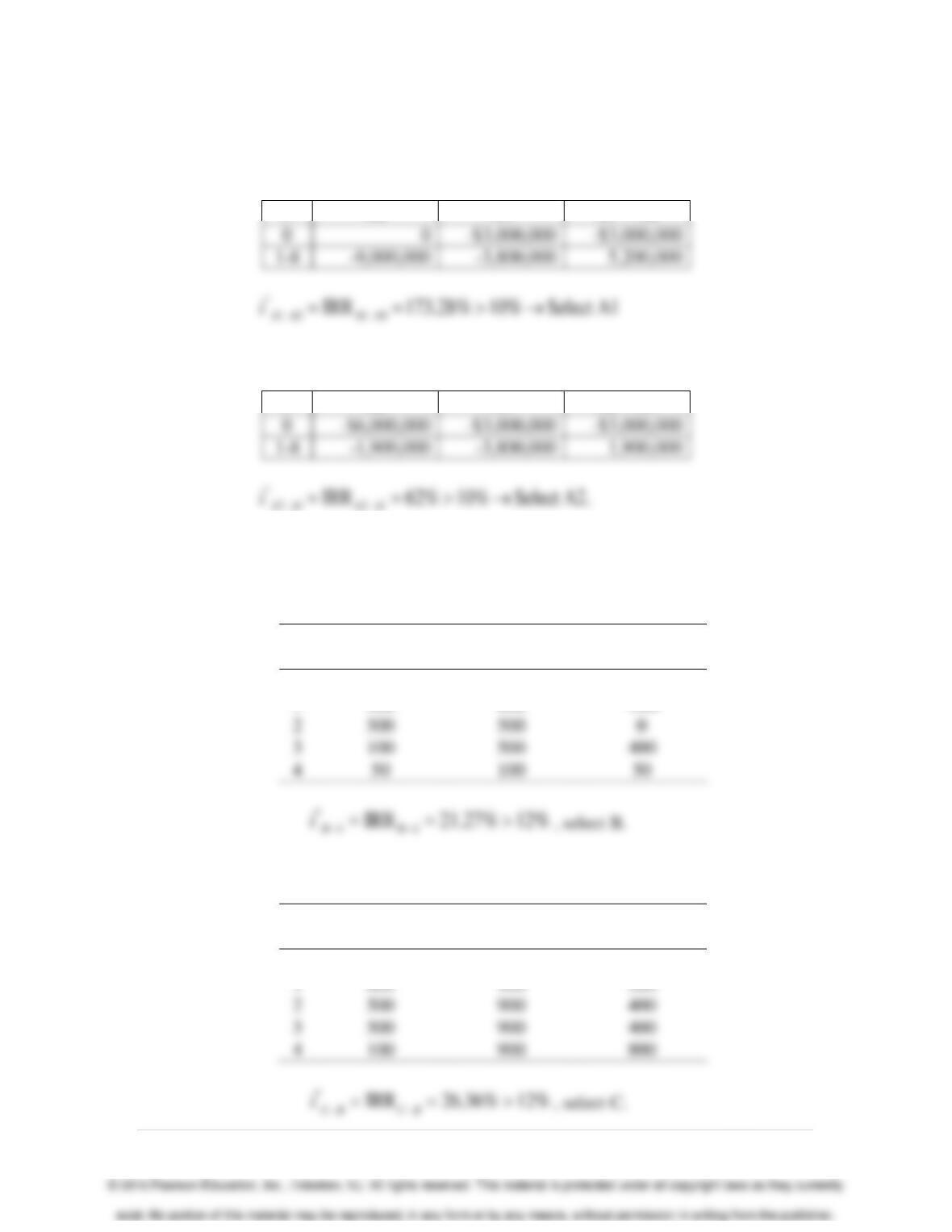
(a) The least common multiple project lives = 6 years → Analysis period 6 years
n
Net Cash Flow
Project A Project B B – A
0 -$100 -$200 -$100
19 | Page
1
60
120
60
Since the incremental cash flow displays a non simple investment, we may need
to calculate RIC on the incremental investment, using the Cash Flow Analyzer.
Or, abandon the IRR analysis and make a selection based on the NPW criterion.
(b) Incremental analysis between C and D:
n
Net Cash Flow
Project C Project D C – D
0
-$4,000
-$2,000
-$2,000
(c) Incremental analysis between E and F:
n
Net Cash Flow
Project E Project F F –E
0
-$2,000
-$3,000
-$1,000
2
50
3
5
50
120
70
6
50
150
100
20 | Page
Let A0 = current practice,
A1 =
just-in–time system,
A2 =
stock-less supply
system.
•Comparison between A0 and A1:
n
A0
A1
A1 – A0
•Comparison between A1 and A2:
n
A2
A1
A2 – A1
7.48
(a)
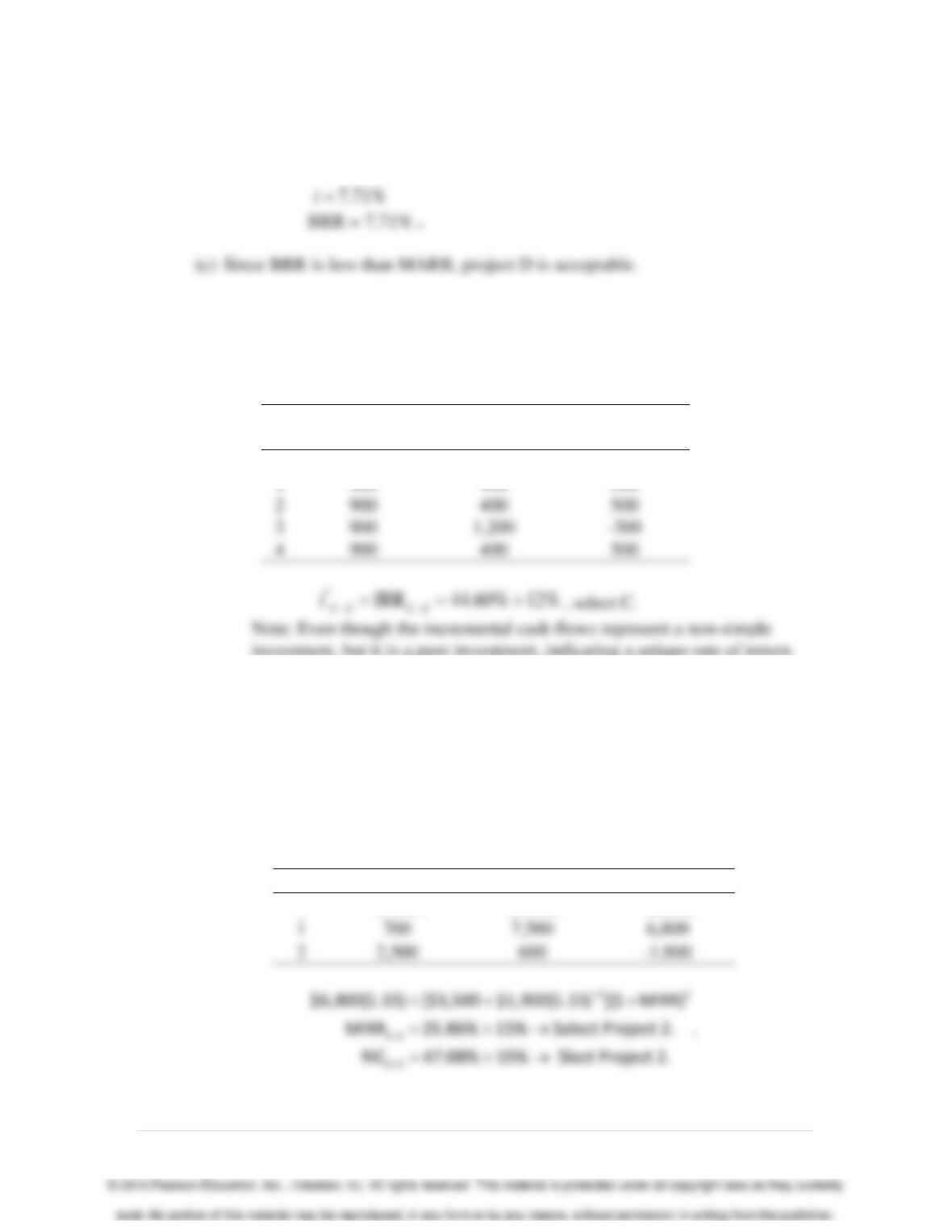
•Project A vs. Project B
n
Net Cash Flow
Project A
Project B
B – A
0
-$1,000
-$1,000
$0
1
900
600
-300
2
500
500
3
100
500
400
4
50
100
50
•Project B vs. Project C
n
Net Cash Flow
Project B
Project C
C – B
0
-$1,000
-$2,000
-$1,000
2
500
900
400
3
500
900
400
4
100
900
800
7.47
21 | Page
(b)
$1, 000 $300( / , , 4)
P A i
=
(d)
n
Net Cash Flow
Project C
Project E
C – E
0
-$2,000
-$1,400
-$600
1
2
3
1,200
4
investment, but it is a pure investment, indicating a unique rate of return.
7.49
(a)
* *
1 2
54.52%, 57.61%,i i= =
and
*
338.41%i=
(b)
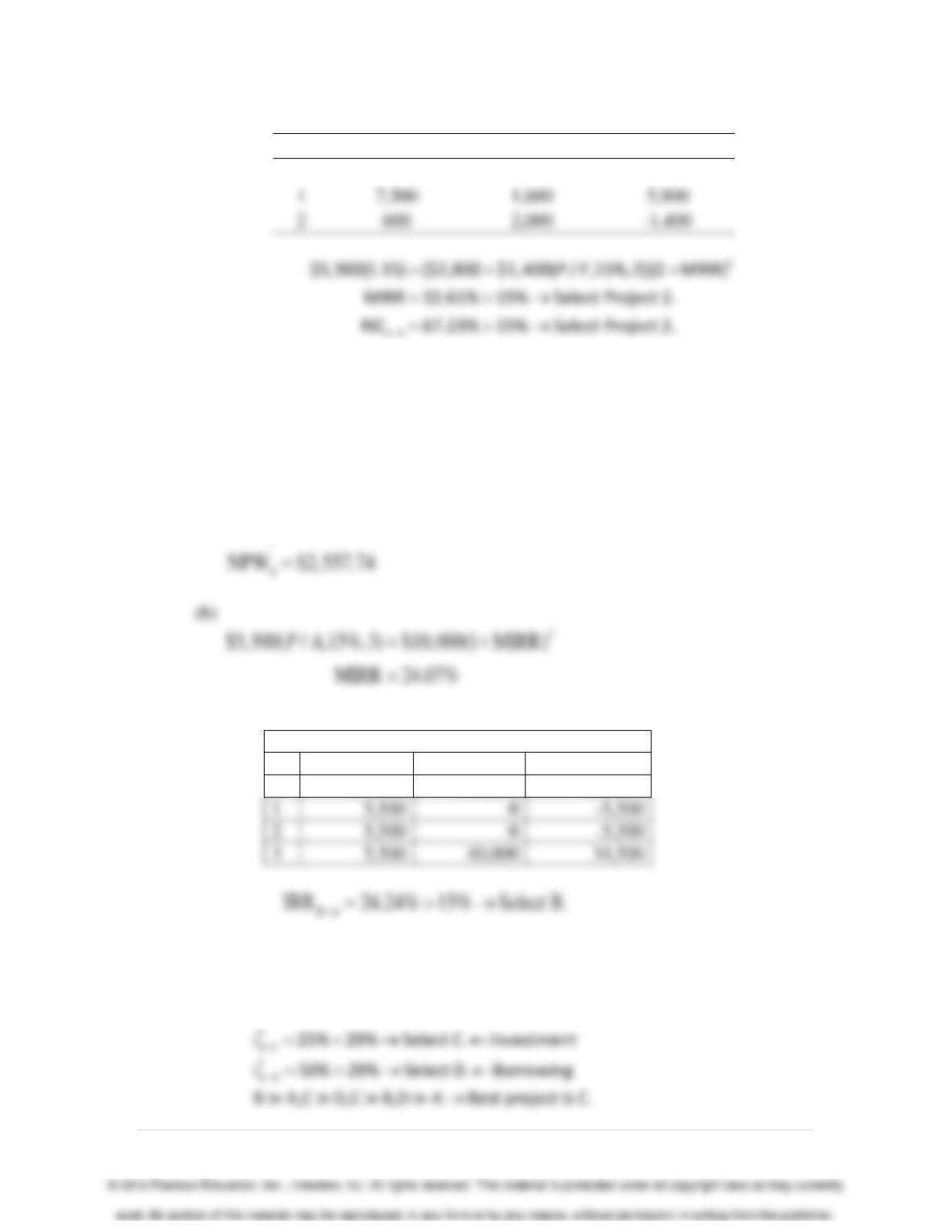
• Project 1 versus Project 2:
n
Project 1
Project 2
2 – 1
0
-$1,500
-$5,000
-$3,500
1
2
• Project 2 versus Project 3:
22 | Page
n
Project 2
Project 3
2 – 3
0
-$5,000
-$2,200
-$2,800
Comments: If you want to apply the IRR decision rule to the non-simple
investments, you should apply the net investment test and make the selection by
calculating the return on invested capital (or true internal rate of return).
7.50
(a)
IRR 25.99%
=
B
(c) Incremental analysis:
Net Cash Flow
n
Project A
Project B
B – A
0
-$10,000
-$20,000
-$10,000
1
2
3
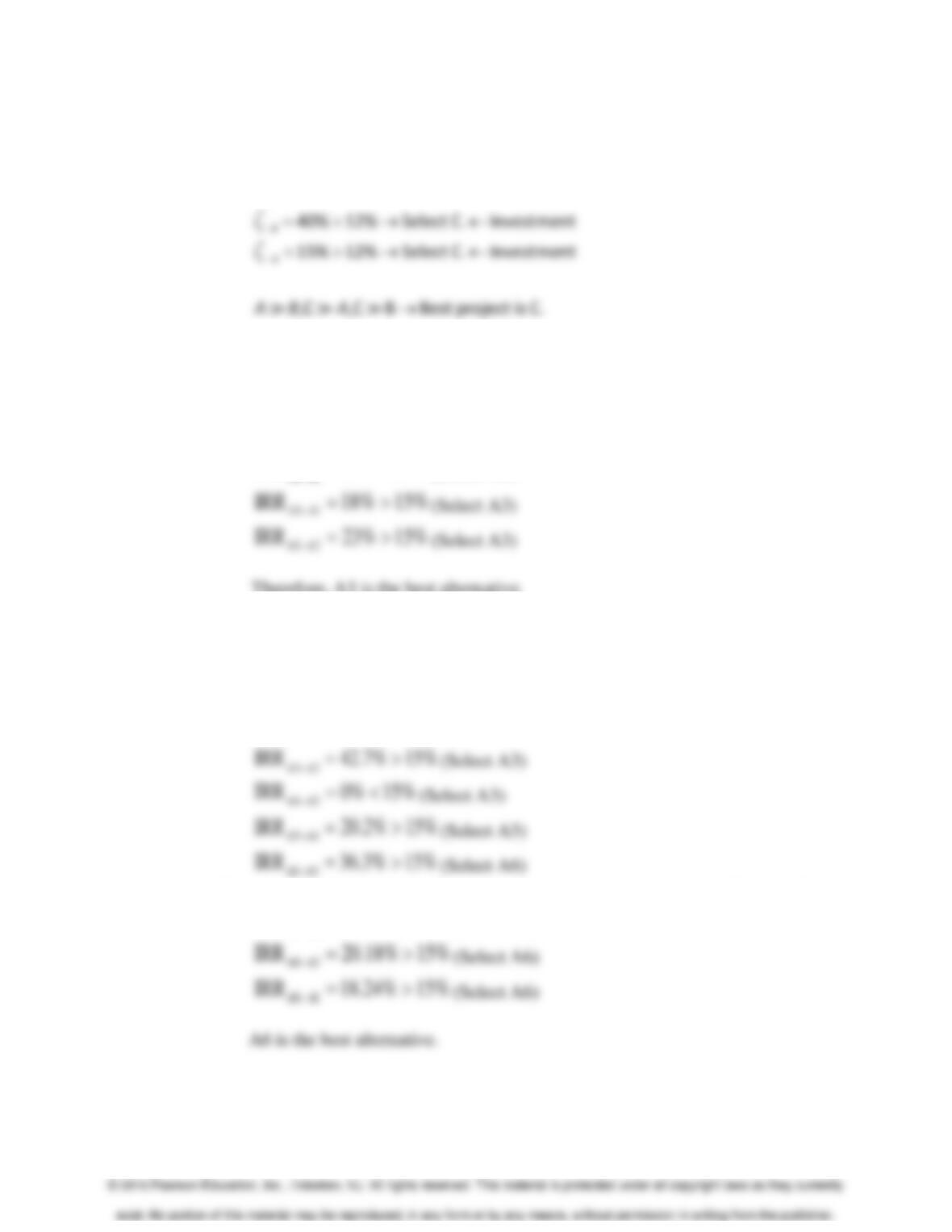
7.51
*
*
85% 29% Select B. Investment
30% 29% Select C. Borrowing
BA
BC
i
i
−
−
=>→ ←
=>→ ←
1
2
23 | Page
7.52 Model C
*
5% 12% Select A. Investment
BA
i
−
=<→ ←
7.53
All projects would be acceptable because individual ROR exceed the MARR.
Based on the incremental analysis, we observe the following relationships:
2 1
IRR 10% 15%
A A−
= <
(Select A1)
Therefore, A3 is the best alternative.
7.54
From the incremental rate of return table, we can deduce the following
relationships:
IRR
A2−A1
=8.9% <15%
(Select A1)
It is necessary to determine the preference relationship among A1, A3, and A6.
3 1
IRR 16.66% 15%
A A−
= >
(Select A3)
24 | Page
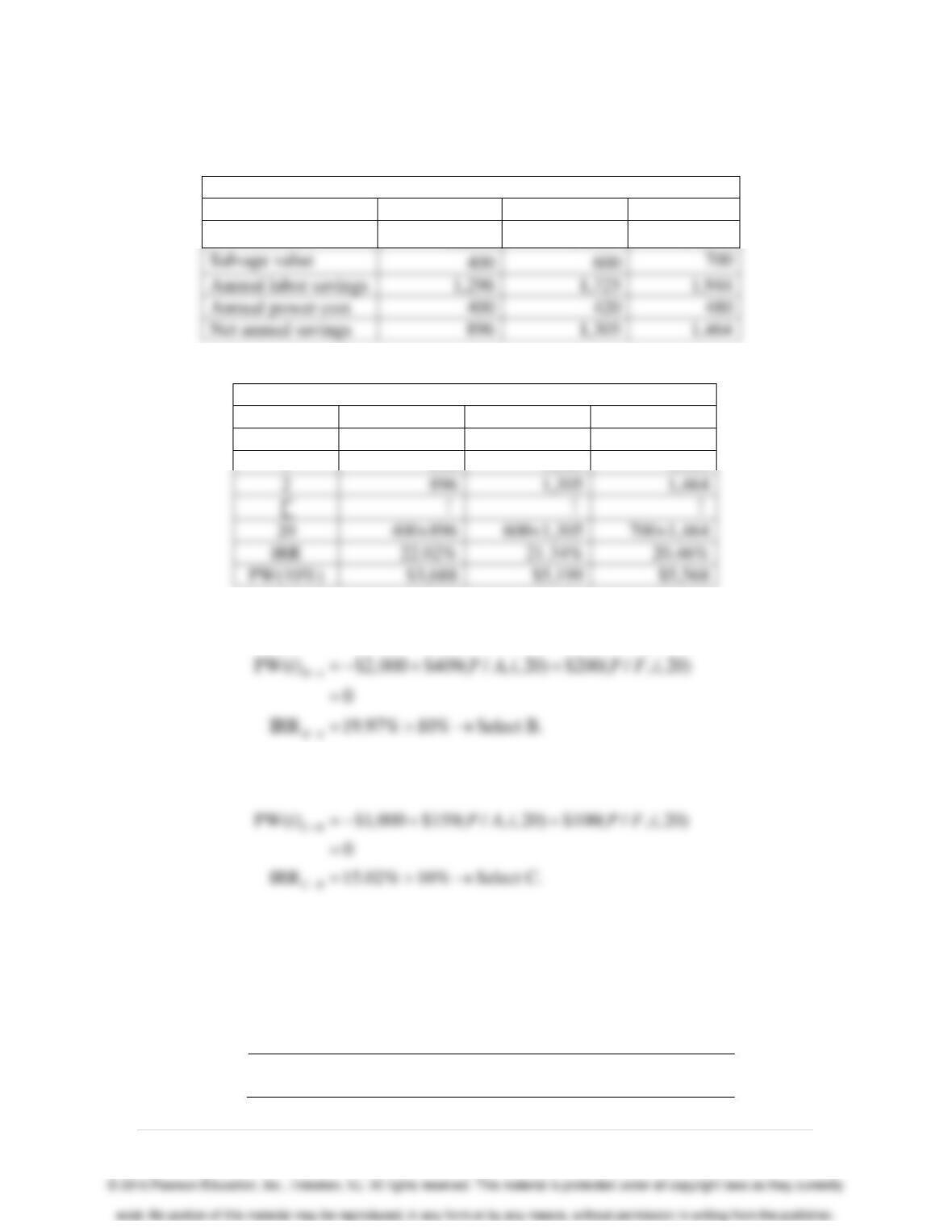
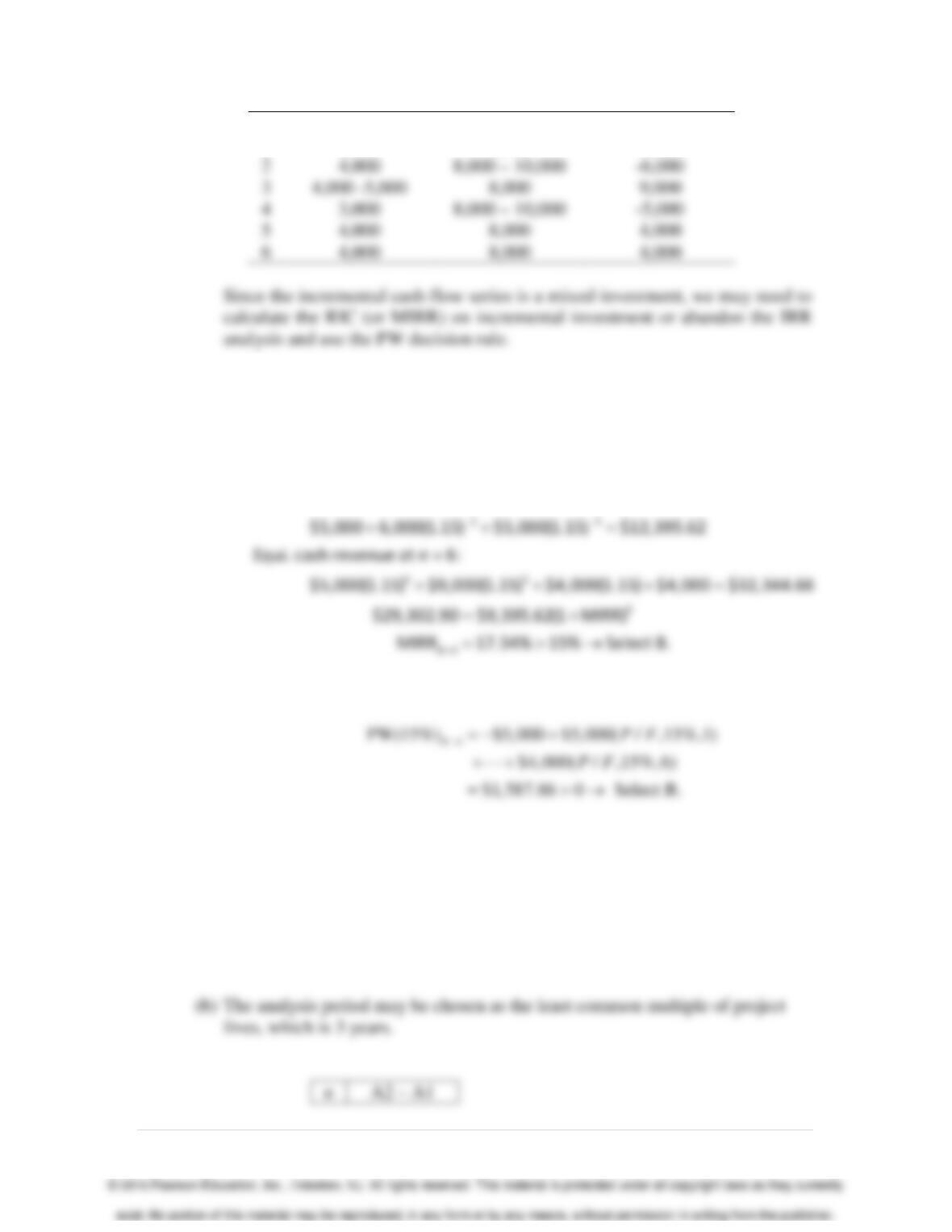
For each power saw model, we need to determine the incremental cash flows
over the “by-hand” operation that will result over a 20-year service life.
Power Saw
Category
Model A
Model B
Model C
Investment cost
$4,000
$6,000 $7,000
Net Cash Flow
n
Model A
Model B
Model C
0
-$4,000
-$6,000
-$7,000
1
896
1,305
1,464
2
896
1,305
1,464
22.02%
21.34%
20.46%
•Model A versus Model B:
•Model B versus Model C:
Unequal Service Lives
7.56
With the least common multiple of 6 project years,
Net Cash Flow
n
Project A
Project B
B – A
7.55
600
1,725
420
480
1,305
25 | Page
0
-$5,000
-$10,000
-$5,000
1
3,000
8,000
5,000
• RIC: Use the Cash Flow Analyzer to find the RIC :
RIC 25.67% 15% Select B.
BA−
= >→
• MIRR:
Equi. cash outlay at = 0:
n
• PW analysis:
7.57
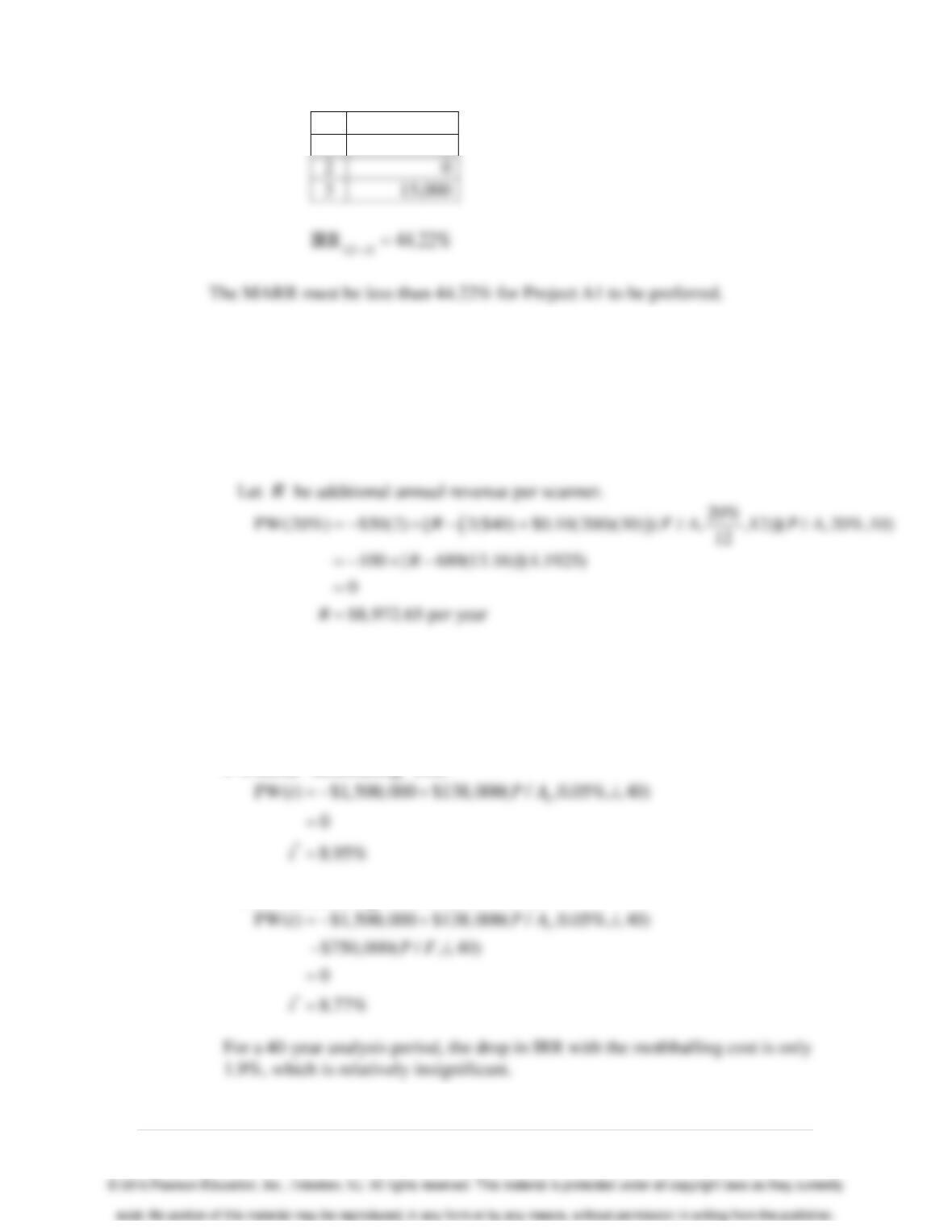
(a) Since there is not much information given regarding the future replacement
options and required service period, we may assume that the required service
period is 3years and project A2 can be repeated at the same cost in the future.
2
4,000
3
8,000
9,000
4
3,000
5
4,000
8,000
4,000
6
4,000
8,000
4,000
26 | Page
0
-$5,000
1
0
Short Case Studies
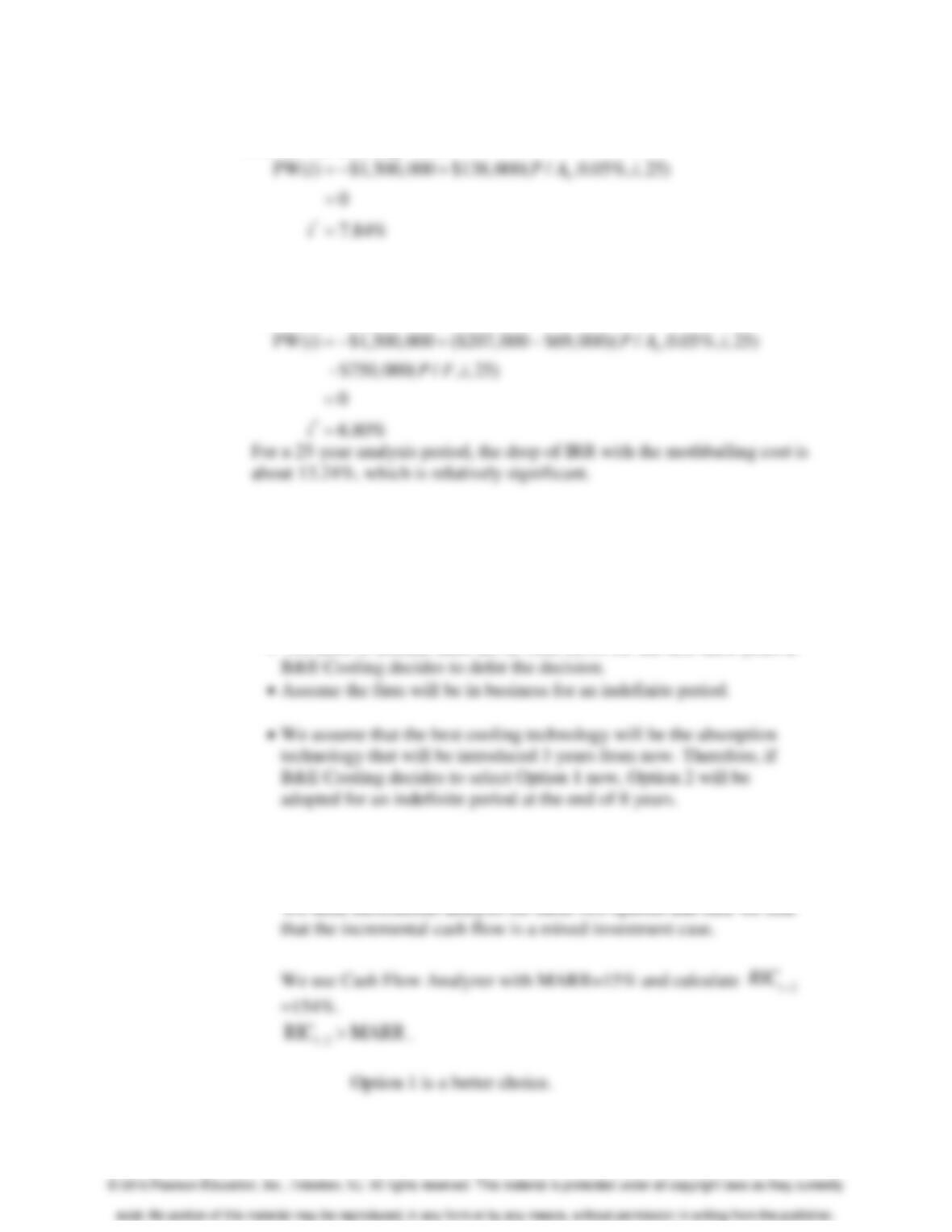
ST 7.1
We assume monthly service fee = $40, the number of transactions per each
scanner per day = 100, and service period 10 years.
ST 7.2
(a) Analysis period of 40 years(unit: thousand $):
• Without “mothballing” cost:
• With “mothballing” cost of $0.75 billion:
2
0
3
27 | Page
(b) Analysis period of 25 years (unit: thousand $):
• Without “mothballing” cost:
• With “mothballing” cost of $0.75 billion:
ST 7.3
We need some reasonable assumptions to get a solution
(a) Assumptions required:
• We need to assume there are no cash flows for the first three years if
(b) Investment decision:
• Rate of return analysis:
ST 7.4
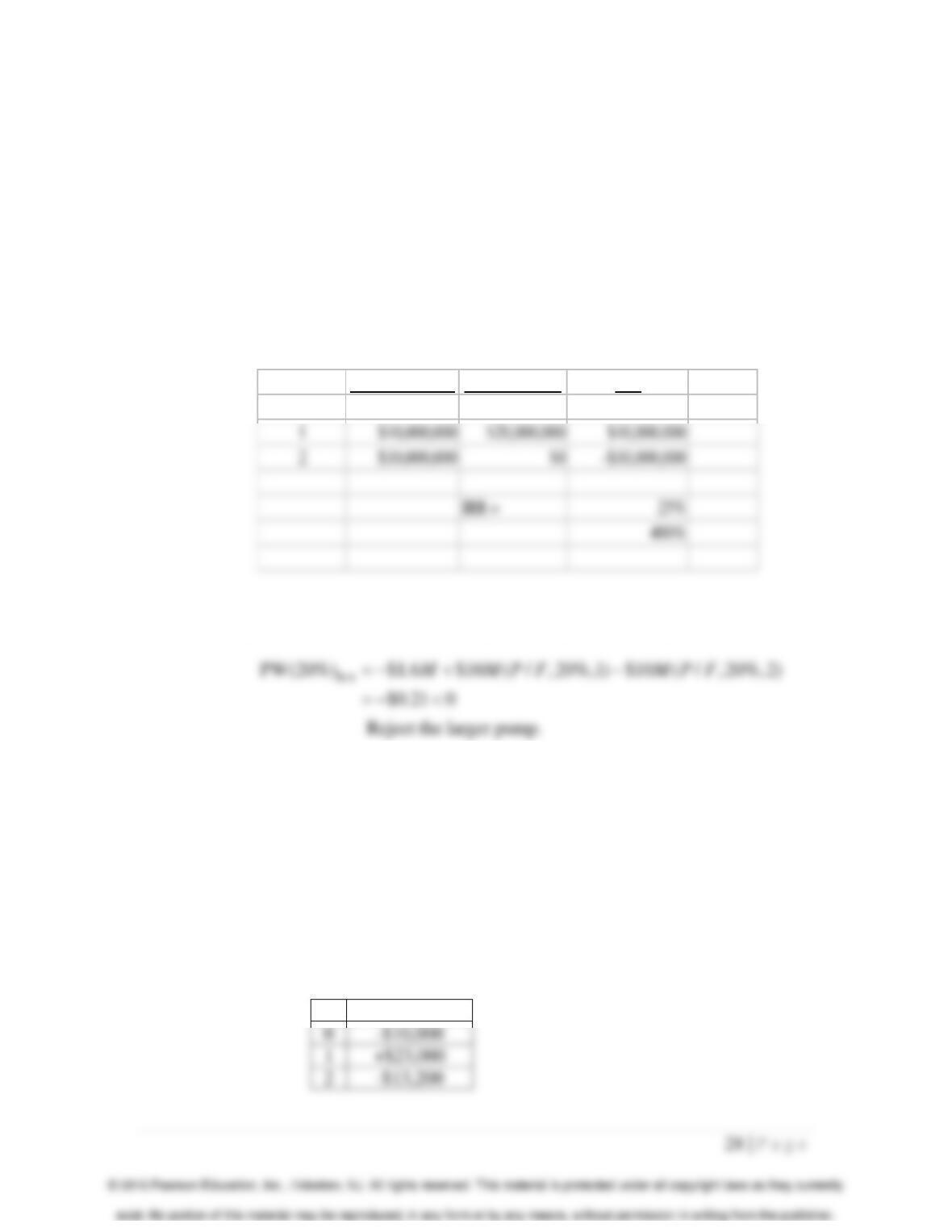
nCurrent Pump(A) Larger Pump(B) B–A
0 $0 –$1,600,000 –$1,600,000
The incremental cash flows result in multiple rates of return (25% and 400%), so
we may abandon the rate of return analysis. Using the PW analysis,
Comments: If we follow the procedure outlined in Appendix 7A, we will find the
return on invested capital to be 4.17% at MARR of 20%, so we will reject the
larger pump.
ST 7.5
(a) Whenever you need to compare a set of mutually exclusive projects based
on the rate of return criterion, you should perform an incremental analysis.
In our example, the incremental cash flows would look like the following:
N
2 – 1
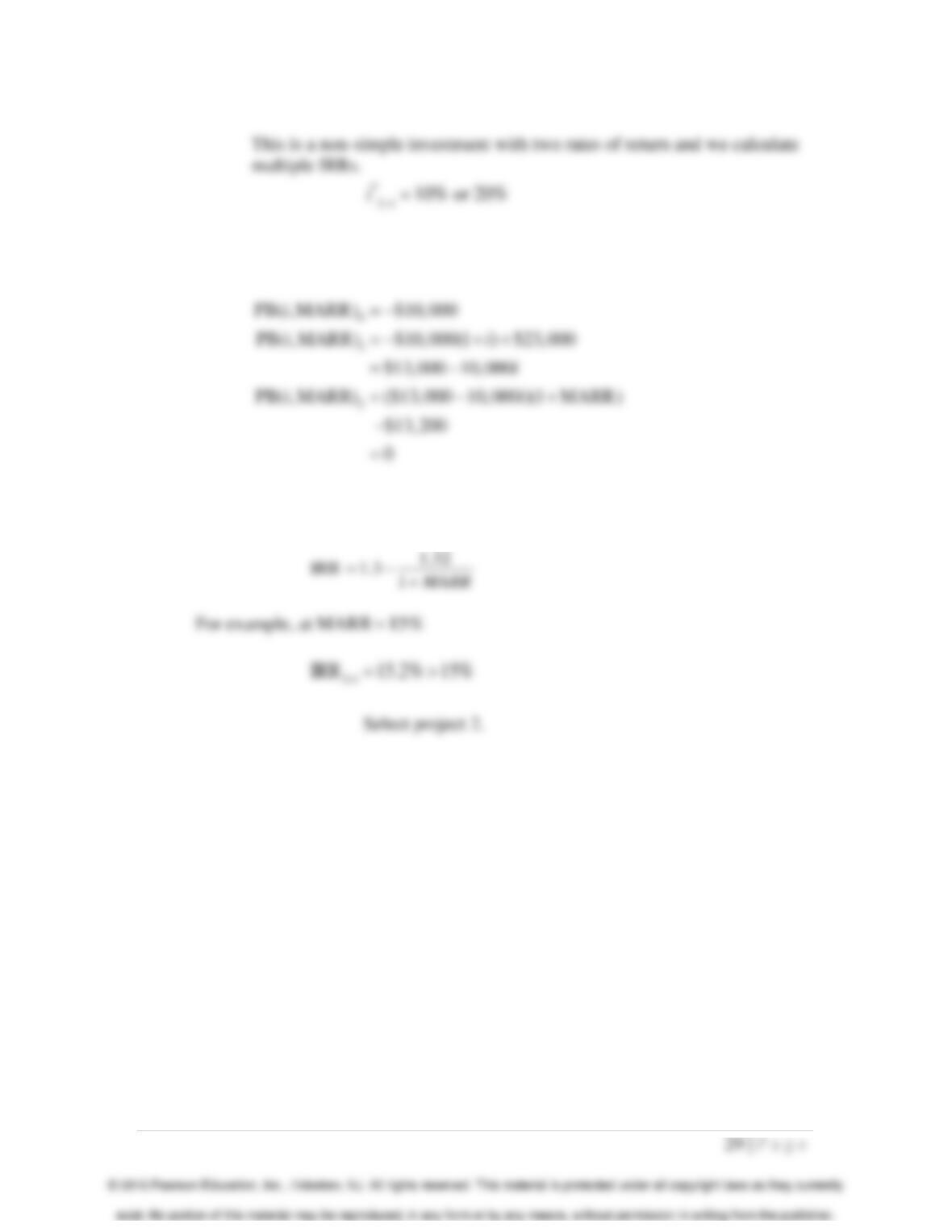
This incremental cash flow is a mixed investment case.
(Note that if
1.3,i>
there will be no feasible solution.) Rearranging the terms
in
2
PB( , MARR)i
gives an expression of IRR as a function of MARR.
30 | Page
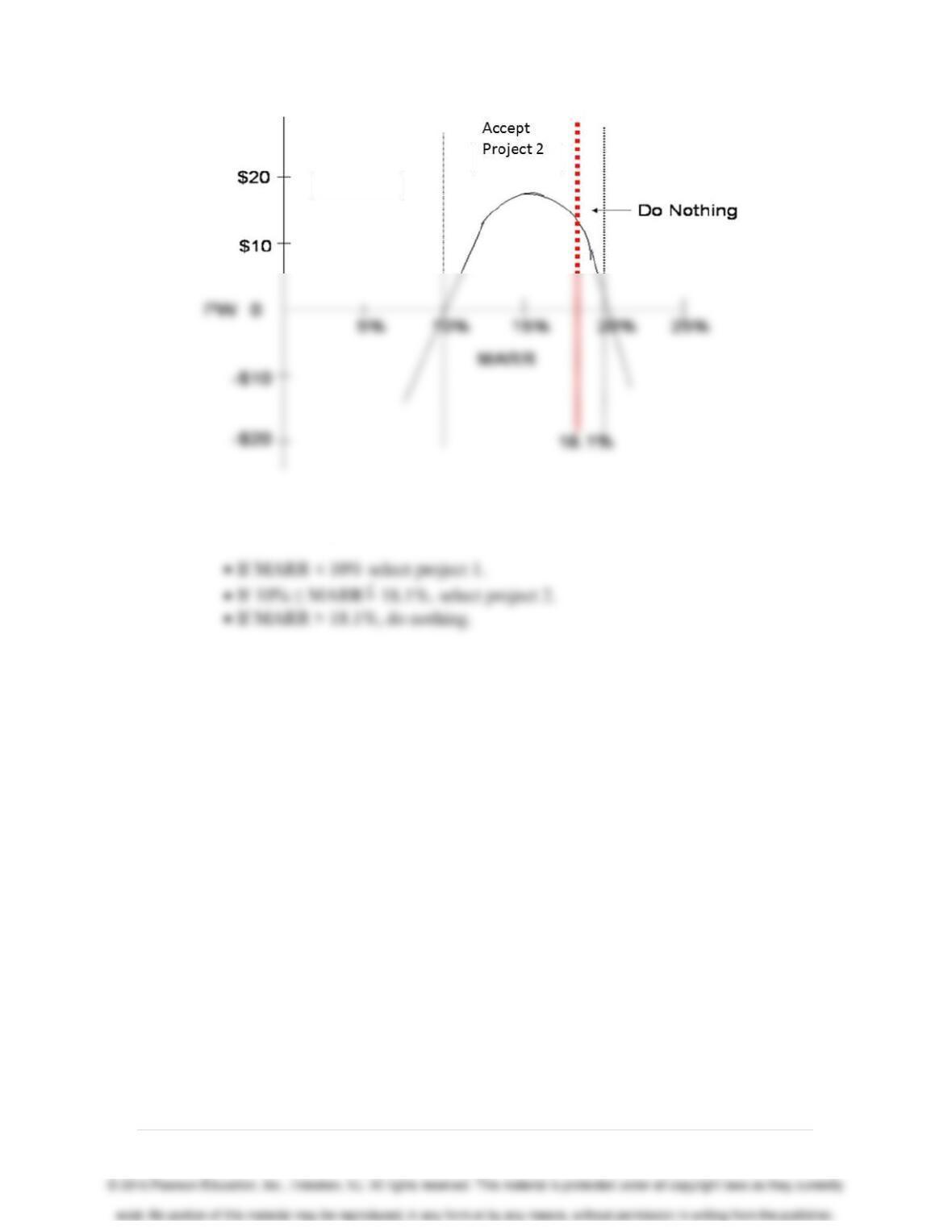
(b) If you plot the present worth as a function of interest rate, you will observe
the following: