and the Coase theorem becomes less applicable as
bargaining gets more difficult.
3. Externalities can be internalized in three ways.
external costs and benefits into their decision-
making pro cesses. Third, the government can
require that producers and consumers pay for the
damage they create, or it can pay producers and
consumers for the benefits they provide.
4. Cost– benefit analy sis does not only apply to pub-
lic goods. People use cost- benefit analy sis all the
time when deciding whether to consume private
goods; in other words, people consume private
society.
5. The tragedy of the commons is a situation that
arises with common- resource goods. Because
these goods are rival in consumption but nonex–
cludable, people can use the goods without pay-
ing for them— and, therefore, without thinking
about what effect their consumption will have on
tragedy of the commons is population growth. In
this case, the common- resource good (or
common resource) is Earth, and the ability to
have children (and therefore indirectly use the
Earth’s resources) is nonexcludable in that there is
Questions for Review
1. When positive externalities are pre sent, free mar–
kets don’t produce as much of an item as would
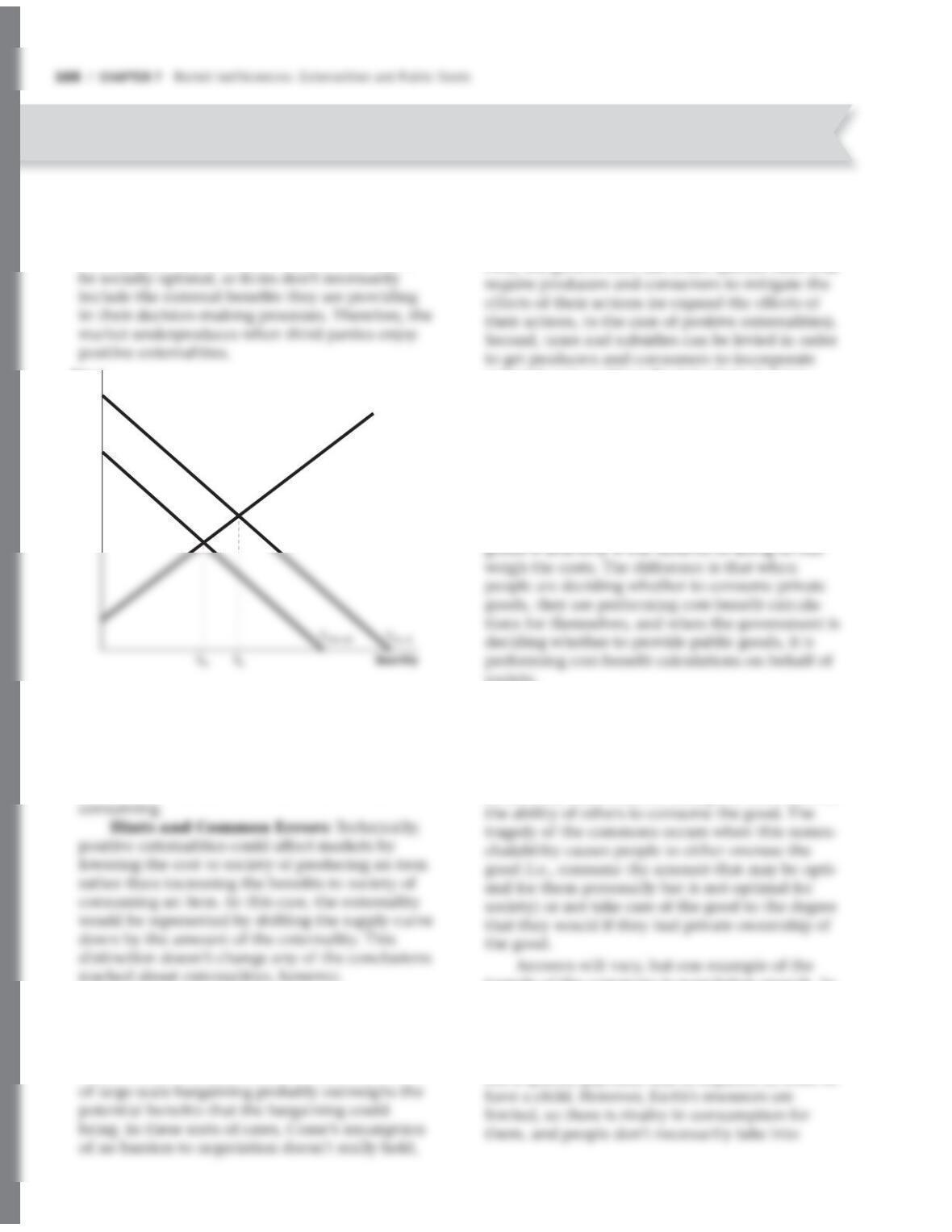
Price
Sinternal
In the previous graph, Qm is the quantity
that the market, left to itself, would produce, as it
is the result of the intersection of internal costs
and benefits. Qs is the socially optimal quantity
because it incorporates the external benefits to
society and considers the total social benefits of
reached about externalities, however.
2. While it might be technically pos si ble, it’s very
likely that as the number of parties involved in
an externality prob lem increases, it’s not practical
to try to solve the prob lem via bargaining. The
reason is that the administrative cost of this sort
Solutions to Chapterfi7 Text Prob lems
is distracting to another student. Other wise,
there is no externality here.
e. This activity generates a positive externality
because it provides benefits to people who nei-
b. This is a club good. You must purchase a ticket
to the game, so the event is excludable, but
once you are inside the arena, every fan can
see the game, so the viewing experience is
nonrival.
c. A Fourth of July fireworks show is a public
good because it’s nearly impossible to limit
consumption to paying customers (hence
nonexcludable), and one person watching the
fireworks doesn’t prevent another person from
being able to fully enjoy the same fireworks
can’t fully consume the same unit of u vac–
cination (hence rivalry in consumption).
f. Streetlights are a public good because con-
4. Making cars safer might cause people to become
overconfident and thus drive more recklessly.
This reckless be hav ior could create negative exter-
nalities for others because it likely imposes costs
on those (such as pedestrians) who are neither
producers nor consumers of automobiles.
5. a. Yes. Some people do not recycle, but they still
benefit from the actions of others that help to
reduce landfill use.
account the overall societal effects when deciding
whether to have more children.
6. The four incentives of private property are the
incentive to maintain, the incentive to protect,
7. Broadcast tele vi sion is nonrival because many
consumers can fully consume the same tele vi sion
broadcast. Broadcast tele vi sion is also nonexclud–
able because it isn’t limited to paying customers.
Economists call goods that share these character–
istics public goods.
Study Prob lems
1. In general, a government can improve societal
welfare by taxing activities that create negative
imize welfare.
2. a. This is a negative externality because it
imposes a cost on you, even though you are
analy sis surrounding the bridge construction.
b. This is a negative externality because it
imposes a cost on those who use the stream,
regardless of whether they actually do busi-
ness with the excavating com pany.
c. This is a positive externality because the
homeowner enjoys a benefit from the soccer
games even though he is neither a producer
Under the proposal, the builder faces the addi-
tional cost of procuring the 10 acres of artificial
toad habitat. If this additional cost is enough to
make the proj ect unprofitable, then the developer
will not move forward with the shopping center.
iPads, and so on. The high transactions costs
affect the costs of iPhones, iPads, and Apple
watches. Apple Inc. should internalize the exter–
nality, which means it should produce fewer
products at higher prices when it includes these
external costs. So from an economic point of
view, choice a, “All parties connected with pollu-
regulation that prohibits firms from polluting the
water, they are free to dump their waste into the
river, although it makes no sense to do so.
13. a. The way the situation is described, the first
homeowner is within his rights to leave the
debris where it is, but the neighbor has an
incentive to pay to get the pile moved. She can
pay her neighbor, or a contractor, $300 to do the
job, and she can pay her neighbor a little extra
to ensure he goes along with the arrangement.
absorb the $300 cost of relocating the debris.
Hints and Common Errors: Technically, a
free rider prob lem could occur with the
environmental benefits of riding bicycles rather
than driving if every one waits around for every-
one else to do the “right” thing, but this is a bit
charging a fare would lead to many “ free rid–
ers” hopping on and off the bus (especially
during class change times). These extra riders
have the effect of slowing down the bus along
its route—
leading to a free– rider prob lem.
7. If the roommates bargain in order to arrive at a
Hints and Common Errors: Instructors
might get a number of unexpected answers to
this question, such as the roommates taking
turns or one roommate buying the other
headphones or something. These answers could
technically be correct and need to be considered
on an individual basis.
9. a. The tax, as taxes generally do, will reduce the
number of leaf blowers sold. In this case, the
quantity of leaf blowers will decrease to the
10. It is ambiguous whether the proposed solution
will make the builder internalize the externality.

cattle having extra land to range over. But no
fence also means $50,000 $20,000 “ $30,000in
liability paid to the wheat farmer.
On balance, then, the lack of a fence makes
By contrast, if the homeowners association
prohibits debris piles, then the first homeowner
has to move the debris, regardless how much or
little stake his neighbor has in seeing that