Chapter 7
Nontariff Barriers and Arguments
for Protection
This chapter continues our discussion of commercial policy. It first details various nontariff barriers to
trade that exist in today’s world. A major part of this discussion is devoted to quotas and other forms of
quantitative barriers such as voluntary export restraints (VERs). In addition, other forms of nontariff
barriers are discussed, largely by illustration. The second part of the chapter is devoted to exploring the
general validity of a number of common arguments for protection. Included in this material are several
examples of strategic trade policy.
We have found that the material in this chapter tends to be very popular with students. They are
especially interested in various examples of nontariff barriers, and Baldwin’s book remains an excellent
source for further illustrations of these policies. We also find it useful to challenge students to provide
arguments of their own for protection. Often, these arguments will be variants upon the invalid arguments
we discuss in the chapter. Classroom discussion devoted to sorting out valid from invalid arguments is
time well spent. For an additional example of the cost of U.S. VER agreements to American industries,
see The Effects of the Steel Voluntary Restraint Agreements on U.S. Steel-Consuming Industries,
U.S.I.T.C. publication #2182, May 1989. Robert Feenstra argues that estimates of the costs of U.S. quota
protection are understated if they ignore the efficiency costs these policies impose on foreign countries
(See “How Costly is Protectionism?” Journal of Economic Perspectives, summer 1992, pp. 159–178).
◼ Chapter Outline
Introduction
Quotas
The Welfare Effects of Quotas
The Equivalence or Nonequivalence of Tariffs and Quotas
Other Nontariff Barriers
Customs Valuation Practices
Chapter 7 Nontariff Barriers and Arguments for Protection 31
Arguments for Protection
Invalid Arguments
Patriotism
Employment
Fallacy of Composition
Fair Play for Domestic Industry
Preservation of the Home Market
Valid Arguments
Government Revenue
◼ Suggested Answers for the End-of-Chapter Exercises
1. In what ways are tariffs and quotas similar in their effects? In what ways do they differ?
Similarities
They both result in higher domestic prices, an increase in domestic production of the good and
a decrease in imports.
Differences
Under an equivalent quota, the distribution of quota rents equivalent to the tariff revenue can vary.
2. Suppose that prospective importing firms hire lobbyists to help them secure from government
authorities the right to import quota-restricted items into a country. How much would importers as
a group be willing to pay lobbyists for their services? Explain. Suppose lobbyists are paid this
amount. What happens to domestic welfare in this case?
32 Husted/Melvin • International Economics, Ninth Edition
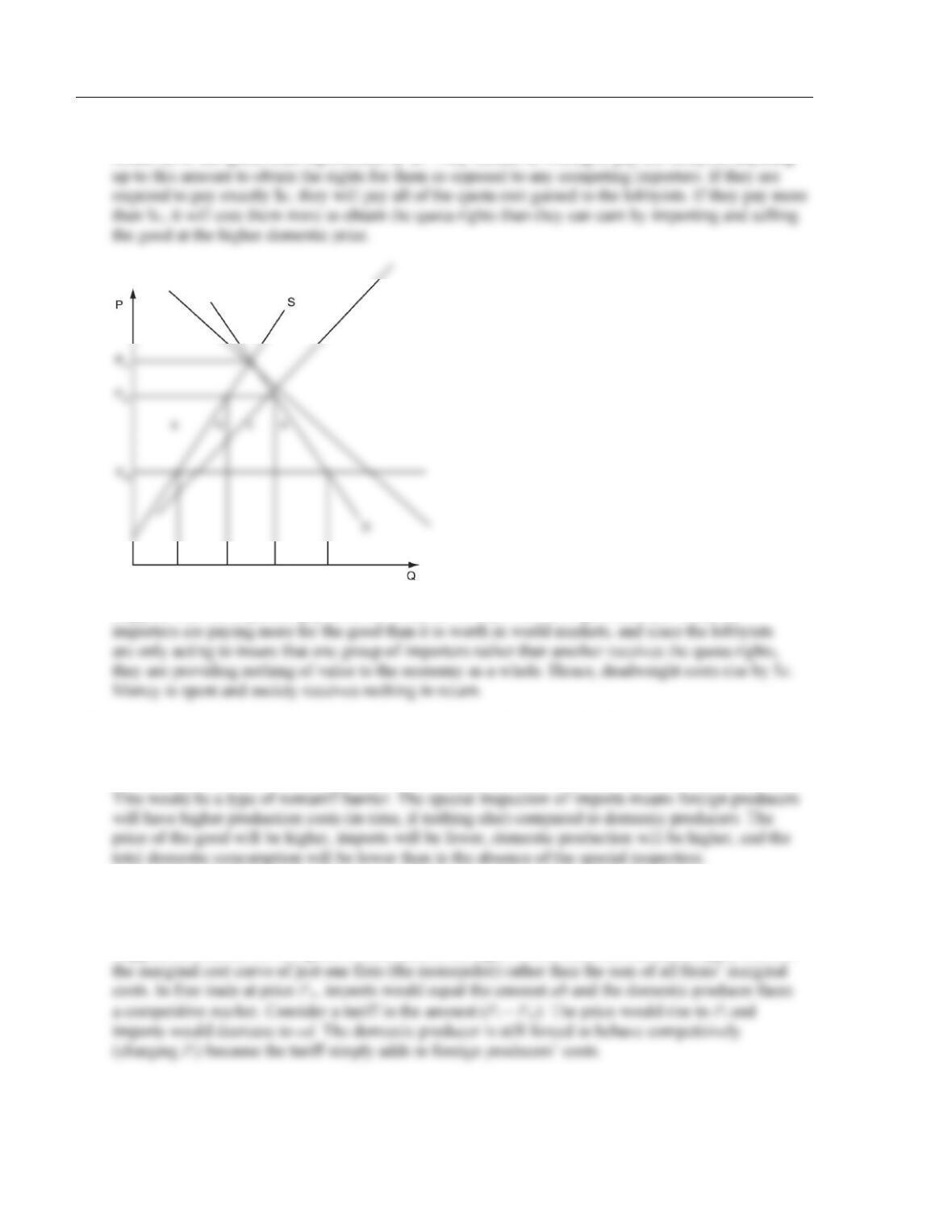
Suppose the market for this good is illustrated to the right. The prospective importers would like to
obtain all of the quota rents represented by $c. They should be willing to pay the lobbyists anything
Suppose that the importers pay all $c to lobbyists in return for the import licenses. Since the
3. Suppose that a country requires special inspections on all imported food but it exempts domestic
production from similar inspection. What effect would this have on imports, domestic production,
prices, and quantity consumed? Explain fully.
4. Show graphically that a monopolist will charge a higher price and produce at a lower level of output
with quota protection than with a tariff protection that yields the same level of imports.
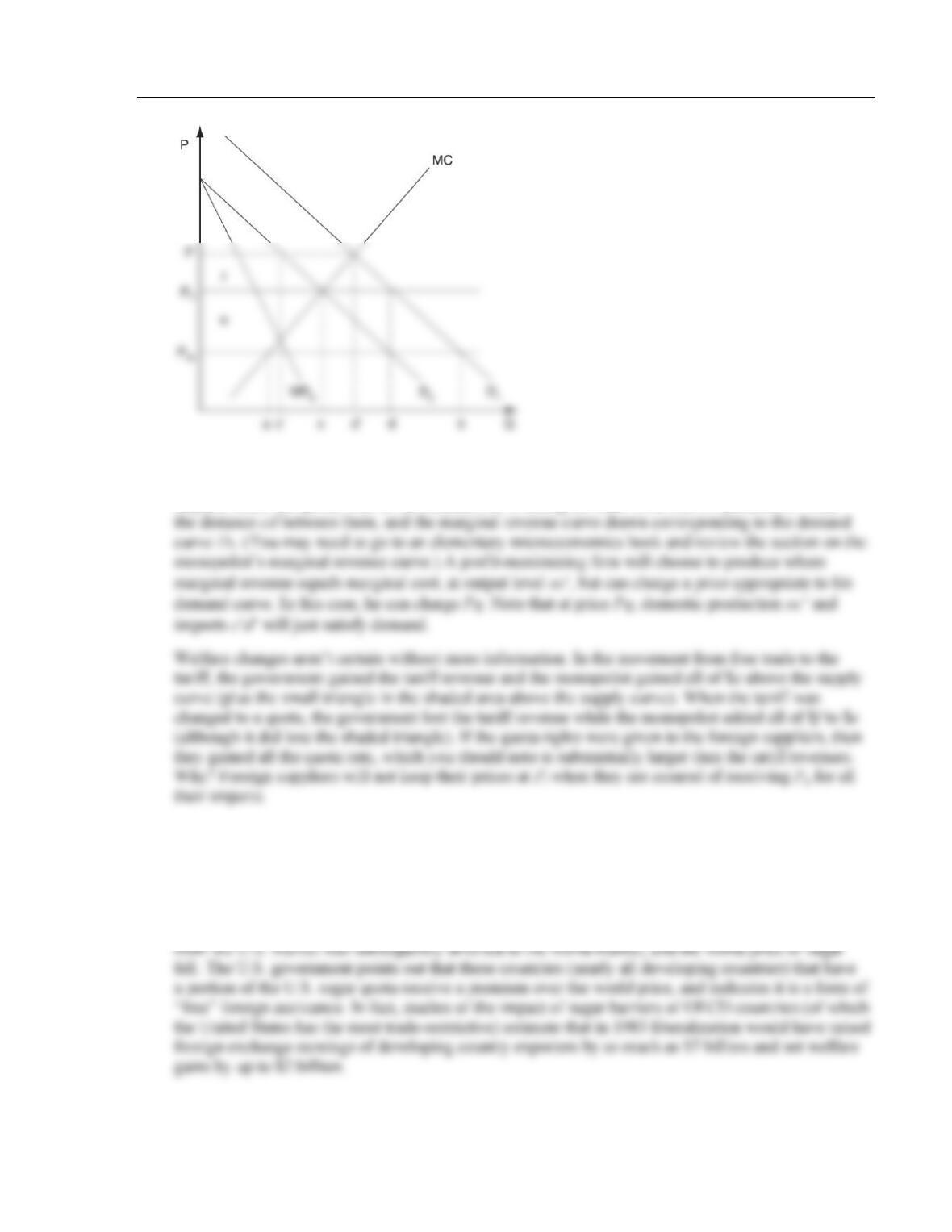
Suppose the market for this good is illustrated to the right. In this case, the domestic supply curve is
Chapter 7 Nontariff Barriers and Arguments for Protection 33
Suppose the tariff was changed to a quota and imports were strictly limited to cd. The domestic
producer can now exercise his monopoly power. He knows that the market demand curve, D1, minus
imports under the quota, will be the demand curve facing his firm. Note that D2 parallels D1 with
5. The United States has used quotas to protect its domestic sugar industry. What has been the likely
impact of these quotas on the world price of sugar (relative to the price that would exist under free
trade)? Explain.
The quotas had the predictable impact on the U.S. sugar market: Prices increased and consumption
decreased. But the question asks about the world price of sugar. The sugar that the quota eliminated
6. Is the optimum tariff argument a valid argument for protection? (Hint: See Chapter 6). Is it the best
policy for these purposes? Explain.
When a country has sufficient market power, it may be possible to impose an import tariff and
improve domestic welfare. This occurs because the country’s action affects the perceived demand
for the good on the world market and forces the importers to lower the world price. In this case, the
7. Consider the example of airplane building and strategic trade policy described in the text. Suppose
that the United States matched Europe’s export subsidy with a subsidy of 10 to Boeing. How would
this policy affect the solution to the game? What would be the welfare effects of this policy on the
United States and Europe?
If the United States matches the European subsidy and there is no further escalation of subsidies, the
payoff matrix will look as follows:
Airbus Boeing
P
N
P
5
5
110
0
N
0
0
0
8. The United States automakers have announced programs to build and market electric cars. Should the
U.S. impose temporary protection on this product to guarantee U.S. commercial success? Why or
why not?
9. Suppose that the domestic demand and supply for hats in a small open economy are given by
Q = 100 − P (demand)
Q = 50 + 2P (supply)
where Q denotes quantity and P denotes price.
a. If the world price is 10, what is the free trade level of imports?
b. Suppose that the country imposes a quota of 11 units. How much will the domestic price rise?
c. What will be the welfare effects on this country of a quota of 11 units?
Chapter 7 Nontariff Barriers and Arguments for Protection 35
d. Suppose instead that this country negotiates a VER of 11 units with its chief foreign supplier.
What are the welfare effects of this policy?
10. According to the analysis in this chapter, VERs are a more costly form of protection than tariffs or
other types of quotas. Why do countries like the United States continue to protect certain industries
using this form of protection?
11. Suppose that Guatland protects its motorcycle industry with a quota that raises domestic prices by
$100 per unit. If Guatland’s government were to then impose a tariff of $90 per motorcycle, what
would happen to Guat motorcycle imports? What would be the welfare effects of this tariff on the
Guat economy?
12. Under what circumstances can commercial policy be an effective tool to solve world environmental
problems? Under what circumstances will commercial policy not be very effective? In general, which
set of circumstances is more likely to exist in the real world?
Commercial policy would be most effective in those cases where the country that imposes the policy
is the primary purchaser of the product whose production is responsible for the environmental