
7 Offshoring of Goods and Services
1. What type of occupation would you like to pursue after graduation? To see what is
available, to the Bureau of Labor Statistics website at: https://www.bls.gov/ooh/.
a. Find four occupations that you think fit the four categories shown in the
horizontal axis of Figure 7-11: nonroutine manual jobs; routine manual jobs;
routine cognitive jobs; and nonroutine cognitive jobs. For each occupation, what
is the growth in employment in the United States, and how does it compare with
the employment growth since 1990 shown in Figure 7-11?
Answer:
Nonroutine manual jobs: Home health aides with growth rate (38%)
b. Choose an occupation that you would most like to pursue, and explain why you
wish to pursue it. What is the employment growth for that occupation?
Work It Out
Consider an offshoring model in which the the hours of labor used in four activities in the
United States and Mexico are as in the table follows.
Note that labor hours in Mexico are twice those in the United States, reflecting Mexico’s
lower productivity. Also note that the ratio of high-skilled to low-skilled labor used in
each activity increases as we move to the right, from 1/6 in assembly to 10/1 in R&D.
Suppose that the wage of U.S. low-skilled workers is $10 per hour and that of high-
skilled workers is $25 per hour, and that the wage of Mexican low-skilled workers is $1
per hour and that of high-skilled workers is $5 per hour (these values are made up to be
convenient, not realistic). Also suppose that the trade costs are 25%, 30%, or 50%, which
means that an additional 25%, 30%, or 50% is added to the costs of offshoring to Mexico.
Hours of Labor Used in Each Activity (per unit of output):
Assembly
Component
Production
Office
Services
R&D
Low–skilled labor
Mexico: 24
Mexico: 16
Mexico: 16
Mexico: 4
U.S.: 6
U.S.: 4
U.S.: 4
U.S.: 1
High-skilled labor
Mexico: 4
U.S.: 1
Mexico: 4
U.S.: 1
Mexico: 8
U.S.: 2
Mexico: 40
U.S.: 10
High–skilled/low-
skilled ratio
1/6
1/4
1/2
10/1
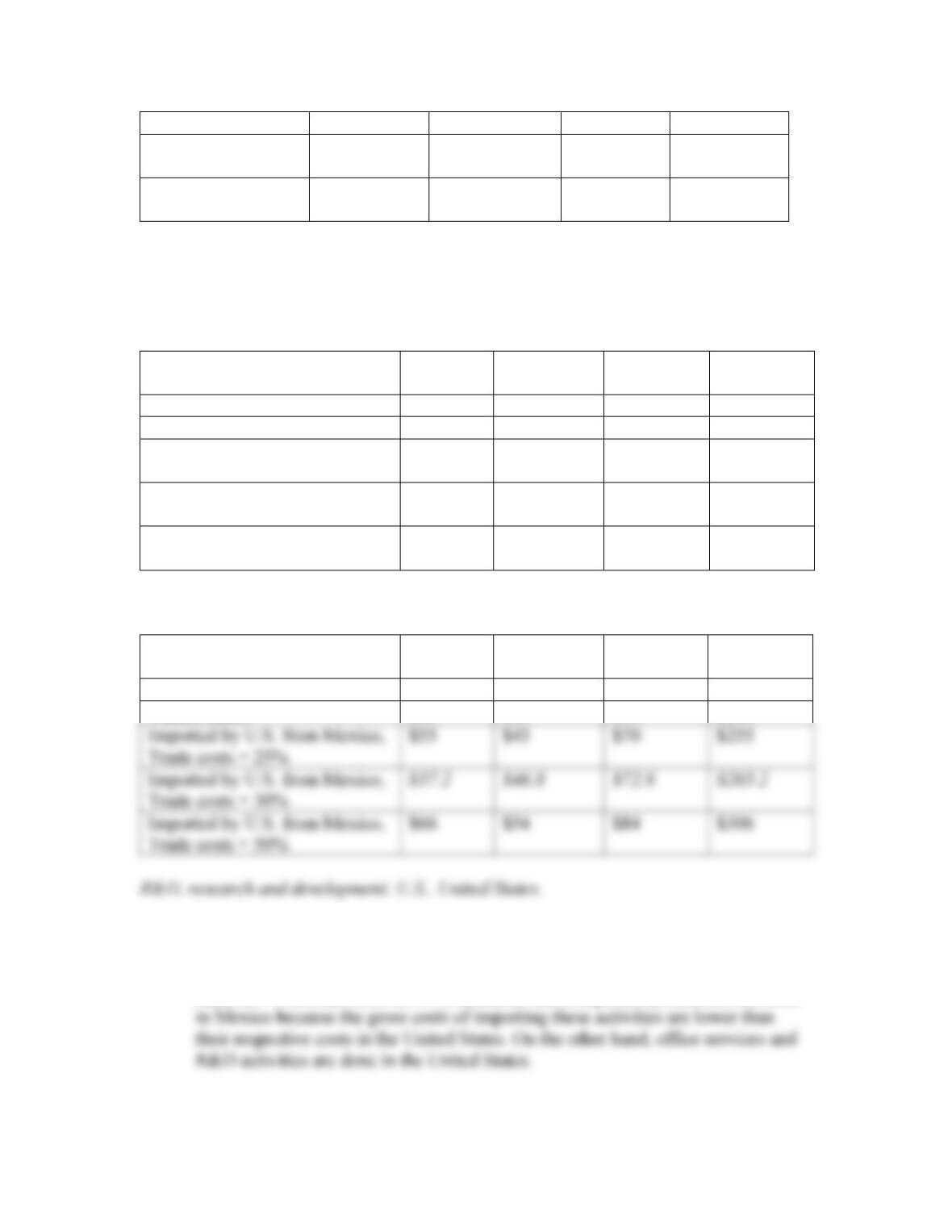
a. Fill in the blank cells in the following table by computing the costs of production
of each activity in each country (two cells are filled in for you).
Assembly
Component
Production
Office
Services
R&D
Mexico
$44
United States
Imported by United States from
Mexico, Trade Costs = 25%
Imported by United States from
Mexico, Trade Costs = 30%
$57.2
Imported by United States from
Mexico, Trade Costs = 50%
Answer: In italics in the following table:
Assembly
Component
Production
Office
Services
R&D
Mexico
$44
$36
$56
$204
United States
$85
$65
$90
$260
b. With trade costs of 50%, where is the value chain sliced? That is, which activities
are cheaper to import from Mexico and which are cheaper to produce in the
United States?
Answer: With trade costs of 50%, assembly and component production are done
c. With trade costs of 30%, and then 25%, where is the value chain sliced?
Imported by U.S. from Mexico,
Trade costs = 25%
$55
$45
$70
$255
Imported by U.S. from Mexico,
Imported by U.S. from Mexico,
Trade costs = 50%
$66
$54
$84
$306

2. Consider an offshoring model in which Home’s skilled labor has a higher relative
wage than Foreign’s skilled labor and in which the costs of capital and trade are
uniform across production activities.
a. Will Home’s offshored production activities be high or low on the value chain for
a given product? That is, will Home offshore production activities that are high-
skilled–intensive, or low–skilled-intensive? Explain.
Answer: The high relative wage of Home high-skilled labor makes high-skilled–
b. Suppose that Home uniformly increases its tariff level, effectively increasing the
cost of importing all goods and services from abroad. How does this affect the
slicing of the value chain?
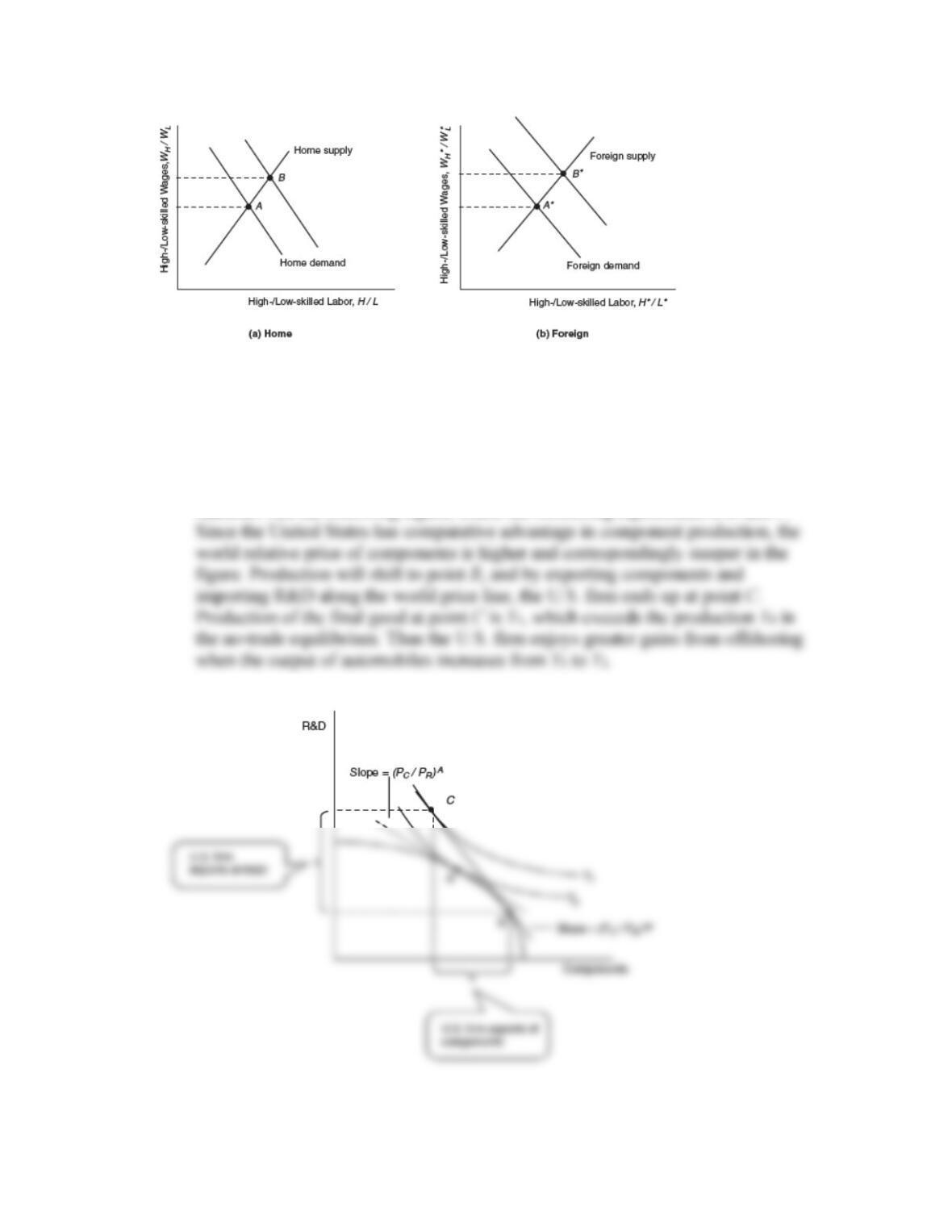
c. Draw relative labor supply and demand diagrams for Home and Foreign showing
the effect of this change. What happens to the relative wage in each country?
Answer: An expansion in the set of production activities done at Home (to
3. Consider a U.S. firm’s production of automobiles, including research and
development and component production.
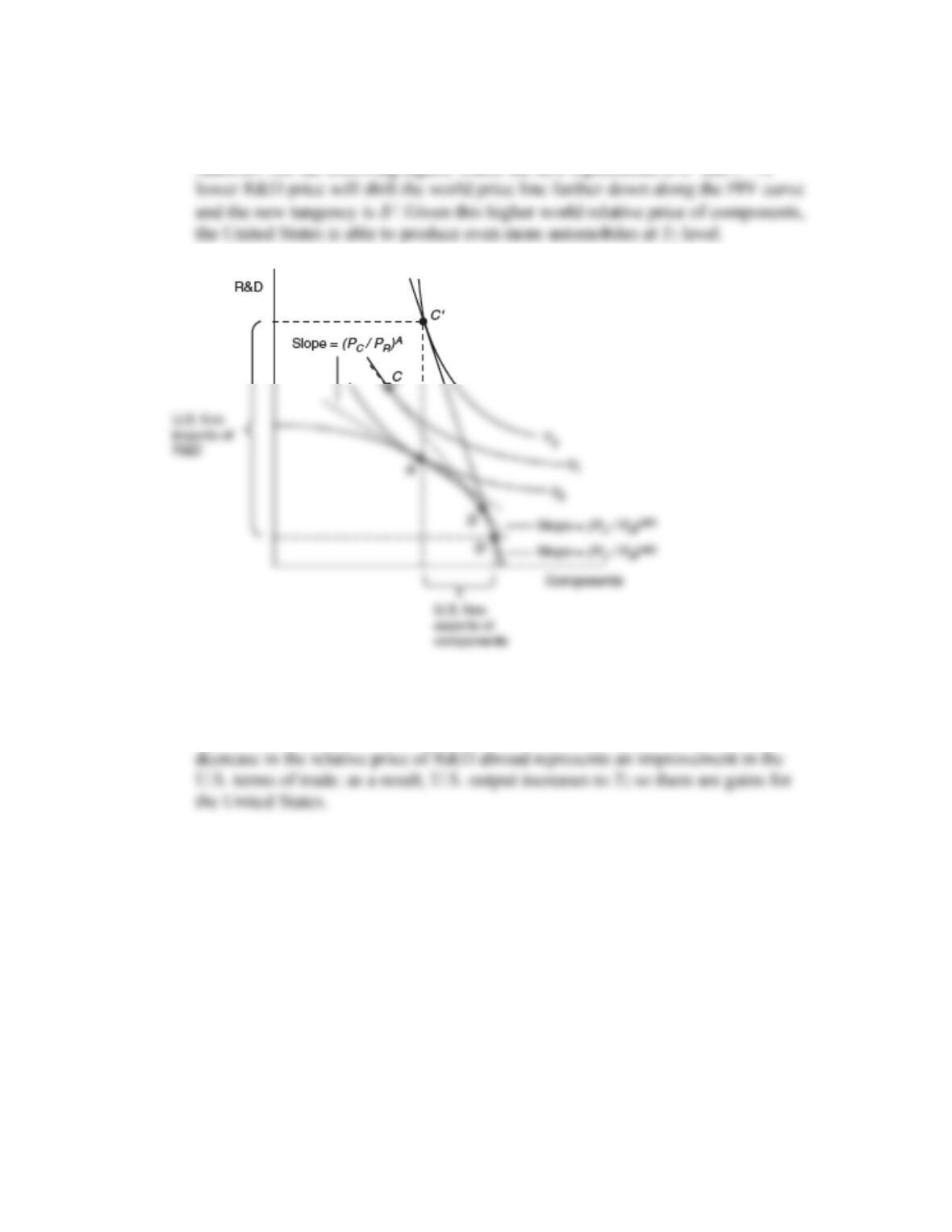
a. Starting from a no-trade equilibrium in a PPF diagram, illustrate the gains from
offshoring if the United States has comparative advantage in component
production.
Answer: See the following figure, where the offshoring equilibrium is B and C.
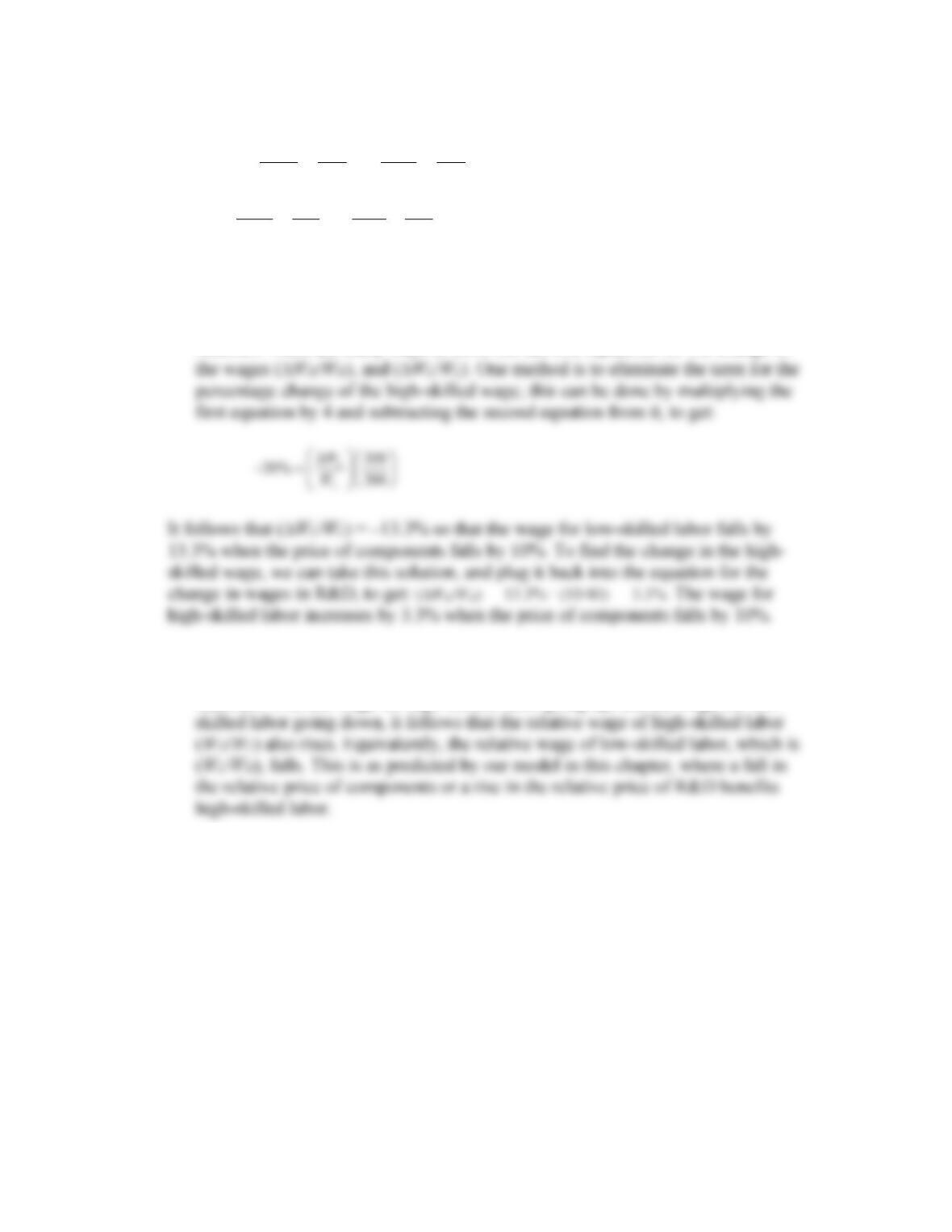
b. Now suppose that advances in engineering abroad decrease the relative price of
research and development. Illustrate this change on your diagram and state the
implications for production in the United States.
Answer: See the following figure, where the new equilibrium is B
′
and C
′
. A
c. Does the U.S. firm gain from advances in research and development abroad?
Explain why or why not.
Answer: Because the United States imports R&D and exports components, a
4. Consider the model of a firm that produces final goods using R&D and components
as inputs, with cost data as follows:
Components: Total costs of production = PC · QC = 200
Earnings of high-skilled labor = WH · HC = 20
Earnings of low-skilled labor = WL · LC = 80
Earnings of capital = R · KC = 100
Share of total costs paid to high-skilled labor = 20/200 = 10%
Share of total costs paid to low-skilled labor = 80/200 = 40%
R&D: Total costs of R&D = PR · QR = 200
Earnings of high-skilled labor = WH · HR = 80
Earnings of low-skilled labor = WL · LR = 20
Earnings of capital = R · KR = 100

Share of total costs paid to high-skilled labor = 80/200 = 40%
Share of total costs paid to low-skilled labor = 20/200 = 10%
a. In which factor(s) is components intensive? In which factor(s) is R&D intensive?
Answer: Component production is intensive in the use of low-skilled labor,
b. Suppose that due to the opening of trade, the price of components falls by ∆ PC/PC
= –10%, and the price of R&D remains unchanged, ∆PR/PR = 0. Using the hint
below, calculate the change in the wage of skilled and low–skilled labor.
Hint: We follow a procedure similar to that used in Chapter 4 when calculating
the change in factor prices in the Heckscher–Ohlin model.
First, write the total costs in each activity as consisting of the payments to labor
and capital:
PC · QC = R · KC + WH · HC + WL · LC, for components
PR · QR = R · KR + WH · HR + WL · LR, for R&D
Because we assume that 50% of costs in components or R&D are always paid to
capital, then R · KC = 0.5(PC · QC) and R · KR = 0.5(PR · QR), so we can rewrite
the above two equations as
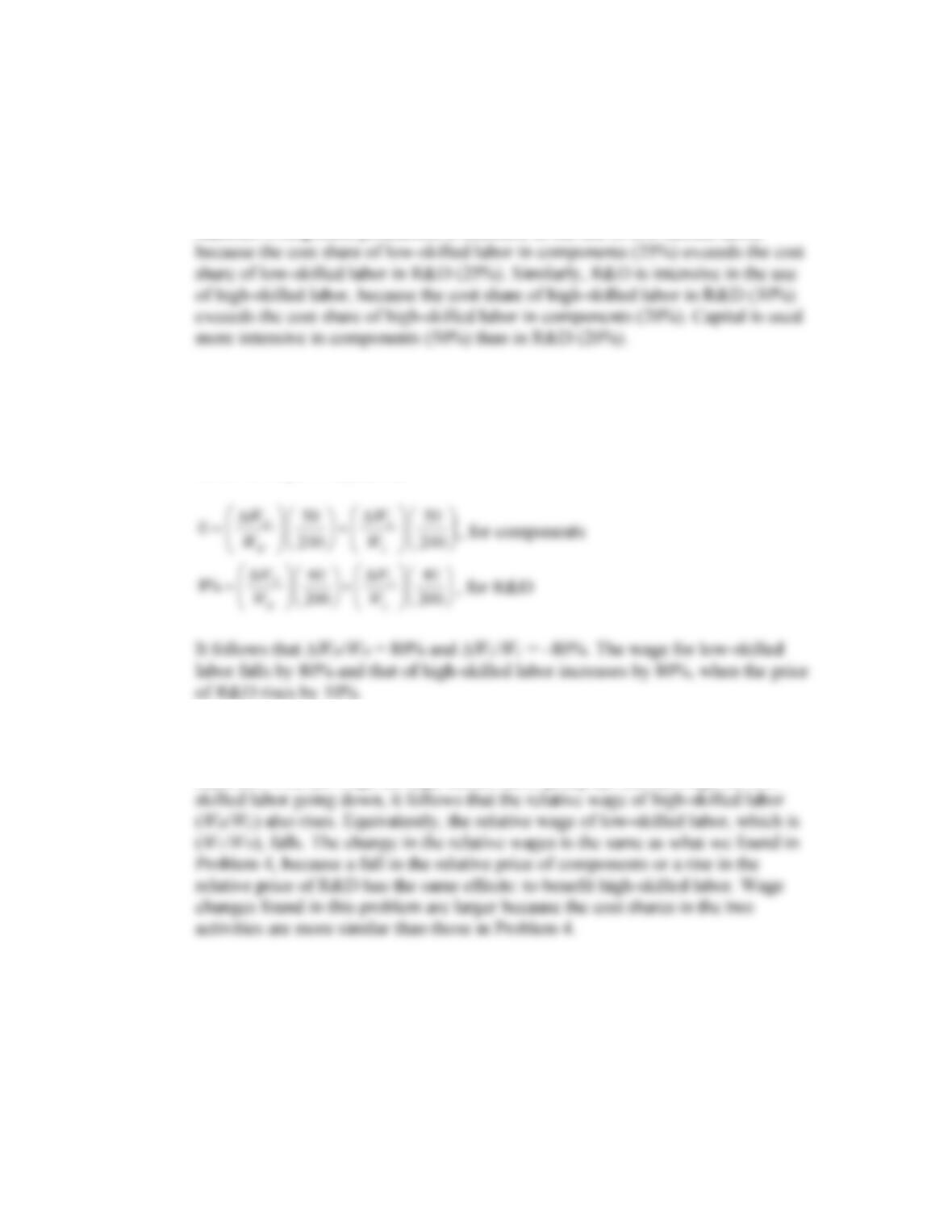
0.5(PC · QC) = WH · HC + WL · LC, for components
0.5(PR · QR) = WH · HR + WL · LR, for R&D
Taking the change in these equations:
0.5(∆PC · QC) = ∆WH · HC + ∆WL · LC, for components
0.5(∆PR · QR) = ∆WH · HR + ∆WL · LR, for R&D
Dividing the equations by (∆PC · QC) and (∆PR · QR), respectively, we can rewrite
the equations as
∆∆∆
= +
··
0.5
··
C HC LC
HL
C H CC L CC
P W H WH
WW
P W PQ W PQ
, for components
∆∆ ∆
= +
··
0.5
··
R H HR L LR
R H RR L RR
P W W H W WH
P W PQ W PQ
, for R&D
Use the cost shares and price change data in these formulas to get
20 80
5% 200 200
∆∆
−= +
HL
HL
WW
WW
, for components
80 20
0200 200
∆∆
= +
HL
HL
WW
WW
, for R&D
Now solve these two equations for the change in the high-skilled wage,
(∆WH/WH ), and the change in the low-skilled wage, (∆WL/WL).
Answer: There are many ways to solve the last two equations for the change in
c. What has happened to the relative wage of high-skilled/low-skilled labor? Does
this match the predictions of the offshoring model in this chapter?
Answer: With the wage for high-skilled labor going up, and the wage for low-
5. Consider the model of a firm that produces final goods using R&D and components
as inputs, with cost data as follows:
Components: Total costs of production = PC · QC = 200
Earnings of high-skilled labor = WH · HC = 50
Earnings of low-skilled labor = WL · LC = 50
Earnings of capital = R · KC = 100
Share of total costs paid to high-skilled labor = 50/200 = 25%
Share of total costs paid to low-skilled labor = 50/200 = 25%
R&D: Total costs of R&D = PR · QR = 200
Earnings of high-skilled labor = WH · HR = 60
Earnings of low-skilled labor = WL · LR = 40
Earnings of capital = R · KR = 40
Share of total costs paid to high-skilled labor = 60/200 = 30%
Share of total costs paid to low-skilled labor = 40/200 = 20%
a. In which factor(s) is components intensive? In which factor(s) is research
intensive?
Answer: Component production is intensive in the use of low-skilled labor,
b. Suppose that due to the opening of trade, the relative price of R&D increases,
∆PR/PR = 10%, whereas the price of components stays unchanged, ∆PC/PC = 0.
Calculate the change in the relative wage of high-skilled and low-skilled labor.
Answer: Following the same hint that was given for Problem 4, we end up with
the following two equations:
c. What has happened to the relative wage of high-skilled/low-skilled labor? How
does this result compare to Problem 4, and explain why it is similar or different.
Answer: With the wage for high-skilled labor going up, and the wage for low-
6. Read the following excerpt, and using what you have learned in this chapter, discuss
how offshoring creates opportunities for the countries involved.
Sudhakar Shenoy, chief executive of Information Management Consultants (IMC)
in Reston, makes an effective pitch for offshoring.
Several years ago IMC saw a market developing for software that would allow
biotech companies to make better and faster use of the new human genome

research. Doing it here, Shenoy calculated, would cost several million dollars,
which he figured would have priced the product too high for most customers. But
by having a small group of engineers at IMC’s Indian subsidiary do much of the
coding work, he was able to bring the project in at $500,000. The result: IMC now
has a thriving line of business in bioinformatics, with major clients and a growing
payroll of six-figure PhDs here. And there are more engineers than ever—six here
for every one in India.
But that’s only part of the good-news story. In Pune, where IMC’s Indian
operations are located, an airport under construction will require lots of U.S.
engineering, design and electronics. At the same time, IMC’s Indian engineers,
who earned annual salaries of $3,500 a decade ago, now command up to
$12,000—enough to buy all manner of imported consumer goods.
Source: Excerpted from Steven Pearlstein, “Still Short of the Offshoring Ideal,”
Washington Post, March 12, 2004.
Answer: By offshoring software in India, IMC is able to pass the cost savings to
7. The quote from the 2004
Economic Report of
the
President
at the beginning of
the
chapter generated a lot of
controversy
that year. The chairman of the Council of
Economic Advisers, N. Gregory Mankiw, made the following additional comments
in a speech while presenting the report: “Outsourcing is just a new way of doing
international trade. More things are tradable than were tradable in the past, and that’s
a good thing.”
Those statements quickly led to reactions from both Democratic and Republican
members of Congress. Tom Daschle, then the Democratic Senate minority leader,
said, “If this is the administration’s position, they owe an apology to every worker in
America.” Dennis Hastert, then Republican Speaker of the House, said, “Outsourcing
can be a problem for American workers and the American economy.” John Kerry,
the 2004 Democratic presidential candidate, referred to businesses that offshored as
“Benedict Arnold corporations.” In response, Mankiw clarified his earlier comments:
“My lack of clarity left the wrong impression that I praised the loss of U.S. jobs.”
You might feel that these statements just represented a squabble between
politicians trying to score points during a presidential campaign. Statements about
outsourcing and offshoring are made during many presidential campaigns, including
in 2016 when Donald Trump said that he’s “never eating another Oreo again”
because its parent company is “closing a factory in Chicago and they’re moving to
Mexico.” With all this media attention, it is worth trying to sort out who gains and
who loses from offshoring.
a. Why does Mankiw say that “outsourcing is a good thing”? Who is it good for in
the United States? Are there overall gains for the United States? Explain with a
diagram.
Answer: Mankiw says that offshoring is “a good thing” because there are overall

b. Later in this chapter, Paul Samuelson is quoted as saying that there is no
necessary surplus of winning over losings” due to offshoring. Use Figure 7-12 to
carefully explain why Samuelson says this.
Answer: Samuelson points out that loss due to offshoring may occur as a result of
c. Go online to find out whether Nabisco still produces Oreo cookies in the United
States, how many jobs are being moved to Mexico, and why.
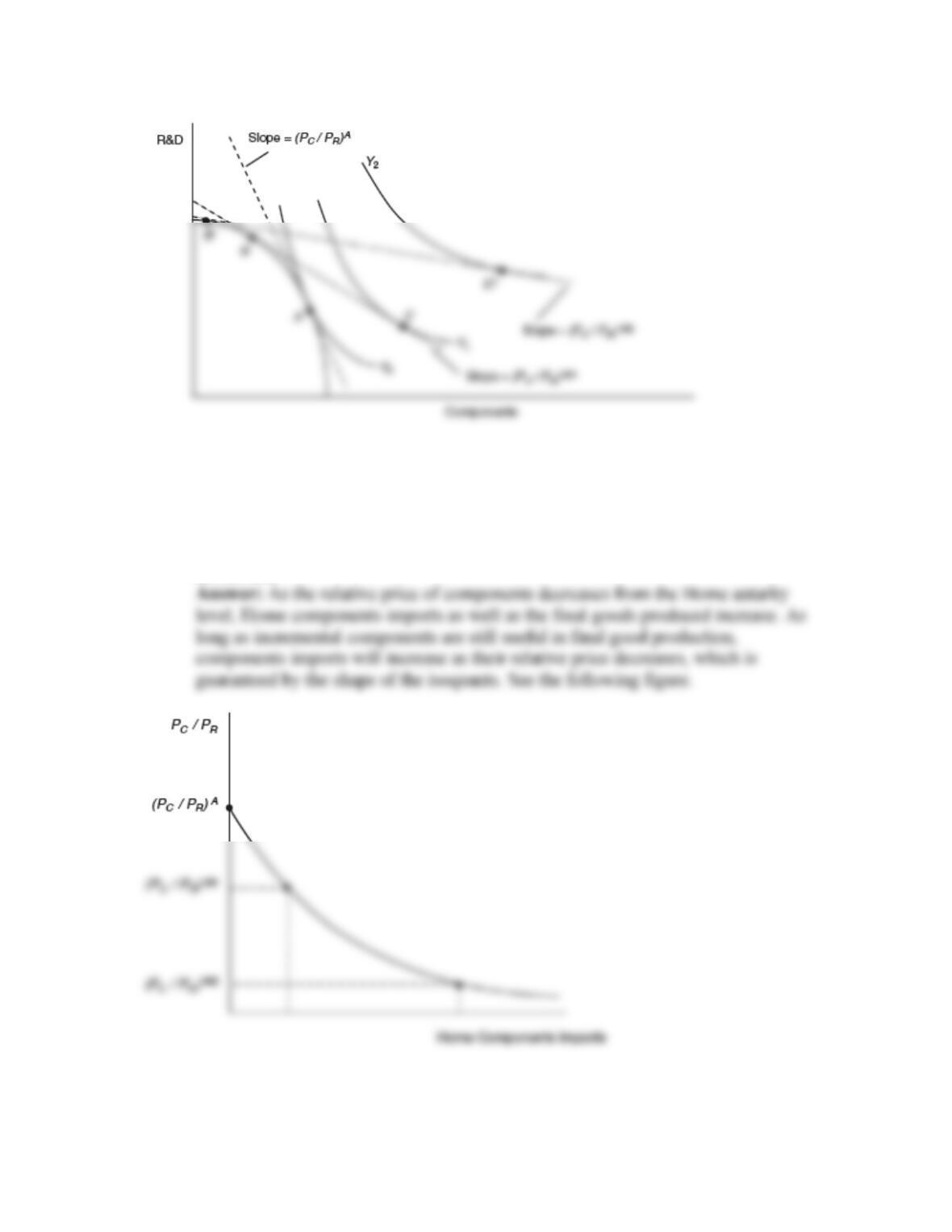
8. In Figure 7-14, we saw that a fall in the relative price of components leads to an
increase in the amount of components imported but that the amount of R&D exported
from Home does not necessarily increase. To explore this further, complete the
following:
a. Let the relative price of components continue to fall in Figure 7-14, and show in a
graph what happens to the equilibrium point on the isoquant for the final good.
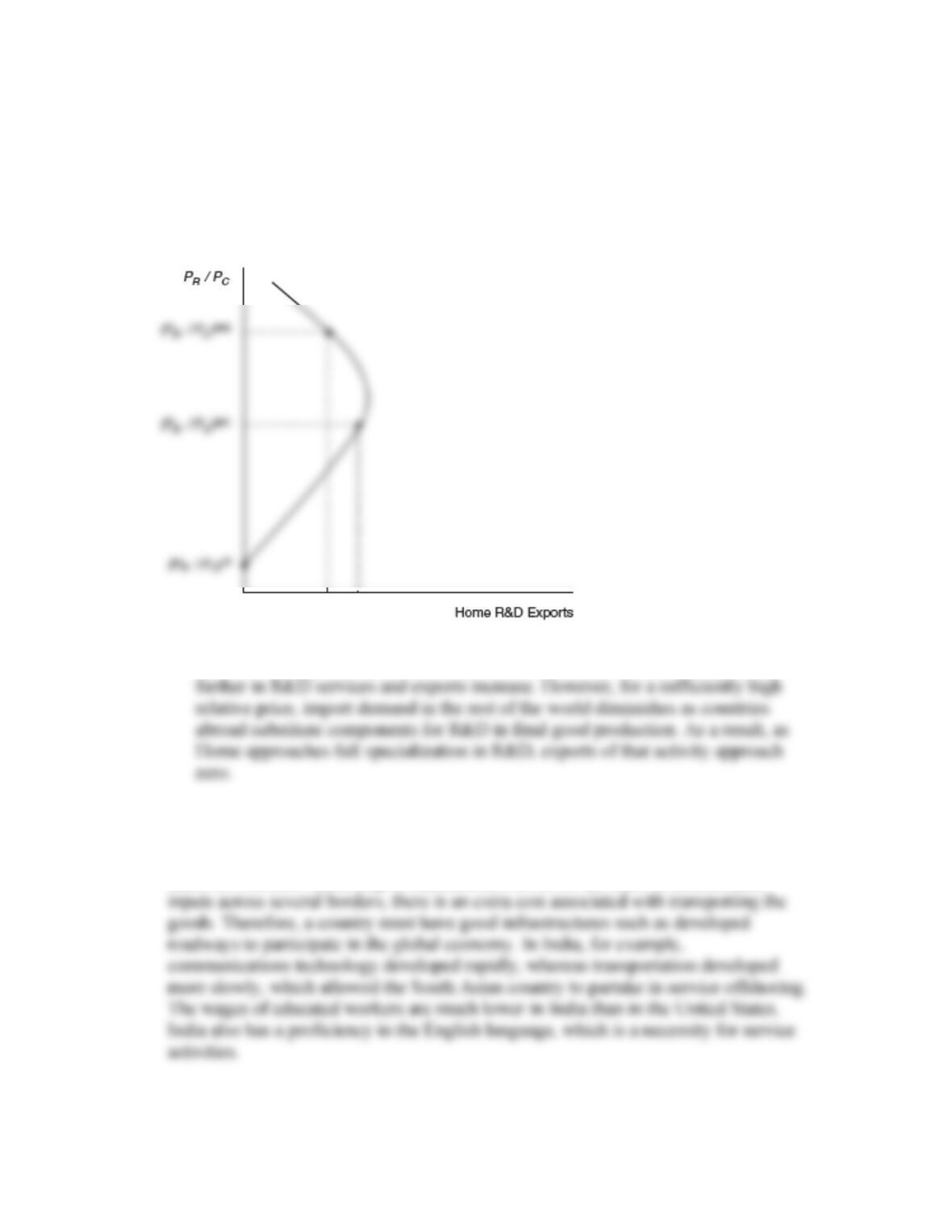
b. Now draw another graph that has the relative price of components on the vertical
axis and the imports of components on the horizontal axis. Start at the no-trade
relative price of components, where imports are zero. Then label the various
world relative prices of components on the vertical axis, and graph the quantity of
imports at each price. Can we be sure that the import demand curve slopes
downward?
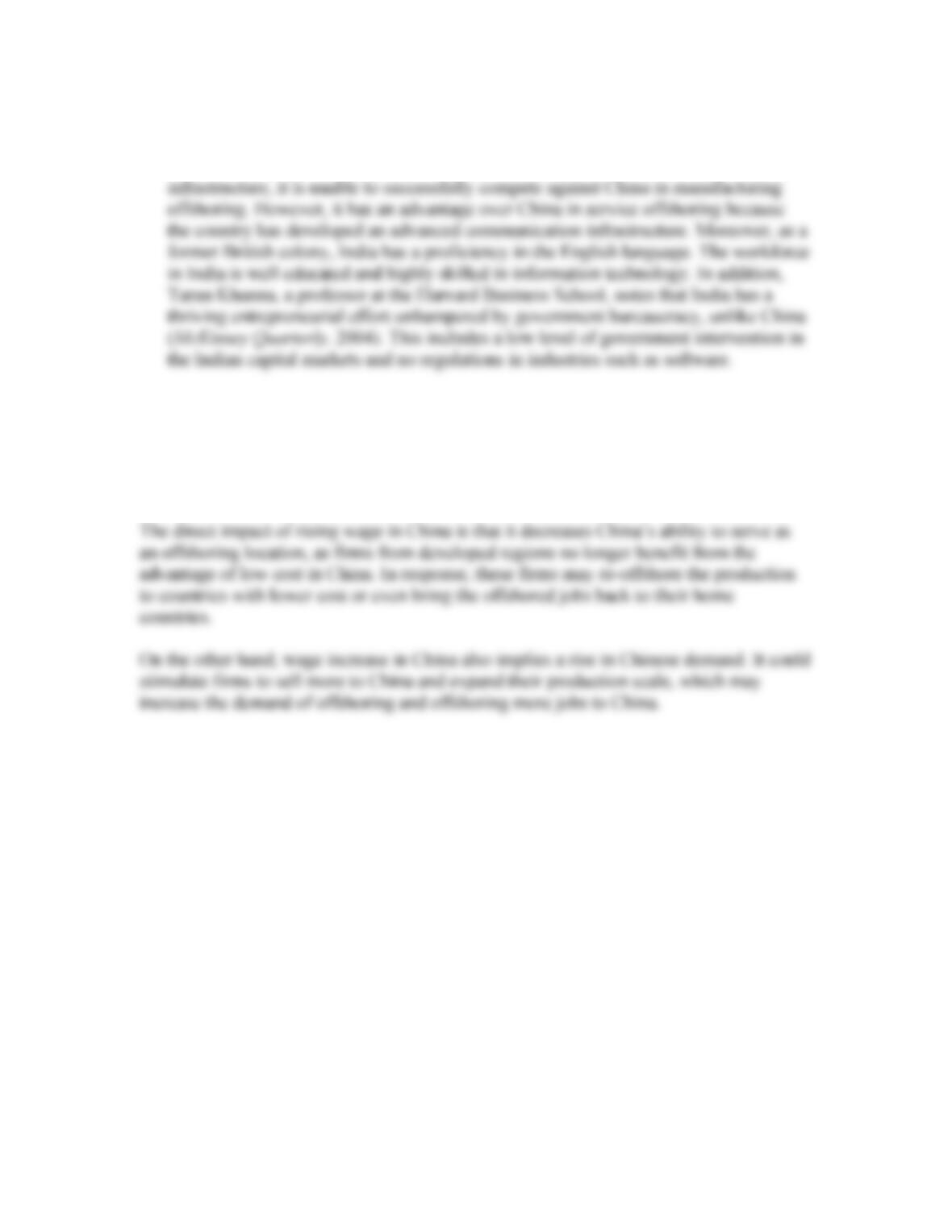
c. Now draw a new graph that has the relative price of R&D on the vertical axis and
the exports of R&D on the horizontal axis. Start at the no-trade relative price of
R&D, where exports are zero. Then label the various world relative prices of
R&D on the vertical axis, and graph the quantity of exports at each price. When
the relative price of R&D is high enough, what do you notice about the export
supply curve?
Answer: See the following figure:
As the relative price of R&D increases from its autarky level, Home specializes
9. Why might it be relatively easier for developing country like India to export service
activities through offshoring than to participate in the global economy by producing
manufacturing components?
Answer: Because offshoring of manufactures involves the trade of intermediate
10. It is widely noted that even though China is the favored destination for manufacturing
offshoring, it is far behind India in the business of offshored services. What
differences between these two countries might account for this causal observation?
Answer: Although wages are also low in India, because of its weak transportation
11. Chinese hourly manufacturing wages have increased by 12% per year on average
since 2001, which is much higher than wage growth in developed or other developing
countries. How will this wage growth in China affect its ability to serve as an offshoring
location?
Answer: This is an open question. Example answers are listed below.