7: Collaboration and Cooperative Teaching: Tools
for Teaching All Learners
Learning Outcomes
After studying this chapter, students should be able to:
• 7-1 Define the term collaboration and identify the purpose and value of
collaborative relationships.
INTASC Standards
● Standard #1: Learner Development. The teacher understands how learners grow and develop,
recognizing that patterns of learning and development vary individually within and across the
cognitive, linguistic, social, emotional, and physical areas, and designs and implements
developmentally appropriate and challenging learning experiences.
● Standard #2: Learning Differences. The teacher uses understanding of individual differences
Council for Exceptional Children
Special educators are to have knowledge of the following:
Standard #2: Curricular Content Knowledge. Beginning special education professionals create
safe, inclusive, culturally responsive learning environments so that individuals with
exceptionalities become active and efficient learners and develop emotional well–being, positive
social interactions, and self–determination,

Chapter Outline
7-1 Collaboration
7-1a Collaboration Between General and Special Educators
1. Who Is the Paraprofessional?
2. Qualifications of Paraprofessionals
4. Responsibilities of Paraprofessionals
7-1c Collaborating with Parents/Families
2. Working with Culturally and Linguistically Diverse Families
7-2 Collaborative Consultation
7-3 Teaming Models
7-3b Interdisciplinary Teams
7-4 Cooperative Teaching
7-4a Cooperative Teaching Options
1. One Teach, One Observe
3. Station Teaching
5. Alternative Teaching
7-4b Research Support
7-4c Suggestions for Building Successful Cooperative Teaching Arrangements
Key Concepts and Terms
collaboration: A cooperative partnership or relationship between two or more
individuals who are working toward achieving a mutually agreed upon goal.
collaborative consultation: A voluntary, focused, and shared problem–solving process
interdisciplinary: A model of teaming in which members perform their evaluations
independently, but program development and instructional recommendations are the
result of information sharing and joint planning.
multidisciplinary: A model of teaming that utilizes the expertise of professionals from
several disciplines, each of whom usually performs his or her assessments,
Lecture Notes
Teachers today no longer work in isolation. The demands placed on educators by an
increasingly diverse student population requires that teachers work in partnership with
other professionals as well as parents.
We view collaboration as a cooperative relationship between two or more individuals
who are committed to working toward a mutually agreed–on goal.
Collaboration between general education teachers and special educators is vital for
creating inclusive learning communities.
It is increasingly common to find paraprofessionals providing instructional as well as
Suggestions for In–Class and Online Activities
1. Learning to be collaborative begins in teacher preparation. With a partner, plan a
3. Which team would be your preference: multidisciplinary, interdisciplinary, or
transdisciplinary? Why?

4. As you are preparing for your teaching career, how do see the paraprofessional
role in the classroom?
Discussion Questions
1. What effect has the contemporary emphasis on building family–professional
partnerships had on power dynamics between teachers and families? Explain
2. In your opinion, in which phase of parental reaction to a learner’s disability would
a family be most open to collaboration with teachers? Explain why.
3. Can cultural sensitivity lead to stereotyping? Explain your answer.
4. Which teaming model is least family–friendly? Which is most family–friendly?
Why?
5. As a prospective special educator, which of the cooperative teaching options
described in Chapter 7 do you find least appealing? Which do you find most
appealing? Explain why.
6. How would you define collaborative consultation?
7. How will you engage a paraprofessional in your classroom?
8. With budget cuts, many states are eliminating the paraprofessional. How would
you defend the need for paraprofessionals in the school system?
9. As a new teacher, how would you approach a veteran teacher about a change to
their teaching and making it more cooperative?
10. Your principal has asked you to make a presentation at the next PTA meeting
about the importance of collaborating with families. What are the 5 most important
points you want to be sure to make?
Field Experiences
1. Interview a classroom teacher about how he or she prepares their lessons. Be
Videos
Watch the MindTap video for this chapter. Have the students write their reflections to the
questions.
Co–Teaching Strategies
1. What does co–teaching look like? Watch this video and describe how you see the
two professionals interact with the learners. Can you tell which professional is the
teacher and which one is the paraprofessional? How?
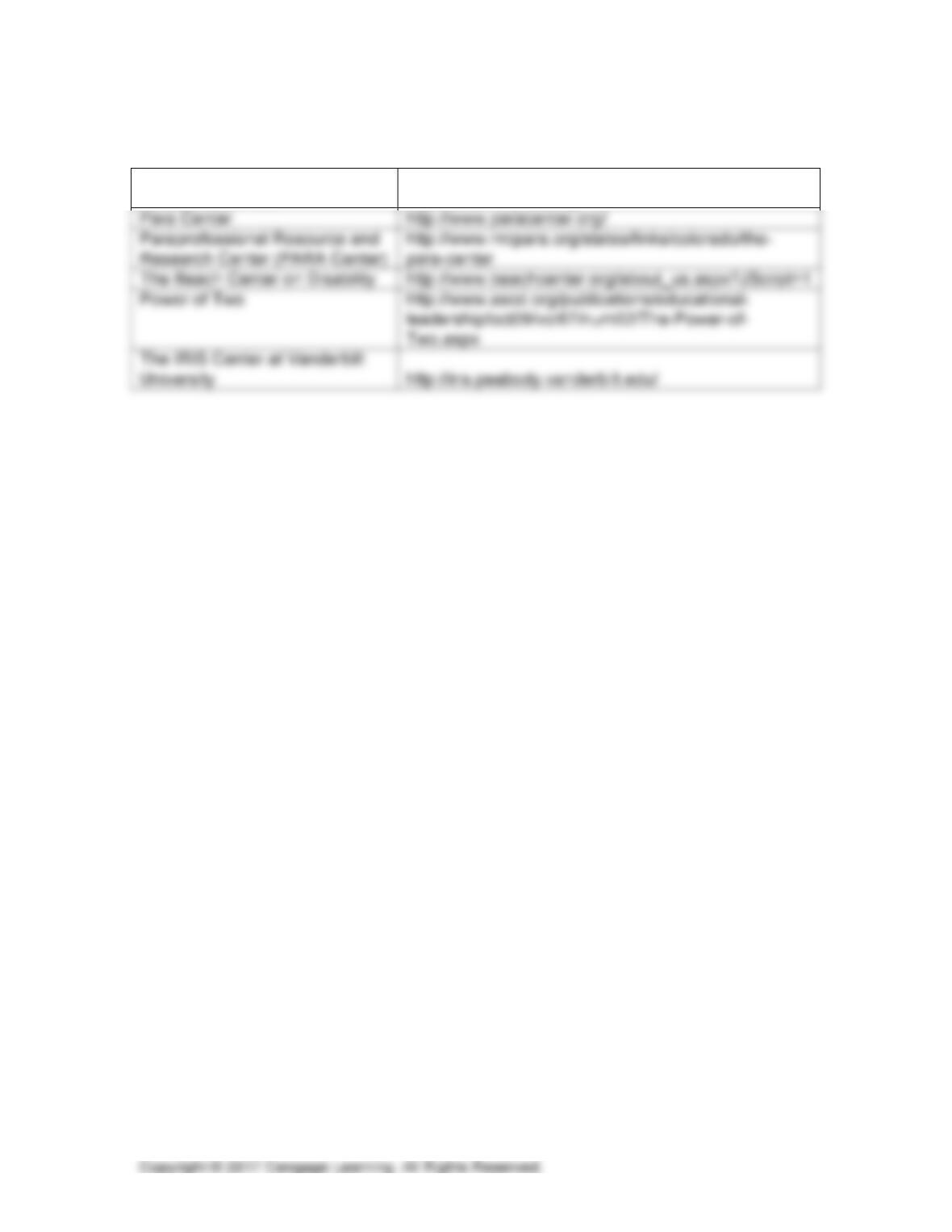
Web Resources
National Resource Center for
Paraprofessionals
http://www.nrcpara.org/
http://www.paracenter.org/
http://www.beachcenter.org/about_us.aspx?JScript=1
http://iris.peabody.vanderbilt.edu/