Chapter 7
The Macroeconomy: Unemployment,
Inflation, and Deflation
◼ Overview
In this chapter, the key concepts in macroeconomics of business fluctuations, unemployment, inflation,
and deflation are introduced. These concepts are discussed at length and their interrelationships are
examined. It is important to stress that the definition, measurement, and interpretation of each of these
◼ Learning Objectives
After studying this chapter, students should be able to:
• 7.1 Explain how the U.S. government calculates the official unemployment rate
• 7.2 Discuss the types of unemployment
• 7.3 Describe how price indexes are calculated and define the key types of price indexes
• 7.4 Evaluate who loses and who gains from inflation and distinguish between nominal and real
interest rates
• 7.5 Understand key features of business fluctuations
◼ Outline
I. Unemployment: Unemployment is the number of adults (16 years or older) who are willing and
able to work and who are actively looking for work but have not found a job.
A. Historical Unemployment Rates: The proportion of the labor force that is unemployed. The
B. Employment, Unemployment, and the Labor Force: All persons 16 years of age and over
C. The Arithmetic Determination of Unemployment: The number of unemployed is a stock
1. Categories of Individuals Who Are Without Work: A person is considered unemployed
in any of the following instances:
a. A job loser: A person who was involuntarily terminated or laid off (40–60 percent of
the unemployed)
2. Duration of Unemployment: The duration of unemployment is inversely related to the
4. Labor Force Participation: The proportion of noninstitutionalized working age persons
II. The Major Types of Unemployment
A. Frictional Unemployment: Unemployment due to the fact that workers must search for
appropriate job offers. This takes time, so they remain temporarily unemployed.
B. Structural Unemployment: Unemployment resulting from a poor match of workers’ skills and
C. Cyclical Unemployment: Unemployment resulting from recession.
D. Full Employment and the Natural Rate of Unemployment: Full employment does not mean
that everyone has a job. The transactions costs in the labor market are not zero.
1. Full Employment: A level of unemployment that corresponds to frictional unemployment
III. Inflation and Deflation: The situation in which the average of all prices of goods and services in
an economy is rising is called inflation. Deflation is a situation in which the average of all prices in
an economy is falling.
A. The Inflation and the Purchasing Power of Money: The value of a person’s money income
B. Measuring the Rate of Inflation: Inflation is measured by a price index.
C. Computing a Price Index: A fixed quantity price index is the cost of today’s market basket
1. Real-World Price Indexes
a. The CPI: The CPI is a weighted average of a specified set of goods and services
purchased by consumers in urban areas.
IV. Anticipated Versus Unanticipated Inflation: Unanticipated inflation is inflation that comes as a
surprise. Anticipated inflation is the inflation rate that we believe will occur and can be either
higher or lower than the actual rate.
A. Inflation and Interest Rates: The nominal interest rate is the market rate of interest. The real
B. Does Inflation Necessarily Hurt Everyone?
1. Unanticipated Inflation: Creditors Lose and Debtors Gain: Creditors lose because the
2. Protecting Against Inflation: Banks and other lenders raise interest rates to protect
3. The Resource Cost of Inflation: Businesses and individuals use resources to protect
V. Changing Inflation and Unemployment: Business Fluctuations: These are the ups (expansions)
and downs (contractions) in business activity throughout the economy. A recession is a contraction
or downturn in the level of business activity. The dating of recessions is done by the National Bureau
of Economic Research. (See Figure 7-6.)
A. A Historical Picture of Business Activity in the United States: Historical changes in U.S.
B. Explaining Business Fluctuations: External Shocks: Although many downturns in economic
◼ Points to Emphasize
Definitions in Economic Measurement
It is helpful to point out that the words “recession,” “unemployment,” and “inflation” mean different
things to different people. It is thus important to define them so that everyone understands what each
word means. It is also important to be able to measure these phenomena. Economists define these
concepts operationally. An operational definition is one that allows the measurement of a concept. Thus
Chapter 7 The Macroeconomy: Unemployment, Inflation, and Deflation 99
Changes in the Economic Status: Recession and Expansion
The text stresses that recessions and expansions are relative concepts. As such, deviations from the trend
growth rate of real GDP can be thought of as recessions or expansions. When the growth rate is above
the trend rate, there is said to be an expansion. It is possible, too, that real output can be increasing, yet a
The Unemployment Rate
“Unemployment” is as elusive a term as is “recession.” The unemployment rate is the ratio of the unemployed
to the labor force. Yet each of these terms is difficult to measure. Students should be aware that the
unemployment rate figures that they hear and read about are operationally, and therefore arbitrarily, defined.
Homemakers are engaged in productive activity. Yet the current operational definition of the labor force
does not include them. If it did, the official unemployment rate would be lower. How should the
voluntarily unemployed be treated? Are they really in the labor force and are they really unemployed?
Frictional, Structural, and Full Employment
Individuals usually think of full employment as being a situation in which there is no unemployment. Full
employment is a rather vague, arbitrary concept. Because transactions costs in labor markets are positive,
there will always be some frictional unemployment. Also, there will always be structural unemployment
Inflation
Inflation evokes strong emotional reactions, yet an operational definition is simply a sustained increase in the
price level as measured by a price index. A price index is a very imperfect measure of the price level. Most
price indexes are fixed-weight indexes in which the weights are the quantities purchased in a base period.
100 Miller • Economics Today, Nineteenth Edition
Real and Nominal Interest Rates
The text examines the issue of real versus nominal interest rates under conditions of inflation. It is
important for students to be able to distinguish these two interest rate concepts. The economy is affected
◼ For Those Who Wish to Stress Theory
Labor Surpluses and Agricultural Surpluses
For those who wish to emphasize theory, draw an analogy between labor surpluses (unemployment)
and agricultural surpluses. In order for agricultural surpluses to exist, prices must be above equilibrium
and not be allowed to fall. The resulting surpluses must be purchased and stored by individual farmers,
Is Inflation a Purely Monetary Phenomenon?
Stating that inflation is purely a monetary phenomenon can generate controversy. Inflation arises when the
money supply is increased relative to the demand for money. This proposition can be illustrated as follows:
1. Suppose the going exchange rate is 1 gallon of oil = 1 quart of milk. Assume that a major oil discovery
2. If the money supply increases relative to the demand for money the relative price of money will fall;
3. Inflation can be understood by using the tools of supply and demand. If the demand for money is
solely or primarily determined by a desire to purchase goods and services, then the demand for
Chapter 7 The Macroeconomy: Unemployment, Inflation, and Deflation 101
Does Inflation Hurt Everyone?
During periods of inflation some gain and some lose. If inflation is underestimated by contracting parties,
then workers who sign long-term contracts, moneylenders, and workers who do not have cost-of-living
Cost-Push Inflation
It is a common theory that unions cause inflation or that the Organization of Petroleum Exporting
Countries (OPEC) causes inflation. It is widely believed that if unions increase wages, businesses will
merely pass these increases off as higher prices. This need not be true. In recent years, U.S. industries,
◼ Further Questions for Class Discussion
1. Social Security cost-of-living adjustments are based on the increase in the CPI between the third
quarter of the previous year and the third quarter of the current year. The percentage increase is
then applied to Social Security benefits beginning in January of the next year. In 2010 and 2011,
2. One interesting question to pose is as follows: Does a rise in the unemployment rate mean
that there is a weakening of the economy? It is generally believed that a higher unemployment
3. During the recession of 2008–2009, many workers who lost their jobs were unable to afford to move
to a new job in a new city and pay rent or buy another home because they could not sell the home
they were in that still had mortgages. This was because of the crash of the housing market caused by
the financial meltdown associated with subprime mortgage lending. What effect would you expect
4. In practice, could nominal interest rates ever be zero in the economy? Yes, if deflation was
5. Could the real interest rate be negative in practice? How about the nominal interest rate? The real
interest rate could be negative if inflation is much higher than expected. For example, if the expected
rate of inflation was 5 percent and lenders wished to earn a real return of 3 percent, then the nominal
◼ Answers to Questions for Critical Analysis
An Increase in the Duration of Unemployment (p. 146)
How might government policies that make it more difficult for businesses to fire workers cause
those businesses to consider more carefully-and hence more slowly-whom they hire to positions in
the first place? Explain your reasoning.
Why a Drop in “Routine Jobs” is Elevating the Natural Rate of Unemployment
(p. 148)
Why do you suppose that many economists argue that unemployment would drop if people
developed stronger critical-thinking, writing, and science and mathematics skills that can be
applied to wider ranges of job tasks?
Chapter 7 The Macroeconomy: Unemployment, Inflation, and Deflation 103
How High One’s Price-Level-Adjusted Income Is Depends on Where One
Lives (p. 151)
Even after adjusting for price-level differences, because state income tax rates vary considerable
across U.S. states, why might an income-threshold definition of who is “rich” yield very different
results across states if it were to be based on after-tax incomes instead of before-tax incomes?
How Variations in Prices of Imported Items Can Push Apart the PPI and CPI
(p. 152)
In what way are the PPI and CPI likely to diverge for a while following a sustained increase in
import price? Explain briefly.
Animal Spirits and Business Fluctuations: Can Fear Cause Recessions?
(p. 157)
Why do you suppose that some economists have suggested that “irrational exuberance”-unjustified
optimism about future economic performance-can contribute to business expansions?
◼ You Are There
Is the Level of Prices Rising in Russia? Take a Look at the “Borscht Index”
(p. 157)
1. If each household in a nation were to track a consumer price index that averaged the prices
of items consumed solely by that household, why would you anticipate that the annual rate of
change of every household’s average of prices likely would differ?
2. Russian government economists follow the U.S. example of publishing a measure of “core
inflation” in which food and energy prices are stripped from the consumer price index before
computing annual inflation rates. Why do you think that Russian “core inflation” is lower
than the annual rate of change in the Russian CPI that includes food prices?
104 Miller • Economics Today, Nineteenth Edition
◼ Issues and Applications
Interpreting Employment data as the Gig Economy Grows (pp. 158–159)
1. Why might the U.S. government, which funds Social Security, Medicare, and unemployment
insurance programs by taxing wages, desire to find a way to reduce self-employment and
inhibit the growth of the gig economy?
2. Why do you suppose that some economists argue that if part-time employment rises while
unemployment remains unchanged, the economy has moved further from full employment?
◼ Research Project
1. To overview the U.S. government’s employment statistics, see the Web Links in MyEconLab.
2. For a glossary of U.S. government employment terminology and classifications, see the Web Links
in MyEconLab.
◼ Answers to Problems
7-1. Suppose that you are given the following information:
Total population
330.0 million
Adult, noninstitutionalized, nonmilitary population
260.0 million
Unemployment
8.5 million
a. If the labor force participation rate is 65 percent, what is the labor force?
b. How many workers are employed?
c. What is the unemployment rate?
a. Multiplying the fraction of people who participate in the labor force, 0.65, times the
7-2. Suppose that you are given the following information:
Labor force
206.2 million
Adults in the military
1.5 million
Nonadult population
48.0 million
Employed adults
196.2 million
Institutionalized adults
3.5 million
Nonmilitary, noninstitutionalized adults not in labor force
40.8 million
a. What is the total population?
b. How many people are unemployed, and what is the unemployment rate?
c. What is the labor force participation rate?
7-3. Suppose that the U.S. nonmilitary, noninstitutionalized adult population is 254 million,
the number employed is 156 million, and the number unemployed is 8 million.
a. What is the unemployment rate?
b. Suppose there is a difference of 60 million between the adult population and the
combined total of people who are employed and unemployed. How do we classify these
60 million people? Based on these figures, what is the U.S. labor force participation rate?
7-4. During the course of a year, the labor force consists of the same 1,000 people. Employers have
chosen not to hire 20 of these people in the face of government regulations making it too costly
to employ them. Hence, they remain unemployed throughout the year. At the same time,
every month during the year, 30 different people become unemployed, and 30 other different
people who were unemployed find jobs.
a. What is the frictional unemployment rate?
b. What is the unemployment rate?
106 Miller • Economics Today, Nineteenth Edition
c. Suppose that a system of unemployment compensation is established. Each month,
30 new people (not including the 20 that employers have chosen not to employ) continue
to become unemployed, but each monthly group of newly unemployed now takes two
months to find a job. After this change, what is the frictional unemployment rate?
d. After the change discussed in part (c), what is the unemployment rate?
7-5. Suppose that a nation has a labor force of 100 people. In January, Amy, Barbara, Carine, and
Denise are unemployed. In February, those four find jobs, but Evan, Francesco, George, and
Horatio become unemployed. Suppose further that every month, the previous four who were
unemployed find jobs and four different people become unemployed. Throughout the year,
however, three people—Ito, Jack, and Kelley—continually remain unemployed because firms
facing government regulations view them as too costly to employ.
a. What is this nation’s frictional unemployment rate?
b. What is its structural unemployment rate?
c. What is its unemployment rate?
7-6. In a country with a labor force of 200, a different group of 10 people becomes unemployed
each month, but becomes employed once again a month later. No others outside these groups
are unemployed.
a. What is this country’s unemployment rate?
b. What is the average duration of unemployment?
c. Suppose that establishment of a system of unemployment compensation increases to two
months the interval that it takes each group of job losers to become employed each
month. Nevertheless, a different group of 10 people still becomes unemployed each
month. Now what is the average duration of unemployment?
d. Following the change discussed in part (c), what is the country’s unemployment rate?
7-7. A nation’s frictional unemployment rate is 1 percent. Its cyclical rate of unemployment is
3 percent, and its structural unemployment rate is 4 percent. What is this nation’s overall rate
of unemployment?
7-8. In 2016, the cost of a market basket of goods was $2,000. In 2018, the cost of the same market
basket of goods was $2,100. Use the price index formula to calculate the price index for 2018 if
2016 is the base year.
7-9. Suppose that in 2017, a typical U.S. student attending a state-supported college bought 10
textbooks at a price of $100 per book and enrolled in 25 credit hours of coursework at a price
of $360 per credit hour. In 2018, the typical student continued to purchase 10 textbooks and
enroll in 25 credit hours, but the price of a textbook rose to $110 per book, and the tuition
price increased to $400 per credit hour. The base year for computing a “student price index”
using this information is 2017. What is the value of the student price index in 2017? In 2018?
Show your work.
7-10. Between 2017 and 2018 in a particular nation, the value of the consumer price index—for
which the base year is 2014—rose by 9.091 percent, to a value of 120 in 2018. What was the
value of the price index in 2017?
7-11. Consider the following price indexes: 90 in 2017, 100 in 2018, 110 in 2019, 121 in 2020,
and 150 in 2021. Answer the following questions.
a. Which year is likely the base year?
b. What is the inflation rate from 2018 to 2019?
c. What is the inflation rate from 2019 to 2020?
d. If the cost of a market basket in 2018 is $2,000, what is the cost of the same basket of
goods and services in 2017? In 2021?
7-12. The real interest rate is 4 percent, and the nominal interest rate is 6 percent. What is the
anticipated rate of inflation?
7-13. Currently, the price index used to calculate the inflation rate is equal to 90. The general
expectation throughout the economy is that next year its value will be 99. The current
nominal interest rate is 12 percent. What is the real interest rate?
7-14. At present, the nominal interest rate is 7 percent, and the expected inflation rate is 5 percent.
The current year is the base year for the price index used to calculate inflation.
a. What is the real interest rate?
b. What is the anticipated value of the price index next year?
7-15. Suppose that in 2019 there is a sudden, unanticipated burst of inflation. Consider the
situations faced by the following individuals. Who gains and who loses?
a. A homeowner whose wages will keep pace with inflation in 2019 but whose monthly
mortgage payments to a savings bank will remain fixed
b. An apartment landlord who has guaranteed to his tenants that their monthly rent
payments during 2019 will be the same as they were during 2018
c. A banker who made an auto loan that the auto buyer will repay at a fixed rate of interest
during 2019
d. A retired individual who earns a pension with fixed monthly payments from her past
employer during 2019
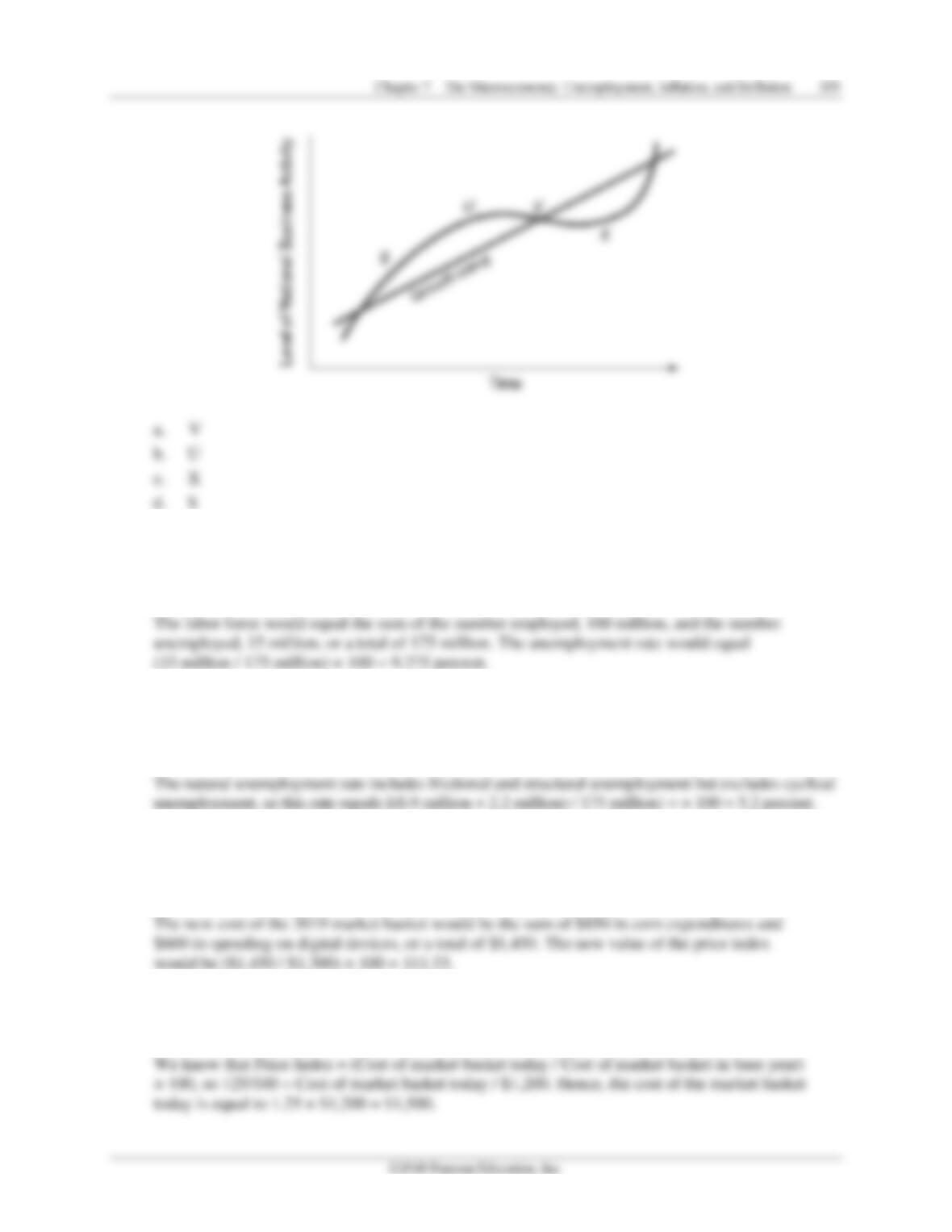
7-16. Consider the diagram below. The line represents the economy’s growth trend, and the curve
represents the economy’s actual course of business fluctuations. For each part below, provide
the letter label from the portion of the curve that corresponds to the associated term.
a. Contraction
b. Peak
c. Trough
d. Expansion
7-17. Suppose that in Figure 7-2, the number of people employed were to expand by 9.2 million,
and the number of people unemployed were to rise by 7.1 million. What would be the new
values of the labor force and of the unemployment rate?
7-18. Suppose that among the 15 million unemployed people in Problem 7-17, currently 6.9 million
are frictionally unemployed, 5.9 million are cyclically unemployed, and 2.2 million are
structurally unemployed. What is the natural rate of unemployment?
7-19. Consider Table 7-1, Suppose that the 2019 price of corn were to rise to $8.50 per bushel but
that the price of a digital device were to fall to $300. The quantities of the two commodities
remain the same, however. How would these changes affect the value of the 2019 price index?
7-20. The cost of a nation’s market basket in the base year is $1,200, and the current year’s price
index equals 125. What is the cost of the market basket in the current year?
7-21. This year’s value of the economy’s price index is 100, and people anticipate that next year’s
value will be 103. The current nominal interest rate is 5 percent. What is the real interest rate?
7-22. This year is the base year for computing the nation’s price index. The current nominal
interest rate is 6 percent, and the real interest rate is 3.5 percent. What is the anticipated
value of next year’s price index?
◼ Selected References
Alchian, Arman A., “Information Costs, Pricing, and Resource Unemployment,” Western Economic
Journal, Vol. 7, June 1969, pp. 109–128.
Alchian, Arman A. and Reuben A. Kessel, “Redistribution of Wealth through Inflation,” Science, Vol.
130, No. 3375, September 4, 1959, pp. 535–539.
Brimmer, Andrew F., “Inflation and Income Distribution in the United States,” Review of Economics and
Statistics, Vol. 53, No. 1, February 1971, pp. 37–48.
Feldstein, Martin, “The Economics of the New Unemployment,” The Public Interest, Fall 1973.
Kessel, Reuben A. and Arman A. Alchian, “Effects of Inflation,” Journal of Political Economy, Vol. 70,
December 1962, pp. 521–537.