Chapter 07 – Businesses and the Costs of Production
7-1
Chapter 07 Businesses and the Costs of Production
QUESTIONS
1. Distinguish between explicit and implicit costs, giving examples of each. What are some
explicit and implicit costs of attending college? LO1
Answer: Explicit costs are payments the firm must make for inputs to non-owners of the
firm to attract them away from other employment, for example, wages and salaries to its
2. Distinguish between accounting profit, economic profit, and normal profit. Does accounting
profit or economic profit determine how entrepreneurs allocate resources between different
business ventures? Explain. LO1
Answer: Accounting profit equals sales revenue minus explicit costs, such as material,
the wages of employees, etc…..
3. Which of the following are short-run and which are long-run adjustments? LO1
a.Wendy’s builds a new restaurant.
b.Harley-Davidson Corporation hires 200 more production workers.
c.A farmer increases the amount of fertilizer used on his corn crop.
d.An Alcoa aluminum plant adds a third shift of workers.
Chapter 07 – Businesses and the Costs of Production
7-2
Answer:
(a) Long-Run. This is a capital investment, which takes time to become productive.
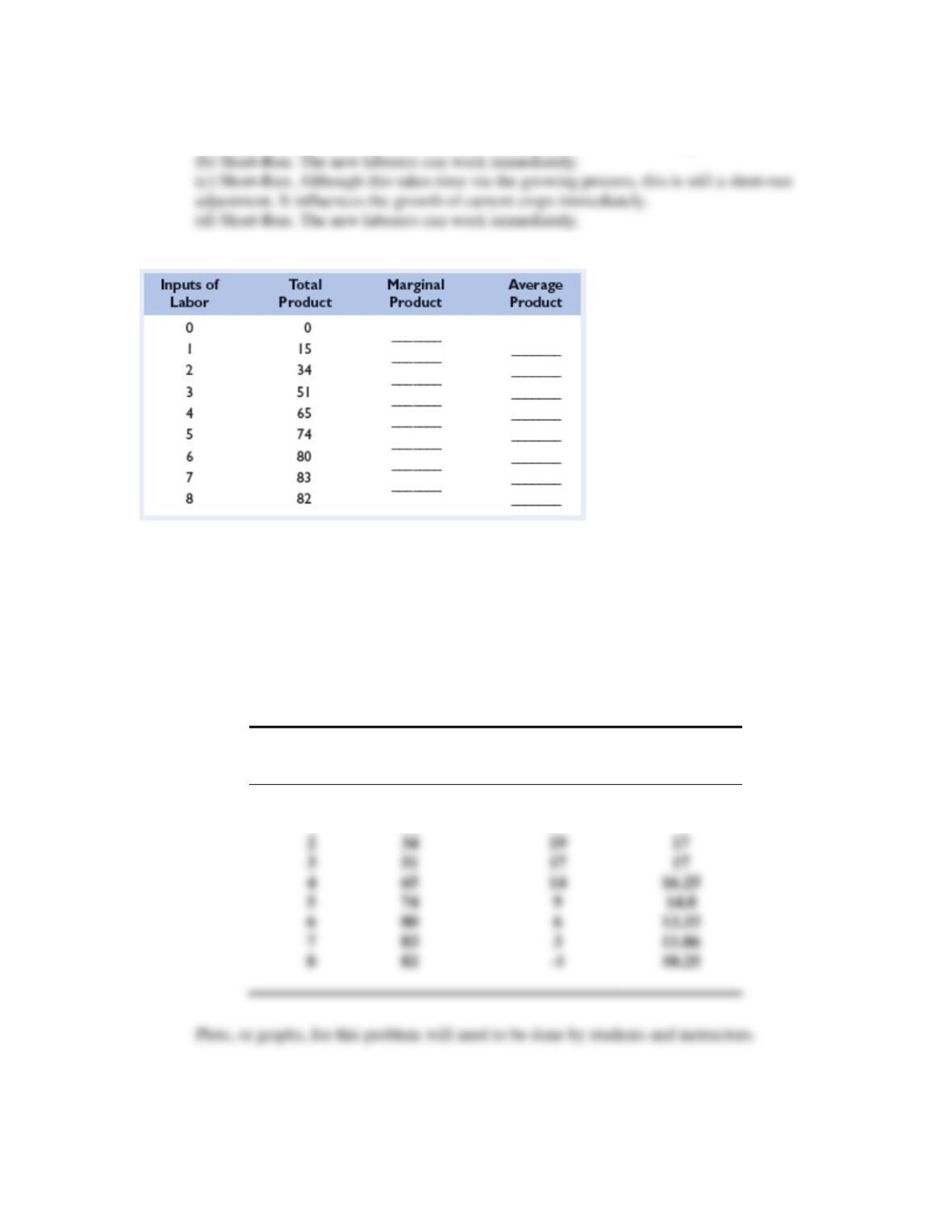
4. Complete the table directly below by calculating marginal product and average product.
Plot the total, marginal, and average products and explain in detail the relationship between each
pair of curves. Explain why marginal product first rises, then declines, and ultimately becomes
negative. What bearing does the law of diminishing returns have on short-run costs? Be specific.
“When marginal product is rising, marginal cost is falling. And when marginal product is
diminishing, marginal cost is rising.” Illustrate and explain graphically. LO2
Answer:
Table:
Inputs of
labor
Total
product
Marginal
product
Average
product
0
1
0
15
NA
15
NA
15
Chapter 07 – Businesses and the Costs of Production
7-3
5. Why can the distinction between fixed costs and variable costs be made in the short run?
Classify the following as fixed or variable costs: advertising expenditures, fuel, interest on
company-issued bonds, shipping charges, payments for raw materials, real estate taxes, executive
salaries, insurance premiums, wage payments, depreciation and obsolescence charges, sales taxes,
and rental payments on leased office machinery. “There are no fixed costs in the long run; all
costs are variable.” Explain. LO3
Answer: The distinction can be made because there are some costs that do not vary with
total output. These are the fixed costs that, fundamentally, are related to the scale or size
of the plant. In the short run, by definition, the scale of the plant cannot change: The firm
Chapter 07 – Businesses and the Costs of Production
7-4
6. List several fixed and variable costs associated with owning and operating an automobile.
Suppose you are considering whether to drive your car or fly 1000 miles to Florida for spring
break. Which costs—fixed, variable, or both—would you take into account in making your
decision? Would any implicit costs be relevant? Explain. LO3
Answer: Fixed costs associated with owning and operating an automobile include the
price of the car (probably monthly payments); insurance; driver’s license; car license; and
depreciation.
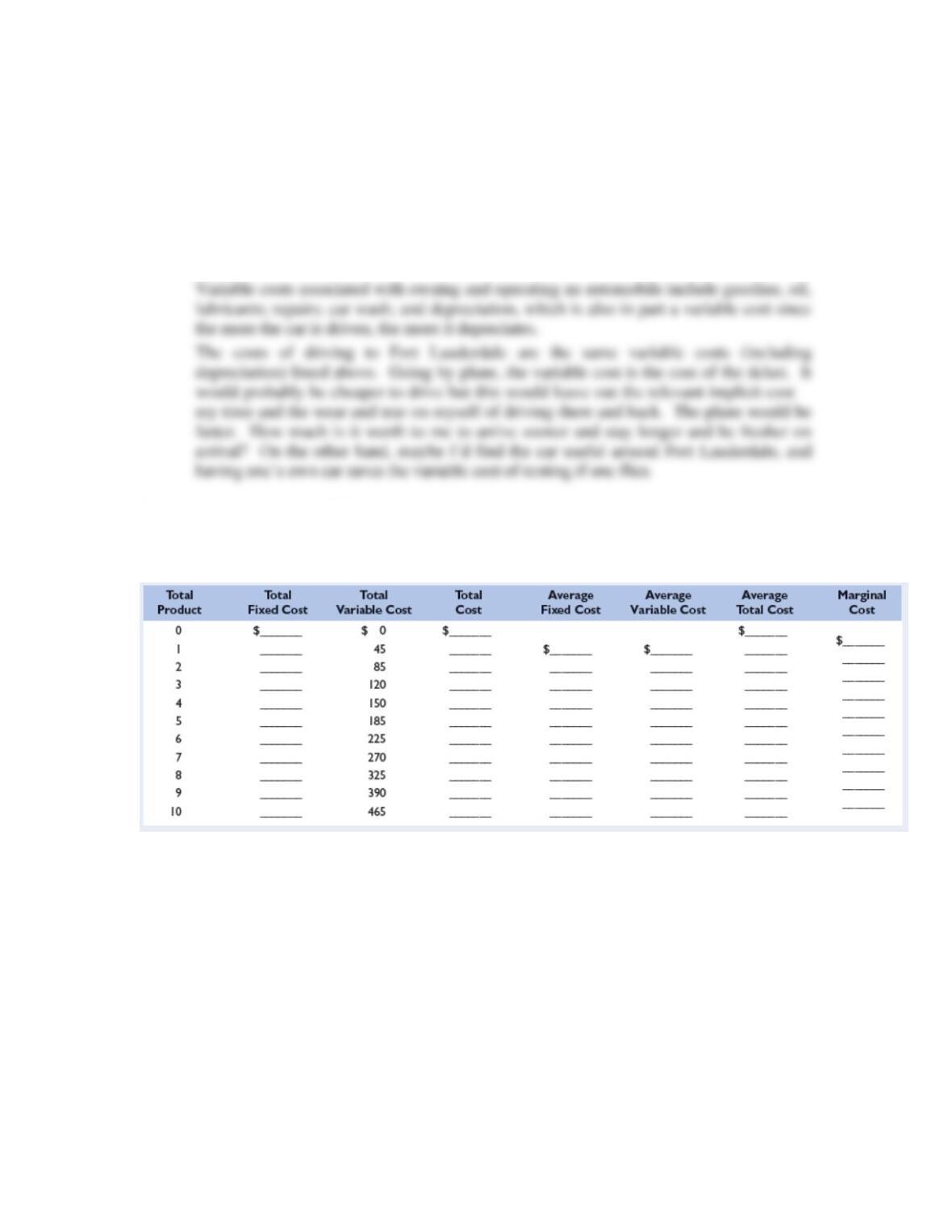
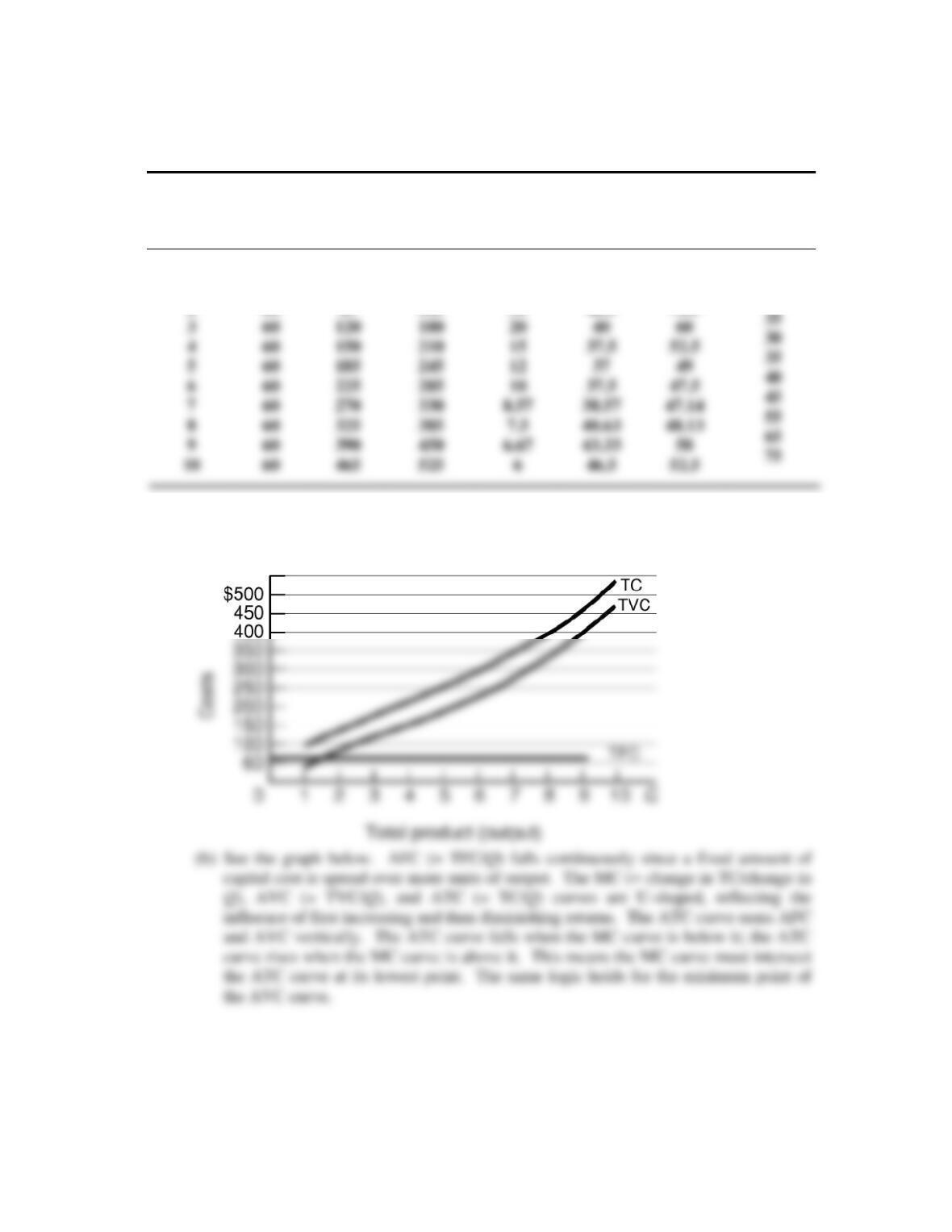
7. A firm has fixed costs of $60 and variable costs as indicated in the table at the bottom of this
page. Complete the table and check your calculations by referring to question 4 at the end of
Chapter 8. LO3
a. Graph total fixed cost, total variable cost, and total cost. Explain how the law of
diminishing returns influences the shapes of the variable-cost and total-cost curves.
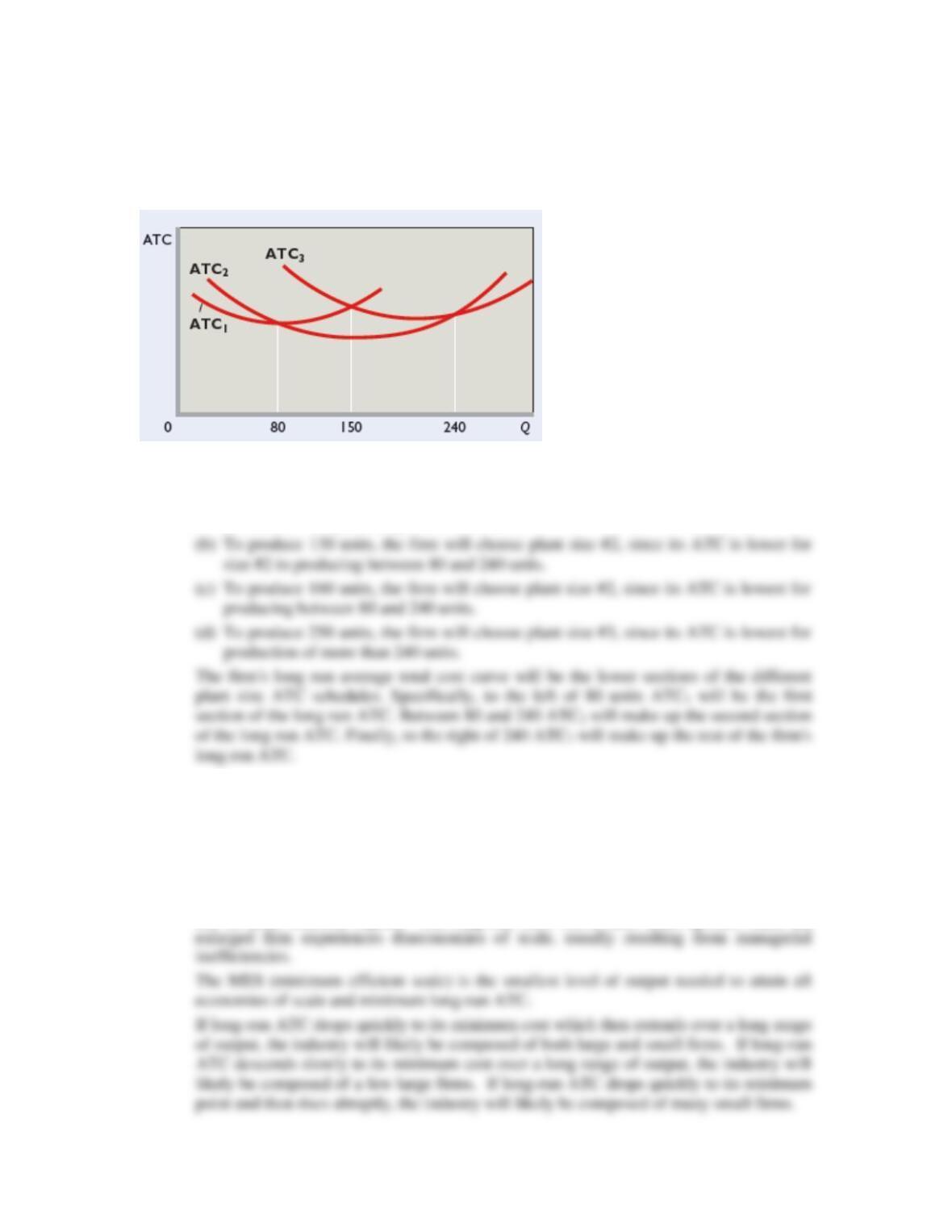
b. Graph AFC, AVC, ATC, and MC. Explain the derivation and shape of each of these four
curves and their relationships to one another. Specifically, explain in nontechnical terms why the
MC curve intersects both the AVC and the ATC curves at their minimum points.
c. Explain how the location of each curve graphed in question 7b would be altered if (1)
total fixed cost had been $100 rather than $60 and (2) total variable cost had been $10 less at each
level of output.
Chapter 07 – Businesses and the Costs of Production
7-5
Answer:
Table:
Total
product
Total
fixed
cost
Total
variable
cost
Total
cost
Average
fixed
cost
Average
variable
cost
Average
total
cost
Marginal
cost
0
1
2
$60
60
60
$ 0
45
85
$0
105
145
$60
30
$45
42.5
$105
72.5
$45
40
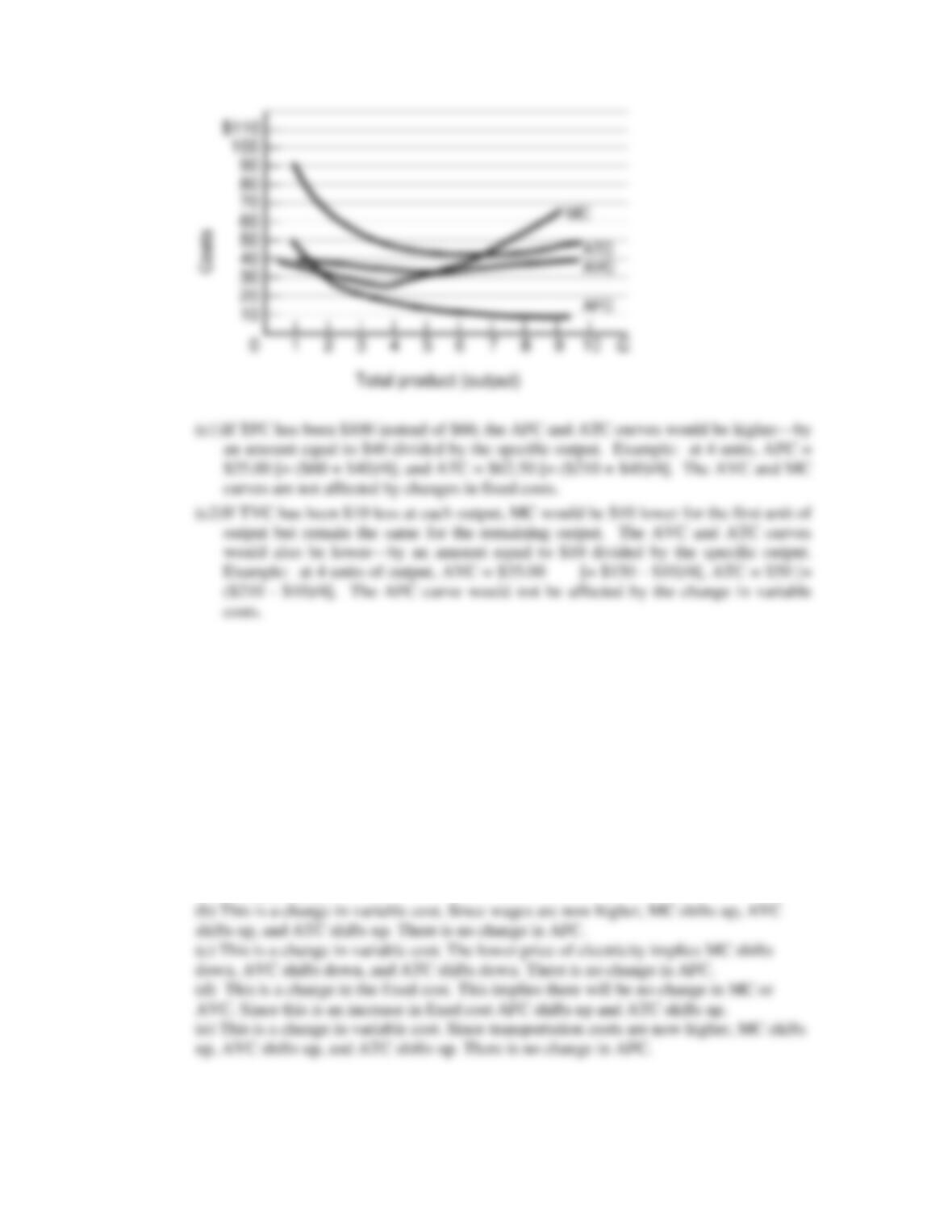
(a) See the graph below. Over the 0 to 4 range of output, the TVC and TC curves slope
upward at a decreasing rate because of increasing marginal returns. The slopes of the
curves then increase at an increasing rate as diminishing marginal returns occur.
Chapter 07 – Businesses and the Costs of Production
7-6
8. Indicate how each of the following would shift the (1) marginal-cost curve, (2) average-
variable-cost curve, (3) average-fixed-cost curve, and (4) average-total-cost curve of a
manufacturing firm. In each case specify the direction of the shift. LO3
a. A reduction in business property taxes.
b. An increase in the nominal wages of production workers.
c. A decrease in the price of electricity.
d. An increase in insurance rates on plant and equipment.
e. An increase in transportation costs.
Answer:
(a) This is a change in the fixed cost. This implies there will be no change in MC or
AVC. Since this is a decrease in fixed cost AFC shifts down and ATC shifts down (sum
of AVC and AFC).
Chapter 07 – Businesses and the Costs of Production
7-7
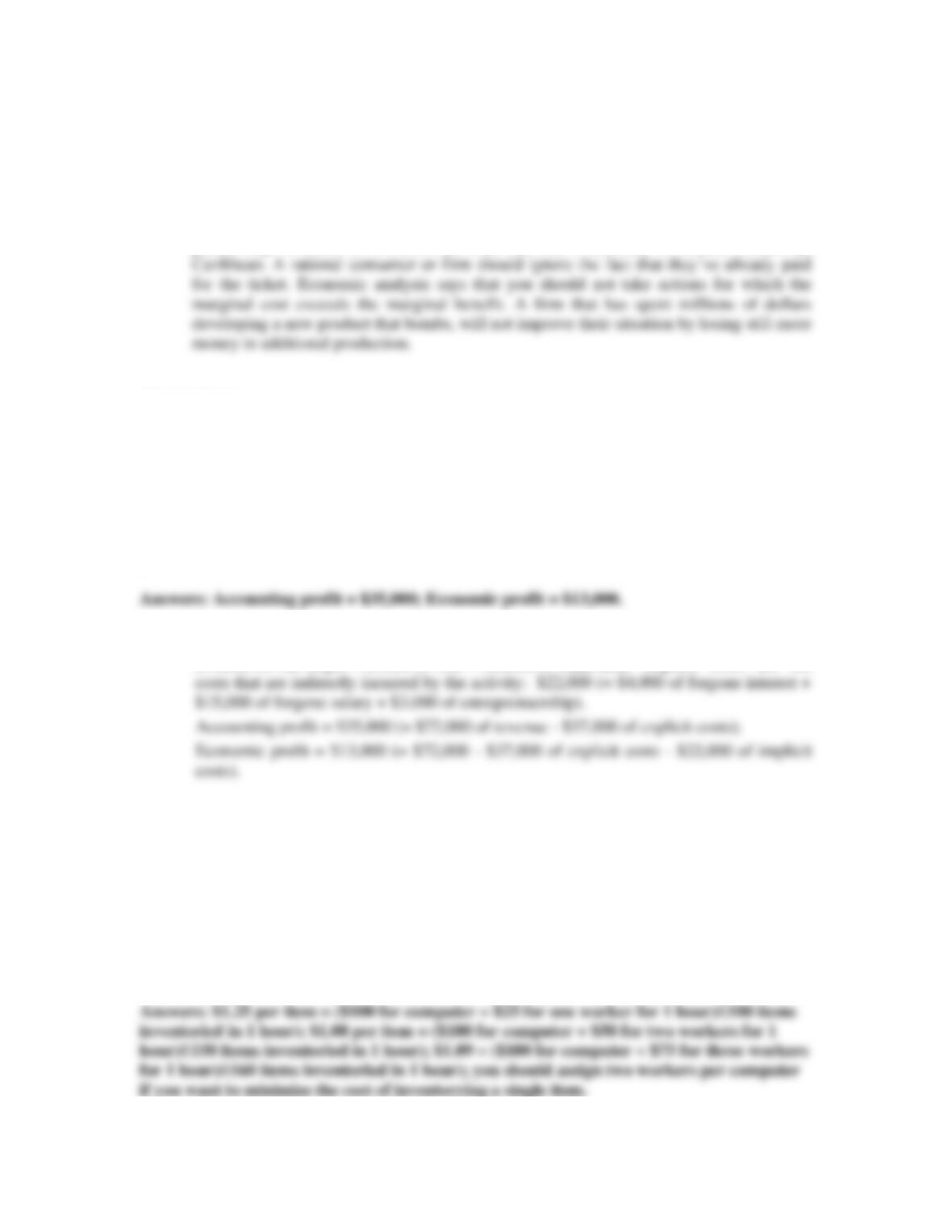
9. Suppose a firm has only three possible plant-size options, represented by the ATC curves
shown in the accompanying figure. What plant size will the firm choose in producing (a) 50, (b)
130, (c) 160, and (d) 250 units of output? Draw the firm’s long-run average-cost curve on the
diagram and describe this curve. LO4
Answer:
(a) To produce 50 units, the firm will choose plant size #1, since its ATC is lower for
this size firm in producing less than 80 units.
10. Use the concepts of economies and dis-economies of scale to explain the shape of a firm’s
long-run ATC curve. What is the concept of minimum efficient scale? What bearing can the
shape of the long-run ATC curve have on the structure of an industry? LO4
Answer: The long-run ATC curve is U-shaped. At first, long-run ATC falls as the firm
expands and realizes economies of scale from labor and managerial specialization and the
use of more efficient capital. The long-run ATC curve later turns upward when the
Chapter 07 – Businesses and the Costs of Production
7-8
11. LAST WORD What is a sunk cost? Provide an example of a sunk cost other than one from
this book. Why are such costs irrelevant in making decisions about future actions?
Answer: A sunk cost is one that cannot be partly or fully recouped by some choice. A
person buys a ticket for a cruise and finds out that a hurricane is headed toward the
PROBLEMS
1. Gomez runs a small pottery firm. He hires one helper at $12,000 per year, pays annual rent of
$5000 for his shop, and spends $20,000 per year on materials. He has $40,000 of his own funds
invested in equipment (pottery wheels, kilns, and so forth) that could earn him $4000 per year if
alternatively invested. He has been offered $15,000 per year to work as a potter for a competitor.
He estimates his entrepreneurial talents are worth $3000 per year. Total annual revenue from
pottery sales is $72,000. Calculate the accounting profit and the economic profit for Gomez’s
pottery firm. LO1
Feedback: Explicit costs are the direct costs incurred from production: $37,000 (=
$12,000 for the helper + $5,000 of rent + $20,000 of materials). Implicit costs are the
2. Imagine you have some workers and some hand-held computers that you can use to take
inventory at a warehouse. There are diminishing returns to taking inventory. If one worker uses
one computer, he can inventory 100 items per hour. Two workers can together inventory 150
items per hour. Three workers can together inventory 160 items per hour. And four or more
workers can together inventory fewer than 160 items per hour. Computers cost $100 each and you
must pay each worker $25 per hour. If you assign one worker per computer, what is the cost of
inventorying a single item with one worker? What if you assign two workers per computer?
Three? How many workers per computer should you assign if you wish to minimize the cost of
inventorying a single item? LO2
Chapter 07 – Businesses and the Costs of Production
7-9
Feedback: Consider the following example. If one worker uses one computer, he can
inventory 100 items per hour. Two workers can together inventory 150 items per hour.
Three workers can together inventory 160 items per hour. And four or more workers can
3. You are a newspaper publisher. You are in the middle of a one-year rental contract for your
factory that requires you to pay $500,000 per month, and you have contractual labor obligations
of $1 million per month that you can’t get out of. You also have a marginal printing cost of $.25
per paper as well as a marginal delivery cost of $.10 per paper. If sales fall by 20 percent from 1
million papers per month to 800,000 papers per month, what happens to the AFC per paper, the
MC per paper, and to the minimum amount that you must charge to break even on these costs?
LO3
Feedback: Consider the following example. You are in the middle of a one-year rental
contract for your factory that requires you to pay $500,000 per month, and you have
contractual labor obligations of $1 million per month that you can’t get out of. You also
have a marginal printing cost of $.25 per paper as well as a marginal delivery cost of $.10
Chapter 07 – Businesses and the Costs of Production
7-10
Now, since MC is constant (each unit of output costs MC to produce) , thus we have
MCxQ = Variable Cost (VC). Note this is variable cost (VC) because we do not have to
produce.
Now assuming sales fall by 20% to 800,000 papers sold, the new average fixed cost
(AFC) is $1.88. This equals the total fixed cost $1.5 million divided by the new number
of papers sold, 800,000 (=$1,500.000/800,000).
Thus, the AFC increases from $1.50 to $1.88 after the decrease in sales.
To break-even before the decline in sales, the company needed to charge enough to cover
the AFC, $1.50, and the average variable cost (AVC) of $0.35 (This is the sum of the
printing cost and delivery cost per paper). Thus, the company needed to charge $1.85 per
paper.
4. There are economies of scale in ranching, especially with regard to fencing land. Suppose that
barbed-wire fencing costs $10,000 per mile to set up. How much would it cost to fence a single
property whose area is one square mile if that property also happens to be perfectly square, with
sides that are each one-mile long? How much would it cost to fence exactly four such properties,
which together would contain four square miles of area? Now, consider how much it would cost
to fence in four square miles of ranch land if, instead, it comes as a single large square that is two–
miles long on each side. Which is more costly—fencing in the four, one-square-mile properties or
the single four-square-mile property? LO4
Feedback: Consider the following example: Barbed-wire fencing costs $10,000 per mile
to set up. How much would it cost to fence a single property whose area is one square
mile if that property also happens to be perfectly square, with sides that are each one-mile
long?

Chapter 07 – Businesses and the Costs of Production
7-11
How much would it cost to fence exactly four such properties, which together would
contain four square miles of area? The four squares below represent our 4 properties.
Each of these cost $40,000 to fence. Thus, the cost of fencing these four properties equals
$160,000 (= 4 x $40,000).
sides, so the total cost of fencing this area is $80,000 (= 4 x $20,000).