07 Case model 12/9/2018
PART D
N10
CPN % 10%
PART E
N10
CPN % 13%
N10
CPN % 7%
9/12/2022 17:15
This spreadsheet model is designed to be used in conjunction with the chapter’s integrated case and the
related PowerPoint slide presentation.
What is the value of a 10-year, $1,000 par value bond with a 10% annual coupon if its required return is
10%?
(2) What is the value of a 7% coupon bond with these characteristics? Would we now have a discount
or a premium bond?
Chapter 7. Bonds and Their Valuation
(1) What is the value of a 13% coupon bond that is otherwise identical to the bond described in part d?
Would we now have a discount or a premium bond?
Years
7% coupon
bond
13% coupon
bond
1$827.23 $1,000 $1,172.77
3$853.95 $1,000 $1,146.05
5$886.28 $1,000 $1,113.72
7$925.39 $1,000 $1,074.61
9$972.73 $1,000 $1,027.27
PART F
Annual coupon pmt $90 Expected return 10.91%
Current price $887 – Current yield 10.15%
(2) What are the total return, the current yield, and the capital gains yield for the discount bond?
Assume that it is held to maturity and the company does not default on it.
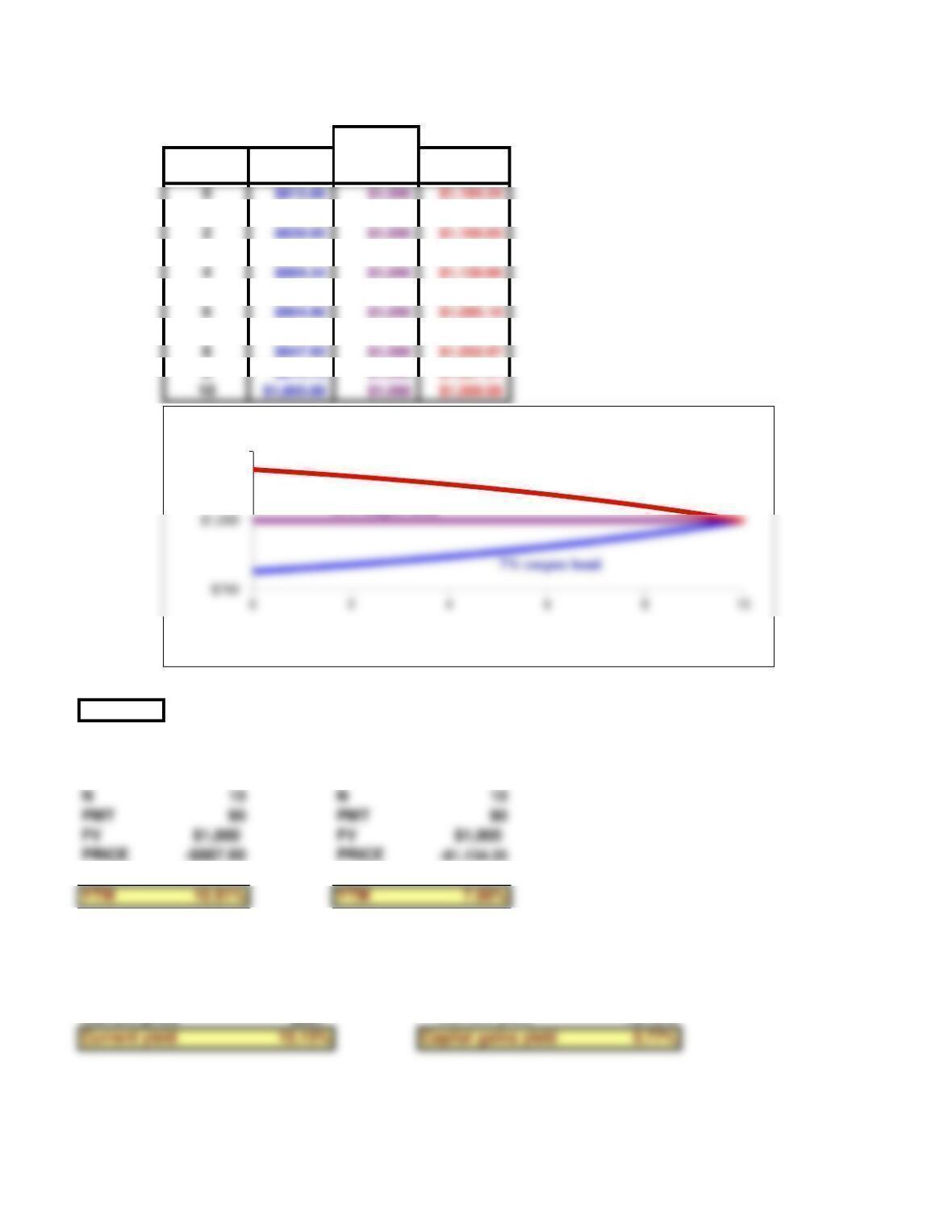
(3) What would happen to the values of the 7%, 10%, and 13% coupon bonds over time if the required
return remained at 10%?
(1) What is the yield to maturity on a 10-year, 9% annual coupon, $1,000 par value bond that sells for
$887.00? That sells for $1,134.20?
10% coupon
bond
$1,250
Value of bond
Years from issue
Changes in Bond Values Over Time
13% coupon bond
10% coupon bond
PART I
N10 Periods per year = 2
I/YR 13%
PART J
N10
I/YR 10.25%
How does the equation for valuing a bond change if semiannual payments are made? Find the value of
a 10-year, semiannual payment, 10% coupon bond if nominal rd = 13%.
Suppose for $1,000 you could buy a 10%, 10-year, annual payment bond or a 10%, 10-year, semiannual
payment bond. They are equally risky. Which would you prefer? If $1,000 is the proper price for the
semiannual bond, what is the equilibrium price for the annual payment bond?
Since the proper price of the semiannual bond is $1,000 and both bonds are equally risky, the EAR
should be used to find the value of the annual payment bond.
PART K
Years to maturity 10
Coupon rate 10%
Price $1,135.90
Nom YTM 8%
Suppose a 10-year, 10%, semiannual coupon bond with a par value of $1,000 is currently selling for
$1,135.90, producing a nominal yield to maturity of 8%. However, it can be called after 4 years for $1,050.
(1) What is the bond’s nominal yield to call (YTC)? (2) If you
bought this bond, would you be more likely to earn the YTM or the YTC?