36
4 Conclusion
In this chapter, we focused on a different type of trade than in previous chapters. Here,
we looked at the intermediate products used in production— not trade in final goods and
services. The Ricardian and Heckscher‒Ohlin models do not apply to intermediate
production goods and services. Instead, we had to focus on how production occurs
internationally, and this involves the issue of offshoring with some production processes
moved overseas. Offshoring implies that a final good may cross borders several times
before assemblage in a final location.
The model of trade presented here is a model that addresses offshoring. We assumed that
the primary reason for offshoring was to lower the costs of production by lowering
wages. Firms seek to move offshore the less skill-intensive processes that engage cheaper
labor.
What we found in this chapter is that the outcome of moving processes to countries
where the ratio of high-skilled to low-skilled labor is relatively cheaper resulted in
increasing the activities in the value chain. This led to an increase in the relative labor
demand for skilled workers in both countries and, as a result, increased their wages as
well.
The data in the 1980s were consistent with our predictions of an increase in the relative
demand for nonproduction or high-skilled workers, which was due to both the increase in
37
the use of high-skill base technology as well as offshoring.
The inconsistency in our model’s predictions in the 1990s, we argued, was due to job
polarization. Job polarization resulted in an increase in the relative wage, but a decrease
in the relative employment of nonproduction workers. It has also resulted in a decrease in
mid–level wage labor and an increase in the growth of high- and low-end wage labor. To
This chapter also provided visibility with real-world examples of how offshoring is
actually occurring in today’s global communities. India was used as an example of a
country that has implemented fiber-optic cables, with a sophisticated Internet and
Encourage your students to think about how all of this applies to them. What type of jobs
are they preparing for, and do their decisions match with what they have learned in this
chapter? How can they expect to thrive in a global economy given the lessons learned in

38
this chapter? What special skills, creative energies, and interests do they have that cannot
be replaced easily?
TEACHING TIPS
Tip 1: Pros and Cons of Offshoring
Offshoring is a hotly debated topic in the world today. As discussed in the Comments
portion of this Instructor’s Resource Manual, most of your students probably know
Tip 2: Relative Demand for Skilled Labor
Students often have trouble understanding how the relative demand for skilled labor can
increase in both countries as a result of trade in intermediate inputs. This concept is
essential to understanding the model of offshoring presented in Chapter 7. It may be
Tip 3: Data Analysis and Recent Trends in Service Trade
The growth in services trade discussed in this chapter has helped make professional

39
services a major component of U.S. GDP. In 2007, the professional services industry
accounted for 17 percent of GDP, and employment in this industry at 25 million has
Tip 4: Outsourcing and Globalization
After completing this chapter, have your students listen to the interview “Outsourcing
and Globalization” as a homework assignment
Overview and Summary of the Interview:
This interview covers many of the topics in this chapter and reviews all of the trade
models discussed so far in this course. And then spends the latter half of the interview

40
discussing the topic of “The Future of Offshoring and You”.
In the latter half of the interview the discussion moves to how globalization and trade
differs in the 21st century and how innovation is changing the landscape of trade. It
revolves around the types of innovations that occurred in the 20th century characterized
by the forklift and the types of innovation that is occurring in the 21st century
characterized by the microphone.

41
Human Capital must become specialized and flexible with new and uncommon skills in
order to retain job security. Those with a new kind of creative ability that might be
characterized with human understanding, wisdom, knowledge, creativity and experience
could be much more important in the new century. Those with limited skills that compete
with computers and whose jobs are characterized by mundane tasks that are easily
codifiable will not survive and competition from trade may indeed drive down these
wages and threaten job security for those individuals.
IN–CLASS PROBLEMS
1. What are the main differences between the offshoring phenomena in manufacturing
versus services?
Answer: Manufacturing involves low-skilled intensive labor, such as the assembly of

42
goods. Therefore, offshoring in manufacturing entails the movement of low-skilled
intensive activities overseas and occurs in countries with low-wage low-skilled labor. By
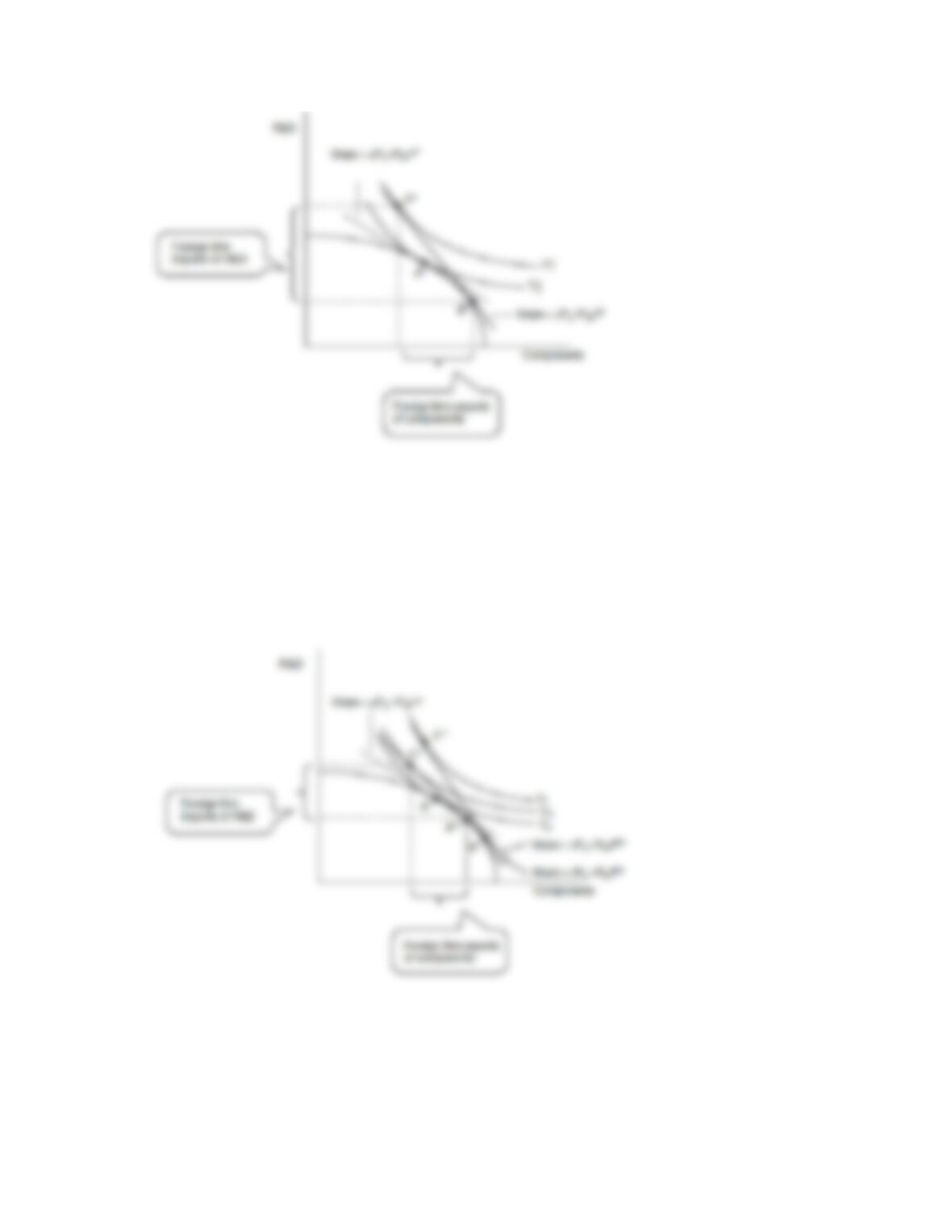
2. In a graph similar to Figure 7-12, illustrate the no-trade equilibrium, A*, for the
Foreign firm.
a. Supposing Foreign engages in international trade, add the world-relative price of
components to your graph. Indicate the Foreign firm’s resource allocation and production
of the final goods when it faces the new price line.
Answer: See the following figure, where the new equilibrium is B* and C*.
43
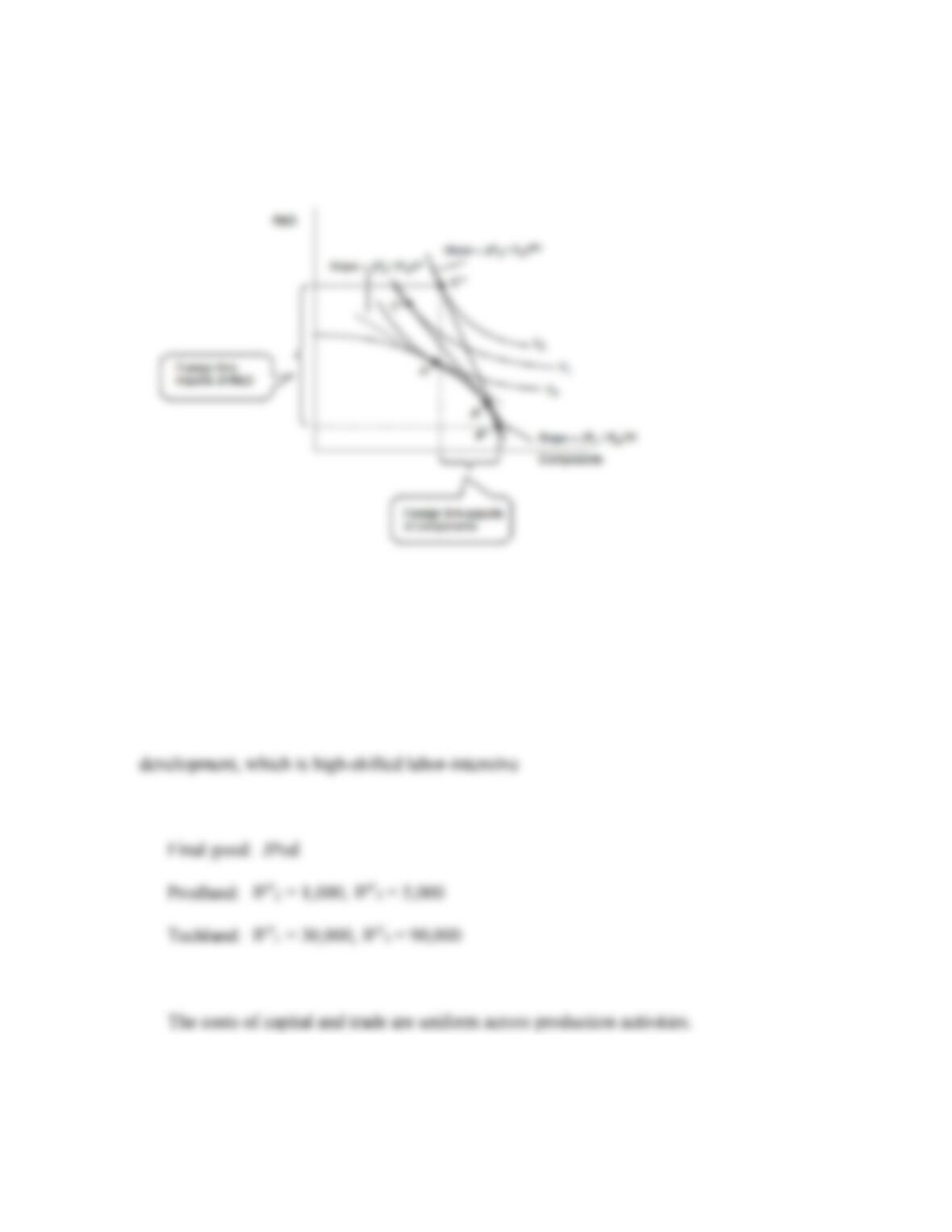
b. Illustrate the gains or losses faced by the firm relative to the initial offshoring
equilibrium, assuming a fall in the price of components.
Answer: See the following figure, where the new equilibrium is B*
′
and C*
′
.
3. Reproduce part (a) of Problem 2. Then illustrate the gains or losses faced by the firm
44
relative to the initial offshoring equilibrium, assuming a fall in the price of R&D.
Answer: See the following figure, where the new equilibrium is B*
′
and C*
′
.
4. Use the simplified offshoring model with two activities and the information below to
answer the following questions:
Two countries: Techland and Prodland
Two activities: Assembly, which is low-skilled labor-intensive, and product
45
a. Which country has the higher relative wage of low-skilled labor?
b. Suppose the two countries engage in trade. Which activity will Techland
outsource? Explain.
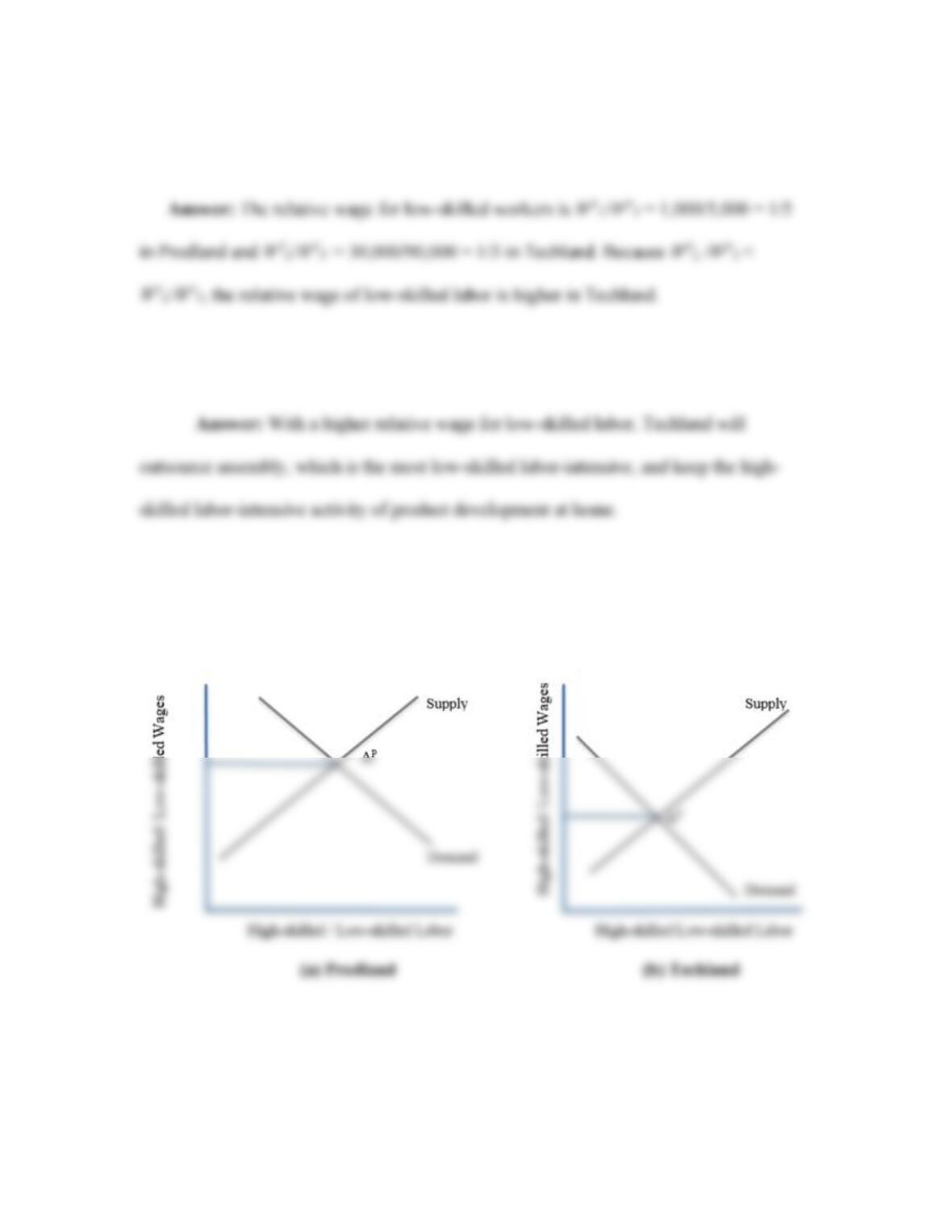
c. Draw relative labor supply and demand diagrams for Prodland and Techland on
separate graphs.
Answer: See the figures below.
d. Suppose the cost of capital in Prodland decreases. What do you expect will happen to

46
the relative wage in each country?
Answer: When the cost of capital declines in Prodland, it becomes more profitable
5. In 2005, there were 127 legislations proposed by 40 states to restrict offshoring. The
following table defining the proposed legislations derives from the National Foundation
for American Policy.
Proposed Legislation
Definition
SCB: State Contract Ban
Prohibit work on state contracts to be
performed overseas or by individuals not
authorized to work in the United States.

47
CCR: Call Center Restrictions
Require operators to identify their location in
some manner.
HDR: Health Care and/or Data
Transfer Restrictions
Ban or require an “opt-in” for data to be
processed outside of the United States.
TAR: Trade Agreement
Restriction
Require that state not be a party to international
trade agreements on procurement.
ISP: In–State Preference
Stipulate in–state preference for state contracts.
SAR: Development Assistance
Restrictions
Restrict development assistance for outsourcing
companies.
9DN: 90-Day Notice
Require 90-day notice for transferring 25% of
workforce.
LSW: Location of State Work
Mandate report on location of state work.
NO: Notification of Outsourcing
Mandate notification to worker of outsourcing.
OCF: Outsourcing
Compensation Fund
Require outsourcing compensation fund for
employees.
Given the list of proposed legislation by states below, identify the potential winners and
losers of the offshoring restrictions:
State
Proposed Legislation
State
Proposed Legislation
Alabama
HDR
Arizona
SCB, CCR
California
CCR, ISP
Colorado
SSB, HDR

48
Connecticut
SCB, CCR, HDR, HDR,
DAR, ISP, 9DN
Florida
CCR, HDR, LSW
Georgia
CCR
Hawaii
SCB, ISP, DAR
Idaho
SCB
Illinois
HDR, CCR
Indiana
SCB
Iowa
SCB, CCR
Kansas
CCR
Maine
SCB
Maryland
SCB, TAR
Massachusetts
SCB
Michigan
ISP
Minnesota
SCB, HDR, CCR
Mississippi
SCB, CCR
Missouri
SCB, CCR, ISP
Montana
SCB
Nebraska
SCB, HDR, ISP
Nevada
HDR
New Hampshire
SCB, DAR, ISP
New Jersey
SCB, CCR
New Mexico
HDR
New York
SCB, DAR, NO
North Carolina
NO
North
Dakota
SCB, ISP
Ohio
SCB, OCF
Oklahoma
SCB
Oregon
SCB, CCR, TAR
Pennsylvania
SCB
Rhode Island
SCB
South
Carolina
ISP
Texas
SCB, HDR
Utah
ISP
Virginia
SCB
Washington
SCB
West Virginia
CCR, SCB, DAR
Wisconsin
SCB

Data from: National Foundation for American Policy, 2006.
Answer: Potential winners would be those whose jobs are banned from being
6. What impacts will the offshoring restrictions in Problem 5 have on industry
competitiveness in the proposed states?
Answer: The competitiveness of the industry facing the offshoring restrictions in the
7. Referring to Problem 5, would the proposed legislation be as restrictive if the services
were outsourced to another state (domestic offshoring) rather than across international
borders (foreign offshoring)? Comment on the welfare of the states involved.
Answer: Offshoring to another state is likely to elicit a significantly less–restrictive
50
8. How does trade today differ from that in the past?
Answer: There is more trade today than in the past. In addition, between 1925 and
1950, two categories—(1) foods, feeds, and beverages and (2) industrial supplies and