Chapter 7
Stocks, Stock Valuation, and Stock Market Equilibrium
ANSWERS TO END-OF-CHAPTER QUESTIONS
7-1 a. A proxy is a document giving one person the authority to act for another, typically the
power to vote shares of common stock. If earnings are poor and stockholders are
dissatisfied, an outside group may solicit the proxies in an effort to overthrow
management and take control of the business, known as a proxy fight. The
preemptive right gives the current shareholders the right to purchase any new shares
a specified number of years.
b. Estimated value (
0
P
ˆ
) is the present value of the expected future cash flows. The
market price (P0) is the price at which an asset can be sold.
c. The required rate of return on common stock, denoted by rs, is the minimum
Answers and Solutions: 7 – 2
d. The capital gains yield results from changing prices and is calculated as (P1 – P0)/P0,
where P0 is the beginning-of-period price and P1 is the end-of-period price. For a
constant growth stock, the capital gains yield is g, the constant growth rate. The
dividend yield on a stock can be defined as either the end-of-period dividend divided
by the beginning-of-period price, or the ratio of the current dividend to the current
price. Valuation formulas use the former definition. The expected total return, or
expected rate of return, is the expected capital gains yield plus the expected dividend
yield on a stock. The expected total return on a bond is the yield to maturity.
f. Preferred stock is a hybrid—it is similar to bonds in some respects and to common
stock in other respects. Preferred dividends are similar to interest payments on bonds
in that they are fixed in amount and generally must be paid before common stock
dividends can be paid. If the preferred dividend is not earned, the directors can omit
it without throwing the company into bankruptcy. So, although preferred stock has a
fixed payment like bonds, a failure to make this payment will not lead to bankruptcy.
Most preferred stocks entitle their owners to regular fixed dividend payments.
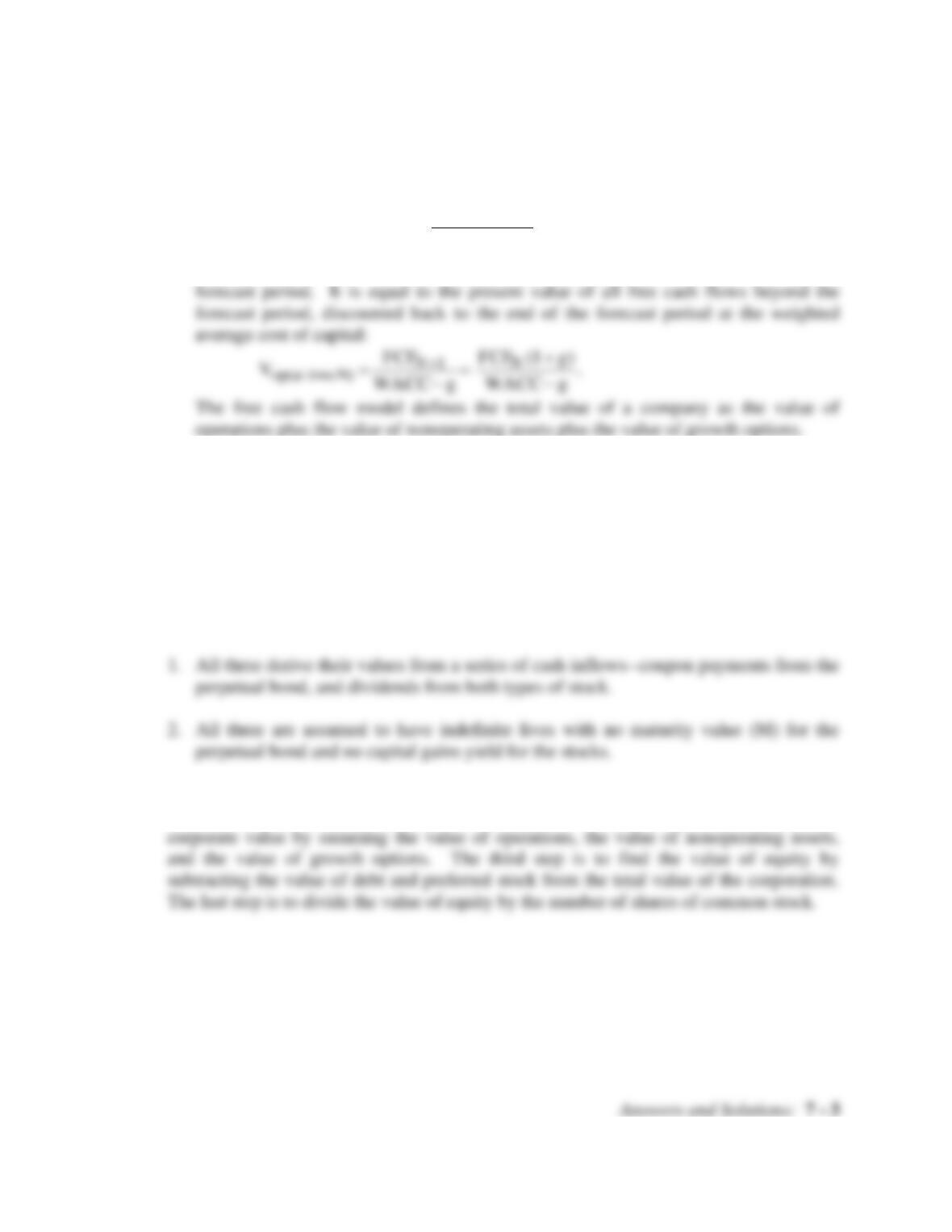
h. The value of operations is the present value of all the future free cash flows that are
expected from current assets-in-place and the expected growth of assets-in-place
when discounted at the weighted average cost of capital:
( )
.
WACC1
FCF
V
1t t
t
0)timeop(at
=+
=
The terminal, or horizon value, is the value of operations at the end of the explicit
7-2 True. The value of a share of stock is the PV of its expected future dividends. If the two
investors expect the same future dividend stream, and they agree on the stock’s riskiness,
then they should reach similar conclusions as to the stock’s value.
7-3 A perpetual bond is similar to a no-growth stock and to a share of preferred stock in the
following ways:
7-4 The first step is to find the value of operations by discounting all expected future free
cash flows at the weighted average cost of capital. The second step is to find the total
Answers and Solutions: 7 – 4
SOLUTIONS TO END-OF–CHAPTER PROBLEMS
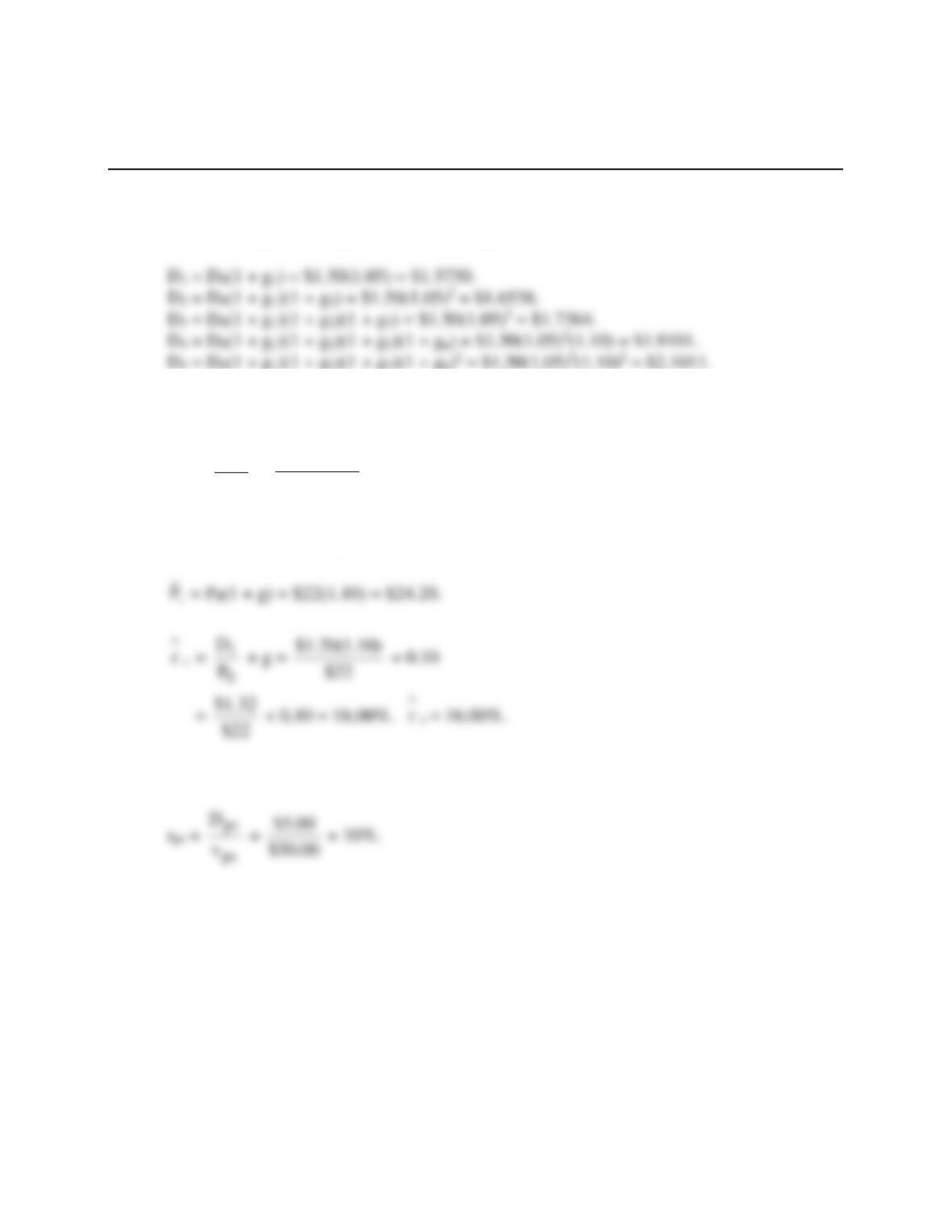
7-1 D0 = $1.50; g1-3 = 5%; gn = 10%; D1 through D5 = ?
7-2 D1 = $1.50; g = 6%; rs = 13%;
0
P
ˆ
= ?
0
P
ˆ
=
gr
D
s
1
−
=
06.013.0
50.1$
−
= $21.43.
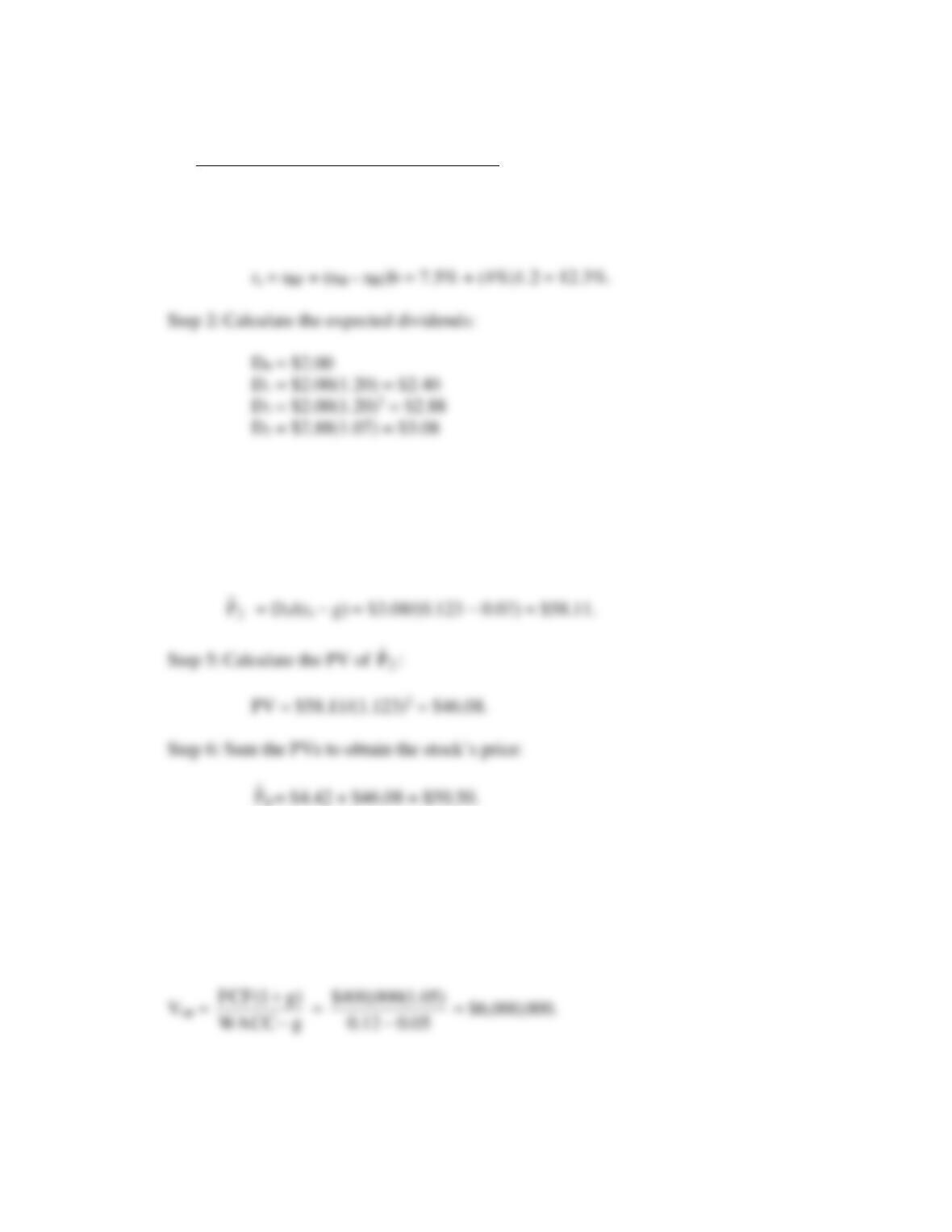
7-3 P0 = $22; D0 = $1.20; g = 10%;
1
P
ˆ
= ?;
r
s= ?
7-4 Dps = $5.00; Vps = $50; rps = ?
Answers and Solutions: 7 – 5
7-5 0 1 2 3
| | | |
D0 = 2.00 D1 D2 D3
2
P
ˆ
Step 1: Calculate the required rate of return on the stock:
Step 3: Calculate the PV of the expected dividends:
PVDiv = $2.40/(1.123) + $2.88/(1.123)2 = $2.14 + $2.28 = $4.42.
Step 4: Calculate
2
P
ˆ
2
P
ˆ
2
P
ˆ
:
0
Alternatively, using a financial calculator, input the following:
CF0 = 0, CF1 = 2.40, and CF2 = 60.99 (2.88 + 58.11) and then enter I/YR = 12.3 to solve
for NPV = $50.50.
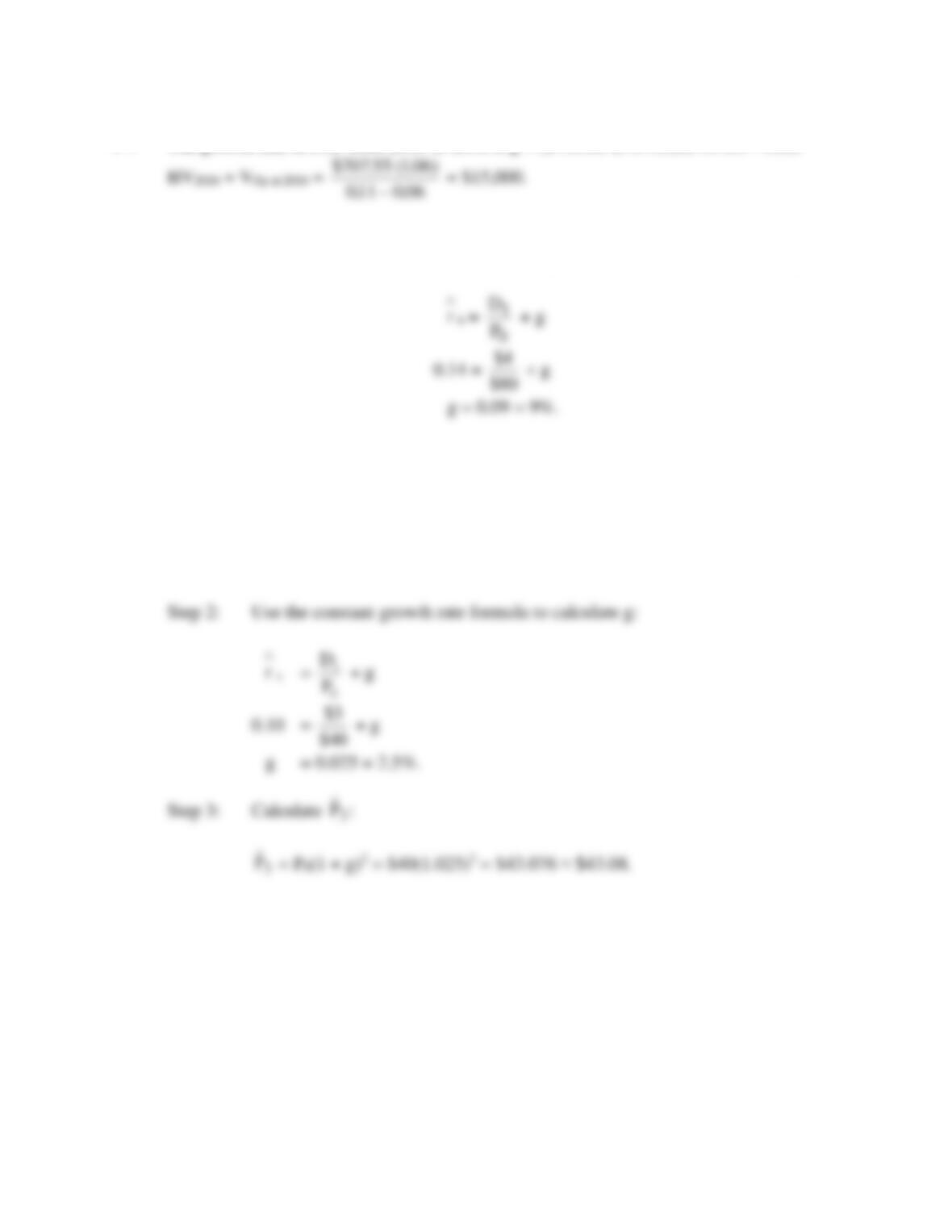
7-6 Value of operations = Vop = PV of expected future free cash flow
Answers and Solutions: 7 – 6
7-7 The growth rate in FCF from 2015 to 2016 is g = ($750.00-$707.55)/$707.50 = 0.06.
7-8 The problem asks you to determine the constant growth rate, given the following facts:
P0 = $80, D1 = $4, and rs = 14%. Use the constant growth rate formula to calculate g:
7-9 The problem asks you to determine the value of
3
P
ˆ
3
P
ˆ
3
P
ˆ
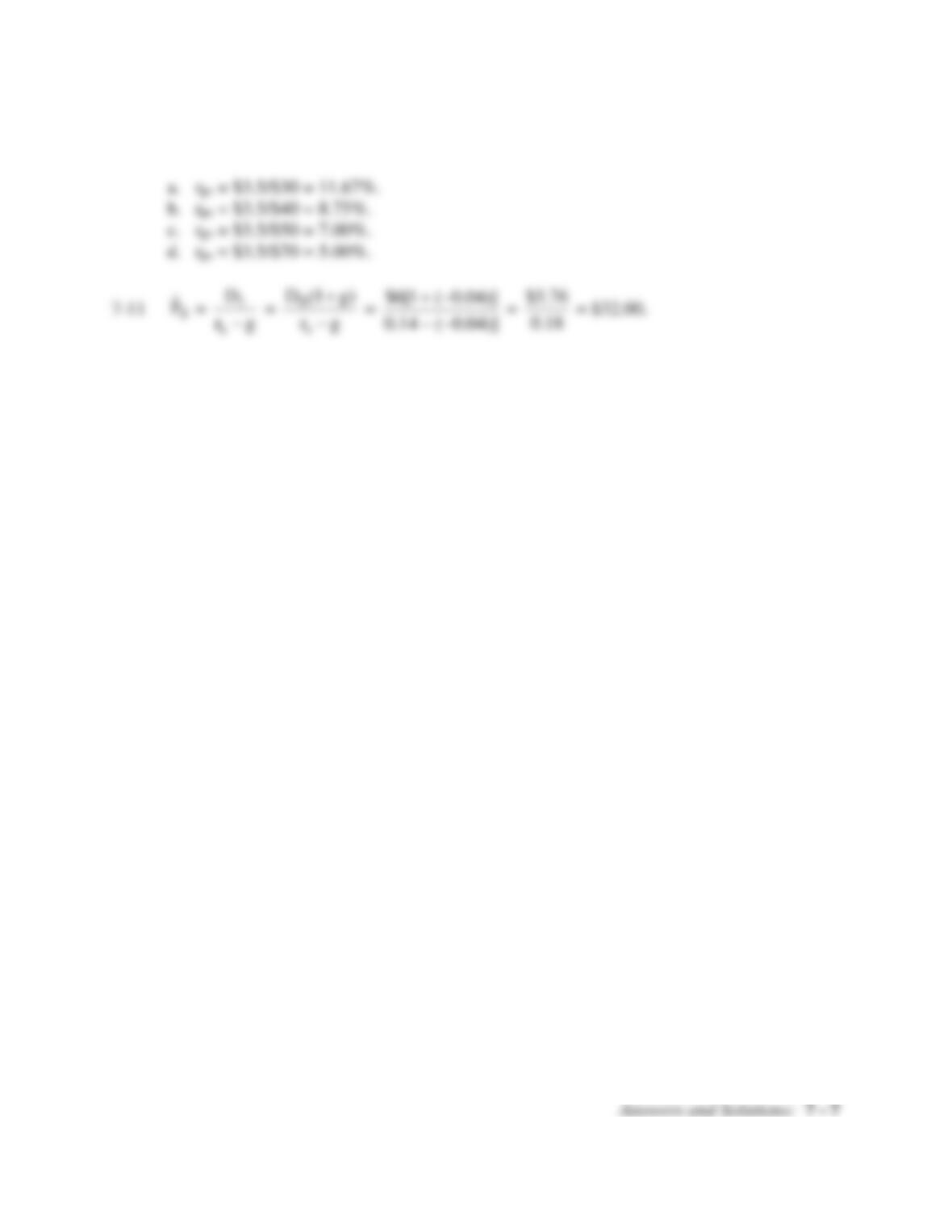
, given the following facts: D1 = $3, b
= 0.8, rRF = 5.2%, RPM = 6%, and P0 = $40. Proceed as follows:
Step 1: Calculate the required rate of return:
rs = rRF + (rM – rRF)b = 5.2% + (6%)0.8 = 10%.
Alternatively, you could calculate D4 and then use the constant growth rate formula to
solve for
3
P
ˆ
:
D4 = D1(1 + g)3 = $3.00(1.025)3 = $3.2307.
3
P
ˆ
= $3.2307/(0.10 – 0.025) = $43.0756 $43.08.
7-10 Vps = Dps/rps; therefore, rps = Dps/Vps.
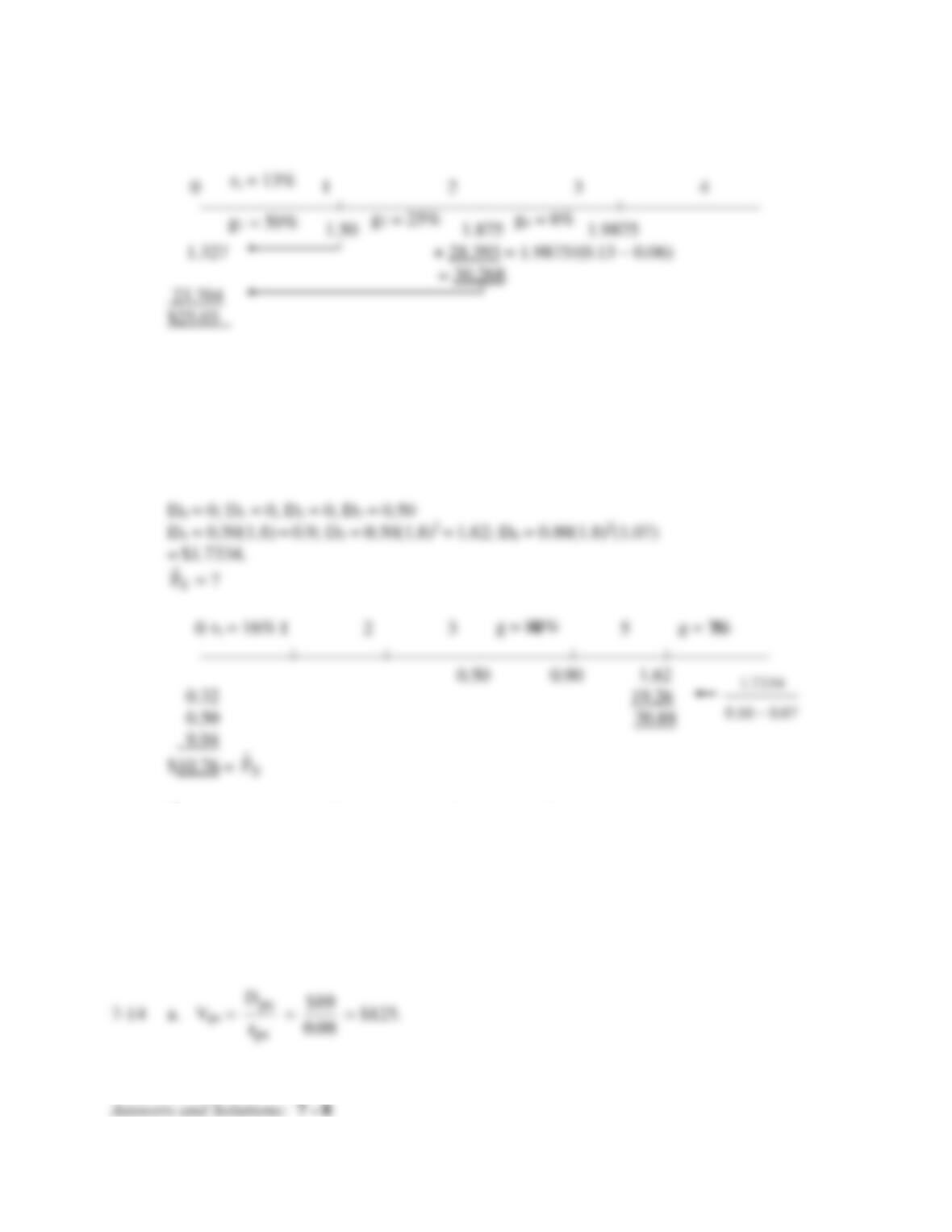
7-12 D0 = $1, rS = 7% + 6% = 13%, g1 = 50%, g2 = 25%, gn = 6%.
7-13 Calculate the dividend stream and place them on a time line. Also, calculate the price of
the stock at the end of the nonconstant growth period, and include it, along with the
dividend to be paid at t = 5, as CF5. Then, enter the cash flows as shown on the time line
into the cash flow register, enter the required rate of return as I = 15, and then find the
value of the stock using the NPV calculation. Be sure to enter CF0 = 0, or else your
answer will be incorrect.
5
P
ˆ
= D6/(rs – g) = 1.7334/(0.16 – 0.07) = 19.26. This is the price of the stock at the end
of Year 5.
CF0 = 0; CF1-2 = 0; CF3 = 0.5; CF4 = 0.9; CF5 = 20.88; I = 16%.
With these cash flows in the CFLO register, press NPV to get the value of the stock
today: NPV = $10.76.
Answers and Solutions: 7 – 9
b. Vps =
12.0
10$
= $83.33.
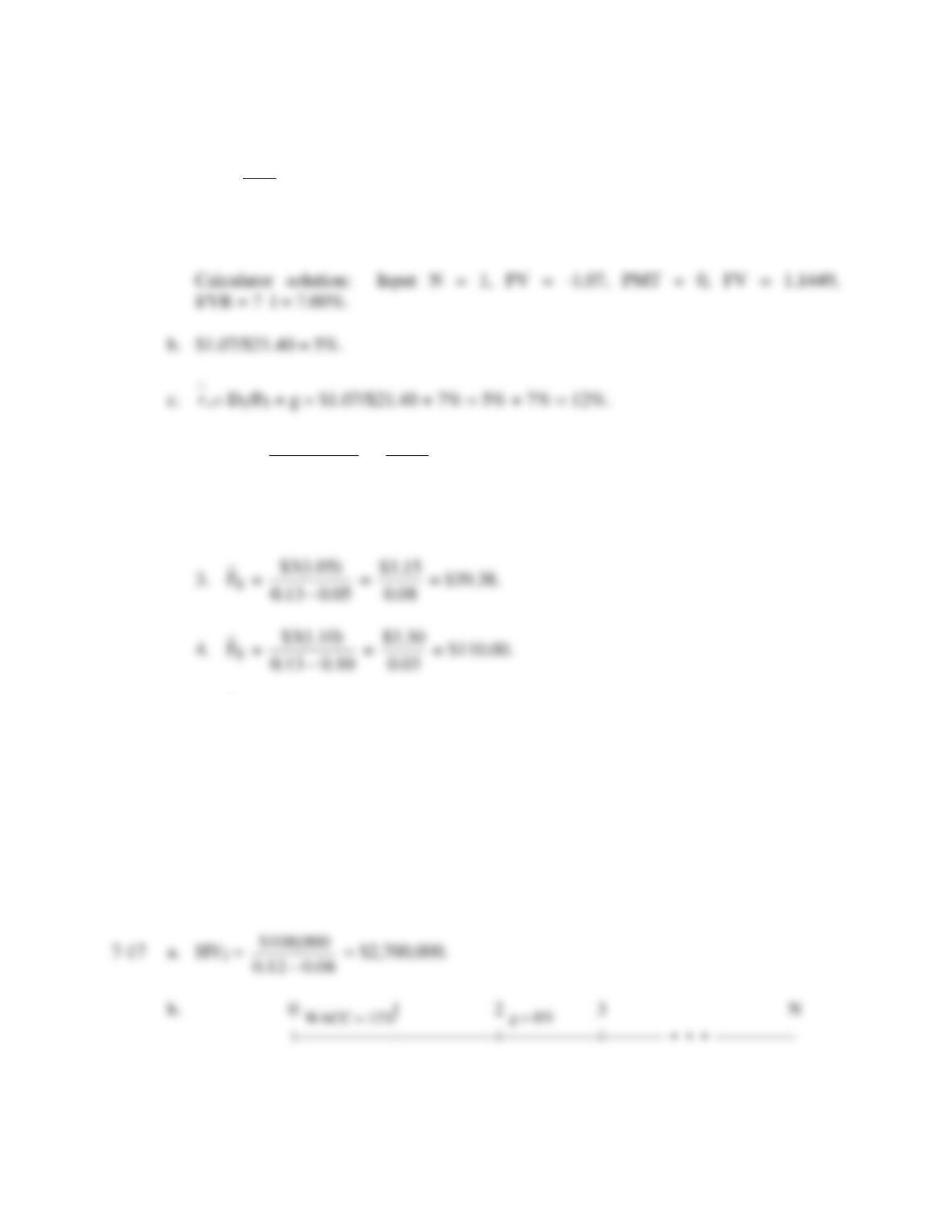
7-15 a. g = $1.1449/$1.07 – 1.0 = 7%.
Calculator solution: Input N = 1, PV = -1.07, PMT = 0, FV = 1.1449,
7-16 a. 1.
0
P
ˆ
=
05.013.0
)05.01(3$
+
−
=
18.0
85.2$
= $15.83.
2.
0
P
ˆ
0
P
ˆ
08.0
15.3$
0
P
ˆ
03.0
30.3$
= $3/0.13 = $23.08.
b. 1.
0
P
ˆ
= $3.39/0 = Undefined.
2.
0
P
ˆ
= $3.45/(-0.02) = -$172.5, which is nonsense.
These results show that the formula does not make sense if the required rate of return
is equal to or less than the expected growth rate.
c. No.
Answers and Solutions: 7 – 10
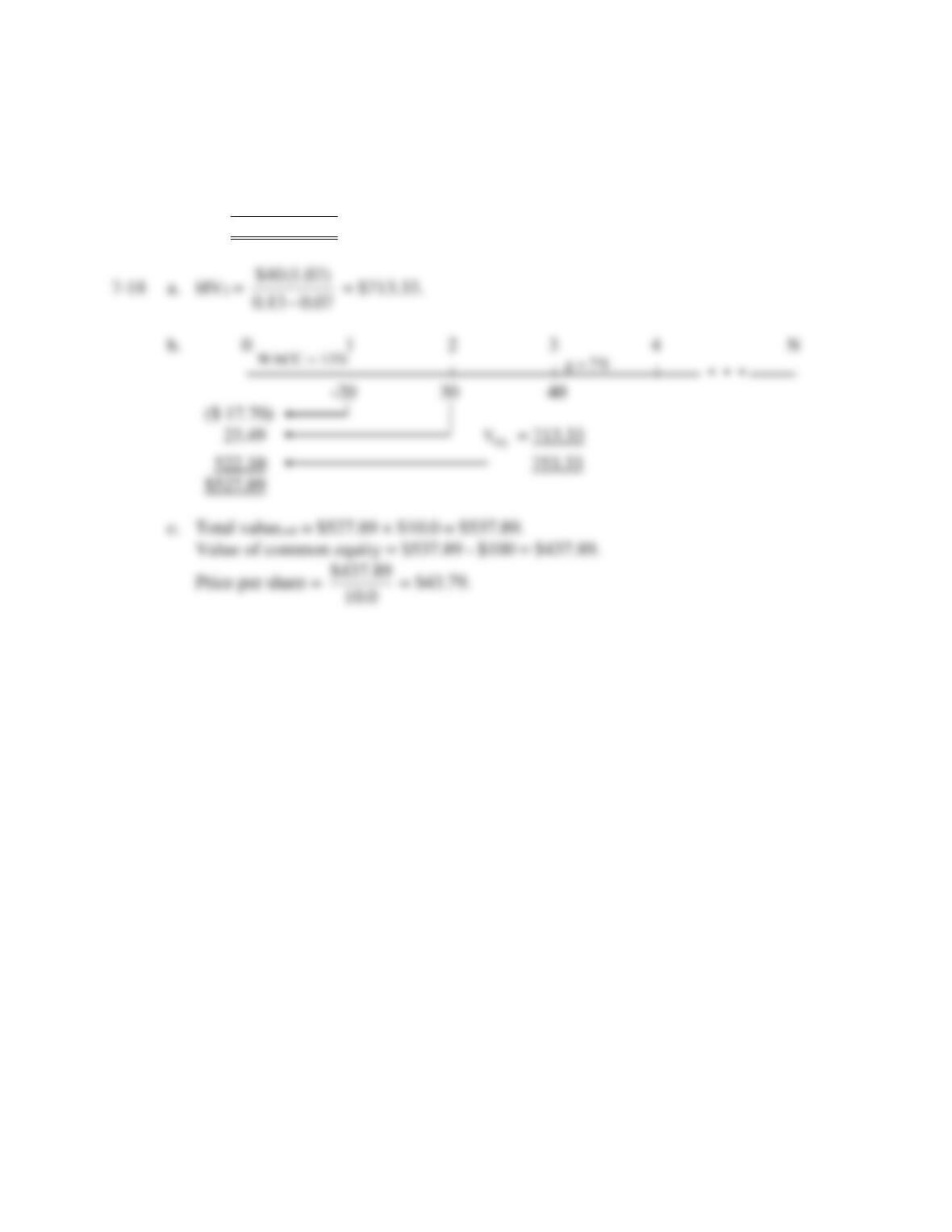
$80,000 $100,000 $108,000
$ 71,428.57
79,719.39
2,152,423.47
$2,303,571.43
7-19 0 g=6% 1 2 3 4
| | | | |
D0 = 1.50 D1 D2 D3 D4
3
P
ˆ
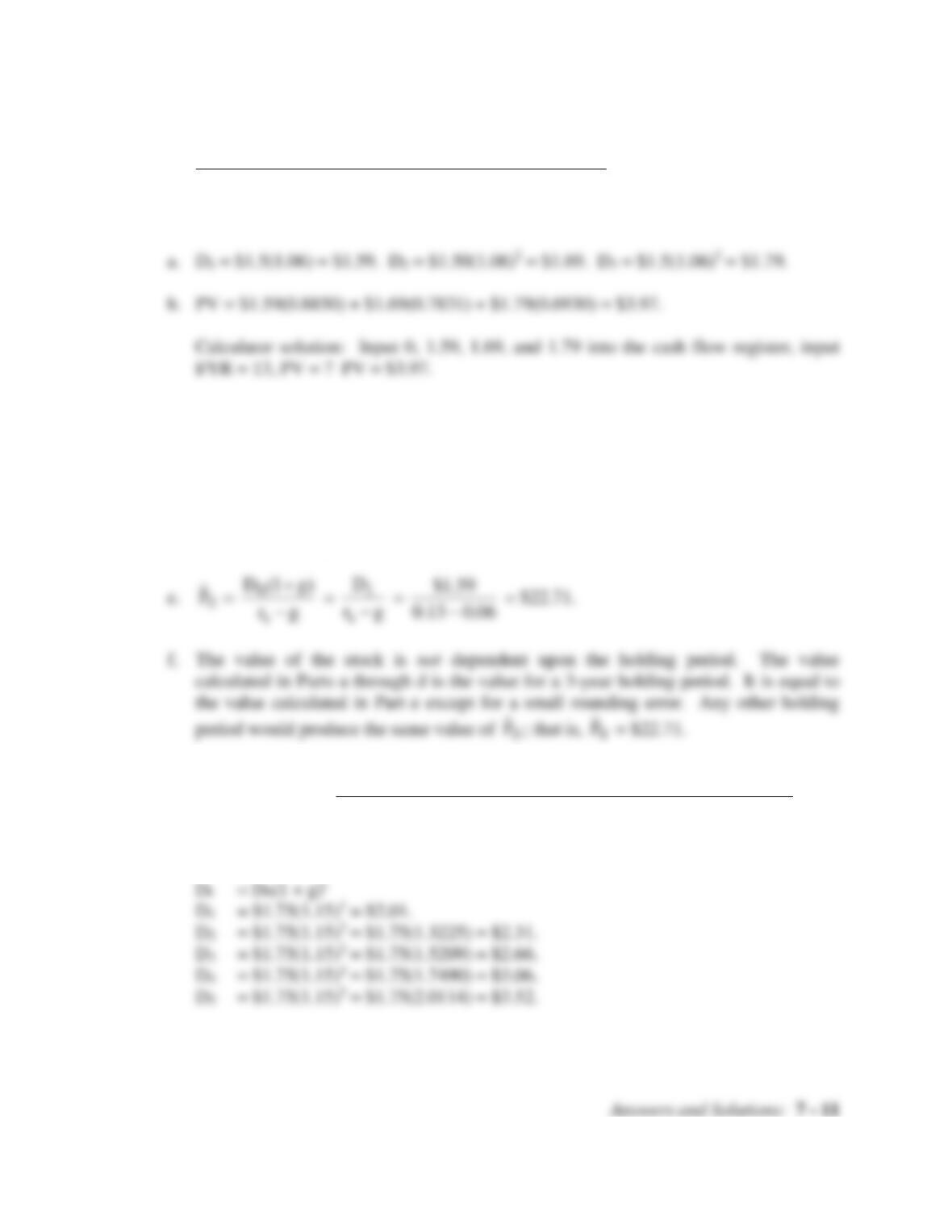
c. $27.05(0.6930) = $18.74.
Calculator solution: Input 0, 0, 0, and 27.05 into the cash flow register, I/YR = 13,
PV = ? PV = $18.74.
d. $18.74 + $3.97 = $22.71 = Maximum price you should pay for the stock. (rounding
differences may give you $22.72.)
7-20 a. End of Year: 0 1 2 3 4 5 6
| | | | | | |
D0 = 1.75 D1
D2 D3 D4 D5 D6
r = 12%
g = 5%
g = 15%
b. Step 1
PV of dividends =
=+
5
1t t
s
t
)r1(
D
.
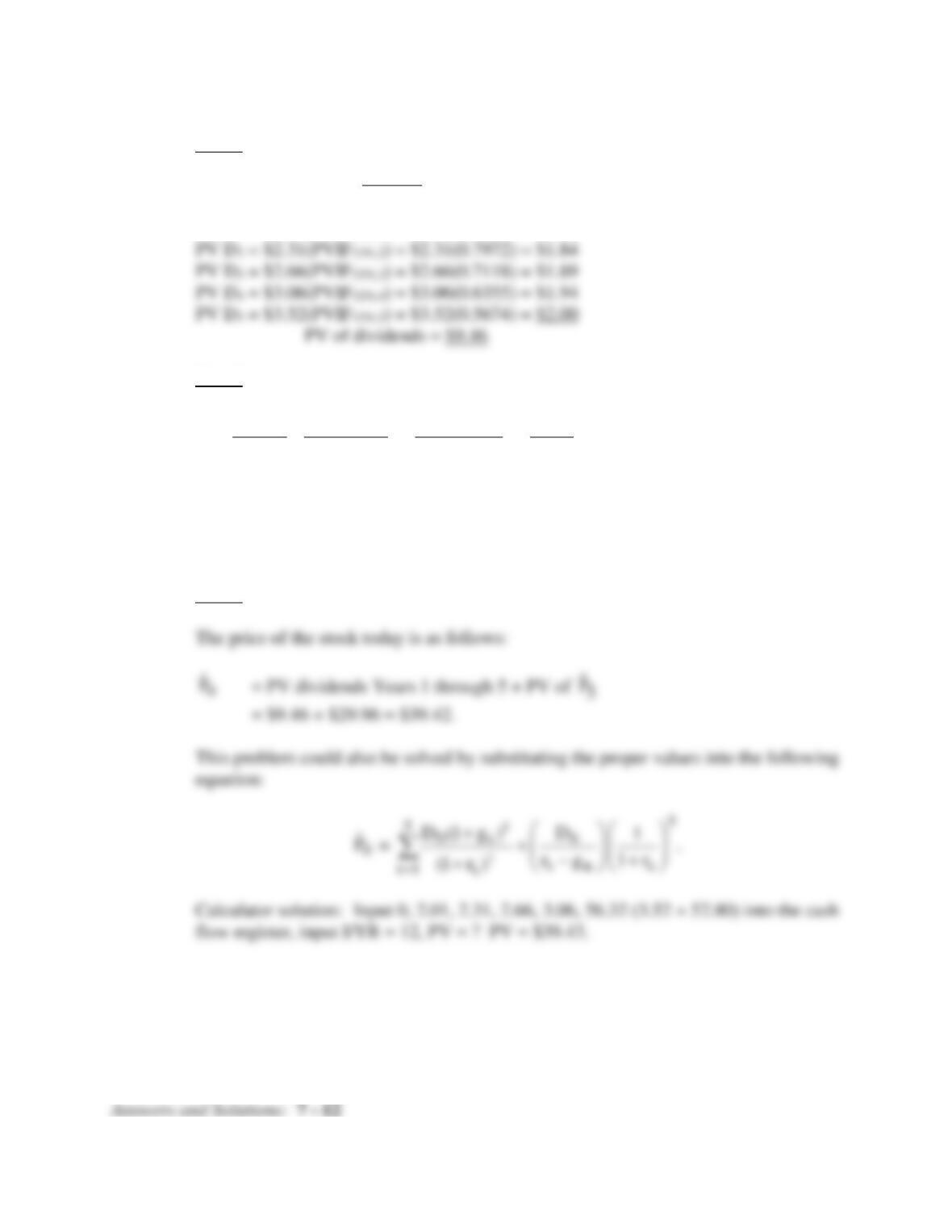
PV D1 = $2.01(PVIF12%,1) = $2.01(0.8929) = $1.79
ns
)n5
ns
6
5gr
g1(D
gr
D
P
ˆ−
+
=
−
=
=
05.012.0
)05.1(52.3$
−
=
07.0
70.3$
= $52.80.
This is the price of the stock 5 years from now. The PV of this price, discounted back
5 years, is as follows:
PV of
5
P
ˆ
= $52.80(PVIF12%,5) = $52.80(0.5674) = $29.96.
Step 3
Answers and Solutions: 7 – 13
c. First Year (t = 0)
D1/P0 = $2.01/$39.42 = 5.10%
Capital gains yield = 6.90%
Expected total return = 12.00%
The main points to note here are as follows:
1. The total yield is always 12% (except for rounding errors).
2. The capital gains yield starts relatively high, then declines as the nonconstant
growth period approaches its end. The dividend yield rises.
7-21 a. Part 1. Graphical representation of the problem:
Nonconstant Normal
growth growth
0 1 2 3 ∞
| | | | |
D0 D1 (D2 +
2
P
ˆ
2
P
ˆ
2
P
ˆ
) D3 D∞
PVD1
0
P
ˆ
= PV(D1) + PV(D2) + PV(
2
P
ˆ
)
=
2
2
2
2
s
1
)r1(
P
ˆ
)r1(
D
)r1(
D
+
+
+
+
+
Answers and Solutions: 7 – 15
Part 2.
Expected dividend yield: D1/P0 = $3.25/$78.35 = 4.15%.
Calculator solution: Input 0, 94.64 (4.225 + 90.415) into the cash flow register, input
I/YR = 12, PV = ? PV = $84.50.
Second, find the capital gains yield:
0
01P
PP
ˆ−
=
35.78$
35.78$50.84$−
= 7.85%.
b. Due to the longer period of supernormal growth, the value of the stock will be higher
for each year. Although the total return will remain the same, rs = 12%, the
distribution between dividend yield and capital gains yield will differ: The dividend
yield will start off lower and the capital gains yield will start off higher for the 5-year
nonconstant growth condition, relative to the 2-year nonconstant growth state. The
dividend yield will increase and the capital gains yield will decline over the 5-year
period until dividend yield = 5% and capital gains yield = 7%.
Answers and Solutions: 7 – 16
d. Some investors need cash dividends (retired people) while others would prefer
growth. Also, investors must pay taxes each year on the dividends received during
the year, while taxes on capital gains can be delayed until the gain is actually realized.
Answers and Solutions: 7 – 17
SOLUTION TO SPREADSHEET PROBLEM
7-22 The detailed solution for the spreadsheet problem, Ch07 P22 Build a Model Solution.xls,
is available at the textbook’s Web site.
Mini Case: 7 – 18
MINI CASE
Sam Strother and Shawna Tibbs are senior vice presidents of the Mutual of Seattle. They
are co-directors of the company’s pension fund management division, with Strother having
responsibility for fixed income securities (primarily bonds) and Tibbs being responsible for
equity investments. A major new client, the Northwestern Municipal League, has
requested that Mutual of Seattle present an investment seminar to the mayors of the cities
in the association, and Strother and Tibbs, who will make the actual presentation, have
asked you to help them.
To illustrate the common stock valuation process, Strother and Tibbs have asked you to
analyze the Temp Force Company, an employment agency that supplies word processor
operators and computer programmers to businesses with temporarily heavy workloads.
You are to answer the following questions.
a. Describe briefly the legal rights and privileges of common stockholders.
Answer: The common stockholders are the owners of a corporation, and as such, they have
certain rights and privileges as described below.
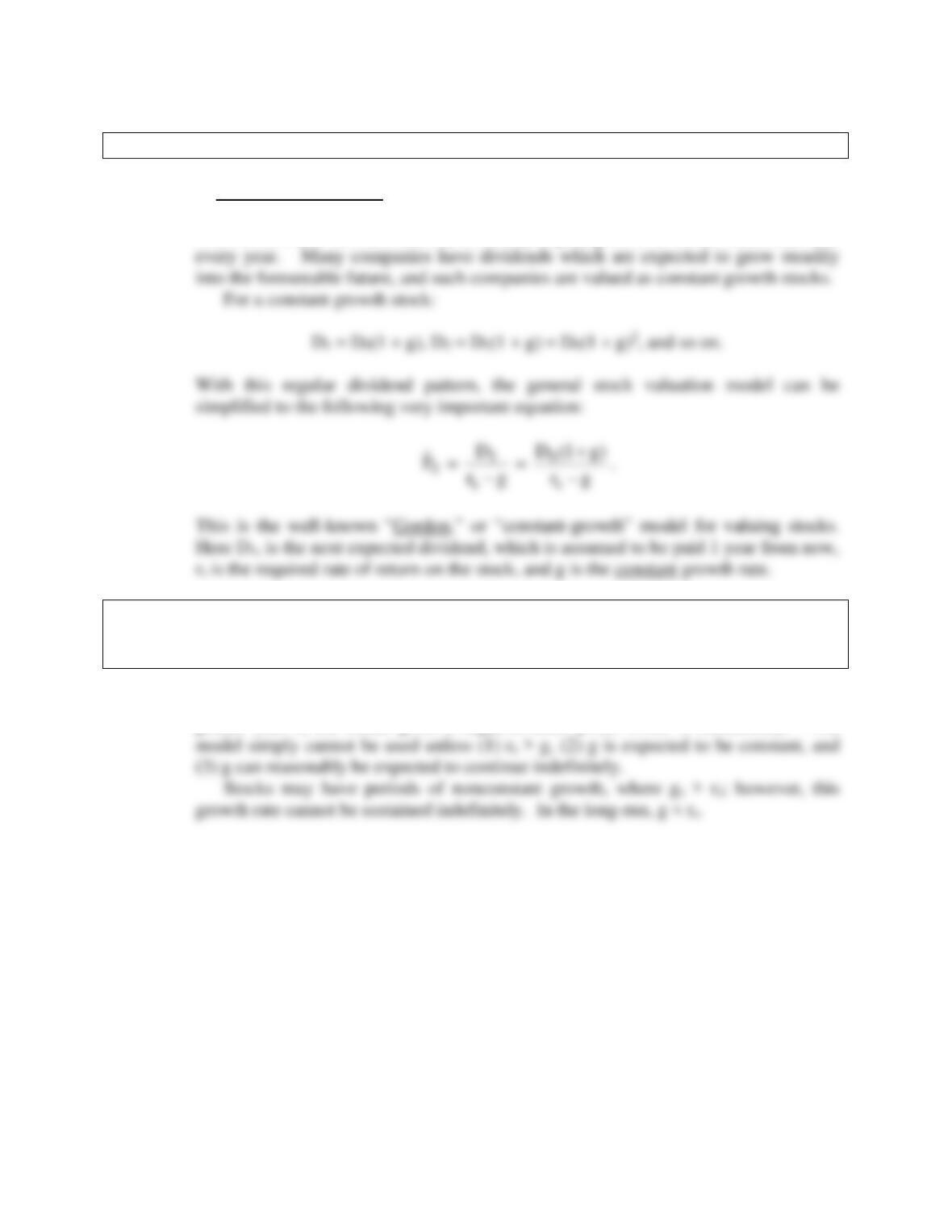
b. 1. Write out a formula that can be used to value any stock, regardless of its
dividend pattern.
Answer: The value of any stock is the present value of its expected dividend stream:
Mini Case: 7 – 19
b. 2. What is a constant growth stock? How are constant growth stocks valued?
Answer: A constant growth stock is one whose dividends are expected to grow at a constant
rate forever. “Constant growth” means that the best estimate of the future growth rate
is some constant number, not that we really expect growth to be the same each and
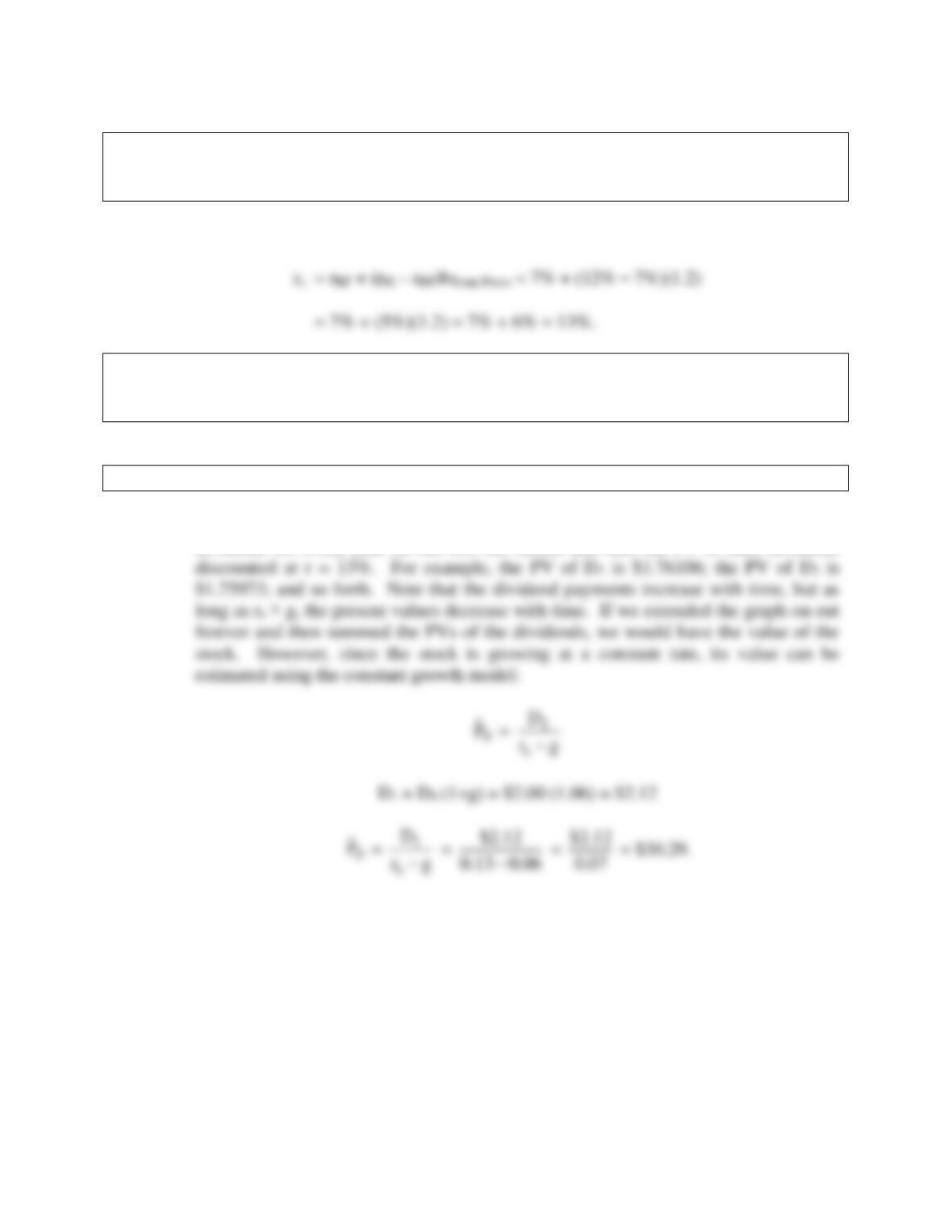
b. 3. What happens if a company has a constant g that exceeds its rs? Will many
stocks have expected g > rs in the short run (i.e., for the next few years)? In the
long run (i.e., forever)?
Answer: The model is derived mathematically, and the derivation requires that rs > g. If g is
greater than rs, the model gives a negative stock price, which is nonsensical. The
Mini Case: 7 – 20
c. Assume that Temp Force has a beta coefficient of 1.2, that the risk-free rate (the
yield on T-bonds) is 7%, and that the market risk premium is 5%. What is the
required rate of return on the firm’s stock?
Answer: Here we use the SML to calculate temp force’s required rate of return:
d. Assume that Temp Force is a constant growth company whose last dividend (D0,
which was paid yesterday) was $2.00 and whose dividend is expected to grow
indefinitely at a 6% rate.
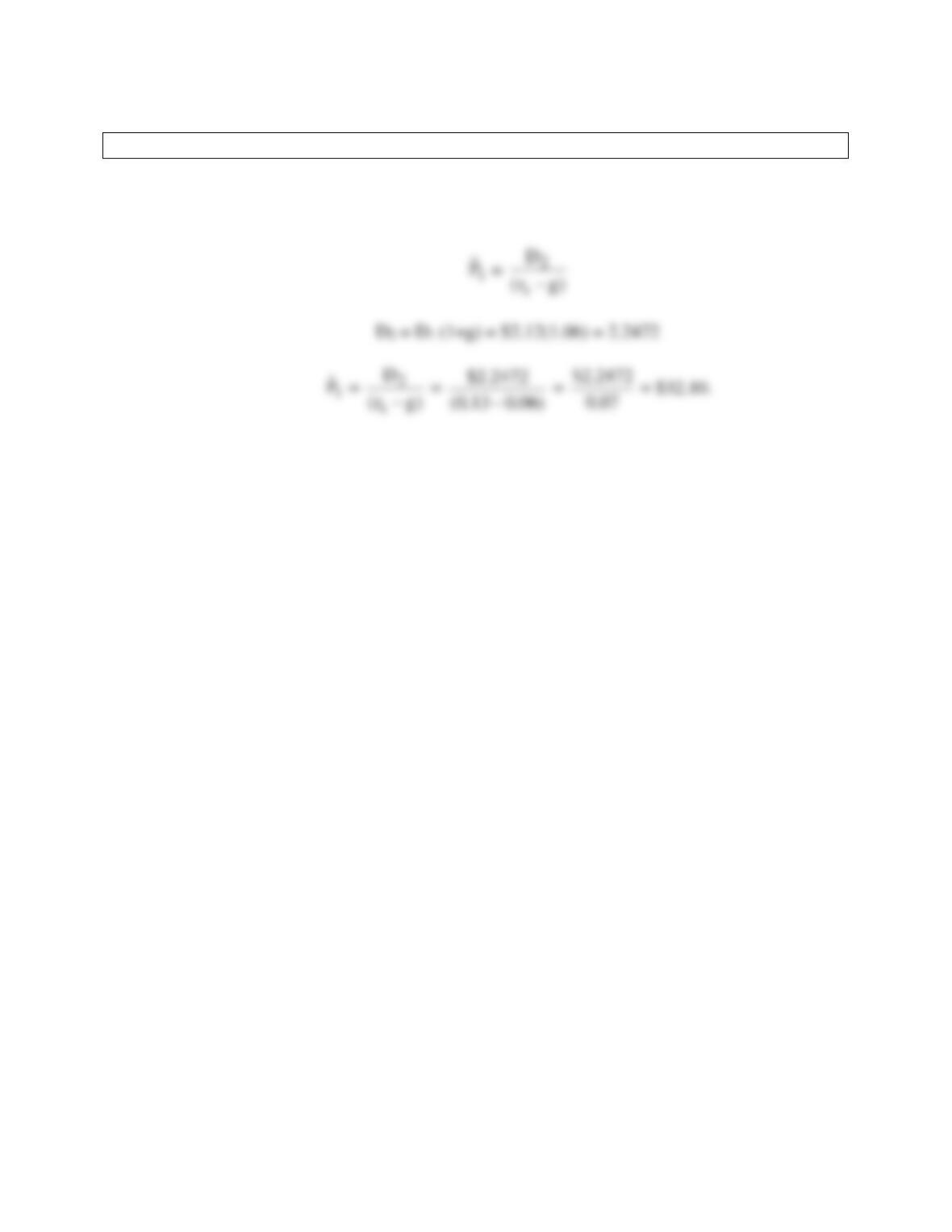
d. 1. What is the firm’s current stock price?
Answer: We could extend the time line on out forever, find the value of Temp Force’s
dividends for every year on out into the future, and then the PV of each dividend,
Mini Case: 7 – 21
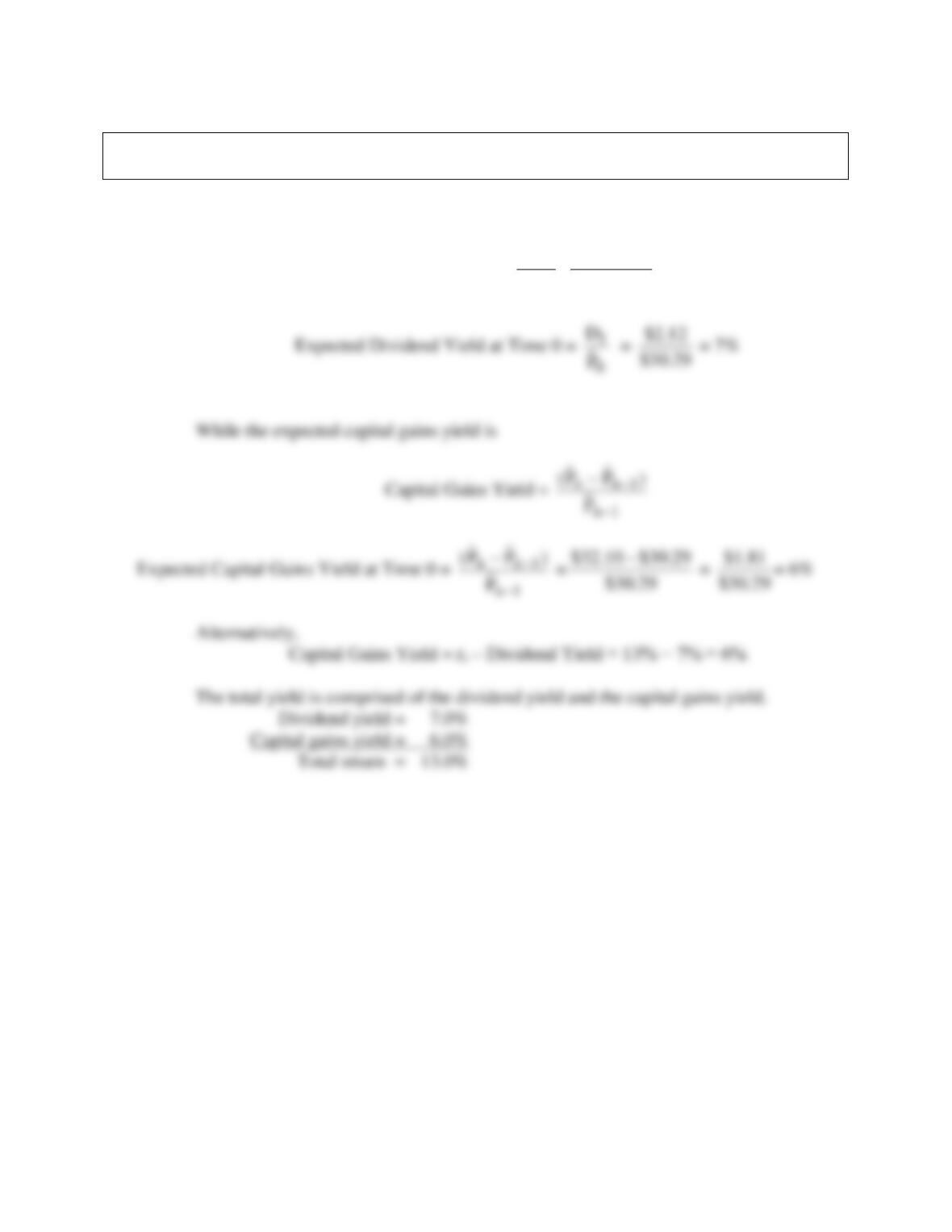
d. 2. What is the stock’s expected value one year from now?
Answer: After one year, D1 will have been paid, so the expected dividend stream will then be
D2, D3, D4, and so on. Thus, the expected value one year from now is $32.10:
Mini Case: 7 – 22
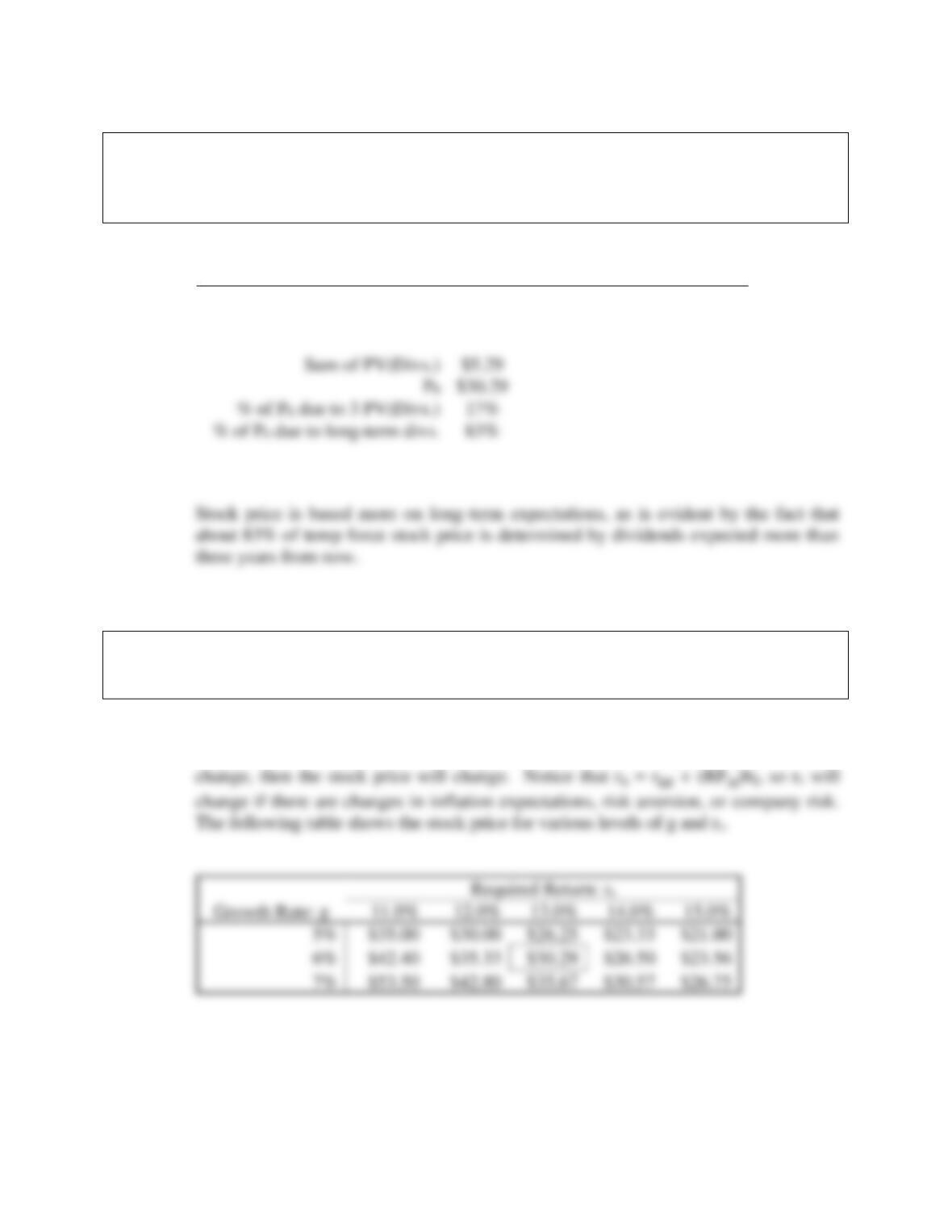
d. 3. What are the expected dividend yield, the capital gains yield, and the total
return during the first year?
Answer: The expected dividend yield in any year n is
Dividend Yield =
1n
n
P
ˆ
D
−
06.013.0
12.2$
−
Mini Case: 7 – 23
e. Suppose Temp Force’s stock price is selling for $30.29. Is the stock price based
more on long-term or short-term expectations? Answer this by finding the
percentage of Temp Force’s current stock price that is based on dividends
expected during Years 1, 2, and 3.
Answer:
Year (t)
0
1
2
3
Dt = D0 (1+g)t
$2.1200
$2.2472
$2.3820
PV(Dt) = Dt/(1+rs)t
$1.8761
$1.7599
$1.6509
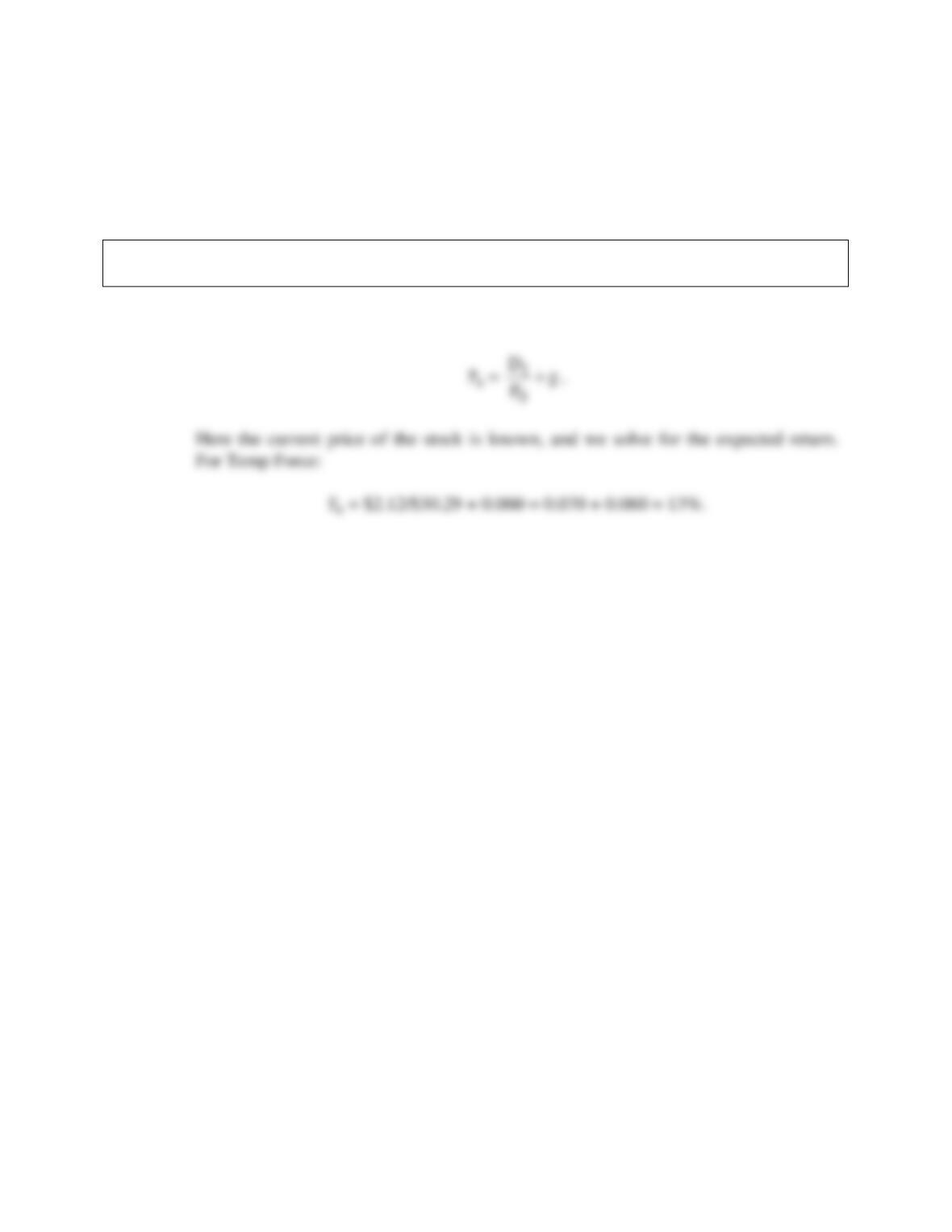
f. Why are stock prices volatile? Using Temp Force as an example, what is the
impact on the estimated stock price if g falls to 5% or rises to 7%? If rs changes
to 12%% or to 14%?
Answer: Using the constant growth model, the price of a stock is P0 = D1 / (rs – g). If estimates
of g change, then the price will change. If estimates of the required return on stock
Mini Case: 7 – 24
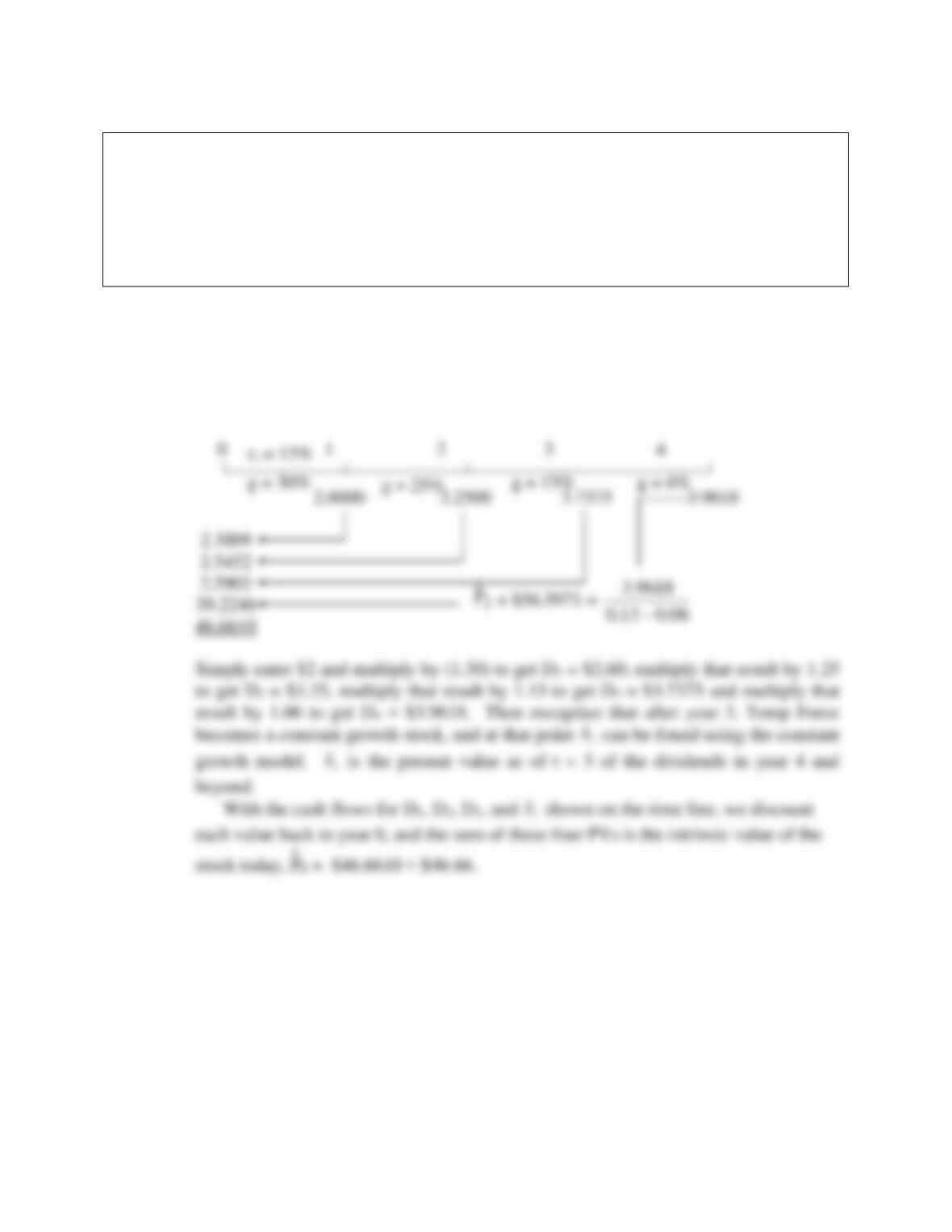
g. Now assume that the stock is currently selling at $30.29. What is its expected
rate of return?
Answer: The constant growth model can be rearranged to this form:
Mini Case: 7 – 25
h. Now assume that Temp Force’s dividend is expected to experience nonconstant
growth of 30% from Year 0 to Year 1, 20% from Year 1 to Year 2, and 10%
from Year 2 to Year 3. After Year 3, dividends will grow at a constant rate of
6%. What is the stock’s intrinsic value under these conditions? What are the
expected dividend yield and capital gains yield during the first year? What are
the expected dividend yield and capital gains yield during the fourth year (from
Year 3 to Year 4)?
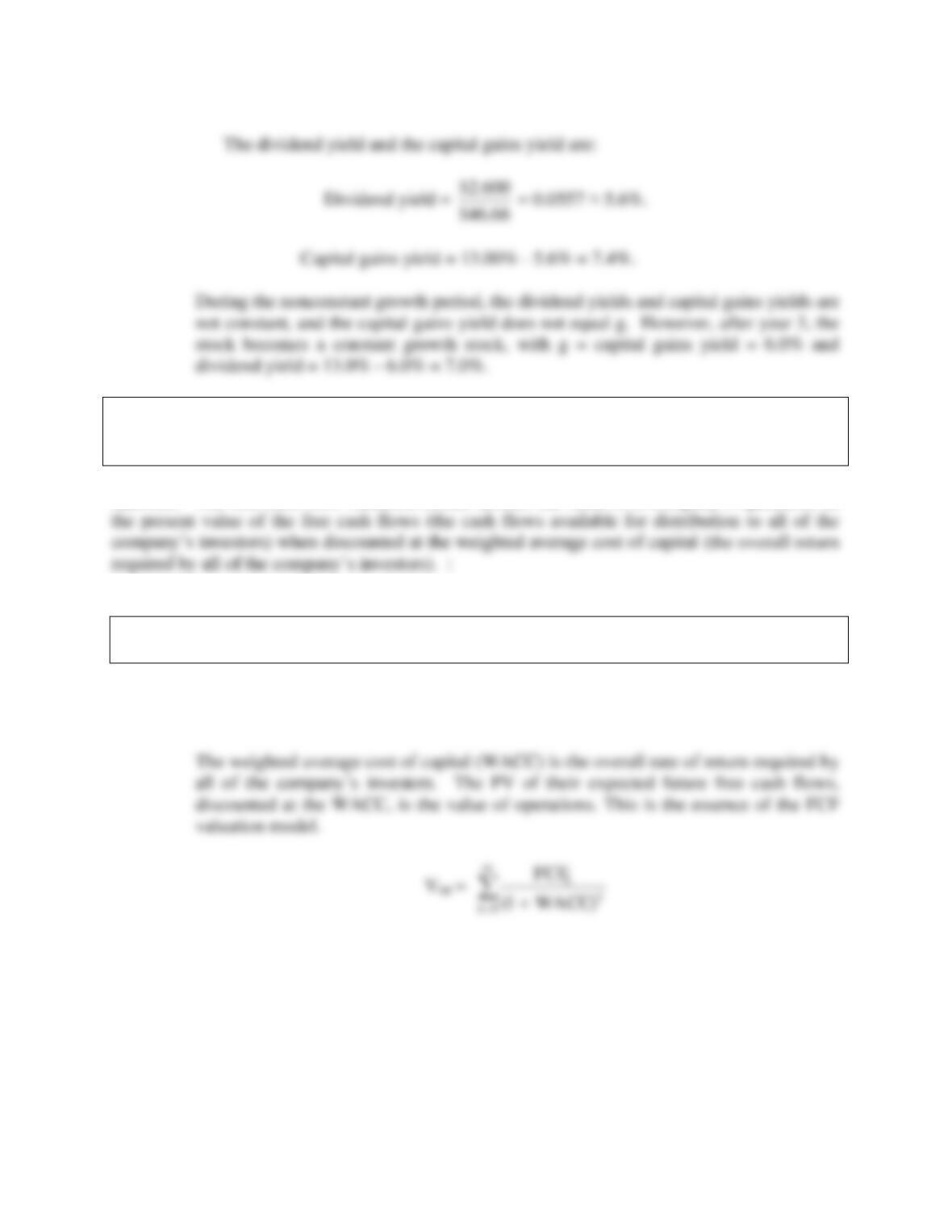
Answer: Temp Force is no longer a constant growth stock, so the constant growth model is not
applicable. Note, however, that the stock is expected to become a constant growth
stock in 3 years. Thus, it has a nonconstant growth period followed by constant
growth. The easiest way to value such nonconstant growth stocks is to set the
situation up on a time line as shown below:
Mini Case: 7 – 26
i. What is the free cash flow valuation model? What are the advantages and
disadvantages of the free cash flow valuation model relative to the dividend
growth model?
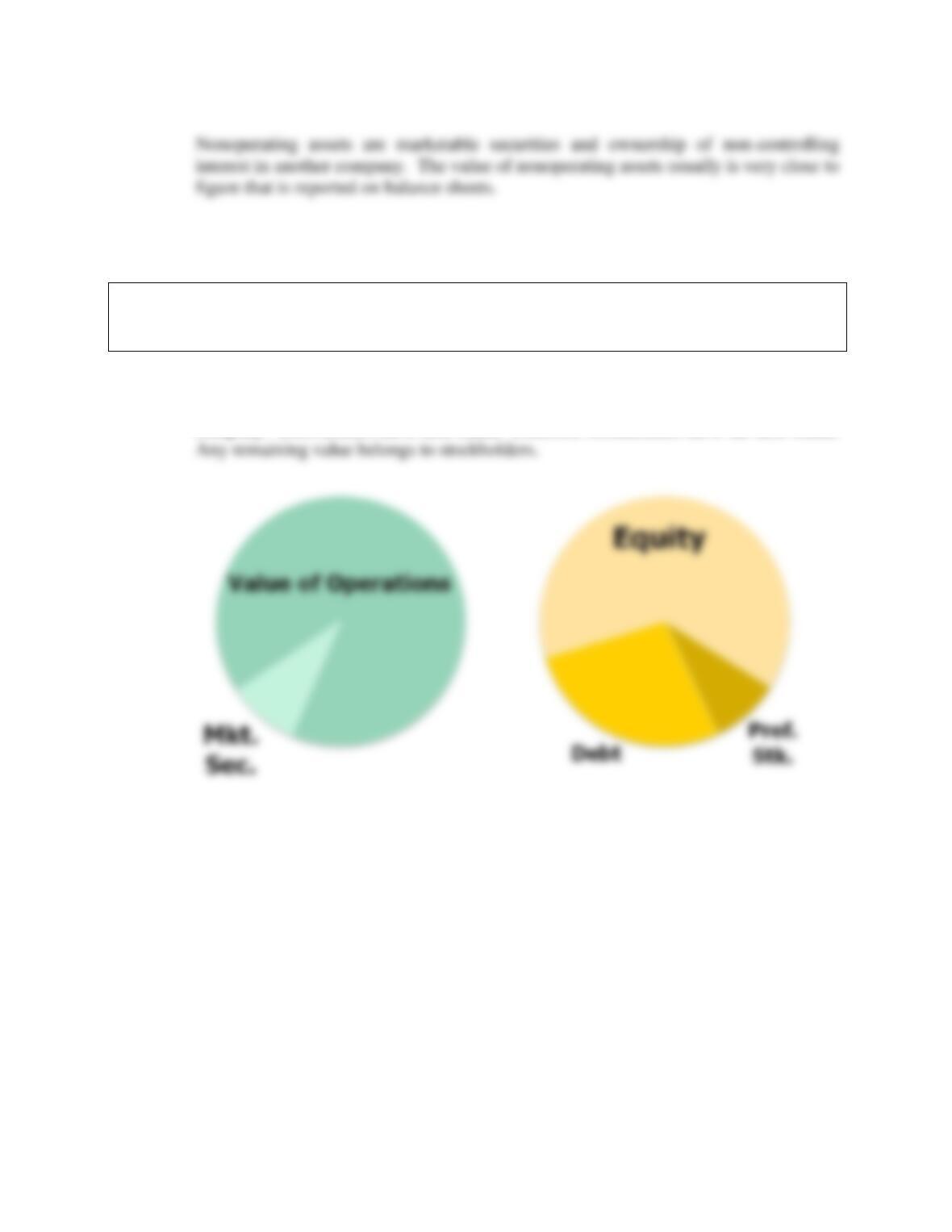
Answer: The free cash flow valuation model defines the value of a company’s operations as
i. What is free cash flow (FCF)? What is the weighted average cost of capital?
What is the free cash flow valuation model?
Answer: Free cash flow (FCF) is the cash flow available for distribution to all of a company’s
investors. FCF is generated by a company’s operations.
Mini Case: 7 – 27
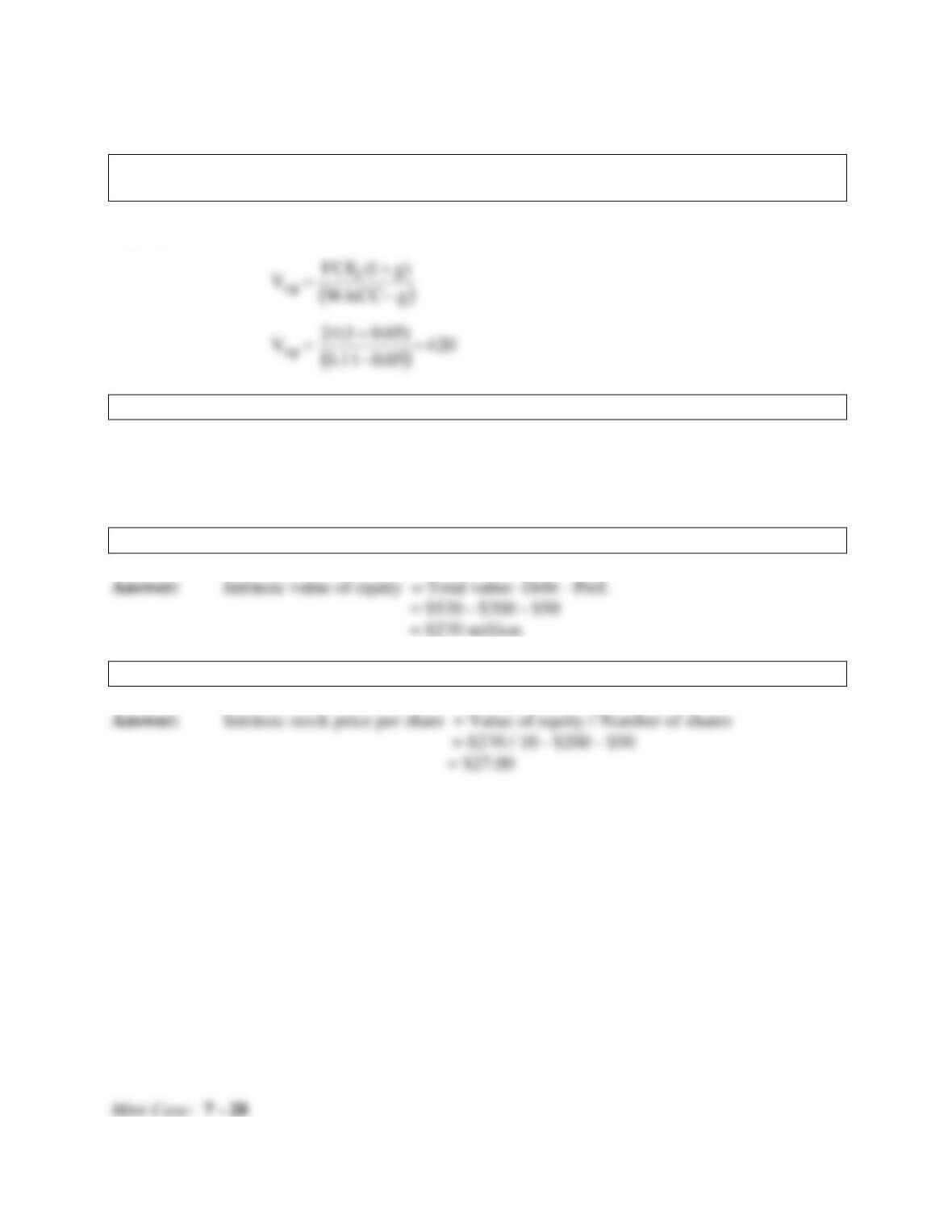
j. Use a pie chart to illustrate the sources that comprise a hypothetical company’s total
value. Using another pie chart, show the claims on a company’s value. How is equity
a residual claim?
Answer: Total corporate value is sum of value of operations and value of nonoperating assets.
Some company’s also have growth options, but assume they are negligible for this
company. Debt holders have first claim. Preferred stockholders have the next claim.
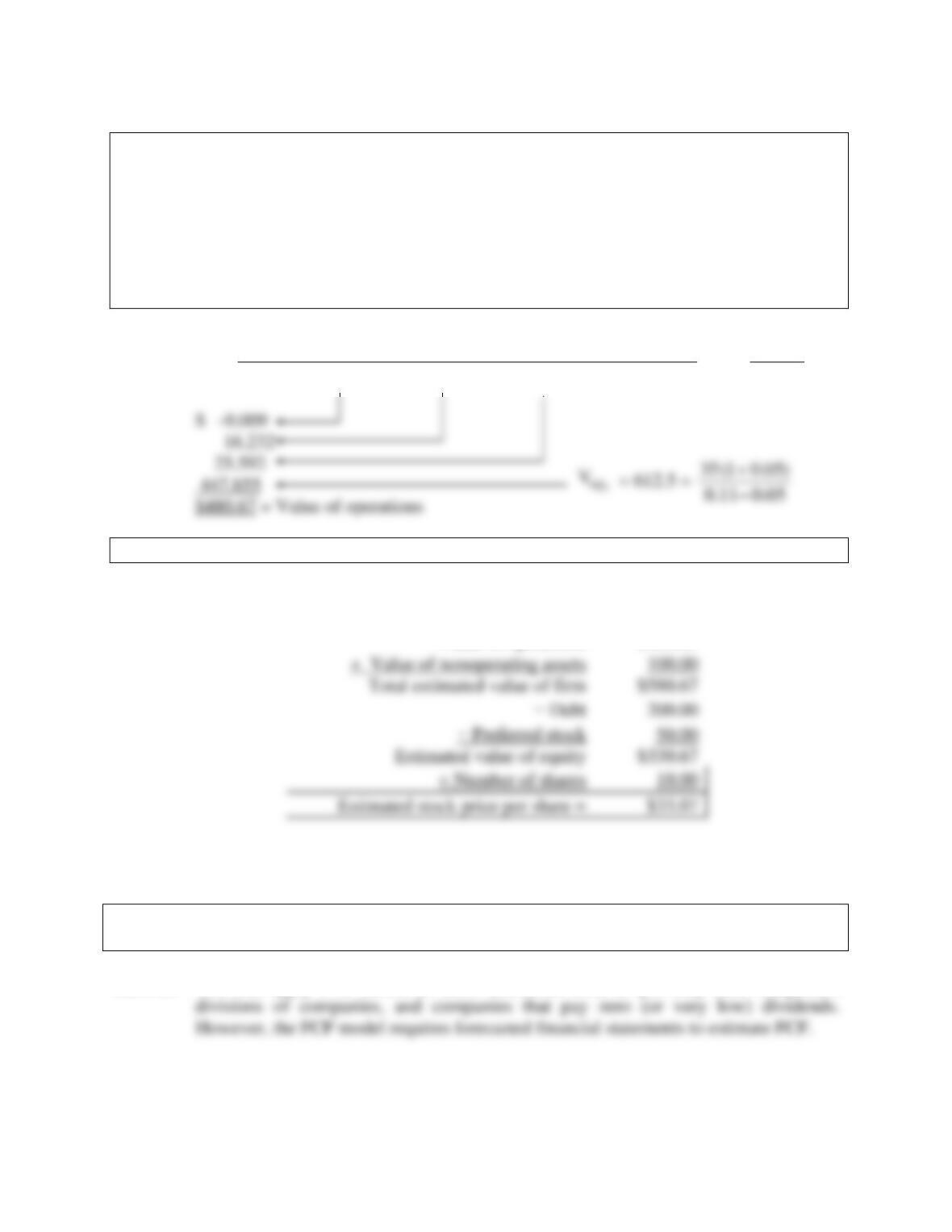
e. 1. Use B&B’s data and the free cash flow valuation model to answer the following
questions. What is its estimated value of operations?
Answer:
e. 2. What is its estimated total corporate value?
Answer: Total corporate value = Vop + Mkt. sec.
= $420 + $100
= $520 million
e. 3. What is its estimated intrinsic value of equity?
e. 4. What is its estimated intrinsic stock price per share?
Mini Case: 7 – 29
l. 1. You have just learned that B&B has undertaken a major expansion that will
change its expected free cash flows to −$10 million in 1 year, $20 million in 2
years, and $35 million in 3 years. After 3 years, free cash flow will grow at a rate
of 5%. No new debt or preferred stock were added, the investment was financed
by equity from the owners. Assume the WACC is unchanged at 11% and that
there are still 10 million shares of stock outstanding. What is its horizon value
(i.e., its value of operations at year three)? What is its current value of
operations (i.e., at time zero)?
Answer: 0 1 2 3 4 N
| | | | | • • • |
-10 25 35
l. 2. What is its value of equity on a price per share basis?
Answer:
Value of operations
$480.67
$580.67
$330.67
m. Compare and contrast the free cash flow valuation model and the dividend
growth model.
Answer: You can apply FCF model in more situations, such as privately held companies,
WACC = 11%
g = 5%
Mini Case: 7 – 30
n. What is market multiple analysis?
Answer: Analysts often use the P/E multiple (the price per share divided by the earnings per
share) or the P/CF multiple (price per share divided by cash flow per share, which is
the earnings per share plus the dividends per share) to value stocks. For example,
0. What is preferred stock? Suppose a share of preferred stock pays a dividend of
$2.10 and investors require a return of 7%. What is the estimated value of the
preferred stock?