
Chapter 7
External Economies of Scale
and the International Location
of Production
◼ Chapter Organization
Economies of Scale and International Trade: An Overview
Economies of Scale and Market Structure
The Theory of External Economies
Specialized Suppliers
Labor Market Pooling
◼ Chapter Overview
In previous chapters, trade between nations was motivated by their differences in factor productivity or
relative factor endowments. The type of trade that occurred, for example of food for manufactures, is
based on comparative advantage and is called interindustry trade. This chapter introduces trade based on
economies of scale in production. Such trade in similar productions is called intraindustry trade and
describes, for example, the trading of one type of manufactured good for another type of manufactured
good. It is shown that trade can occur when there are no technological or endowment differences but when
there are economies of scale or increasing returns in production, as opposed to the constant returns to scale
assumed in previous chapters.

34 Krugman/Obstfeld/Melitz • International Economics: Theory & Policy, Tenth Edition
External economies of scale (EES) lead to a clustering of firms in one location for three main reasons:
1. Specialized suppliers: By locating next to firms in the same industry, you are able to specialize in one
aspect of the production process and outsource other stages of production to neighboring firms.
Market equilibrium in an EES industry is determined by the intersection of market demand and supply
as in the constant returns case. The key difference here is that the market supply curve is forward falling,
reflecting the fact that average costs in the industry actually fall as industry production (i.e., size) rises. This
distinction drives trade in this model. When two countries trade, it makes sense to concentrate production
The pattern of trade is only partially explained by comparative advantage. Rather, it may be a historical
accident that led to the formation of an industry in a particular location. The chapter gives the example of
why global button manufacturing is concentrated in one town in China, mostly because one firm in the 1980s
began producing buttons there. That the location of production is not entirely dependent on comparative
advantage presents situations in which trade can actually make a country worse off. For example, if button
production is already established in China, then Chinese button producers have an advantage over firms in
Chapter 7 External Economies of Scale and the International Location of Production 35
◼ Answers to Textbook Problems
1. Cases a and d represent external economies of scale as industry production is concentrated in a just a
few locations. The benefits of geographical clustering include a greater variety of specialized services
2. This view is flawed in the sense that countries produce more than one good. Trade allows a country to
free up resources from a relatively less efficient industry and expand production in industries with more
efficient production. With increasing returns, this expansion of production will drive down costs.
3. Dynamic increasing returns occur whenever average costs fall with cumulative output. In other words, a
learning curve exists that favors established producers over startups. This is an open-ended question,
though the examples in Question 9 provide some ideas. Two industries characterized by dynamic
4. a. The relatively few locations for production suggest external economies of scale in production.
If these operations are large, there may also be large internal economies of scale in production.
b. Because economies of scale are significant in airplane production, it tends to be done by a small
number of (imperfectly competitive) firms at a limited number of locations. One such location is
Seattle, where Boeing produces airplanes.

36 Krugman/Obstfeld/Melitz • International Economics: Theory & Policy, Tenth Edition
5. a. Both countries have identical forward-falling supply curves, so the pattern of production will
depend entirely on which country establishes its industry first. The country that moves first will
have a cost advantage over the other country because it is producing a larger quantity of the
6. The three forces driving external economies of scale are access to specialized suppliers, labor market
pooling, and knowledge spillovers. As these forces weaken, so too do the cost advantages of geographic
clustering. The location of production becomes increasingly driven by factor costs when industries
move away from external economies of scale toward traditional constant returns to scale.
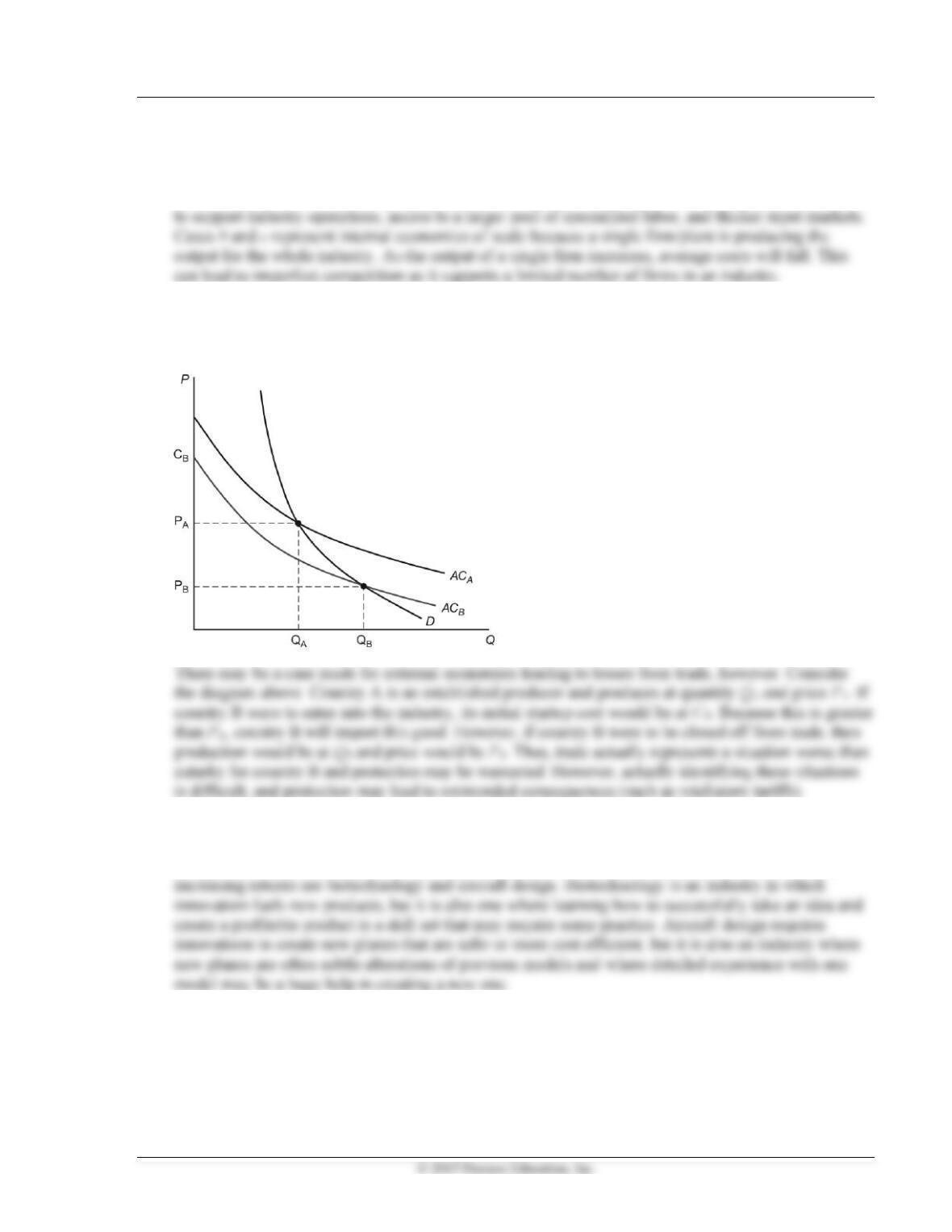
7. Even with higher wages in China, the external economies of scale industries located in China may not
move to lower-wage countries. Consider Figure 7-4 in the text. China’s average cost curve lies above
8. Consider again two different scenarios: In scenario 1, there are two firms in the same location and a
local labor supply of 200 for both firms. In scenario 2, the two firms are far apart, and each firm has
9. a. External economies of scale are likely due to the need to have a common pool of labor with
technical skills. Dynamic increasing returns may be likely due to the need for continual
innovation and learning.
b. External economies are unlikely because it is difficult to see how the costs of a single firm would

Chapter 7 External Economies of Scale and the International Location of Production 37