CHAPTER 7 | Comparative Advantage and
the Gains from International
Trade
Brief Chapter Summary and Learning Objectives
7.1 The United States in the International Economy (pages 286–289)
7.2 Comparative Advantage in International Trade (pages 289–291)
Explain the difference between comparative advantage and absolute advantage in
7.3 How Countries Gain from International Trade (pages 291–296)
7.4 Government Policies That Restrict International Trade (pages 296–305)
Analyze the economic effects of government policies that restrict international trade.
7.5 The Arguments over Trade Policies and Globalization (pages 305–309)
Evaluate the arguments over trade policy and globalization.
▪ Globalization is the movement for countries to become more open to foreign trade and
investment.
CHAPTER 7 | Comparative Advantage and the Gains from International Trade 149
Key Terms
Absolute advantage, p. 290. The ability to
produce more of a good or service than
competitors when using the same amount of
resources.
Dumping, p. 308. Selling a product for a price
below its cost of production.
Exports, p. 286. Goods and services produced
domestically but sold in other countries.
Opportunity cost, p. 289. The highest-valued
alternative that must be given up to engage in
an activity.
Tariff, p. 286. A tax imposed by a government
on imports.
Terms of trade, p. 291. The ratio at which a
country can trade its exports for imports from
other countries.
Chapter Outline
President Obama, Nike, and Free Trade
Today, 99 percent of shoes sold in the United States are made overseas. Nike employs about 26,000
150 CHAPTER 7 | Comparative Advantage and the Gains from International Trade
7.1
The United States in the International Economy (pages 286–289)
Learning Objective: Discuss the role of international trade in the U.S. economy.
The increase in international trade over the past fifty years is the result of falling shipping costs, the
spread of inexpensive and reliable communications, and changes in government policies. Over this
A. The Importance of Trade to the U.S. Economy
In 1970, exports and imports were both less than 6 percent of U.S. GDP. In 2014, exports were about
B. U.S. International Trade in a World Context
The United States is the world’s second largest exporter, but international trade is less important to the
United States than it is to most other countries.
Extra Solved Problem 7.1
U.S. Jobs Supported by Exports of Goods and Services
The textbook explains that many jobs in the United States are affected, directly or indirectly, by
Jobs Supported by Exports in 2013
Industry Jobs Share of Industry
Industry Supported Employment
Agriculture, forestry, fishing, hunting 457,238 23 percent
Industry Jobs Share of Industry
Industry Supported Employment
Professional and business services 2,215,536 11 percent
CHAPTER 7 | Comparative Advantage and the Gains from International Trade 151
a. Why is the percentage of jobs in the United States supported by exports of goods greater than the
percentage of jobs supported by exports of services?
b. In December 2015 the average hourly earnings of employees in the professional and business
services sector ($30.24) were greater than the average hourly earnings of all employees on private
nonfarm payrolls ($25.24). How are firms in this industry able to export their services (directly or
indirectly) despite their relatively high labor costs?
Source: Chris Rasmussen, “Jobs Supported by Exports 2013: Product and Industry,” International Trade Administration, U.S.
Department of Commerce, December 11, 2015; and the U.S. Bureau of Labor Statistics.
Solving the Problem
Step 1: Review the chapter material.
This problem is about the role of international trade in the economy of the United States, so
Extra Making
the
Connection
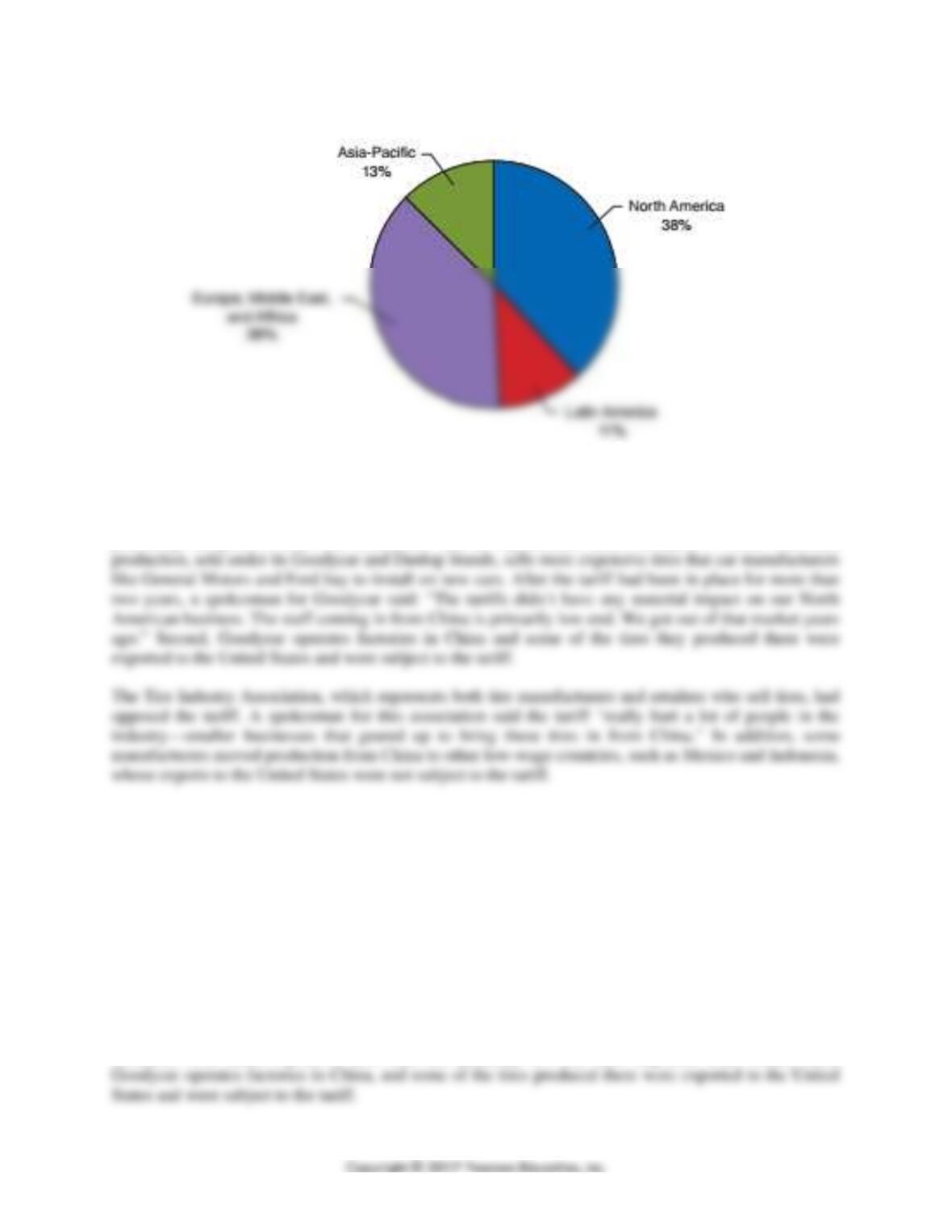
Goodyear and the Tire Tariff
Goodyear Tire & Rubber Company, headquartered in Akron, Ohio, has been a leading U.S.
manufacturing firm for more than a century. If you watch football or other events, you have probably seen
152 CHAPTER 7 | Comparative Advantage and the Gains from International Trade
So when President Obama announced a 35 percent tariff on imports of Chinese tires in 2009, it was not
necessarily good news for Goodyear for two key reasons. First, like many markets, tires are differentiated,
meaning that many different types of tires are produced. Chinese firms concentrate primarily on
producing inexpensive tires that consumers buy as replacement tires. Goodyear’s North American
At the beginning of 2013, with the tire tariff having expired, Goodyear’s profits rose more than 50 percent
compared with the previous year, despite increases in imports of Chinese tires.
Sources: Jeff Bennett, “Goodyear Posts First-Quarter Profit,” Wall Street Journal, April 26, 2013; John Bussey, “Get-Tough
Policy on Chinese Tires Falls Flat,” Wall Street Journal, January 20, 2012; Edmund L. Andrews, “U.S. Adds Tariffs on Chinese
Tires,” New York Times, September 12, 2009; and Goodyear Tire & Rubber Company, Annual Report, 2012.
Question
Goodyear manufactures tires in the United States, so you might expect that the firm would benefit from a
tariff on imports of Chinese tires. Yet Goodyear actually opposed the Obama administration’s decision to
impose the tariff. Briefly explain why Goodyear was not in favor of the tire tariff.
Answer
Goodyear sells more expensive tires than the primarily low-end tires imported from China. Also,
CHAPTER 7 | Comparative Advantage and the Gains from International Trade 153
Copyright © 2017 Pearson Education, Inc.
7.2
Comparative Advantage in International Trade (pages 289–291)
Learning Objective: Explain the difference between comparative advantage and
absolute advantage in international trade.
People trade because it makes them better off, whether the buyer and seller live in the same city or in
different countries.
A. A Brief Review of Comparative Advantage
Comparative advantage is the ability of an individual, a firm, or a country to produce a good or service
B. Comparative Advantage and Absolute Advantage
Comparative advantage explains why people pursue different occupations and why countries produce
Extra Making
the
Connection
Can the United States Benefit from Trade with India?
The growth of the economy of India in the twenty-first century has caused some U.S. workers to fear they
may lose their jobs to skilled English-speaking Indian workers. Indian engineers who develop new
technology and computer programmers earn only about one-fifth as much as their counterparts in the
United States. Because Indian workers are able to do both jobs at a lower cost, India has an absolute
154 CHAPTER 7 | Comparative Advantage and the Gains from International Trade
7.3
How Countries Gain from International Trade (pages 291–296)
Learning Objective: Explain how countries gain from international trade.
Autarky is a situation in which a country does not trade with other countries.
A. Increasing Consumption through Trade
The terms of trade is the ratio at which a country can trade its exports for imports from other countries.
Although countries as a whole are better off trading, trade can harm firms and workers in industries that
B. Why Don’t We See Complete Specialization?
We don’t see complete specialization in the real world for three reasons: not all goods and services are
traded internationally; production of goods involves increasing opportunity costs; tastes for products
differ.
C. Does Anyone Lose as a Result of International Trade?
When trade takes place between two countries, both countries benefit because each experiences an
D. Where Does Comparative Advantage Come From?
Among the main sources of comparative advantage are: climate and natural resources; relative abundance
E. Comparative Advantage over Time: The Rise and Fall—and Rise—of the U.S.
Consumer Electronics Industry
A country may develop a comparative advantage in the production of a good and later lose its
comparative advantage in that good and develop a comparative advantage in producing other goods. This
CHAPTER 7 | Comparative Advantage and the Gains from International Trade 155
Extra Making
the
Connection
Leaving New York City is Risky for Financial Firms
The name “Wall Street” is shorthand for the whole U.S. financial system of banks, brokerage houses, and
other financial firms. Wall Street is also, of course, an actual street in the New York City borough of
Manhattan. The New York Stock Exchange is located on Wall Street, and many financial firms have their
headquarters in Manhattan. There are also a lot of financial firms located outside Manhattan, but many of
the largest firms believe that there are advantages to being located close to Wall Street. For instance, in
1997, UBS, a large Swiss bank, moved its North American headquarters from Manhattan to Stamford,
Connecticut, where it built the largest facility for trading financial securities in the world.
The original concentration of financial firms in Manhattan was something of a historical accident. In
colonial times and up through the early nineteenth century, Philadelphia and Boston were at least close
rivals to New York City as business and financial centers. In fact, Philadelphia had a larger population
than New York City and was the headquarters of the federal government’s first two central banks. New
center in the country.
But the Erie Canal has long since ceased to operate, and most stock trading takes place electronically
rather than on the floor of the New York Stock Exchange. So, why has New York continued to see a high
concentration of financial firms, with some firms that temporarily left deciding to return? The answer is
Large financial firms located outside Manhattan, particularly those that heavily trade securities or attempt
to make deals that involve mergers between firms, may have higher costs than firms located in
Manhattan. Having many financial firms originally located in Manhattan was a historical accident, but
external economies gave the area a comparative advantage in providing financial services once the
industry began to grow there.
156 CHAPTER 7 | Comparative Advantage and the Gains from International Trade
Question
Instagram is a smartphone app now owned by Facebook. According to an article that discusses the
climate for software firms in the San Francisco Bay Area, the success of Instagram “is a tale about the
culture of the Bay Area tech scene, driven by a tightly woven web of entrepreneurs and investors who
nurture one another’s projects with money, advice and introductions to the right people.” What
advantages does being located in the Bay Area give to startup software firms? In what circumstances can
software firms located elsewhere overcome these advantages? Are the advantages the Bay Area has likely
to persist over time?
Source: Somini Sengupta, Nicole Perlroth, and Jenna Wortham, “Behind Instagram’s Success, Networking the Old Way,” New
York Times, April 13, 2012.
Answer
Startup software firms located in the Bay Area can take advantage of the availability of skilled workers,
7.4
Government Policies That Restrict International Trade (pages 296–305)
Learning Objective: Analyze the economic effects of government policies that restrict
international trade.
Free trade is trade between countries that is without government restrictions. Free trade helps consumers,
but hurts firms that are less efficient than foreign competitors. As a result, these firms and their workers
are often supporters of government policies that restrict trade. These policies usually take one of two
forms: tariffs, and quotas and voluntary export restraints.
A. Tariffs
Tariffs are taxes governments impose on goods imported into a country. Like any other tax, a tariff
B. Quotas and Voluntary Export Restraints
A quota is a numerical limit a government imposes on the quantity of a good that can be imported into
the country. A quota has an effect similar to a tariff. For many years, Congress has imposed a quota on
C. Measuring the Economic Effect of the Sugar Quota
A quota increases the domestic price of the good for which the quota is imposed, resulting in an increase
in producer surplus and a loss of consumer surplus. A license from the U.S. government is required to
CHAPTER 7 | Comparative Advantage and the Gains from International Trade 157
D. The High Cost of Preserving Jobs with Tariffs and Quotas
Although jobs are saved in industries subject to tariffs and quotas, the jobs are saved at a high cost to
consumers. Many countries use tariffs and quotas to try to protect jobs. The tariff on shoes costs U.S.
E. Gains from Unilateral Elimination of Tariffs and Quotas
It is easier to gain political support for reducing or eliminating a tariff or quota if it is done as part of an
F. Other Barriers to Trade
Governments sometimes erect other barriers to trade. For example, a government may impose strict health
and safety requirements on imports to shield domestic firms from foreign competition. Many
governments also restrict imports of certain products on national security grounds.
Extra Making
the
Connection
The Effect on the U.S. Economy of the Tariff on Chinese Tires
In 2009 the federal government imposed a tariff on imports of tires from China. The United Steelworkers
Union, which represents workers in some U.S. tire factories, pushed for the tariff in order to save jobs. As
with supporters of other tariffs and quotas who argue that these interferences with trade save jobs, the
Steelworkers Union was focusing only on the jobs in tire manufacturing. We have seen that a tariff or
quota makes it easier for domestic firms to compete against foreign firms that may have lower costs.
Economists Gary Clyde Hufbauer and Sean Lowry of the Petersen Institute for International Economics
have estimated the effect of the tire tariff on the U.S. economy. The tariff succeeded in reducing imports
of Chinese tires by raising their prices. Some consumers switched from Chinese tires to tires imported
158 CHAPTER 7 | Comparative Advantage and the Gains from International Trade
Because consumers spent more on tires as a result of the tariff, they had less to spend on other goods.
Drawing on studies of the relationship between consumer spending and jobs in retailing, Hufbauer and
Lowry estimate that the tariff resulted in a decline of 3,731 jobs in retailing. So, the short-run effect of the
tariff during the years it was in effect would have been a net decline of 2,500 jobs.
Question
An economic analysis of a proposal to impose a quota on steel imports into the United States indicated
that the quota would save 3,700 jobs in the steel industry but cost about 35,000 jobs in other U.S.
industries. Why would a quota on steel imports cause employment to decline in other industries? Which
other industries is a steel quota likely to affect?
Source: Douglas A. Irwin, Free Trade Under Fire, Princeton, NJ: Princeton University Press, 2002, p. 82.
Answer
A quota on steel imports raises the costs of producing goods that use steel. As a result, the prices of these
Question
According to the analysis by Hufbauer and Lowry, of the additional $1.1 billion consumers spent on tires
as a result of the tariff on Chinese tires, the workers whose jobs were saved in the U.S. tire industry
received only about $48 million in wages. Wouldn’t it have been cheaper for the federal government to
have raised taxes on U.S. consumers and given the money to tire workers rather than to have imposed a
tariff? If so, why didn’t the federal government adopt this alternative policy?
Source: Gary Clyde Hufbauer and Sean Lowry, “US Tire Tariffs: Saving Few Jobs at High Cost,” Peterson Institute for
International Economics, Policy Brief Number PB12-9, April 2012.
Answer
It would have been cheaper for the federal government to have raised taxes on U.S. consumers and given
the money to tire workers rather than to have imposed a tariff. Several reasons could explain why the
CHAPTER 7 | Comparative Advantage and the Gains from International Trade 159
Extra Making
the
Connection
Save Jobs Making Hangers … and Lose Jobs in Dry Cleaning
When supporters of tariffs and quotas argue that these interferences with trade save jobs, they are
referring to jobs in the industry protected by the tariffs and quotas. We have seen that a tariff or quota
makes it easier for domestic firms to compete against foreign firms that may have lower costs. More
production by domestic firms means more employment at those firms, thereby saving jobs in that
industry. But as we have also seen, other industries can see their costs rise as a result of the tariff or quota,
causing firms in these industries to raise prices. Higher prices will reduce the quantity demanded resulting
in lower production and fewer jobs in those industries.
At the time the tariff was imposed, the dry cleaning industry employed 221,230 workers. Over the
following two years, employment declined by about 17,000 workers, although not all of this decline was
due to the increase in the cost of hangers. The ITC estimated that the tariff would save about 300 jobs in
U.S. factories producing wire hangers, and it would raise the average cost per dry cleaner by about $4,000
per year. At the time the tariff was imposed, there were about 30,000 dry cleaners in the United States, so
the total cost of the tariff was about $120,000,000. The cost each year per job saved was about
$120,000,000/300 = $400,000. At the time, the typical worker making wire hangers was earning about
$31,000 per year. As dry cleaners, their employees, and consumers buying wire hangers found out, tariffs
can be an expensive and ineffective way to attempt to preserve jobs.
Question
An economic analysis of a proposal to impose a quota on steel imports into the United States indicated
that the quota would save 3,700 jobs in the steel industry but cost about 35,000 jobs in other U.S.
industries. Why would a quota on steel imports cause employment to fall in other industries? Which other
industries are likely to be most affected?
Source: Douglas A. Irwin, Free Trade Under Fire, (Princeton, NJ: Princeton University Press, 2002), p. 82.
Answer
A quota on steel imports raises the costs of producing goods that use steel. As a result, the prices of these
160 CHAPTER 7 | Comparative Advantage and the Gains from International Trade
7.5
The Arguments over Trade Policies and Globalization (pages 305–309)
Learning Objective: Evaluate the arguments over trade policies and globalization.
Debates over the merits of free trade, policies to restrict trade date back to the beginning of the United
States. In 1930, the United States passed the Smoot-Hawley Tariff, which raised tariff rates to nearly
60 percent. After World War II, government officials from the United States and Europe established the
General Agreement on Tariffs and Trade (GATT) to reduce tariffs and revive international trade.
Countries that joined GATT agreed not to impose new tariffs or import quotas. The GATT was replaced
by the World Trade Organization in 1995. The World Trade Organization (WTO) is an international
organization that oversees international trade agreements.
A. Why Do Some People Oppose the World Trade Organization?
After World War II, many low-income countries erected trade barriers. When the barriers failed to
produce much economic growth, many of these countries decided in the 1980s to become more open to
B. Dumping
Dumping is selling a product for a price below its cost of production. Using tariffs to offset the effects of
dumping is controversial because it is difficult to calculate the true production costs of a good.
C. Positive versus Normative Analysis (Once Again)
Many economists do not support interferences with trade, such as the sugar quota. But the opposite view
is intellectually respectable. Measuring the effect of the sugar quota on the U.S. economy is an example
CHAPTER 7 | Comparative Advantage and the Gains from International Trade 161
Extra Solved Problem 7.5
Sunlight—Unfair Competition?
Arguments over international trade are nothing new. Alexander Hamilton called for the protection of so–
called “infant industries” in the United States, and farming interests have long favored trade restrictions to
prevent consumers from buying cheaper food products from abroad. Although the countries and industries
We are suffering from the intolerable competition of a foreign rival, placed, it would seem, in a
condition so superior to ours for the production of light that he absolutely inundates our national
Solving the Problem
Step 1: Review the chapter material.
This problem is about arguments over trade policies, so you may want to review the section “The
Arguments over Trade Policies and Globalization,” which begins on page 305 in the textbook.
Step 2: Cite arguments from chapter 7 that are similar to those raised in Bastiat’s petition.
In describing protectionism, the textbook states:
For as long as international trade has existed, governments have attempted to restrict it to protect