Chapter 6:
1. In each case below, indicate which good you think has a relatively more price elastic demand and
identify the most likely reason, in terms of the determinants of the elasticity of demand (more substitutes,
greater share of budget or more time to adjust).
a. cars or Chevrolets
b. salt or housing
c. going to a New York Mets game or a Cleveland Indians game
d. natural gas this month or over the course of a year
Answers:
a. Chevrolets (more substitutes)
2. How might your elasticity of demand for copying and binding services vary if your work presentation is
next week versus in two hours?
Answer: Demand would be relatively more inelastic if your work presentation is in two
3. The San Francisco Giants want to boost revenues from ticket sales next season. You are hired as an
economic consultant and asked to advise the Giants whether to raise or lower ticket prices next year. If
the elasticity of demand for Giants game tickets is estimated to be –1.6, what would you advise? If the
elasticity of demand equals -0.4?
Answer: If the elasticity of demand is estimated to equal –1.6, then demand is relatively
4. For each of the following pairs, identify which one is likely to exhibit more elastic demand:
a. shampoo; Paul Mitchell Shampoo
b. air travel prompted by an illness in the family; vacation air travel
c. paper clips; an apartment rental
d. prescription heart medication; generic aspirin
Answers:
a. Demand for Paul Mitchell Shampoo is likely more elastic than is demand for shampoo in
5. Using the midpoint formula for calculating the elasticity of demand, if the price of a good fell from $42 to
$38, what would be the elasticity of demand if the quantity demanded changed from:
a. $19 to $21?
b. $27 to $33?
c. $195 to $205?
Answers:
a. The elasticity of demand would equal 1.
6. Explain why using the midpoint formula for calculating the elasticity of demand gives the same result
whether price increases or decreases, but using the initial price and quantity instead of the average does
not.
Answer: The average of prices and quantities demanded does no t change when the
7. Why is a more narrowly defined good (pizza) likely to have a greater elasticity of demand than a more
broadly defined good (food)?
8. If the elasticity of demand for hamburgers equals -1.5 and the quantity demanded equals 40,000,
predict what will happen to the quantity demanded of hamburgers when the price increases by 10
percent? If the price falls by 5 percent, what will happen?
Answer: If the price increases by 10%, quantity demanded will fall by 15% when the
9. -sloping linear demand curve, the slope and
therefore the elasticity
Answer: The statement is only partially correct. Along a downward-sloping linear demand
10. If the midpoint on a straight-line demand curve is at a price of $7, what can we say about the elasticity
of demand for a price change from $12 to $10? What about from $6 to $4?
Answer: The demand is relatively elastic at prices above the midpoint of a straight-line
11. Assume the following weekly demand schedule for Sunshine DVD Rentals in Cloverdale.
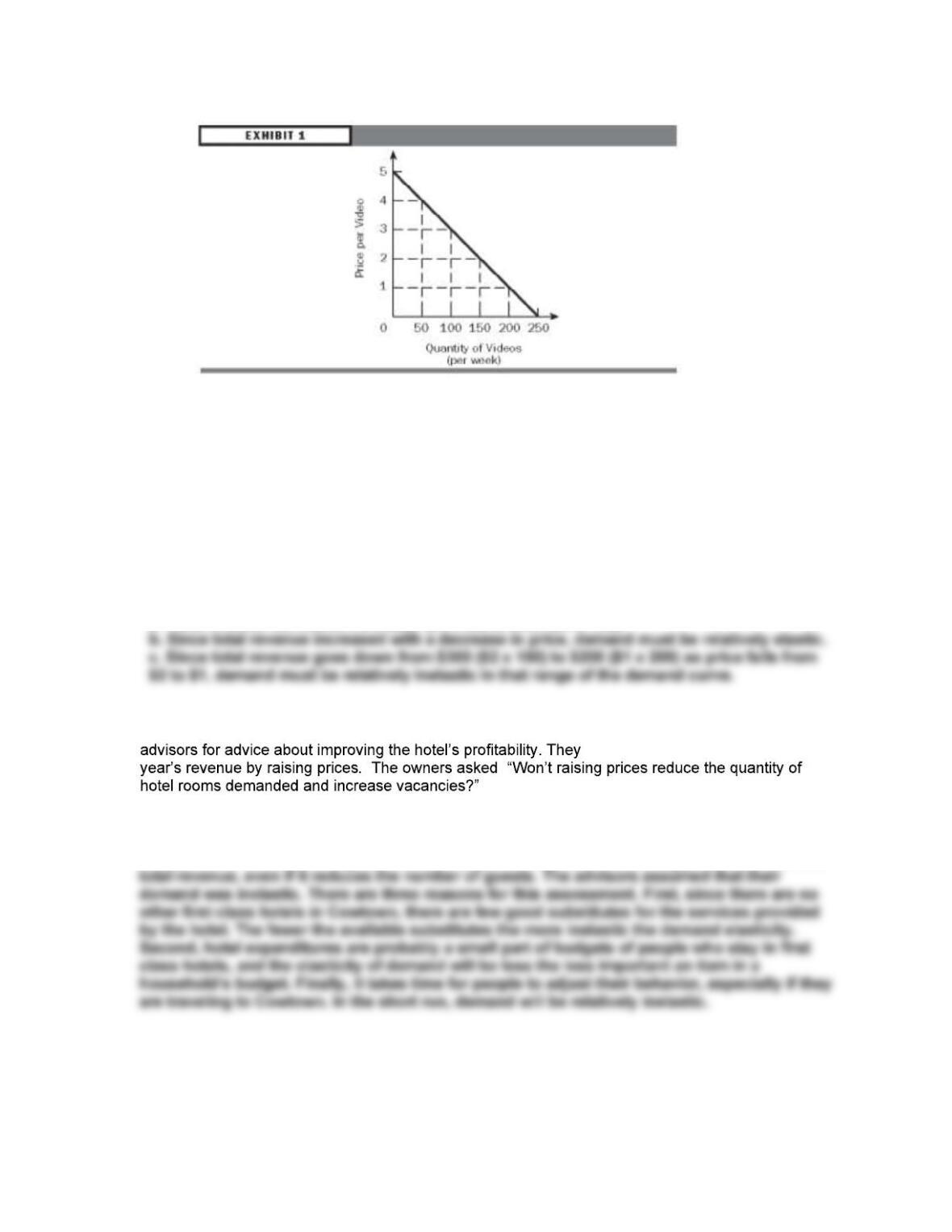
a. When Sunshine DVD Rentals lowers their rental price from $4 to $3, what happens to its total
revenue?
b. Between a price of $4 and a price of $3, is the demand for Sunshine DVD Rentals in
Cloverdale elastic or inelastic?
c. Between a price of $2 and a price of $1, is the demand for Sunshine DVD Rentals in
Cloverdale elastic or inelastic?
Answers:
a. Total revenue increases from $200 ($4 x 50) to $300 ($3 x 100).
12. The Cowtown Hotel is the only first-class hotel in Fort Worth. The hotel owners hired economics
suggested it could increase this
,
What do you think the advisors replied? Why
would they suggest increasing prices?
Answer: If the demand facing the Cowtown Hotel is inelastic, then raising prices will increase
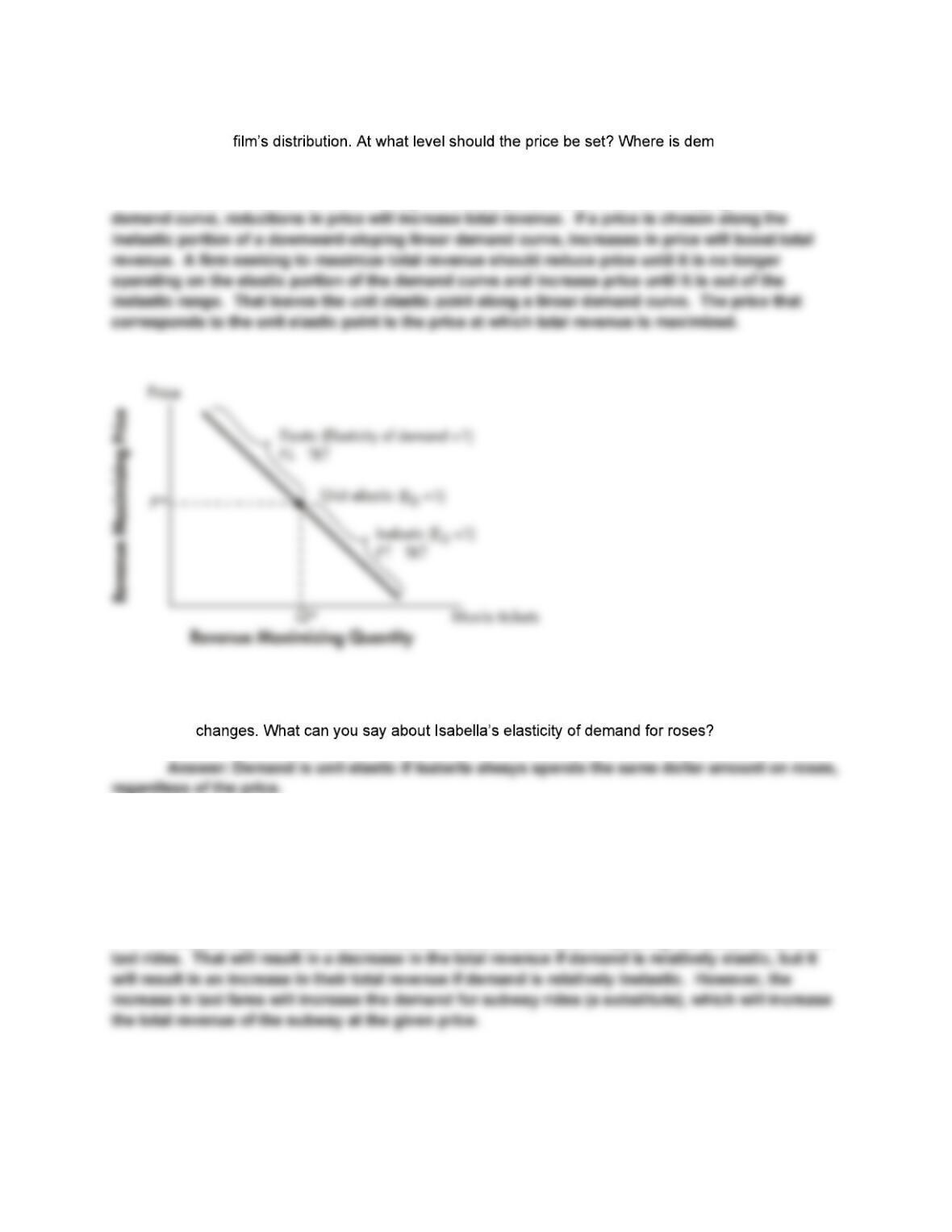
13. A movie production company faces a linear demand curve for its film, and it seeks to maximize total
revenue from the and elastic,
inelastic, or unit elastic? Explain.
Answer: If a price is chosen along the elastic portion of a downward-sloping linear
14. Isabella always spends $50 on red roses each month and simply adjusts the quantity she purchases
as the price
15. If taxi fares in a city rise, what will happen to the total revenue received by taxi operators? If the fares
charged for subway rides, a substitute for taxi rides, do not change, what will happen to the total revenue
earned by the subway as a result?
Answer: An increase in taxi fares will result in a movement up along the demand curve for
16.
wants to be reelected, but the town of Gapville needs more revenue for its schools. He has a choice
between taxing tickets to professional basketball games or food. If the demand for food is relatively
inelastic while the supply is relatively elastic, and if the demand for professional basketball games is
relatively elastic while the supply is relatively inelastic, in which case would the tax burden fall primarily on
consumers? In which case would the tax burden fall primarily on producers?
Answer: When demand is less elastic than supply, the tax burden falls primarily on consumers.
17. Indicate whether a pair of products are substitutes, complements, or neither based upon the following
estimates for the cross-price elasticity of demand:
a. 0.5
b. -0.5
Answers:
a. substitutes
18. Using the midpoint formula for calculating the elasticity of supply, if the price of a good rose from $95
to $105, what would be the elasticity of supply if the quantity supplied changed from:
a. 38 to 42?
b. 78 to 82?
c. 54 to 66?
Answers:
19. Why is an increase in price more likely to decrease the total revenue of a seller in the long run than in
the short run?
20. If both supply curves and demand curves are more elastic in the long run than in the short run, how
does the incidence of a tax change from the short run to the long run as a result? What happens to the
revenue raised from a given tax over time, ceteris paribus?
Answer: Relative inelasticities of supply and demand determine the incidence of a tax. If
the difference between the short-run and long-run elasticity was greater on one side of the market
21. Assume you had the following observations on U.S. intercity rail travel: Between 1990 and 1993 rail
travel increased from 17.5 passenger miles per person to 19 passenger miles per person. At the same
time neither per mile railroad price or incomes changed but the per mile price of intercity airline travel
increased by 7.5 percent. Between 1995 and 1998 per capita incomes rose by approximately 13 percent
while the price of travel by rail and plane stayed constant. Intercity rail travel was 20 passenger miles per
periods:
a. Calculate the income elasticity of demand for intercity rail travel.
b. Calculate the cross price elasticity of demand for intercity rail travel.
c. Are air travel and rail travel substitutes or complements? Is intercity rail travel a normal or an inferior
good?
Answers:
a. The income elasticity of demand equals (the percentage change in the quantity demanded)/ (the