Chapter 6
Long-Run Economic Growth
◼ Learning Objectives
I. Goals of Chapter 6
A. Discuss the sources of economic growth and the fundamentals of growth accounting (Sec. 6.1)
II. Notes to Eighth Edition Users
A. We shortened and simplified the discussion of the post-1973 slowdown in productivity growth
122 Abel/Bernanke/Croushore • Macroeconomics, Ninth Edition
◼ Teaching Notes
I. The Sources of Economic Growth (Sec. 6.1)
A. Production function
Y = AF(K, N) (6.1)
1. Decompose into growth rate form: the growth accounting equation
B. Growth accounting
1. Four steps in breaking output growth into its causes (productivity growth, capital input
2. Growth accounting and productivity trends
a. Denison’s results for 1929–1982 (text Table 6.3)
(1) Entire period output growth 2.92%; due to labor 1.34%; due to capital 0.56%; due to
Theoretical Application
Growth accounting provides the basis for the real business cycle (RBC) model of the economy,
which we will discuss in greater detail in Chapter 10. The RBC model takes movements in total
factor productivity to be the primary source of business cycle fluctuations.
Chapter 6 Long-Run Economic Growth 123
Data Application
Mark Wynne’s article, “The Comparative Growth Performance of the U.S. Economy in the
b. Oil prices—huge increase in oil prices reduced productivity of capital and labor,
especially in basic industries
c. New industrial revolution—learning process for information technology from 1973 to
1990 meant slower growth
4. Application: the rebound in U.S. productivity growth
a. Labor productivity growth increased sharply in the second half of the 1990s
e. The increase in labor productivity can be traced to the ICT (information and
communications technologies) revolution
(1) But other countries also had an ICT revolution, and their labor productivity did not
rise as much as in the United States
(2) European labor productivity did not rise as much as in the United States because of
government regulations
II. Long-Run Growth: The Solow Model (Sec. 6.2)
A. Two basic questions about growth
1. What’s the relationship between the long-run standard of living and the saving rate,
B. Setup of the Solow model
1. Basic assumptions and variables
a. Population and workforce grow at same rate n
124 Abel/Bernanke/Croushore • Macroeconomics, Ninth Edition
2. The per-worker production function
a. yt = f(kt) (6.5)
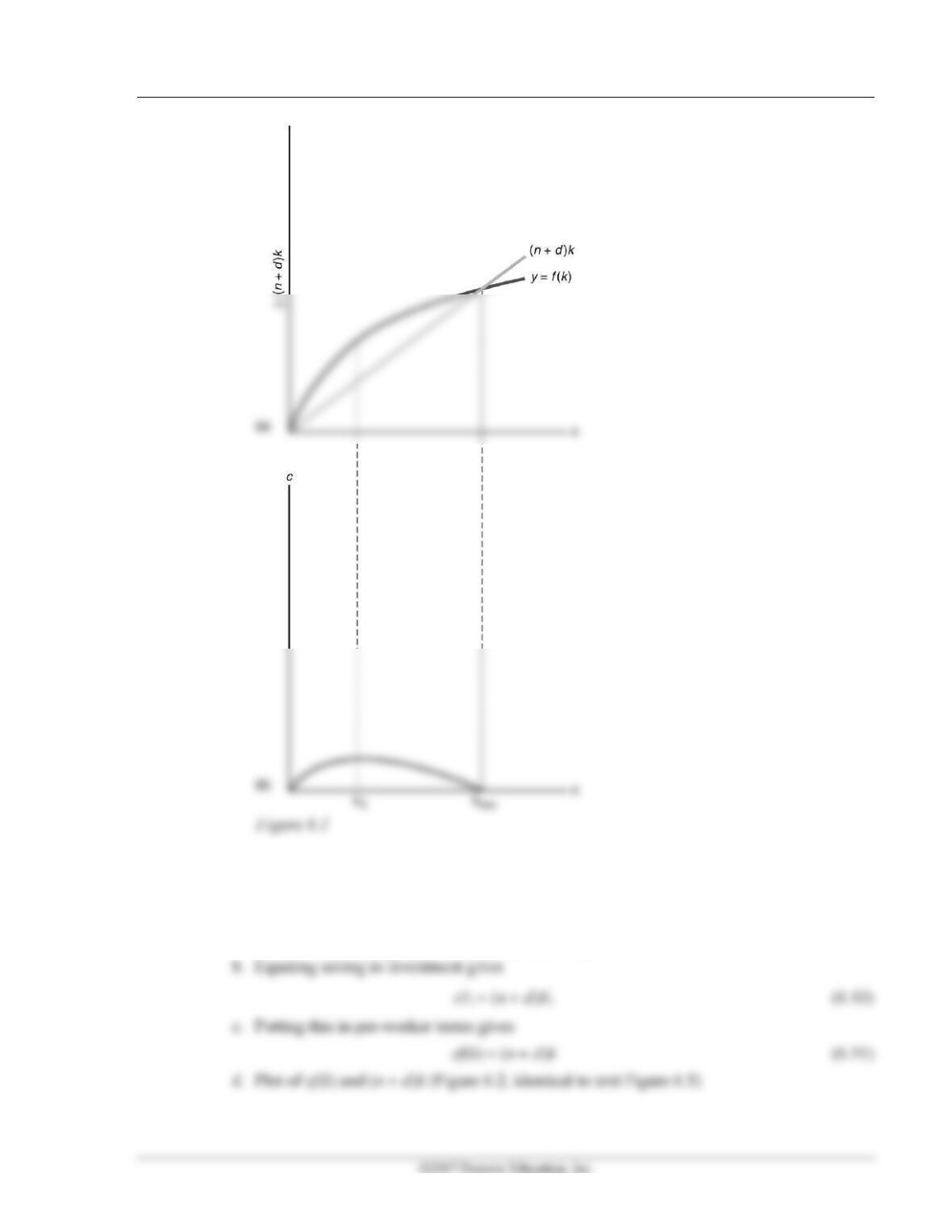
3. Steady states
a. Steady state: yt, ct, and kt are constant over time
b. Gross investment must
(1) Replace worn out capital, dKt
(2) Expand so the capital stock grows as the economy grows, nKt
c. It = (n + d)Kt (6.6)
Chapter 6 Long-Run Economic Growth 125
4. Reaching the steady state
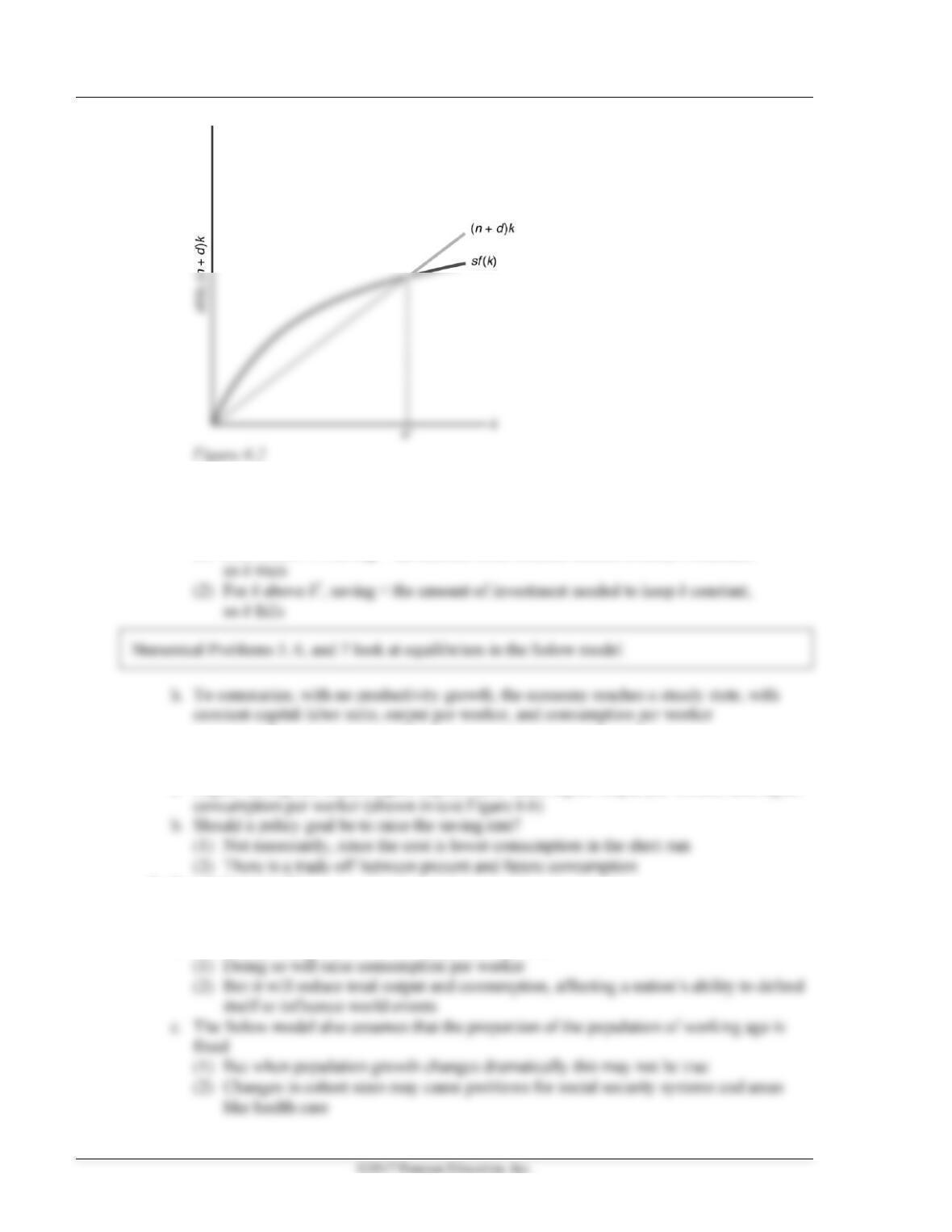
a. Suppose saving is proportional to current income:
St = sYt, (6.9)
where s is the saving rate, which is between 0 and 1
126 Abel/Bernanke/Croushore • Macroeconomics, Ninth Edition
e. The only possible steady-state capital-labor ratio is k*
f. Output at that point is y* = f(k*); consumption is c* = f(k*) − (n + d)k*
g. If k begins at some level other than k*, it will move toward k*
(1) For k below k*, saving > the amount of investment needed to keep k constant,
C. The fundamental determinants of long-run living standards
1. The saving rate
a. Higher saving rate means higher capital-labor ratio, higher output per worker, and higher
2. Population growth
a. Higher population growth means a lower capital-labor ratio, lower output per worker,
and lower consumption per worker (shown in text Figure 6.7)
b. Should a policy goal be to reduce population growth?
Chapter 6 Long-Run Economic Growth 127
3. Productivity growth
a. The key factor in economic growth is productivity improvement
d. Can consumption per worker grow indefinitely?
(1) The saving rate can’t rise forever (it peaks at 100%) and the population growth rate
can’t fall forever
(2) But productivity and innovation can always occur, so living standards can rise
continuously
Analytical Problems 1, 2, 3, and 4 look at how changes in the fundamentals affect an economy’s
economic growth.
4. Application: The growth of China
a. China is an economic juggernaut
(1) Population 1.4 billion people
b. Fast output growth attributable to
(1) Huge increase in capital investment
c. Will China be able to keep growing rapidly?
(1) Rapid growth because of use of underemployed resources, using advanced
III. Endogenous Growth Theory—Explaining the Sources of Productivity Growth (Sec. 6.3)
A. Aggregate production function
Y = AK (6.12)
1. Constant MPK
a. Human capital
128 Abel/Bernanke/Croushore • Macroeconomics, Ninth Edition
Data Application
For more information and a look at the data on the returns to human capital, see Ellis W. Tallman
and Ping Wang, “Human Capital Investment and Economic Growth: New Routes in Theory
B. Implications of endogenous growth
1. Suppose saving is a constant fraction of output: S = sAK
2. Since investment = net investment + depreciation, I = K + dK
Theoretical Application
The Wall Street Journal discussed the theory of endogenous growth and the contributions of
Stanford economist Paul Romer, in the article “Wealth of Notions,” January 21, 1997.
C. Summary
1. Endogenous growth theory attempts to explain, rather than assume, the economy’s growth
Policy Application
For a good review of how government policy can contribute to economic growth, see Satyajit
Chapter 6 Long-Run Economic Growth 129
Data Application
Is the Solow model or the model of endogenous growth a better representation of how economic
growth is determined? To find out, Ben S. Bernanke and Refet S. Gürkaynak of Princeton
University examined data from many different countries from 1960 to 1998 (“Is Growth
However, the Solow model implies that even if an economy is not in a steady state, the growth
rate of total factor productivity (TFP) is exogenous: it does not depend on the saving rate or on
any other behavioral variable, such as the level of education in a country or the growth rate of the
labor force. After constructing measures of long-run TFP growth for about 50 countries,
Bernanke and Gürkaynak examined the relationship between it and other variables. They found
that there is, in fact, a strong relationship between TFP growth and the saving rate, some
IV. Government Policies to Raise Long-Run Living Standards (Sec. 6.4)
A. Policies to affect the saving rate
1. If the private market is efficient, the government shouldn’t try to change the saving rate
2. How can saving be increased?
a. One way is to raise the real interest rate to encourage saving; but the response of saving to
B. Policies to raise the rate of productivity growth
1. Improving infrastructure
130 Abel/Bernanke/Croushore • Macroeconomics, Ninth Edition
c. U.S. infrastructure spending has declined in the last two decades
d. Would increased infrastructure spending increase productivity?
(1) There might be reverse causation: Richer countries with higher productivity spend
2. Building human capital
a. There’s a strong connection between productivity and human capital
3. Encouraging research and development
a. Support scientific research
b. Fund government research facilities
Policy Application
Many issues relating to government policy and its effects on growth are discussed in a special issue
Chapter 6 Long-Run Economic Growth 131
◼ Additional Issues for Classroom Discussion
1. More on Measurement and Productivity
The textbook discusses some of the issues involved in measurement and productivity. If the quality of
outputs isn’t accounted for accurately, then increases in quality go unmeasured, and real GDP is higher
2. Financial Institutions and Growth
We often take for granted our well-developed financial system. But many countries have financial
institutions that are much more primitive than ours. You may wish to discuss with your class the
3. Is Growth Good?
Students like to discuss the benefits versus the costs of growth. While it’s easy for the government to
calculate output (GDP), it’s much harder to account for the quality of life. And everyone is aware of the