Chapter 6
The Standard Trade Model
◼ Chapter Organization
A Standard Model of a Trading Economy
Production Possibilities and Relative Supply
Relative Prices and Demand
The Welfare Effect of Changes in the Terms of Trade
Determining Relative Prices
Economic Growth: A Shift of the RS Curve
Growth and the Production Possibility Frontier
World Relative Supply and the Terms of Trade
◼ Chapter Overview
Previous chapters have highlighted specific sources of comparative advantage that give rise to
international trade. This chapter presents a general model that admits previous models as special cases.
This “standard trade model” is the workhorse of international trade theory and can be used to address a wide
range of issues. Some of these issues, such as the welfare and distributional effects of economic growth,
transfers between nations, and tariffs and subsidies on traded goods, are considered in this chapter.
28 Krugman/Obstfeld/Melitz • International Economics: Theory & Policy, Tenth Edition
You may want to work with this standard diagram to demonstrate a number of basic points. First, an autarkic
economy must produce what it consumes, which determines the equilibrium price ratio; and second, opening
an economy to trade shifts the price ratio line and unambiguously increases welfare. Third, an improvement
in the terms of trade (ratio of export prices to import prices) increases welfare in the economy. Fourth, it is
straightforward to move from a small country analysis to a two-country analysis by introducing a structure
of world relative demand and supply curves, which determine relative prices.
The example provided in the text considers the popular arguments in the media that growth in China hurts
the United States. The analysis presented in this chapter demonstrates that the bias of growth is important
in determining welfare effects rather than the country in which growth occurs. The existence of biased
growth and the possibility of immiserizing growth are discussed. The Relative Supply (RS) and Relative
Demand (RD) curves illustrate the effect of biased growth on the terms of trade. The new terms
of trade line can be used with the general equilibrium analysis to find the welfare effects of growth. A general
principle that emerges is that a country that experiences export-biased growth will have a deterioration in its
terms of trade, while a country that experiences import-biased growth has an improvement in its terms of
trade. A case study argues that this is really an empirical question, and the evidence suggests that the rapid
growth of countries like China has not led to a significant deterioration of the U.S. terms of trade nor has it
drastically improved China’s terms of trade.
Chapter 6 The Standard Trade Model 29
◼ Answers to Textbook Problems
1.
2.
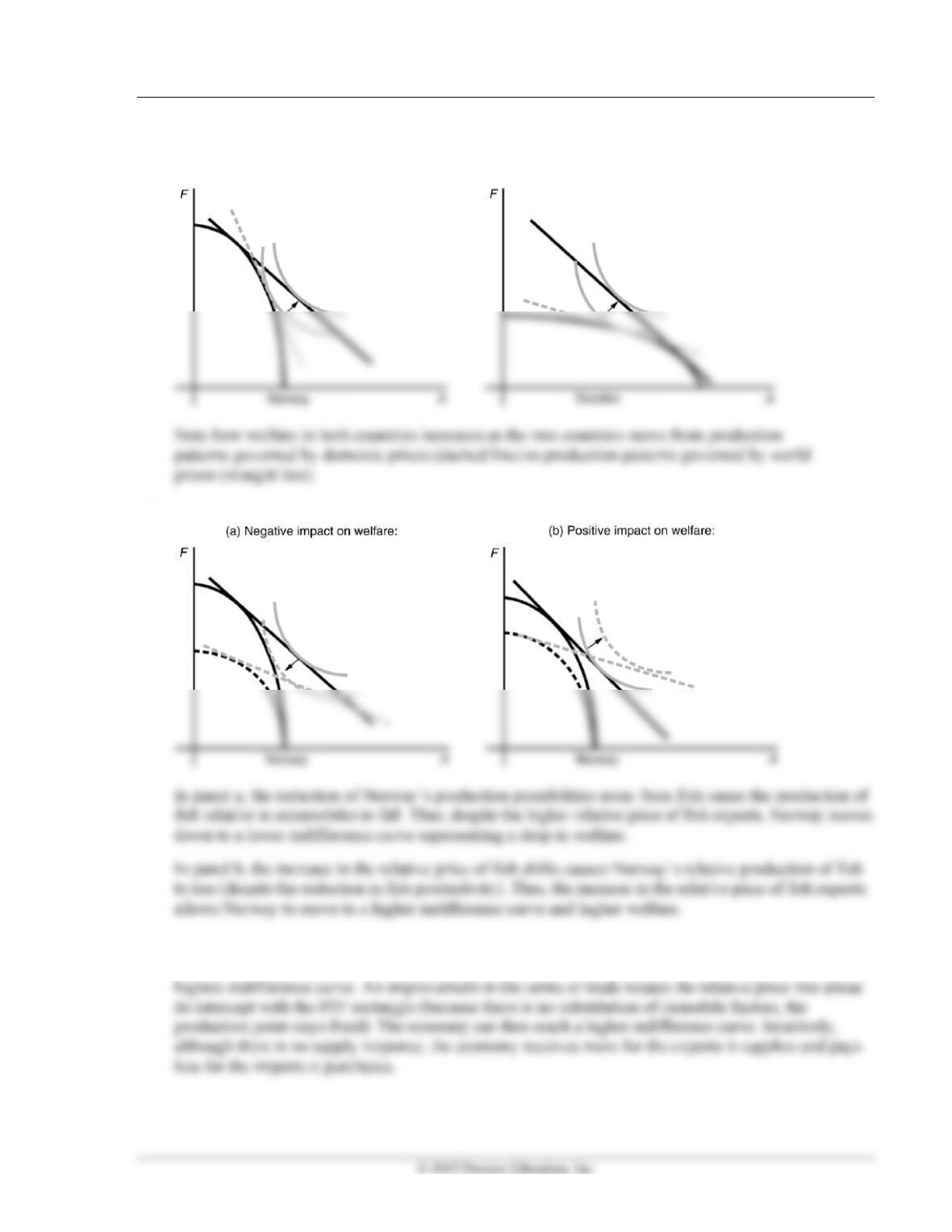
3. An increase in the terms of trade increases welfare when the PPF is right-angled. The production
point is the corner of the PPF. The consumption point is the tangency of the relative price line and the
4. The difference from the standard diagram is that the indifference curves are right angles rather than
5. The terms of trade for Japan, a manufactures (M) exporter and a raw materials (R) importer, is the world
relative price of manufactures in terms of raw materials (pM/pR). The terms of trade change can be
determined by the shifts in the world relative supply and demand (manufactures relative to raw materials)
curves. Note that in the following answers, world relative supply (RS) and relative demand (RD) are
always M relative to R. We consider all countries to be large, such that changes affect the world
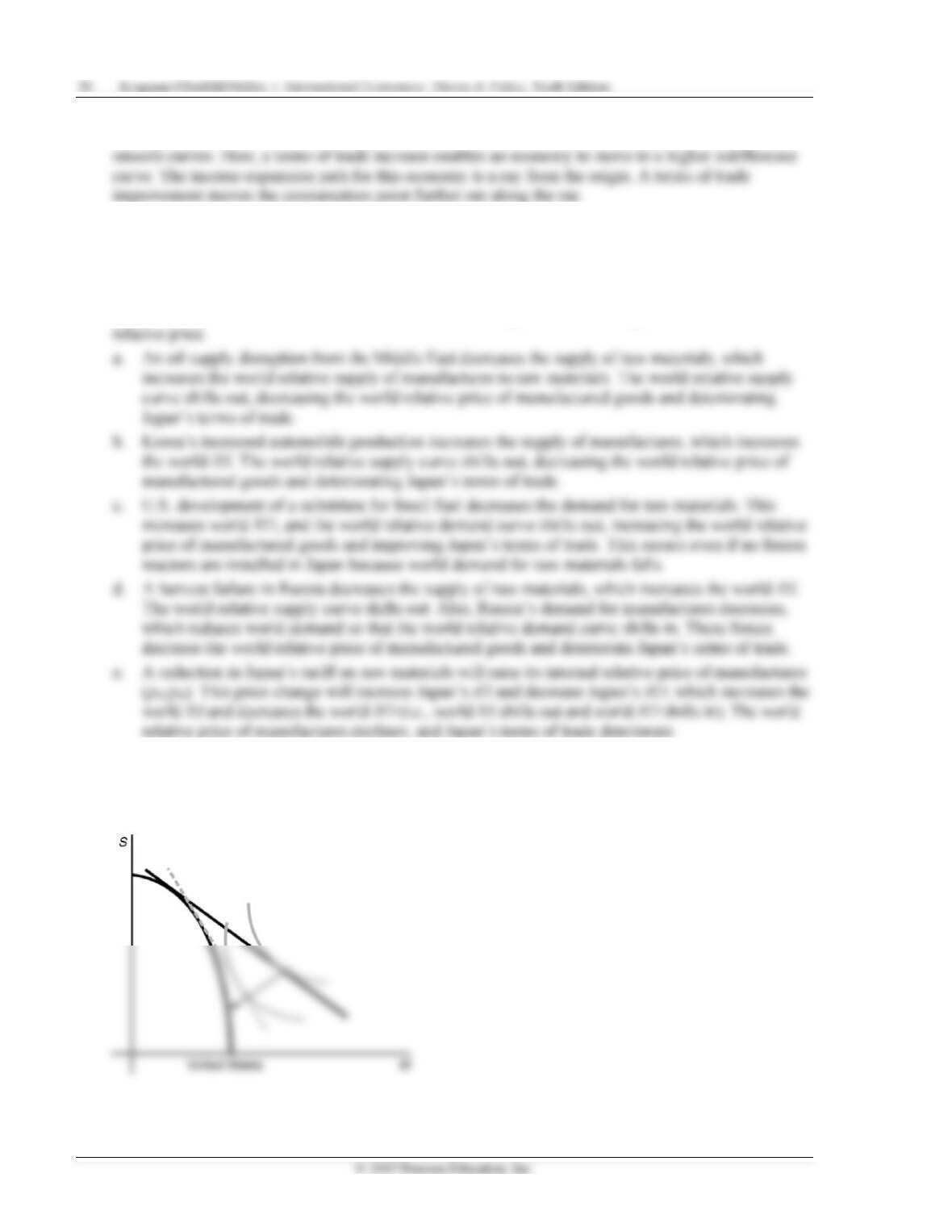
6. The declining price of services relative to manufactured goods shifts the isovalue line clockwise so
that relatively fewer services and more manufactured goods are produced in the United States, thus
reducing U.S. welfare.
Chapter 6 The Standard Trade Model 31
7. These results acknowledge the biased growth that occurs when there is an increase in one factor of
production. An increase in the capital stock of either country favors production of good X, while an
increase in the labor supply favors production of good Y. Also, recognize the Heckscher-Ohlin result
that an economy will export that good that uses intensively the factor which that economy has in
8. Immiserizing growth occurs when the welfare deteriorating effects of a worsening in an economy’s
terms of trade swamp the welfare improving effects of growth. For this to occur, an economy must
undergo very biased growth, and the economy must be a large enough actor in the world economy
such that its actions spill over to adversely alter the terms of trade to a large degree. This combination
of events is unlikely to occur in practice.
9. India opening its markets to world trade should be good for the United States if the change reduces
the relative price of goods that China sends to the United States and hence increases the relative price
10. What matters for welfare are the external terms of trade. Suppose that country X exports good A and
imports good B, while country Y exports good B and imports good A. The export subsidy in country
X will raise the internal price of the export good A, leading to an increase in production of good A
32 Krugman/Obstfeld/Melitz • International Economics: Theory & Policy, Tenth Edition
11. International borrowing and lending implies a trade-off between the production of current and future
consumption much like trade in goods implies a trade-off between production of different goods.
The more current consumption you select, the less future consumption you will be able to engage
12. Comparative advantage in international borrowing and lending is driven by the relative price of future
consumption and, more specifically, the real interest rate. As the real interest rate rises, the relative price
of future consumption 1/(1 + r) falls. Effectively, a country with a high real interest rate is one that has
high returns on investment. Such a country will prefer to borrow today and take advantage of the high
return on investment and enjoy the fruits of current investment with high returns in the future.
a. Countries like Argentina and Canada should have high real interest rates as there are large
investment opportunities that have yet to be exploited. These countries will have a low price of
future consumption and will be biased toward exporting future consumption, preferring to
borrow today.
b. Countries like the United Kingdom in the 19th century or the United States today will have
relatively lower real interest rates as they already have a high level of capital and limited returns