Chapter 6
The Theory of Tariffs and Quotas
◼ Outline
Introduction: Tariffs and Quotas
Analysis of a Tariff
Consumer and Producer Surplus
Prices, Output, and Consumption
Resource Allocation and Income Distribution
Case Study: A Comparison of Tariff Rates
Analysis of Quotas
Types of Quotas
The Effect on the Profits of Foreign Producers
Hidden Forms of Protection
Case Study: Intellectual Property Rights and Trade
◼ What Students Should Know after Reading Chapter 6
Chapter 6 introduces students to tariffs, quotas, and non-tariff measures. Tariffs are addressed first, using
the tools of consumer and producer surplus in a simple partial equilibrium setting to show the effects of
tariffs on resource allocation and income distribution. Deadweight losses from tariffs are identified, and
a distinction is drawn between consumption losses and efficiency losses. Other potential costs of tariffs,
34 Gerber • International Economics, Sixth Edition
The last part of the chapter addresses other non-tariff measures. Examples and the problem of interpreting
whether a measure is protectionist or serves the public interest are identified. A case study on intellectual
property rights describes both the benefits and the potential costs of enforcement through TRIPs.
Subthemes to develop could include the lack of overall coordination of trade protection and problems of
◼ Assignment Ideas
1. Have students research trade barriers that are important to a specific industry. These could be
assigned by country or at a multilateral level. Students could be asked to create a briefing for use in
lobbying U.S. governmental officials prior to multilateral trade talks. If this industry wants to
increase its exports, which international trade barriers will it want to have reduced? Are the barriers
largely tariffs, quotas, or non-tariff measures?
2. Have students research the trade policies and trade barriers of a particular country. A number of
questions can be used to guide the assignment. (See the WTO site, mentioned above.)
• How high are tariffs? Are there quotas or quota-like measures? In what sectors?
• Are there other non-tariff measures that the United States finds objectionable? Are there currently
discussions to resolve these issues?
Resources for these assignments include:
i. World Trade Organization (www.wto.org).
ii. Country Commercial Guides, published by the International Trade Administration of the
3. Suppose a domestically produced motor bicycle sells at a world price of $5,000 under unrestricted
trade. The domestic producer uses $3,000 worth of imported inputs, (VA*). The $2,000 difference
between the world price of the final motor bicycle and the cost of the imported components represents
domestic value added (VA). Domestic value-added includes the payments made to domestic labor
and capital inputs. Under restricted trade, domestic value-added cannot exceed $2,000, or the price of
the domestically produced motor bicycle will exceed that of imported ones and the domestic ones
will not sell. Suppose a 10 percent ad valorem (on the value) tariff is imposed on the imported motor
bicycle.
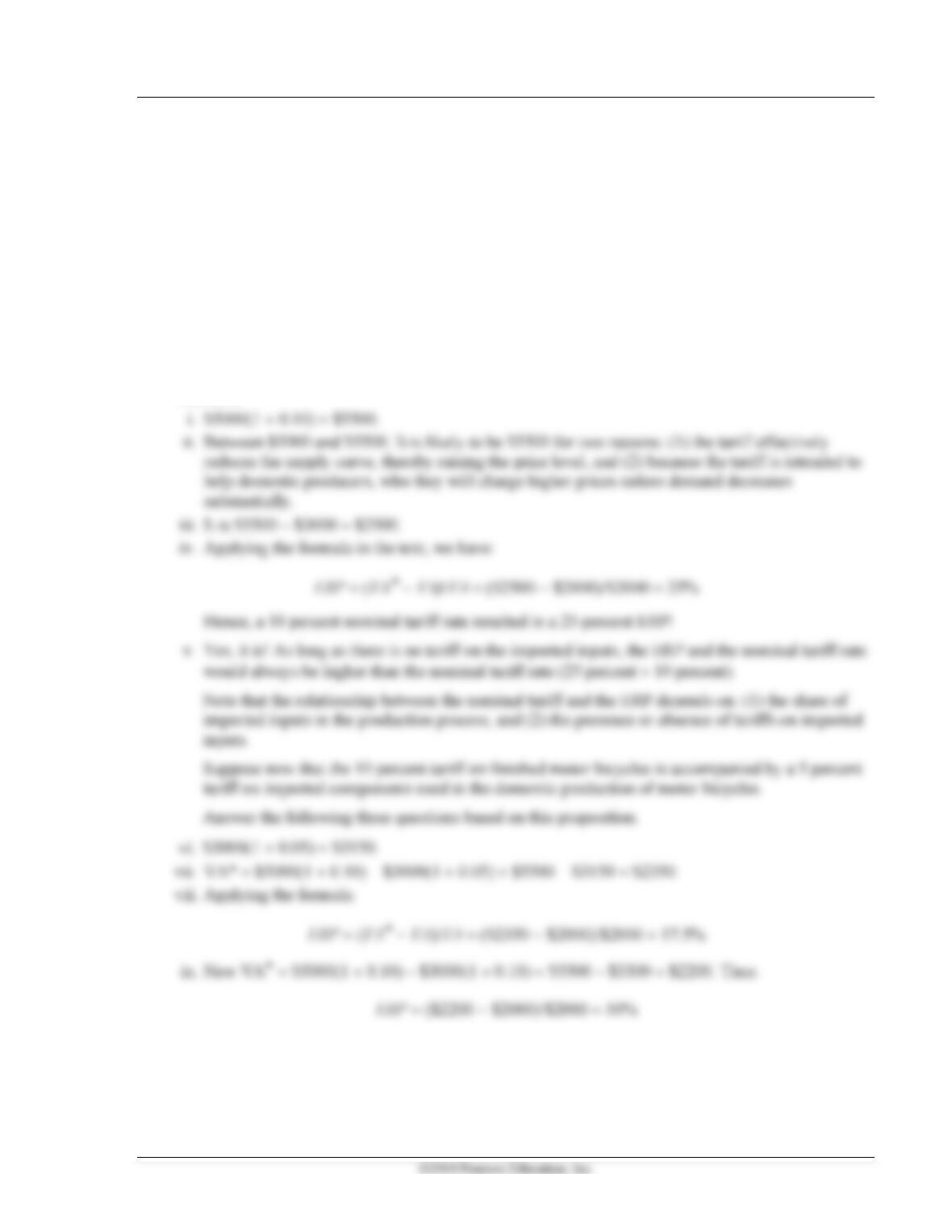
i. What is the domestic price of the imported motor bicycle?
Chapter 6 The Theory of Tariffs and Quotas 35
ii. What is the possible price of the domestically produced motor bicycle?
iii. What is the domestic value-added of the imported motor bicycle (VA*)?
iv. What is the effective rate of protection (ERP)?
v. Is this an effective rate of protection? Why or why not?
vi. What price do domestic producers pay on the imported components that they use as inputs?
vii. What is the amount of the new domestic value-added after the tariff? (Note: the new value-added
is the difference between the tariffed price of imported motor bicycles and the tariffed price of
imported inputs used in domestic production.)
viii. What is the value of the new ERP?
ix. Suppose that the government decided to tax the imported inputs by the same rate (10 percent) as
the finished imported good. What is the ERP under this condition?
Answers:
36 Gerber • International Economics, Sixth Edition
◼ Answers to End-of-Chapter Questions
1. Graph the supply and demand of a good that is both produced domestically and imported. Assume
that the country is not large enough to affect the world price. Illustrate the effects of a tariff on
imports. Discuss the following:
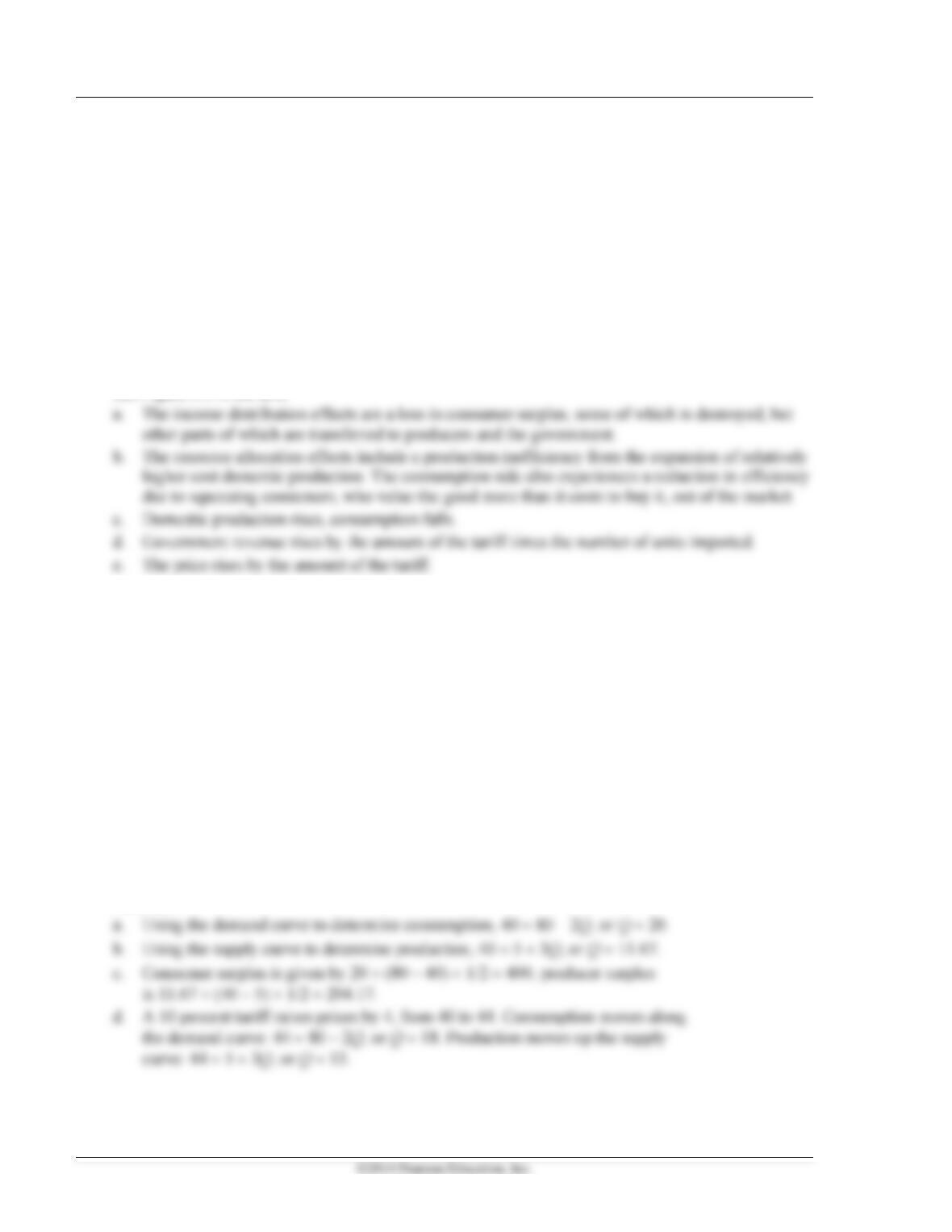
a. Income distribution effects
b. Resource allocation effects
c. Domestic production and consumption effects
d. Government revenue effects
e. Price of the good effects
Answers:
See Figure 6.3 in the text.
2. Suppose the world price for a good is 40 and the domestic demand-and-supply curves are given by
the following equations:
Demand: P = 80 – 2Q
Supply: P = 5 + 3Q
a. How much is consumed?
b. How much is produced at home?
c. What are the values of consumer and producer surplus?
d. If a tariff of 10 percent is imposed, by how much do consumption and
domestic production change?
e. What is the change in consumer and producer surplus?
f. How much revenue does the government earn from the tariff?
g. What is the net national cost of the tariff?
Answers:
Chapter 6 The Theory of Tariffs and Quotas 37
3. Under what conditions may a tariff actually make a country better off?
4. In addition to the production and consumption side deadweight losses, what are some of the other
potential costs of tariffs?
5. The Uruguay Round of the GATT began a process of phasing out the use of voluntary export
restraints. Why did they come into widespread use in the 1980s? For example, given that VERs
are a form of quotas, and that they create quota rents and a larger reduction in national welfare than
tariffs, why did nations use them instead of tariffs?
6. The GATT strongly favors tariffs as a protective measure over quotas or other nontariff measures. It
encourages new members to convert quotas to their tariff equivalents. One of the main reasons tariffs
are preferred is because they are more transparent, particularly by comparison to nontariff measures.
Explain the idea of transparency, and how nontariff measures may be nontransparent.
Answer: Transparency refers to the ability of everyone to easily discover and understand the rules.
7. Suppose that bicycles are made in the United States out of a combination of domestic and
foreign parts.
a. If a bike sells for $500 but requires $300 of imported parts, what is the domestic value added?
b. If a 20 percent tariff is levied on bikes of the same quality and with the same features, how do
the price and the domestic value added change? (Assume the United States cannot cause the
world price to change.)
c. What is the effective rate of protection?
d. If in addition to the 20 percent tariff on the final good, a 20 percent tariff on imported parts is
also levied, what is the effective rate of protection for U.S. bike manufacturers?
Answers: