Chapter 6
Funding the Public Sector
◼ Overview
The chapter covers taxation from the point of view of the government and the taxpayer. It examines the
relationship between tax rates and tax revenues. The chapter addresses taxation and taxation systems.
Proportional, progressive, and regressive tax structures are examined in the context of average and marginal
tax rates. Important federal taxes such as personal income tax, corporate income tax, Social Security, and
unemployment taxes are discussed. Then federal, state, and local taxation and spending are compared.
◼ Learning Objectives
After studying this chapter students should be able to:
• 6.1 Distinguish between average tax rates and marginal tax rates
• 6.2 Explain the structure of the U.S. income tax system
◼ Outline
I. Paying for the Public Sector: Systems of Taxation: The three sources of funding for governments
are user charges, taxes, and borrowing.
A. The Government Budget Constraint: The government budget constraint states that the limit
B. Implementing Taxation with Tax Rates: Because there is a government budget constraint, a
major concern of any government is how to collect taxes.
1. The Tax Base and the Tax Rate: The tax base is the value of goods, services, wealth, or
2. Marginal and Average Tax Rates: The marginal tax rate is defined as the change in the
tax payment divided by the change in income, or the percentage of additional dollars of
84 Miller • Economics Today, Nineteenth Edition
C. Taxation Systems: All taxes can fit into one of three types of taxation systems: proportional,
progressive, and regressive.
1. Proportional Taxation: A tax system in which as the individual’s income goes up, the tax
2. Progressive Taxation: A tax system in which as one earns more income, a higher
3. Regressive Taxation: A tax system in which as more dollars are earned, the percentage of
II. The Most Important Federal Taxes: The federal government imposes income taxes on both
individuals and corporations. It collects Social Security taxes and a variety of other taxes.
A. The Federal Personal Income Tax: This tax accounts for 47 percent of federal revenues
B. The Treatment of Capital Gains: A capital gain is the positive difference between the selling
C. The Corporate Income Tax: This tax accounts for 12 percent of federal revenues.
Corporations pay taxes on corporate profits, and that tax is progressive. (See Figures 6-1 and
Table 6-2.)
1. Double Taxation: Corporate profits are taxed once as corporate profits with the tax paid
by the corporations. Profits distributed as dividends to individuals are taxed again as
2. Who Really Pays the Corporate Income Tax? Corporations do not really exist apart
D. Social Security and Unemployment Taxes: These are taxes on payrolls.
1. Social Security Taxes: The Federal Insurance Contributions Act (FICA) in 1935 brought
2. Unemployment Insurance Taxes: The Unemployment Tax is a payroll tax paid by the
III. Tax Rates and Tax Revenues: The two fundamental issues that governments face when they try
to fund their operations by taxing market activities are how tax rates can be set to maximize tax
revenues for the government.
A. Sales Taxes: Taxes assessed on the prices paid on a large set of goods and services. They are
Chapter 6 Funding the Public Sector 85
B. Static Tax Analysis: The economic evaluation of the effects of a change in tax rates that
C. Dynamic Tax Analysis: The economic evaluation of tax rate changes that recognizes that the
D. Maximizing Tax Revenues: Dynamic tax analysis indicates that as a tax rate increases, the
IV. Taxation from the Point of View of Producers and Consumers: Taxes on goods and services
are levied by all levels of government. These taxes affect market prices and quantities.
B. How Taxes Affect the Market Price and Equilibrium Quantity: The decrease in supply
C. Who Pays the Tax? Both producers and consumers end up paying the tax depending on
the price elasticity of demand. The amount paid by consumers is the difference between the
◼ Points to Emphasize
Marginal and Average Tax Rates
Students often get marginal concepts and average concepts confused. This is the first point in the course
where this issue and its implications are discussed. It is often useful to have them work a problem in
Example 1
Progressive Tax
(1)
Taxable Income
($)
(2)
Tax Paid
($)
(3)
Additional Tax Paid
($)
(4)
Average Tax Rate
(2/1)%
(5)
Marginal Tax Rate
(3/1)%
0
0
—
—
—
86 Miller • Economics Today, Nineteenth Edition
Example 2
Proportional Tax
(1)
Taxable Income
($)
(2)
Tax Paid
($)
(3)
Additional Tax Paid
($)
(4)
Average Tax Rate
(2/1)%
(5)
Marginal Tax Rate
(3/1)%
0
0
—
—
—
Example 3
Regressive Tax
(1)
Taxable Income
($)
(2)
Tax Paid
($)
(3)
Additional Tax Paid
($)
(4)
Average Tax Rate
(2/1)%
(5)
Marginal Tax Rate
(3/1)%
0
0
—
—
—
Taxation Systems and Marginal and Average Tax Rates
Many controversies that arise in taxation policy do so because of the issue of fairness. Although
economists cannot say that one tax is “more fair” than another, we can say whether a tax is regressive,
progressive, or proportional. In the 2008 presidential election, the Democratic candidate, Barack Obama,
Static versus Dynamic Tax Analysis
Politicians often use static tax analysis to present the tax consequences of a tax increase in a favorable
Chapter 6 Funding the Public Sector 87
◼ For Those Who Wish to Stress Theory
Price Elasticity of Demand and Tax Revenues
The text examines the effect of a tax on equilibrium price and quantity and shows that the burden of a
The Implications of High Payroll Tax Rates in the United States
One important issue mentioned is that if the wage cap is eliminated and the Social Security tax rate is
raised from a marginal rate of zero on income earned above the current cap, the highest marginal tax rate
(combined maximum marginal tax rate in the income tax code of 35 percent plus the Social Security
◼ Further Questions for Class Discussion
1. “The power to tax is the power to destroy.” Phosphorous was used in making matches in the
nineteenth and early twentieth centuries. It turned out that phosphorous was very toxic to both
2. Would the burden of financing the federal highway system from general revenue funds be greater
than that of the current system of financing it from gasoline taxes? Answer: There would be no
3. Suppose that 10,000,000 units of a good are sold in a given market each year. A politician
argues that imposing a tax of $5.00 per unit would increase tax revenues for the government by
$50,000,000. Is she right? Explain. No, the politician is not right. She is ignoring the dynamic
4. Suppose that a corporation had pretax profits of $5,000,000. How much in corporate profits taxes
would it pay? Suppose that the company distributed all of its after-tax profits to its 10 stockholders
each of whom owns 10 percent of the shares in the company. Further, assume that each of these
stockholders earned a $350,000 salary in their regular jobs at other companies. What would be
the highest marginal tax rate on that $5,000,000 of corporate earnings? (Hint: Look at the tax
5. Page 132 of the text describes an example of the effect of some states’ special income taxes on
“millionaires.” If a government wants to increase income tax revenues, what would it do to the
◼ Answers to Questions for Critical Analysis
The Progressive U.S. Income Tax System (p. 126)
If average income tax rates paid by the lowest-income taxpayers were increased to equality with
those paid by the highest-income taxpayers, would the U.S. income tax system become more or less
progressive? Explain your reasoning.
Inducing Disability Insurance Recipients Not to Work Causes Payouts to
Exceed Taxes (p. 130)
Why do you suppose that economists commonly refer to the elimination of all disability payments
from people able to work part-time as a “tax” imposed on a disabled individual who is willing and
able to earn part-time wage income?
Chapter 6 Funding the Public Sector 89
Are Vehicle User Fees an Inevitable Replacement for Gasoline Excise Taxes?
(p. 131)
Given that the current gasoline excise tax is computed by applying a per-gallon tax rate to each
gallon and that a future vehicular user fee would be calculated by applying a per-mile fee to each
mile, is there any economic distinction between a “tax” and a “fee”? Explain.
North Carolina Cuts Tax Rates and Expands a Tax Base, and Its Revenue Increase
(p. 133)
Why is there always a difference between static analysis and dynamic analysis of tax changes?
Trying to Boost Government Tax Receipts by Making Tax Delinquents Feel Bad
(p. 134)
Why might people be willing to sacrifice dollars to avoid “feeling bad” about flouting tax laws?
◼ You Are There
Mergers Move U.S. Firms Abroad and Reduce the U.S. Income Tax Base (p. 136)
1. Why is the main objective of these cross-border mergers, whether the U.S. firm is the
acquirer or the company that is acquired, to change the legal domicile of the merged firm
from the standpoint of income taxation?
2. Given that in recent years the governments of many nations have been reducing corporate
income tax rates in relation to the U.S. rate (which remains one of the world’s highest), is the
U.S. tax base shrinkage likely to slow down or speed up? Explain.
◼ Issues & Applications
Will Taxing “Remote Sales” Be a Salvation for Sinking State Budgets (pp. 137−138)
1. How could the legal expenses incurred in establishing rights to assess remote taxes and the
costs that states incur in collecting such taxes cut further into dynamic-analysis estimates of
the net revenue gains to states from implementing the taxes?
2. Why might pressures to satisfy government budget constraints give state governments
incentives to seek to tax remote sales even if they were to determine that actual net revenues
collected likely would be less than originally estimated?
◼ Research Project
1. Take a look at the estimates from the National Council of State Legislatures for revenues forgone
◼ Answers to Problems
6-1. A senior citizen gets a part-time job at a fast-food restaurant. She earns $8 per hour for each
hour she works, and she works exactly 25 hours per week. Thus, her total pretax weekly
income is $200. Her total income tax assessment each week is $40. She pays $3 in taxes for the
final hour she works each week.
a. What is this person’s average tax rate each week?
b. What is the marginal tax rate for the last hour she works each week?
6-2. For purposes of assessing income taxes, there are three official income levels for workers
in a small country: high, medium, and low. For the last hour on the job during a 40-hour
workweek, a high income worker pays a marginal income tax rate of 15 percent, a medium-
income worker pays a marginal tax rate of 20 percent, and a low-income worker is assessed
a 25 percent marginal income tax rate. Based only on this information, does this nation’s
income tax system appear to be progressive, proportional, or regressive?
6-3. Consider the table below when answering the questions that follow. Show your work, and
explain briefly.
Christino
Jarius
Meg
Taxes
Taxes
Taxes
Income
Paid
Income
Paid
Income
Paid
$1,000
$200
$1,000
$200
$1,000
$200
Chapter 6 Funding the Public Sector 91
a. What is Christino’s marginal tax rate?
b. What is Jarius’s marginal tax rate?
c. What is Meg’s marginal tax rate?
b. Jarius’s marginal tax rate is
c. Meg’s marginal tax rate is
6-4. Refer to the table in Problem 6-3 when answering the following questions. Show your
work, and explain briefly.
a. Does Christino experience progressive, proportional, or regressive taxation?
b. Does Jarius experience progressive, proportional, or regressive taxation?
c. Does Meg experience progressive, proportional, or regressive taxation?
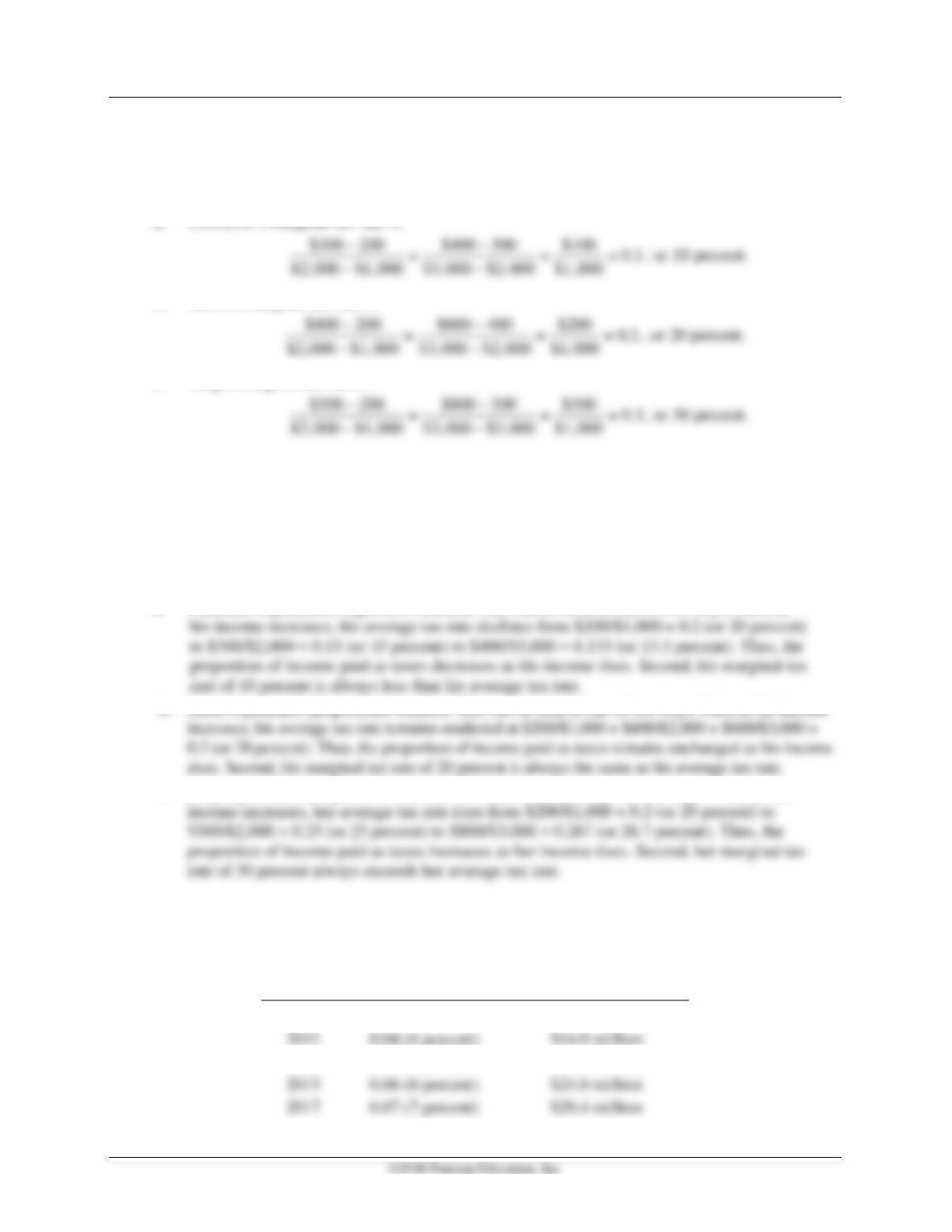
a. Christino experiences regressive taxation. This can be seen in one of two ways. First, as
c. Meg experiences progressive taxation. This can be seen in one of two ways. First, as her
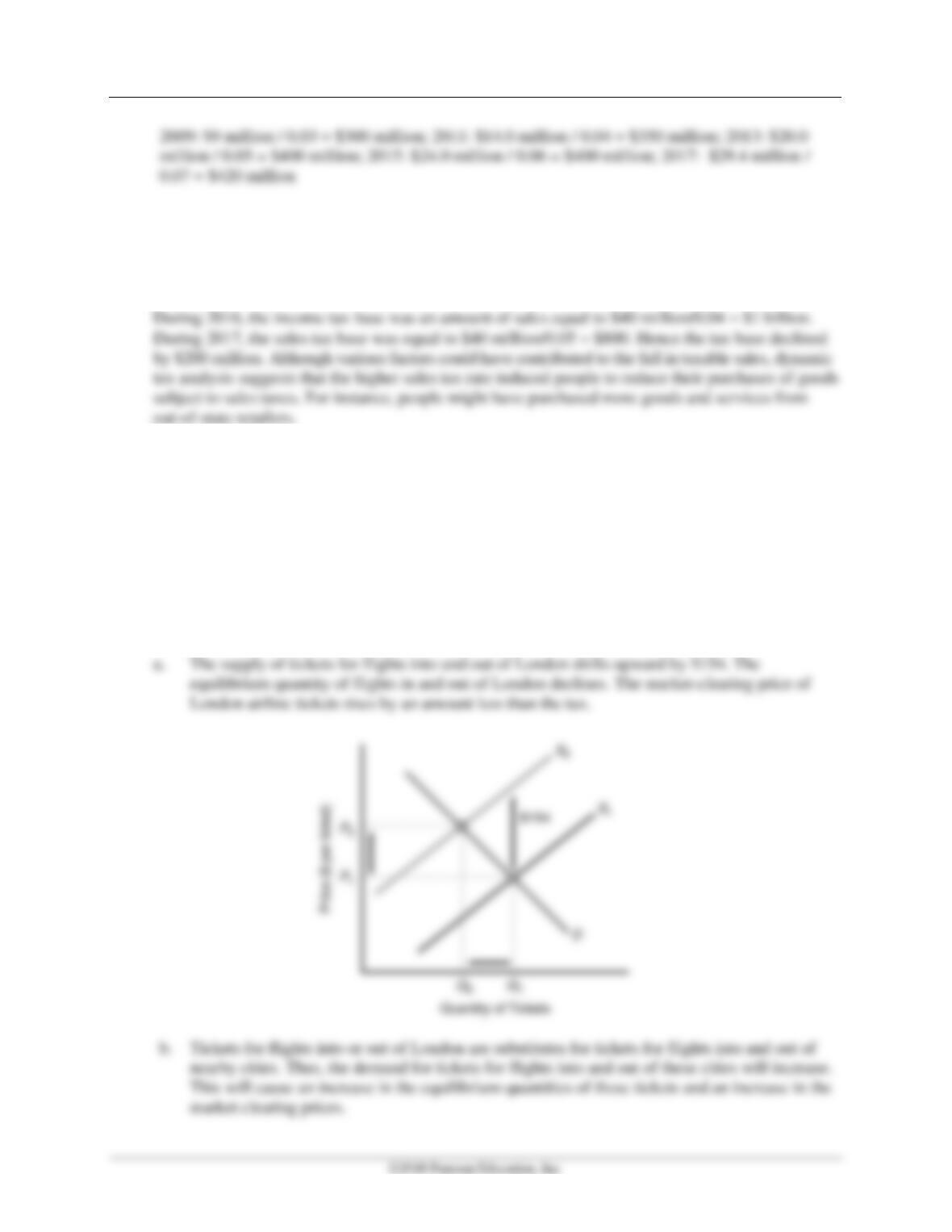
6-5. Suppose that a state has increased its sales tax rate every other year since 2009. Assume the
state collected all sales taxes that residents legally owed. The table below summarizes its
experience. What were total taxable sales in this state during each year displayed in the table?
Year
Sales Tax Rate
Sales Tax Collections
2009
0.03 (3 percent)
$9.0 million
2013
0.05 (5 percent)
$20.0 million
2015
0.06 (6 percent)
$24.0 million
2017
0.07 (7 percent)
$29.4 million
92 Miller • Economics Today, Nineteenth Edition
6-6. The sales tax rate applied to all purchases within a state was 0.04 (4 percent) throughout 2016
but increased to 0.05 (5 percent) during all of 2017. The state government collected all taxes
due, but its tax revenues were equal to $40 million each year. What happened to the sales tax
base between 2016 and 2017? What could account for this result?
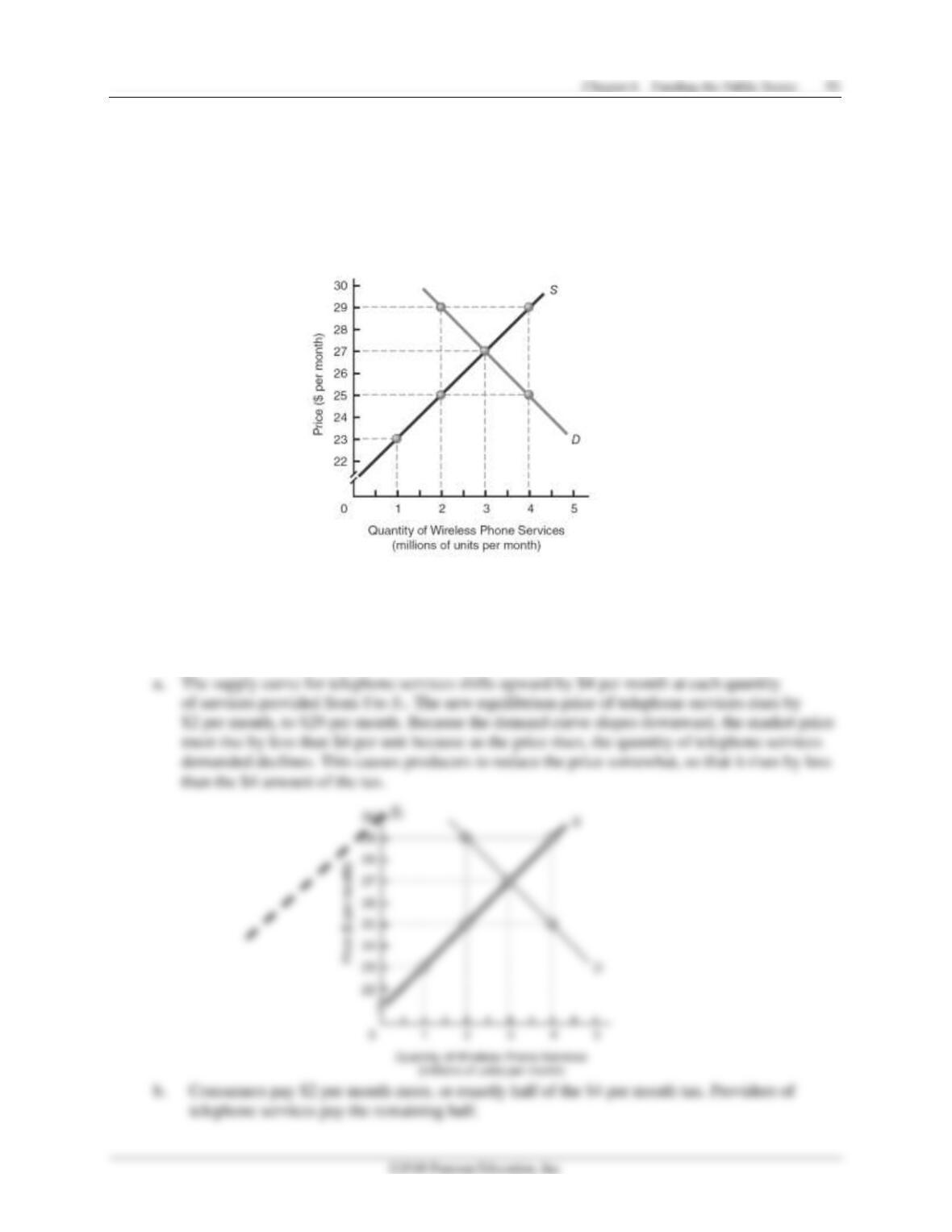
6-7. The British government recently imposed a unit excise tax of about $154 per ticket on airline
tickets applying to flights to or from London airports. In answering the following questions,
assume normally shaped demand and supply curves.
a. Use an appropriate diagram to predict effects of the ticket tax on the market-clearing
price of London airline tickets and on the equilibrium number of flights into and out of
London.
b. What do you predict is likely to happen to the equilibrium price of tickets for air flights
into and out of cities that are in close proximity to London but are not subject to the new
ticket tax? Explain your reasoning.
6-8. To raise funds aimed at providing more support for public schools, a state government has
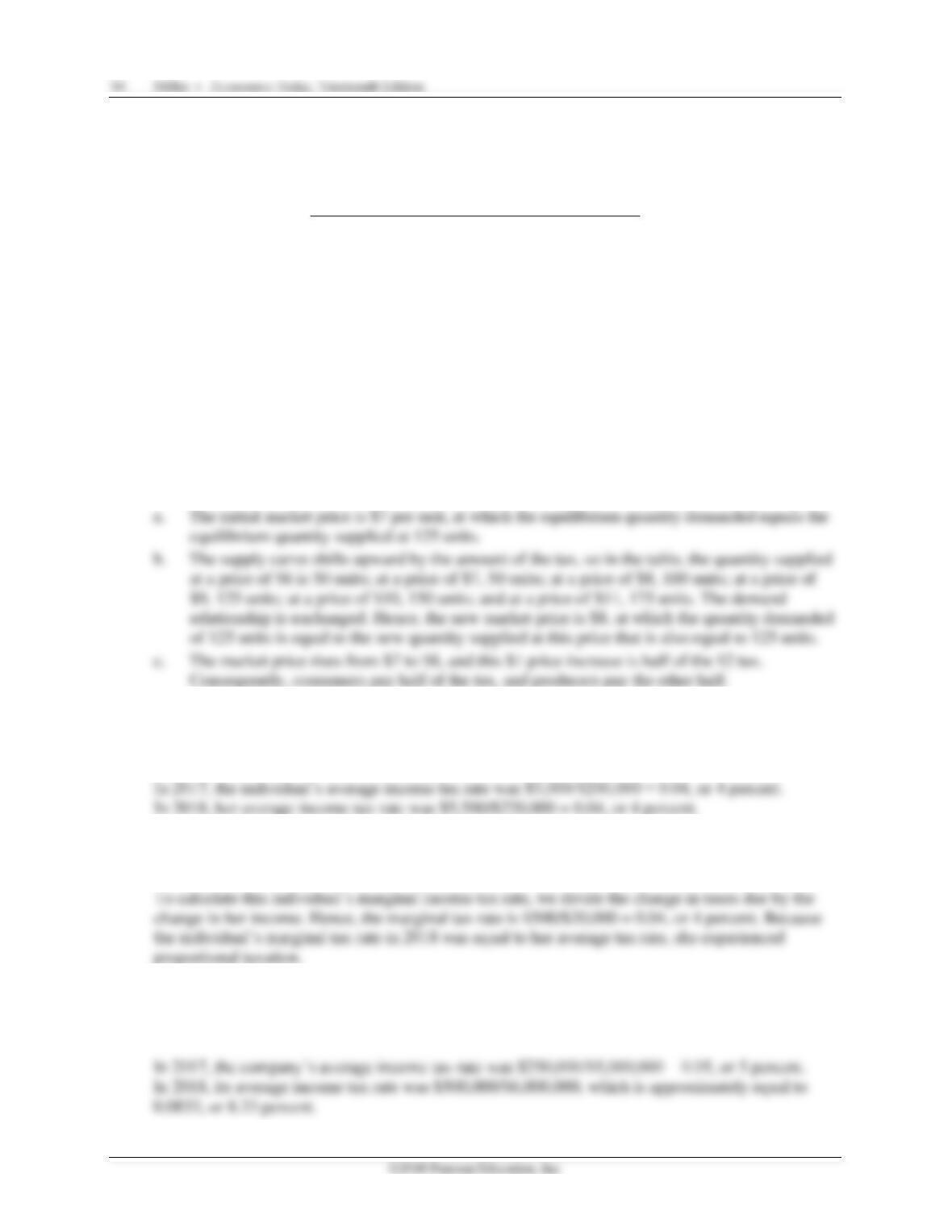
just imposed a unit excise tax equal to $4 for each monthly unit of wireless phone services
sold by each company operating in the state. The following diagram depicts the positions
of the demand and supply curves for wireless phone services before the unit excise tax was
imposed. Use this diagram to determine the position of the new market supply curve now that
the tax hike has gone into effect.
a. Does imposing the $4-per-month unit excise tax cause the market price of wireless phone
services to rise by $4 per month? Why or why not?
b. What portion of the $4-per-month unit excise tax is paid by consumers? What portion is
paid by providers of wireless phone services?
6-9. The following information applies to the market for a particular item in the absence of a unit
excise tax:
Price
Quantity
Quantity
($ per unit)
Supplied
Demanded
4
50
200
5
75
175
6
100
150
7
125
125
8
150
100
9
175
75
a. According to the information in the table, in the absence of a unit excise tax, what is the
market price? What is the equilibrium quantity?
b. Suppose that the government decides to subject producers of this item to a unit excise tax
equal to $2 per unit sold. What is the new market price? What is the new equilibrium
quantity?
c. What portion of the tax is paid by producers? What portion of the tax is paid by consumers?
6-10. Between 2017 and 2018, a small businessperson’s income increased from $200,000 to
$220,000. The annual state income taxes that she paid increased from $5,000 to $5,500.
What was her average state income tax rate in each year?
6-11. In problem 6-10, what was the individual’s marginal state income tax rate in 2018? Did this
individual experience proportional, progressive, or regressive taxation? Explain briefly.
6-12. Between 2017 and 2018, the income received by a company located in a city rose from
$5,000,000 to $6,000,000. The annual city income taxes that the company paid increased from
$250,000 to $500,000. What was the company’s average city income tax rate in each year?
©2018 Pearson Education, Inc.
6-13. In Problem 6-12, what was the company’s marginal city income tax rate in 2018? Did this
company experience proportional, progressive, or regressive taxation? Explain briefly.
6-14. Consider Figure 6–3. Suppose that the government raises its sales tax rate from 4 percent to
6 percent. Does the direction of the effect on the government’s tax revenues indicated by the
figure’s dynamic tax analysis accord with the prediction that would have been forthcoming
from static tax analysis? Explain briefly.
6-15. Consider Figure 6–3. Suppose that the government raises its sales tax rate from 6 percent to
8 percent. Are the predictions of static tax analysis and dynamic tax analysis in agreement on
the direction of the change of the government’s tax revenues? Explain briefly.
◼ Selected References
Bruce, Neil, Public Finance and the American Economy, 2nd ed. Boston: Addison-Wesley, November
2000.
The Budget of the United States Government, Fiscal Year 2011.