Chapter 06 – Consumer Behavior
6-1
Chapter 06 Consumer Behavior
QUESTIONS
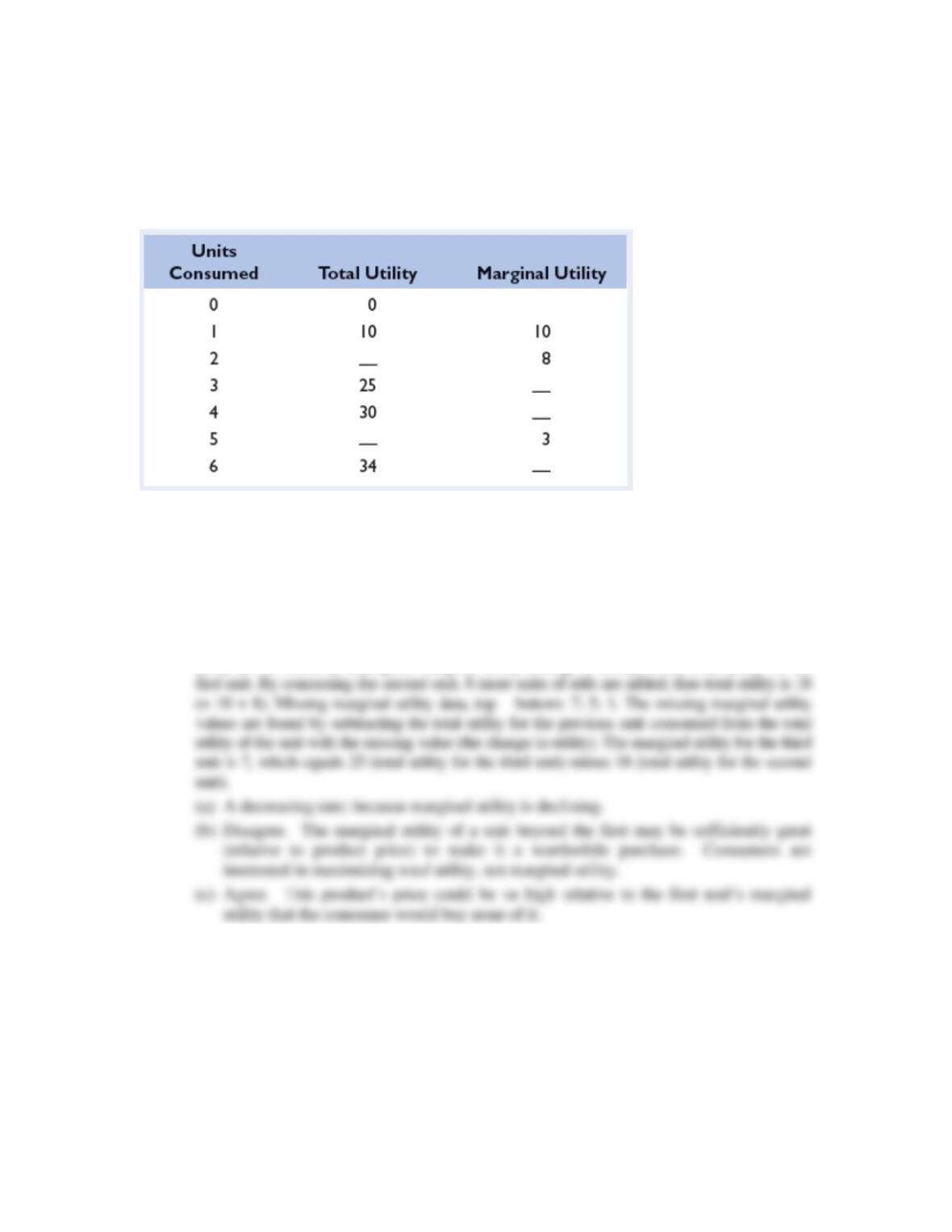
1. Complete the following table and answer the questions below: LO1
a. At which rate is total utility increasing: a constant rate, a decreasing rate, or an increasing rate?
How do you know?
b. “A rational consumer will purchase only 1 unit of the product represented by these data since
that amount maximizes marginal utility.” Do you agree? Explain why or why not.
c. “It is possible that a rational consumer will not purchase any units of the product represented
by these data.” Do you agree? Explain why or why not.
Answer: Missing total utility data, top – bottom: 18; 33. The missing total utility for the second
unity can be found by adding the marginal utility (change in utility) to the total utility for the
2. Mrs. Simpson buys loaves of bread and quarts of milk each week at prices of $1 and 80 cents,
respectively. At present she is buying these products in amounts such that the marginal utilities
from the last units purchased of the two products are 80 and 70 utils, respectively. Is she buying
the utility-maximizing combination of bread and milk? If not, how should she reallocate her
expenditures between the two goods? LO2
Chapter 06 – Consumer Behavior
6-2
Answer: Mrs. Wilson is not buying the utility-maximizing combination of bread and milk
3. How can time be incorporated into the theory of consumer behavior? Explain the following
comment: “Want to make millions of dollars? Devise a product that saves Americans lots of
time.” LO2
Answer: Time is money. This expression is a time-saving way of making the point that
for a person who can make so much per hour, every hour spent not working is so much
4. Explain: LO2
a. Before economic growth, there were too few goods; after growth, there is too little time.
b. It is irrational for an individual to take the time to be completely rational in economic decision
making.
c. Telling your spouse where you would like to go out to eat for your birthday makes sense in
terms of utility maximization.
Answer:
(a) Before economic growth, most people lived at the subsistence level. By practically
anyone’s definition, this implies “too few goods.” After economic growth, goods are
in relative abundance. To make (or consume) more takes time, but the relative
Chapter 06 – Consumer Behavior
6-3
5. In the last decade or so there has been a dramatic expansion of small retail convenience stores
(such as 7 Eleven, Kwik Shop, and Circle K), although their prices are generally much higher
than prices in large supermarkets. What explains the success of the convenience stores? LO2
Answer: These stores are selling convenience as well as the goods that are purchased
there. Because of their small size and convenient locations, they save busy consumers
6. Many apartment-complex owners are installing water meters for each apartment and billing the
occupants according to the amount of water they use. This is in contrast to the former procedure
of having a central meter for the entire complex and dividing up the collective water expense as
part of the rent. Where individual meters have been installed, water usage has declined 10 to 40
percent. Explain that drop, referring to price and marginal utility. LO3
Answer: The way we pay for a good or service can significantly alter the amount
purchased. An individual living in an apartment complex who paid a share of the water
7. Using the utility-maximization rule as your point of reference, explain the income and
substitution effects of an increase in the price of product B, with no change in the price of product
A. LO4
Answer: The utility-maximization rule compares the marginal utilities per dollar of goods
under consideration (in this case A and B). An increase in the price of product B would
8. ADVANCED ANAYLSIS A “mathematically fair bet” is one in which the amount won will
on average equal the amount bet, for example when a gambler bets, say, $100 for a 10 percent
chance to win $1000 ($100 = .10 x $1000). Assuming diminishing marginal utility of dollars,
explain why this is not a fair bet in terms of utility. Why is it even a less fair bet when the
“house” takes a cut of each dollar bet? So is gambling irrational? LO4
Chapter 06 – Consumer Behavior
6-4
Answer: Because the marginal utility of money diminishes the more you have, the utility
9. Suppose that Ike is loss averse. In the morning, Ike’s stockbroker calls to tell him that he has
gained $1000 on his stock portfolio. In the evening, his accountant calls to tell him that he owes
an extra $1000 in taxes. At the end of the day, does Ike feel emotionally neutral since the dollar
value of the gain in his stock portfolio exactly offsets the amount of extra taxes he has to pay?
Explain. LO5
Answer: If Ike is loss averse he will feel losses more intensely than gains. This implies
that the increase in taxes of $1000 will cause a greater level of disutility than the gain in
10. You just accepted a campus job helping to raise money for your school’s athletic program.
You are told to draft a fundraising letter. The bottom of the letter asks recipients to write down a
donation amount. If you want to raise as much money as possible, would it be better if the text of
that section mentioned that your school is #3 in the nation in sports or that you are better than
99% of other schools at sports? Explain. LO5
Answer: The framing effect suggests that we might raise more revenue by stating that
the school is better in sports than 99% of other schools. This is because the value 99
11. LAST WORD What do you think of the ethics of using unconscious nudges to alter people’s
behavior? Before you answer, consider the following argument made by economists Richard
Thaler and Cass Sunstein, who favor the use of nudges. They argue that in most situations we
couldn’t avoid nudging even if we wanted to because whatever policy we choose will contain
some set of unconscious nudges and incentives that will influence people. Thus, they say, we
might as well choose the wisest set of nudges.
Answer: The argument by Thaler and Sunstein is correct. For example, if the default
Chapter 06 – Consumer Behavior
6-5
PROBLEMS
1. Mylie’s total utility from singing the same song over and over is 50 utils after one repetition,
90 utils after two repetitions, 70 utils after three repetitions, 20 utils after four repetitions, -50
utils after five repetitions, and -200 utils after six repetitions. Write down her marginal utility for
each repetition. Once Mylie’s total utility begins to decrease, does each additional singing of the
song hurt more than the previous one or less than the previous one? LO1
Feedback: Consider the following values: Mylie’s total utility from singing the same
song over and over is 50 utils after one repetition, 90 utils after two repetitions, 70 utils
after three repetitions, 20 utils after four repetitions, -50 utils after five repetitions, and –
200 utils after six repetitions.
2. John likes Coca-Cola. After consuming one Coke, John has a total utility of 10 utils. After two
Cokes, he has a total utility of 25 utils. After three Cokes, he has a total utility of 50 utils. Does
John show diminishing marginal utility for Coke or does he show increasing marginal utility for
Coke? Suppose that John has $3 in his pocket. If Cokes cost $1 each and John is willing to spend
one of his dollars on purchasing a first can of Coke, would he spend his second dollar on a Coke,
too? What about the third dollar? If John’s marginal utility for Coke keeps on increasing no
matter how many Cokes he drinks, would it be fair to say that he is addicted to Coke? LO1
Feedback: Consider the following values: After consuming one Coke, John has a total
utility of 10 utils. After two Cokes, he has a total utility of 25 utils. After three Cokes, he
has a total utility of 50 utils. Also, assume John has $3 in his pocket and Cokes cost $1
each.
Chapter 06 – Consumer Behavior
6-6
3. Suppose that Omar’s marginal utility for cups of coffee is constant at 1.5 utils per cup, no
matter how many cups he drinks. On the other hand, his marginal utility per doughnut is 10 for
the first doughnut he eats, 9 for the second he eats, 8 for the third he eats, and so on (that is,
declining by 1 util per additional doughnut). In addition, suppose that coffee costs $1 per cup,
doughnuts cost $1 each, and Omar has a budget that he can spend only on doughnuts, coffee, or
both. How big would that budget have to be before he would spend a dollar buying a first cup of
coffee? LO2
Feedback: Consider the following example: Suppose that Omar’s marginal utility for
cups of coffee is constant at 1.5 utils per cup, no matter how many cups he drinks. On the
other hand, his marginal utility per doughnut is 10 for the first doughnut he eats, 9 for the
second he eats, 8 for the third he eats, and so on (that is, declining by 1 util per additional
doughnut). In addition, suppose that coffee costs $1 per cup, doughnuts cost $1 each, and
Omar has a budget that he can spend only on doughnuts and/or coffee.
Chapter 06 – Consumer Behavior
6-7
4. Columns 1 through 4 in the table below show the marginal utility, measured in utils, that
Ricardo would get by purchasing various amounts of products A, B, C, and D. Column 5 shows
the marginal utility Ricardo gets from saving. Assume that the prices of A, B, C, and D are,
respectively, $18, $6, $4, and $24 and that Ricardo has an income of $106. LO2
a. What quantities of A, B, C, and D will Ricardo purchase in maximizing his utility?
b. How many dollars will Ricardo choose to save?
c. Check your answers by substituting them into the algebraic statement of the utility-maximizing
rule (verify that all of the income has been exhausted between the various goods and savings).
Feedback: Consider the following information and use the table above: the prices of A,
B, C, and D are, respectively, $18, $6, $4, and $24 and Ricardo has an income of $106.
The first step is to convert the marginal utility values into marginal utility per dollar
values. Recall this is MU/P.
Marginal
Utility
per dollar
unit 1
Marginal
Utility
per dollar
unit 2
Marginal
Utility
per dollar
unit 3
Marginal
Utility
per dollar
unit 4
Marginal
Utility
per dollar
unit 5
Marginal
Utility
per dollar
unit 6
Marginal
Utility
per dollar
unit 7
Marginal
Utility
per dollar
unit 8
units
Column 2
4.00
2.50
2.00
1.50
1.17
0.83
0.33
0.17
3
Column 3
3.75
3.00
2.00
1.75
1.25
1.00
0.88
0.75
3
Column 4
1.50
1.25
1.00
0.75
0.54
0.29
0.17
0.08
0
Column 5
5.00
4.00
3.00
2.00
1.00
0.50
0.25
0.13
4
Column 1
4.00
3.00
2.50
2.00
1.50
1.00
0.83
0.67
4
Chapter 06 – Consumer Behavior
6-8
is marginal utility per dollar for good A). The columns represent the marginal utility per
dollar for the different goods for each unit consumed and saving (for example, column 1
‘Marginal Utility per dollar unit 1′ tells us the marginal utility per dollar for the first unit
of every good and savings). This will makes the comparison a little easier.
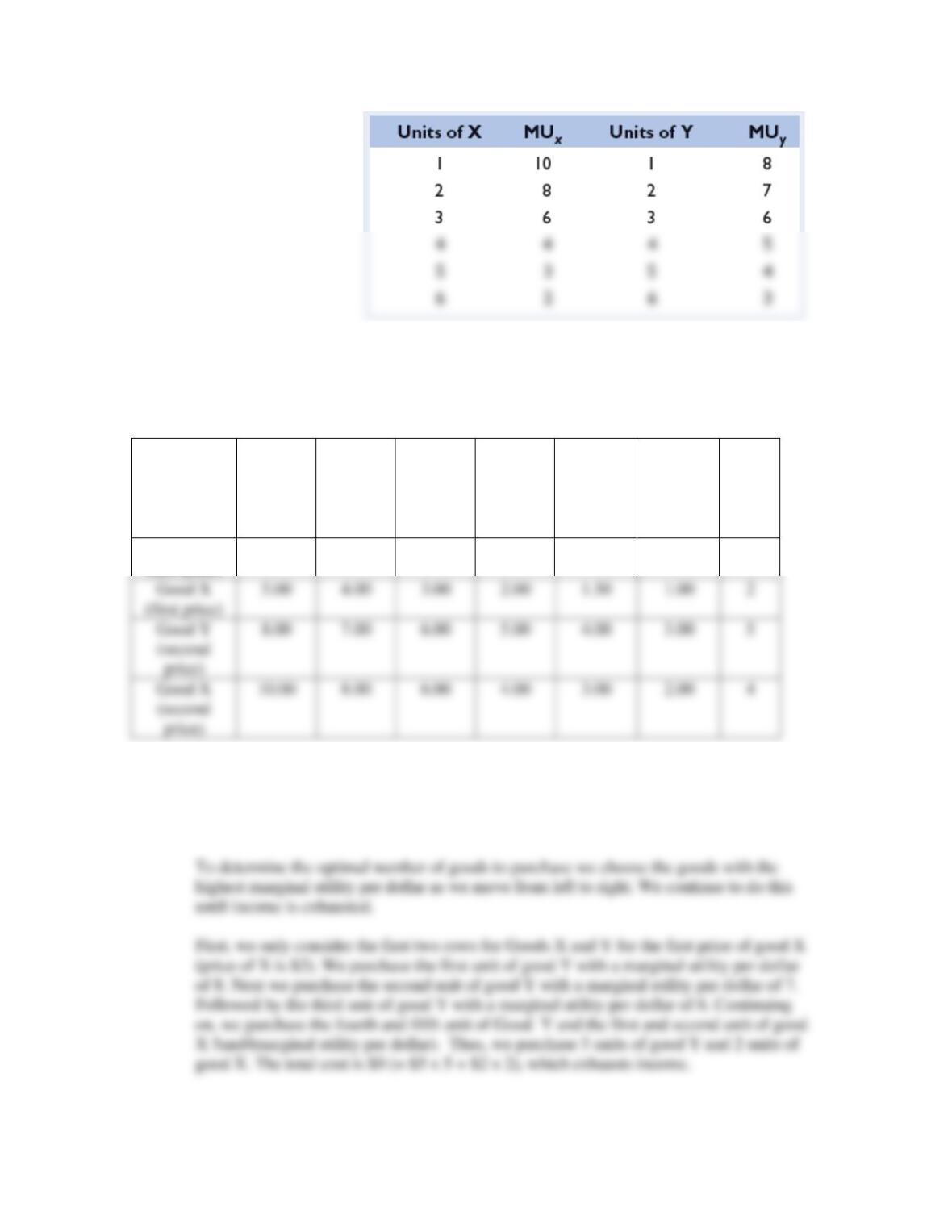
5. You are choosing between two goods, X and Y, and your marginal utility from each is as
shown in the table below. If your income is $9 and the prices of X and Y are $2 and $1,
respectively, what quantities of each will you purchase to maximize utility? What total utility will
you realize? Assume that, other things remaining unchanged, the price of X falls to $1. What
quantities of X and Y will you now purchase? Using the two prices and quantities for X, derive a
demand schedule (prices and quantities demanded table) for X. LO3
Feedback: Consider the following table and information as an example:
Chapter 06 – Consumer Behavior
6-9
Your income is $9 and the prices of X and Y are $2 and $1, respectively.
The first step is to convert the marginal utility values into marginal utility per dollar
values. Recall this is MU/P. See the table below.
Marginal
Utility
per
dollar
unit 1
Marginal
Utility
per
dollar
unit 2
Marginal
Utility
per
dollar
unit 3
Marginal
Utility
per
dollar
unit 4
Marginal
Utility
per
dollar
unit 5
Marginal
Utility
per
dollar
unit 6
Units
Good Y
(first price)
8.00
7.00
6.00
5.00
4.00
3.00
5
Good X
(first price)
5.00
4.00
3.00
2.00
1.50
1.00
2
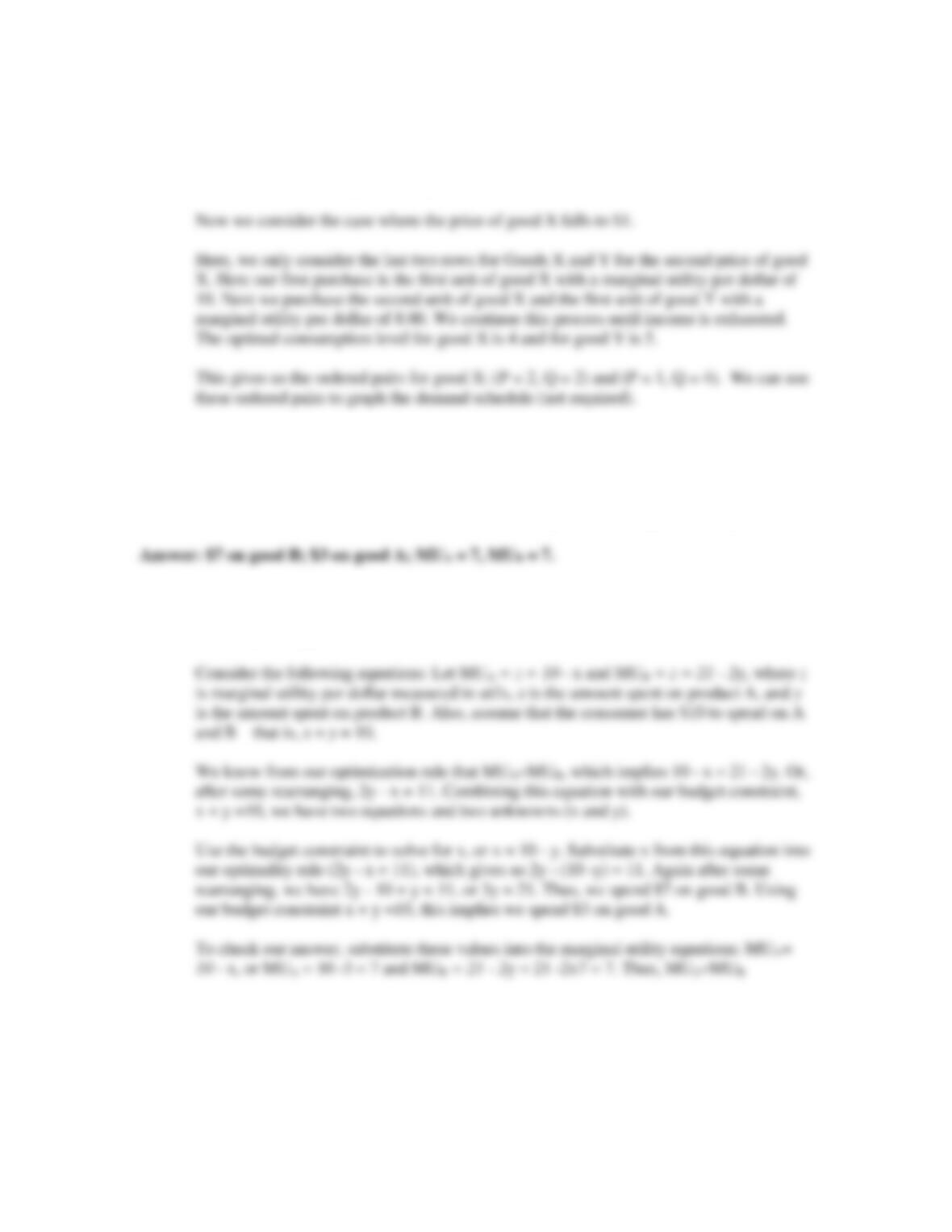
The first two rows define the marginal utility per dollar for goods X and Y when the price
of good X is $2 and the price of Good Y is $1. Each column is the marginal utility for the
unit consumed (Marginal utility per dollar for unit 1 is for the first unit consumed,
Marginal utility per dollar for unit 2 is for the second unit consumed, etc…).
Chapter 06 – Consumer Behavior
6-10
The total utility is then found by adding up the marginal utility values for the goods
consumed using the values in the original table. The total utility from good Y is 30 (=8 +
7 + 6 + 5 + 4) and the total utility from good X is 18 (=10 + 8). The sum of these two
values is the total utility, which equals 48 (=30 + 18).
6. ADVANCED ANAYLSIS Let MUA = z = 10 – x and MUB = z = 21 – 2y, where z is marginal
utility per dollar measured in utils, x is the amount spent on product A, and y is the amount spent
on product B. Assume that the consumer has $10 to spend on A and B—that is, x + y = 10. How
is the $10 best allocated between A and B? How much utility will the marginal dollar yield? LO3
Feedback: To solve this system of equations we set the MUA=MUB. This is required if
we are maximizing utility. This leaves with only x and y to solve for using the
individual’s budget constraint.
Chapter 06 – Consumer Behavior
6-11
7. Suppose that with a budget of $100, Deborah spends $60 on sushi and $40 on bagels when
sushi costs $2 per piece and bagels cost $2 per bagel. But then, after the price of bagels falls to $1
per bagel, she spends $50 on sushi and $50 on bagels. How many pieces of sushi and how many
bagels did Deborah consume before the price change? At the new prices, how much money
would it have cost Deborah to buy those same quantities (the ones that she consumed before the
price change)? Given that it used to take Deborah’s entire $100 to buy those quantities, how big is
the income effect caused by the reduction in the price of bagels? LO4
Feedback: Consider the following values as an example. Suppose that with a budget of
$100, Deborah spends $60 on sushi and $40 on bagels when sushi costs $2 per piece and
bagels cost $2 per bagel. But then, after the price of bagels falls to $1 per bagel, she
spends $50 on sushi and $50 on bagels.