CHAPTER 6 | Firms, the Stock Market, and
Corporate Governance
Brief Chapter Summary and Learning Objectives
6.1 Types of Firms (pages 252–256)
Categorize the major types of firms in the United States.
6.2 How Firms Raise Funds (pages 256–263)
Explain how firms raise the funds they need to operate and expand.
6.3 Using Financial Statements to Evaluate a Corporation (pages 263–265)
6.4 Corporate Governance Policy and the Financial Crisis of 2007–2009
(pages 265–269)
Explain the role that corporate governance problems may have played in the financial
crisis of 2007–2009.
▪ Several scandals in the early 2000s involved top managers who inflated profits and hid
Appendix: Tools to Analyze Firms’ Financial Information (pages 275–283)
Understand the concept of present value and the information contained on a firm’s income
statement and balance sheet.

CHAPTER 6 | Firms, the Stock Market, and Corporate Governance 123
Key Terms
Accounting profit, p. 264. A firm’s net income,
measured as revenue minus operating expenses
and taxes paid.
Asset, p. 252. Anything of value owned by a
person or a firm.
Corporate governance, p. 255. The way in
which a corporation is structured and the effect
that structure has on the corporation’s behavior.
Corporation, p. 252. A legal form of business
that provides owners with protection from losing
more than their investment should the business
fail.
Coupon payment, p. 257. An interest payment
on a bond.
Indirect finance, p. 256. A flow of funds
from savers to borrowers through financial
intermediaries such as banks. Intermediaries
raise funds from savers to lend to firms
(and other borrowers).
Interest rate, p. 257. The cost of borrowing
more than they have invested in the firm.
Opportunity cost, p. 264. The highest-valued
alternative that must be given up to engage in an
activity.
Partnership, p. 252. A firm owned jointly by
two or more persons and not organized as a
corporation.
Principal-agent problem, p. 255. A problem
caused by an agent pursuing his own interests
124 CHAPTER 6 | Firms, the Stock Market, and Corporate Governance
Key Terms—Appendix
Present value, p. 275. The value in today’s
dollars of funds to be paid or received in the
future.
Stockholders’ equity, p. 281. The difference
between the value of a corporation’s assets and
the value of its liabilities; also known as net
worth.
Chapter Outline
Is Twitter the Next Facebook?
A major decision for a successful media startup company is whether to remain a private firm, to become a
public firm, or to sell itself to a larger company. Firms such as Facebook, Twitter, Snapchat, and
6.1
Types of Firms (pages 252–256)
Learning Objective: Categorize the major types of firms in the United States.
In the United States, there are three legal categories of firms. A sole proprietorship is a firm owned by a
A. Who Is Liable? Limited and Unlimited Liability
The owners of sole proprietorships and partnerships have unlimited liability, which means that there is no
legal distinction between the personal assets of the owners and the assets of the firm. An asset is anything
B. Corporations Earn the Majority of Revenue and Profits
Although only 18 percent of all firms are corporations, corporations account for the majority of revenue
and profits earned by all firms.
CHAPTER 6 | Firms, the Stock Market, and Corporate Governance 125
C. The Structure of Corporations and the Principal-Agent Problem
Most large corporations have a similar management structure. Corporate governance is the way in
which a corporation is structured and the effect that structure has on the corporation’s behavior.
Teaching Tips
Corporations are often described as “publicly owned.” Be sure your students do not mistakenly believe
this phrase means “government owned.”
Extra Solved Problem 6.1
The Risks of Private Enterprise: The “Names” of Lloyd’s of London
The world famous insurance company Lloyd’s of London got its start in London in the 1600s. Ship
owners would come to Edward Lloyd’s coffeehouse to find someone to insure (or “underwrite”) their
insurance policies sold to a wide variety of clients.
By the 1980s, 34,000 people around the world had invested in Lloyd’s as Names. A series of disasters in
the 1980s and 1990s—such as earthquakes and oil spills—resulted in huge payments made on Lloyd’s
insurance policies. It had become clear that Lloyd’s was not a corporation and the Names did not have the
limited liability that a corporation’s stockholders have. Many Names lost far more than they had invested.
Some of those who invested in Lloyd’s had the financial resources to absorb their losses, but others did
126 CHAPTER 6 | Firms, the Stock Market, and Corporate Governance
Solving the Problem
Step 1: Review the chapter material.
This problem is about firms and corporate governance, so you may want to review the section
“Types of Firms,” which begins on page 252 in the textbook.
Step 2: Answer part (a) by explaining what characteristic of Lloyd’s of London’s business
organization was responsible for the financial losses suffered by the Names who
had invested in Lloyd’s.
Lloyd’s of London was a partnership. A disadvantage of partnerships, as well as sole
Step 3: Answer part (b) by explaining how the losses suffered by Enron and WorldCom
stockholders were different from the losses suffered by Lloyd’s of London’s
Names.
Enron and WorldCom were corporations, so their stockholders had limited liability. Their
losses were limited to the amount they had invested in these firms.
6.2
How Firms Raise Funds (pages 256–263)
Learning Objective: Explain how firms raise the funds they need to operate and
expand.
To earn a profit, a firm must raise funds to pay for its operations. If a small business is successful and the
A. Sources of External Funds
Unless firms rely on retained earnings, they must obtain the external funds they need from others. The
economy’s financial system transfers funds from savers to borrowers—directly through financial
markets or indirectly through financial intermediaries such as banks. Firms raise external funds in two
CHAPTER 6 | Firms, the Stock Market, and Corporate Governance 127
Many bonds that corporations issue have maturities of thirty years. The interest rate that a borrower
selling a bond has to pay depends on how likely bond buyers think that the bond seller is to default. The
higher the default risk on a bond, the higher the interest rate.
B. Stock and Bond Markets Provide Capital—and Information
Most buying and selling of stocks and bonds involves investors reselling existing stocks and bonds. There
is no single place where stocks and bonds are bought and sold. Some trading takes place in buildings
called exchanges. Computer technology has spread trading to securities dealers outside of exchanges.
These dealers comprise the over-the-counter market. Shares of stock represent claims on the profits of
firms that issue them. Changes in the prices of stocks, bonds, and other securities reflect investors’ future
expectations.
C. The Fluctuating Stock Market
Stock market indexes are averages of stock prices, with the value of the index set equal to 100 in the base
year. The three most widely followed U.S. stock indexes are: the Dow Jones Industrial Average, the
128 CHAPTER 6 | Firms, the Stock Market, and Corporate Governance
Teaching Tips
The double taxation of corporate profits-once from the corporate profits tax and again from the income
Extra Making
the
Connection
Following Abercrombie & Fitch’s Stock Price in the Financial
Pages
If you read the online stock listings on the Wall Street Journal’s Web site or on another site, you will
notice that the listings pack into a small space a lot of information about what happened to stocks during
the previous day’s trading. The following figure reproduces a small portion of the listings from the Wall
Street Journal on June 8, 2013, for stocks listed on the New York Stock Exchange. The listings provide
information on the buying and selling of stocks of five firms during the previous day. Let’s focus on the
highlighted listing for Abercrombie & Fitch, the clothing store, and examine the information in each
column:
• The first column gives the name of the company.
• The second column gives the firm’s “ticker” symbol (ANF), which you may have seen scrolling
along the bottom of the screen on cable financial news channels.
• The eighth column (%Chg) gives the change in the price in percentage terms rather than in dollar
terms.
• The ninth column (Vol) gives the number of shares of stock traded on the previous day.
• The tenth column (52-Week High) and the eleventh column (52-Week Low) give, the highest
price the stock has sold for and the lowest price the stock has sold for during the previous year.
These numbers tell how volatile the stock price is—how much it fluctuates over the course of the
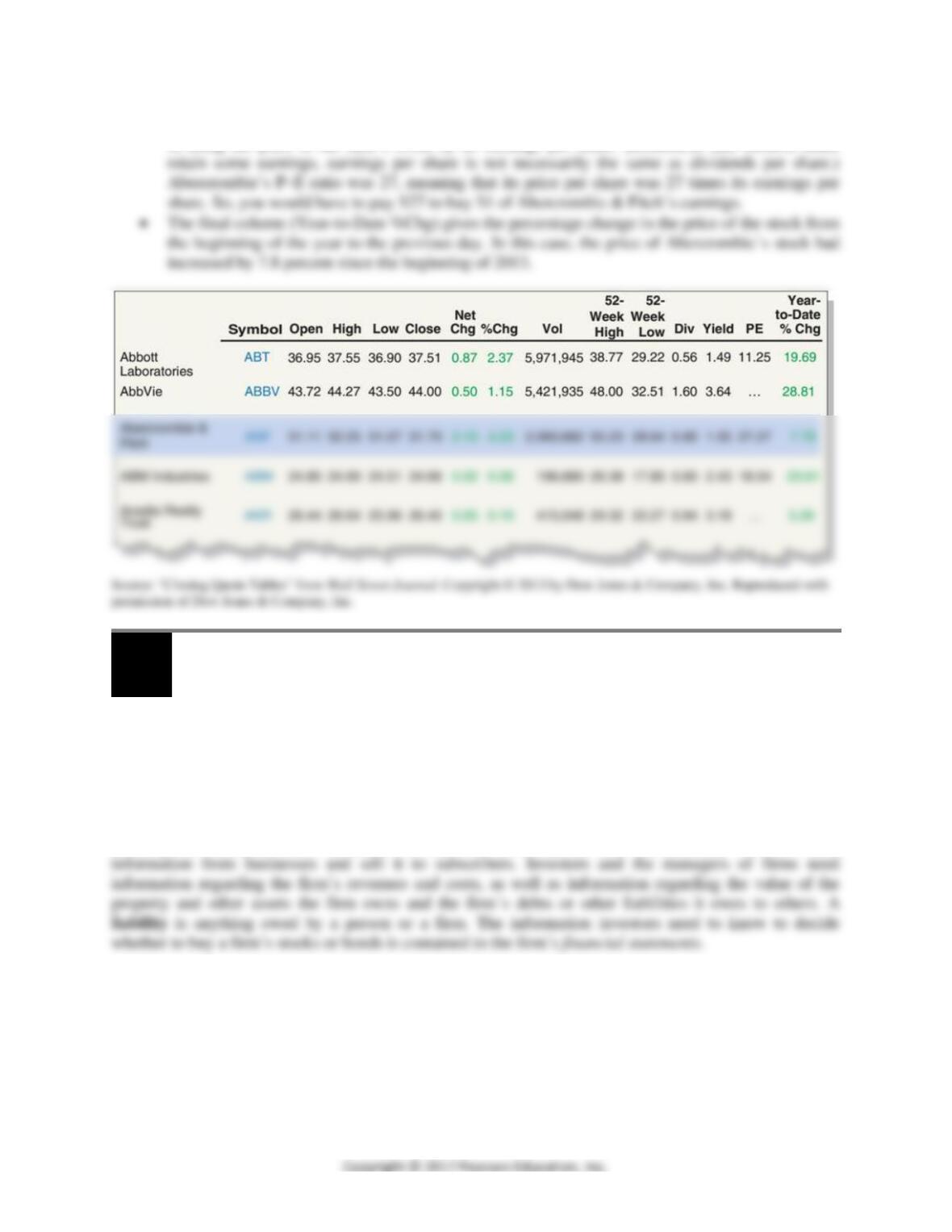
CHAPTER 6 | Firms, the Stock Market, and Corporate Governance 129
• The fourteenth column (PE) gives the P–E ratio (or price–earnings ratio), which is calculated by
dividing the price of the firm’s stock by its earnings per share. (Remember that because firms
6.3
Using Financial Statements to Evaluate a Corporation (pages 263–265)
Learning Objective: Understand the information corporations include in their financial
statements.
Before a firm can sell new issues of stocks or bonds, it must provide investors with information about its
finances. To borrow money, firms must disclose financial information to the lender. In most high-income
countries, government agencies require firms that want to sell securities to disclose financial information
to the public. In the United States, the Securities and Exchange Commission (SEC) requires publicly
owned firms to report their performance according to generally accepted accounting principles.
Some private companies (for example, Moody’s Investor Service and Standard and Poor’s) collect
A. The Income Statement
A firm’s income statement is a financial statement that shows a firm’s revenues, costs, and profit over a
period of time. The income statement starts with a firm’s revenue and subtracts its operating expenses and
taxes. Accounting profit is a firm’s net income, measured as revenue minus operating expenses and taxes
paid. Accounting profit neglects some of the firm’s costs. Economic profit is the firm’s revenues minus
all of its implicit and explicit costs. Because economic profit takes into account all costs it provides a
better indication than accounting profit of how successful a firm is. Economists always measure cost as
130 CHAPTER 6 | Firms, the Stock Market, and Corporate Governance
B. The Balance Sheet
A balance sheet is a financial statement that sums up a firm’s financial position on a particular day, usually
the end of a quarter or year. A balance sheet summarizes a firm’s assets and liabilities. Subtracting the value
of a firm’s liabilities from the value of its assets leaves its new worth. Net worth is what the firm’s owners
would be left with if the firm were closed, its assets sold, and its liabilities paid off.
Teaching Tips
Although it is a macroeconomic topic, your students may be interested in the role stock prices play as an
admittedly imperfect leading economic indicator. Changes in stock prices reflect firms’ expected future
Extra Making
the
Connection
A Bull in China’s Financial Shop
Prospects for Sichuan Changhong Electric Co., manufacturer of plasma televisions and liquid crystal
displays, looked excellent in 2008, with rapidly growing output, employment, and profits earned from
trade in the world economy. And Changhong was not alone. In the 2000s, the Chinese economy was
sizzling. China’s output grew by 11.4 percent during 2007, dominated by an astonishing 24 percent
growth in investment in plant and equipment. The Chinese economic juggernaut caught the attention of
the global business community—and charged onto the U.S. political stage, as China’s growth fueled
concerns about job losses in the United States.
CHAPTER 6 | Firms, the Stock Market, and Corporate Governance 131
China’s prospects for long-term economic growth depend importantly on a better developed financial
system to generate information for borrowers and lenders. Many economists have urged Chinese officials
6.4
Corporate Governance Policy and the Financial Crisis of 2007–2009
(pages 265–269)
Learning Objective: Explain the role that corporate governance problems may have
played in the financial crisis of 2007–2009.
Firms disclose financial statements in periodic filings to the federal government and in annual reports to
shareholders. The management of a firm has two reasons to attract investors and keep the firm’s stock
A. The Accounting Scandals of the Early 2000s
In the early 2000s, top managers at some firms, such as Enron and WorldCom, falsified their firms’
financial statements to mislead investors about how profitable they were. The federal government
regulates how financial statements are prepared but cannot guarantee the accuracy of the statements. To
B. The Financial Crisis of 2007–2009
Beginning in 2007 and lasting into 2009, the U.S. economy suffered the worst financial crisis since the
Great Depression. At the heart of the crisis was a problem in the mortgage market. Beginning in the
1970s, financial institutions began securitizing mortgage loans. Mortgage-backed securities are similar to
bonds—buyers receive regular interest payments, which in this case come from the payments made on the
132 CHAPTER 6 | Firms, the Stock Market, and Corporate Governance
Many investors complained that they weren’t aware of how risky some of the assets on the balance sheets
of financial firms were. Some observers believed that the managers of many financial firms misled
investors about the riskiness of these assets. In the fall of 2008, Fannie Mae and Freddie Mac were
C. Did Principal-Agent Problems Help Cause the 2007–2009 Financial Crisis?
Beginning in the 1990s, private investment banks began to securitize mortgages. Investment banks had
traditionally concentrated on providing advice to corporations selling stocks and bonds and on
underwriting the issuance of stocks and bonds. To address the risks of investment banking, Congress
passed the Glass-Steagall Act in 1933 to prevent firms from being both commercial banks and investment
Extra Economics in Your Life:
Spreading the Risks of Stock Ownership
Question: Buying shares of stock would be risky even in the absence of principal-agent problems.
Shareholders enjoy limited liability but, unlike bonds, stock dividends are not always paid, and
shareholders always face the possibility that stock prices can fall below the level the shareholders paid for
them. Aside from buying shares of well-known companies, how can people with limited funds minimize
the risks involved in investing in stocks?
Answer: Many people choose to purchase stocks through mutual funds, which are professionally
managed investments that combine, or pool, the funds of many investors. Mutual fund managers can use
Extra AN INSIDE LOOK News Article to Use in Class
Visit www.myeconlab.com for current An Inside Look news articles.
CHAPTER 6 | Firms, the Stock Market, and Corporate Governance 133
Appendix
Tools to Analyze Firms’ Financial Information (pages 275–283)
Learning Objective: Understand the concept of present value and the information contained on a
firm’s income statement and balance sheet.
Large firms raise funds from outside investors, and outside investors seek information on firms and the
assurance that the firms’ managers will act in the interests of investors.
Using Present Value to Make Investment Decisions
If you own shares of stock or a bond, you will receive payments in the form of dividends or coupons over a
number of years. Most people value funds they already have more highly than funds they will receive in the
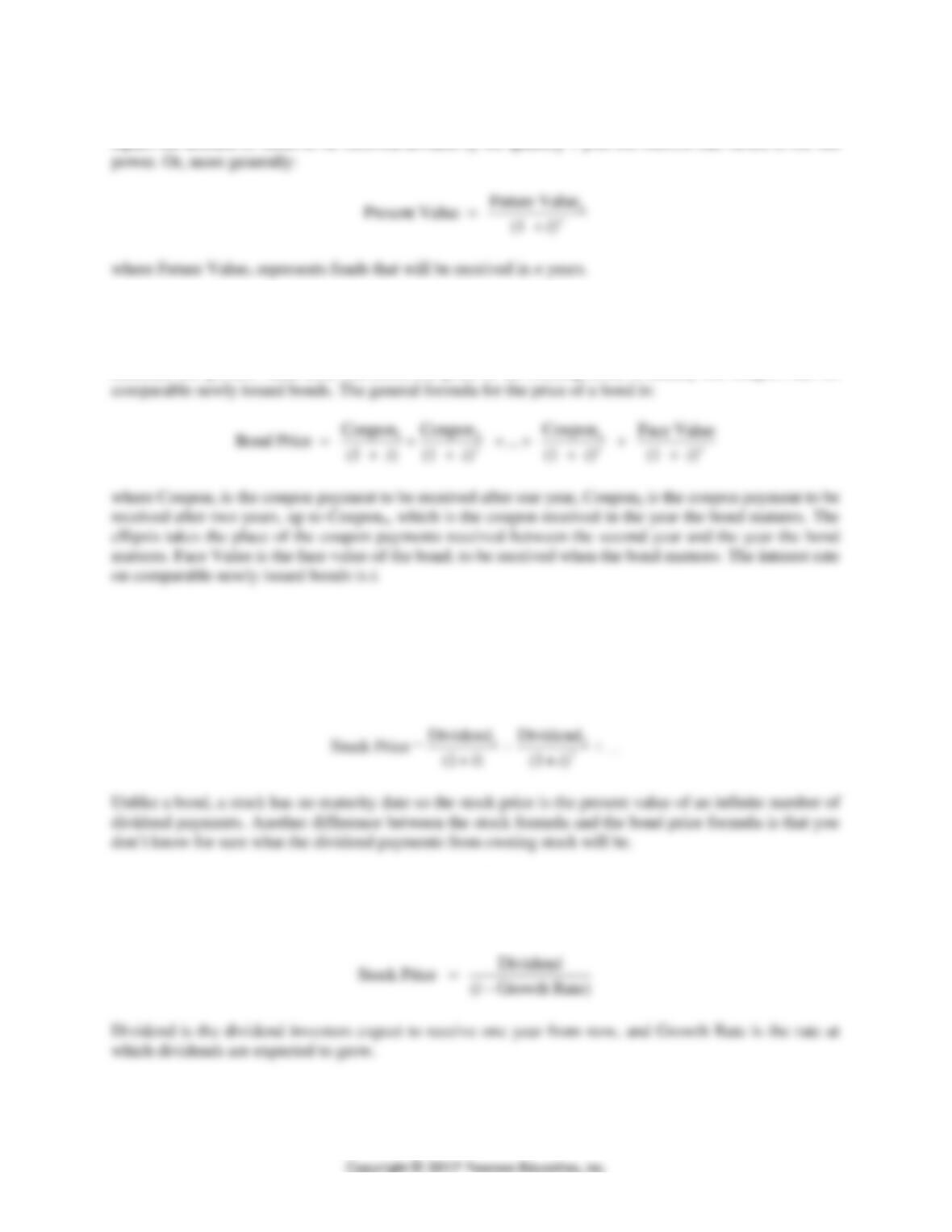
future. Present value is the value in today’s dollars of funds to be paid or received in the future. Say that you
The present value of funds to be received in one year—Future Value1—can be calculated by dividing the
amount of those funds to be received by 1 plus the interest rate. The formula can be expanded to calculate
the value of funds to be received more than one year in the future. Suppose you are asked to lend
$1,000 for two years and are promised 10 percent interest per year. After two years, you will be paid back
$1,100 (1 + 0.10) or $1,210. Or:
134 CHAPTER 6 | Firms, the Stock Market, and Corporate Governance
We can generalize the concept to say that the present value of funds to be received n years in the future
equals the amount of funds to be received divided by the quantity 1 plus the interest rate raised to the nth
A. Using Present Value to Calculate Bond Prices
The price of a financial asset, such as a bond, should be equal to the present value of the payments to be
received from owning the asset. The relevant interest rate used by investors in the bond market to
calculate the present value and, therefore, the price of an existing bond is usually the coupon rate on
B. Using Present Value to Calculate Stock Prices
The price of a share of stock should be equal to the present value of the dividends investors expect to
receive as a result of owning the stock.
The general formula for the price of a stock is:
C. A Simple Formula for Calculating Stock Prices
It is possible to simplify the formula for determining the price of a stock if we assume that dividends
grow at a constant rate: