CHAPTER 6 | Firms, the Stock Market, and Corporate Governance 135
Going Deeper into Financial Statements
Key sources of information about a corporation’s profitability and financial position are its principal
financial statements—the income statement and the balance sheet.
A. Analyzing Income Statements
A firm’s income statement summarizes its revenues, costs, and profit over a period of time. Listed first
are the revenues the firm earned. Listed next are operating expenses, including the cost of revenue, which
B. Analyzing Balance Sheets
A firm’s balance sheet summarizes its financial position on a particular day, usually the end of a quarter
or year. Subtracting the value of a firm’s liabilities from the value of its assets leaves its net worth.
Because a corporation’s stockholders are its owners, net worth is often listed as stockholders’ equity.
Stockholders’ equity is the difference between the value of a corporation’s assets and the value of its
liabilities, which is also known as net worth. The value of a firm’s assets must equal the value of its
Teaching Tips
Although the principal-agent problem is a serious one, managers who pursue their own goals at the
expense of the firm’s best interests invite the scrutiny of institutional investors such as mutual funds and
136 CHAPTER 6 | Firms, the Stock Market, and Corporate Governance
Solutions to End-of-Chapter Exercises
6.1
Types of Firms
Learning Objective: Categorize the major types of firms in the United States.
Review Questions
1.1 A sole proprietorship is owned by a single individual and isn’t organized as a corporation. A
1.2 Limited liability is a legal provision that shields owners of a corporation from losing more than
they have invested in the firm. The government grants this privilege to corporations because
1.3 Because the stockholders of a corporation can never lose more than the amount they invested in
1.4 Shares of stock represent partial ownership in large corporations, so that those who own stock
own the corporation and share in the company’s profits. Control of the corporation is possessed
1.5 The principal-agent problem results when an agent pursues his own interests rather than the
Problems and Applications
1.6 It depends on the type of business you are entering. Incorporation has the advantage of limited
liability but the disadvantage of additional taxes. If you choose not to form a corporation, then
CHAPTER 6 | Firms, the Stock Market, and Corporate Governance 137
1.7 Before the incorporation law was passed, owners of all businesses established in Connecticut had
1.8 The person making this argument does not understand that stockholders in a corporation have
limited liability. Limited liability is the legal provision that shields owners of a corporation from
1.9 Early in the nineteenth century, state legislatures in the United States began passing general
incorporation laws, allowing firms to be organized as corporations. These laws gave owners of
1.10 a. Many large, existing firms are focused on improving existing goods and services because
they have established markets and the firms have expertise in producing these products. New
firms have incentives to establish markets with new “disruptive” innovations that have a high
1.11 a. Licensing requirements for some professions, such as medical doctors, help to reassure the
public that competent individuals provide vital human services. However, many critics view
licensing requirements for other professions, such as yoga teachers and hair braiders, as
1.12 The principal is the person who wants to get something done and hires an agent to do the job.
Seen this way, the students are the principals, along with a state’s taxpayers, at least at public
universities. In effect, students hire the instructor to do a job that they can’t easily do by
138 CHAPTER 6 | Firms, the Stock Market, and Corporate Governance
1.13 Top managers know more about how the company is run than do the firm’s shareholders. The
1.14 Sales personnel have an incentive to receive the highest income possible for the least amount of
effort. The owner of the business would like his or her employees to make as many sales as
1.15 Private equity firms do reduce problems of corporate governance by helping to establish a market
6.2
How Firms Raise Funds
Learning Objective: Explain how firms raise the funds they need to operate and
expand.
Review Questions
2.1 Direct finance occurs when a firm obtains funds directly from savers through the stock or bond
market. Indirect finance occurs when firms obtain funds from savers indirectly through an
2.2 A bond is a loan because the firm promises to pay back the principal and interest to the
bondholder. Rather than a loan, a share of stock is the purchase of part ownership of a company
2.3 Stock and bond markets provide information that helps investors anticipate what will happen to
the firm. If they are optimistic and think the firm will earn higher profits, then they will bid up the
price of its stock. If they are pessimistic, then the price of the stock will fall. If they are
pessimistic and fear that the firm might suffer financial losses and default on its bond payments,
CHAPTER 6 | Firms, the Stock Market, and Corporate Governance 139
Problems and Applications
2.5 You would be better off if you had bought the stock because it will have increased in value, while
the interest the firm pays on the bonds will have remained the same.
2.8 a. Moody’s top bond rating is Aaa. Moody’s must have had concerns about McDonald’s ability
to repay its debt. Such concerns could have been influenced by slow sales growth and
2.9 Selling their services to investors would create a “free rider” problem. An investor who bought
2.10 a. Google’s stock price will fall because its expected future revenues and profits will have
fallen.
b. Google’s stock price will rise because Google’s after-tax profits will rise.
2.11 The statement is false. These shares were traded in the secondary market (the NASDAQ), so the
money went from the investors who had owned these shares to the investors who bought the
shares in the market. The money didn’t go to Microsoft.
2.12 Attempting to forecast stock prices is inherently difficult for anyone because stock prices are
140 CHAPTER 6 | Firms, the Stock Market, and Corporate Governance
2.13 Warren Buffet advises individual (non-professional) investors to concentrate on buying shares of
mutual funds that charge relatively low fees. Mutual funds allow individuals to diversify their
investments so that a decline in the price of a single stock or bond can be offset by price increases
6.3
Using Financial Statements to Evaluate a Corporation
Learning Objective: Understand the information corporations include in their financial
statements.
Review Questions
3.1 An asset is anything of value that a firm owns (such as a building). A liability is a debt or
obligation owed by a firm (such as an unpaid electric bill).
3.2. A firm’s balance sheet is a snapshot of the firm’s assets and liabilities on a particular day (such as
the end of a quarter). A firm’s income statement summarizes its revenues, costs, and profit over a
period of time (such as a year).
Problems and Applications
3.5 Paolo has forgotten to take into account the opportunity cost of keeping the money invested. If he
were to keep the money invested in bonds, he would earn an interest rate of 10 percent per year.
CHAPTER 6 | Firms, the Stock Market, and Corporate Governance 141
3.6 Their costs are the same. Even though Alfredo receives the pizza ovens for free, as the owner of
the restaurant he incurs an opportunity cost by using the ovens in his own business. There is an
opportunity cost because he is giving up the funds he could receive by leasing the ovens or by
3.7 a. Accounting profit = revenues – explicit costs. Explicit costs are those that involve spending
money, which include $75,000 paid to assistants and $10,000 for utilities. Accounting profit
3.8 Twitter’s initial public offering (IPO) was in 2013. Corporations must file annual reports with the
3.9 a. By stating that a stock is “overvalued,” a person means that in his opinion the stock price is
higher than the firm’s expected future profitability would justify.
6.4
Corporate Governance Policy and the Financial Crisis of 2007–2009
Learning Objective: Explain the role that corporate governance problems may have
played in the financial crisis of 2007-2009.
Review Questions
4.1 The Sarbanes-Oxley Act of 2002 was intended to strengthen the reliability of corporate financial
reports. It was passed in reaction to the accounting fraud at companies like Enron and WorldCom.
142 CHAPTER 6 | Firms, the Stock Market, and Corporate Governance
Problems and Applications
4.3 Corporate governance is the way in which a corporation is structured and the effect a
4.4 Having members of the boards of director serve for longer periods could be bad news for
corporate governance if it means that stockholders now exert less influence on the board and the
4.5 There are benefits and drawbacks to being a private firm rather than a public firm. One benefit to
being a private firm is that top managers can take a longer-term view and make decisions that
4.6 a. Investors in primary and secondary markets make decisions on which firms to invest in, when
to invest, how much to invest, and when to sell based on information about firms. If the
information is misleading, investors will invest less or, possibly, stop investing. Capital
Solutions to Real-Time Data Exercises
D6.1 The following data are from September 4, 2015.
(a) $88.26
CHAPTER 6 | Firms, the Stock Market, and Corporate Governance 143
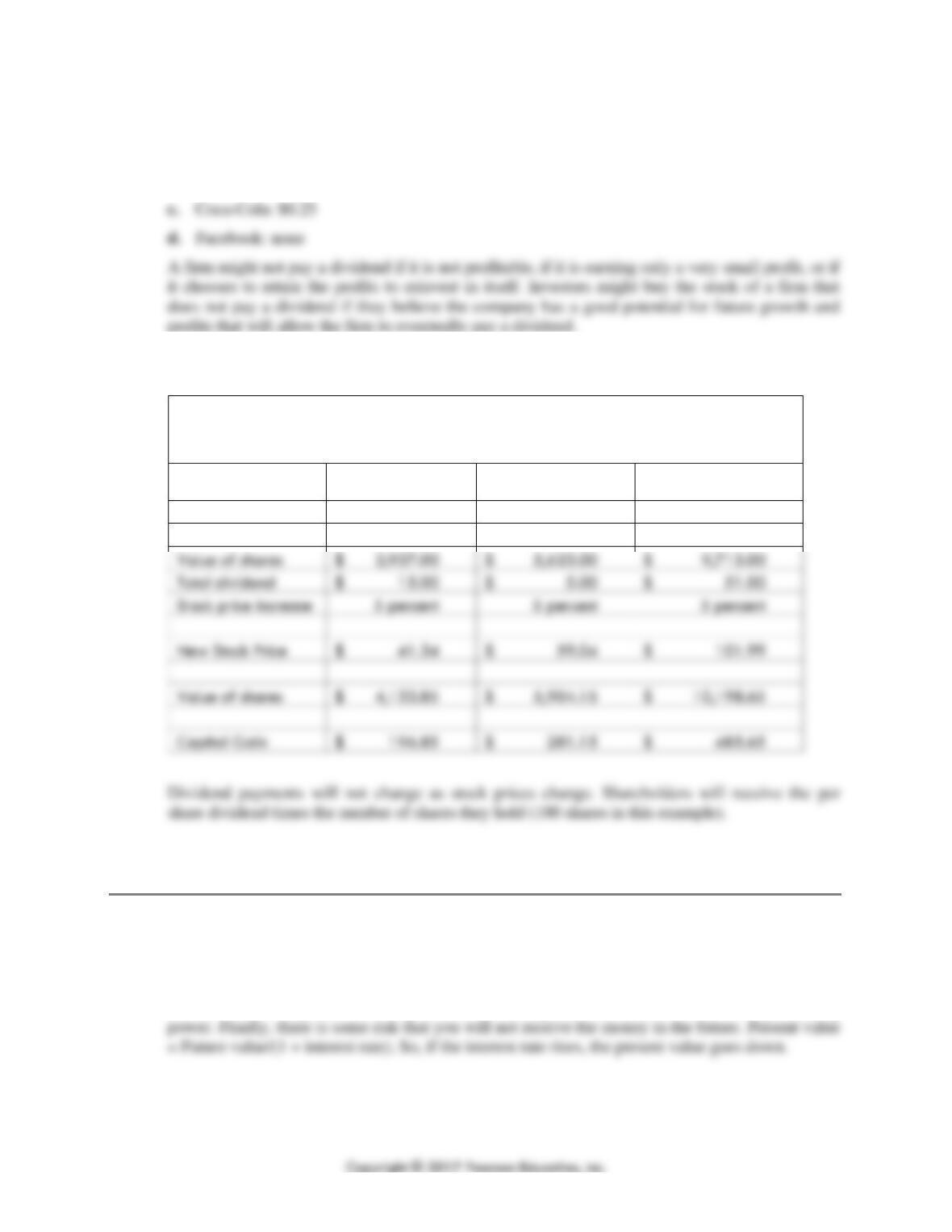
D6.2 The following graph shows performance of prices of stocks on the NASDAQ Index from
February 1971 to September 2015. The NASDAQ Composite Stock Index tracks stock prices for
over 2,500 companies. The table below the graphs describes how stock prices moved just before,
during, and just after recessions from 1957 to the present. Stock prices have typically declined
before recessions. Immediately following the ends of recessions, stock prices have typically risen,
although there are several exceptions. The movement of stock prices during recessions has been
quite varied.
Date of Recession
Stock Prices
Before Recession
Stock Prices During
Recession
Stock Prices
After
Recession
August 1957 – April 1958
Declined
Declined, then rose
Rose
April 1960 – February 1961
Declined
Rose and Declined, but
generally rose
Declined
December 1969 – November 1970
Declined
Declined, then rose
Rose
November 1973 – March 1975
Stable
Declined, then rose
Rose
January 1980 – July 1980
Declined
Rose, Declined, then rose
Rose
generally rose, declined
and then rose
July 1990 – March 1991
Declined
Declined, then rose
Rose
March 2001 – November 2001
Declined
Declined, rose, declined,
then rose
Rose
December 2007 – June 2009
Declined
Declined
Declined
144 CHAPTER 6 | Firms, the Stock Market, and Corporate Governance
D6.3 The following data are from September 2015:
a. Microsoft: $0.31
b. Apple: $0.52
D6.4
19-Jun-15
Company
Morgan Stanley
Citigroup Inc.
PNC
Stock Symbol
MS
C
PNC
Closing Price
$ 39.37
$ 56.23
$ 97.13
latest dividend
$ 0.15
$ 0.05
$ 0.51
number of shares
100
100
100
Value of shares
$ 3,937.00
$ 5,623.00
$ 9,713.00
Total dividend
$ 15.00
$ 5.00
$ 51.00
Stock price increase
5 percent
5 percent
5 percent
New Stock Price
$ 41.34
$ 59.04
$ 101.99
Value of shares
$ 4,133.85
$ 5,904.15
$ 10,198.65
Capital Gain
$ 196.85
$ 281.15
$ 485.65
Solutions to Chapter 6 Appendix
Review Questions
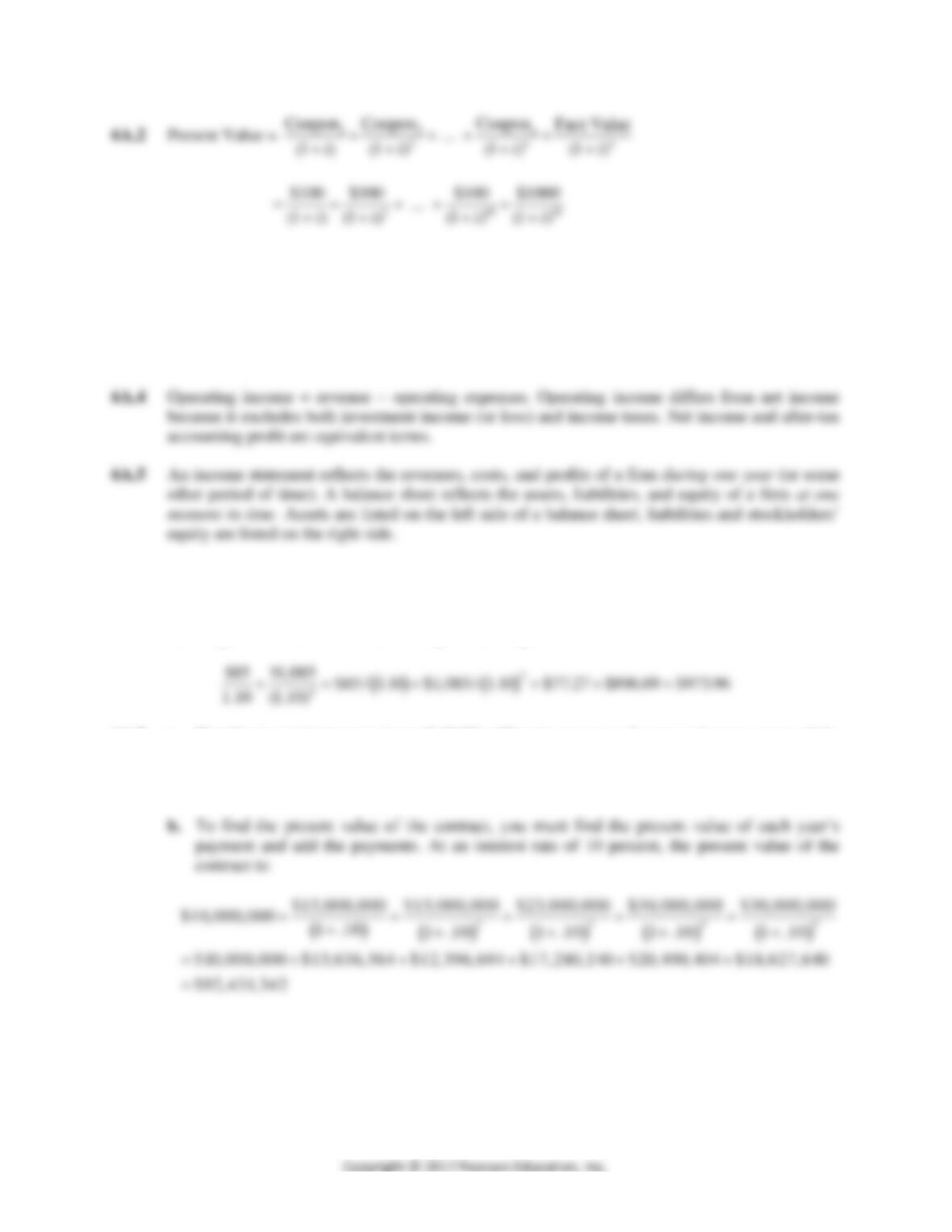
6A.1 Money received at some future date is worth less than money received today because if you have
the money today, you can use it today to buy goods and services and receive enjoyment from
them. In addition, prices are likely to rise, so money received later will have less purchasing
CHAPTER 6 | Firms, the Stock Market, and Corporate Governance 145
6A.3 The present value of bond payments is generally much more certain. The coupon payments and
the face value are part of the bond contract, but the future dividends of the firm are not known
with certainty. In addition, the bond payments are spread out over a specific number of years, but
the stock dividends extend out toward infinity (or the life of the firm). The main similarity is that
both sets of future payments are discounted by dividing by (1 + interest rate) raised to the number
of years in the future that the payment will be received.
Problems and Applications
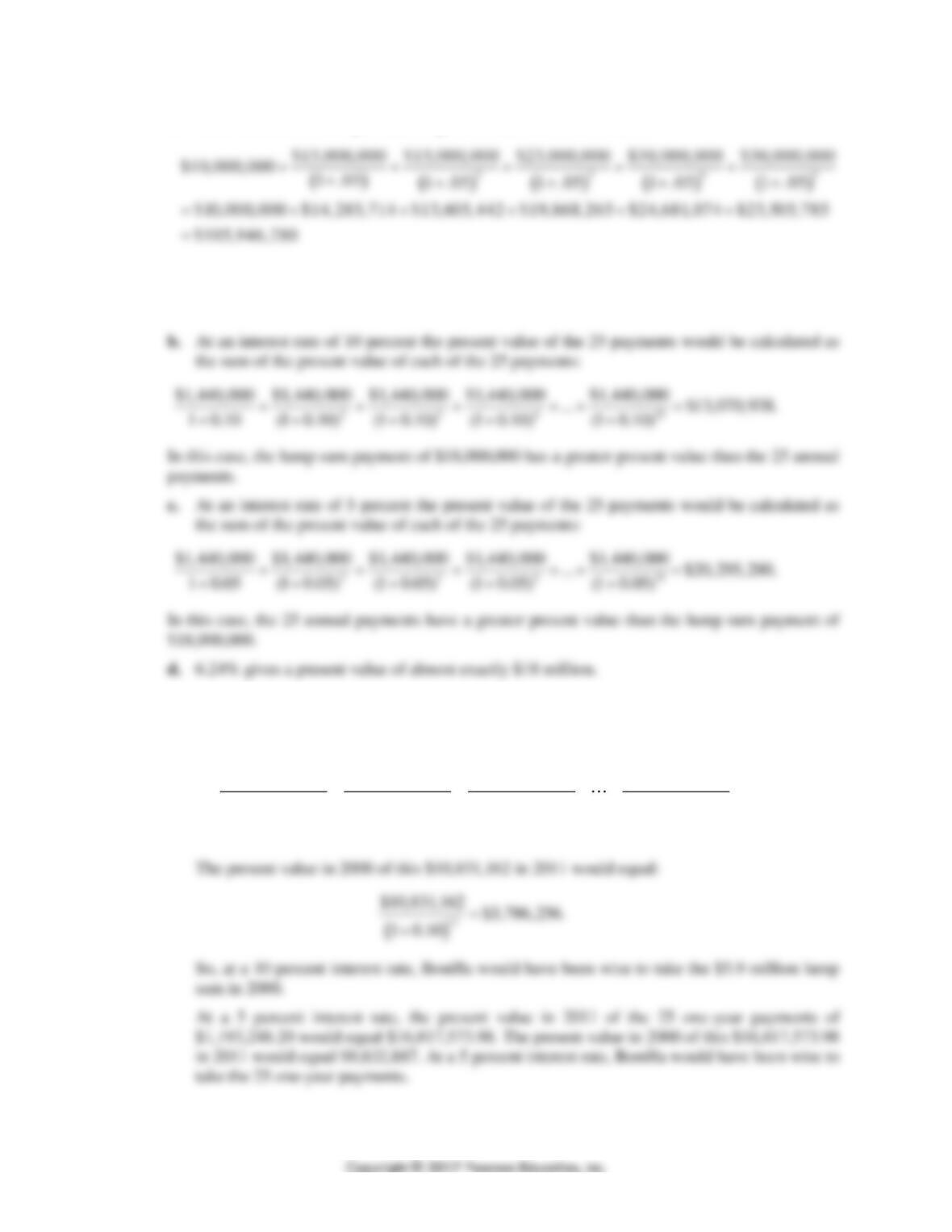
6A.6 To find the present value of the bond, you must find the present value of each payment and add
them together. At an interest rate of 10 percent, the present value of the bond is:
6A.7 a. Hamilton’s contract was not worth $125 million in present-value terms because most of the
money will be received in future years and is therefore worth less in present-value terms. This
statement would be correct only if the interest rate equaled zero. (Note: Hamilton was traded
to the Texas Rangers during the 2015 season.)
146 CHAPTER 6 | Firms, the Stock Market, and Corporate Governance
c. At an interest rate of 5 percent, the present value of the contract is:
6A.8 a. If the winner had opted for the 25 annual payments, she would have received:
25 × $1,440,000 = $36,000,000.
6A.9 The decision of which is more valuable depends on the rate of interest used in calculating the
present value. At a 10 percent interest rate, the present value in 2011 of the 25 one-year payments
of $1,193,248.20 would equal:
( ) ( ) ( ) ( )
2 3 25
$1,193,248.20 $1,193, 248.20 $1,193,248.20 $1,193, 248.20
1 .10 1 .10 1 .10 1 .10
+ + + +
++ + +
= $10,831,162.
CHAPTER 6 | Firms, the Stock Market, and Corporate Governance 147
6A.11 Interest rates on newly issued bonds are likely to rise as a result of inflation. This will cause the
price of your bond to fall.
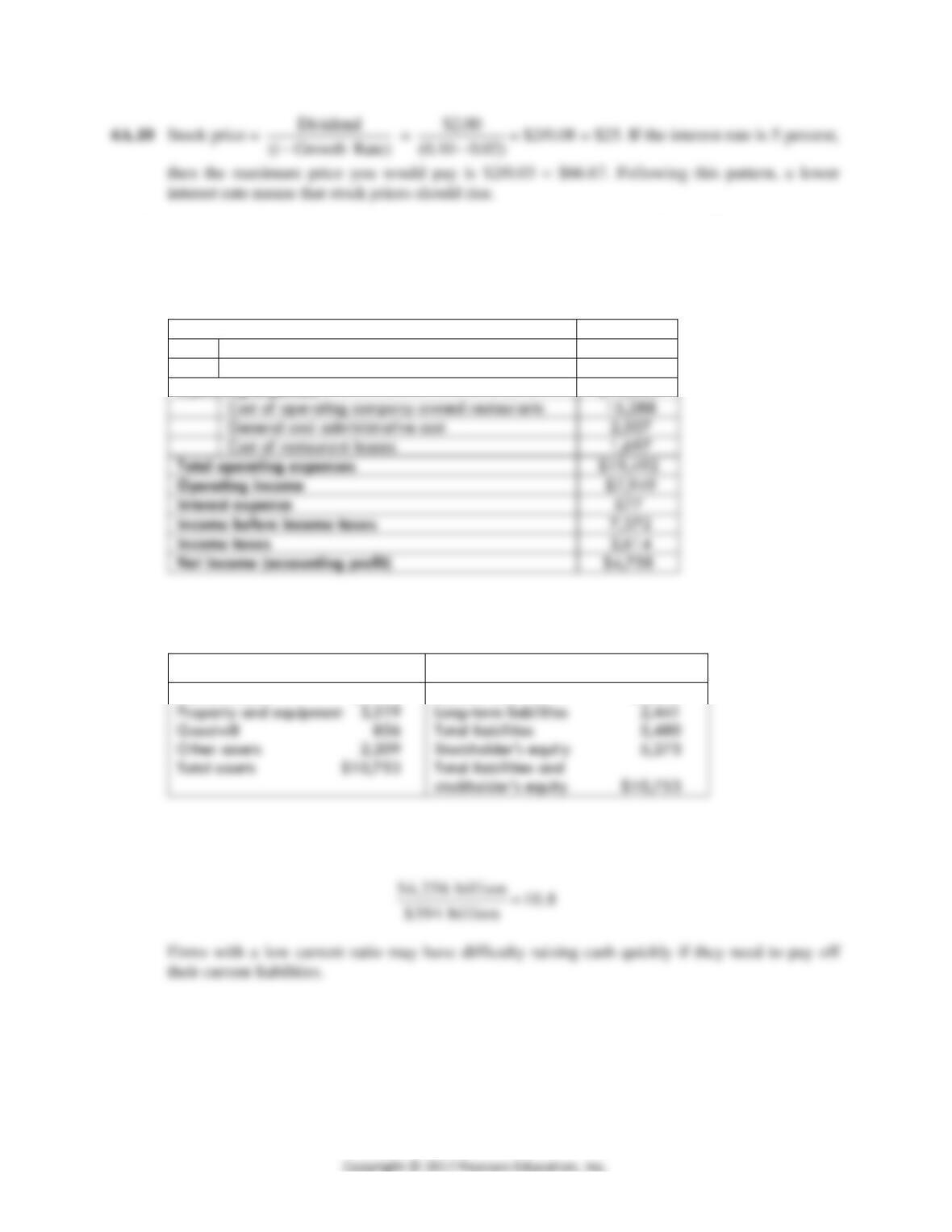
6A.12 Values are in millions of dollars.
Revenue
$27,441
Revenue from company restaurants
18,169
Revenue from franchised restaurants
9,272
Operating expenses
$19,492
Cost of operating company-owned restaurants
15,288
General and administrative cost
2,507
Cost of restaurant leases
1,697
Total operating expenses
$19,492
Operating income
$7,949
Interest expense
Income before income taxes
7,372
Income taxes
2,614
Net income (accounting profit)
$4,758
6A.13 Values are in millions of dollars.
Assets
Liabilities
Current assets $4,169
Current liabilities $3,039
6A.14 Twitter’s current ratio (values are in millions of dollars) =