CHAPTER 51
Monetary Policy
LEARNING OBJECTIVES
Describe a brief history of the evolution of the Central Bank and the Federal Reserve.
Discuss the evolution and impact of regulation and deregulation of the financial system.
Describe the structure of the Federal Reserve.
OUTLINE OF CHAPTER
I. Evolution of Banks and Regulations
II. The Structure of the Federal Reserve System
KEY TERMS
deflation
overall falling pric
es
Federal Deposit Insurance Corporation
institution that insures bank accounts up to a certain amount of money
the interest rate that bankers charge each other for overnight loans
has the function
of buying and selling government bonds on the open market
aggregate spending is higher than aggregate production
policy designed to increase or decrease the flow of money and credit with the aim of managing
the rates of growth, unemployment, and/or inflation
panic
widespread apprehension about the financial system leading to impulsive reactions; during the
1930s banking panics where sparked by bank failures and millions of people lost their savings
reserves
at the Fed
ANSWERS TO END OF CHAPTER REVIEW QUESTIONS
Describe a brief history of the evolution of the Central Bank and the Federal Reserve.
1. How has the role of the Central Bank and the Federal Reserve changed over time?
The Federal Reserve was established in 1913 to be a lender of last resort in order to
2. List and describe key policies implemented to increase stability in the banking
sector.
The most important innovation was the creation of the federal Deposit Insurance
Discuss the evolution and impact of regulation and deregulation of the financial system.
3. What are the conservative arguments for deregulating the banks?
The conservative argument for deregulation is that bank regulations prevented banks
4. What are the progressive arguments for not deregulating the banks?
Describe the structure of the Federal Reserve.
5. the basic structure of the Federal Reserve system.
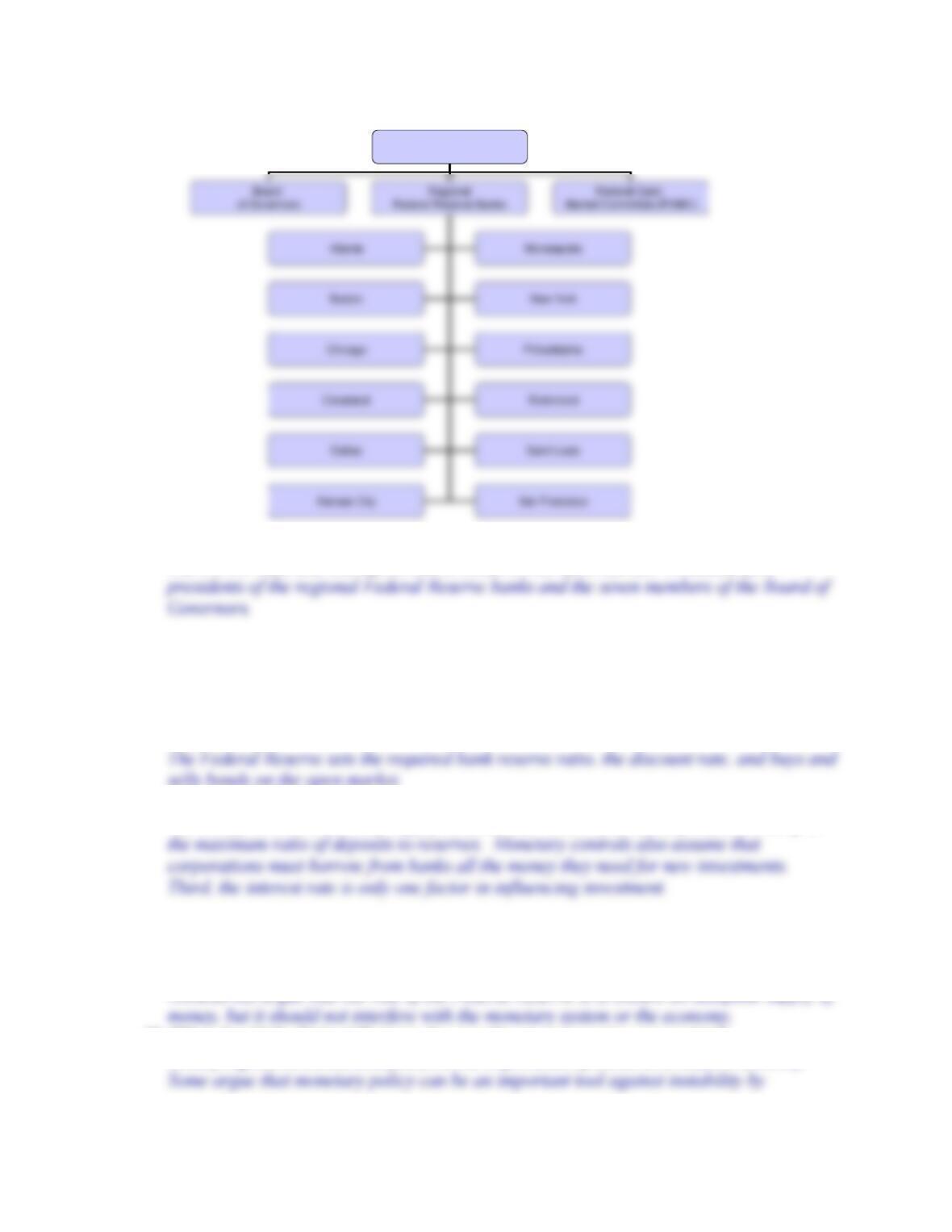
Federal Reserve
System
6. What is the role of the Federal Open Market Committee and why is it so important?
The FOMC buys and sells government bonds on the open market. It includes five
List the tools used by the Federal Reserve, and discuss how and why they are used in
periods of recession and inflation.
7. What are the three main tools used by the Federal Reserve to affect inflation or un-
employment?
8. Discuss the effectiveness of each tool.
The ability to limit the money supply assumes that banks have already made loans up to
Compare and contrast the main views of monetary policy.
9. What should the Federal Reserve do according to conservatives economists?
Monetarists argue that the role of the Federal Reserve is to ensure an adequate supply of
10. What should the Federal Reserve do according to progressive economists?
Some progressive economists focus on the importance of credit in a modern economy.
Discuss the actual history of recent monetary policy under President George W. Bush.
11. Describe some monetary policy decisions under the Bush administration.
In response to the recession of 2001, the Federal Reserve began an expansionary policy
12.
criticisms?
Conservatives argue that lowering interest rates would lead to more spending by
APPENDIX 51.1
Furious Debates on Monetary Policy
LEARNING OBJECTIVE FOR APPENDIX 51.1
Compare and contrast the debates about money and monetary policy in the U.S. economy
OUTLINE OF APPENDIX
I. Classical and Progressive Economists on Money
KEY TERMS IN APPENDIX 51.1
monetarism
a school of economic thought that believes the economic system works very well except when
ANSWERS TO APPENDIX 51.1 REVIEW QUESTIONS
Compare and contrast the debates about money and monetary policy in the U.S. economy
1. How does the focus on production for money profits introduce instability into the
economy? Explain.
The goal under capitalism is to turn money into money, which means that money is not
2. What are problems using monetary policy to lower unemployment?
The basic problem of monetary policy in a recession is that even if monetary policy
3. What are the major propositions of monetarists? How do these relate to the conclusion
of how monetary policy should be conducted?
Free markets are efficient and promote growth. Economic disturbances are the
abstain entirely from discretionary short-run monetary policy.
4. What are the criticisms of monetarism? How do these impact conclusions about the
conduct of monetary policy?
Critics disagree with the monetarist assertion that the economy automatically correct