Chapter 5 Saving and Investment in the Open Economy 111
An increase in desired investment has the opposite effect. The increase in investment reduces the
domestic country’s current account and leads to an increase in the world real interest rate to restore
equilibrium.
9. An increase in the government budget deficit raises the current account deficit of a small open
economy if and only if the increase in the budget deficit reduces national saving. Since the current
10. The United States has had twin deficits in the 1980s and first half of the 1990s; but in World Wars I
112 Abel/Bernanke/Croushore • Macroeconomics, Ninth Edition
Numerical Problems
1.
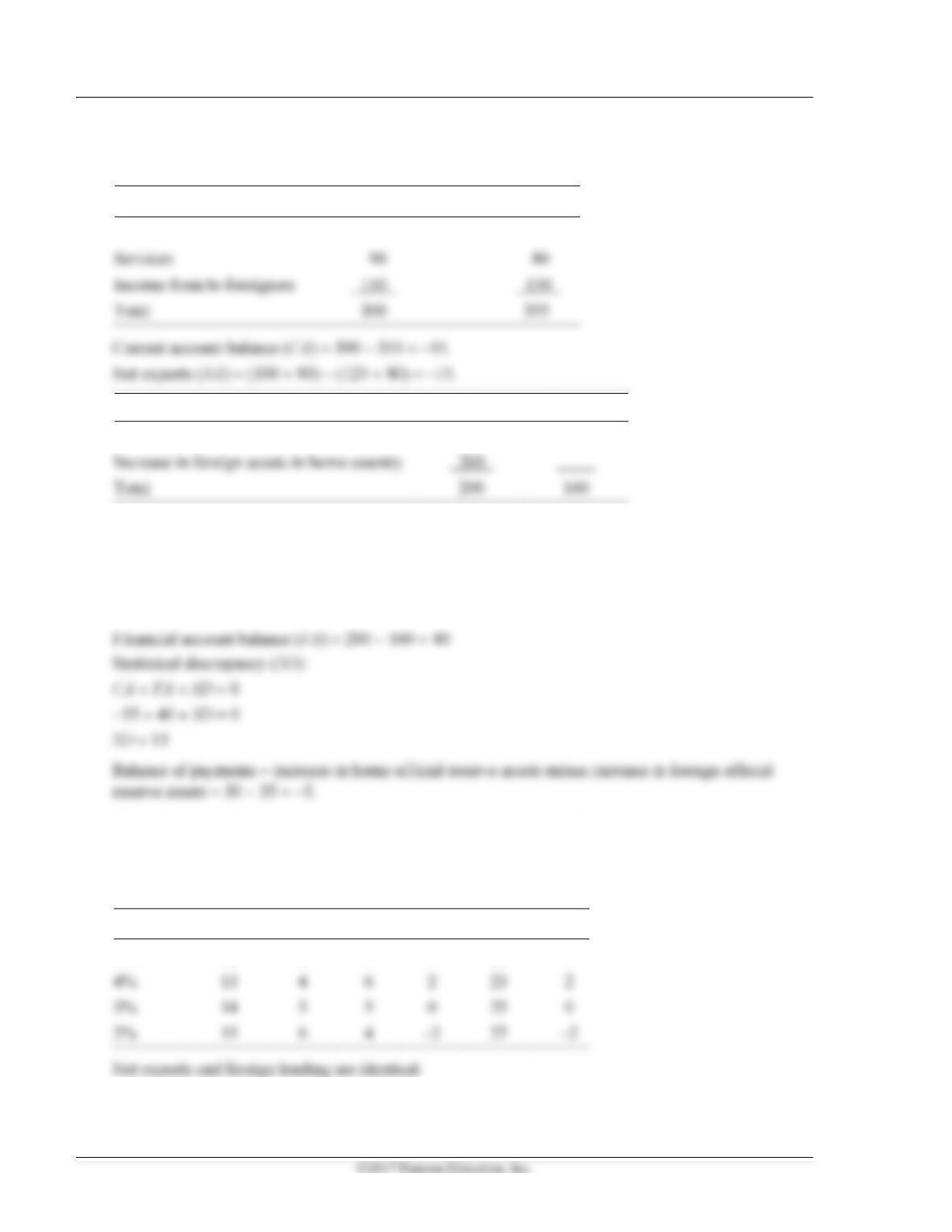
Current Account
Credit (+)
Debits (−)
Goods
100
125
Services
90
Income from/to foreigners
Financial Account
Credit (+)
Debits (−)
Increase in home country assets abroad
160
Increase in foreign assets in home country
Notice that the increase in home reserve assets is just a subcategory of the increase in home country
assets, so it is not included separately. Similarly, the increase in foreign reserve assets is just a
subcategory of the increase in foreign assets in the home country. The information about the changes
in home and foreign reserve assets is included for calculation of the balance of payments only; it does
not affect the financial account.
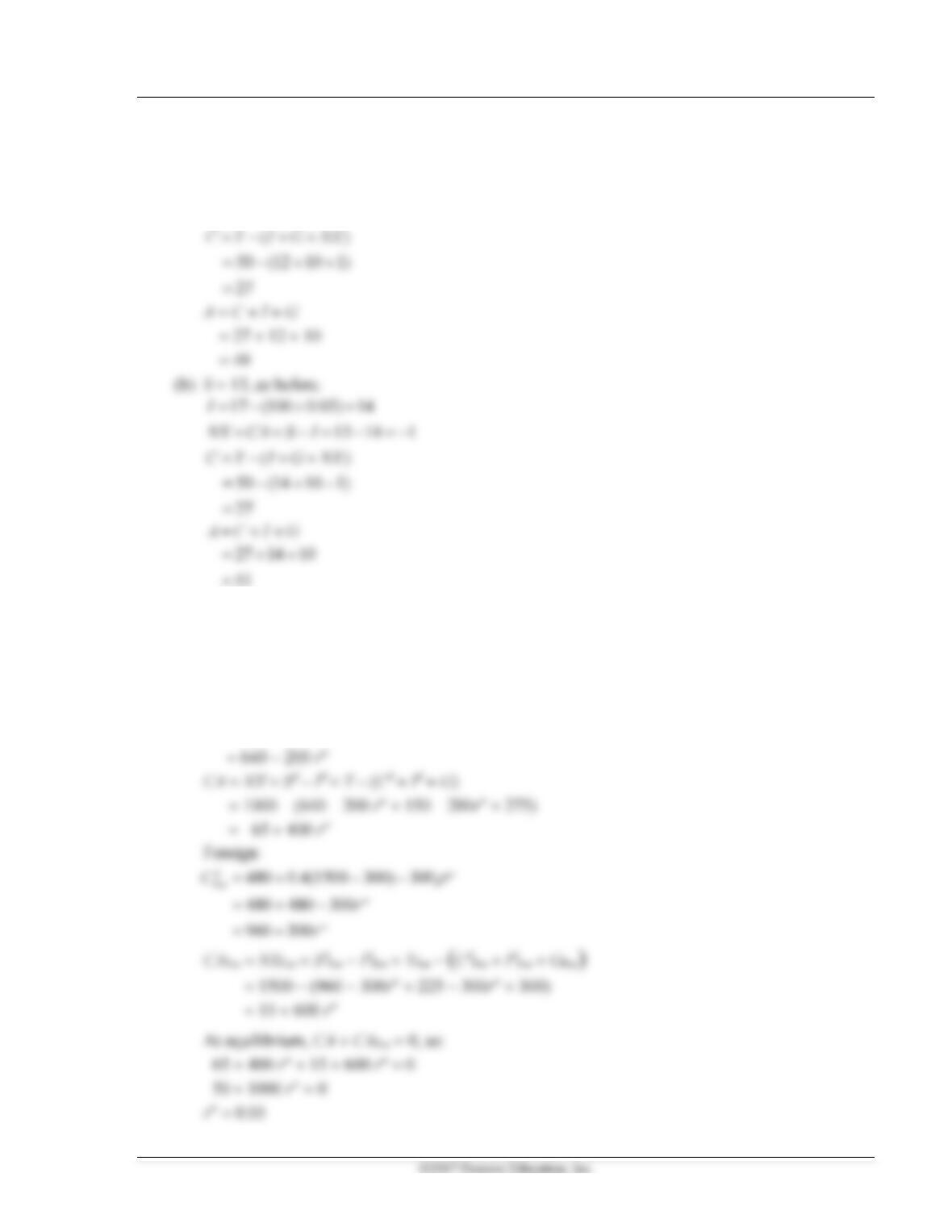
2. The following table calculates key variables for this question for different values of the real interest
rate. The column for S is calculated by the equation S = Y − (Cd + G). The column headed S − I is
foreign lending. Absorption (A) is Cd + Id + G. Net exports (NX) are output (Y) minus absorption (A).
Every column except r consists of dollar amounts in billions.
r
Cd
Id
S
S − I
A
NX
5%
12
3
7
4
21
4
3%
Chapter 5 Saving and Investment in the Open Economy 113
3. All variables but interest rates are in billions of dollars.
(a) S = 10 + (100 0.03) = 13
15 (100 0.03) 12
13 12 1
I
NX CA S I
= − =
= = − = − =
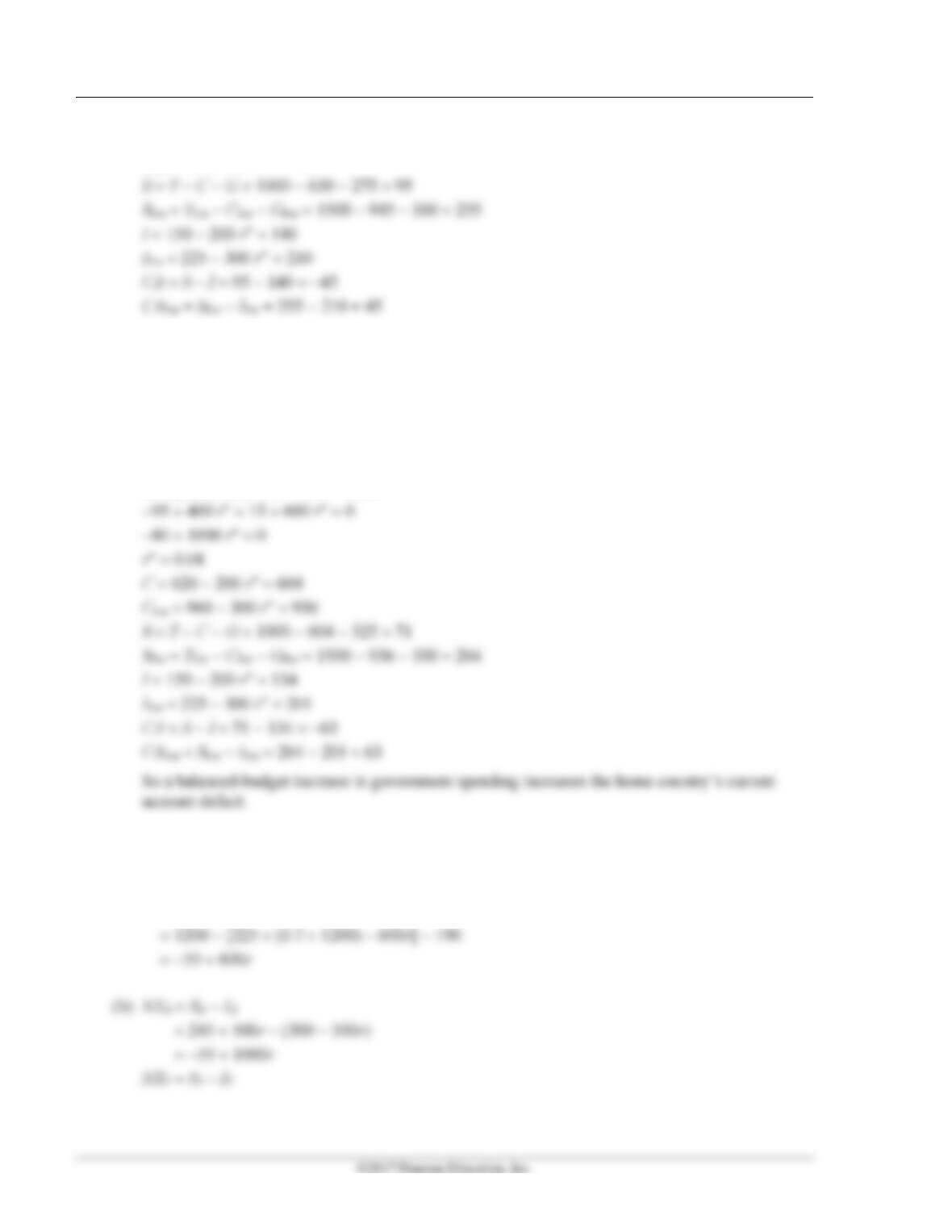
4. (a) To find the equilibrium interest rate (rw), we must first calculate the current account for each
country as a function of rw. Then we can find the value of rw that clears the goods market, that is,
where CA + CAFor = 0.
Home:
Cd = 320 + 0.4(1000 − 200) − 200rw
= 320 + 320 − 200 rw
114 Abel/Bernanke/Croushore • Macroeconomics, Ninth Edition
C = 640 − 200 rw = 630
CFor = 960 − 300 rw = 945
(b) Cd = 320 + 0.4(1000 − 250) − 200 rw
= 320 + 300 − 200 rw
= 620 − 200 rw
CA = NX = Sd − Id = Y − (Cd + Id + G)
= 1000 − (620 − 200 rw + 150 − 200 rw + 325)
= −95 + 400 rw
At equilibrium, CA + CAFor = 0, so:
5. (a) SH = YH − CH − GH
= 1000 − [100 + (0.5 1000) − 500r] − 155
= 245 + 500r
SF = YF − CF − GF
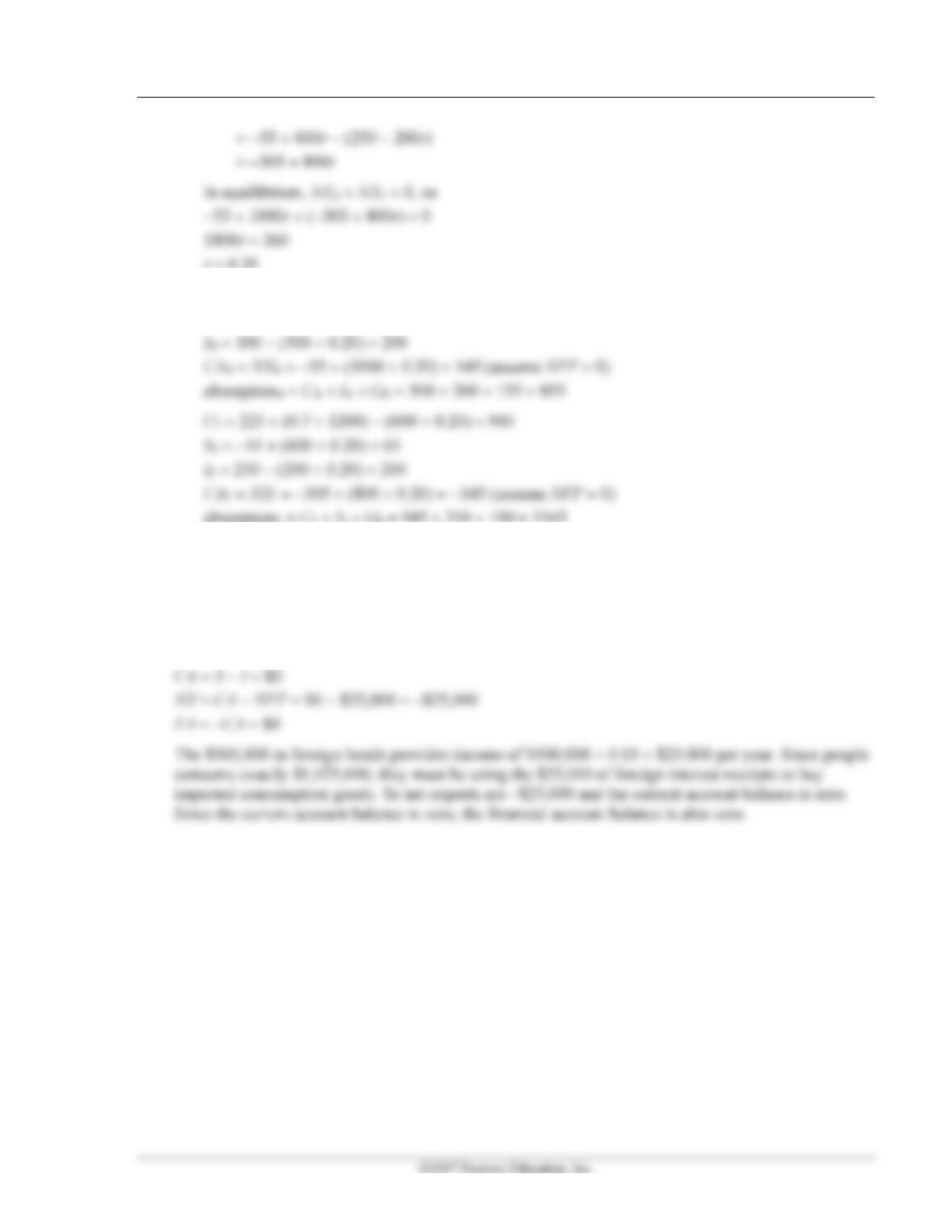
Chapter 5 Saving and Investment in the Open Economy 115
r = 0.20
(c) CH = 100 + (0.5 1000) − (500 0.20) = 500
SH = 245 + (500 0.20) = 345
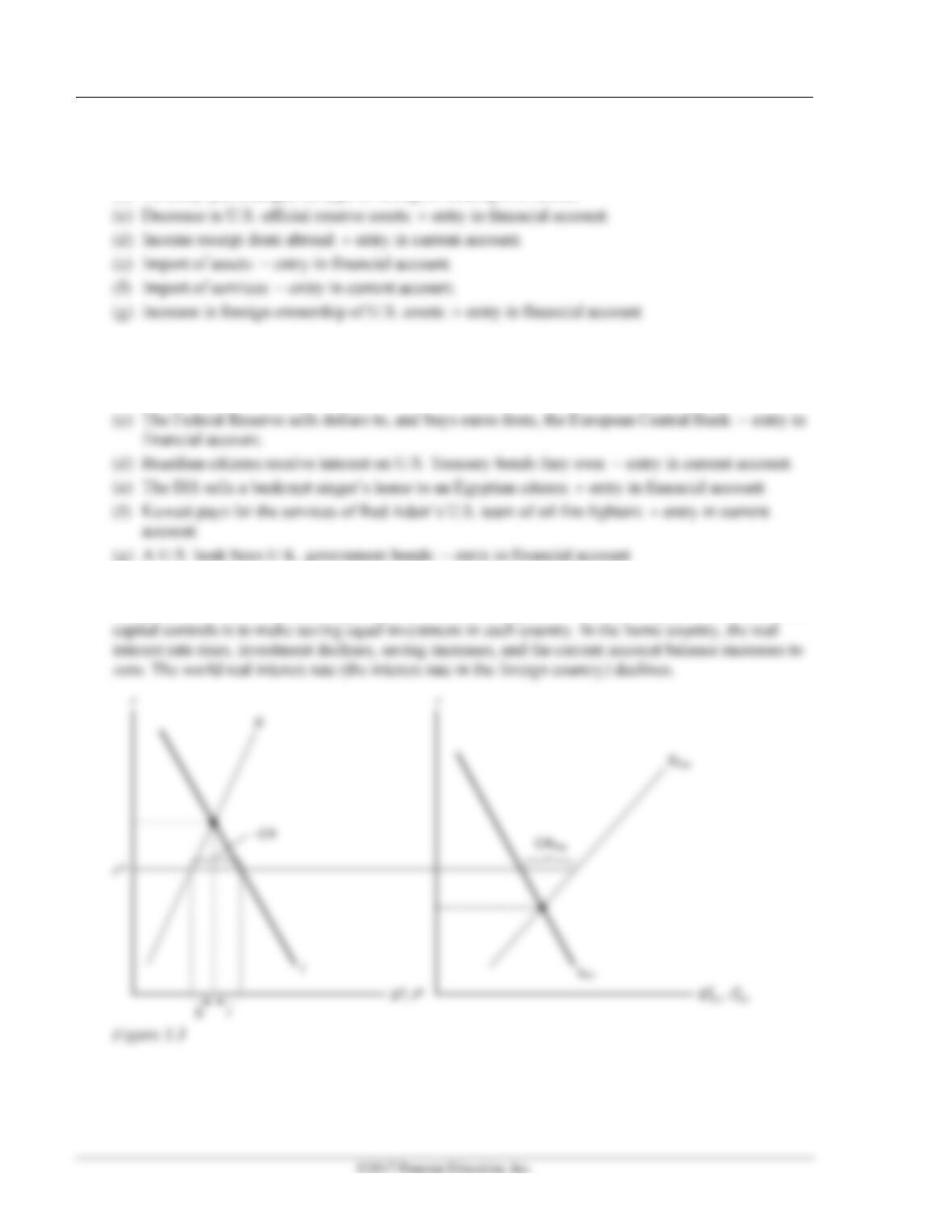
6. GDP = Y = $1,000,000 = total production of coconuts
GNP = $1,025,000 = production of coconuts + net factor income from abroad
NFP = $25,000
I = $0
S = Y + NFP − C − G = $1,000,000 + $25,000 − $1,025,000 − $0 = $0
116 Abel/Bernanke/Croushore • Macroeconomics, Ninth Edition
Analytical Problems
1. (a) Export of merchandise: + entry in current account.
(b) No entry: just changes the type of foreigner holding U.S. assets.
2. There are many possible answers; an example for each is given here.
(a) U.S. citizens buy cars from the foreign country: − entry in current account.
(b) No transaction needed.
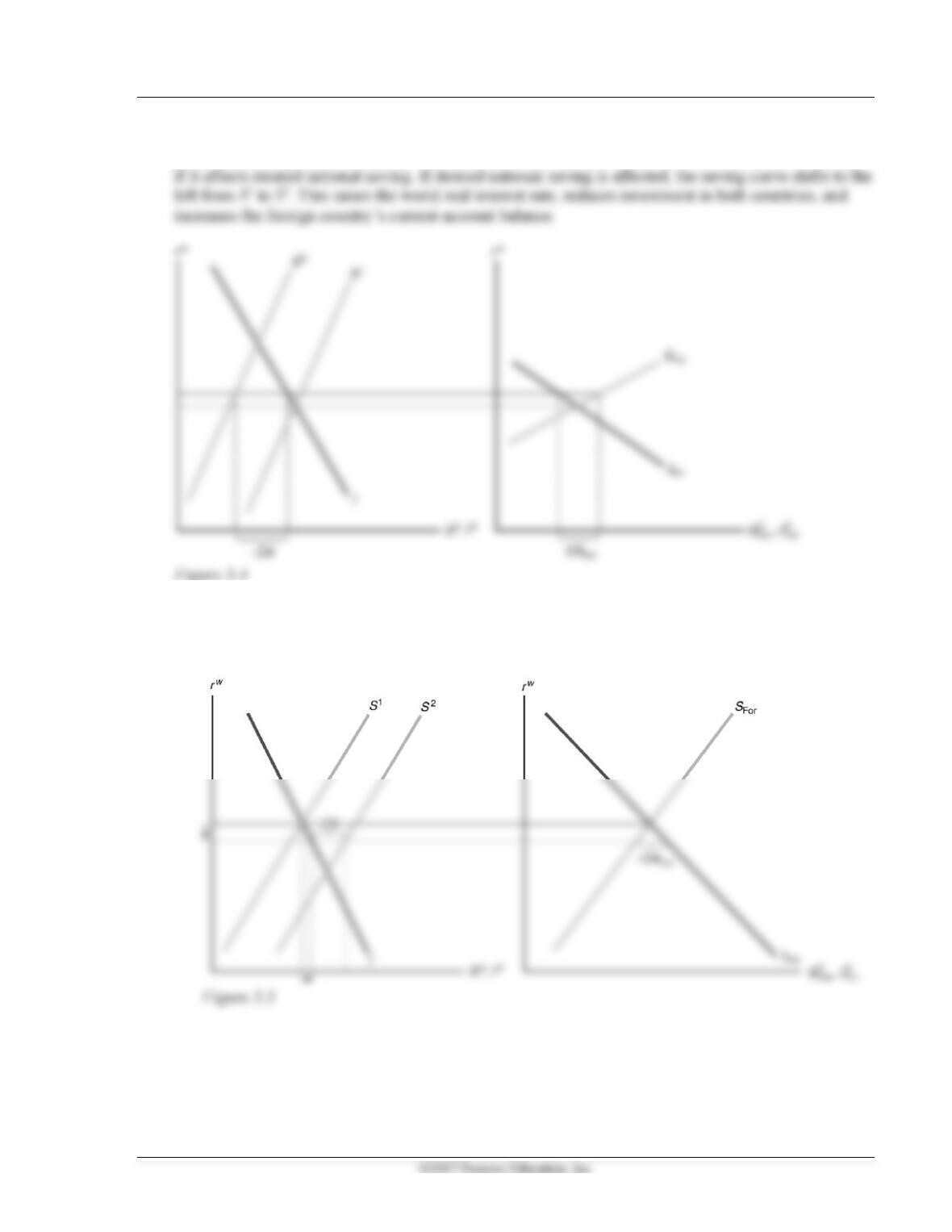
3. In Figure 5.3, before the capital controls are imposed, the home country has a current account deficit
of the amount CA, while the foreign country has a matching current account surplus. The effect of the
Chapter 5 Saving and Investment in the Open Economy 117
4. In Figure 5.4, suppose initially that both countries have a zero current account. A rise in the
government budget deficit has no effect on desired investment, so it affects the current account only
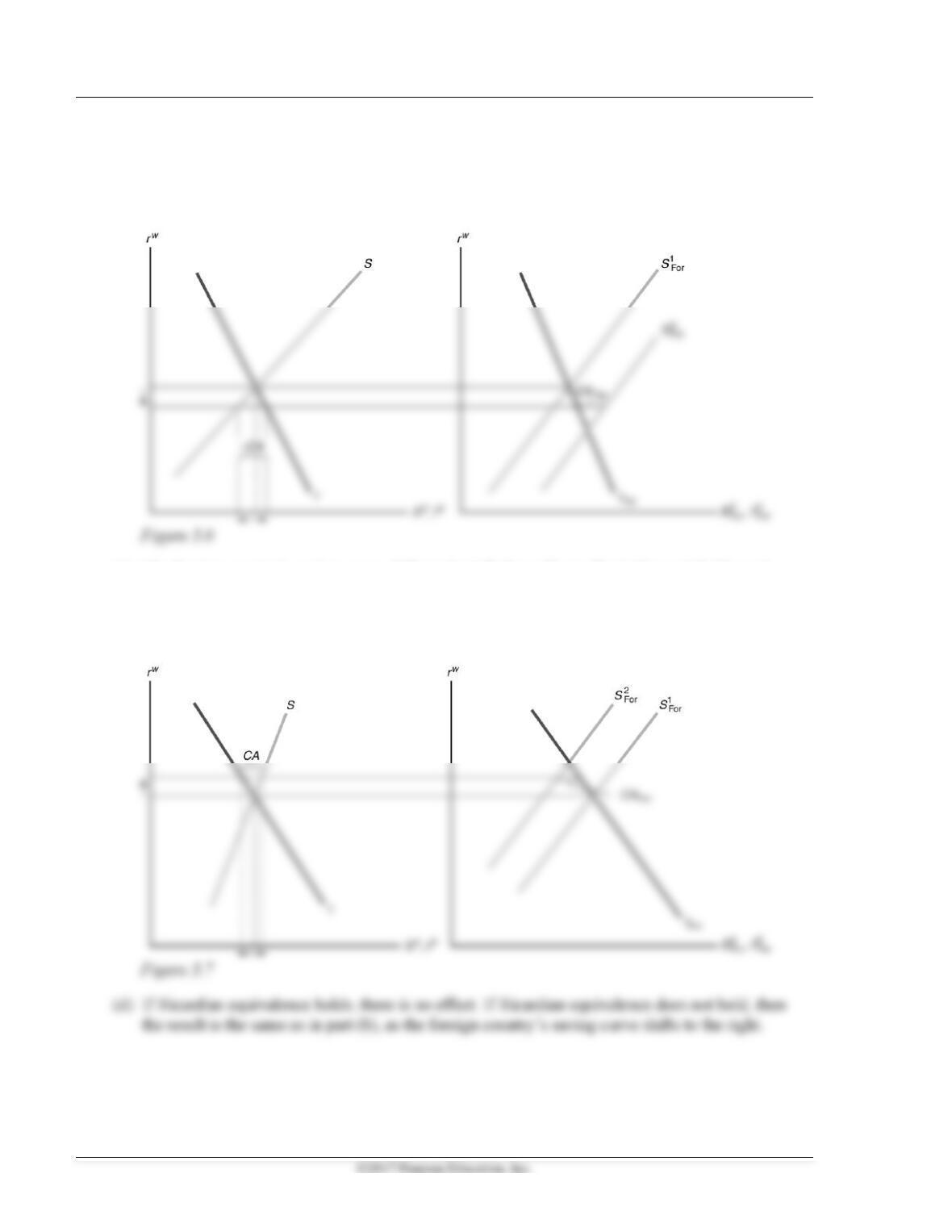
5. (a) The home country’s saving curve shifts to the right, from S1 to S2 in Figure 5.5. The real world
interest rate falls, so that the current account surplus in the home country equals the current
account deficit in the foreign country. From Figure 5.5, S rises, I rises, CA rises, rw falls.
118 Abel/Bernanke/Croushore • Macroeconomics, Ninth Edition
(b) The foreign country’s saving curve shifts to the right, from
1
For
S
to
2
For
S
in Figure 5.6. The real
world interest rate must fall, so the current account surplus in the foreign country equals the
current account deficit in the home country. As shown in the figure, S falls, I rises, CA falls,
rw falls.
(c) The foreign country’s saving curve shifts to the left, from
1
For
S
to
2
For
S
in Figure 5.7. The real
world interest rate must rise, so the current account deficit in the foreign country equals the
current account surplus in the home country. As shown in the figure, S rises, I falls, CA rises,
rw rises.
Chapter 5 Saving and Investment in the Open Economy 119
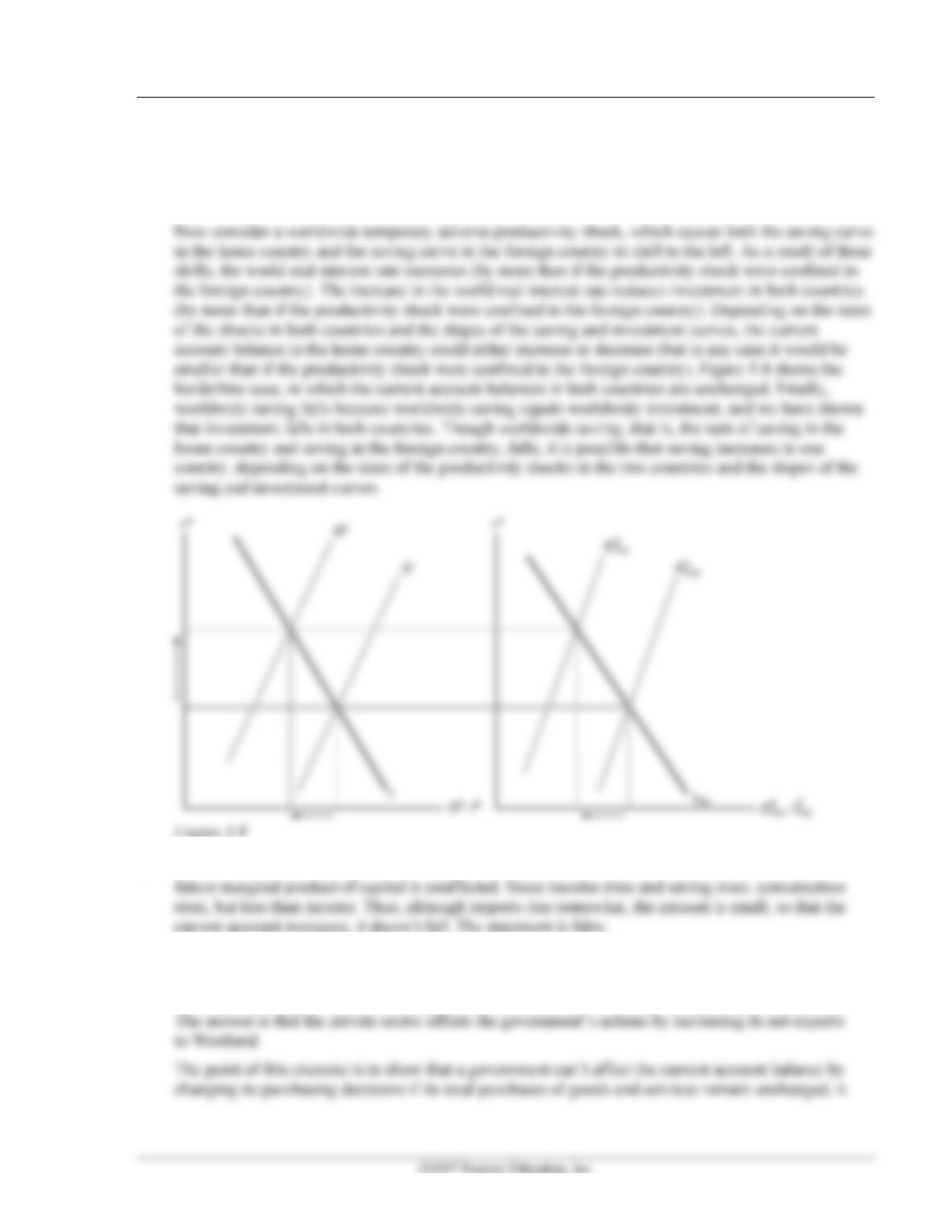
6. A temporary adverse supply shock hitting the foreign economy causes the foreign saving curve to
shift to the left, from
1
For
S
to
2
For
S
in Figure 5.7. This raises the equilibrium world real interest rate,
increasing home country saving and decreasing home country investment. Since saving rises and
investment falls, the home country’s current account balance increases.
7. The shock shifts the saving curve to the right, with no change in the investment curve, since the
8. Note that when the government of Eastland makes this change, it isn’t changing total government
purchases, so there’s no effect on national saving. Thus the current account balance is unaffected.
How can that be, given that Eastland’s government is now purchasing more goods from Westland?
120 Abel/Bernanke/Croushore • Macroeconomics, Ninth Edition
Working with Macroeconomic Data
1. The trend in the openness index is a gradual increase over time. The openness index was about 6% in
2. Output and absorption have slight differences; saving and investment differ by the current account