Chapter 5
Money and Inflation
◼ Chapter Outline, Overview, and Teaching Tips
Chapter Outline
What Is Money?
Meaning of Money
Functions of Money
The Federal Reserve System and the Control of the Money Supply
Federal Reserve Banks
Measuring Money
The Federal Reserve’s Monetary Aggregates
The Fed’s Use of M1 Versus M2 in Practice
Macroeconomics in the News: The Monetary Aggregates
Quantity Theory of Money
Velocity of Money and the Equation of Exchange
Quantity Theory and Inflation
Application: Testing the Quantity Theory of Money
Hyperinflation
Policy and Practice: The Zimbabwean Hyperinflation
Inflation and Interest Rates
Application: Testing the Fisher Effect
The Cost of Inflation
Chapter 5 Money and Inflation 45
Control of the Monetary Base
Federal Reserve Open Market Operations
Multiple Deposit Creation: A Simple Model
Deposit Creation: The Single Bank
Deposit Creation: The Banking System
Overview of the Money Supply Process
Application: Quantitative Easing and the Money Supply, 2007–2013
The Money Multiplier
Deriving the Money Multiplier
Chapter Overview and Teaching Tips
Chapter 5 examines Milton Friedman’s famous adage that “inflation is always and everywhere a monetary
phenomenon.” It shows that in the long run, inflation is determined by the growth rate of the quantity of
money.
The first half of the chapter also contains a brief discussion of the central bank in the United States, the
Federal Reserve System, and how it controls the quantity of money, also referred to as the money supply.
For instructors who want to cover how the Federal Reserve determines the money supply in more detail,
the chapter has an appendix on the money supply process. This appendix outlines how the Fed controls the
46 Mishkin • Macroeconomics: Policy and Practice, Second Edition
during the recent financial crisis, always engages student interest. The second half of the chapter develops
the quantity theory of money. The key equation to get students to understand is the equation of exchange
◼ Answers to End of Chapter Review Questions and Problems
Answers to Review Questions
What Is Money?
1. Money is anything that is accepted generally in payment for goods and services or in repayment of
debts. As a medium of exchange, money is used to pay for goods and services. This function of money,
which replaces barter exchanges of goods and services, reduces transaction costs by eliminating the
The Federal Reserve System and the Control of the Money Supply
2. The Federal Reserve uses open market operations, its purchases and sales of government bonds, to
control the money supply. To increase the money supply, the Fed will buy government bonds. When
Measuring Money
3. The M1 monetary aggregate, the Fed’s narrowest measure of the money supply, consists of the most
liquid assets that function as mediums of exchange: currency held by the nonbank public, nonbank
Quantity Theory of Money
4. The key classical assumption is that wages and prices are completely flexible.
5. The equation of exchange is derived from the definition of velocity as the average number of times
per year that a dollar is spent to buy the total output produced in the economy. Total spending is P
Y, and the quantity of money available to spend is M, so velocity V = (P Y)/M. This definition of
Chapter 5 Money and Inflation 47
6. The classical dichotomy, the quantity theory of money, and the neutrality of money are classical
long-run views about how changes in the money supply affect the economy. Because classical
economists assume that wages and prices are flexible, supply and demand for output and factor
services are equal in the long run. Based on this, the classical dichotomy holds that the aggregate
7. Based on the relationship that the percentage change in a product of two variables is approximately
equal to the sum of the percentage change in each variable, the equation of exchange, M V = P Y
can be converted to % M + %V = %P + %Y. Knowing that the percentage change is the same as
Hyperinflation
8. Hyperinflation is generally defined as inflation in excess of 1,000 percent per year. The main cause of
Inflation and Interest Rates
9. According to the Fisher effect, an increase in expected inflation causes a one-to-one change in
The Cost of Inflation
10. Anticipated inflation has several costs. Individuals and businesses incur “shoe–leather” costs to
minimize their cash holdings in order to take advantage of higher nominal interest rates when
inflation increases. Businesses incur menu costs to inform their customers of price changes. Inflation
also imposes costs on taxpayers, who are taxed on their nominal incomes and capital gains rather than
on the real values of these items and, therefore, must pay higher taxes even though their real incomes
48 Mishkin • Macroeconomics: Policy and Practice, Second Edition
Answers to Problems
What is Money?
1. a. Most probably people used some type of bank note or a check to pay for a house in order to avoid
all the problems associated with wandering around in a wagon filled with silver and gold. Not to
mention its weight, one has to consider also the risk of being robbed. Gold and silver pieces were
considered (along with many different types of money) to be “commodity money.” In short,
2. The degree of liquidity of an asset is measured by considering how much time and effort (i.e., transaction
costs) are needed to convert that asset into currency. Currency is by definition the most liquid type of
money. Different types of money have different degrees of liquidity. A check, which represents a
3. a. This situation illustrates the medium-of-exchange function of money. We often do not think why
we accept money in exchange for hours spent working, as we are so accustomed to using money.
The medium-of-exchange function of money refers to its ability to facilitate trades (hours worked
per money and then money per groceries) in a society.
b. In this case we observe money performing its unit-of-account function. If modern societies did
not use money as a unit of account, then the price of apples would have to be quoted in terms of
Measuring Money
4. a. To estimate annualized rates, multiply the three months percentage growth rate by 4 and the six
months percentage growth rate by 2. The table on the next page shows the results:
Chapter 5 Money and Inflation 49
Annualized Growth Rate
Period
M1
M2
3 months
9.17%
6.68%
6 months
5.84%
5. Your actions will reduce your checking account balance and increase your holdings of money market
mutual fund shares. Considering this transaction only, M1 will decrease as one if its components
Quantity Theory of Money
6. a. According to the quantity theory of money, the money supply times the velocity of money equals
aggregate spending. Aggregate spending therefore equals 200 million stone beads.
b. The velocity of money is defined as the ratio of aggregate spending to the money supply. If a
7.
50 Mishkin • Macroeconomics: Policy and Practice, Second Edition
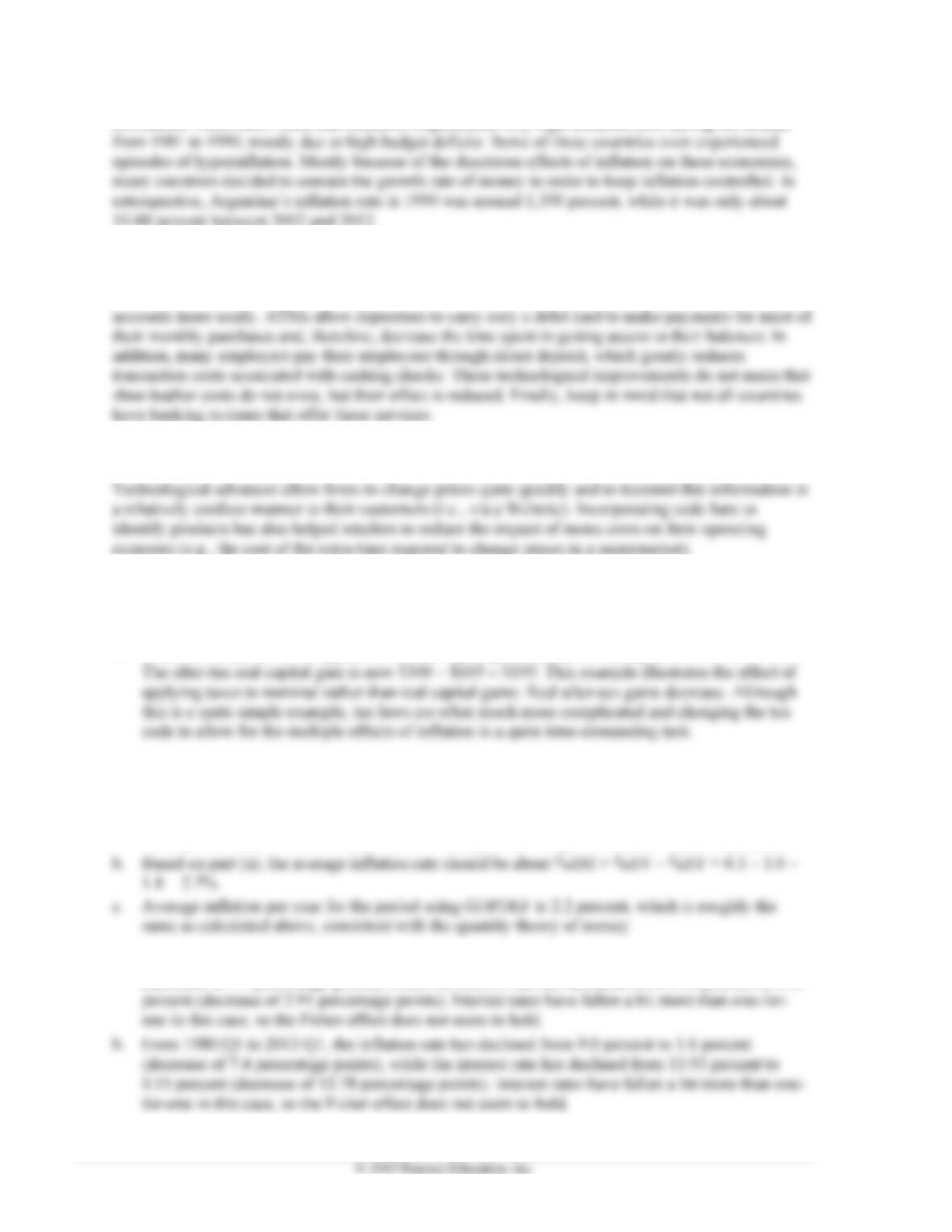
considered. Most Latin American countries experienced very high inflation rates during the decade
10.88 percent between 2002 and 2012.
The Cost of Inflation
8. Online banking and ATMs reduce the impact of shoe-leather costs on the economy. Online banking
allows depositors to move their balances in their noninterest-bearing checking accounts to savings
9. Technological improvements as the ones described above resulted in menu costs being less important.
As noted in the text, menu costs do not impose a significant problem when inflation is moderately low.
10. a. To calculate the after-tax real capital gain, one has to subtract taxes paid from the real capital gain.
If the tax rate is applied to nominal capital gains, then taxes will equal $500 0.35 = $175. The
after-tax real capital gain is therefore $300 − $175 = $125.
b. In this case, the tax rate is applied to the real capital gain and, therefore, equals $300 0.35 = $105.
◼ Answers to Data Analysis Problems
1. a. From 2000:Q1 to 2013:Q1, average growth in real GDP is about 1.8 percent, average growth in
velocity has been –1.6 percent, and the M1 money stock has grown about 6.1 percent per year.
2. a. From 2005:Q1 to 2013:Q1, the inflation rate has declined from 3.3 percent to 1.6 percent
(decrease of 1.7 percentage points), while the interest rate has declined from 3.06 percent to 0.15
Chapter 5 Money and Inflation 51
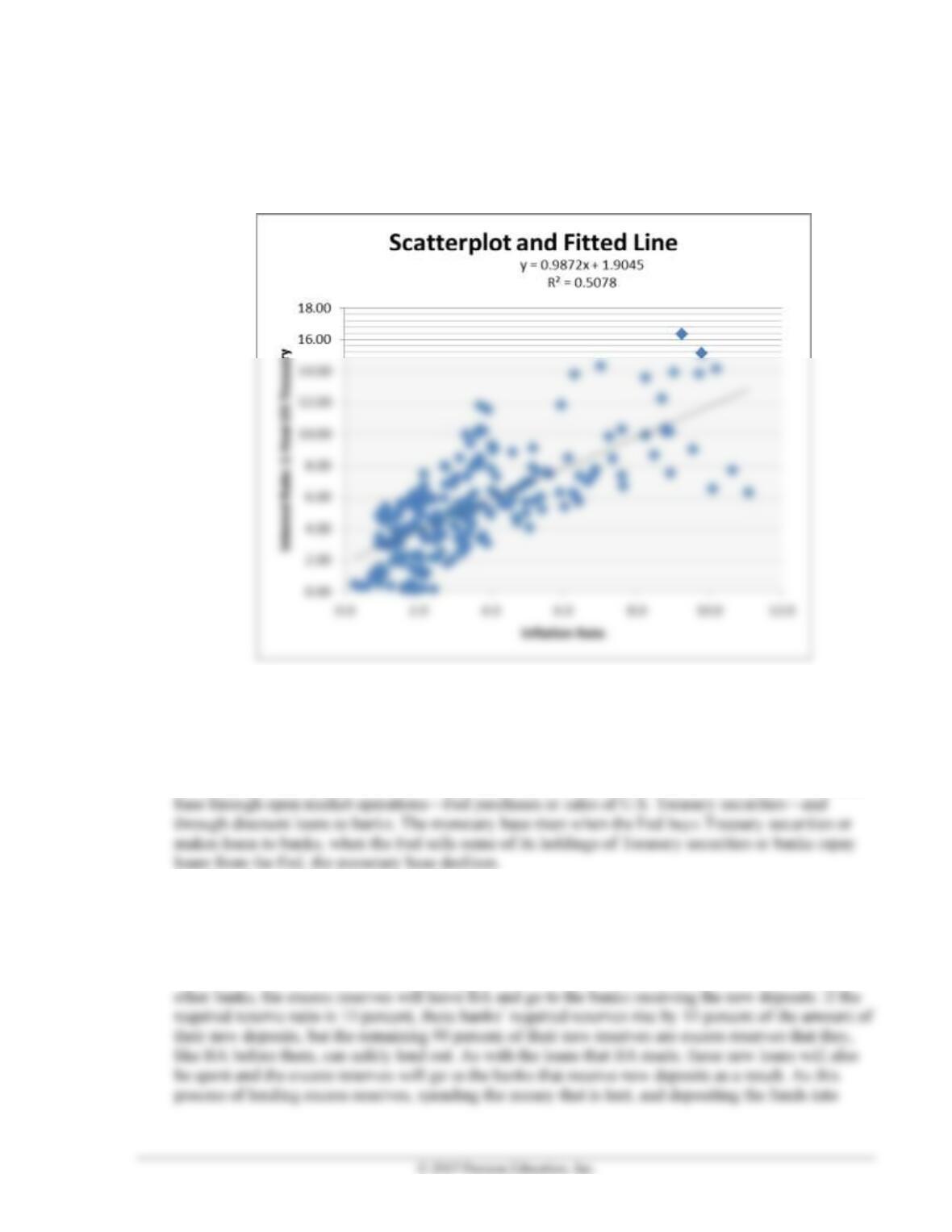
c. The scatterplot and regression line are shown below. Overall, the data show very strong support
for the Fisher equation, below. The slope of the regression coefficient is 0.987; meaning on
average, for every one percentage point increase in the inflation rate, the nominal interest rate
will rise by 0.987 percentage points, demonstrating a very close correspondence to the Fisher
Effect.
◼ Answers to Review Questions and Problems in Web Appendix,
“The Money Supply Process”
1. The monetary base is the sum of currency in circulation and bank reserves, which consist of banks’
vault cash and the deposits they hold at the Federal Reserve. The Fed influences the size of the monetary
2. When the Fed purchases the Treasury securities from Bank of America (BA), the bank’s reserves rise
by the dollar amount of the Fed purchase. Because the Fed’s purchase does not increase BA’s
deposits, all of BA’s new reserves are excess reserves that it can safely lend (without lowering its
reserves below the required level). When BA lends its excess reserves, it creates new deposits on
which the borrowers write checks to buy goods and services. When these checks are deposited into
52 Mishkin • Macroeconomics: Policy and Practice, Second Edition
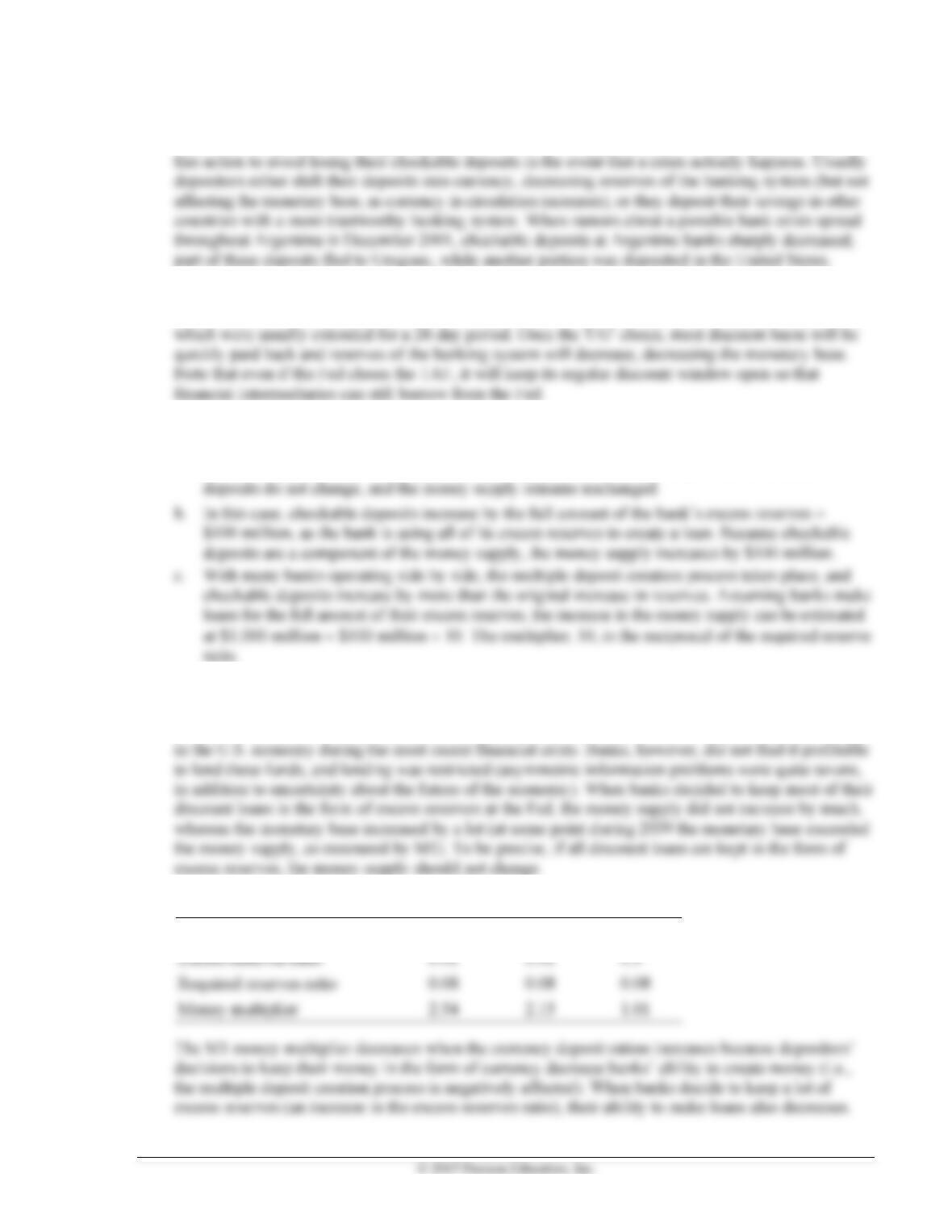
3. The Federal Reserve controls the nonborrowed monetary base, the portion of the monetary base that
it creates thorough open market operations. An increase in the nonborrowed monetary base increases
the monetary base, so more multiple deposit creation can take place and the money supply rises. The
Fed and banks influence borrowed reserves. (The Fed can discourage or encourage bank borrowing
4.
Federal Reserve System
Assets
Liabilities
5.
Federal Reserve System
Assets
Liabilities
Government Securities
−$200
Reserves
−$200
Banking System
Assets
Liabilities
Chapter 5 Money and Inflation 53
6. In a country prone to banking crises in which depositors may end up losing their deposits, even a rumor
about a banking crisis encourages depositors to shift their deposits into currency. Depositors resort to
7. The closing of the TAF program would be equivalent to the repayment of discount loans by financial
intermediaries. If the TAF closes, financial intermediaries will have to pay back their discount loans,
8. a. In this case, the bank decides not to make loans; therefore, there is no increase in checkable
deposits. The monetary base has increased, as the bank is holding more reserves as a result of the
open market operation, but because it is not using these reserves to create loans, checkable
9. If banks decide to borrow from the Fed, discount loans will increase, and the borrowed monetary base
will increase one to one with the expansion of discount loans. This is what happened when the Fed
decided to facilitate the access to funds for financial intermediaries so that credit could keep flowing
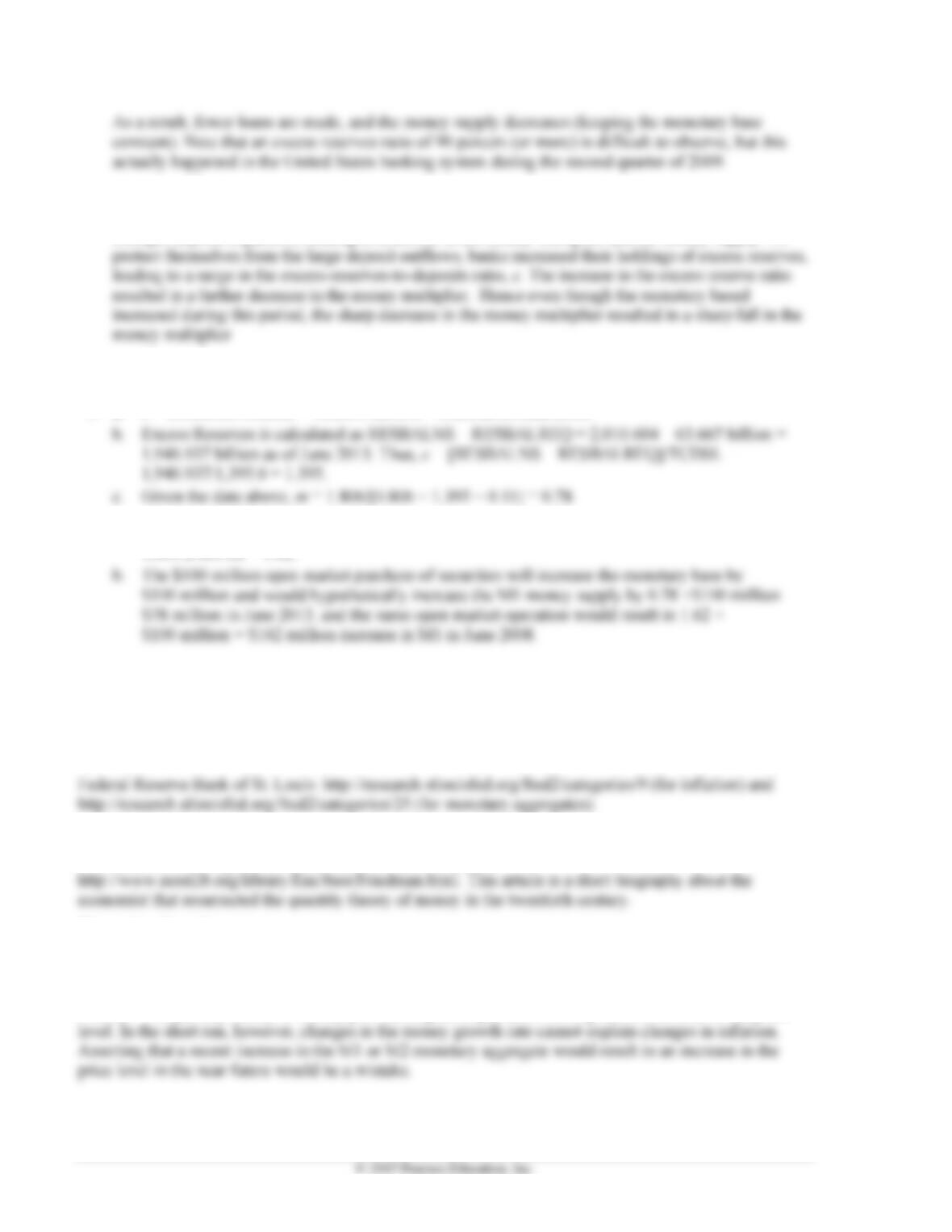
10.
Currency deposit ratio
0.5
0.7
0.5
Excess reserves ratio
0.01
0.01
0.9
Money multiplier
2.54
2.15
1.01
54 Mishkin • Macroeconomics: Policy and Practice, Second Edition
11. The loss of confidence in the banking system led to surge in holdings of currency and a decline in the
holdings of deposits. The resulting rise in the currency-deposit ratio, c, reduced the overall level of
multiple deposit expansion, leading to a decline in the money multiplier and the money supply. To
Answers to Appendix Data Analysis Problems
1. a. c = CURRNS/TCDSL = 1,124.9/1,395.6 = 0.806 as of June 2013.
2. a. The money multiplier for June 2013 is 2,522.3/3,222.3 = 0.78; for June 2008, the multiplier is
1,401.2/863.88 = 1.62.
◼ Data Sources, Related Articles, and Discussion Questions
A. For Information About Application: Testing the Quantity Theory of Money
Data Sources
Related Article
The Concise Encyclopedia of Economics, “Milton Friedman”:
Discussion Question
What would be the problem of applying the insights of the quantity theory of money to explain short-run
changes in the inflation and money growth rates?
Answer: The quantity theory of money provides a good explanation to long-run movements in the price
Chapter 5 Money and Inflation 55
B. For Information About Policy and Practice: The Zimbabwean Hyperinflation
Data Sources
World Bank Data and Statistics: http://data.worldbank.org/country/zimbabwe. Here you can find summary
statistics about Zimbabwe. You can get more data by following the “DATABANK” link.
Related Article
Martinez, Ibsen, “Can ‘New’ Currency Abate Venezuelan Inflation?”:
(including Zimbabwe).
Discussion Question
By which mechanisms can a hyperinflation affect the performance of the economy (e.g., effects on the
unemployment rate, and GDP growth rate)?
Answer: Hyperinflation is a very disruptive event. Not only does it affect the rate at which prices increase,
C. For Information About Application: Testing the Fisher Effect
Data Source
Federal Reserve Data: http://www.federalreserve.gov/releases/h15/update/. Here you can find information
about inflation expectations. The expected inflation rate (for each maturity) can be calculated by
subtracting the interest rate on the TIPS (inflation indexed) bonds from the interest rate on the (same
maturity) Treasury bonds.
Related Article
Mishkin, Frederic S., “The Real Interest Rate: An Empirical Investigation”:
Discussion Question
Suppose that according to a survey about inflation expectations, inflation is expected to rise in the near
future. Would this mean that nominal interest rates will increase as well? Explain your answer.
Answer: The evidence about the link between inflation expectations and nominal interest rates indicates
D. For Information About Application: Quantitative Easing and the Money
Supply, 2007–2013
Data Sources
Federal Reserve Bank of St. Louis: http://research.stlouisfed.org/fred2/categories/25. Here you can find data
about the M1 money multiplier (second series). Note the evolution of the M1 money multiplier since 2007,
56 Mishkin • Macroeconomics: Policy and Practice, Second Edition
and check how this explains the relatively smaller increase in M1 in relation to the increase in the
monetary base.
Related Article
O’Driscoll Jr., Gerald P. “Where’s the Inflation? Coming to your neighborhood”:
Discussion Questions
Suppose that after the increase in the monetary base engineered by the Federal Reserve (quantitative
easing) someone argues that this will unambiguously result in an increase in the money supply and,
therefore, will create inflation. Would you agree with this idea? Why or why not?
Answer: The surge in the monetary base results in an increase in the money supply only if the money
E. For Information About Web Appendix Application: The Great Depression
Bank Panics and the Money Supply, 1930–1933
Data Source
Federal Reserve Bank of St. Louis: http://research.stlouisfed.org/fred2/series/MULT?cid=25. Here you can
Related Article
Discussion Question
During the 2007–2009 crisis in the United States, the currency deposit ratio did not increase significantly
(as opposed to the 1931–1933 banking crisis), even though quite a few banks failed during the 2007–2009
crisis. Why do you think that the currency deposit ratio did not change by much in the most recent crisis?
Answer: The answer to this question is related to the behavior of depositors and their desire to keep their