
Chapter 5: Time Value of Money
Learning Objectives
81
Chapter 5
Time Value of Money
Learning Objectives
After reading this chapter, students should be able to do the following:
◆ Explain how the time value of money works and discuss why it is such an important concept in finance.
◆ Calculate the present value and future value of lump sums.
◆ Identify the different types of annuities, calculate the present value and future value of both an
ordinary annuity and an annuity due, and calculate the relevant annuity payments.
◆ Calculate the present value and future value of an uneven cash flow stream. You will use this
knowledge in later chapters that show how to value common stocks and corporate projects.
◆ Explain the difference between nominal, periodic, and effective interest rates. An understanding of
these concepts is necessary when comparing rates of returns on alternative investments.
◆ Discuss the basics of loan amortization and develop a loan amortization schedule that you might use
when considering an auto loan or home mortgage loan.

82
Lecture Suggestions
Chapter 5: Time Value of Money
Lecture Suggestions
We regard Chapter 5 as the most important chapter in the book, so we spend a good bit of time on it. We
approach time value in three ways. First, we try to get students to understand the basic concepts by use of
time lines and simple logic. Second, we explain how the basic formulas follow the logic set forth in the time
lines. Third, we show how financial calculators and spreadsheets can be used to solve various time value
problems in an efficient manner. Once we have been through the basics, we have students work problems
and become proficient with the calculations and also get an idea about the sensitivity of output, such as
present or future value, to changes in input variables, such as the interest rate or number of payments.
Some instructors prefer to take a strictly analytical approach and have students focus on the
formulas themselves. The argument is made that students treat their calculators as “black boxes,” and that
they do not understand where their answers are coming from or what they mean. We disagree. We think
that our approach shows students the logic behind the calculations as well as alternative approaches, and
because calculators are so efficient, students can actually see the significance of what they are doing better
if they use a calculator. We also think it is important to teach students how to use the type of technology
(calculators and spreadsheets) they must use when they venture out into the real world.
In the past, the biggest stumbling block to many of our students has been time value, and the
biggest problem was that they did not know how to use their calculator. Since time value is the foundation
for many of the concepts that follow, this chapter is near the beginning of the text. This gives students
more time to become comfortable with the concepts and the tools (formulas, calculators, and spreadsheets)
covered in this chapter. Therefore, we strongly encourage students to get a calculator, learn to use it, and
bring it to class so they can work problems with us as we go through the lectures. Our urging, plus the fact
that we can now provide relatively brief, course-specific manuals for the leading calculators, has reduced if
not eliminated the problem.
Our research suggests that the best calculator for the money for most students is the HP-10BII+.
Finance and accounting majors might be better off with a more powerful calculator, such as the HP-17BII+.
We recommend these two for people who do not already have a calculator, but we tell them that any
financial calculator that has an IRR function will do.
We also tell students that it is essential that they work lots of problems, including the end–of–
chapter problems. We emphasize that this chapter is critical, so they should invest the time now to get the
material down. We stress that they simply cannot do well with the material that follows without having this
material down cold. Bond and stock valuation, cost of capital, and capital budgeting make little sense, and
one certainly cannot work problems in these areas, without understanding time value of money first. We
also repeat our request that students get a financial calculator and our brief manual for it that can be found
on the website and bring the calculator to class so they can work through calculations as we cover them in
the lecture.
What we cover, and the way we cover it, can be seen by scanning the slides and Integrated Case
solution for Chapter 5, which appears at the end of this chapter’s solutions. For other suggestions about
the lecture, please see the “Lecture Suggestions” in Chapter 2, where we describe how we conduct our
classes.
DAYS ON CHAPTER: 4 OF 56 DAYS (50-minute periods)
Answers to End-of-Chapter Questions
5-1 The opportunity cost is the rate of interest one could earn on an alternative investment with a risk
equal to the risk of the investment in question. This is the value of I in the TVM equations, and it is
5-2 True. The second series is an uneven cash flow stream, but it contains an annuity of $400 for 8
5-3 True, because of compounding effects—growth on growth. The following example demonstrates
the point. The annual growth rate is I in the following equation:
$1(1 + I)10 = $2.
We can find I in the equation above as follows:
5-4 For the same stated rate, daily compounding is best. You would earn more “interest on interest.”
5-5 False. One can find the present value of an embedded annuity and add this PV to the PVs of the
other individual cash flows to determine the present value of the cash flow stream.
5-7 The annual percentage rate (APR) is the periodic rate times the number of periods per year. It is
also called the nominal, or stated, rate. With the “Truth in Lending” law, Congress required that
financial institutions disclose the APR so the rate charged would be more “transparent” to
5-8 A loan amortization schedule is a table showing precisely how a loan will be repaid. It gives the
required payment on each payment date and a breakdown of the payment, showing how much is
Solutions to End-of–Chapter Problems
5-1 0 1 2 3 4 5
| | | | | |
PV = 2,000 FV5 = ?
5-2 0 5 10 15 20
| | | | |
PV = ? FV20 = 29,000
5-3 0 19
| |
PV = 350,000 FV19 = 800,000
5-4 0 N = ?
| |
PV = 1
FVN = 2
5-5 0 1 2 N – 2 N – 1 N
| | | • • • | | |
PV = 33,556.25 5,000 5,000 5,000 5,000 FV = 220,000
6%
5%
4.0%
12%
I/YR = ?
Chapter 5: Time Value of Money
Answers and Solutions
85
5-6 Ordinary annuity:
0 1 2 3 4 5
| | | | | |
800 800 800 800 800
FVA5 = ?
5-7 0 1 2 3 4 5 6
| | | | | | |
150 150 150 250 300 500
PV = ? FV = ?
Using a financial calculator, enter the following: CF0 = 0; CF1 =150; Nj = 3; CF4 = 250 (Note
calculator will show CF2 on screen.); CF5 = 300 (Note calculator will show CF3 on screen.); CF6 =
500 (Note calculator will show CF4 on screen.); and I/YR = 11. Solve for NPV = $976.60.
5-8 Using a financial calculator, enter the following: N = 60, I/YR = 8/12 = 0.6667, PV = -40000, and
FV = 0. Solve for PMT = $811.06.
EAR =
M
NOM
M
I
1
+
– 1.0
5%
11%
86
Answers and Solutions
Chapter 5: Time Value of Money
5-9 a. 0 1
| | $600(1.06) = $636.00.
-600 FV = ?
b. 0 1 2
| | | $600(1.06)2 = $674.16.
–600 FV = ?
c. 0 1
| | $600(1/1.06) = $566.04.
PV = ? 600
d. 0 1 2
| | | $600(1/1.06)2 = $534.00.
PV = ? 600
5-10 a. 0 1 2 3 4 5 6 7 8 9 10
| | | | | | | | | | | $200(1.04)10 = $296.05.
-200 FV = ?
b. 0 1 2 3 4 5 6 7 8 9 10
| | | | | | | | | | | $200(1.08)10 = $431.78.
-200 FV = ?
c. 0 1 2 3 4 5 6 7 8 9 10
| | | | | | | | | | | $200/(1.04)10 = $135.11.
PV = ? 200
6%
6%
6%
6%
4%
4%
8%
Chapter 5: Time Value of Money
Answers and Solutions
87
d. 0 1 2 3 4 5 6 7 8 9 10
| | | | | | | | | | |
PV = ? 1,870.00
$1,870.0/(1.08)10 = $866.17.
e. The present value is the value today of a sum of money to be received in the future. For
example, the value today of $1,870.00 to be received 10 years in the future is $866.17 at an
5-11 a. 2013 2014 2015 2016 2017 2018
| | | | | |
-2.5 5 (in millions)
b. The calculation described in the quotation fails to consider the compounding effect of interest.
It can be demonstrated to be incorrect as follows:
5-12 These problems can all be solved using a financial calculator by entering the known values shown
on the time lines and then pressing the I/YR button.
a. 0 1
| |
+720 -792
?
8%
I/YR = ?
88
Answers and Solutions
Chapter 5: Time Value of Money
c. 0 14
| |
+65,000 –98,319
d. 0 1 2 3 4 5
| | | | | |
+15,000 -4,058.60 -4,058.60 -4,058.60 -4,058.60 -4,058.60
5-13 a. ?
| |
-300 600
With a financial calculator, enter I/YR = 6, PV = -300, PMT = 0, and FV = 600. Then press the
N key to find N = 11.90. Override I/YR with the other values to find N = 5.67, 3.64, and 1.00.
c. ?
| | Enter: I/YR = 21, PV = –300, PMT = 0, and FV = 600.
–300 600 N = 3.64.
–300 600 N = 1.00.
5-14 a. 0 1 2 3 4 5 6 7 8
| | | | | | | | |
500 500 500 500 500 500 500 500
FV = ?
b. 0 1 2 3 4
| | | | |
250 250 250 250
FV = ?
I/YR = ?
I/YR = ?
6%
21%
14%
7%
Chapter 5: Time Value of Money
Answers and Solutions
89
c. 0 1 2 3 4
| | | | |
700 700 700 700
FV = ?
d. To solve part d using a financial calculator, repeat the procedures discussed in parts a, b, and c,
but first switch the calculator to “BEG” mode. Make sure you switch the calculator back to “END”
mode after working the problem.
1. 0 1 2 3 4 5 6 7 8
| | | | | | | | |
500 500 500 500 500 500 500 500 FV = ?
2. 0 1 2 3 4
| | | | |
250 250 250 250 FV = ?
3. 0 1 2 3 4
| | | | |
700 700 700 700 FV = ?
5-15 a. 0 1 2 3 4 5 6 7 8 9 10 11 12
| | | | | | | | | | | | |
PV = ? 600 600 600 600 600 600 600 600 600 600 600 600
With a financial calculator, simply enter the known values and then press the key for the
unknown. Enter: N = 12, I/YR = 8, PMT = -600, and FV = 0. PV = $4,521.65.
b. 0 1 2 3 4 5 6
| | | | | | |
PV = ? 300 300 300 300 300 300
With a financial calculator, enter: N = 6, I/YR = 4, PMT = -300, and FV = 0. PV = $1,572.64.
c. 0 1 2 3 4 5 6
| | | | | | |
PV = ? 500 500 500 500 500 500
0%
14%
7%
0%
8%
4%
0%
90
Answers and Solutions
Chapter 5: Time Value of Money
d. 1. 0 1 2 3 4 5 6 7 8 9 10 11 12
| | | | | | | | | | | | |
600 600 600 600 600 600 600 600 600 600 600 600
PV = ?
2. 0 1 2 3 4 5 6
| | | | | | |
300 300 300 300 300 300
PV = ?
3. 0 1 2 3 4 5 6
| | | | | | |
500 500 500 500 500 500
PV = ?
5-16 PV5% = $600/0.05 = $12,000. PV10% = $600/0.10 = $6,000.
5-17 0 1 2 3 4 30
| | | | | • • • |
230,000 –20,430.31 –20,430.31 –20,430.31 –20,430.31 –20,430.31
5-18 a. Cash Stream A Cash Stream B
0 1 2 3 4 5 0 1 2 3 4 5
| | | | | | | | | | | |
PV = ? 150 450 450 450 250 PV = ? 250 450 450 450 150
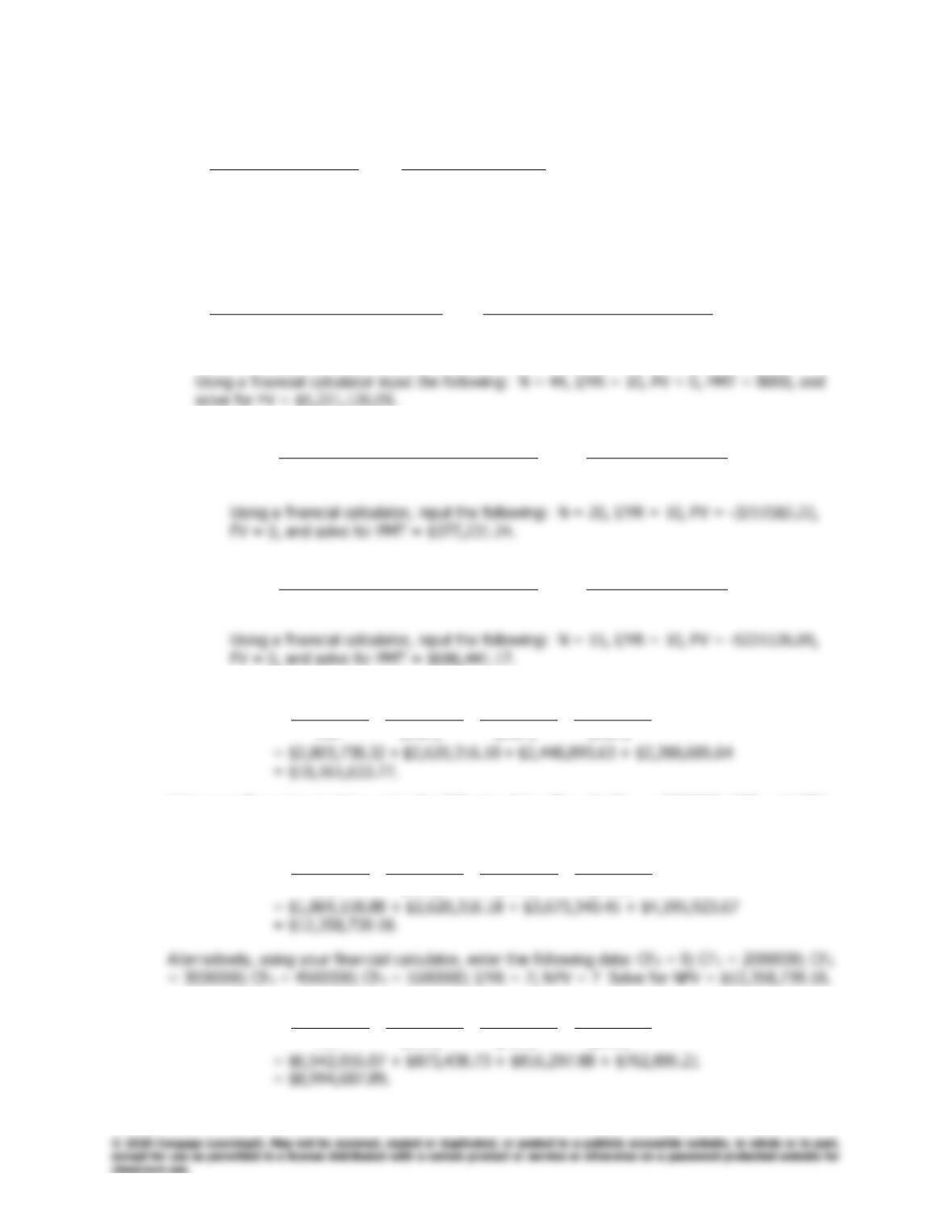
With a financial calculator, simply enter the cash flows (be sure to enter CF0 = 0), enter I/YR
= 5, and press the NPV key to find NPV = PV = $1,505.84 for the first problem. Override I/YR
I/YR = ?
8%
4%
0%
5%
5%
Chapter 5: Time Value of Money
Answers and Solutions
91
5-19 a. Begin with a time line:
26 27 64 65
| | • • • | |
8,000 8,000 8,000
FV = ?
Using a financial calculator input the following: N = 39, I/YR = 10, PV = 0, PMT = 8000, and
solve for FV = $3,211,582.22.
b. 26 27 69 70
| | • • • | |
8,000 8,000 8,000
FV = ?
c. 1. 65 66 67 84 85
| | | • • • | |
3,211,582.22 PMT PMT PMT PMT
2. 70 71 72 84 85
| | | • • • | |
5,221,126.09 PMT PMT PMT PMT
5-20 Contract 1: PV =
432 )07.1(
000,000,3$
)07.1(
000,000,3$
)07.1(
000,000,3$
07.1
000,000,3$ +++
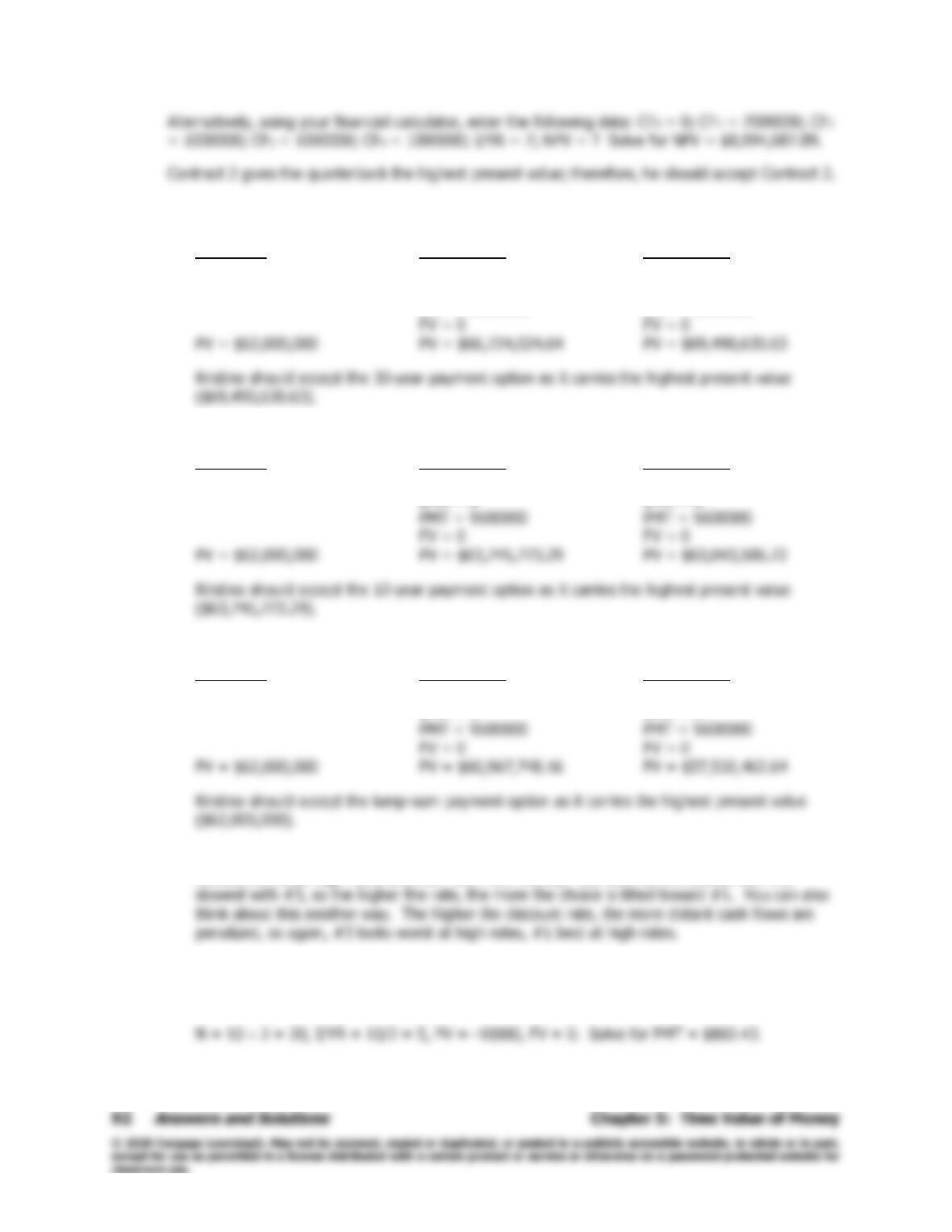
Using your financial calculator, enter the following data: CF0 = 0; CF1-4 = 3000000; I/YR = 7; NPV
= ? Solve for NPV = $10,161,633.77.
Contract 2: PV =
432 )07.1(
000,500,5$
)07.1(
000,500,4$
)07.1(
000,000,3$
07.1
000,000,2$ +++
Contract 3: PV =
432 )07.1(
000,000,1$
)07.1(
000,000,1$
)07.1(
000,000,1$
07.1
000,000,7$ +++
10%
10%
10%
10%
5-21 a. If Kristina expects a 7% annual return on her investments:
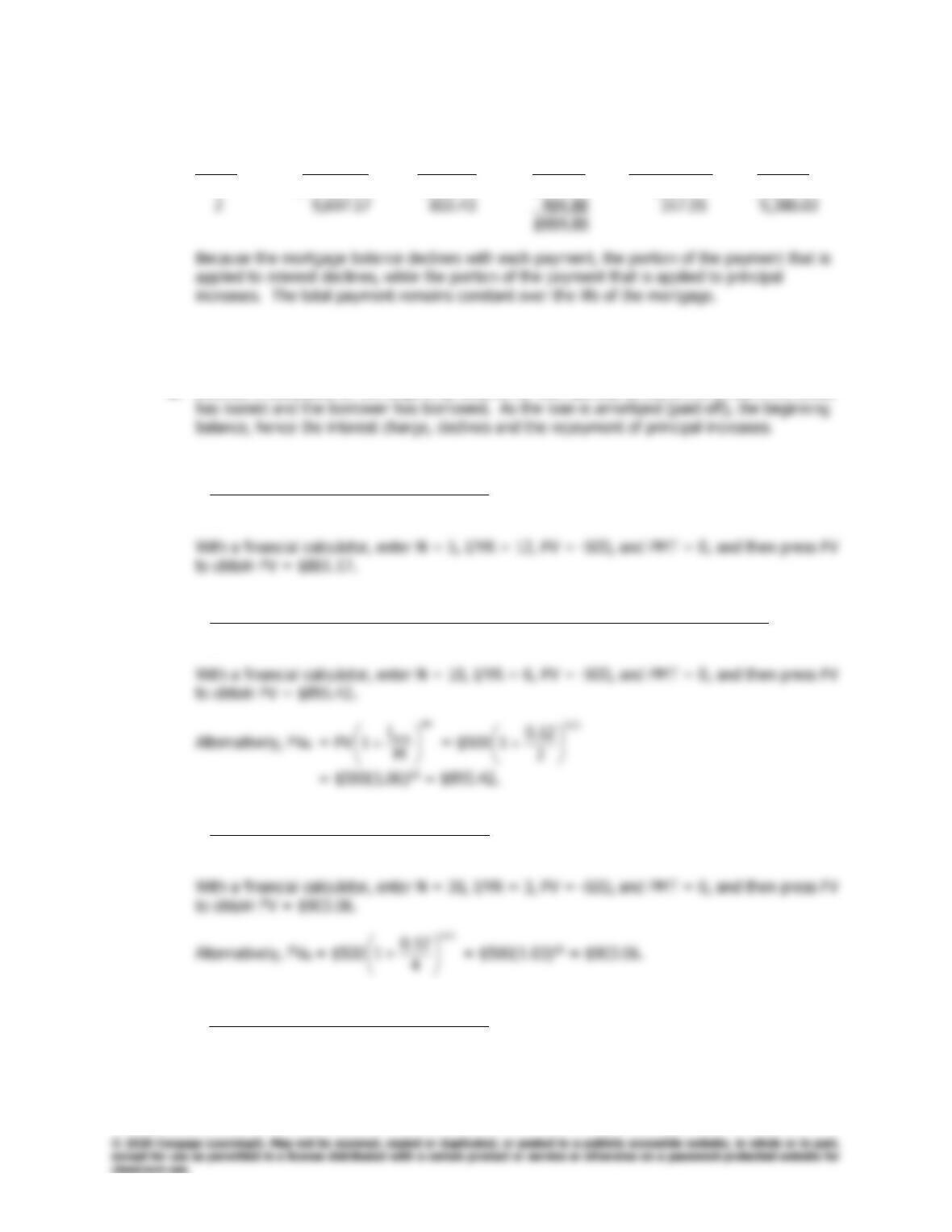
1 payment 10 payments 30 payments
N = 10 N = 30
I/YR = 7 I/YR = 7
PMT = 9500000 PMT = 5600000
b. If Kristina expects an 8% annual return on her investments:
1 payment 10 payments 30 payments
N = 10 N = 30
I/YR = 8 I/YR = 8
c. If Kristina expects a 9% annual return on her investments:
1 payment 10 payments 30 payments
N = 10 N = 30
I/YR = 9 I/YR = 9
d. The higher the interest rate, the more useful it is to get money rapidly, because it can be
invested at those high rates and earn lots more money. So, cash comes fastest with #1,
5-22 a. This can be done with a calculator by specifying an interest rate of 5% per period for 20
periods with 1 payment per period.
Chapter 5: Time Value of Money
Answers and Solutions
93
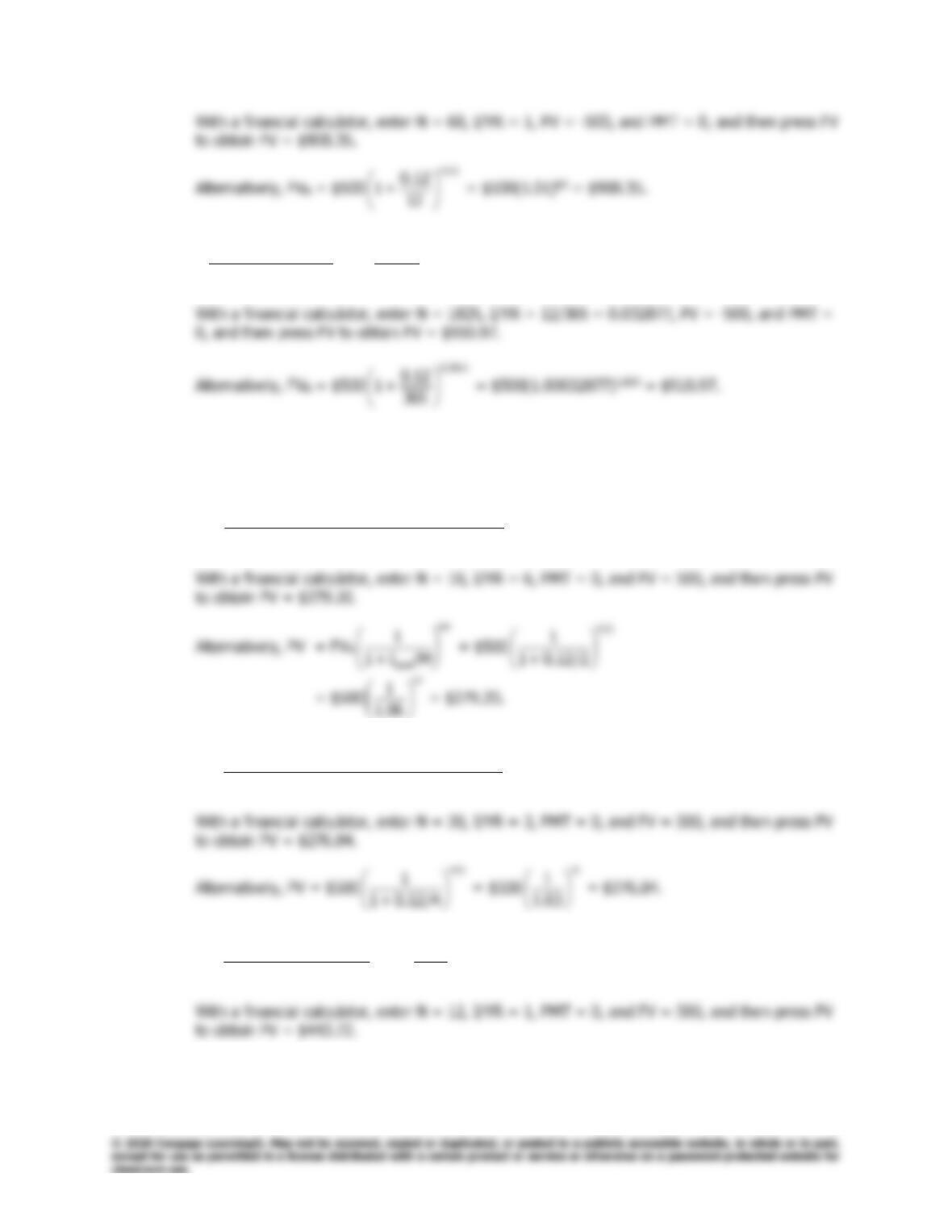
b. Set up an amortization table:
Beginning Payment of Ending
Period Balance Payment Interest Principal Balance
1 $10,000.00 $802.43 $500.00 $302.43 $9,697.57
c. Jan must report interest of $984.88 on Schedule B for the first year. Her interest income will
decline in each successive year for the reason explained in part b.
d. Interest is calculated on the beginning balance for each period, as this is the amount the lender
5-23 a. 0 1 2 3 4 5
| | | | | |
-500 FV = ?
b. 0 1 2 3 4 5 6 7 8 9 10
| | | | | | | | | | |
-500 FV = ?
c. 0 4 8 12 16 20
| | | | | |
-500 FV = ?
d. 0 12 24 36 48 60
| | | | | |
-500 FV = ?
12%
6%
3%
1%
94
Answers and Solutions
Chapter 5: Time Value of Money
e. 0 365 1,825
| | • • • |
-500 FV = ?
f. The FVs increase because as the compounding periods increase, interest is earned on interest
more frequently.
5-24 a. 0 2 4 6 8 10
| | | | | |
PV = ? 500
b. 0 4 8 12 16 20
| | | | | |
PV = ? 500
c. 0 1 2 12
| | | • • • |
PV = ? 500
6%
3%
1%
0.0329%
Chapter 5: Time Value of Money
Answers and Solutions
95
d. The PVs for parts a and b decline as periods per year increase. This occurs because, with more
frequent compounding, a smaller initial amount (PV) is required to get to $500 after 5 years. For
part c, even though there are 12 periods/year, compounding occurs over only 1 year, so the PV is
larger.
5-25 a. 0 1 2 3 9 10
| | | | • • • | |
-400 –400 -400 -400 –400
FV = ?
5-26 Using the information given in the problem, you can solve for the maximum car price attainable.
Financed for 48 months Financed for 60 months
5-27 a. Bank A: INOM = Effective annual rate = 2%.
Bank B:
b. If funds must be left on deposit until the end of the compounding period (1 year for Bank A
and 1 day for Bank B), and you think there is a high probability that you will make a withdrawal
during the year, then Bank B might be preferable. For example, if the withdrawal is made after
6%
96
Answers and Solutions
Chapter 5: Time Value of Money
5-28 Here you want to have an effective annual rate on the credit extended that is 3% more than what
the bank is charging you, so you can cover overhead. First, we must find the EAR = EFF% on the
bank loan. Enter NOM% = 9, P/YR = 12, and press EFF% to get EAR = 9.38069%.
Alternative solution: We need to find the effective annual rate (EAR) the bank is charging first.
Then, we can add 3% to this EAR to calculate the nominal rate that you should quote your
customers.
Bank EAR: EAR = (1 + INOM/M)M – 1 = (1 + 0.09/12)12 – 1 = 9.38069%.
5-29 INOM = 9%, daily compounding 360-day year.
Cost per day = 0.09/360 = 0.00025 = 0.025%.
5-30 a. Using the information given in the problem, you can solve for the length of time required to
reach $1 million.
Therefore, Leslie will be 25 + 25.08 = 50.08 years old when she becomes a millionaire.
b. Using the 25.075966-year target, you can solve for the required payment:
N = 25.075966; I/YR = 8; PV = 10000; FV = -1000000; then solve for PMT = $12,649.64.
c. Allison is investing in a relatively safe fund, so there is a good chance that she will achieve her
5-31 a. 0 1 2 3 4
| | | | |
PV = ? –5,000 -5,000 -5,000 -5,000
5-32 0 1 2 3 4 5 6
| | | | | | |
1,500 1,500 1,500 1,500 1,500 ?
FV = 10,000
Year 5.
Now find the FV of $1,500 for 5 years at 5% as follows: N = 5, I/YR = 5, PV = 0, PMT = -1500,
and solve for FV = $8,288.45. Compound this value for 1 year at 5% to obtain the value in the
account after 6 years and before the last payment is made; it is $8,288.45(1.05) = $8,702.87.
Thus, you will have to make a payment of $10,000 – $8,702.87 = $1,297.13 at Year 6.
5-33 Begin with a time line:
0 1 2 3
| | | |
9,000 9,450 9,922.50
FV = ?
6%
5%
8%
98
Answers and Solutions
Chapter 5: Time Value of Money
5-34 a. With a financial calculator, enter N = 3, I/YR = 8, PV = –19000, and FV = 0, and solve for PMT
Beginning Repayment Remaining
Year Balance Payment Interest of Principal Balance
1 $19,000.00 $ 7,372.64 $1,520.00 $5,852.64 $13,147.36
b. % Interest % Principal
Year 1: $1,520/$7,372.64 = 20.62% $5,852.64/$7,372.64 = 79.38%
5-35 a. Using a financial calculator, enter N = 3, I/YR = 5, PV = –126000, and FV = 0, then solve for
PMT = $46,268.28.
3-year amortization schedule:
Beginning Principal Ending
Period Balance Payment Interest Repayment Balance
1 $126,000.00 $46,268.28 $6,300.00 $39,968.28 $86,031.72
payments that could be paid (affordable).
b. Using a financial calculator, enter N = 30, I/YR = 5, PV = –126000, and FV = 0, then solve for
PMT = $8,196.48.
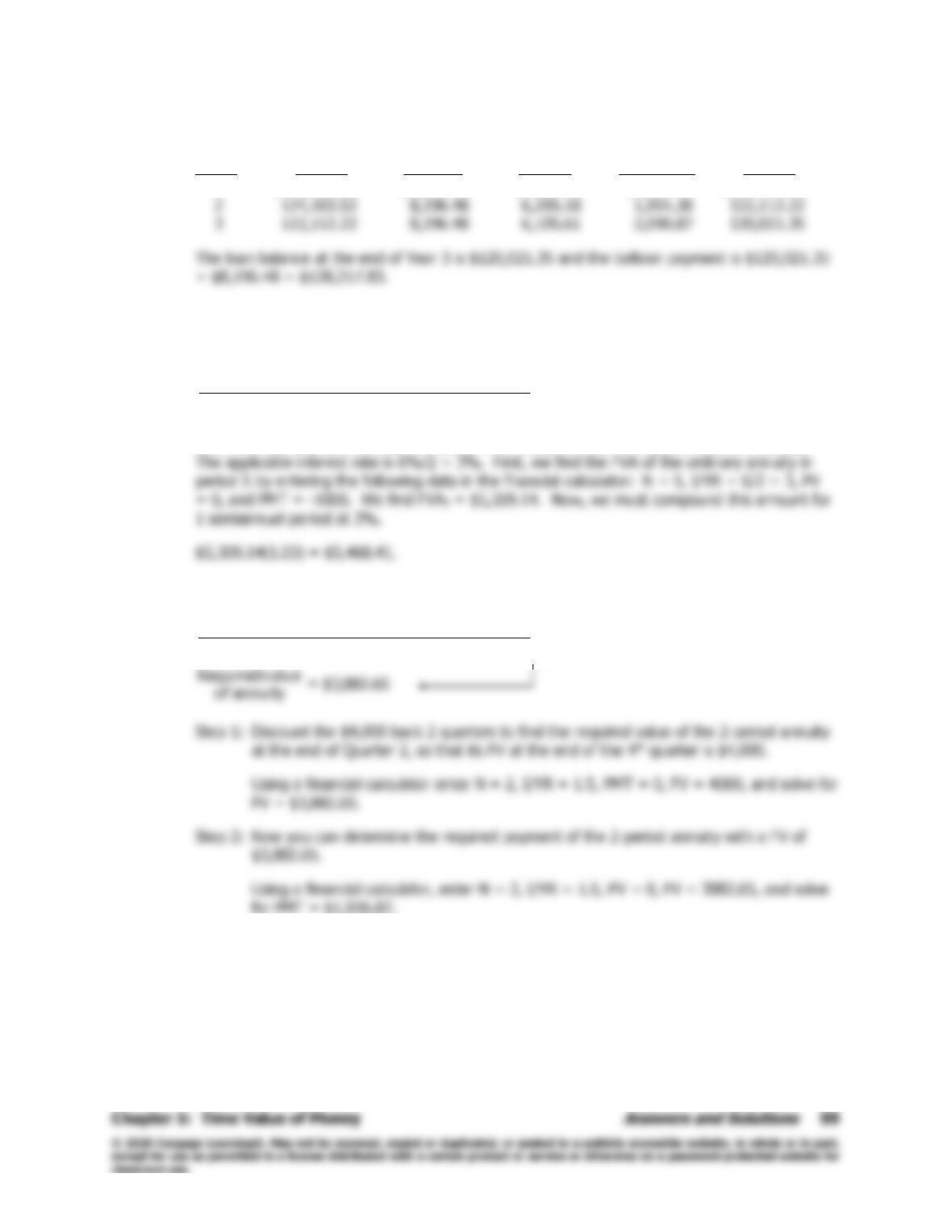
c. 30-year amortization with balloon payment at end of Year 3:
Beginning Principal Ending
Period Balance Payment Interest Repayment Balance
1 $126,000.00 $8,196.48 $6,300.00 $1,896.48 $124,103.52
5-36 a. Begin with a time line:
0 1 2 3 4 5 6 6-mos.
0 1 2 3 Years
| | | | | | |
1,000 1,000 1,000 1,000 1,000 FVA = ?
Since the first payment is made 6 months from today, we have a 5-period ordinary annuity.
b. Here’s the time line:
0 1 2 3 4 Qtrs
| | | | |
PMT = ? PMT = ? FV = 4,000
5-37 a. Using the information given in the problem, you can solve for the length of time required to
pay off the card.
I/YR = 1.5 (18%/12); PV = 372.71; PMT = -10; FV = 0; and then solve for N = 55 months.
3%
1.5%
100
Answers and Solutions
Chapter 5: Time Value of Money
5-38 0 1 2 3
12/31/17 12/31/18 12/31/19 12/31/20 12/31/21
| | | | |
36,000.00 37,080.00 38,192.40 39,338.17 40,518.32
300,000.00
5-39 1. Will save for 10 years, then receive payments for 25 years. How much must he deposit at the
end of each of the next 10 years?
2. Wants payments of $50,000 per year in today’s dollars for first payment only. Real income will
decline. Inflation will be 4%. Therefore, to find the inflated fixed payments, we have this time line:
0 5 10
| | |
50,000 FV = ?
8%
4%