Chapter 5: Time Value of Money
Answers and Solutions
101
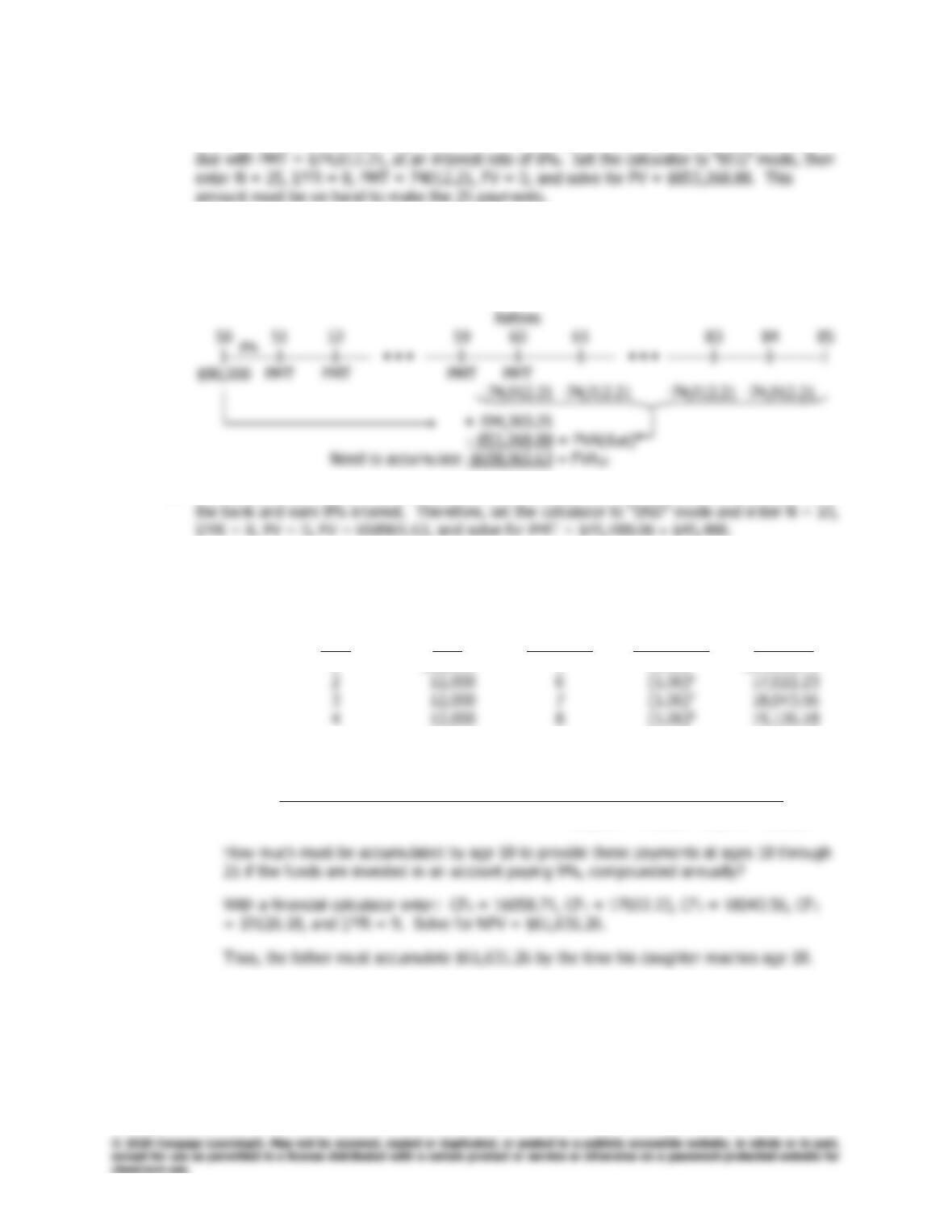
4. He wants to withdraw, or have payments of, $74,012.21 per year for 25 years, with the first
payment made at the beginning of the first retirement year. So, we have a 25-year annuity
5. Since the original $90,000, which grows to $194,303.25, will be available, we must save
enough to accumulate $853,268.88 – $194,303.25 = $658,965.63.
So, the time line looks like this:
6. The $658,965.63 is the FV of a 10-year ordinary annuity. The payments will be deposited in
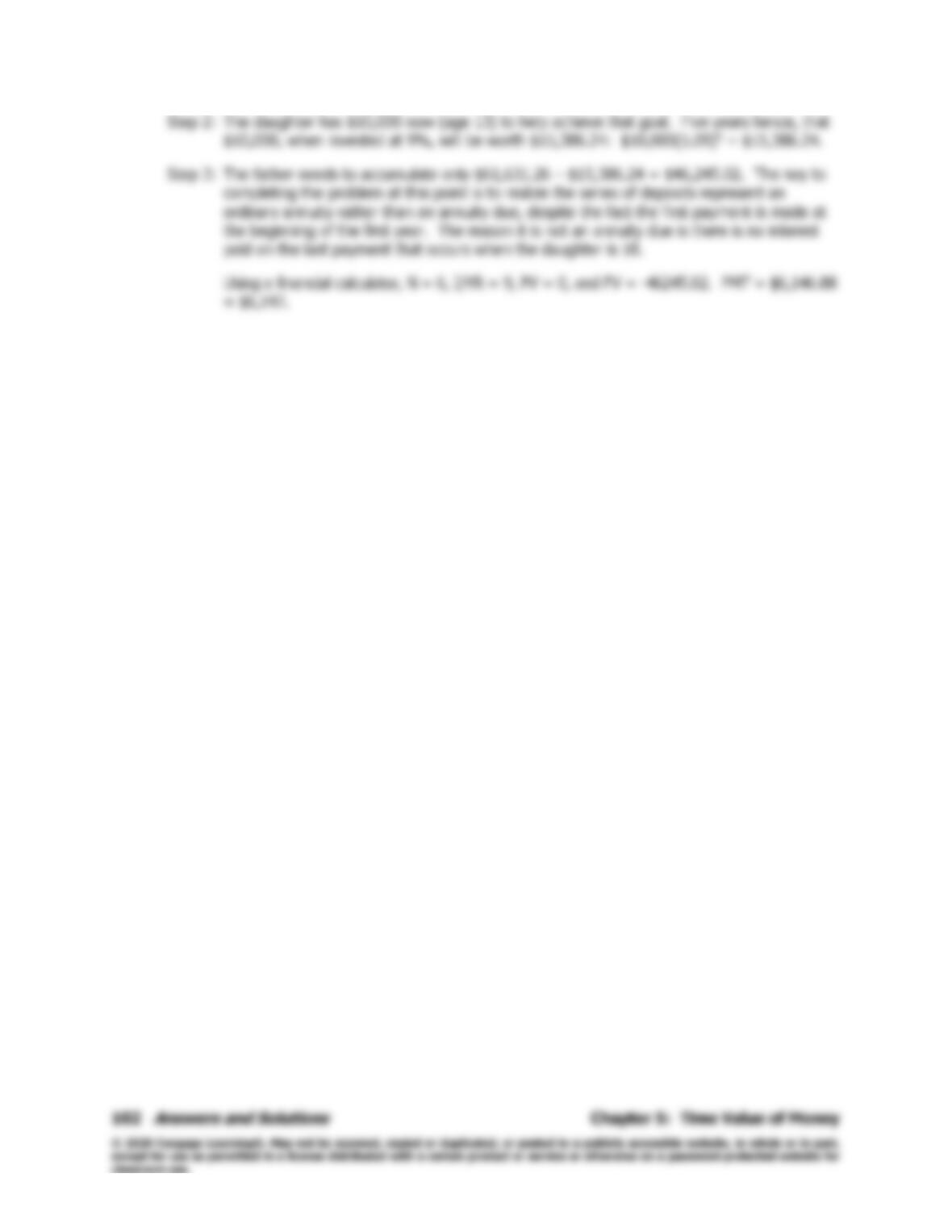
5-40 Step 1: Determine the annual cost of college. The current cost is $12,000 per year, but that is
escalating at a 6% inflation rate:
College Current Years Inflation Cash
Year Cost from Now Adjustment Required
1 $12,000 5 (1.06)5 $16,058.71
Now put these costs on a time line:
13 14 15 16 17 18 19 20 21
| | | | | | | | |
-16,059 –17,022 –18,044 –19,126
Chapter 5: Time Value of Money
Comprehensive/Spreadsheet Problem
103
Comprehensive/Spreadsheet Problem
Note to Instructors:
The solution to this problem is not provided to students at the back of their text. Instructors
can access the
Excel
file on the textbook’s website.
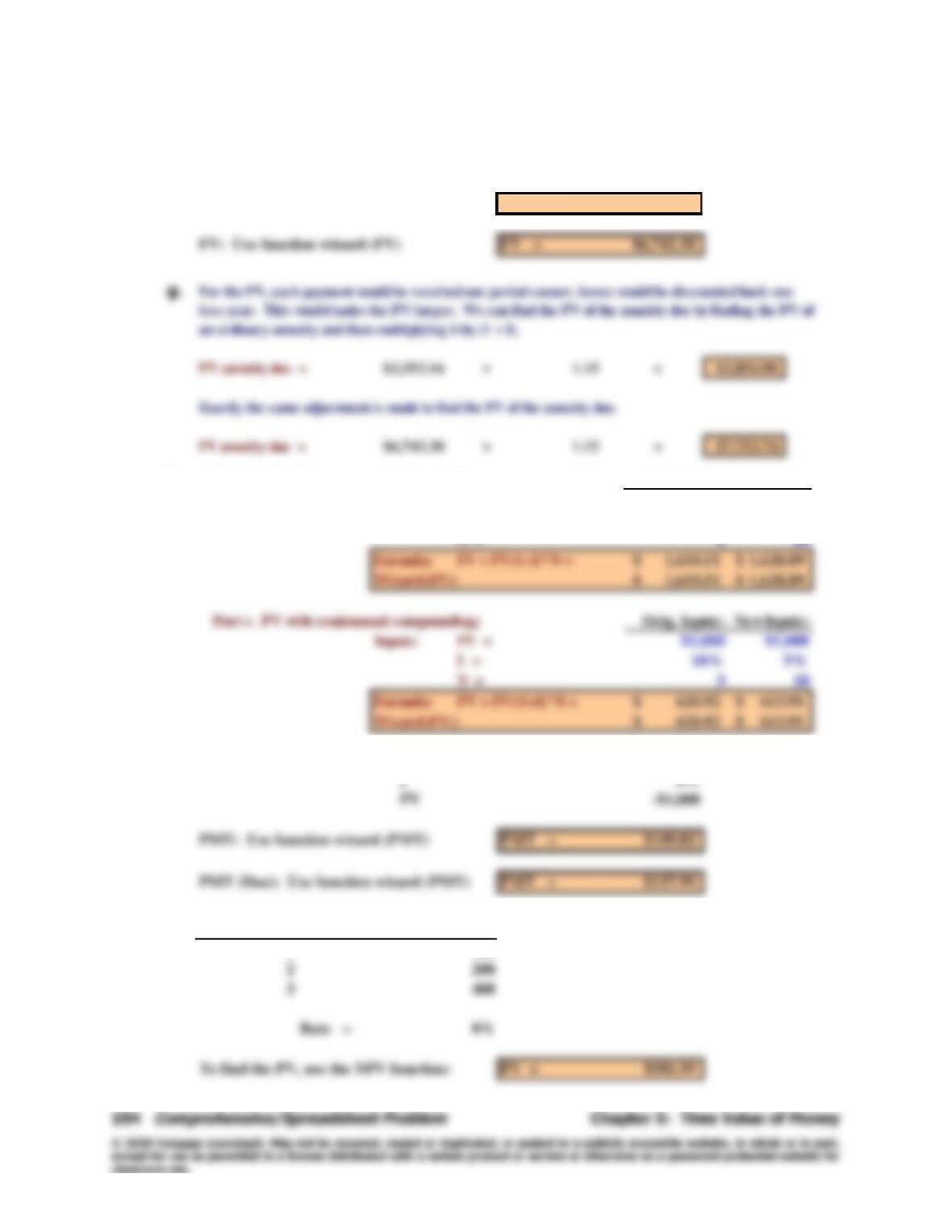
5-41 a.
I = 10%
b.
c.
d.
e.
Inputs: PV = $1,000
Years (D11)
1,610.51$ 0% 5% 20%
0$1,000.00 $1,000.00 $1,000.00
Interest Rate (D10)
Inputs: FV = $1,000
I = 10%
Inputs: PV = –$1,000
FV = $2,000
Inputs: PV = –36.5
FV = 73
f.
h.
i.
PMT: Use function wizard (PMT) PMT = $149.03
j.
Inputs: PMT (1,000)$
N 5
I15%
PV: Use function wizard (PV) PV = $3,352.16
Inputs: N 10
Year Payment
1100
Part a. FV with semiannual compounding: Orig. Inputs: New Inputs:
Inputs: PV = $1,000 $1,000
I = 10% 5%
Chapter 5: Time Value of Money
Comprehensive/Spreadsheet Problem
105
Excel does not have a function for the sum of the future values for a set of uneven payments. Therefore,
we must find this FV by some other method. Probably the easiest procedure is to simply compound each
k.
5 banks offer nominal rates of 6% , but differ in their compounding frequency.
A = annually; B = semiannually; C = quarterly; D = monthly; and E = daily.
I NOM 6%
Deposit $5,000
(1) A B C D E
(i) EAR 6.00% 6.09% 6.14% 6.17% 6.18%
(2) Would they be equally able to attract funds? No. People would prefer more compounding to less.
(i) What nominal rate would cause all banks to provide same EAR as Bank A?
(3) You need $5,000 at the end of the year. How much do you need to deposit annually for A,
semiannually, for B, etc. beginning today, to have $5,000 at the end of the year?
An alternative procedure for finding the FV would be to find the PV of the series using the NPV
function, then compound that amount for 3 years at 8% , as is done below:
106
Comprehensive/Spreadsheet Problem
Chapter 5: Time Value of Money
l.
Original amount of mortgage: $15,000
Term to maturity: 4
Interest rate: 8%
Chapter 5: Time Value of Money
Integrated Case
107
Integrated Case
5-42
First National Bank
Time Value of Money Analysis
You have applied for a job with a local bank. As part of its evaluation process,
you must take an examination on time value of money analysis covering the
following questions.
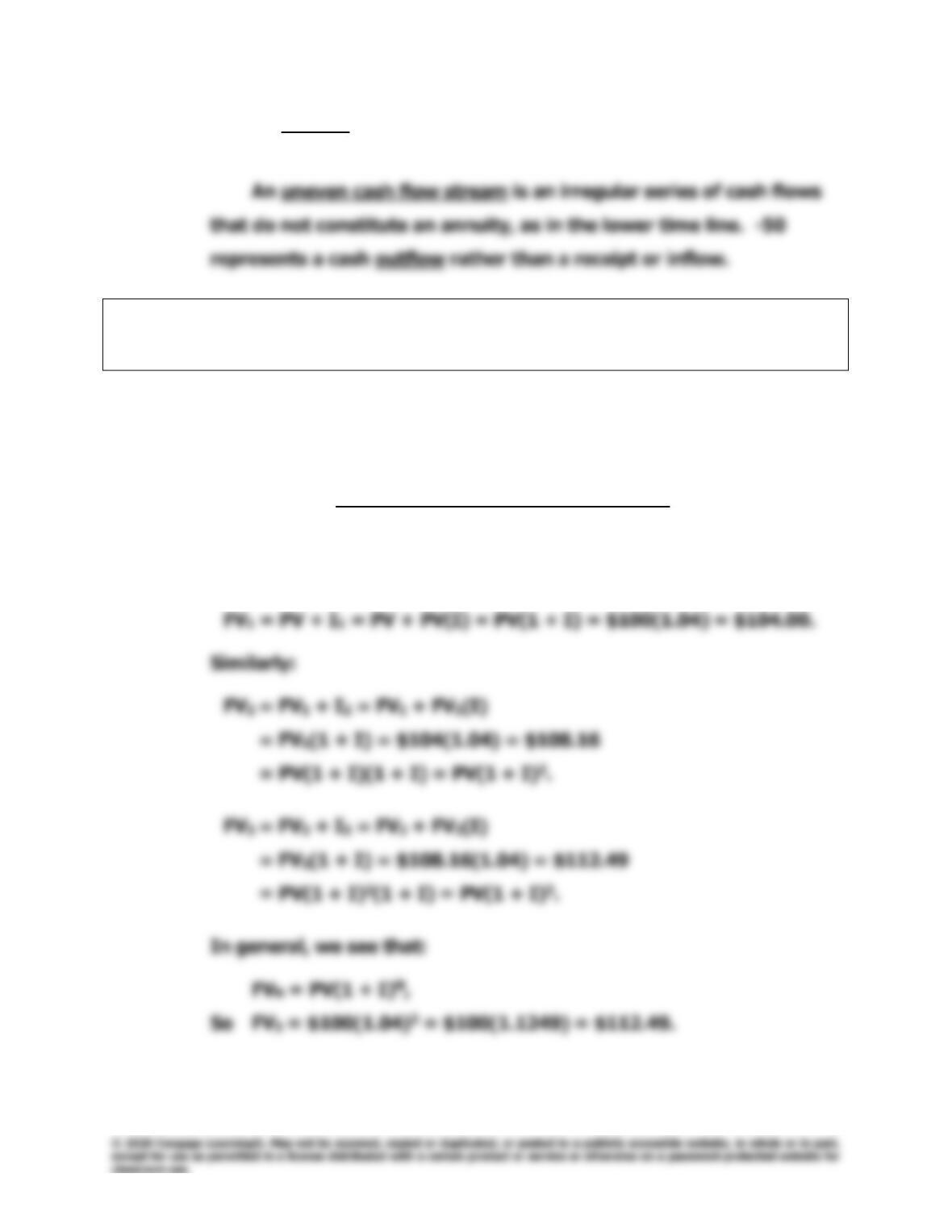
A. Draw time lines for (1) a $100 lump sum cash flow at the end of
Year 2; (2) an ordinary annuity of $100 per year for 3 years; and (3)
an uneven cash flow stream of –$50, $100, $75, and $50 at the end
of Years 0 through 3.
ANSWER: [Show S5-1 through S5-5 here.] A time line is a graphical
representation that is used to show the timing of cash flows. The
tick marks represent end of periods (often years), so Time 0 is today;
108
Integrated Case
Chapter 5: Time Value of Money
An annuity is a series of equal cash flows occurring over equal
intervals, as illustrated in the middle time line.
B. (1) What’s the future value of $100 after 3 years if it earns 4%, annual
compounding?
ANSWER: [Show S5-6 through S5-8 here.] Show dollars corresponding to
question mark, calculated as follows:
0 1 2 3
| | | |
100 FV = ?
After 1 year:
4%
Chapter 5: Time Value of Money
Integrated Case
109
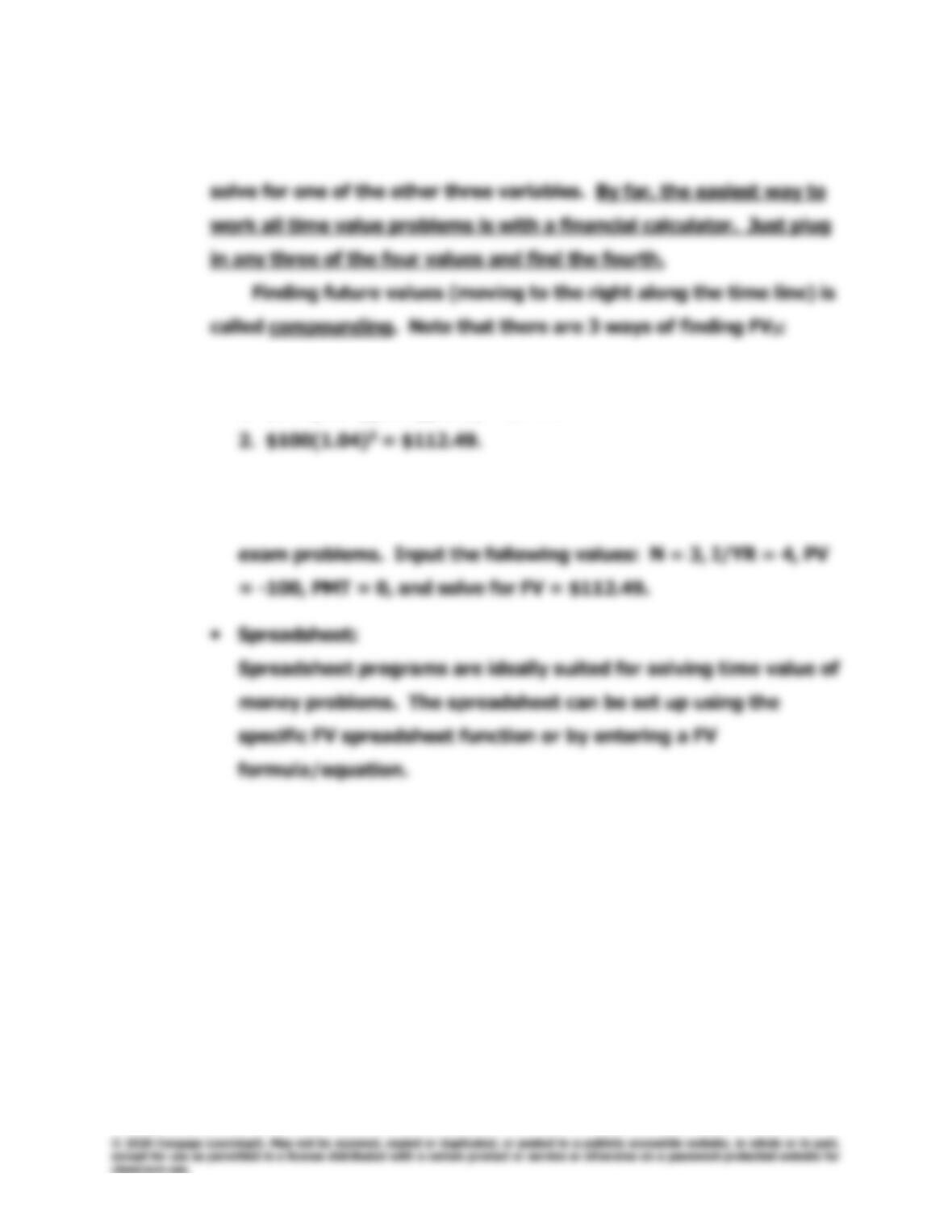
Note that this equation has 4 variables: FVN, PV, I/YR, and N. Here,
we know all except FVN, so we solve for FVN. We will, however, often
• Regular calculator:
1. $100(1.04)(1.04)(1.04) = $112.49.
• Financial calculator:
This is especially efficient for more complex problems, including
110
Integrated Case
Chapter 5: Time Value of Money
B. (2) What’s the present value of $100 to be received in 3 years if the
interest rate is 4%, annual compounding?
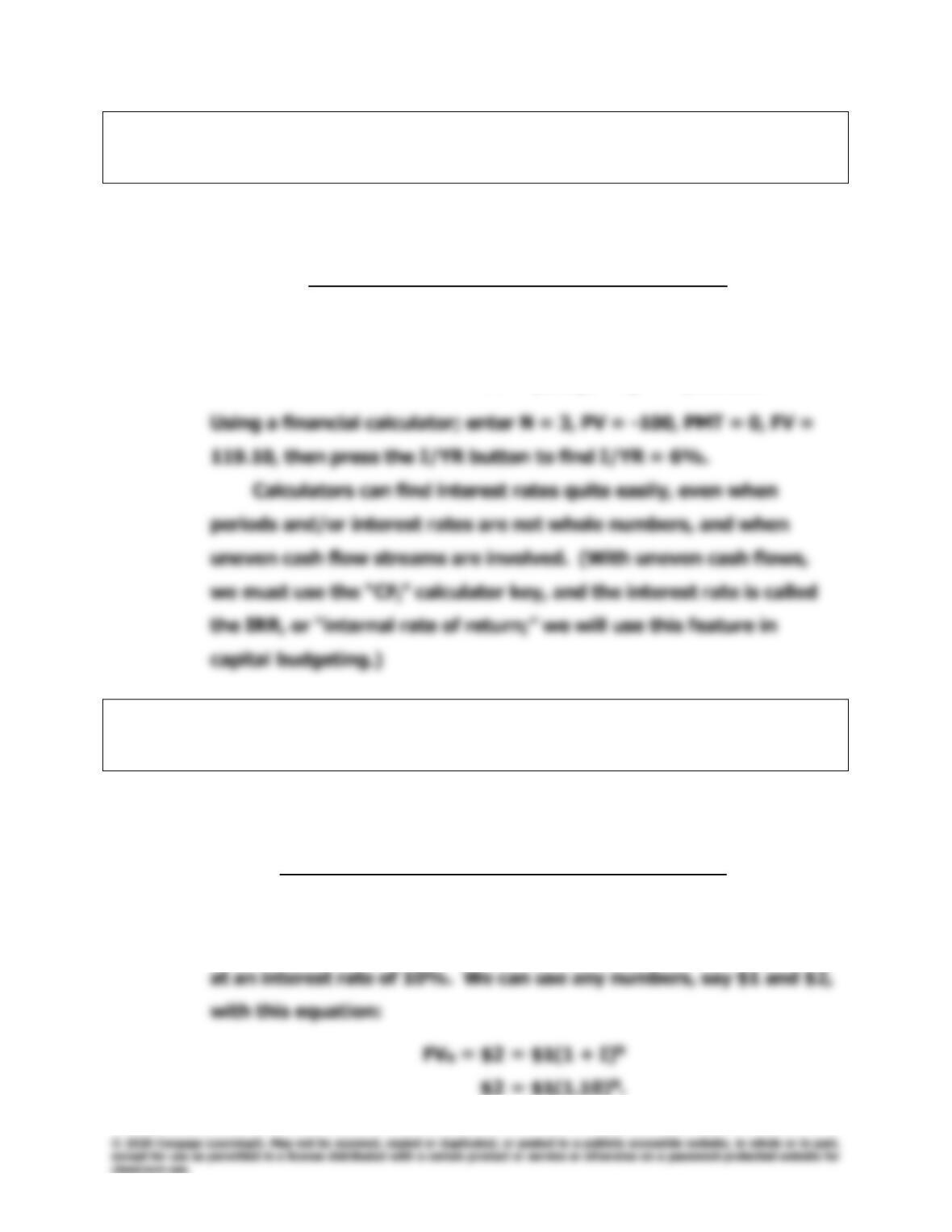
Answer: [Show S5-9 through S5-11 here.] Finding present values, or
discounting (moving to the left along the time line), is the reverse of
compounding, and the basic present value equation is the reciprocal
of the compounding equation:
0 1 2 3
| | | |
PV = ? 100
4%
Chapter 5: Time Value of Money
Integrated Case
111
C. What annual interest rate would cause $100 to grow to $119.10 in 3
years?
ANSWER: [Show S5-12 here.]
0 1 2 3
| | | |
–100 119.10
$100(1 + I) $100(1 + I)2
$100(1 + I)3
FV = $100(1 + I)3 = $119.10.
D. If a company’s sales are growing at a rate of 10% annually, how
long will it take sales to double?
ANSWER: [Show S5-13 here.] We have this situation in time line format:
0 1 2 7.3 8
| | | | |
-1 2
Say we want to find out how long it will take us to double our money
10%
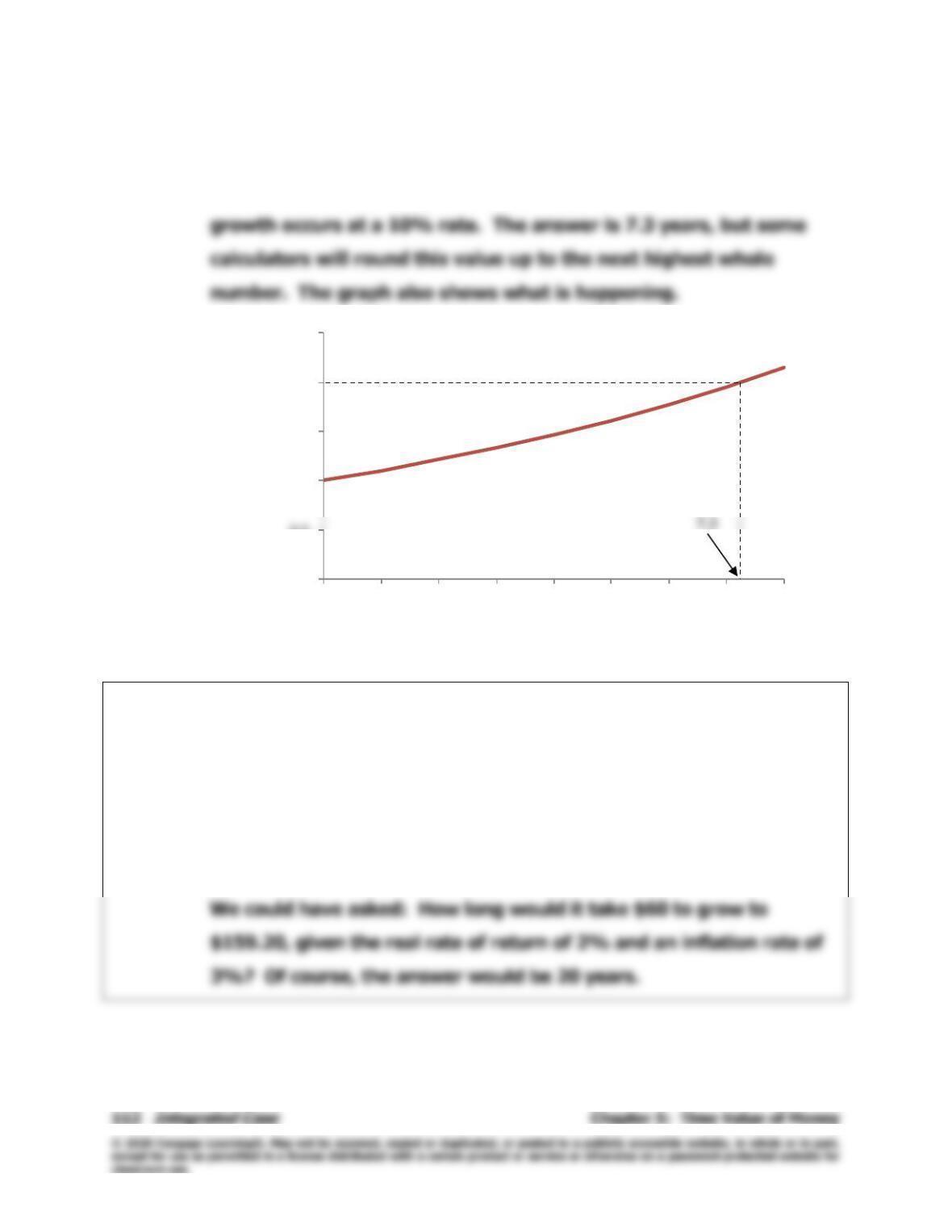
We would plug I/YR = 10, PV = –1, PMT = 0, and FV = 2 into our
calculator, and then press the N button to find the number of years
it would take $1 (or any other beginning amount) to double when
0
0.5
1
1.5
2
2.5
0
1
2
3
4
5
6
7
8
FV
Years
Optional Question
A farmer can spend $60/acre to plant pine trees on some marginal land. The
expected real rate of return is 2%, and the expected inflation rate is 3%. What
is the expected value of the timber after 20 years?
ANSWER: FV20 = $60(1 + 0.02 + 0.03)20 = $60(1.05)20 = $159.20 per acre.