(If a transaction doesn’t happen, consumer sur–
plus and producer surplus from that transaction
are zero by default, and zero surplus is better
than a negative surplus.) The areas of positive
they won’t make choices that result in negative
surplus, or loss.
4. An efficient allocation of resources is one that
maximizes total surplus, which is the sum of
consumer surplus and producer surplus. In
parties affected by the market.
5. If the goal is to minimize deadweight loss, taxes
should be levied on markets that have either very
inelastic demand or very inelastic supply. Dead-
weight loss arises when economic activity (i.e.,
quantity transacted) decreases, and decreases in
quantity transacted are smaller when demand or
supply is inelastic.
Hints and Common Errors: The text
gives an example of small deadweight loss using
inelastic demand, but it’s impor tant to note that
the same reasoning can be applied to cases of
inelastic supply.
Questions for Review
1. Consumer surplus represents the net benefits to
consumers from participating in a market.
2. Producer surplus represents the net benefits to
producers from participating in a market. Because
the producer’s willingness to sell is the minimum
amount that a producer would sell an item for,
willingness to sell represents the opportunity
3. Because transactions between producers and
consumers are voluntary, consumers and pro-
ducers in well- functioning markets are only
going to conduct transactions that provide
them with nonnegative amounts of surplus.
S
Price
Positive
Solutions to Chapterfi5 Text Prob lems
Solutions to Chapterfi5 Text Prob lems / 125
Hints and Common Errors: Technically,
it’s unclear whether the student would consume
the fourth slice of pizza, as she is indifferent
between consuming and not consuming at this
Hints and Common Errors: Notice that
this is consistent with lower prices resulting in
more consumer surplus. This is due to two
factors: first, the consumer gets more surplus on
each unit consumed, and second, the consumer
consumes more units.
2. a. Before the tax, the equilibrium quantity occurs
where quantity demanded and quantity sup-
plied are equal at the same price, namely at 30
units in this case. Because the market price is
$10, consumers get 10 w ($16 $10) “ $60in sur-
10 w ($10 $10) “ $0 from the third 10 units, for
a total of $90in producer surplus.
Hints and Common Errors: It’s impor tant
to remember that willingness to pay is related to
come into the market at $13, and so on, so we can
conclude that 10 consumers have a willingness to
pay of $16, 10 have a willingness to pay of $13,
and so forth. Similarly, producers’ willingness to
sell is the price at which they come into the
Price
Price
Q2Quantity
S2
Hints and Common Errors: Sometimes
it’s unclear whether a tax is on producers or
consumers. You learned in the text that the
market outcome is the same regardless of whether
have a large deadweight loss from taxation.
7. For a while, as tax rates go from small to moder–
ate, tax revenues increase as tax rates increase. At
some point as tax rates go from moderate to large,
however, tax revenues will begin to decrease as
Study Prob lems
1. a. At a price of $3, the student will buy four slices
of pizza. The student will get $6 $3 “ $3in
consumer surplus from the first slice,
Price
CS
S
P2
CS
S
Hints and Common Errors: It should be
obvious that producer surplus increases when
demand increases, as producers are selling more
at a higher price with no increase in cost. It’s less
amount, so consumers must be getting more
surplus.
7. a. Consumer surplus before the tax is equal to
area A B E.
Hints and Common Errors: Consumer
surplus is always equal to the area below the
relevant demand curve, above the price that the
consumer has to pay, and to the left of the
willingness to sell of $4 for the first 10 units, $7
for 10 more units, and so forth.
b. After the tax is implemented, the equilibrium
occurs at a quantity where quantity
demanded and quantity supplied are the
same at a price that is $6 (the amount of the
for a total of $30in consumer surplus.
Because the price for the producers is $7,
producers get 10 w ($7 $4) “ $30in surplus
from the first 10 units and 10 w ($7 $7) “ $0
from the second 10 units, for a total of $30in
producer surplus.
$45 $30 “ $15. The consumer surplus from the
resale is equal to $80 $60 “ $20, as Nick’s will-
ingness to pay was $80 but he actually paid $60.
The producer surplus from the resale is equal to
$60 $45 “ $15, as Andrew valued the cannon at
4. Good candidates for an excise tax are items for
which there is fairly inelastic demand. As we
learned in earlier chapters, one reason goods have
inelastic demand is that they don’t have a lot of
available substitutes. In the examples, cigarettes,
toilet paper, and automobile tires are the items
that don’t have many close substitutes and are
thus likely to have inelastic demand.
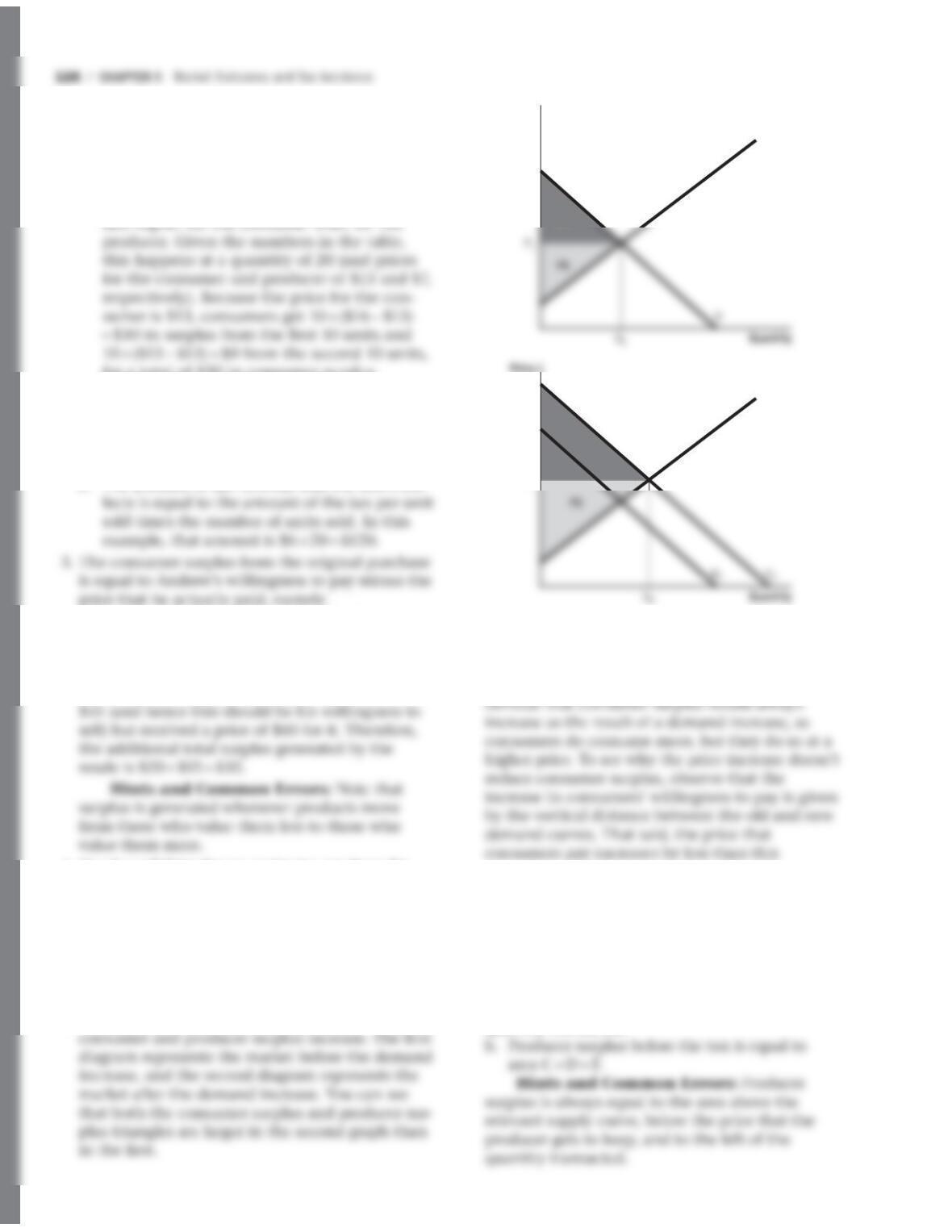
6. When the demand for blueberries increases, both
Solutions to Chapterfi5 Text Prob lems / 127
Hints and Common Errors: It should be
obvious that consumer surplus increases when
supply increases, as consumers are getting more
at a lower price. It’s less obvious that producer
surplus would always increase as the result of a
supply increase, as producers do sell more, but
2,500 20P “ 500 80P
3,000 “ 100P
P “ 30
PE⫽$30
QE⫽1900 2500
Quantity
D
S
$6.25
ing the supply of the item (as firms are given
incentives to produce and sell). Either way, subsi-
dies encourage transactions in a market and
result in equilibrium quantities that are higher
than those without the subsidies.
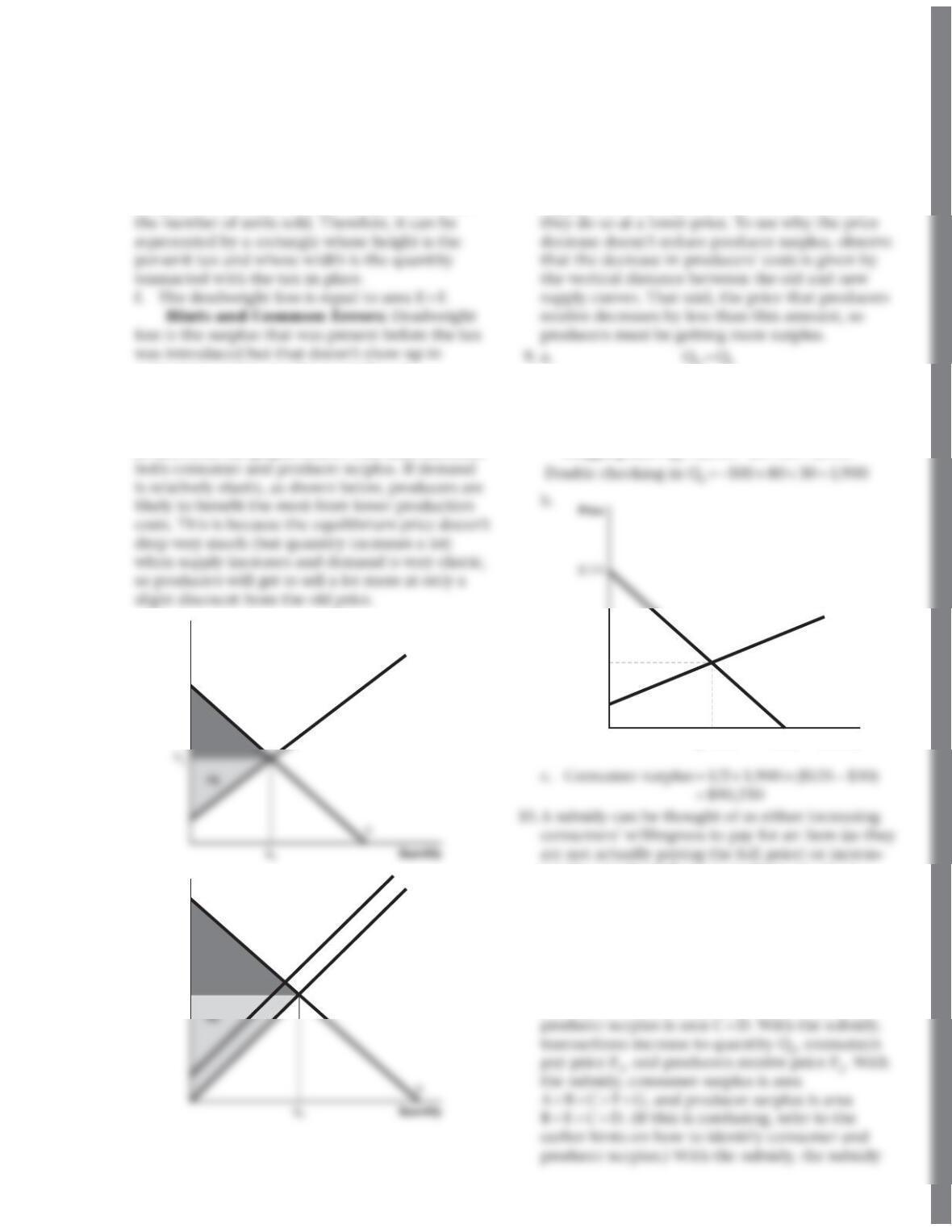
In the following graph, the market price is P1,
and the market quantity is Q1 without the
subsidy. Consumer surplus is area A B, and
c. Consumer surplus after the tax is equal to
area A.
d. Producer surplus after the tax is equal to area D.
e. Tax revenue is equal to area B C.
Hints and Common Errors: Tax revenue
is equal to the amount of the tax per unit times
consumer surplus, producer surplus, or
government revenue once the tax is in place.
8. The decreased cost of production causes supply to
increase and the supply curve to shift to the right,
Price
CS
S
Price
P2
CS
S2
S1
candies the most. The following solutions might
improve how the candies are allocated:
a. Donate unwanted candies to charity or giving
cil, pen, crayons, eraser, a small book, or fun
items such as stickers, puzzles, or coloring
books.
c. Allow neighbors to participate voluntarily.
Some neighbors turn off their lights if they
paid by consumers, which the new marked price
plus the tax, can be read off the original demand
curve using the new, lower quantity, Q2. This
total amount paid, P2 tax, will be higher than
the original price, P1.
Price
S
provider must pay out an amount equal to the
per– unit subsidy times the number of units
transacted, which can be represented by a
Price
P2
A
BE
S2
Hints and Common Errors:
Mathematically and graphically, a subsidy is
equivalent to a negative tax, so you can analyze
subsidies in the same way you do taxes by doing
every thing backward. Note that with a subsidy,
the price that the producer receives is going to be
higher than the price that the consumer pays, as