1
2
3
4
5
6
7
10
11
12
13
14
A B C D E F G H
SECTION 5-8 12/12/2018
SOLUTIONS TO SELF-TEST QUESTIONS
N5
I4%
N5
I4%
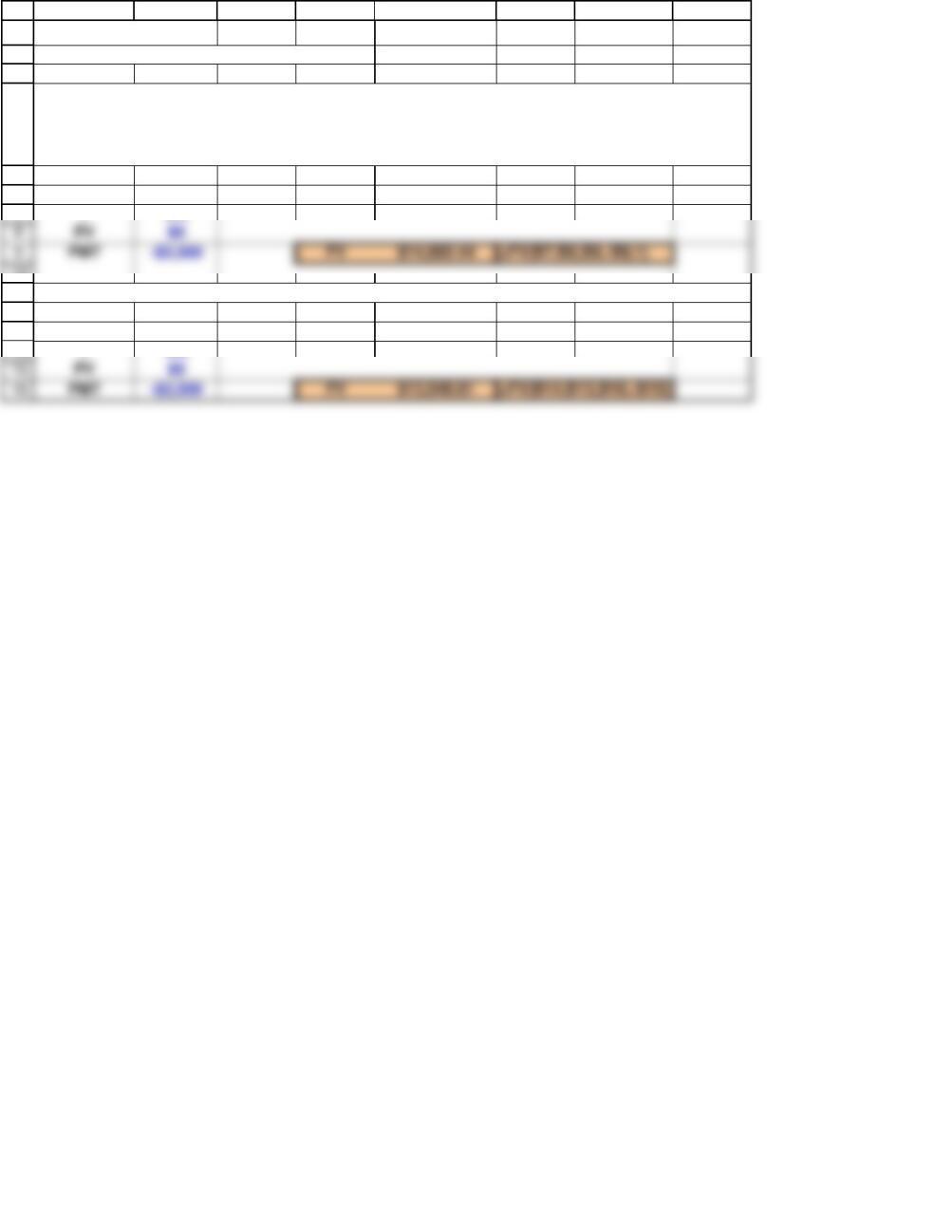
3a. Assume that you plan to buy a condo 5 years from now, and you need to save for a down
payment. You plan to save $2,500 per year (with the first deposit made immediately ), and you
will deposit the funds in a bank account that pays 4% interest. How much will you have after 5
years?
3b. How much will you have if you make the deposits at the end of each year?
21
1
2
3
4
5
6
7
I4%
10
11
12
13
17
18
19
20
21
N10 N10 N10
I10% I4% I0%
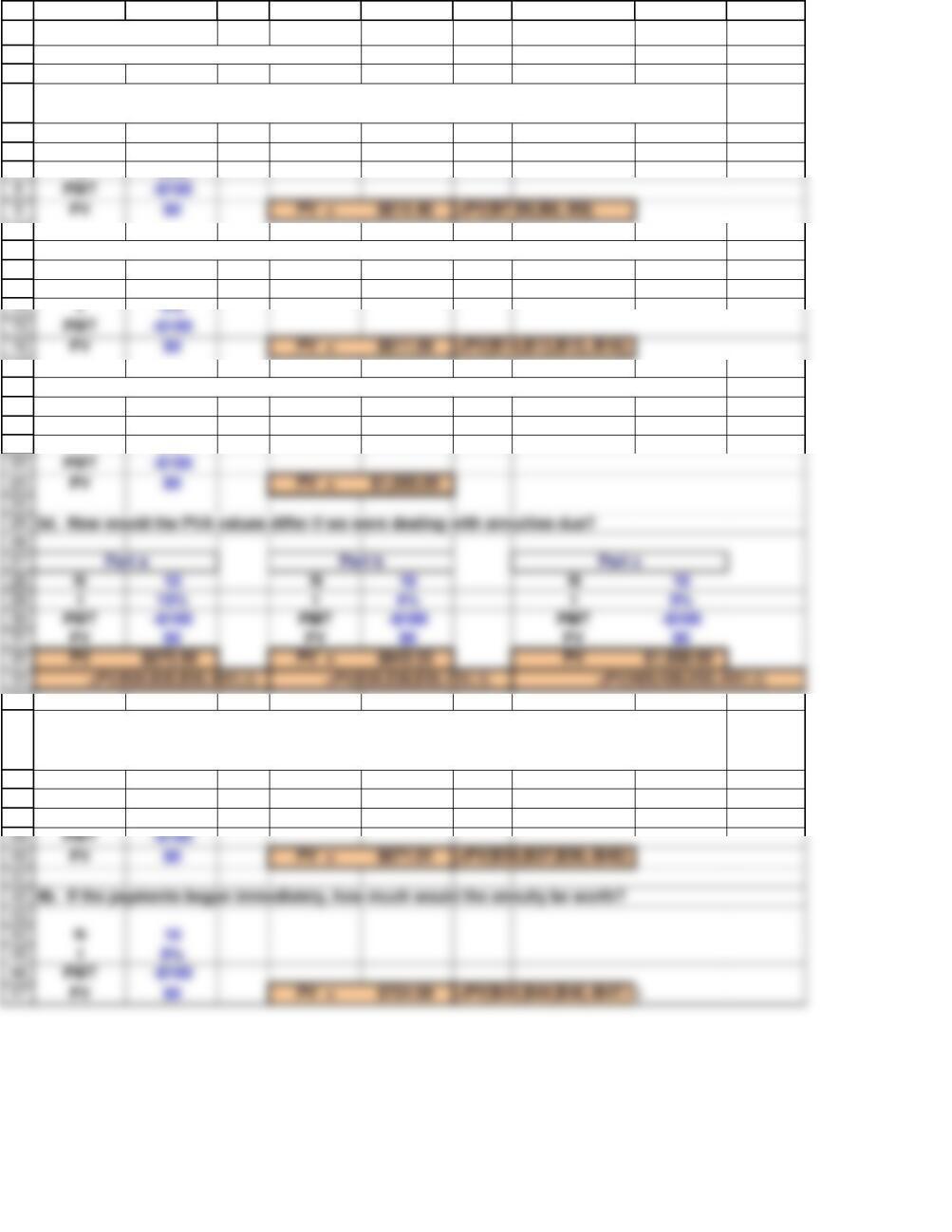
3d. How would the PVA values differ if we were dealing with annuities due?
34
35
36
37
38
N10
I8%
4b. If the payments began immediately, how much would the annuity be worth?
A B C D E F G H I
SECTION 5-9 12/12/2018
SOLUTIONS TO SELF-TEST QUESTIONS
N10
I10%
N10
N10
I0%
N10
I8%
4a. Assume that you are offered an annuity that pays $100 at the end of each year for 10
years. You could earn 8% on your money in other investments with equal risk. What is the
most you should pay for the annuity?
3a. What is the PVA of an ordinary annuity with 10 payments of $100 if the appropriate
interest rate is 10%?
3b. What would the PVA be if the interest rate was 4%?
3c. What if the interest rate was 0%?
22
1
2
3
4
5
6
7
I7%
10
11
12
13
17
18
19
20
21
PV $100,000
24
25
26
27
PV $100,000
31
32
33
34
38
39
40
41
42
45
46
47
48
49
52
53
A B C D E F G H
SECTION 5-10 12/12/2018
SOLUTIONS TO SELF-TEST QUESTIONS
N10
I7%
N10
I7.0%
PV $100,000
I0.0%
I7.0%
N12
PMT $12,000
N10
PMT -$10,000
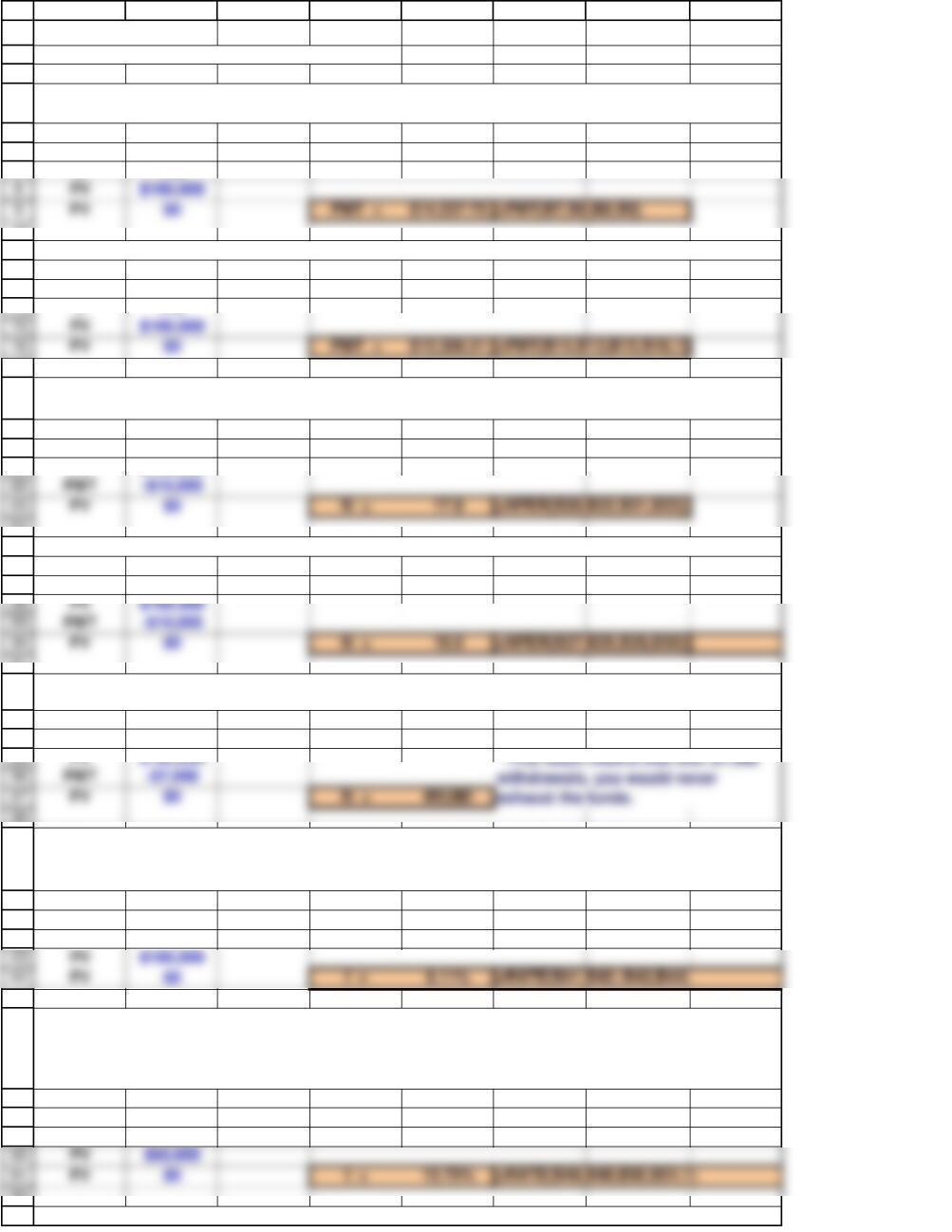
4b. If you think a “fair” return would be 6%, how much should you ask for the annuity?
2c. How long would they last if you earned the 7% but limited your withdrawals to $7,000 per year?
3. Your uncle named you as the beneficiary of his life insurance policy. The insurance company
gives you a choice of $100,000 today or a 12-year annuity of $12,000 at the end of each year. What
rate of return is the insurance company offering?
1a. Suppose you inherited $100,000 and invested it at 7% per year. What is the most you could
withdraw at the end of each of the next 10 years and have a zero balance at Year 10?
1b. How would your answer change if you made withdrawals at the beginning of each year?
2a. If you had $100,000 that was invested at 7% and you wanted to withdraw $10,000 at the end of
each year, how long would your funds last?
2b. How long would they last if you earned 0%?
4a. Assume that you just inherited an annuity that will pay you $10,000 per year for 10 years, with
the first payment being made today. A friend of your mother offers to give you $60,000 for the
annuity. If you sell it, what rate of return would your mother’s friend earn on his investment?
23
54
55
56
A B C D E F G H
N10
I6%
24
1
2
3
4
5
6
7
8
9
10
A B C D E F G H
SECTION 5-11 12/12/2018
SOLUTIONS TO SELF-TEST QUESTIONS
PMT $1,000
I5% PV $20,000 =B6/B7
**The perpetuity value formula
1a. What’s the present value of a perpetuity that pays $1,000 per year, beginning one year from
now, if the appropriate interest rate is 5%?
1b. What would the value be if payments on the annuity began immediately?
25
PMT $1,000
I5% PV $21,000
1
2
3
4
5
6
7
8
14
15
16
17
18
25
26
27
28
29
A B C D E F G H I J K L
SECTION 5-12 12/12/2018
SOLUTIONS TO SELF-TEST QUESTIONS
Interest rate 6%
Year 0 1 2 3 4 5
Interest rate 6%
Interest rate 8%
2a. What’s the present value of a 5-year ordinary annuity of $100 plus an additional $500 at the end
of Year 5 if the interest rate is 6%?
2b. What is the PV if the $100 payments occur in Years 1 through 10 and the $500 comes at the end
of Year 10?
3. What’s the present value of the following uneven cash flow stream: $0 at Time 0, $100 in Year 1
(or at Time 1), $200 in Year 2, $0 in Year 3, and $400 in Year 4 if the interest rate is 8%?
26
1
2
3
4
5
6
A B C D E
SECTION 5-13 12/12/2018
SOLUTIONS TO SELF-TEST QUESTIONS
Interest rate 15%
2. What is the future value of this cash flow stream: $100 at the end of 1 year, $150 due after 2 years, and $300 due
after 3 years if the appropriate interest rate is 15%?
27
1
2
3
4
5
6
7
8
9
14
15
16
17
A B C D E F G H
SECTION 5-14 12/12/2018
SOLUTIONS TO SELF-TEST QUESTIONS
Interest rate 6%
Year 0 1 2 3 4
Ann Pmt -$465 $100 $100 $100 $100
Year 0 1 2 3
1. An investment costs $465 and is expected to produce cash flows of $100 at the end of each of
the next 4 years, then an extra lump sum payment of $200 at the end of the 4th year. What is the
expected rate of return on this investment?
2. An investment costs $465 and is expected to produce cash flows of $100 at the end Year 1, $200
at the end or Year 2, and $300 at the end of Year 3. What is the expected rate of return on this
investment?
28
1
2
3
4
5
6
7
10
11
12
13
14
I8%
17
18
19
20
24
25
26
27
28
A B C D E F G H
SECTION 5-15 12/12/2018
SOLUTIONS TO SELF-TEST QUESTIONS
N3
I8%
N36
I0.67%
N3
N36
I1%
2a. What’s the future value of $100 after 3 years if the appropriate interest rate is 8%,
compounded annually?
2b. Compounded monthly?
3a. What’s the present value of $100 due in 3 years if the appropriate interest rate is 8%,
compounded annually?
3b. Compounded monthly?
29
1
2
3
4
5
6
A B C D E F G H
SECTION 5-16 12/12/2018
SOLUTIONS TO SELF-TEST QUESTIONS
Nominal rate 18%
3. By law, credit card issuers must print their annual percentage rate (APR) on their
monthly statements. A common APR is 18% with interest paid monthly. What is the EFF%
on such a loan?
30
1
2
3
4
5
6
7
Interest pd (days)
12
13
14
15
16
21
22
23
24
25
A B C D E F G H
SECTION 5-17 12/12/2018
SOLUTIONS TO SELF-TEST QUESTIONS
Loan $1,000,000
Interest rate 9%
Loan $1,000,000
Interest rate 9%
Loan $1,000
Interest rate 7%
1b. What would the interest be if the bank used a 365-day year?
1a. Suppose a company borrowed $1 million at a rate of 9%, simple interest, with interest paid
at the end of each month. The bank uses a 360-day year. How much interest would the firm
have to pay in a 30-day month?
2a. Suppose you deposited $1,000 in a credit union that pays 7% with daily compounding and
a 365-day year. What is the EFF%, and how much could you withdraw after 7 months,
assuming this is 7/12 of a year?
31
Interest pd (days)
1
2
3
4
5
6
7
12
13
14
15
18
2$20,758.99 $11,641.01 $1,660.72 $9,980.29 $10,778.71
3$10,778.71 $11,641.01 $862.30 $10,778.71 $0.00
19
20
21
A B C D E F G H
SECTION 5-18 12/12/2018
SOLUTIONS TO SELF-TEST QUESTIONS
N3
I8%
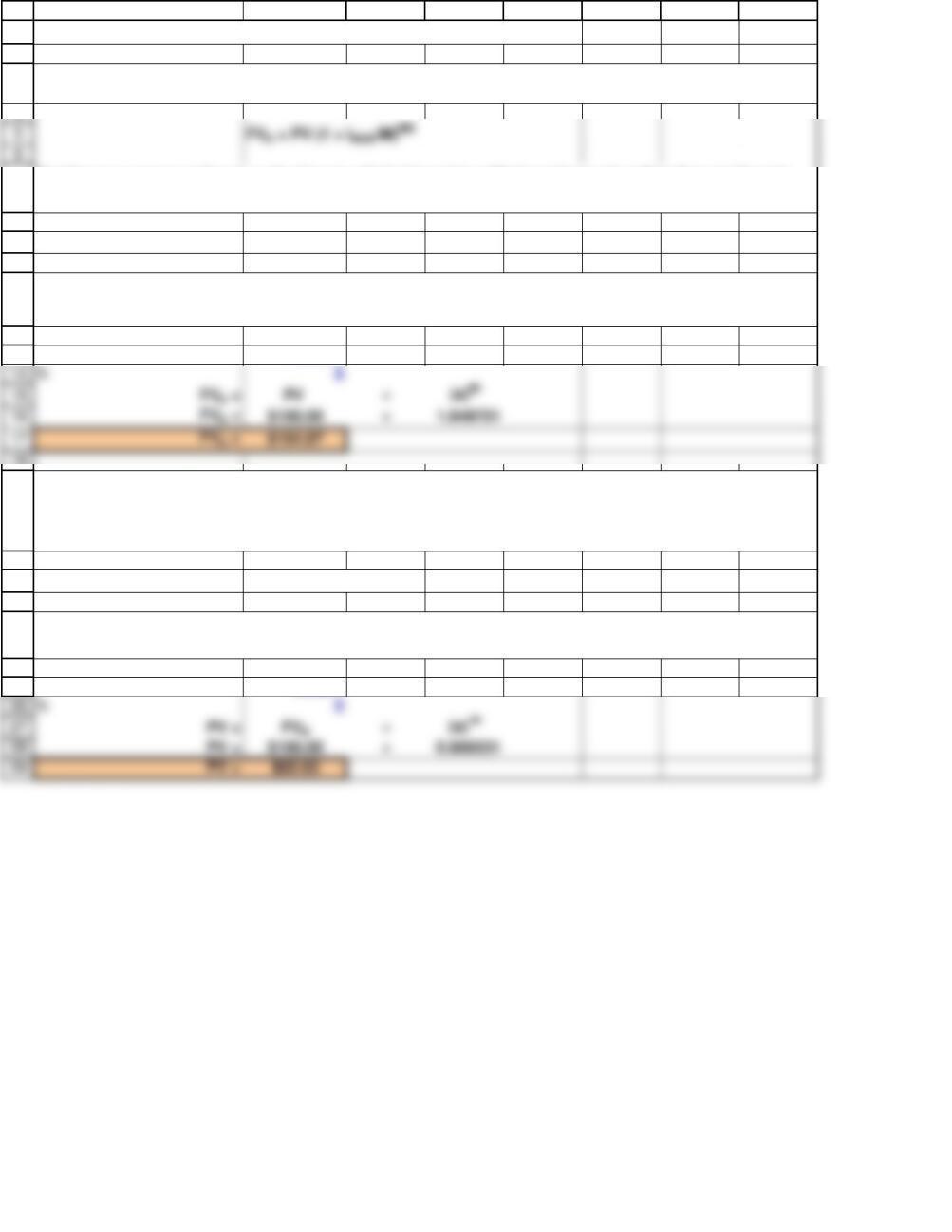
Loan Amortization Schedule, $30,000 at 8% for 3 Years
Amount borrowed: $30,000
Years: 3
Year
1$30,000.00 $11,641.01 $2,400.00 $9,241.01 $20,758.99
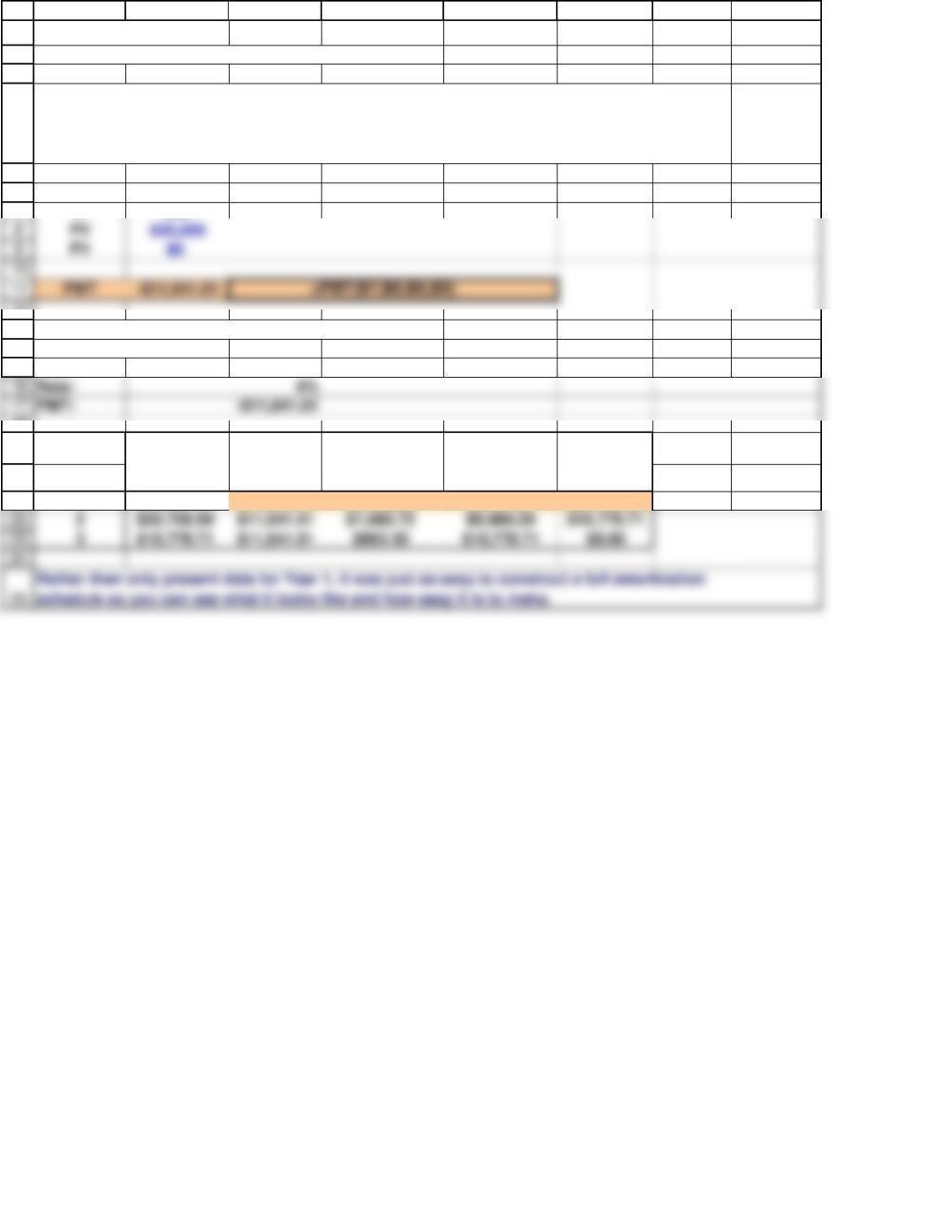
1. Suppose you borrowed $30,000 on a student loan at a rate of 8% and must repay it in 3
equal installments at the end of each of the next 3 years. How large would your payments be,
how much of the first payment would represent interest, how much would be principal, and
what would your ending balance be after the first year?
Beginning
Amount
(1)
Payment
(2)
Interest (3)
Repayment of
Principal (4)
Ending
Balance
(5)
32
1
2
3
7
8
9
10
11
12
13
18
19
20
21
22
23
24
25
A B C D E F G H
WEB APPENDIX 5A: CONTINUOUS COMPOUNDING AND DISCOUNTING 12/12/2018
FVN = PV (e)IN
PV
$100.00
I
10.00%
PV = FVN (e)-IN
FV
$100.00
I
10.00%
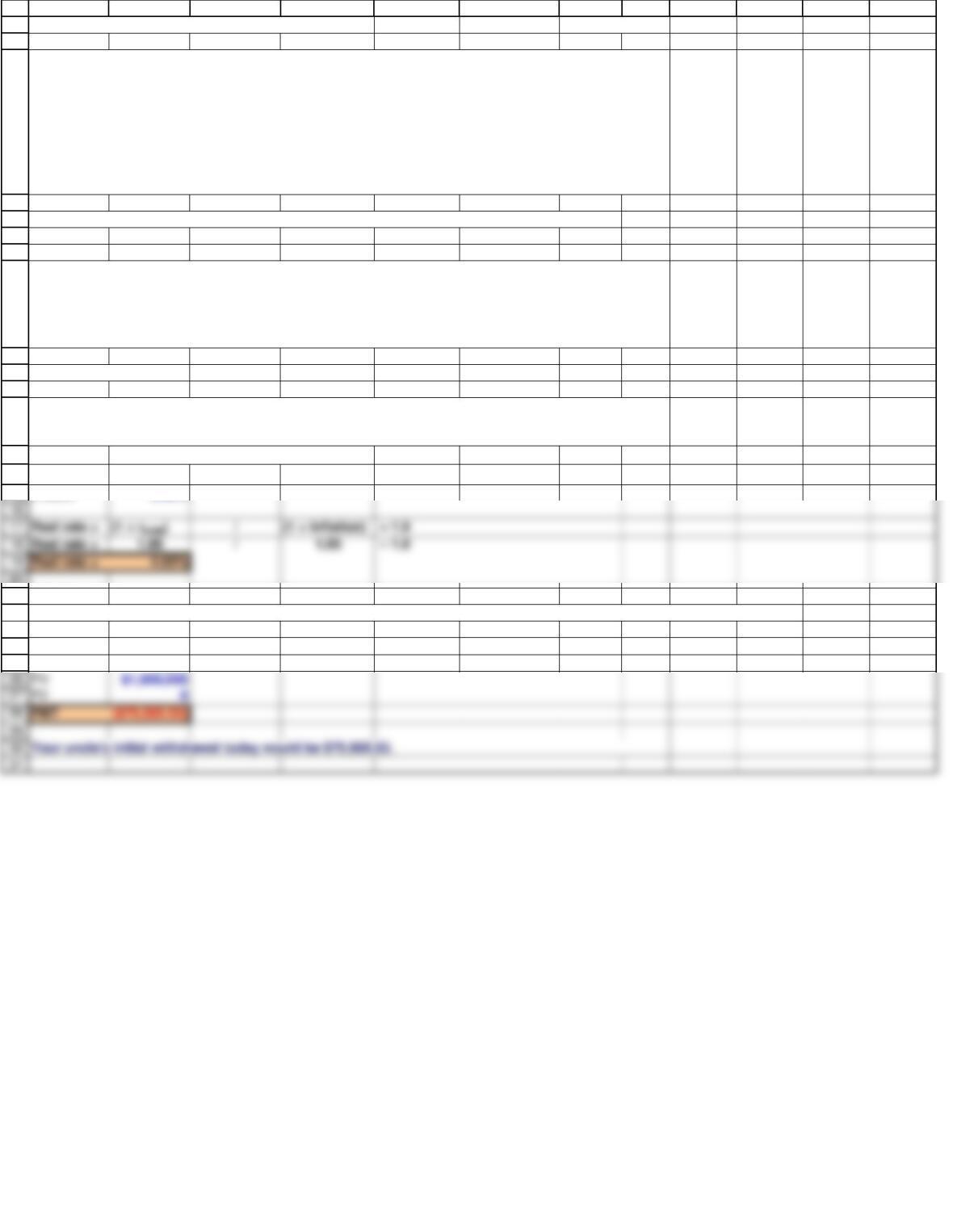
When more frequent compounding occurs, the future value of an amount can be calculated as follows:
Continuous compounding is a situation in which interest is added continuously rather than at discrete
points in time. The equation for continuous compounding is:
If we deposit $100 today in an account that pays 10% interest compounded continuously, what amount
will be in the account at the end of 5 years?
Continuous discounting is the reverse of continuous compounding. It is equal to the value today of a
future amount discounted at an interest rate with continuous compounding rather than at discrete points
in time. The equation for continuous discounting is:
What is the value today of $100 withdrawn in 5 years from an account that pays 10% interest
compounded continuously?
33
FVN = PV (1 + INOM/M)MN
1
2
3
4
5
6
7
8
9
10
11
12
13
14
15
20
21
22
23
24
25
A B C D E F G H I J K L
WEB APPENDIX 5B: GROWING ANNUITIES 12/12/2018
EXAMPLE 1: FINDING A CONSTANT REAL INCOME, IMMEDIATE FIRST WITHDRAWAL
PROBLEM
Use Financial Calculator
Step 1:
Real rate = (1 + rNOM)/(1 + Inflation) – 1.0
rNOM 8.00%
Inflation 3.00%
Step 2:
BEGIN
N20
I4.85%
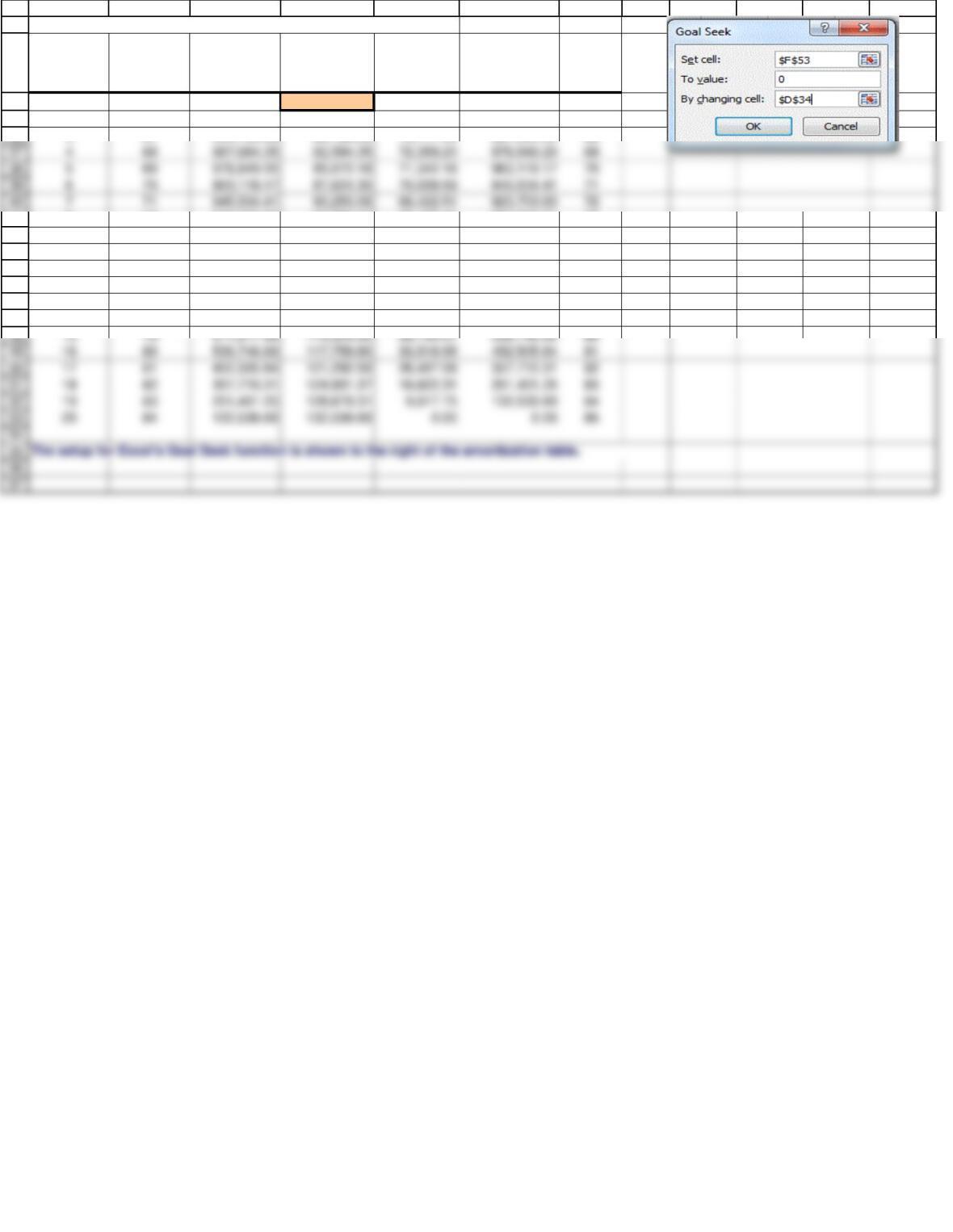
A growing annuity is a series of payments that grow at a constant rate. Growing annuities are often
used in the area of financial planning. Suppose a prospective retiree wants to determine the
constant real, or inflation-adjusted, withdrawals he or she can make from a given amount of money
over a specified number of years. This problem can be solved in one of two ways. (1) Use a financial
calculator, where we first calculate the real rate of return, which is the nominal rate adjusted for
inflation, and use it for I to find the withdrawal. (2) Set up a spreadsheet model similar to an
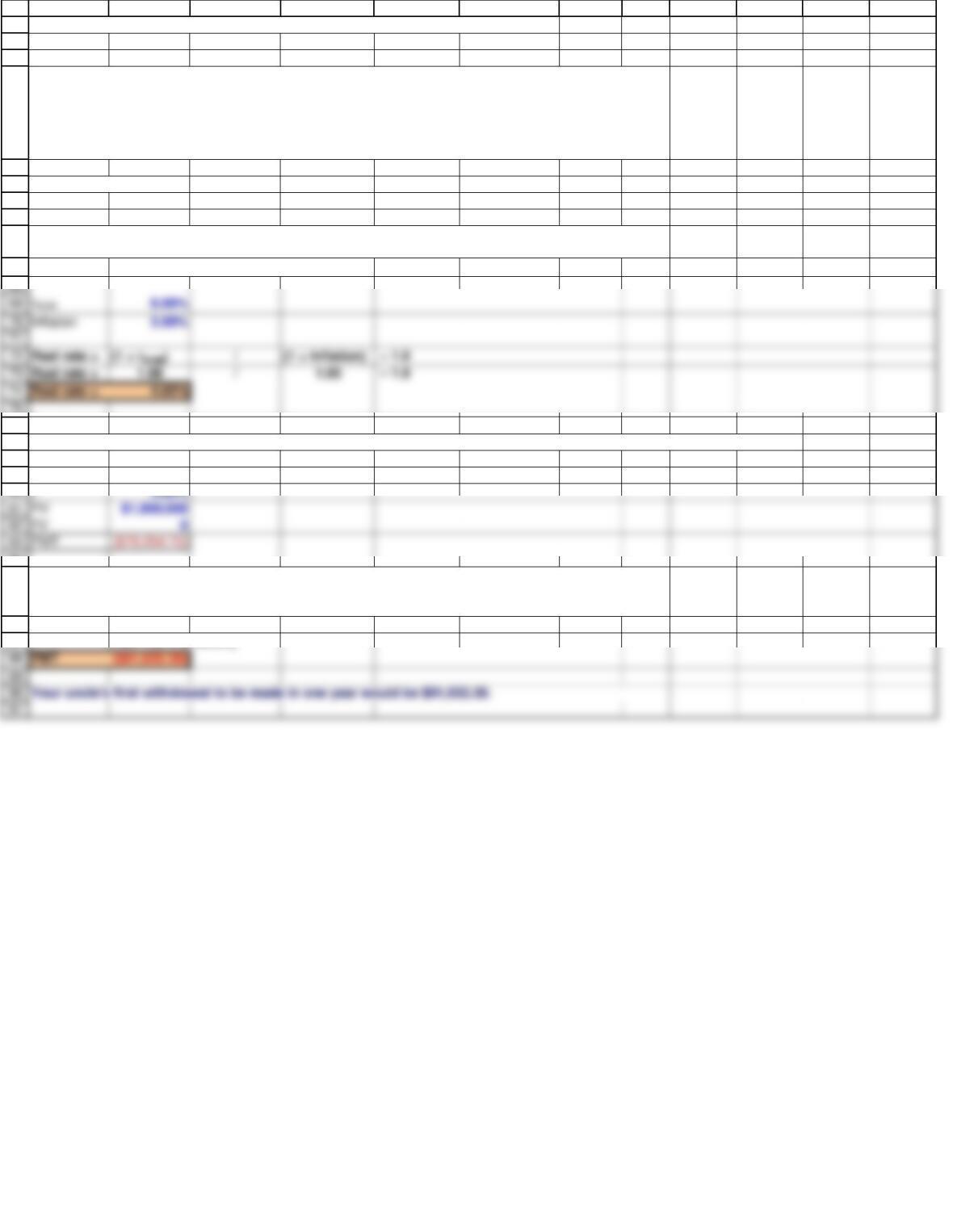
amortization table and use Excel’s Goal Seek function to find the initial inflation-adjusted withdrawal.
Suppose your uncle, who is 65 years old, is contemplating retirement. He expects to live for another
20 years, has a $1 million nest egg, expects to earn 8% on his investments, expects inflation to
average 3% per year, and wants to withdraw a constant real amount annually over the next
remaining 20 years. If the first withdrawal is to be made today , what is the amount of the initial
withdrawal?
Before we can use a financial calculator, we must first find the expected real , or inflation-adjusted ,
rate of return. The real rate is calculated as follows:
Now we have all the inputs needed to solve this problem with the financial calculator.
34
32
33
34
35
36
41
42
43
44
45
46
47
A B C D E F G H I J K L
Use Amortization Schedule and Excel’s Goal Seek Function
Year
Age at
Beg. of Year
Beginning
Balance
Withdrawal
Made at Beg.
Of Year
Interest
Earned
During Year
Ending Balance
Age at
End of
Year
165 $1,000,000.00 $75,585.53 $73,953.16 $998,367.62 66
266 998,367.62 77,853.10 73,641.16 994,155.68 67
367 994,155.68 80,188.69 73,117.36 987,084.35 68
872 923,703.83 92,960.67 66,459.45 897,202.61 73
973 897,202.61 95,749.49 64,116.25 865,569.37 74
10 74 865,569.37 98,621.98 61,355.79 828,303.18 75
11 75 828,303.18 101,580.64 58,137.80 784,860.35 76
12 76 784,860.35 104,628.06 54,418.58 734,650.88 77
13 77 734,650.88 107,766.90 50,150.72 677,034.70 78
14 78 677,034.70 110,999.91 45,282.78 611,317.58 79
35
58
59
60
61
62
63
64
65
66
67
76
77
78
79
84
85
86
87
A B C D E F G H I J K L
EXAMPLE 2: CONSTANT REAL INCOME, END-OF-YEAR WITHDRAWALS
PROBLEM
Use Financial Calculator
Step 1:
Real rate = (1 + rNOM)/(1 + Inflation) – 1.0
Step 2:
END
N20
PMT × (1 + Inflation)
Suppose your uncle, who is 65 years old, is contemplating retirement. He expects to live for another
20 years, has a $1 million nest egg, expects to earn 8% on his investments, expects inflation to
average 3% per year, and wants to withdraw a constant real amount annually over the next
remaining 20 years. If the first withdrawal is to be made one year from today , what is the amount of
the initial withdrawal?
Before we can use a financial calculator, we must first find the expected real , or inflation-adjusted ,
rate of return. The real rate is calculated as follows:
Now we have all the inputs needed to solve this problem with the financial calculator.
This amount needs to be adjusted for inflation during the year because this amount is in beginning-
of- year dollars, so this PMT amount must be multiplied by 1 + Inflation rate. The initial withdrawal
should be calculated as follows:
36
73
74
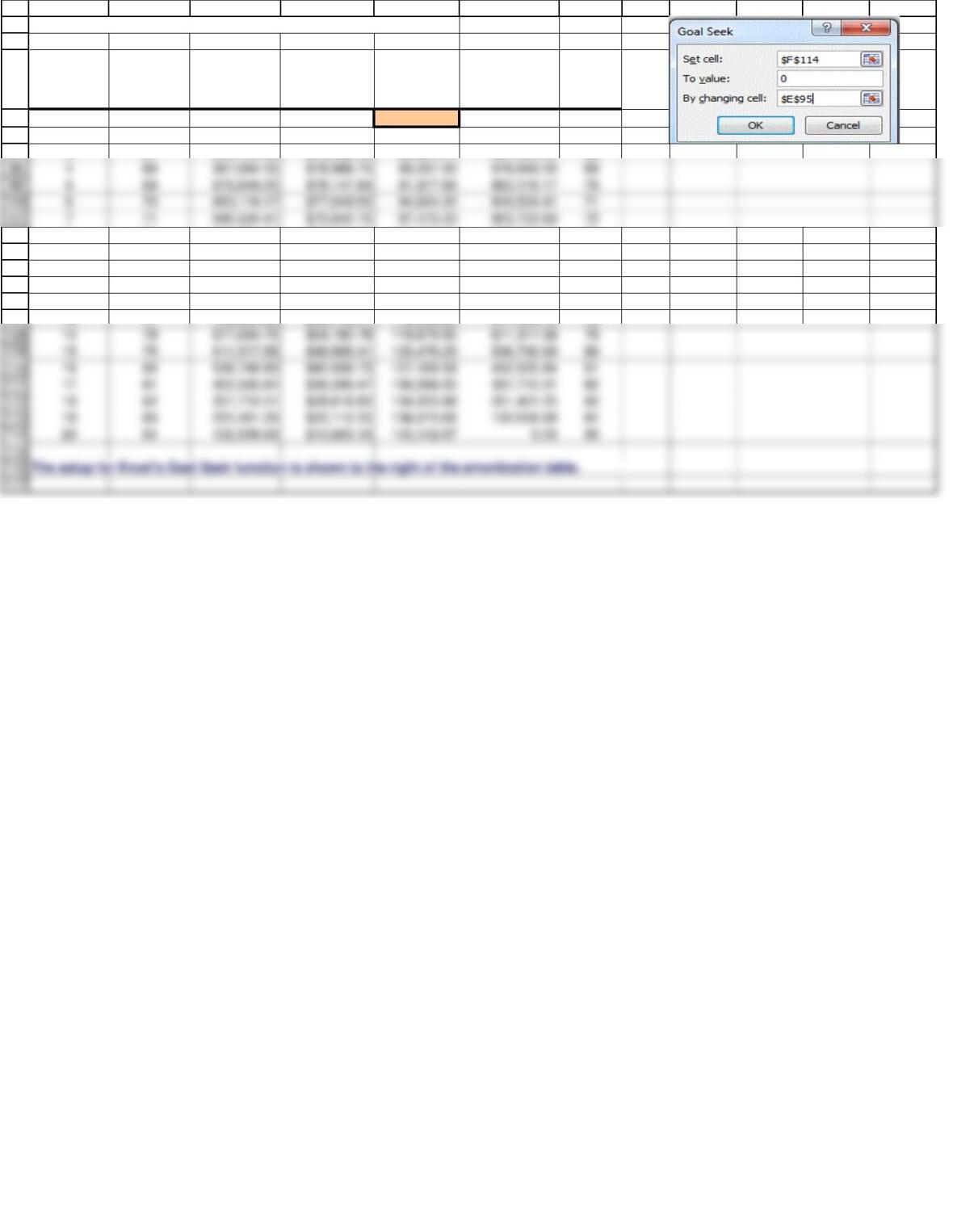
92
93
94
95
96
97
102
103
104
105
106
107
A B C D E F G H I J K L
Use Amortization Schedule and Excel’s Goal Seek Function
Year
Age at
Beg. of Year
Beginning
Balance
Interest
Earned During
Year
Withdrawal
Made at End
Of Year
Ending Balance
Age at
End of
Year
165 $1,000,000.00 $80,000.00 $81,632.38 $998,367.62 66
266 998,367.62 $79,869.41 84,081.35 994,155.68 67
367 994,155.68 $79,532.45 86,603.79 987,084.35 68
872 923,703.83 $73,896.31 100,397.53 897,202.61 73
973 897,202.61 $71,776.21 103,409.45 865,569.37 74
10 74 865,569.37 $69,245.55 106,511.74 828,303.18 75
11 75 828,303.18 $66,264.25 109,707.09 784,860.35 76
12 76 784,860.35 $62,788.83 112,998.30 734,650.88 77
13 77 734,650.88 $58,772.07 116,388.25 677,034.70 78
37
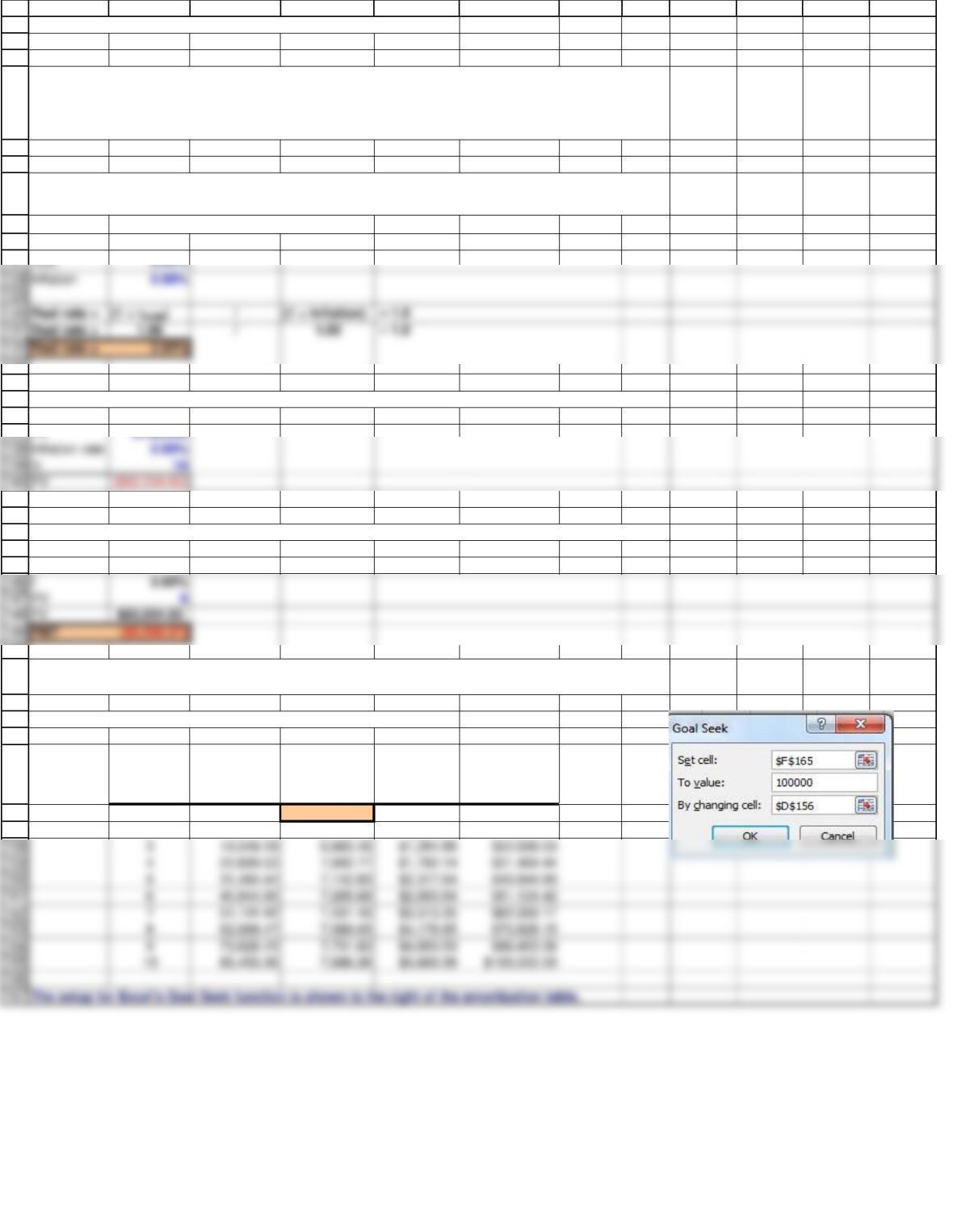
118
119
120
121
122
123
124
125
126
127
133
134
135
136
141
142
143
144
145
150
151
152
153
154
155
156
157
A B C D E F G H I J K L
EXAMPLE 3: INITIAL DEPOSIT TO ACCUMULATE A FUTURE SUM
PROBLEM
Step 1:
Real rate = (1 + rNOM)/(1 + Inflation) – 1.0
rNOM 6.00%
Step 2:
Step 3:
BEGIN
N10
Use Amortization Schedule and Excel’s Goal Seek Function
Year
Beginning
Balance
Deposit Made
at Beg. Of
Year
Interest
Earned
During Year
Ending Balance
1 $0.00 $6,598.87 $395.93 $6,994.80
2 6,994.80 6,730.85 $823.54 $14,549.19
Calculate the size of the required initial payment.
A deposit of $6,598.87 made today and growing by 2% per year will accumulate to $100,000 by Year
10 if the interest rate is 6%.
Suppose you need to accumulate $100,000 in 10 years. You plan to make a deposit now, at Time 0,
and then to make 9 more deposits at the beginning of the following 9 years, for a total of 10 deposits.
The bank pays 6% interest, and you expect to increase your initial deposit amount by the 2% inflation
rate each year.
Before we can use a financial calculator, we must first find the expected real , or inflation-adjusted ,
rate of return. The real rate is calculated as follows:
Need to calculate the purchasing power of $100,000 in 10 years, i.e., calculate PV.
38
131
132