5 Movement of Labor and Capital Between Countries
1. Under Headlines: Brussels Resumes Policy Push to Share out Refugees across EU,
there is a map showing persons seeking asylum in the European Union, as of May 2015.
In this question, you will be asked to update these figures to reflect the most recent data
a. How many asylum seekers are in Germany for the whole of 2015, or in the most
recent year available? Also write down the number of asylum seekers in 2015, or
the most recent year available, for one other country shown in the Headlines
article.
b. Use the “Data” tab on the left of this webpage to learn more about the
applications of asylum seekers and the decisions on those applications. What is
the difference between “first instance” decisions and “final decisions” on asylum
applications? Write down the numbers of these decisions for 2015, or the most
recent year available, in Germany and in the other country that you chose in part
(a).
Answer:
First instance decision: Decision (positive and negative) considering
applications for international protection as well as the grants of authorizations to
c. What is a “first permit” and how many were issued in Germany and in the other
country that you chose, for 2015 or the most recent year available? What is the
number of “all valid permits” in these two countries, and how does that compare
with the population of these countries?
Answer: First permit is the residence permit issued to a person for the first time.
2. In the short-run specific-factors model, examine the impact on a small country
following a natural disaster that decreases its population. Assume that land is specific
to agriculture, and capital is specific to manufacturing, whereas labor is free to move
between the two sectors.
a. In a diagram similar to Figure 5–2, determine the impact of the decrease in the
workforce on the output of each industry and the equilibrium wage.
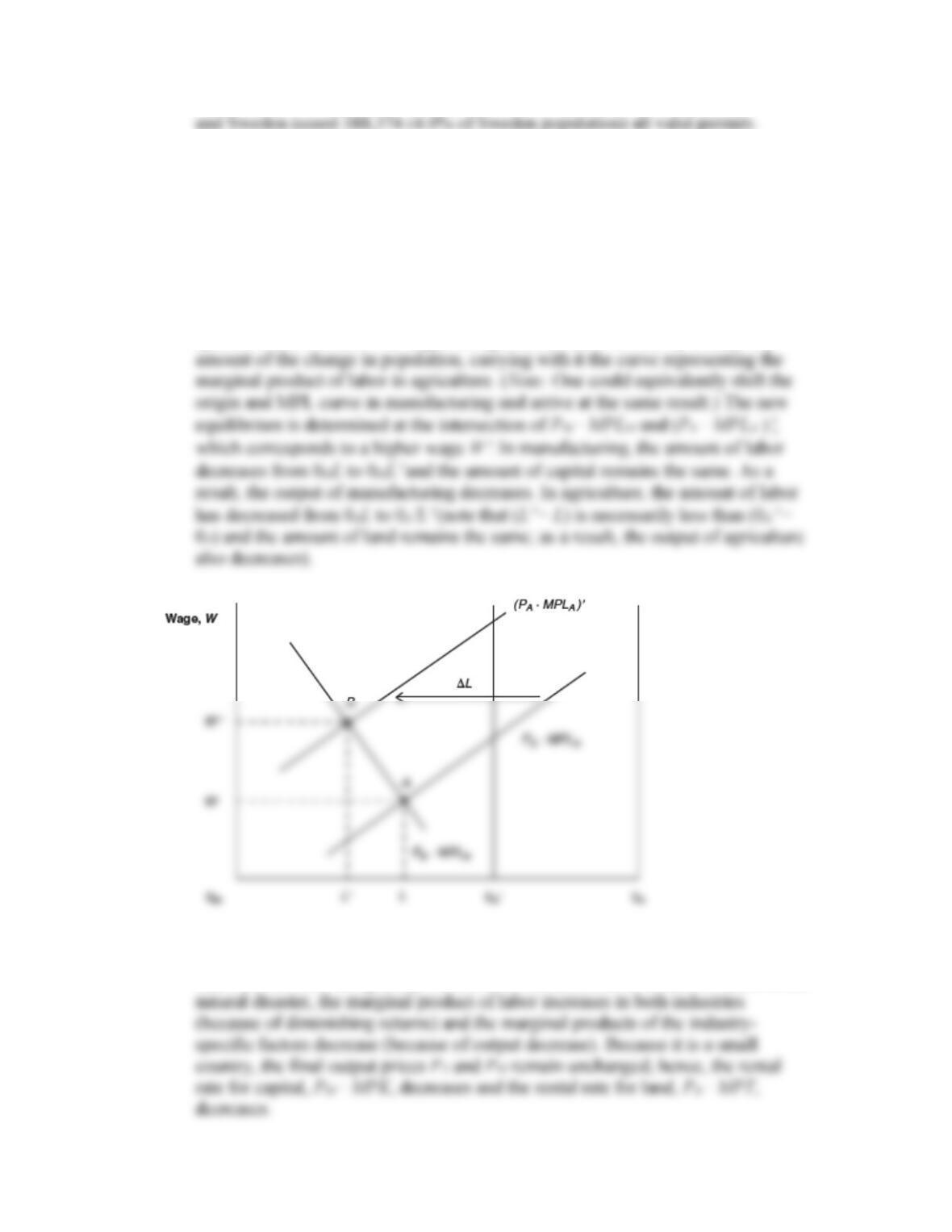
Answer: The following diagram depicts a decrease in population (labor) in the
specific-factors model. The origin for agriculture shifts inward by exactly the
b. What happens to the rentals on capital and land?
Answer: Because the quantity of labor in both industries decreases because of the
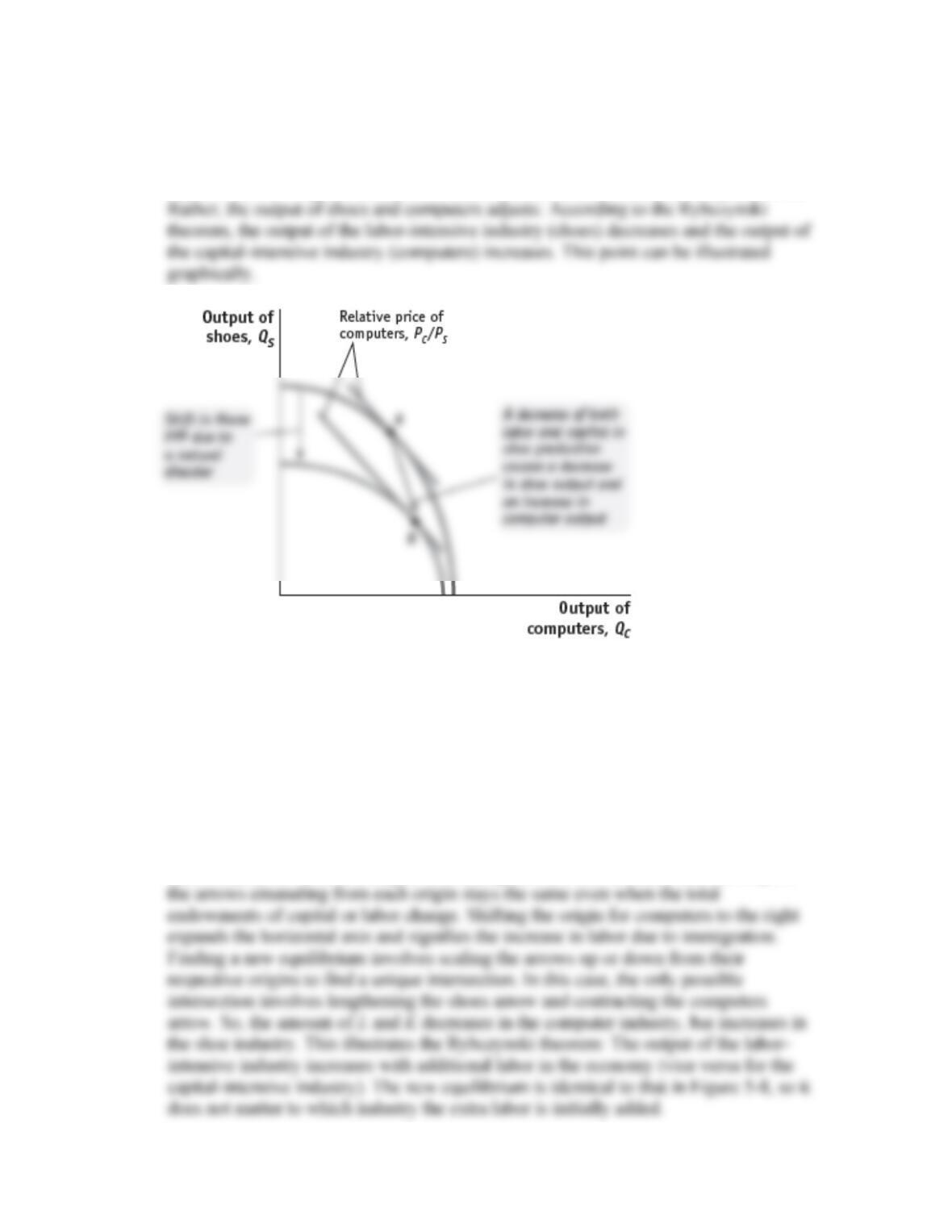
3. How would your answer to Problem 2 change if instead we use the long-run model,
with shoes and computers produced using labor and capital?
Answer: In the long-run model, a decrease in labor does not affect factor prices at all.
4. Consider an increase in the supply of labor due to immigration, and use the long-run
model. Figure 5-7 shows the box diagram and the leftward shift of the origin for the
shoe industry. Redraw this diagram but instead shift to the right the origin for
computers. That is, expand the labor axis by the amount ∆L but shift it to the right
rather than to the left. With the new diagram, show how the amount of labor and
capital in shoes and computers is determined, without any change in factor prices.
Carefully explain what has happened to the amount of labor and capital used in each
industry and to the output of each industry.
Answer: Keeping factor prices constant (i.e., W and RK constant), the K/L ratio in
each industry remains unchanged. In the diagram below, this means that the slope of
5. In the short-run specific-factors model, consider a decrease in the stock of land. For
example, suppose a natural disaster decreases the quantity of arable land used for
planting crops.
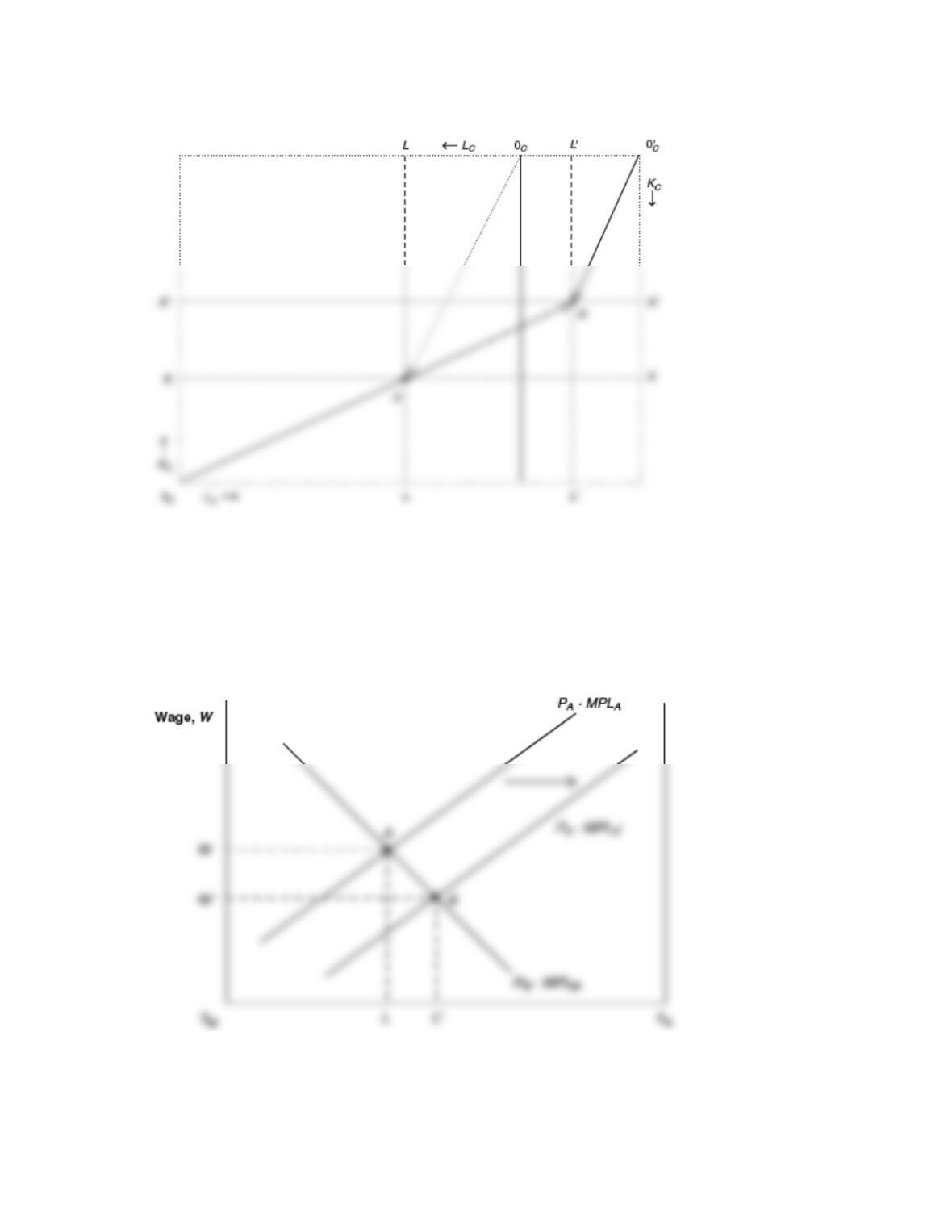
a. Redraw panel (a) of Figure 5-11 starting from the initial equilibrium at point A.
Answer:
b. What is the effect of this change in land on the quantity of labor in each industry
and on the equilibrium wage?
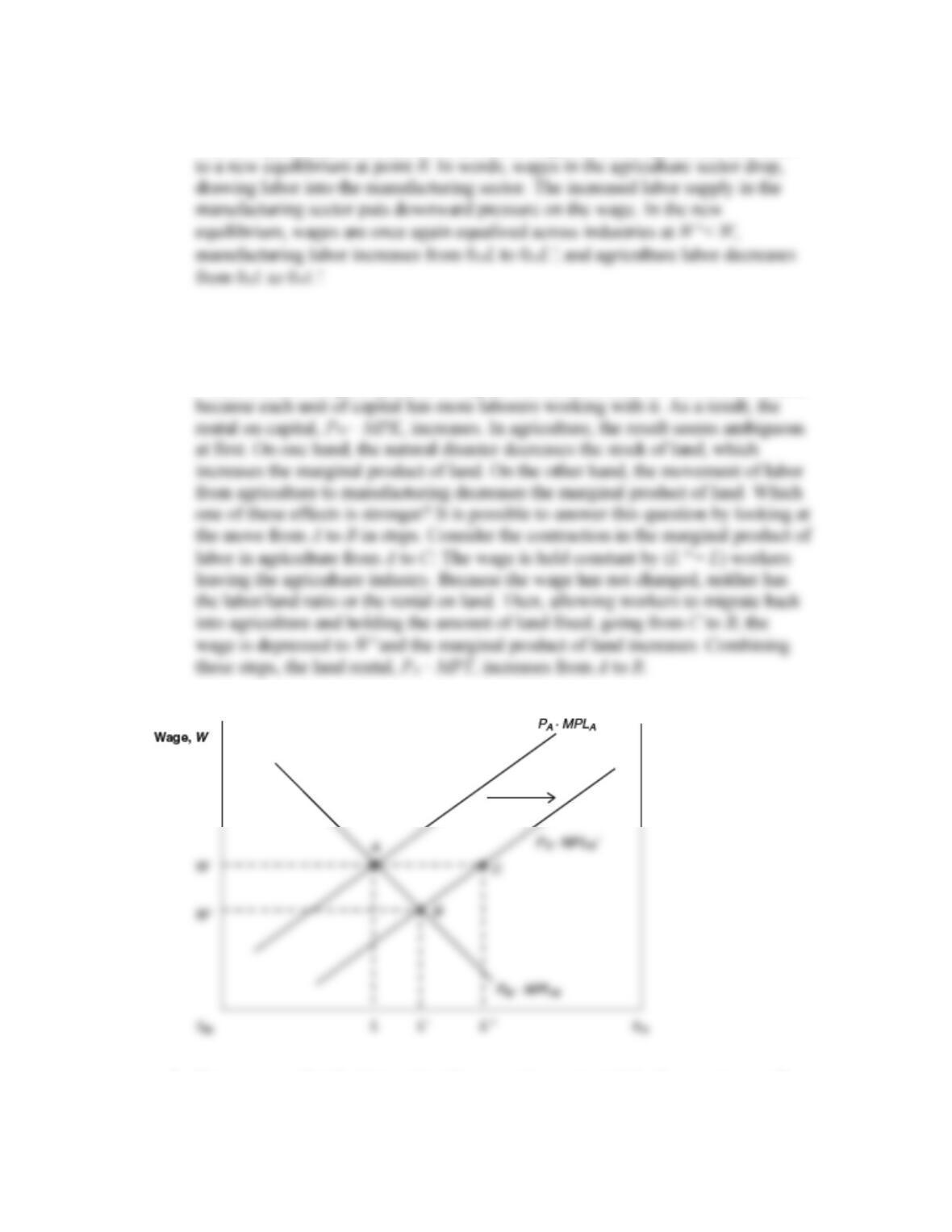
Answer: With less land per laborer in the agriculture sector, MPLA decreases.
This is represented by an inward shift in the wage curve for agriculture and leads
c. What is the effect on the rental on land and the rental on capital?
Answer: In the manufacturing industry, the quantity of labor increases and the
amount of capital remains the same (i.e., the labor/capital ratio increases).
Therefore, the marginal product of capital increases because of the natural disaster
d. Now suppose that the international community wants to help the country struck
by the natural disaster and decides to do so by increasing its level of FDI. So the
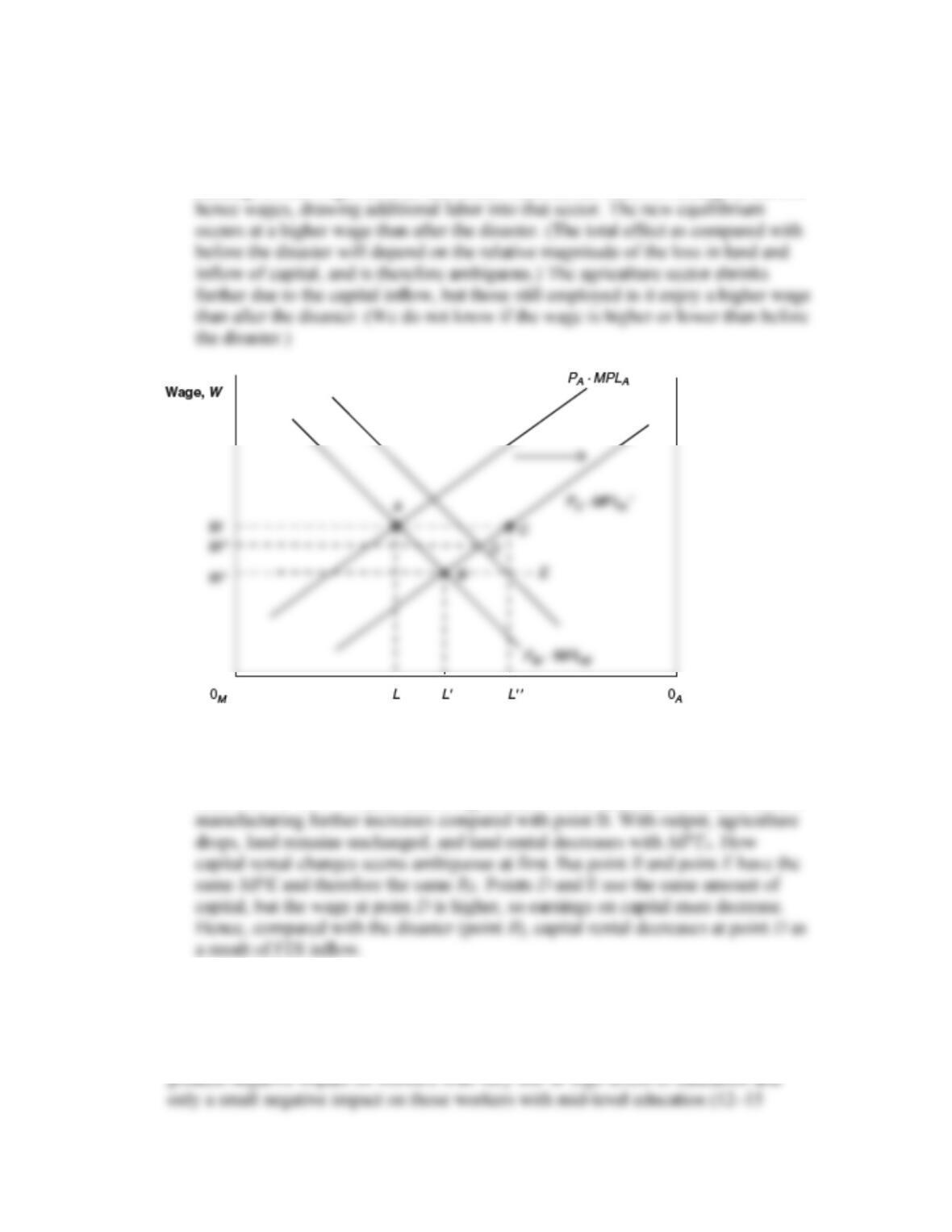
rest of the world increases its investment in physical capital in the stricken
country. Illustrate the effect of this policy on the equilibrium wage and rentals.
Answer: An increase in FDI increases the amount of capital in manufacturing,
shifting out the wage curve in that sector. This has the effect of raising MPLM and
As shown in the graph, suppose the wage curve of manufacturing shifts to the
right and the new equilibrium point moves from B to D, then equilibrium wage
rises from W
′
to W
′′
. Labor used in agriculture further decreases and labor used in
6. According to part A of Table 5-1, what education level loses most (i.e., has the
greatest decrease in wage) from immigration to the United States? Does this result
depend on keeping the rental on capital constant? Explain why or why not.
Answer: In the short run, holding capital fixed, the table shows immigration has the
Work It Out
Suppose that computers use 4 units of capital for each worker, so that KC = 4 · LC,
whereas shoes use 0.2 units of capital for each worker, so that KS = 0.2 · LS. There are
200 workers and 200 units of capital in the economy.
a. Solve for the amount of labor and capital used in each industry.
Hint: The box diagram shown in Figure 5-6 means that the amount of labor and
capital used in each industry must add up to the total for the economy, so that
KC + KS = 200 and LC + LS = 200
Use the facts that KC = 4 · LC and KS = 0.2 · LS to rewrite these equations as:
4 · LC + 0.2 · LS = 100 and LC + LS = 200
Use these two equations to solve for LC and LS, and then calculate the amount of
capital used in each industry using KC = 4 · LC and KS = 0.2 · LS.
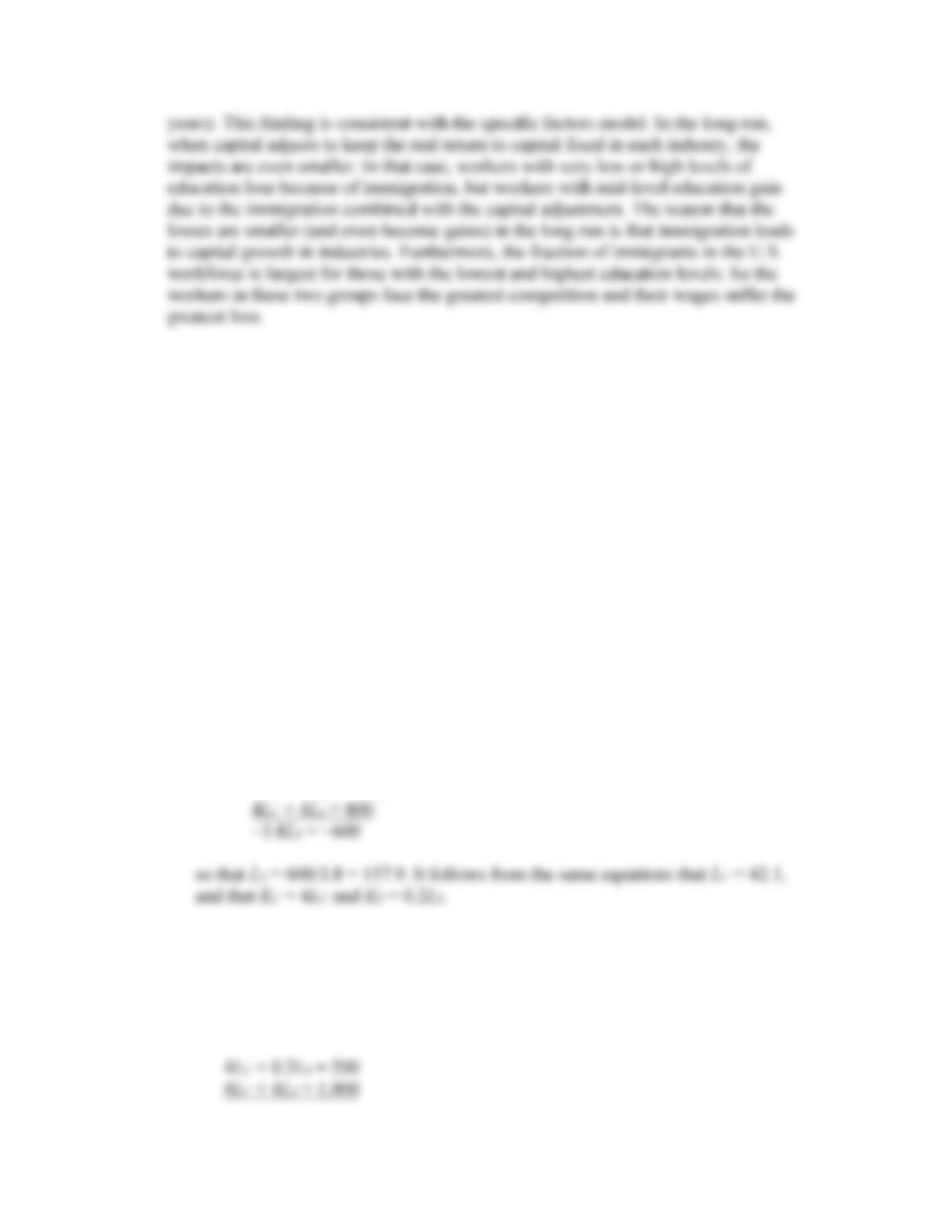
Answer: The above two equations can be solved as:
4LC + 0.2LS = 200
b. Suppose that the number of workers increases to 250 because of immigration,
keeping total capital fixed at 200. Again, solve for the amount of labor and capital
used in each industry. Hint: Redo the calculations from part (a), but using LC + LS
= 250.
Answer: The labor equations are now solved as:
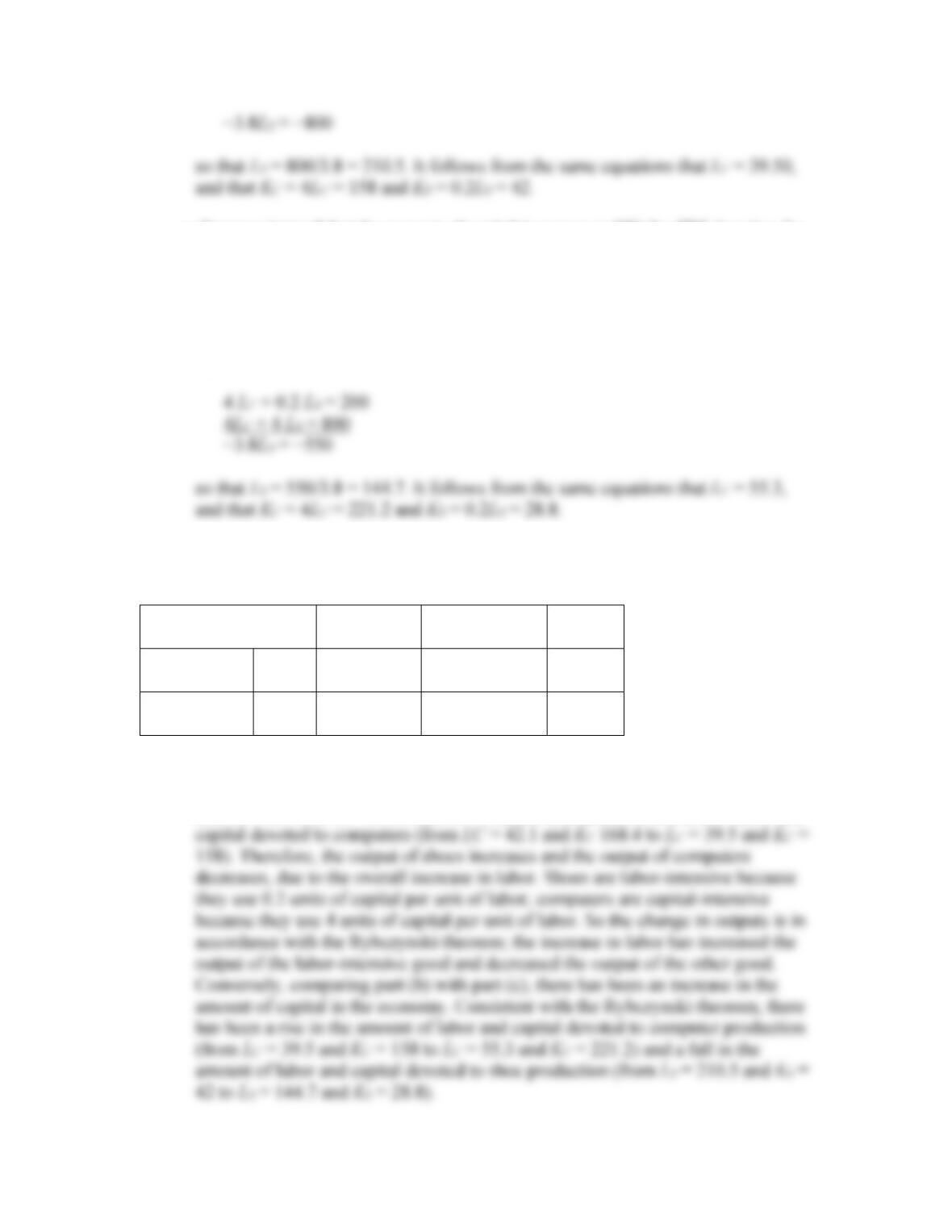
c. Suppose instead that the amount of capital increases to 250 due FDI, keeping the
total number of workers fixed at 200. Again solve for the amount of labor and
capital used in each industry. Hint: Redo the calculations from part (a), using KC
+ KS = 250.
Answer: The first labor equation is now: 4LC + 0.2LS = 250, so the labor
equations are solved as:
d. Explain how your results in parts (b) and (c) are related to the Rybczynski
theorem.
(a)
Original
(b)
Immigration
(c)
FDI
Computer
K
L
168.4
42.1
158
39.5
221.2
55.3
Shoe
K
L
31.6
157.9
42
210.5
28.8
144.7
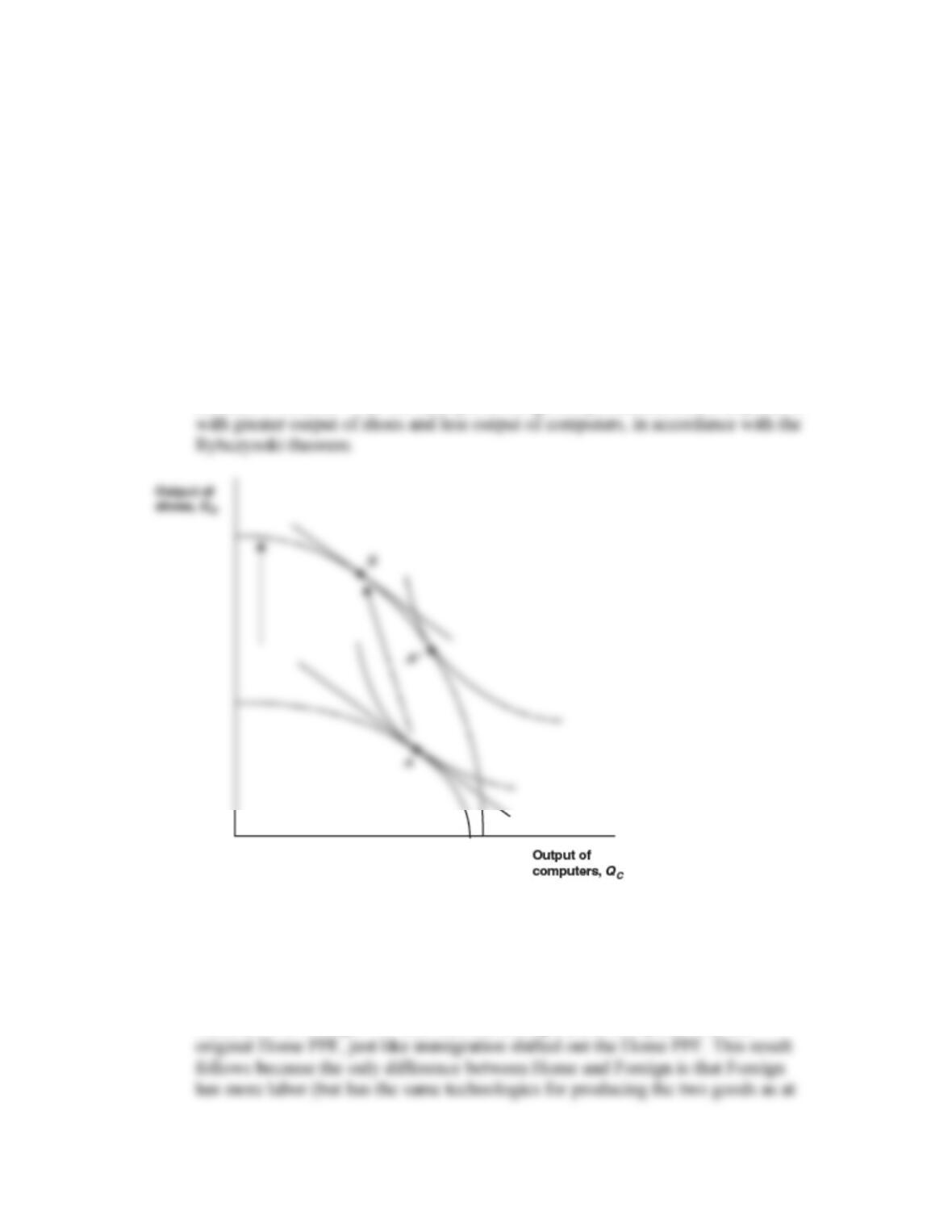
Answer: Comparing part (a) with part (b), the amount of labor in the economy
has increased the amount of labor and capital devoted to shoes (from LS = 157.9
and KS = 331.6 to LS = 210.5 and KS = 42) and decreased the amount of labor and
Questions 7 and 8 explore the implications of the Rybczynski theorem and the factor
price insensitivity result for the Heckscher–Ohlin model from Chapter 4.
7. In this question, we use the Rybczynski theorem to review the derivation of the
Heckscher–Ohlin theorem.
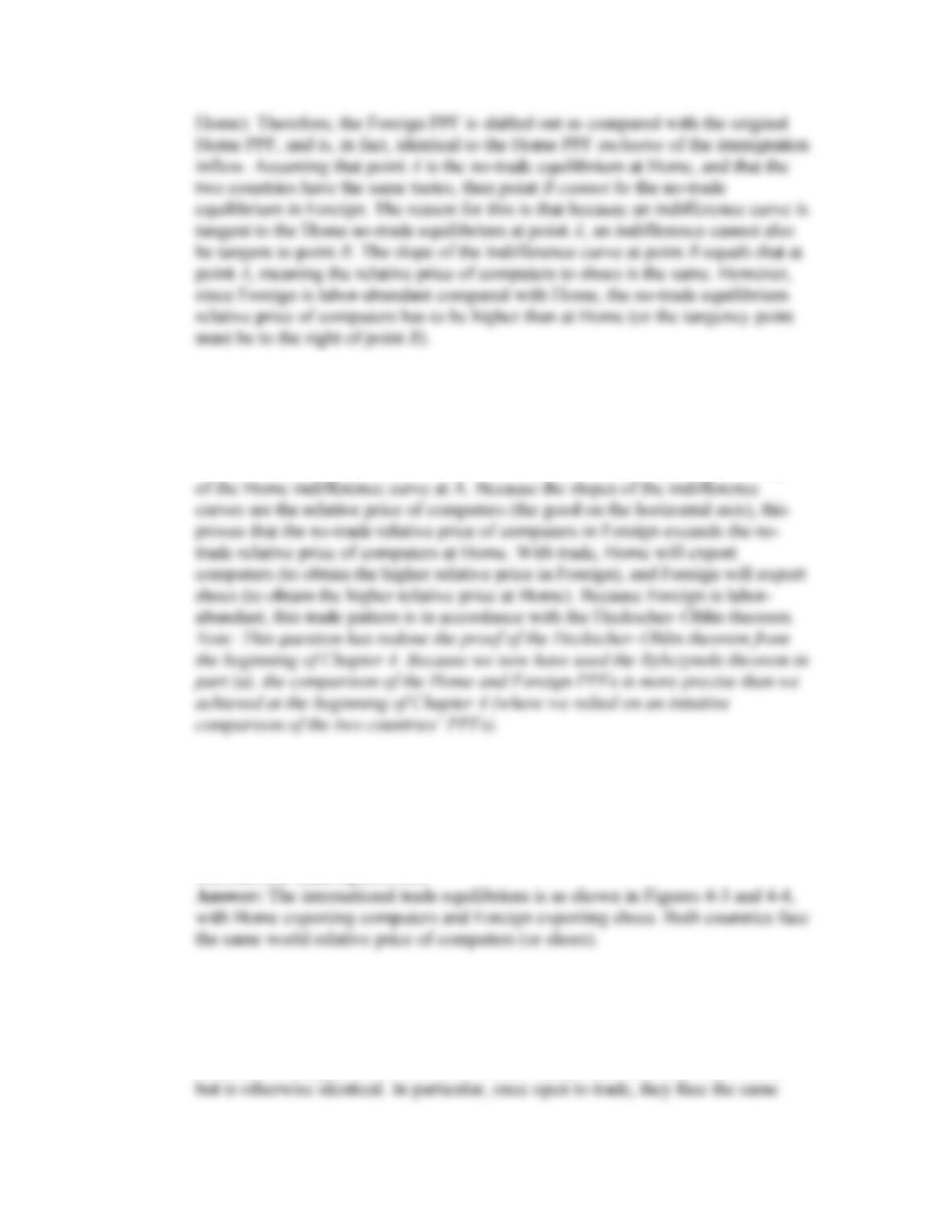
a. Start at the no-trade equilibrium point A on the Home PPF in Figure 4-2, panel
(a). Suppose that through immigration, the amount of labor in Home grows. Draw
the new PPF, and label the point B where production would occur with the same
prices for goods. Hint: You can refer back to Figure 5-8 to see the effect of
immigration on the PPF.
Answer: Figure 5-8, reproduced below, shows the shift in the Home PPF due to
the inflow of labor. With the same prices for goods, production occurs at point B,
b. Suppose that the only difference between Foreign and Home is that Foreign has
more labor. Otherwise, the technologies used to produce each good are the same
across countries. Then how does the Foreign PPF compare with the new Home
PPF (including immigration) that you drew in part (a)? Is point B the no-trade
equilibrium in Foreign? Explain why or why not.
Answer: The Foreign PPF is shifted out and upward as compared with the
c. Illustrate a new point, A*, that is the no–trade equilibrium in Foreign. How do the
relative no-trade prices of computers compare in Home and Foreign? Therefore,
what will be the pattern of trade between the countries, and why?
Answer: The Foreign no-trade point A* is shown with an indifference curve
tangent to it. The slope of the Foreign indifference curve at A* exceeds the slope
8. Continuing from Problem 7, we now use the factor price insensitivity result to
compare factor prices across countries in the Heckscher–Ohlin model.
a. Illustrate the international trade equilibrium on the Home and Foreign production
possibility frontiers. Hint: You can refer back to Figure 4-3 to see the
international trade equilibrium.
b. Suppose that the only difference between Foreign and Home is that Foreign has
more labor. Otherwise, the technologies used to produce each good are the same
across countries. Then, according to the factor price insensitivity result, how will
the wage and rental compare in the two countries?
Answer: This is just like Problem 7, where Foreign has more labor than Home
c. Call the result in part (b) “factor price equalization.” Is this a realistic result?
Hint: You can refer to Figure 4-9 to see wages across countries.
Answer: The factor price equalization theorem is a logical result in the
d. Based on our extension of the Heckscher–Ohlin model at the end of Chapter 4,
what is one reason why the factor price equalization result does not hold in
reality?
Answer: The reason that the factor price equalization theorem does not hold in
9. Recall the formula from the application, “The Effect of FDI on Rentals and Wages in
Singapore.” Give an intuitive explanation for this formula for the rental rate. Hint:
Describe one side of the equation as a marginal benefit and the other as a marginal
cost.
10. In Table 5-2, we show the growth in the real rental and real wages in Singapore,
along with the implied productivity growth. One way to calculate the productivity
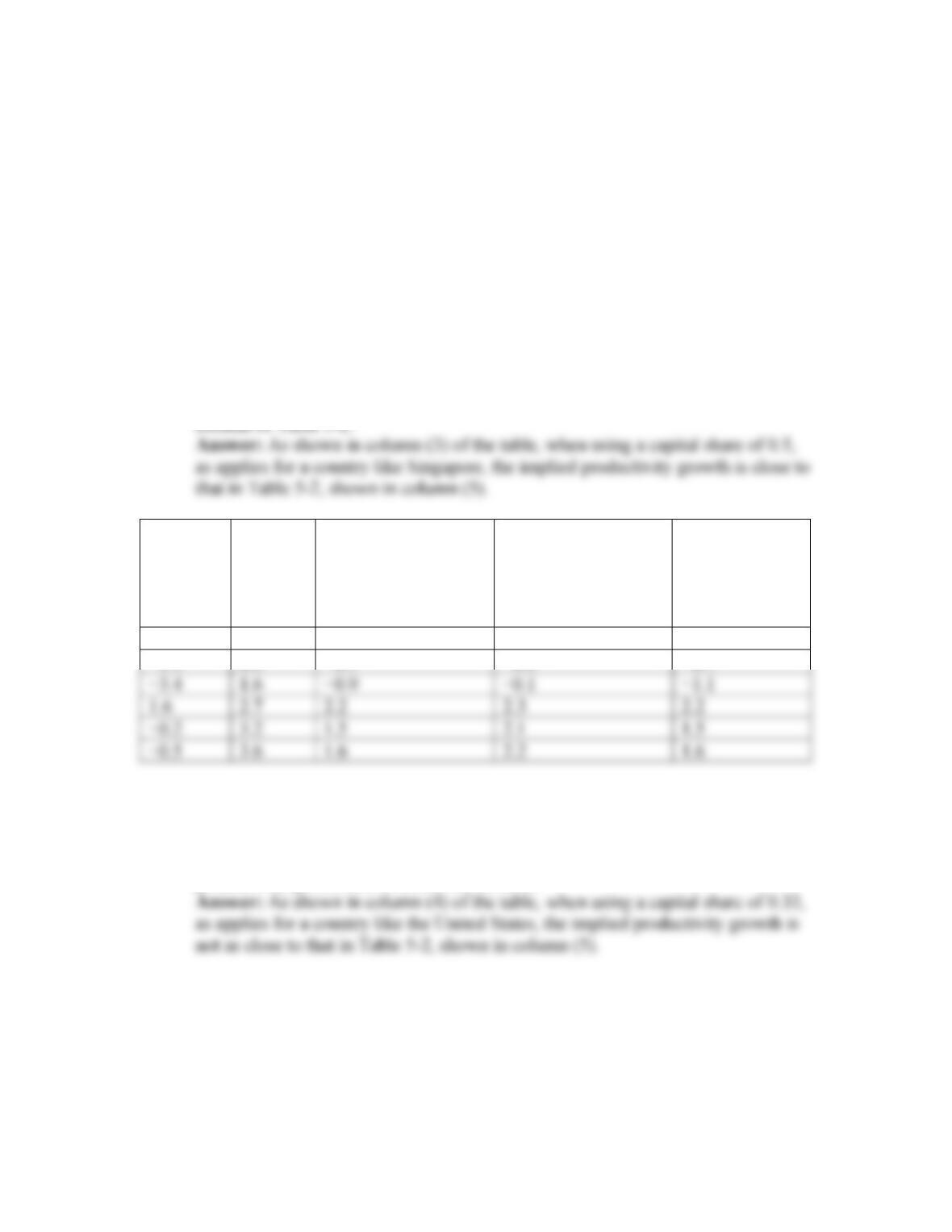
growth is to take the average of the growth in the real rental and real wage. The idea
is that firms can afford to pay more to labor and capital if there is productivity
growth, so in that case real factor prices should be growing. But if there is no
productivity growth, the average of the growth in the real rental and real wage should
be close to zero.
To calculate the average of the growth in the real factor prices, we use the shares of
GDP going to capital and labor. Specifically, we multiply the growth in the real rental
by the capital share of GDP and add the growth in the real wage multiplied by the
labor share of GDP. Then answer the following:
a. For a capital-rich country like Singapore, the share of capital in GDP is about
one-half and the share of labor is also one–half. Using these shares, calculate the
average of the growth in the real rental and real wage shown in each row of Table
5-2. How do your answers compare with the productivity growth shown in the last
(1)
Rental
(2)
Wages
(3)
Productivity
Using Capital
Share of 0.5 =
(1) · 0.5 + (2) · 0.5
(4)
Productivity
Using Capital
Share of 0.33 =
(1) · 0.33 + (2) · 0.67
(5)
Productivity
from
Table 5-2
−5.0
2.6
−1.2
0.1
−1.5
−1.9
0.5
−0.7
−0.3
−0.7
−3.4
1.6
−0.9
−0.1
−1.1
1.6
2.7
2.2
2.3
2.2
−0.2
3.2
1.5
2.1
1.5
−0.5
3.6
1.6
2.2
1.6
b. For an industrialized country like the United States, the share of capital in GDP is
about one-third, and the share of labor in GDP is about two-thirds. Using these
shares, calculate the average of the growth in the real rental and real wage shown
in each row of Table 5-2. How do your answers now compare with the
productivity growth shown in the last column?
11. Figure 5-14 is a supply and demand diagram for the world labor market. Starting at
points A and A*, consider a situation where some Foreign workers migrate to Home
but not enough to reach the equilibrium with full migration (point B). As a result of
the migration, the Home wage decreases from W to W
′′
> W
′
, and the Foreign wage
increases from W* to W** < W
′
.
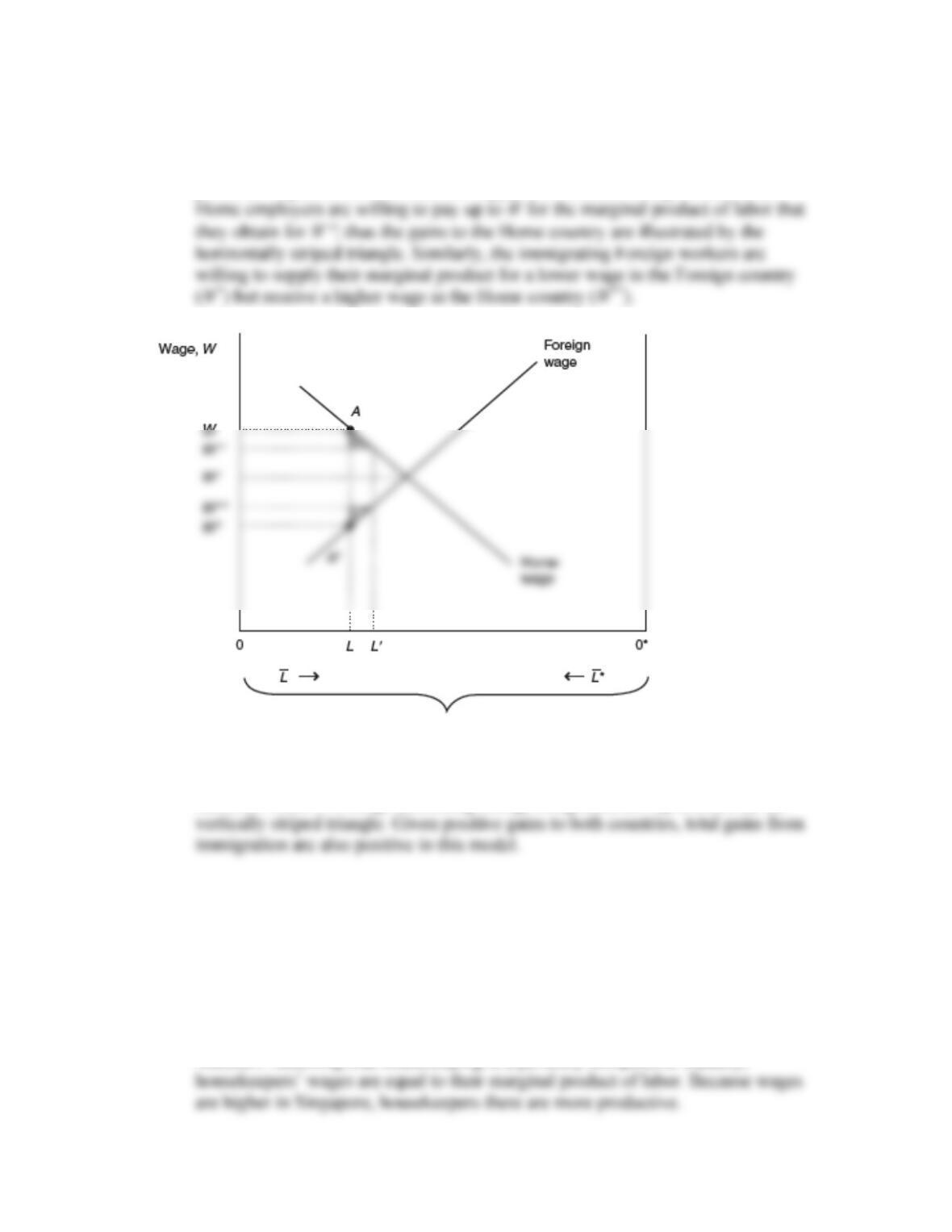
a. Are there gains that accrue to the Home country? If so, redraw the graph and
identify the magnitude of the gains for each country. If not, say why not.
Answer: Gains from trade in the following graph are analogous to consumer and
producer surplus in the conventional supply and demand setting. In this case,
b. Are there gains that accrue to the Foreign country? If so, again show the
magnitude of these gains in the diagram and show the world gains.
Answer: Gains to Foreign (including foreign emigrants) are represented by the
12. A housekeeper from the Philippines is contemplating immigrating to Singapore in
search of higher wages. Suppose that the housekeeper earns approximately $3,000
annually and expects to find a job in Singapore worth approximately $8,000 annually
for a period of 3 years. Furthermore, assume that the cost of living in Singapore is
$800 more per year than at home.
a. What can we say about the productivity of housekeepers in Singapore versus the
Philippines? Explain.
Answer: Assuming that housekeeping is a perfectly competitive industry,

b. What is the total gain to the housekeeper from migrating?
Answer: The total gains from migrating are the net benefits relative to staying in
c. Is there a corresponding gain for the employer in Singapore? Explain.