5: Diversity in the Classroom: Students with Low-
Incidence Disabilities
Learning Outcomes
After studying this chapter, students should be able to:
• 5-1 Describe the characteristics of students with hearing impairments and its
causes.
• 5-2 Describe the characteristics of students with visual impairments and its
causes.
• 5-3 Describe the characteristics of students with deaf–blindness and its causes.
INTASC Standards
Standard #1: Learner Development. The teacher understands how learners grow and develop,
recognizing that patterns of learning and development vary individually within and across the
Council for Exceptional Children
Special educators are to have knowledge of the following:
Standard #1: Learner Development and Individual Learning Differences. Beginning special
education professionals understand how exceptionalities may interact with development and
learning and use this knowledge to provide meaningful and challenging learning experiences for
individuals with exceptionalities.
Chapter Outline
5-1 Learners with Hearing Impairments
5-1a Defining Hearing Impairments
5-1c How Many Learners Exhibit Hearing Impairments?
5-1d What Are Some of the Causes of Hearing Impairment?
5-1e Selected Learning and Behavioral Characteristics of Learners with Hearing
Impairment
2. Speech and Language
5-2 Learners with Visual Impairments
5-2b Classification of Learners with Visual Impairments
5-2c How Many Learners Exhibit Visual Impairments?
5-2d What Are Some of the Causes of Visual Impairment?
2. Defects of the Ocular Muscle
4. Other Conditions
5-2e Selected Learning and Behavioral Characteristics of Learners with Visual
Impairment
1. Academic Achievement
3. Orientation and Mobility
5-3 Learners with Deaf–Blindness
5-3a Defining Deaf–Blindness
5-3b How Many Learners Exhibit Deaf–Blindness?
5-3c What Are Some of the Causes of Deaf–Blindness?
5-3d Selected Learning and Behavioral Characteristics of Learners with Deaf–
Blindness
1. Communication
5-4 Learners with Autism Spectrum Disorders
1. IDEA Definition
3. Asperger Syndrome
5-4b How Many Learners Exhibit Autism Spectrum Disorders?
5-4c What Are Some of the Causes of Autism Spectrum Disorders?
5-4d Selected Learning and Behavioral Characteristics of Learners with Autism
Spectrum Disorders
5-5 Learners with Physical Disabilities, Health Disabilities, or Traumatic Brain Injury
5-5a Defining Physical Disabilities, Health Disabilities, and Traumatic Brain Injury
5-5b Conditions Associated with Physical and Health Disabilities
2. Cerebral Palsy
4. Muscular Dystrophy
6. Traumatic Brain Injury
8. Major Health Impairments
5-5c How Many Learners Exhibit Physical Disabilities, Health Disabilities, or
Traumatic Brain Injury?
5-5d What Are Some of the Causes of Physical Disabilities, Health Disabilities,
and Traumatic Brain Injury?
5-5e Selected Learning and Behavioral Characteristics
2. Functional Effects of the Disability
4. Students with Traumatic Brain Injury
5-6 Summary of Selected Learning and Behavioral Characteristics
Key Concepts and Terms
absence seizures: A common seizure disorder that causes an individual to lose
consciousness, stop moving, and stare straight ahead.
Asperger syndrome: A pervasive developmental disorder with severe and sustained
ataxic cerebral palsy: A type of cerebral palsy that is characterized by poor balance
and equilibrium in addition to uncoordinated voluntary movement.
athetoid cerebral palsy: A type of cerebral palsy in which movements are contorted,
abnormal, and purposeless.
autism spectrum disorders: A developmental disorder characterized by abnormal or
impaired development in social interaction and communication and a markedly restricted
repertoire of activity and interest.
blind: Impairment in which an individual may have some light or form perception or be
totally without sight.
Braille: A tactile communication system for reading and writing that utilizes various
combinations of six embossed dots.
CHARGE association: A rare genetic disorder resulting in deaf–blindness, a syndrome
Deaf community: Individuals who are deaf or hard of hearing who see themselves as
belonging to a different culture with its own language (sign language), traditions, and
values.
decibels: A unit of sound pressure.
diplegia: Paralysis (or spasticity) of the legs and partly of the arms.
intervener: A person with specialized training and skills in deaf–blindness who provides
individualized assistance to students.
legally blind: A visual acuity of 20/200 or less in the better eye with correction or a
visual field that is no greater than 20 degrees.
low incidence disabilities: The group of disability categories (sensory impairments,
other health impairments: Chronic or acute health problems that result in limited
strength, vitality, or alertness and that adversely affect educational performance.
otitis media: An infection of the middle ear.
paraplegia: Paralysis (or spasticity) of the legs.
physical disabilities: A variety of conditions and impairments resulting in the inability to
muscles occurring in one or more muscle groups, resulting in stiff, uncoordinated
movements.
stereotypic behaviors: A variety of repetitive behaviors that people with disabilities may
exhibit, including eye rubbing, head weaving, hand flapping, and body rocking.
tonic–clonic seizures: A seizure disorder that causes convulsions, loss of
print); the inability to see or see well, even with correction.
Lecture Notes
Although learners with low–incidence disabilities represent only a small percentage of
individuals enrolled in specials education, their instructional and behavioral needs can
sometimes be especially challenging.
Effective teachers focus on the strengths and individual needs of their students and not
their disability labels.
On rare occasions, some learners will be diagnosed with both deafness and blindness.
These learners are referred to as having deaf–blindness.
Suggestions for In–Class or Online Activities
2. At the beginning of class, pass out blindfolds to half of the students and ask them
3. On a different note, you could pass out cotton balls and have the students put
4. If able to move the furniture in your class, push tables closer together and put
Discussion Questions
1. What is a potential barrier to successful inclusion for hearing impaired students?
2. What are the three defining characteristics typical of learners with ASD? What
3. Name two or three possible functional effects of an orthopedic impairment that
could affect student performance. What accommodations might you make, as a
general educator, to mitigate these effects?
4. Name two or three possible psychosocial or environmental factors that could
affect the school performance of a student with a major health impairment.
5. What accommodations might you make, as a general educator, to help such a
student cope with these factors?
treatment?
9. Learners with ASD may also exhibit self–mutilating behaviors, like banging
their head or chewing on their fingers. How would you clam this learner?
10. Do you wear glasses on contacts? Describe how you feel when you do not have
them with you.
Field Experiences
1. Contact your local school system and ask to volunteer in a class with children
3. Contact your local Special Olympics and attend an event as a volunteer or a
spectator.
Videos
A Day Through a Deaf Person’s Eyes
1. Ever wonder what it is like to be deaf? Watch this video and notice the strategies
2. Explain how the girl in the video interacts socially.
Introduction to Applied Behavior Analysis
1. A common therapy to work with learners with autism is applied behavior analysis
(ABA), but what does that mean? After watching, define ABA.
2. ABA is a strict program. Did you notice anything that you felt uncomfortable with
in the video? Do you think you could work in a classroom that uses ABA? Why or
why not?
Web Resources
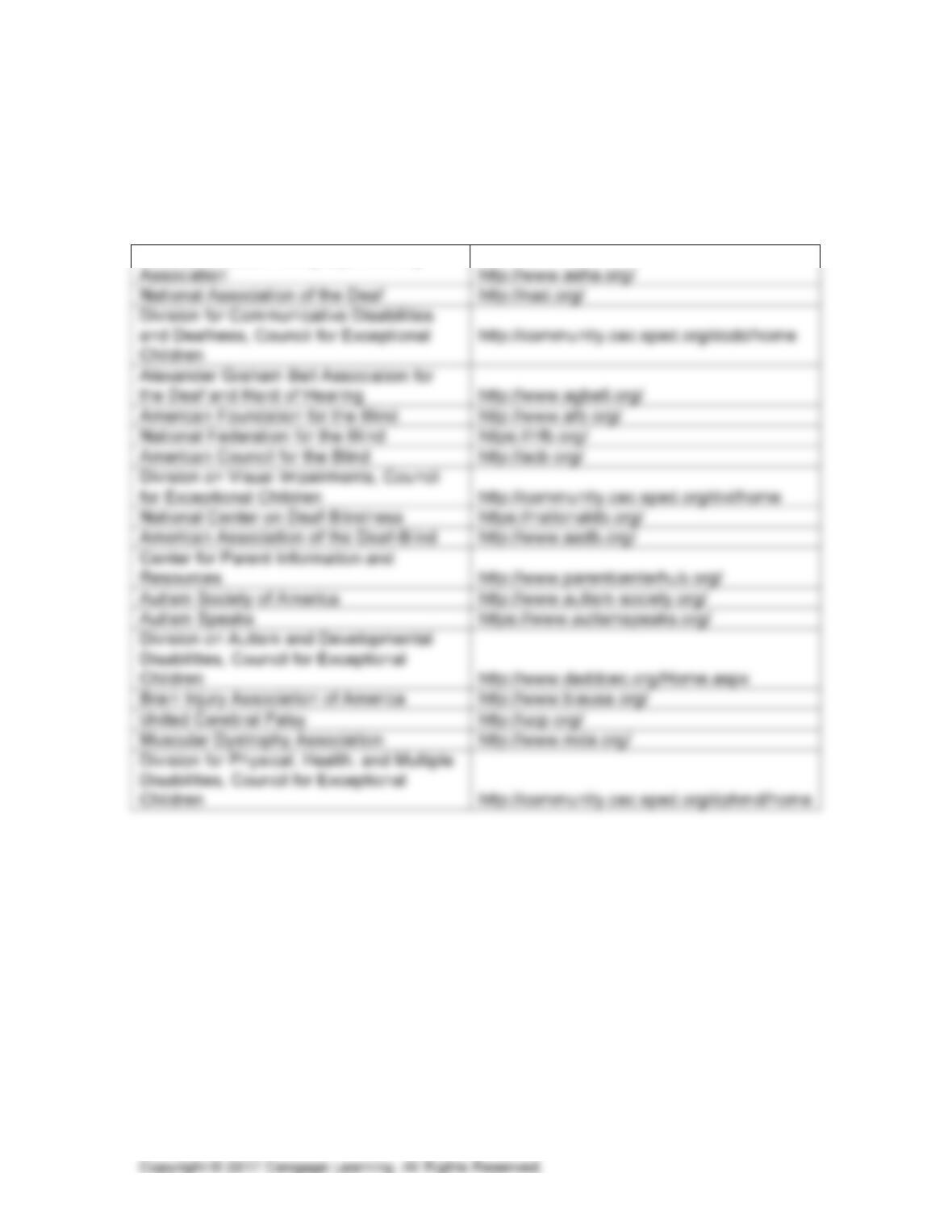
American Speech–Language–Hearing