Chapter 5
Public Spending and Public Choice
◼ Overview
The chapter introduces the economic functions of government, which are the ways in which the
government affects resource allocation in a modern mixed economy. It begins by examining the
beneficial aspects of a price system. Then the issue of market failure is examined, along with how
◼ Learning Objectives
After studying this chapter students should be able to:
• 5.1 Explain how market failures such as externalities might justify economic functions of government
• 5.2 Distinguish between private goods and public goods and explain the nature of the free-rider
problem
◼ Outline
I. Market Failures and Externalities
A. Advantage of a Price System: A price system allows all resources to move from lower valued
uses to higher valued uses via voluntary exchange.
2. Benefits of Competition among Sellers and Among Buyers: The benefits of a price
system are high levels of economic efficiency, the existence of consumer sovereignty,
Chapter 5 Public Spending and Public Choice 65
B. Market Failures and Externalities: In a pure market system, competition generates economic
efficiency only when individuals know and must bear the true opportunity costs of their actions.
1. Externalities: A consequence of an economic activity that spills over to affect third parties,
2. External Costs in Graphical Form: (See Figure 5-1(a))
3. External Benefits in Graphical Form: (See Figure 5-1(b))
4. Resource Misallocations of Externalities: When there are external costs, the market will
tend to overallocate resources to the production of the good or service in question because
those goods or services are priced deceptively low. The reason is that the producers of
those goods and services do not have to take into account the external costs that they
C. How the Government Can Correct Negative Externalities: When there are external costs,
the market will overallocate resources to the production of goods and services in question; that
is, price is too low and quantity is too high because all costs are not reflected in the good’s price.
1. Special Taxes: Taxes on output would reduce output but would not provide an incentive
2. Regulation: The government could specify a maximum allowable rate of pollution.
D. How the Government Can Correct Positive Externalities
2. Subsidies: Government can require that certain actions be undertaken, e.g., inoculations
of school children.
II. The Other Economic Functions of Government: The functions of government that affect the way
in which exchange and resource allocation are carried out in the economy.
A. Providing a Legal System: All relationships among consumers and businesses are governed by
legal rules. Much of the legal system is involved with defining and protecting property rights.
B. Promoting Competition: Promoting competition is a way of increasing the efficiency of the
certain activities that restrain trade.
C. Providing Public Goods: Public goods are goods to which the principle of rival consumption
does not apply and that are jointly consumed by many individuals simultaneously.
1. Private Goods and Rival Consumption: The principle of rival consumption applies to
3. Characteristics of Public Goods
a. Public goods can be used by more and more people at no additional cost and without
4. Free Riders: The free rider problem is a situation associated with public goods when
D. Ensuring Economywide Stability: The federal government is charged under the Employment
Act of 1946 to stabilize the economy at high levels of employment.
III. The Political Functions of Government: These are normative functions of government.
A. Government-Sponsored and Government-Inhibited Goods: The government defines certain
goods and services as desirable or undesirable. A government-sponsored good is a good that
B. Income Redistribution: Government explicitly redistributes income by progressive taxation
and by transfer payments and transfers in kind. Transfer payments are money payments made
IV. Public Spending and Transfer Programs: Governments use tax revenues to fund spending on
public goods, merit goods, and transfer payments. (See Figure 5-2, Figure 5-3.)
A. Publicly Subsidized Health Care: Medicare: A federal program that pays hospital and
physicians’ bills for persons over the age of 65. In return for paying a tax on earnings while
in the workforce (currently 2.9 percent of wages and salaries, plus 3.8 percent on certain
income for high-income households), retirees are ensured that the majority of their hospital
and doctors’ bills will be paid with public monies.
1. The Simple Economics of Medicare: By providing a subsidy, consumers of medical care
2. Medicare Incentives at Work
a. Physicians’ incomes and medical school applications have grown rapidly, for-profit
3. Health Care Subsidies Continue to Grow: Medicare’s cost has risen from 0.7 percent of
Chapter 5 Public Spending and Public Choice 67
B. Economic Issues of Public Education: State and local governments in the United States
spend about $900 billion, or more than 6 percent, of national income on education. The federal
government now also spends tens of billions of dollars through grants and transfers to state and
local governments.
1. The Now-Familiar Economics of Public Education: Governments provide public
education at prices well below those that would otherwise prevail in the marketplace for
2. The Incentive Problems of Public Education: Since the 1960s, various measures of
the performance of U.S. primary and secondary students have failed to increase even as
V. Collective Decision Making: The Theory of Public Choice: Collective decision making is how
voters, politicians, and other interested parties act to influence nonmarket decisions. The theory of
public choice is the study of collective decision making.
A. Similarities in Market and Public-Sector Decision Making: There is an assumption of
self-interest being the motivating force in both sectors.
1. Opportunity Cost: Because everything that is spent by government plus everything
2. Competition: In the public sector, the competition is between bureaucrats, elected
3. Similarity of Individuals: Persons in government face a different incentive structure,
B. Differences between Market and Collective Decision Making
1. Government Goods and Services at Zero Price: Most goods and services that governments
2. Use of Force: Governments can legally use force in the regulation of economic affairs,
but the private sector cannot.
3. Voting versus Spending: In the market sector, a dollar voting system exists and differs
from the voting system in the public sector in three ways:
68 Miller • Economics Today, Nineteenth Edition
◼ Points to Emphasize
Public Goods
A good way to introduce public goods is to use the case of a popular singer in the 1960s who refused to pay
that portion of her income tax that she estimated to be allocated to national defense. This example can show
2. Why national defense would arise in suboptimal quantities in a free market.
Externalities and Resource Allocation
The topic of externalities is covered more rigorously in Chapter 31. One way to approach the issue
of negative externalities is to show why pollution is considered an example of a negative externality
Effect of the Legal System
Discussions could be centered on how providing a legal system lowers transaction costs of doing business
and promotes commerce. A good way to show this is to contrast a market for an illegal product, such as
marijuana, with the market for a legal product, such as cigarettes. In the marijuana market, sellers have
Income Redistribution
When in-kind transfers of income (such as food stamps and rent subsidies) are included in the
measurement of the distribution of income, some individuals believe significant income redistribution
Chapter 5 Public Spending and Public Choice 69
The Effects of Subsidizing Medical Services
It is clear that the effect of subsidizing the purchase of health care (or any other product) increases the
Medicare Incentives
An important concept in economics is that incentives matter. They affect behavior in predictable ways
that are often overlooked by policymakers. Medicare provides significant incentives for consumers to
Similarities of Individuals in Government and the Private Sector
As in the case of the analysis of Medicare, incentives matter; that is, they affect behavior in predictable ways.
In both sectors, individuals pursue their own self-interest. In the case of an individual in the private sector,
◼ For Those Who Wish to Stress Theory
Allocation of Scarce Resources by the Public Sector
A challenging publication, by Dwight R. Lee of Virginia Polytechnic Institute and State University, can
provide the foundation for an interesting discussion. The Political Economy of Social Conflict, or Malice
1. A political battle has existed over federal land use decisions. Both environmentalists and private
energy companies want to use federal lands to maximize their own interests and preferences, and
each wants to impose the costs of these benefits on the other group. The side that “wins” the political
2. Governmental choice has largely replaced parental choice in educational decisions. Public schools
have become battle zones for such issues as busing, racial balance, creationism versus evolution,
3. Social Security has created strife between the young and the old. The 1939 amendments to the
Subsidizing the Cost of Medical Services and Utility Theory
Does the law of diminishing marginal utility apply to medical services, tests, and procedures? The
consumer typically does not go into a clinic and select a given quantity of medical services in the
Rising Cost of Medical Services under Medicare
One of the predictions of the economics of Medicare is that the price of medical services will increase
according to the law of supply. One way of explaining that more services will be provided at a higher
◼ Further Questions for Class Discussion
1. Government-sponsored goods are viewed as socially desirable. This suggests that they are believed
to have positive externalities associated with their consumption. They are subsidized or provided by
2. The level and composition of government spending always involves normative issues. One issue was
what to do with the budget surplus that existed in the late 1990s and 2000. There was a real political
3. Suppose that 10,000,000 units of medical services were sold in the United States each year at an
average price of $200 per unit. A politician argues that having the government pay $100 per unit
4. In the health care debate about reforming the health care system in the United States in 2009, it
became clear that the public became concerned that health care might be rationed and even that
“death panels” might be used to determine when to stop major procedures to keep a dying person
alive. Health care, according to this view, should not be denied to anyone for any reason. Have
5. Could it be possible that Americans buy too much oil because they do not pay a price for it that
reflects its true costs to the economy, and that as a result, U.S. dependence on foreign oil has been
increasing? An argument can be made that a substantial part of U.S. military spending in recent
◼ Answers to Questions for Critical Analysis
That Noisy Drone Hovering by Your House? Your Property Rights Are
Unclear (p. 102)
Could negative externalities from drone flights be addressed if it were possible for people to
negotiate prices at which drone owners would pay explicit fees for the right to fly drones above
people’s properties? Explain your reasoning.
72 Miller • Economics Today, Nineteenth Edition
Is Regulation the Solution for an Expanding Cloud of Orbital Pollution? (p. 105)
Given that even the tiniest bit of fast-traveling space junk, such as a fleck of paint, can damage a
satellite or pierce the thin covering of spaceship, why might the IADC Committee experience
problems determining the “appropriate” level of orbital pollution?
Funding Public Goods: Differences in Valuations versus Competencies (p. 108)
Based on the above discussion, would a government find it easier or harder to raise funds for a
public good that all people value similarly but that current government officials possess varying
capabilities to provide?
Medicare’s “1 Percent” (p. 112)
Who provides the $16 billion paid to Medicare’s “1 percent” every year – alongside the additional
$74 billion in payments to the other 99 percent of physicians who receive payments from Medicare?
Mixed Public Choice Incentives and Policies for School Lunches (p. 115)
Why do representatives of taxpayers who fund the NSLP program experience more difficulties in
designing effective incentive structures for officials who manage that program than do a company’s
shareholders who seek to change the incentives confronting firms’ managers?
◼ You Are There
Addressing Rail-Freight Transportation Externalities (p. 116)
1. How does a city’s decision to assess substantial fines on rail operators that persistently
generate traffic congestion affect the supply curve for rail services within the city?
2. Why do you think that the federal government requires rail operators to mount expensive
horns and sound them – at prescribed decibel levels- at all street crossings? (Hint: what
significant negative spillovers can a train create at a street crossing?)
Chapter 5 Public Spending and Public Choice 73
◼ Issues & Applications
The U.S. Measles Treat—Once Nearly Eliminated be Less So Today
(pp. 117–118)
1. How does the jump in measles cases since 2014 illustrate the positive externality associated
with measles vaccinations? Explain briefly.
2. How might the federal or state governments act to try to boost the external benefits arising
from inoculations against the measles virus?
◼ Research Project
1. To contemplate why the measles virus spreads so widely among unvaccinated people, thereby
2. For the latest data about the incidence of measles cases in the United States, see the Web Links in
◼ Answers to Problems
5-1. Many people who do not smoke cigars are bothered by the odor of cigar smoke. If private
contracting is impossible, will too many or too few cigars be produced and consumed? Taking
all costs into account, is the market price of cigars too high or too low?
In the absence of laws forbidding cigar smoking in public places, people who are bothered by the
5-2. Suppose that repeated application of a pesticide used on orange trees causes harmful
contamination of groundwater. The pesticide is applied annually in almost all of the orange
groves throughout the world. Most orange growers regard the pesticide as a key input in their
production of oranges.
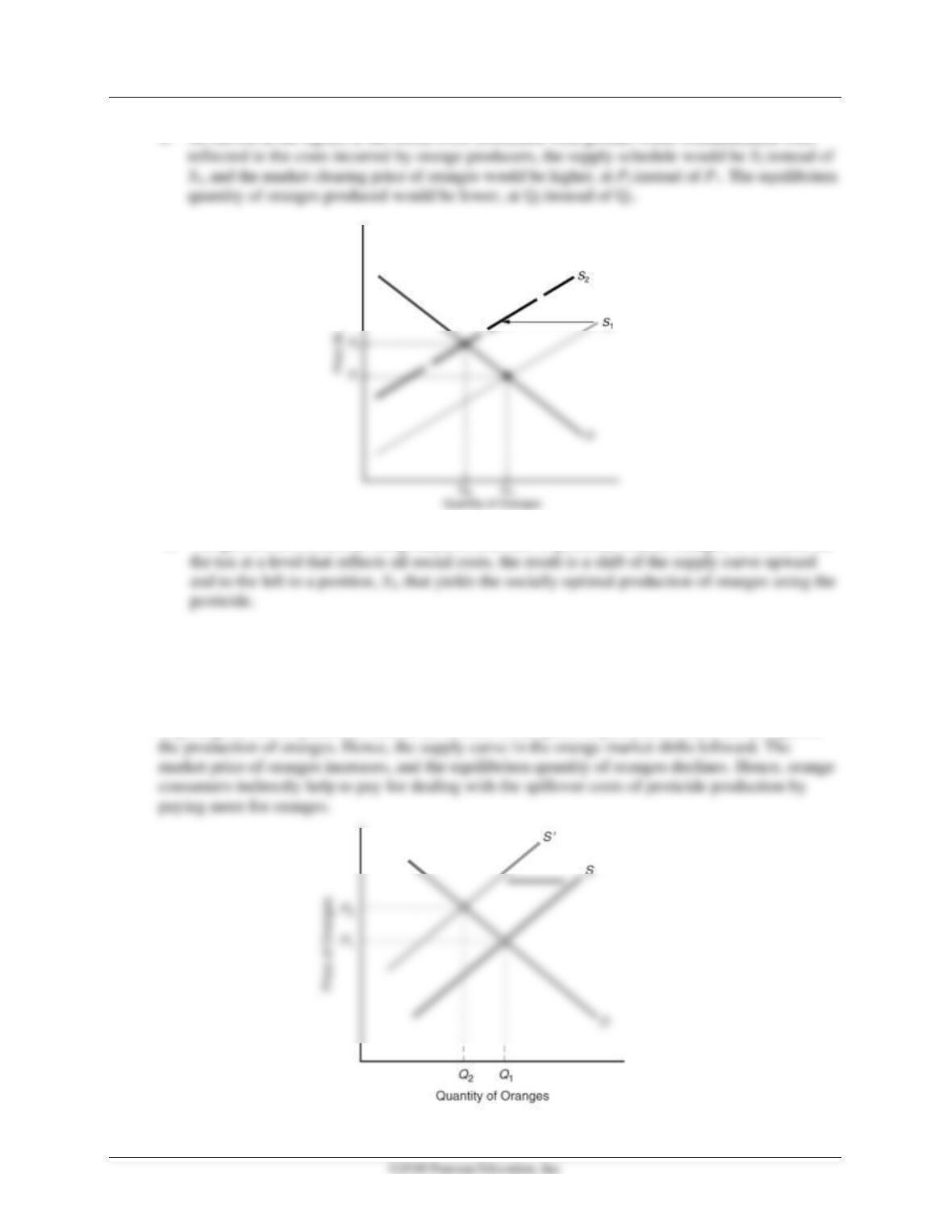
a. Use a diagram of the market for the pesticide to illustrate the implications of a failure of
orange producers’ costs to reflect the social costs of groundwater contamination.
b. Use your diagram from part (a) to explain a government policy that might be effective in
achieving the amount of orange production that fully reflects all social costs.
74 Miller • Economics Today, Nineteenth Edition
a. As shown in the figure, if the social costs associated with ground-water contamination were
b. The government could tax the production and sale of pesticide-treated oranges. If it is able set
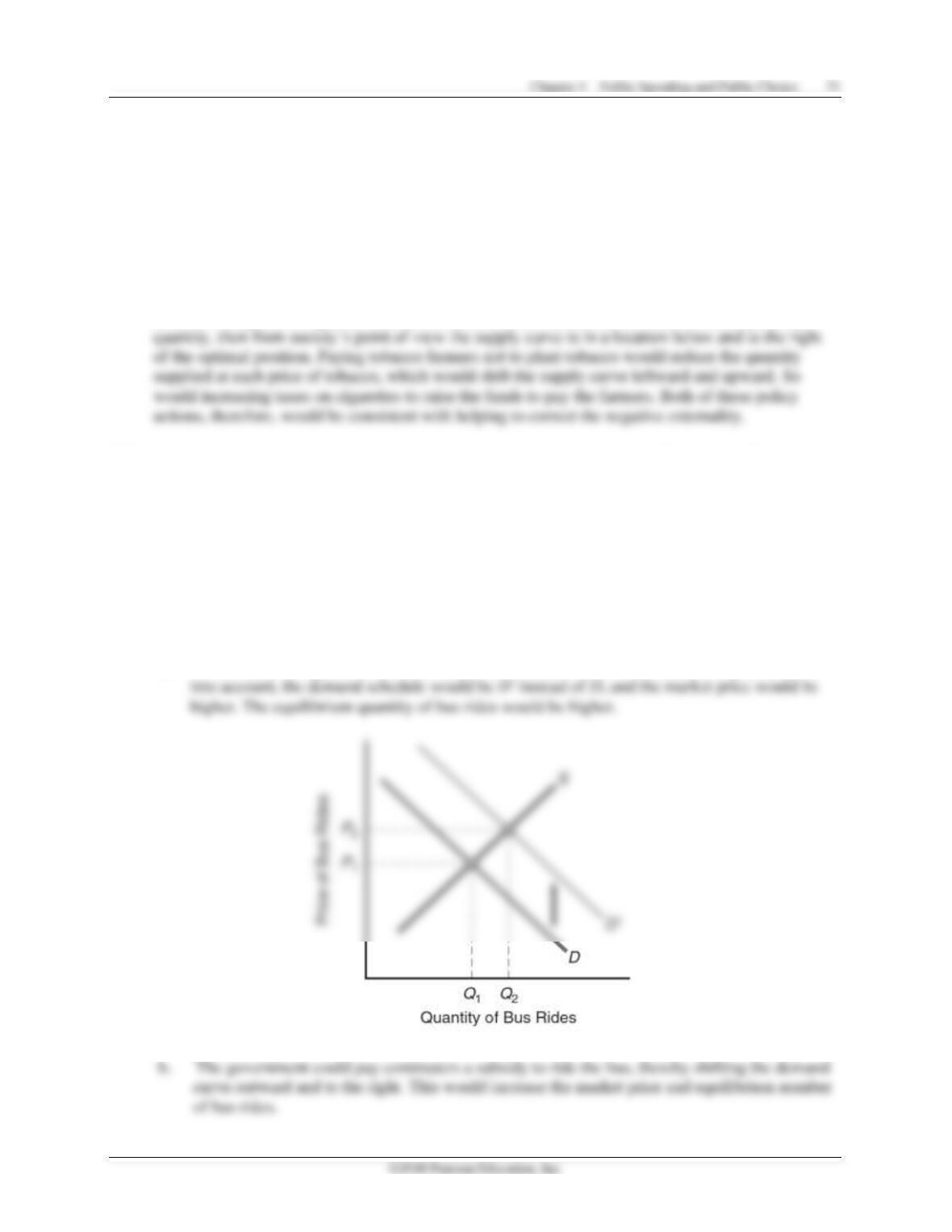
5-3. Now draw a diagram of the market for oranges. Explain how the government policy you
discussed in part (b) of Problem 5-2 is likely to affect the market price and equilibrium
quantity in the orange market. In what sense do consumers of oranges now “pay” for dealing
with the spillover costs of pesticide production?
Imposing the tax on pesticides causes an increase in the price of pesticides, which are an input in
5-4. Suppose the U.S. government determines that cigarette smoking creates social costs not
reflected in the current market price and equilibrium quantity of cigarettes. A study has
recommended that the government can correct for the externality effect of cigarette
consumption by paying farmers not to plant tobacco used to manufacture cigarettes. It also
recommends raising the funds to make these payments by increasing taxes on cigarettes.
Assuming that the government is correct that cigarette smoking creates external costs,
evaluate whether the study’s recommended policies might help correct this negative
externality.
If the consumption of cigarettes creates social costs not reflected in the current market price and
5-5. A nation’s government has determined that mass transit, such as bus lines, helps alleviate
traffic congestion, thereby benefiting both individual auto commuters and companies that
desire to move products and factors of production speedily along streets and highways.
Nevertheless, even though several private bus lines are in service, the country’s commuters
are failing to take into account the social benefits of the use of mass transit.
a. Discuss, in the context of demand-supply analysis, the essential implications of
commuters’ failure to take into account the social benefits associated with bus ridership.
b. Explain a government policy that might be effective in achieving the socially efficient use
of bus services.
a. As shown in the figure below, if the social benefits associated with bus ridership were taken
b. The government could pay commuters a subsidy to ride the bus, thereby shifting the demand
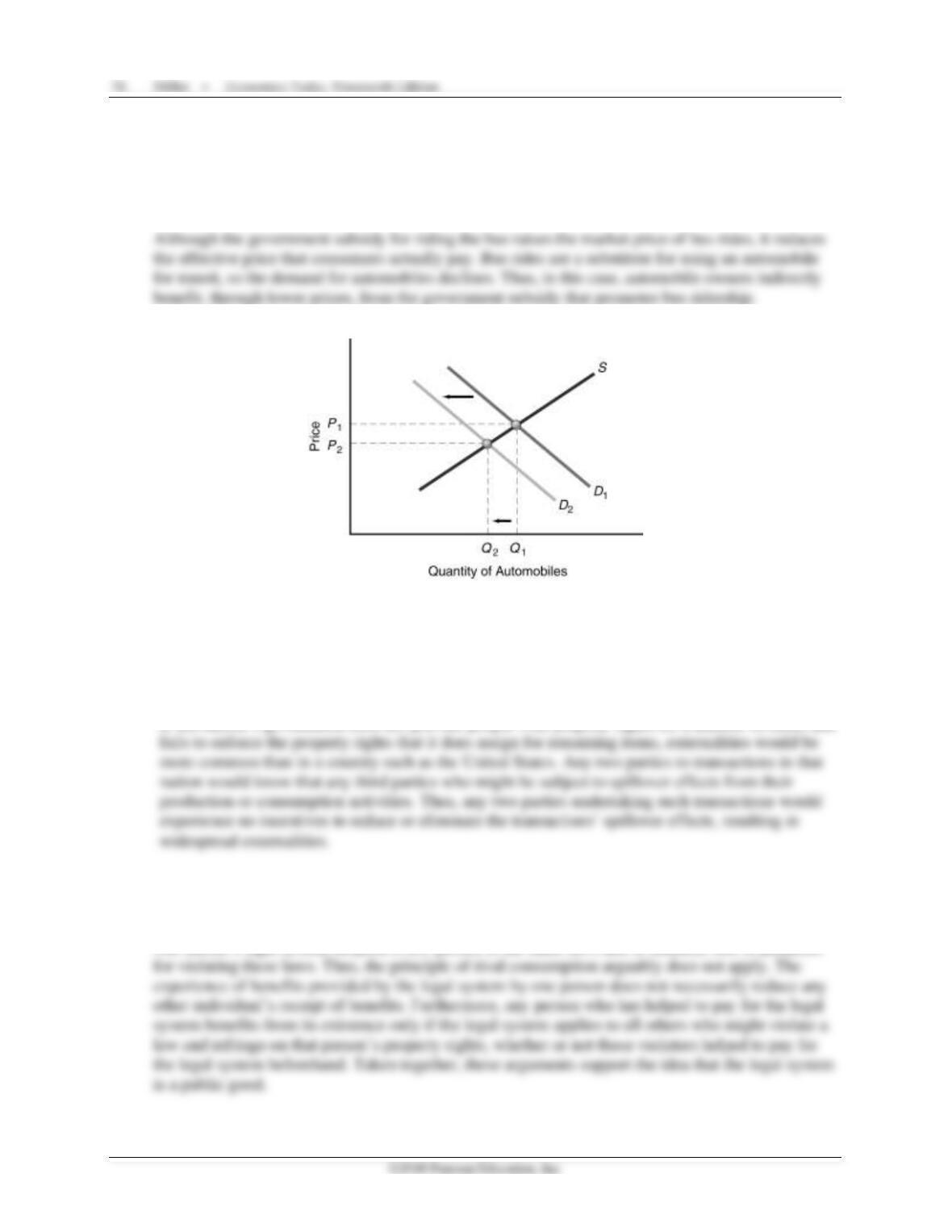
5-6. Draw a diagram of this nation’s market for automobiles, which are a substitute for buses.
Explain how the government policy you discussed in part (b) of Problem 5-5 is likely to affect
the market price and equilibrium quantity in the country’s auto market. How are auto
consumers affected by this policy to attain the spillover benefits of bus transit?
5-7. Consider a nation with a government that does not provide people with property rights for a
number of items and that fails to enforce the property rights it does assign for remaining
items. Would externalities be more or less common in this nation than in a country such as
the United States? Explain.
If this nation’s government does not provide people with property rights for a number of items and
5-8. Many economists suggest that our nation’s legal system is an example of a public good. Does
the legal system satisfy the key properties of a public good? Explain your reasoning.
Our nation’s legal system subjects every person to the same laws and to identical sets of penalties
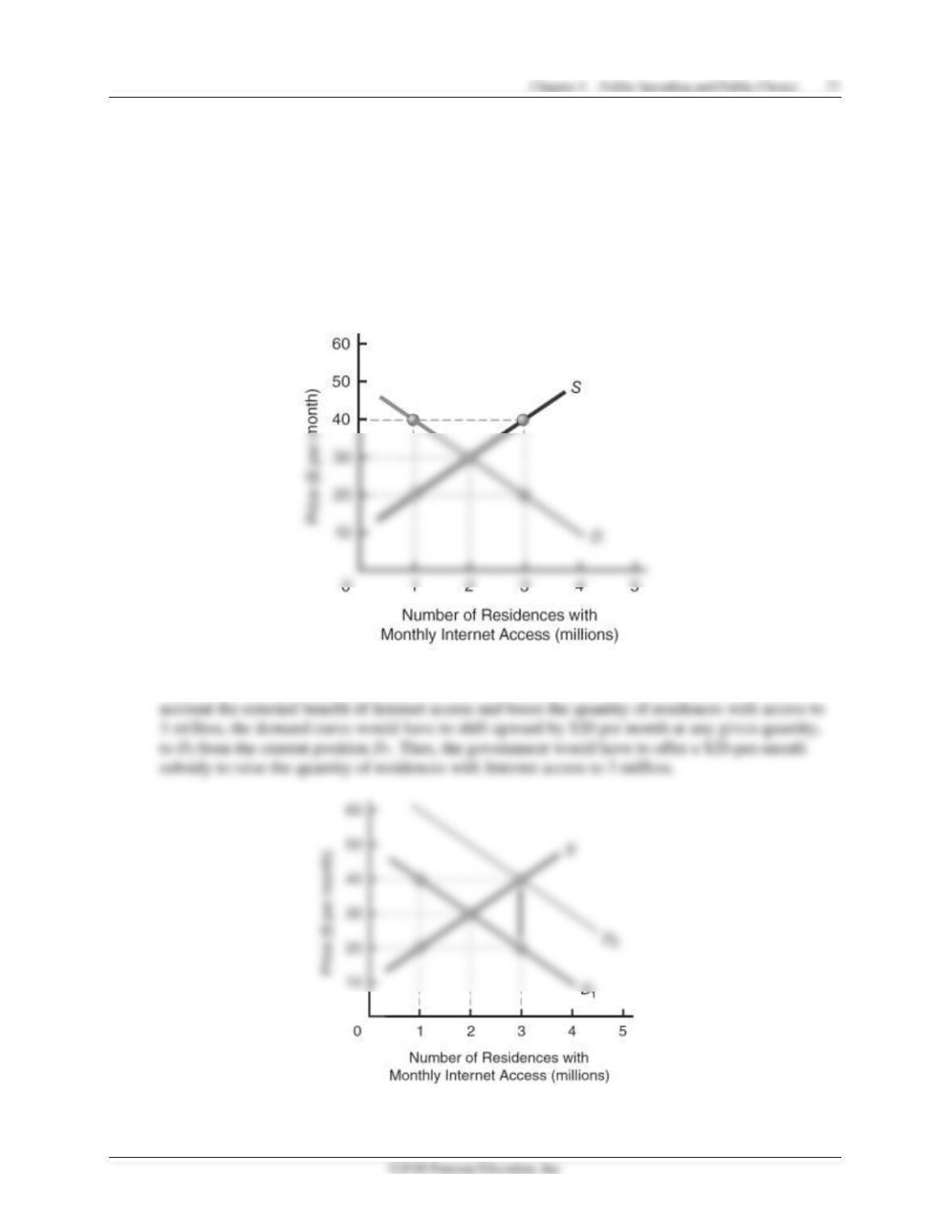
5-9. Displayed in the diagram below are conditions in the market for residential Internet access in
a U.S. state. The government of this state has determined that access to the Internet improves
the learning skills of children, which it has concluded is an external benefit of Internet access.
The government has also concluded that if these external benefits were to be taken into
account, 3 million residences would have Internet access. Suppose that the state government’s
judgments about the benefits of Internet access are correct and that it wishes to offer a per-
unit subsidy just sufficient to increase total Internet access to 3 million residences. What per-
unit subsidy should it offer? Use the diagram to explain how providing this subsidy would
affect conditions in the state’s market for residential Internet access.
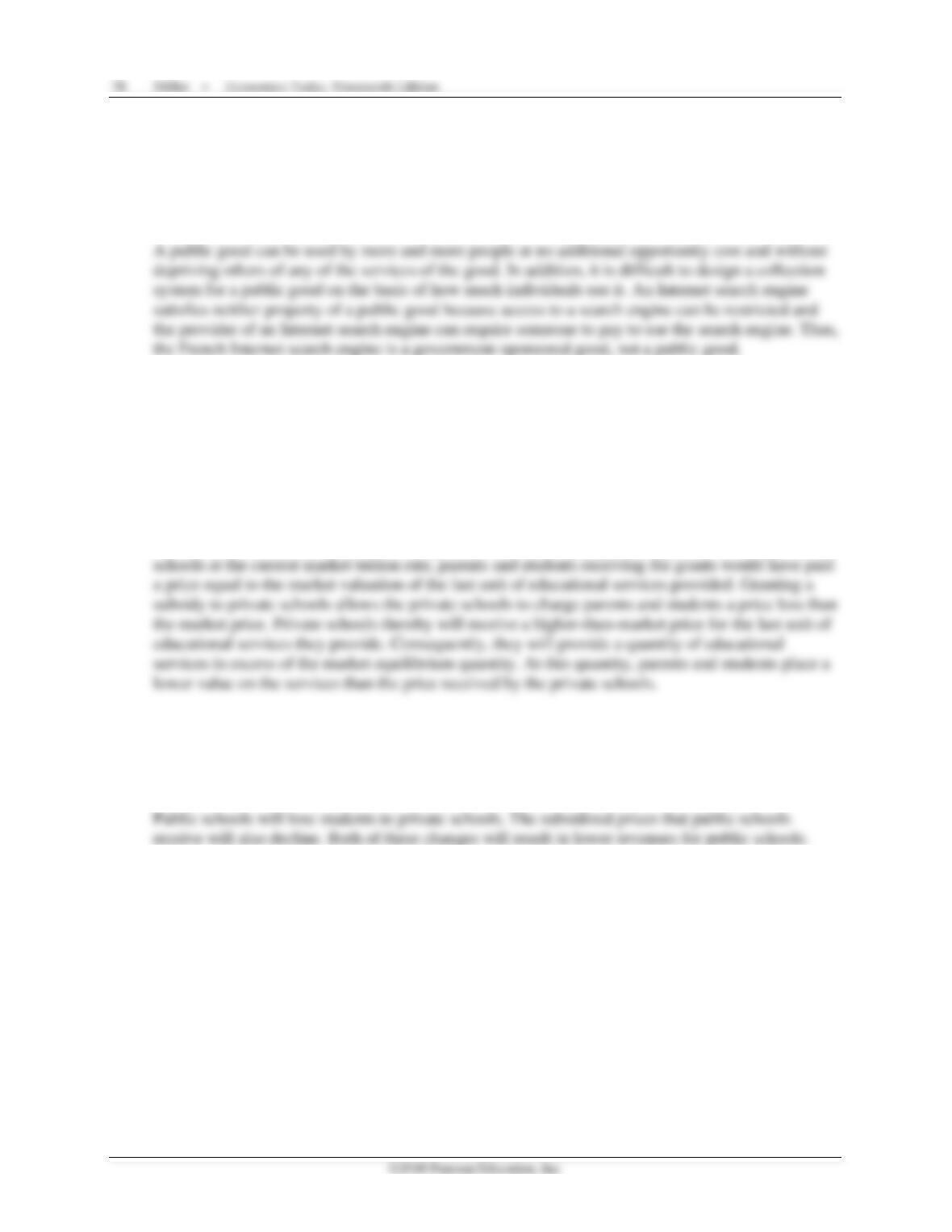
At present, the equilibrium quantity of residences with Internet access is 2 million. To take into
5-10. The French government recently allocated the equivalent of more than $120 million in public
funds to Quaero (Latin for “I search”), an Internet search engine analogous to Google or
Yahoo. Does an Internet search engine satisfy the key characteristics of a public good? Why
or why not? Based on your answer, is a publicly funded Internet search engine a public good
or a government-sponsored good?
5-11. A government offers to let a number of students at public schools transfer to private schools
under two conditions: It will transmit to private schools the same per-pupil subsidy it
provides public schools, and the private schools will be required to admit the students at a
below-market net tuition rate. Will the economic outcome be the same as the one that would
have arisen if the government instead simply provided students with grants to cover the
current market tuition rate at the private school? (Hint: Does it matter if schools receive
payments directly from the government or from consumers?)
No, the outcome will be different. If the government had simply provided grants to attend private
5-12. After a government implements a voucher program, granting funds that families can spend at
schools of their choice, numerous students in public schools switch to private schools. The
program’s per-unit subsidy is exactly equal to the external benefit from private educational
services. Is anyone likely to lose out nonetheless? If so, who?
5-13. Suppose that the current price of a tablet device is $300 and that people are buying 1 million
drives per year. The government decides to begin subsidizing the purchase of new tablet
devices. The government believes that the appropriate price is $260 per tablet, so the program
offers to send people cash for the difference between $260 and whatever the people pay for
each tablet they buy.
a. If no consumers change their tablet-buying behavior, how much will this program cost
the taxpayers?
b. Will the subsidy cause people to buy more, fewer, or the same number of tablets?
Explain.
Chapter 5 Public Spending and Public Choice 79
c. Suppose that people end up buying 1.5 million tablets once the program is in place. If the
market price of tablets does not change, how much will this program cost the taxpayers?
d. Under the assumption that the program causes people to buy 1.5 million tablets and also
causes the market price of tablets to rise to $320, how much will this program cost the
taxpayers?
5-14. Scans of internal organs using magnetic resonance imaging (MRI) devices are often covered
by subsidized health insurance programs such as Medicare. Consider the following table
illustrating hypothetical quantities of individual MRI testing procedures demanded and
supplied at various prices, and then answer the questions that follow.
Price
Quantity
Demanded
Quantity
Supplied
$100
100,000
40,000
$300
90,000
60,000
$500
80,000
80,000
$700
70,000
100,000
$900
60,000
120,000
a. In the absence of a government-subsidized health plan, what is the equilibrium price of
MRI tests? What is the amount of society’s total spending on MRI tests?
b. Suppose that the government establishes a health plan guaranteeing that all qualified
participants can purchase MRI tests at an effective price (that is, out-of-pocket cost) to
the individual of $100 per test. How many MRI tests will people consume?
c. What is the per-unit price that induces producers to provide the number of MRI tests
demanded at the government-guaranteed price of $100? What is society’s total spending
on MRI tests?
d. Under the government’s coverage of MRI tests, what is the per-unit subsidy it provides?
What is the total subsidy that the government pays to support MRI testing at its
guaranteed price?
5-15. Suppose that, as part of an expansion of its State Care health system, a state government
decides to offer a $50 subsidy to all people who, according to their physicians, should have
their own blood pressure monitoring devices. Prior to this governmental decision, the market-
clearing price of blood pressure monitors in this state was $50, and the equilibrium quantity
purchased was 20,000 per year.
80 Miller • Economics Today, Nineteenth Edition
a. After the government expands its State Care plan, people in this state desire to purchase
40,000 devices each year. Manufacturers of blood pressure monitors are willing to
provide 40,000 devices at a price of $60 per device. What out-of-pocket price does each
consumer pay for a blood pressure monitor?
b. What is the dollar amount of the increase in total expenditures on blood pressure
monitors in this state following the expansion in the State Care program?
c. Following the expansion of the State Care program, what percentage of total
expenditures on blood pressure monitors is paid by the government? What percentage of
total expenditures is paid by consumers of these devices?
5-16. A government agency is contemplating launching an effort to expand the scope of its activities.
One rationale for doing so is that another government agency might make the same effort and,
if successful, receive larger budget allocations in future years. Another rationale for expanding
the agency’s activities is that this will make the jobs of its workers more interesting, which may
help the government agency attract better-qualified employees. Nevertheless, the agency will
have to convince more than half of the House of Representatives and the Senate to approve a
formal proposal to expand its activities. In addition, to expand its activities, the agency must
have the authority to force private companies it does not currently regulate to be officially
licensed by agency personnel. Identify which aspects of this problem are similar to those faced
by firms that operate in private markets and which aspects are specific to the public sector.
5-17. Suppose that panel (a) of Figure 5-1 applies to Pennsylvania’s steel market. Suppose that steel
manufacturers in this state adopt a new technique for producing steel that entails a smaller
external cost. In the absence of any government action to correct the negative externality from
steel production, would the overallocation of resources to steel production in Pennsylvania be
larger or smaller following the adoption of the next steel-manufacturing technique?
5-18. Based on your answer to Question 5-17, if Pennsylvania’s government aims to correct the
steel market’s negative externality via an effluent fee, is the appropriate fee higher or lower
now that steel producers have adopted the new technique? Why or why not?
5-19. Consider panel (b) of Figure 5-1. Assume that a careful study of the likely transmission of
influenza in light of a changed population distribution has revealed that the external benefits
from inoculations are greater than currently displayed in the graph. In light of this
information, is the underallocation of resources to the provision of flu-vaccine inoculations
larger or smaller than indicated in panel (b)?
5-20. Based on your answer to Question 5-19, if the government aims to correct the positive
externality in the inoculation market via a per-unit subsidy to consumers, in the wake of
study is the appropriate per-unit subsidy higher or lower than before?
5-21. An online video game has the technical capability for a large number of players to participate,
as long as a game administrator works to ensure constant functionality of the game. Adding
more players deprives no other participants of the entertainment services provided by the
online game. It has been easy, however, to set up a system for excluding participation by
anyone who fails to contribute $5 per month to a fund that ensures covering extra expenses
generated by that player’s participation. Is this game a public good?
5-22. Consider the market for a health care service displayed in Figure 5-4, in which the government
currently pays a per-unit subsidy M. If the government raises the value of M to a larger dollar
amount per unit of service, what will happen to the out-of-pocket price paid by consumers, the
price required to induce suppliers to provide services, and the quantity of services provided?
Will the government’s total expense for this health care service rise or fall?
82 Miller • Economics Today, Nineteenth Edition
◼ Selected References
Bator, F.M., “The Anatomy of Market Failure,” Quarterly Journal of Economics, Vol. 72, August 1958,
pp. 351–379.
Buchanan, James and Gordon Tullock, The Calculus of Consent, University of Michigan Press, 1962.
Lee, Dwight R., The Political Economy of Social Conflict, or Malice in Plunderland, Los Angeles:
International Institute for Economic Research, Original Paper 36, 1982.
Laffer, A.B. and J.P. Seymour, eds., The Economics of the Tax Revolt: A Reader, New York: Harcourt
Brace Jovanovich, 1979.
McKean, Roland, “The Unseen Hand in Government,” American Economic Review, June 1965,
pp. 496–506.
Ott, David J. and Attiat F. Ott, Federal Budget Policy, 3rd ed., Washington: The Brookings Institute,
1977.