Instructor’s Manual 5-1
5
CULTURAL AND LINGUISTIC DIVERSITY
INSTRUCTOR OVERVIEW
Chapter 5 explores the tensions and inconsistencies that exist in labeling children who are
linguistically and culturally diverse—particularly if the intent to assure needed services and
support that children or youth without “a label” would not otherwise receive. Language
competence plays a significant role in how professionals experience the range of abilities in these
children. When a child like José (in the opening Snapshot) is not thriving academically or
socially, professionals face challenges in making decisions and selecting appropriate instruction,
interventions, and school placements.
How are population trends among diverse learners influencing education in the United States
today? How do we fairly identify children with disabilities who are also culturally and
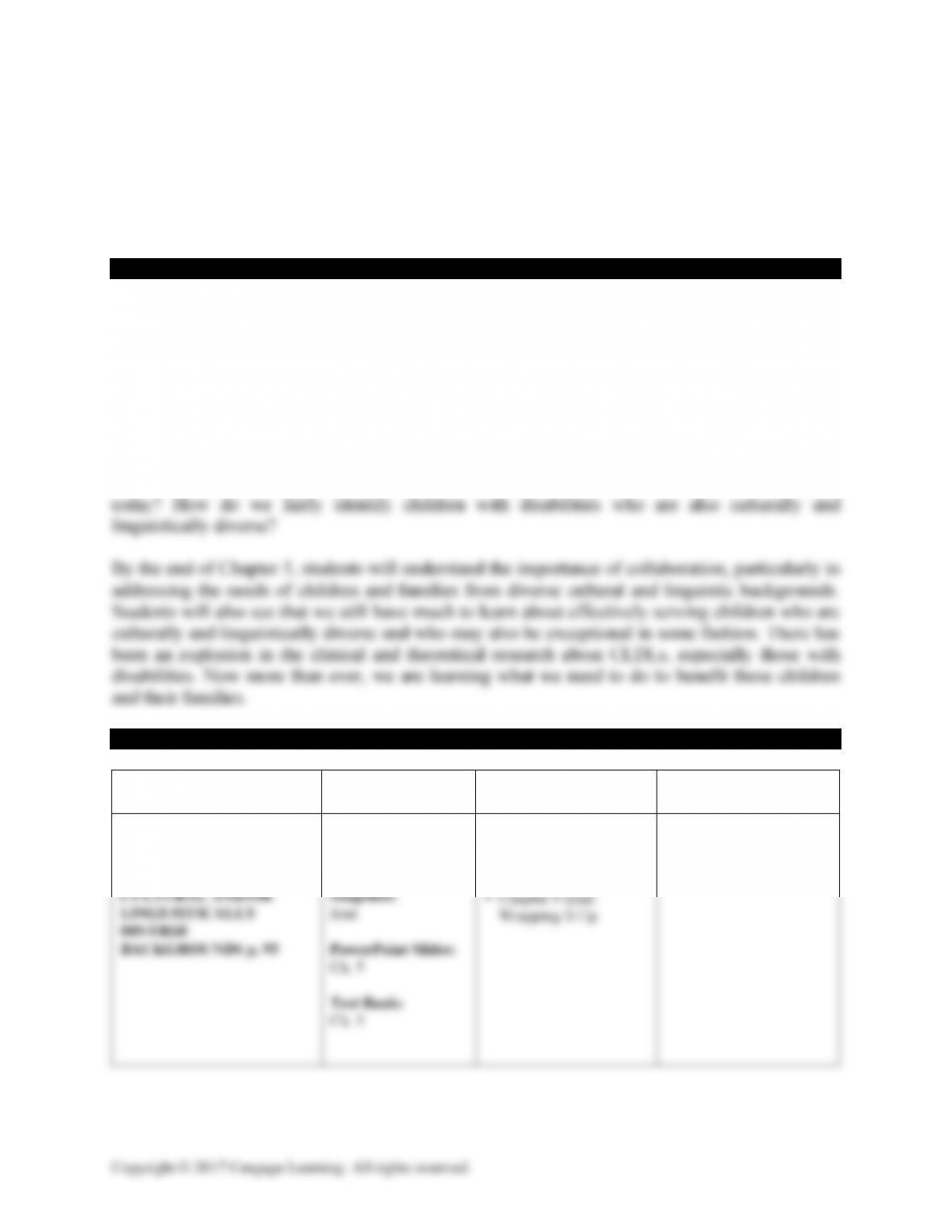
CHAPTER-AT-A-GLANCE
DETAILED
OUTLINE
TRADITIONAL
LEARNING
ONLINE
LEARNING
CEC
STANDARDS
5–1 A CHANGING ERA IN
THE LIVES OF
STUDENTS WITH
DISABLITIES FROM
CULTURAL AND/OR
LINGUISTICALLY
DIVERSE
BACKGROUNDS p. 95
Learning
Objectives:
5-1
Snapshot:
José
PowerPoint Slides:
Ch. 5
Test Bank:
Ch. 5
MindTap for Human
Exceptionality
• Chapter 5 Quiz: Did
You Get It?
• Chapter 5 Quiz:
Wrapping It Up
2 Learning Environments
Instructor’s Manual 5-2
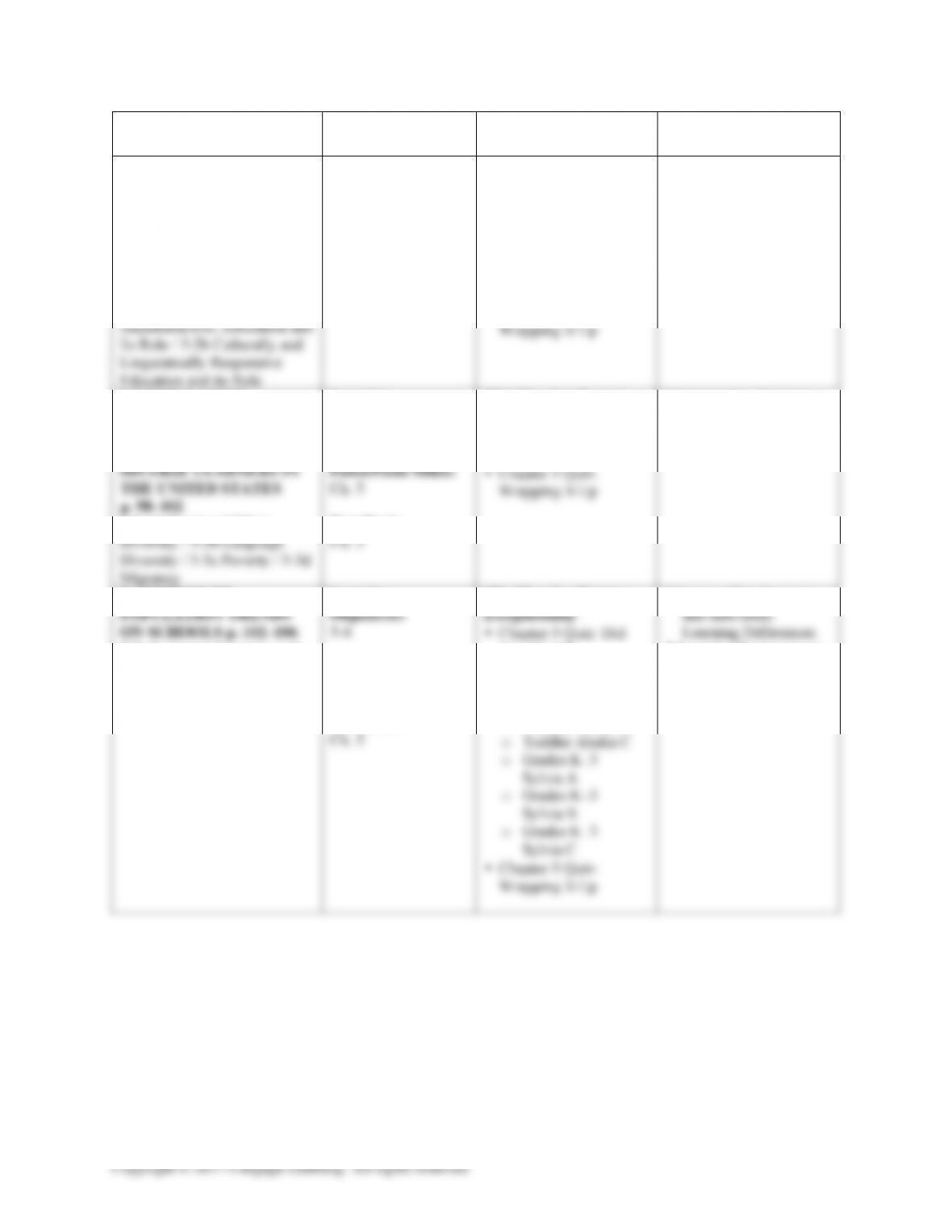
DETAILED
OUTLINE
TRADITIONAL
LEARNING
ONLINE
LEARNING
CEC
STANDARDS
5-2 THE PURPOSES AND
APPROACHES OF
BILINGUAL/ESL
EDUCATION AND
CULTURALLY AND
LINGUISTICALLY
RESPONSIVE
EDUCATION p. 96–98
5-2a Dual–Language
Immersion/ESL Education and
Its Role / 5–2b Culturally and
Linguistically Responsive
Education and its Role
Learning
Objectives:
5-2
PowerPoint Slides:
Ch. 5
Test Bank:
Ch. 5
MindTap for Human
Exceptionality
• Chapter 5 Video Case:
Sheltered English
Immersion in One
Third Grade Classroom
• Chapter 5 Quiz: Did
You Get It?
• Chapter 5 Quiz:
Wrapping It Up
2 Learning Environments
5-3 POPULATION
TRENDS AMONG
CULTURALLY AND
LINGUISTICALLY
DIVERSE LEARNERS IN
THE UNITED STATES
p. 98–102
5-3a Cultural and Ethnic
Diversity / 5–3b Language
Diversity / 5–3c Poverty / 5–3d
Migrancy
Learning
Objectives:
5-3
PowerPoint Slides:
Ch. 5
Test Bank:
Ch. 5
MindTap for Human
Exceptionality
• Chapter 5 Quiz: Did
You Get It?
• Chapter 5 Quiz:
Wrapping It Up
1 Learner Development
and Individual
Learning Differences
5-4 EFFECT OF
POPULATION TRENDS
ON SCHOOLS p. 102–106
5-4a Language Learning and
Schools / 5–4b Poverty and
Schools / 5–4c Migrancy and
Schools
Learning
Objectives:
5-4
PowerPoint Slides:
Ch. 5
Test Bank:
Ch. 5
MindTap for Human
Exceptionality
• Chapter 5 Quiz: Did
You Get It?
• Chapter 5 Scenario
(6 options):
o Toddler Abelia A
o Toddler Abelia B
o Toddler Abelia C
o Grades K–3
Sylvia A
o Grades K–3
Sylvia B
o Grades K–3
Sylvia C
• Chapter 5 Quiz:
Wrapping It Up
1 Learner Development
and Individual
Learning Differences
2 Learning Environments
Instructor’s Manual 5-3
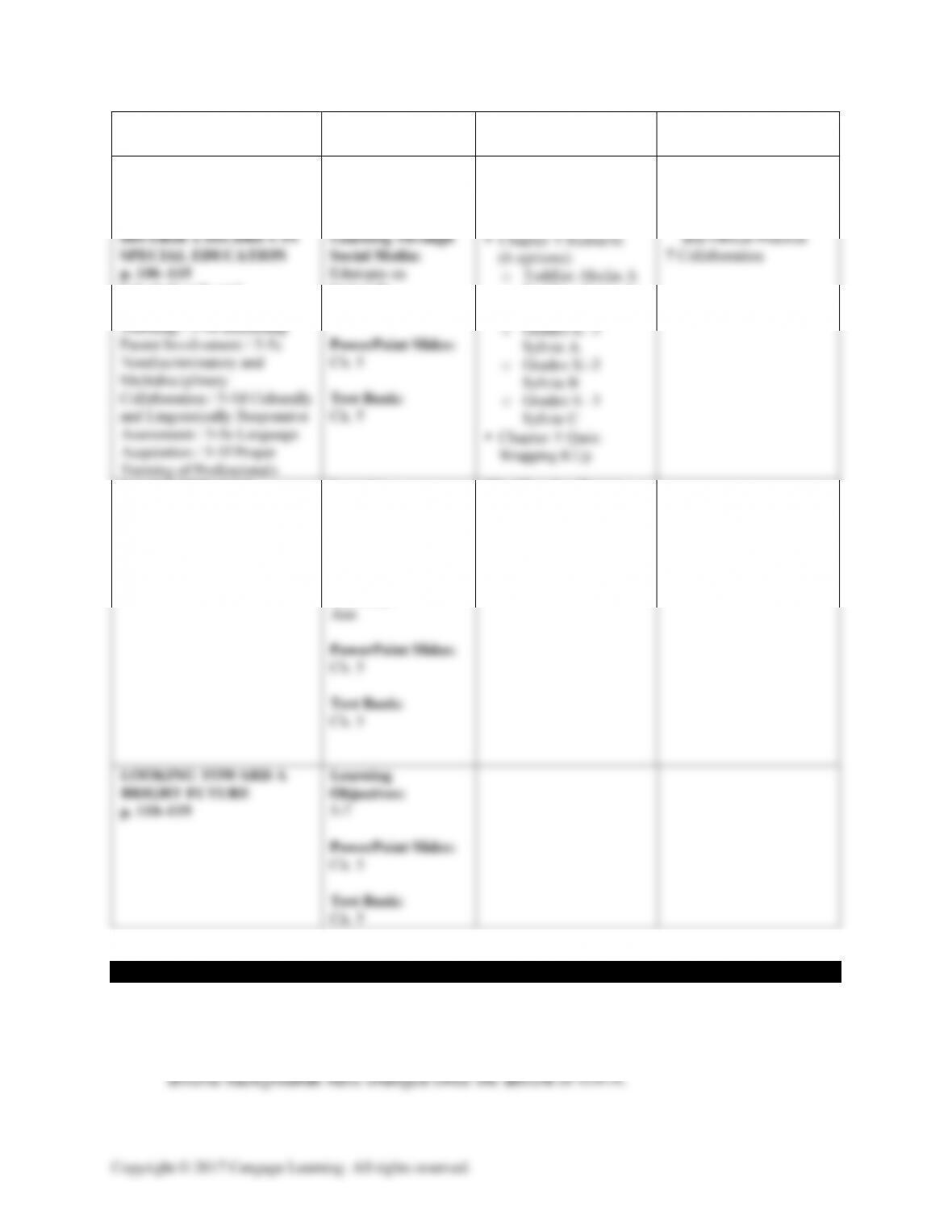
DETAILED
OUTLINE
TRADITIONAL
LEARNING
ONLINE
LEARNING
CEC
STANDARDS
5-5 DECREASING
DISPROPORTIONALITY
OF CULTURALLY AND
LINGUISTICALLY
DIVERSE CHILDREN IN
SPECIAL EDUCATION
p. 106–115
5-5a Culturally and
Linguistically Responsive
Teaching / 5–5b Increasing
Parent Involvement / 5–5c
Nondiscriminatory and
Multidisciplinary
Collaboration / 5–5d Culturally
and Linguistically Responsive
Assessment / 5–5e Language
Acquisition / 5–5f Proper
Training of Professionals
Learning
Objectives:
5-5
Learning Through
Social Media:
Edutopia on
Culturally
Responsive Teaching
PowerPoint Slides:
Ch. 5
Test Bank:
Ch. 5
MindTap for Human
Exceptionality
• Chapter 5 Quiz: Did
You Get It?
• Chapter 5 Scenario
(6 options):
o Toddler Abelia A
o Toddler Abelia B
o Toddler Abelia C
o Grades K–3
Sylvia A
o Grades K–3
Sylvia B
o Grades K–3
Sylvia C
• Chapter 5 Quiz:
Wrapping It Up
4 Assessment
5 Instructional Planning
and Strategies
6 Professional Learning
and Ethical Practice
7 Collaboration
5-6 CULTURALLY
RESPONSIVE SPECIAL
EDUCATION p. 115–118
Learning
Objectives:
5-6
Case Study on
Embracing
Diversity:
Ana
PowerPoint Slides:
Ch. 5
Test Bank:
Ch. 5
MindTap for Human
Exceptionality
• Chapter 5 Quiz: Did
You Get It?
• Chapter 5 Quiz:
Wrapping It Up
LOOKING TOWARD A
BRIGHT FUTURE
p. 118–119
Learning
Objectives:
5-7
PowerPoint Slides:
Ch. 5
Test Bank:
Ch. 5
LEARNING OBJECTIVES
5-1 Describe how the lives of students with disabilities from culturally and/or linguistically
Instructor’s Manual 5-4
Copyright © 2017 Cengage Learning. All rights reserved.
5-3 Describe population trends among culturally and linguistically diverse learners,
especially prevalence by race and ethnicity, speakers of other languages, poverty, and
5-4 Describe how these population trends affect public education.
5-5 Identify ways that public schools can decrease the disproportionality of culturally and
linguistically diverse learners (CLDLs) in special education and improve significantly
5-7 Identify promising changes in public education that support culturally and linguistically
diverse learners with disabilities.
CHAPTER/ LECTURE OUTLINE
• 5-1 A CHANGING ERA IN THE LIVES OF STUDENTS WITH DISABLITIES
FROM CULTURAL AND/OR LINGUISTICALLY DIVERSE BACKGROUNDS
o Families with culturally and linguistically diverse backgrounds live in an exciting
time of change in our U.S. communities. These children, youth, and their parents
bring with them a variety of strengths and challenges that create tensions as well
as opportunities for educators and others to expand their horizons and fine-tune
their practices.
o There are many terms used to describe these learners, including:
! Culturally and linguistically diverse learners (CLDL): Individuals
whose culture and/or language is different from the majority of the
population.
! Emergent bilingual learner (EBL): A person who is in the process of
language.
o Types of language instruction programs geared toward these learners include:
! Culturally and linguistically responsive education: Education that is
designed to seek positive changes in how schools think about children
from diverse backgrounds and develops instructional practices that use the
Instructor’s Manual 5-5
Copyright © 2017 Cengage Learning. All rights reserved.
funds of knowledge about their students’ culture and their language in
respectful and meaningful and effective ways to support their learning.
term for bilingual education.
• 5-2 THE PURPOSES AND APPROACHES OF BILINGUAL/ESL EDUCATION
AND CULTURALLY AND LINGUISTICALLY RESPONSIVE EDUCATION
o The differences among the goals and approaches of general, special, and
culturally and linguistically responsive education often create challenges for
o 5-2a Dual Language Immersion/ESL Education and Its Role
! Dual-language education includes a variety of language instruction
programs provided in two languages.
o 5-2b Culturally and Linguistically Responsive Education and its Role
! Cultural responsiveness is “the ability to learn from and relate
respectfully with people of your own culture as well as those from another
• 5-3 POPULATION TRENDS AMONG CULTURALLY AND LINGUISTICALLY
DIVERSE LEARNERS IN THE UNITED STATES
o Prevalence refers to the number of people in a given population who exhibit a
condition or are placed in a particular category. Disproportionality is the
overrepresentation or underrepresentation of a specific cultural or ethnic group
within a specified setting when compared to the percentage of their representation
or prevalence in the general population.
o 5-3a Cultural and Ethnic Diversity
! Several culturally or ethnically diverse groups of people are growing
rapidly. In some cases, this rate of growth is twice that of the white
o 5-3b Language Diversity
Instructor’s Manual 5-6
Copyright © 2017 Cengage Learning. All rights reserved.
o 5-3c Poverty
! Poverty is found more often in CLDL populations than in mainstream
o 5-3d Migrancy
! The United States is the top migrant destination in the world.
! Children from Migrant Families: The circumstances of migrancy are
associated with economic disadvantage as well as linguistic and cultural
• 5-4 EFFECT OF POPULATION TRENDS ON SCHOOLS
o Regular education programs and specialized services are impacted greatly by the
number of children who enter their doors with English language learning needs,
with poverty-related issues, or with the challenges associated with migrancy.
o 5-4a Language Learning and Schools
! There is an ever-increasing need to provide linguistically appropriate
o 5-4b Poverty and Schools
! Research evidence indicates that thoughtfully developed, culturally
responsive early intervention programs provided by well-trained
o 5-4c Migrancy and Schools
! Migrant children experience major challenges in achieving solid school
success and developing enduring relationships with peers, teachers, and
other adults.
• 5-5 DECREASING DISPROPORTIONALITY OF CULTURALLY AND
LINGUISTICALLY DIVERSE CHILDREN IN SPECIAL EDUCATION
o Decisions must be centered on information gathered from culturally and
linguistically responsive evaluations and aligned to their individual learning
strengths and needs.
o 5-5a Culturally and Linguistically Responsive Teaching
! Culturally and linguistically responsive teaching makes vital connections
among and between children’s classrooms, their schools, families, and the
broader community to support students’ learning and development.
! Teachers must gather information about children in a culturally responsive
Instructor’s Manual 5-7
Copyright © 2017 Cengage Learning. All rights reserved.
o 5-5b Increasing Parent Involvement
! Parents as partners with teachers in the education of children provides the
greatest potential for their achieving maximum benefits academically in
o 5-5c Nondiscriminatory and Multidisciplinary Collaboration
! Multidisciplinary collaboration: Collaboration between parents and
professionals with different expertise (classroom teacher, assessment
o 5-5d Culturally and Linguistically Responsive Assessment
! Test Bias, Assessment Errors, and Measurement
• Assessment bias: A test or testing procedure that creates a
disadvantage for one group as a consequence of factors unrelated
to ability, such as culture, linguistic or racial background or
o 5-5e Language Acquisition
! Because all language acquisition is based on developmental stages and
o 5-5f Proper Training of Professionals
! Selection of culturally and linguistically responsive practices requires a
knowledge base that is beyond that of many education professionals.
Instructor’s Manual 5-8
Copyright © 2017 Cengage Learning. All rights reserved.
• 5-6 CULTURALLY RESPONSIVE SPECIAL EDUCATION
o For all children identified for special education, the first consideration in
developing an individual education program (IEP) are the educational strengths
and needs of the child as established by a collaborative team of professionals in
• LOOKING TOWARD A BRIGHT FUTURE
o We are much more aware of culturally and linguistically responsive educational
practices in the schools and classrooms and that these practices matter
significantly to the well-being of these learners.
DISCUSSION STARTERS
1. What challenges confront educators when teaching children from culturally and
linguistically diverse backgrounds?
2. How may poverty and migrancy contribute to the academic difficulties of children with
CLD backgrounds, often resulting in their referral to special education?
3. Describe your own experience with multicultural education. What was the diversity of
the school you attended as a child?
4. What academic strengths and challenges do you observe in the students who are
IN-CLASS OR ONLINE ACTIVITY SUGGESTIONS
ACTIVITY 1
INTRODUCTION: The philosophy behind multicultural education rejects the views that schools
should seek to blend cultural differences and merely tolerate cultural pluralism. Instead,
supporters believe that schools should encourage diversity.
ACTIVITY: Discuss with students whether the goal of blending cultural differences is realistic for
education. Is it a goal that the majority culture would support? Should teachers be expected to
ACTIVITY 2
INTRODUCTION: Appropriate education for culturally diverse populations must emanate from
common purposes and goals of education.
Instructor’s Manual 5-9
Copyright © 2017 Cengage Learning. All rights reserved.
ACTIVITY: Discuss with class members their opinions of the purposes and common goals of
general education. What are the goals of multicultural education? Are the same goals appropriate
for all students? Interview a parent of a culturally diverse student about their feelings, beliefs,
and experiences regarding education.
ACTIVITY 3
INTRODUCTION: Children from cultural minority backgrounds represent a disproportionately large
group in special education as a result of labeling and placement decisions based on
psychoeducational assessment. The major difficulty lies in the bias of the measurement
ACTIVITY 4
INTRODUCTION: Some authors suggest that appropriate instruction is the pivotal concept in
multicultural special education. Appropriate instruction for students in special education is
typically arranged through the development of an individualized education program (IEP).
ACTIVITY: Discuss what components should be included in an IEP to address problems that arise
from cultural diversity (e.g., strategies to communicate across cultural boundaries). Guide the
class in developing an IEP for the students described in the Snapshot.
Alternatively, observe and interview a bilingual educator about the strategies they use to
ACTIVITY 5
INTRODUCTION: Different cultures hold different beliefs about education. Activities of utmost
importance to one cultural group may be seen as less important or even offensive to another.
ACTIVITY: Instruct each class member to interview an individual from another culture, or invite a
representative from another culture to speak to the class. Questions to pose include:
• Is education provided on an equal basis to both men and women in your culture?
• How many years of schooling do most people receive?
• Is education provided for only certain economic groups?
• What types of courses are taught?
• Are certain courses required for everyone?
Instructor’s Manual 5–10
Copyright © 2017 Cengage Learning. All rights reserved.
ACTIVITY 6
INTRODUCTION: A student from poverty may be at risk before he or she is even born.
ACTIVITY: Discuss the following: In what ways can support services be provided to mothers at
risk (poor, single, etc.). After birth, what types of services can be provided? Are these services
commonly available?
ACTIVITY 7
INTRODUCTION: Much remains to be learned about the effects that expectations have on
students—namely, how and the degree to which expectations affect performance. All students
are subject to expectations of parents, teachers, and the like. Unfortunately, expectations
ACTIVITY 8
INTRODUCTION: Colleges and universities are continually addressing the issue of how to better
prepare teachers to meet the diverse needs of students.
ACTIVITY: Instruct students to list the skills they will need to teach students from culturally
diverse backgrounds. Afterward, discuss the lists with students and ask questions such as:
• Are those skills significantly different from those needed to teach students from the
cultural majority? If so, how?
• Should a course be designed specifically to address issues in multicultural education?
VIDEO ACTIVITIES
ACTIVITY 1
VIDEO: Academic Conversations with ELLs: Series Overview
VIDEO URL: https://www.teachingchannel.org/videos/improve-conversation-skills-ells-ousd
Instructor’s Manual 5–11
Copyright © 2017 Cengage Learning. All rights reserved.
ACTIVITY 2
VIDEO: High Expectations: Students Learn to Rise to the Occasion
ACTIVITY: Watch the Edutopia video titled High Expectations: Students Learn to Rise to the
Occasion to see how one school used a focus on teamwork, individualized instruction, and
ongoing assessment to improve the achievement of diverse and low income students. Afterward,
have students discuss questions such as:
• Is the heavy time and resource commitment worth the expenditure?
• Why is common lesson planning time critical?
ACTIVITY 3
VIDEO: 3 Ways to Speak English
VIDEO URL: https://www.ted.com/talks/jamila_lyiscott_3_ways_to_speak_english
ACTIVITY: Attending to language acquisition for children who are culturally and linguistically
diverse is especially important. Watch the TED talk by Jamila Lyiscott titled 3 Ways to Speak
English to explore what is means to be articulate. What can you learn about identity from
language?
DEBATE FORUM
SPECIAL EDUCATION SERVICES FOR CLDLS
Many influences come into play as we consider language and cultural diversity issues in
education, and referral and subsequent placement of CLDL into special education. The study of
culture and associated variables is seldom well–served by attempts to identify simplistic causal
relationships. Research on race and culture involves complex and interacting variables that do
not lead to simplistic conclusions (Emerson & Hatton, 2007; Newell & Kratochwill, 2007; Ram,
2005).
POINT
IDEA is very clear that children with disabilities have the right to a free and appropriate
public education (FAPE). It is unlawful to prevent a child with a disability from receiving special
education services even if the child has limited English proficiency, lacks appropriate schooling,
or has missed sufficient school to cause a lack of progress, as long as these issues are not the
primary reason(s) for the learning problems. Too often, schools set rigid rules in place that
unintentionally hinder early identification and intervention. The intent is to avoid
Instructor’s Manual 5–12
Copyright © 2017 Cengage Learning. All rights reserved.
• Is the child making the same progress as other peers whose backgrounds and ages are
similar to the child?
• What are the parents’ concerns? What do they see as strengths and concerns at home?
• What are this child’s strengths in the classroom?
• Who does the child play with at recess or after school?
• Does the child use social language with friends in English and/or another language?
COUNTERPOINT
CLDLs might be inappropriately considered for special education as long as their
performance is primarily a language and/or cultural matter. It could be argued that the reason
for a CLDL receiving special help is irrelevant as long as he received that extra help. This
perspective may have intuitive appeal, but it is not a satisfactory position for professionals
involved in the rules and effective practices of educational research.
If a CLDL received special education because of their cultural and language
background, not primarily because of a disability, that child would have been labeled and
placed inappropriately. Unfortunately, children can often become “the label,” thus impeding
their progress. The concept of the self–fulfilling prophecy resulting in children and
TAKE A STAND
Do you think there are risks involved in assessing and providing special education services to a
CLDL? Explain your answer.
SOURCES CITED
Instructor’s Manual 5–13
Copyright © 2017 Cengage Learning. All rights reserved.
Ram, R. (2005). Income inequality, poverty, and population health: Evidence from recent data for the United States.
Social Science and Medicine, 61, 2568–2576.
Snyder, C. R., Shorey, H. S., & Rand, K. L. (2006). Using hope theory to teaching and mentor academically at–
risk students. In W. Buskist and S. F. Davis (Eds.), Handbook of the teaching of psychology (pp. 170–174).
Malden, MA: Blackwell Publishing.
Spangenberg, E. R., & Sprott, D. E. (2006). Self–monitoring and susceptibility to the influence of self–prophecy.
Journal of Consumer Research, 32, 550–556.
Teemant, A., Graham, R.C., and Pinnegar, S. (2007). Developing second language literacy: Instructional guide, 3rd
ed. Provo, UT: Brigham Young University.
Trouilloud, D., Sarrazin, P., & Bressoux, P. (2006). Relation between teachers’ early expectations and students’
later perceived competence in physical education classes: Autonomy–supportive climate as a moderator.
Journal of Educational Psychology, 98, 75–86.
CASE STUDY FEEDBACK
Ana
1. What were Ana’s mother’s funds of knowledge?
Ana’s mother appears to have a practical understanding of the value of record keeping
2. What culturally responsive practices did the school and community use?
The school provided an interpreter to the meeting. The MDT received information about