Chapter 5
Saving and Investment in the Open Economy
◼ Learning Objectives
I. Goals of Chapter 5
A. Explain how the balance of payments is calculated (Sec. 5.1)
B. Discuss goods market equilibrium in an open economy (Sec. 5.2)
II. Notes to Eighth Edition Users
A. In section 5.1, we simplify the measurement of the current account balance to reflect recent
changes in government accounting methods, changing the term “capital and financial account
Chapter 5 Saving and Investment in the Open Economy 101
◼ Teaching Notes
I. Balance of Payments Accounting (Sec. 5.1)
A. Balance of payments accounts
1. The record of a country’s international transactions
B. The current account
1. Net exports of goods and services
2. Net income from abroad
3. Net unilateral transfers
4. Sum of net exports of goods and services, net income from abroad, and net unilateral
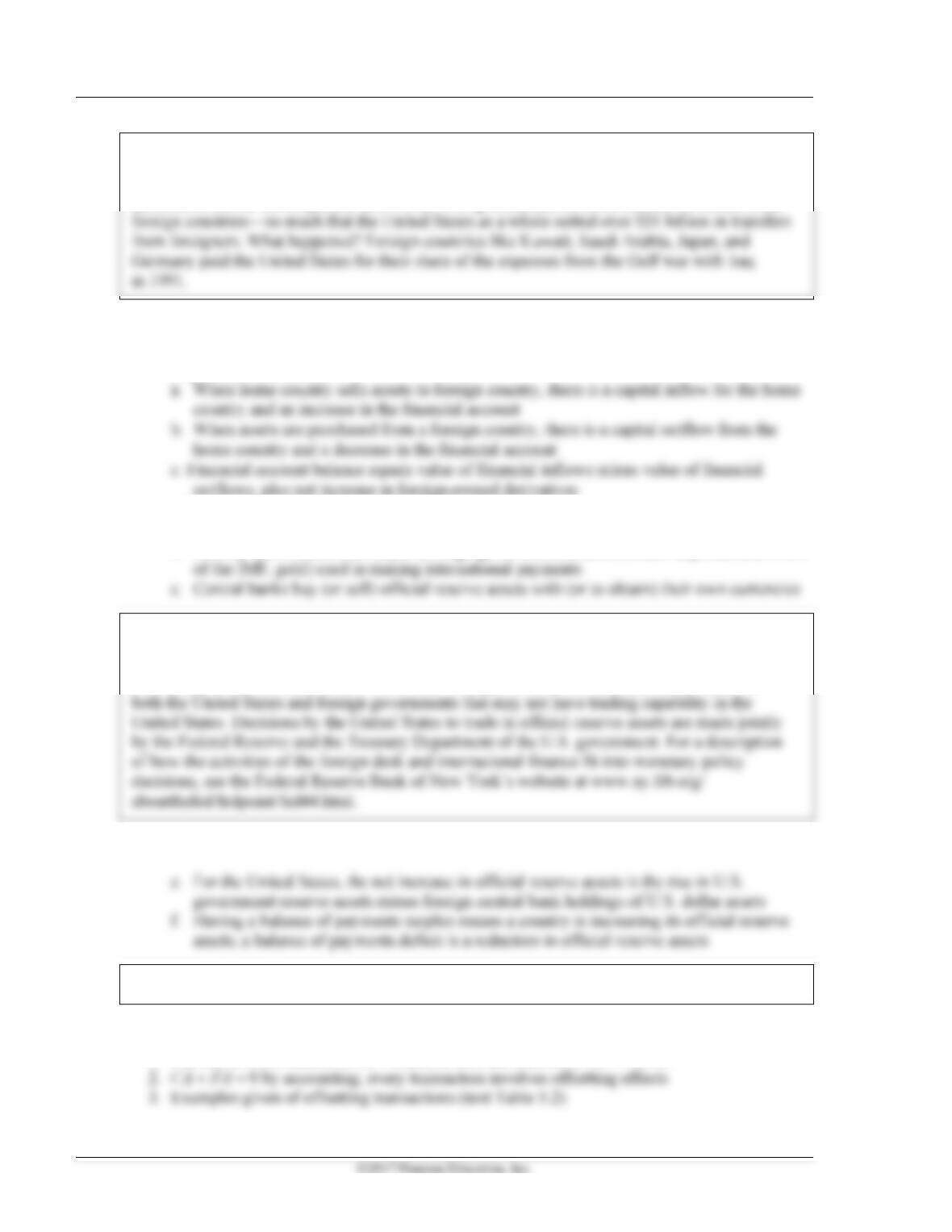
Students may be helped if you draw the basic balance of payments chart without numbers, but
with + and − signs, so they can see more clearly where the different entries go:
Negative (–) Positive (+)
Current Account
Net exports
Exports of goods __________
Exports of services __________
Financial Account
Increase in foreign-owned assets __________
102 Abel/Bernanke/Croushore • Macroeconomics, Ninth Edition
Data Application
Though the U.S. government generally is a net donor to other countries, providing significant
amounts of aid for development, in 1991 the U.S. government received billions of dollars from
C. The financial account
1. The financial account records trades in existing assets, either real (e.g., houses) or financial
(e.g., stocks and bonds)
3. The balance of payments
a. Transactions in official reserve assets are conducted by central banks of countries
b. Official reserve assets are assets (foreign government securities, bank deposits, and SDRs
Policy Application
In the United States, trades of official reserve assets are carried out through a trading desk in
the Federal Reserve Bank of New York. The “foreign desk,” as it is called, makes trades for
d. Balance of payments equals net increase in a country’s official reserve assets
Analytical Problem 1 gives students practice in making entries into a balance of payments table.
D. The relationship between the current account and the financial account
1. Current account balance (CA) + financial account balance (FA) = 0 (5.1)
Chapter 5 Saving and Investment in the Open Economy 103
Analytical Problem 2 gives students practice with offsetting transactions in the balance of
Data Application
Sometimes the statistical discrepancy can be quite large, as counting cross-border transactions is
E. Net foreign assets and the balance of payments accounts
1. Net foreign assets are a country’s foreign assets minus its foreign liabilities
a. Net foreign assets may change in value (e.g., change in stock prices)
b. Net foreign assets may change through acquisition of new assets or liabilities
2. The net increase in foreign assets equals a country’s current account surplus
Numerical Problem 6 looks at the balance of payments when there are internationally traded
assets.
F. Application: The United States as international debtor
1. The rise in foreign liabilities by the United States since the early 1980s has been very large
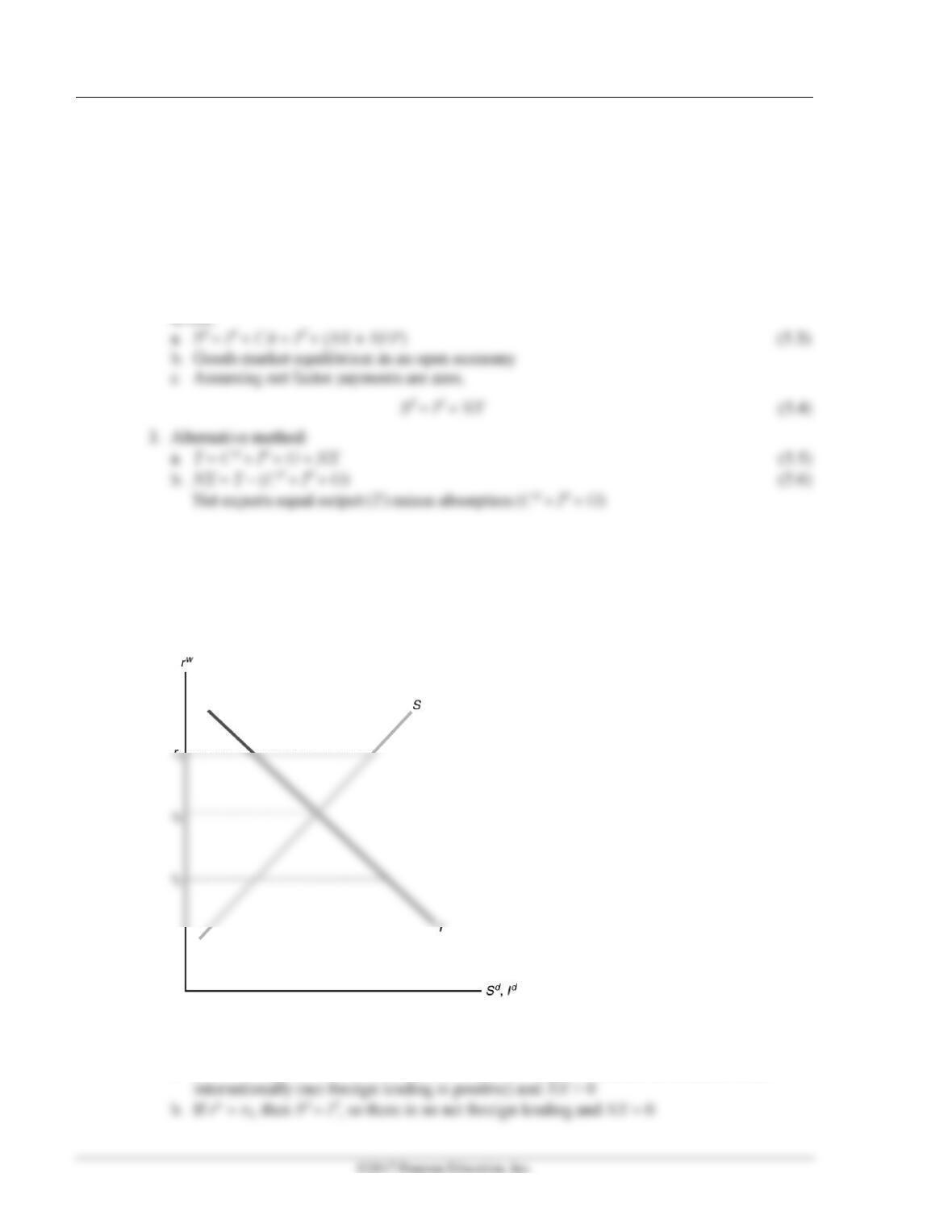
(text Figure 5.1)
104 Abel/Bernanke/Croushore • Macroeconomics, Ninth Edition
II. Goods Market Equilibrium in an Open Economy (Sec. 5.2)
A. From Ch. 2,
S = I + CA = I + (NX + NFP) (5.2)
1. So national saving has two uses:
a. Increase the capital stock by domestic investment
b. Increase the stock of net foreign assets by lending to foreigners
2. To get goods market equilibrium, national saving and investment must equal their desired
levels:
III. Saving and Investment in a Small Open Economy (Sec. 5.3)
A. Small open economy: an economy too small to affect the world real interest rate
1. World real interest rate (rw): the real interest rate in the international capital market
2. Key assumption: Residents of the small open economy can borrow or lend at the expected
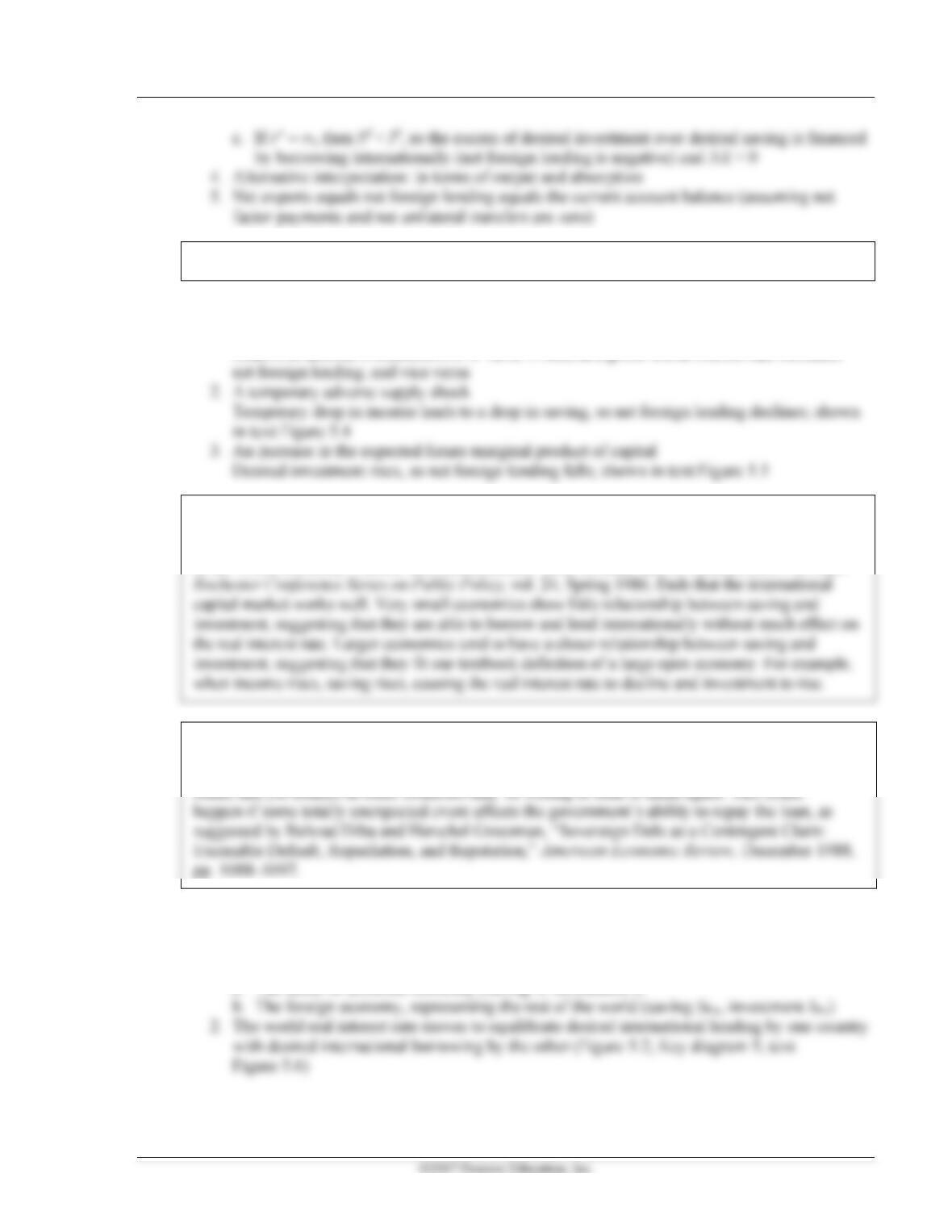
world real interest rate (Figure 5.1; Key diagram 4; like text Figures 5.2 and 5.3)
Figure 5.1
3. Result: rw may be such that Sd > Id, Sd = Id, or Sd < Id
a. If rw = r1, then Sd > Id, so the excess of desired saving over desired investment is lent
Chapter 5 Saving and Investment in the Open Economy 105
Numerical Problems 2 and 3 look at saving and investment in small open economies.
B. The effects of economic shocks in a small open economy
1. Anything that increases desired national saving (Y rises, future output falls, or G falls)
relative to desired investment (MPKf falls,
rises) at a given world interest rate increases
Data Application
Does the international capital market work well? Maurice Obstfeld, in his article, “Capital Mobility
in the World Economy: Theory and Measurement,” in K. Brunner and A. Meltzer, eds., Carnegie-
Policy Application
There may be circumstances in which it’s best for sovereign governments to default on their
IV. Saving and Investment in Large Open Economies (Sec. 5.4)
A. Large open economy: an economy large enough to affect the world real interest rate
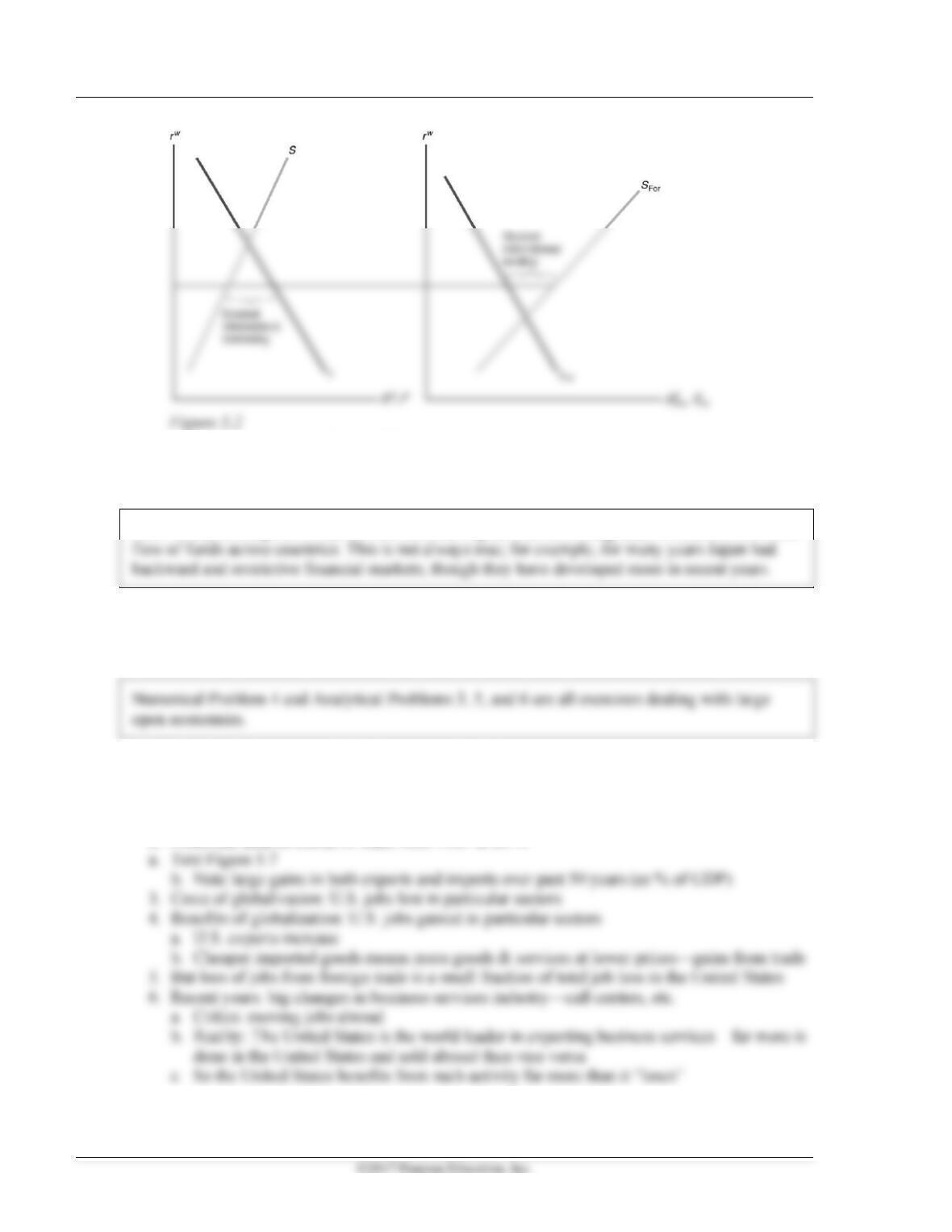
1. Suppose there are just two economies in the world
a. The home or domestic economy (saving S, investment I)
106 Abel/Bernanke/Croushore • Macroeconomics, Ninth Edition
3. Equivalent statement: The equilibrium world real interest rate is determined such that a
current account surplus in one country is equal in magnitude to the current account deficit
in the other
Note: A key assumption is that the international capital market is integrated, so that there is a free
4. Changes in the equilibrium world real interest rate: Any factor that increases desired
international lending of a country relative to desired international borrowing causes the
world real interest rate to fall
B. Application: The impact of globalization on the U.S. economy
1. World’s economies are increasingly interdependent—more international trade
and investment
a. Should the U.S. reign in globalization?
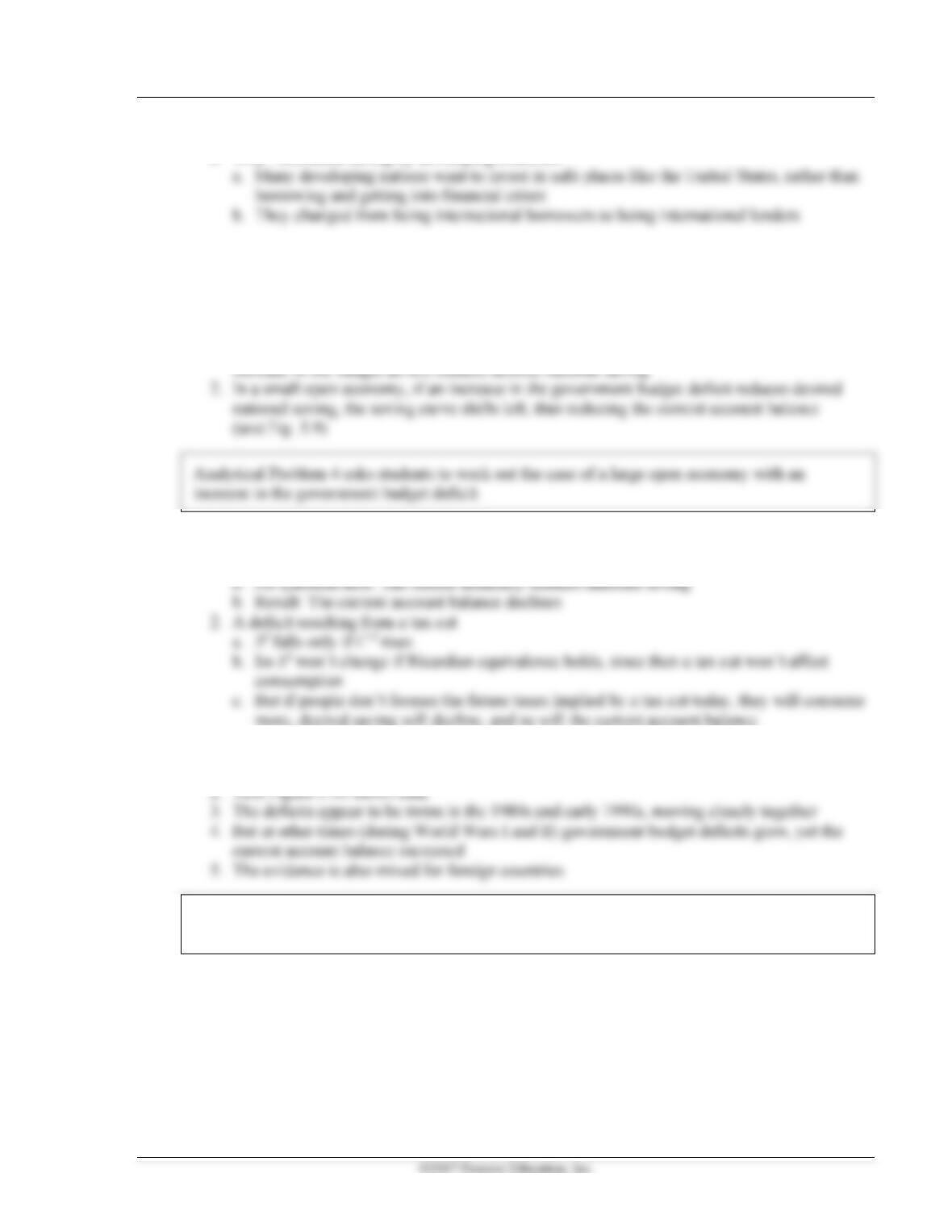
2. Historical data on trends in trade from 1929 to 2014
C. Application: Recent trends in the U.S. current account deficit
Chapter 5 Saving and Investment in the Open Economy 107
1. U.S. current account deficit is large (text Fig. 5.8)
2. Why? Increased saving by developing countries
V. Fiscal Policy and the Current Account (Sec. 5.5)
Are government budget deficits necessarily accompanied by current account deficits? That is, are
there “twin deficits”?
A. The critical factor: the response of national saving
1. An increase in the government budget deficit raises the current account deficit only if the
B. The government budget deficit and national saving
1. A deficit caused by increased government purchases
more, desired saving will decline, and so will the current account balance
C. Application: the twin deficits
1. Relationship between the U.S. government budget deficit and U.S. current account deficit
Analytical problem 4 looks at the relationship between government budget deficits and the
current account balance for a large open economy.
108 Abel/Bernanke/Croushore • Macroeconomics, Ninth Edition
◼ Additional Issues for Classroom Discussion
1. How Open Is Our Economy?
Many people don’t realize the extent of our interdependence with other countries. Though net exports are
small as a proportion of GDP, imports and exports aren’t insubstantial, as each is over 10% of GDP today,
compared with less than 5% in 1960.
You might also show them some data describing the size of imports and exports as a percent of GDP:
Year
Exports/GDP
Imports/GDP
1960
3.5%
4.0%
1965
3.5%
4.2%
1970
4.1%
5.5%
1975
5.0%
5.2%
1980
1985
5.2%
7.6%
1990
7.5%
1995
2000
2. Should We Run Balance of Payments Surpluses?
Because people seem worried that the United States has run continual balance of payments deficits, you
3. Should We Worry About Foreign Ownership of U.S. Assets?
In 1994, Mexico faced severe economic problems when foreign investors began pulling their money out of
Chapter 5 Saving and Investment in the Open Economy 109
4. Should Countries Cooperate?
As we’ve seen in this chapter, government policies in one country may have effects in others. Fiscal and
monetary policies affect interest rates both at home and abroad. Yet for the most part, countries decide on
110 Abel/Bernanke/Croushore • Macroeconomics, Ninth Edition
◼ Answers to Textbook Problems
Review Questions
1. Positive items in the current account are exports of goods and services and income receipts from
2. The current account includes only the trade of currently produced goods and services. Trades of
existing assets are counted in the financial account.
3. The sale of books from the United States to Brazil increases the U.S. current account balance.
Offsetting transactions include anything that is a negative item in the current account or the financial
4. In any period, the net amount of new foreign assets that a country acquires equals its current account
surplus, which in turn must equal its financial account deficit. A country with greater net foreign
5. In a small open economy, saving does not have to be equal to investment. Saving can be used to
finance domestic investment or it can be lent abroad. So saving equals investment plus net exports.
6. A small open economy is likely to run a large current account deficit and to borrow abroad if desired
investment increases substantially or if desired national saving declines substantially. Desired
investment could increase if there is an increase in the expected future marginal product of capital or
7. In a world with two large open economies, the world real interest rate is determined such that desired
8. An increase in desired national saving in a large open economy reduces the world real interest rate.