CHAPTER 5: SAVING AND INVESTMENT IN THE OPEN ECONOMY
LEARNING OBJECTIVES
I. Goals of Chapter 5
A. Develop the idea that a country’s spending need not equal its production in
every period, due to foreign trade
TEACHING NOTES
I. Balance of Payments Accounting (Sec. 5.1)
A. Balance of payments accounting
1. The record of a country’s international transactions
B. The current account
1. Net exports of goods and services
a. Merchandise trade: Exports minus imports = merchandise trade
2. Investment income from assets abroad
a. Investment income received from abroad is a credit item, since
3. Current transfers
a. Payments made from one country to another
b. Negative current transfers for Canada, since Canada is a net
payer of transfers to other countries
76 Chapter 5
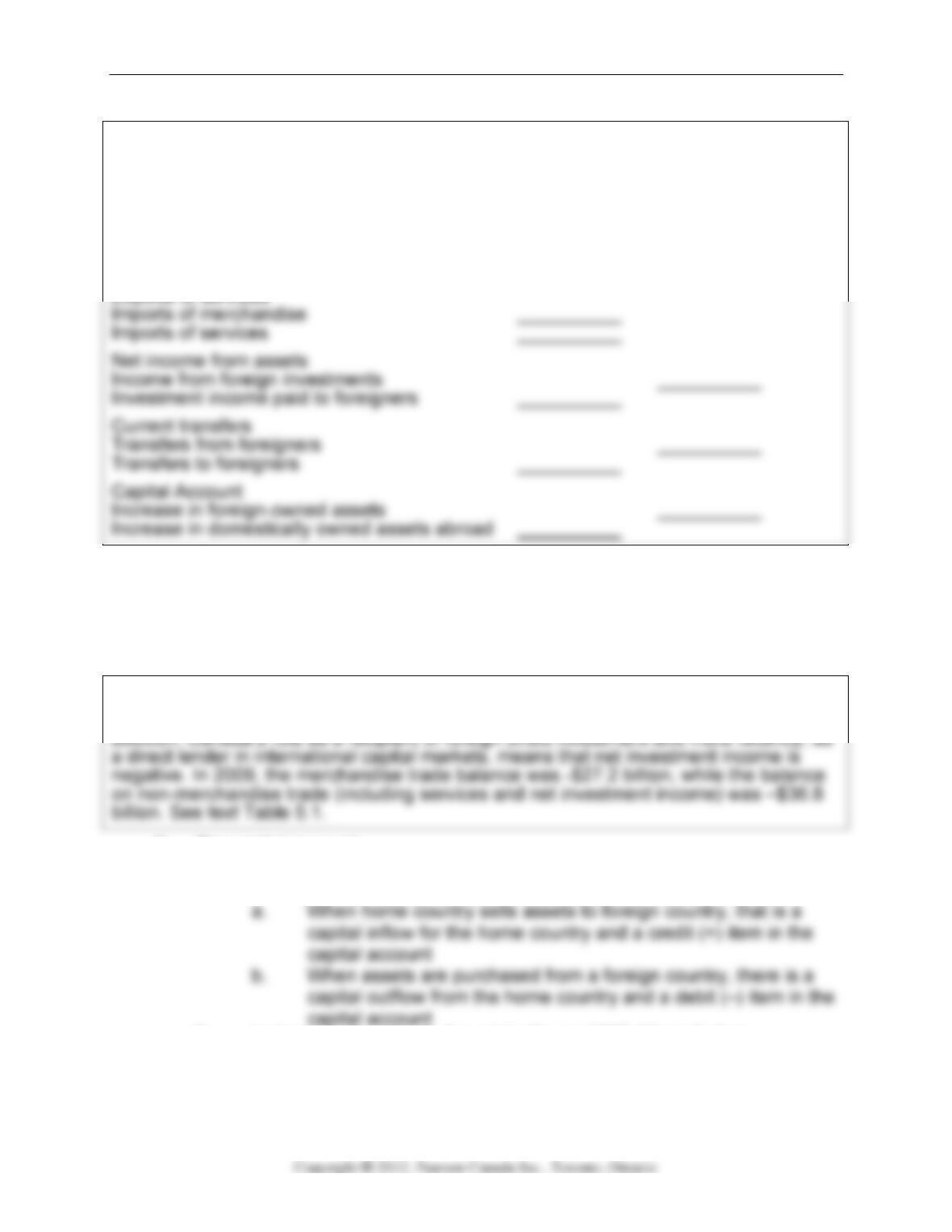
Students may be helped if you draw the basic balance of payments chart without
numbers, but with + and – signs, so they can see more clearly where the different
entries go:
Debit (–) Credit (+)
Current Account
Net exports
Exports of merchandise __________
4. Sum of net exports of goods and services, net investment income from
assets abroad, and current transfers is the current account balance
a. Positive current account balance implies current account
surplus
b. Negative current account balance implies current account deficit
Data Application
Canada runs a deficit on the merchandise trade balance and has a deficit in services. In
C. The capital account
1. The capital account records trades in existing assets, either real (for
example, houses) or financial (for example, stocks and bonds)
2. Instructors should note the relabelling in 1997. Most of what
economists call the capital account is in the capital and financial
account.
Saving and Investment in the Open Economy 77
The terminology used here is a bit confusing, because we talk about a capital account,
3. The official settlements balance
a. Transactions in official reserve assets are conducted by central
banks of countries
b. Official reserve assets are assets (foreign government
deficit is a reduction in official reserve assets
Analytical Problem 1 gives students practice in making entries into a balance of
payments table.
D. The relationship between the current account and the capital account
1. Current account balance (CA) + capital account balance (KA) – 0 (5.1)
Analytical Problem 2 gives students practice with offsetting transactions in the balance
of payments accounts, while Numerical Problem 1 has them calculating various
important balances.
Data Application
Sometimes the statistical discrepancy can be quite large, as counting cross-border
transactions is quite difficult. For example, in 2009 the current account balance was –
$43.4 billion, and the statistical discrepancy was -$0.4 billion.
78 Chapter 5
E. Net foreign assets and the balance of payments accounts
1. Net foreign assets are a country’s foreign assets minus its foreign
liabilities
a. Net foreign assets may change in value (example: change in
stock prices)
Numerical Problem 5 looks at the national saving and world interest rate.
F. A Closer Look 5.2: Does Mars have a current account surplus?
1. Adding together all countries’ current account balances gives a current
account deficit for the world
II. Goods Market Equilibrium in an Open Economy (Sec. 5.2)
A. From Ch. 2, S = I + CA = I + (NX + NFP) (5.2)
1. So national saving has two uses:
a. Increase the capital stock by domestic investment
III. Saving and Investment in a Small Open Economy (Sec. 5.3)
A. Small open economy: an economy too small to affect the world real interest
rate
Saving and Investment in the Open Economy 79
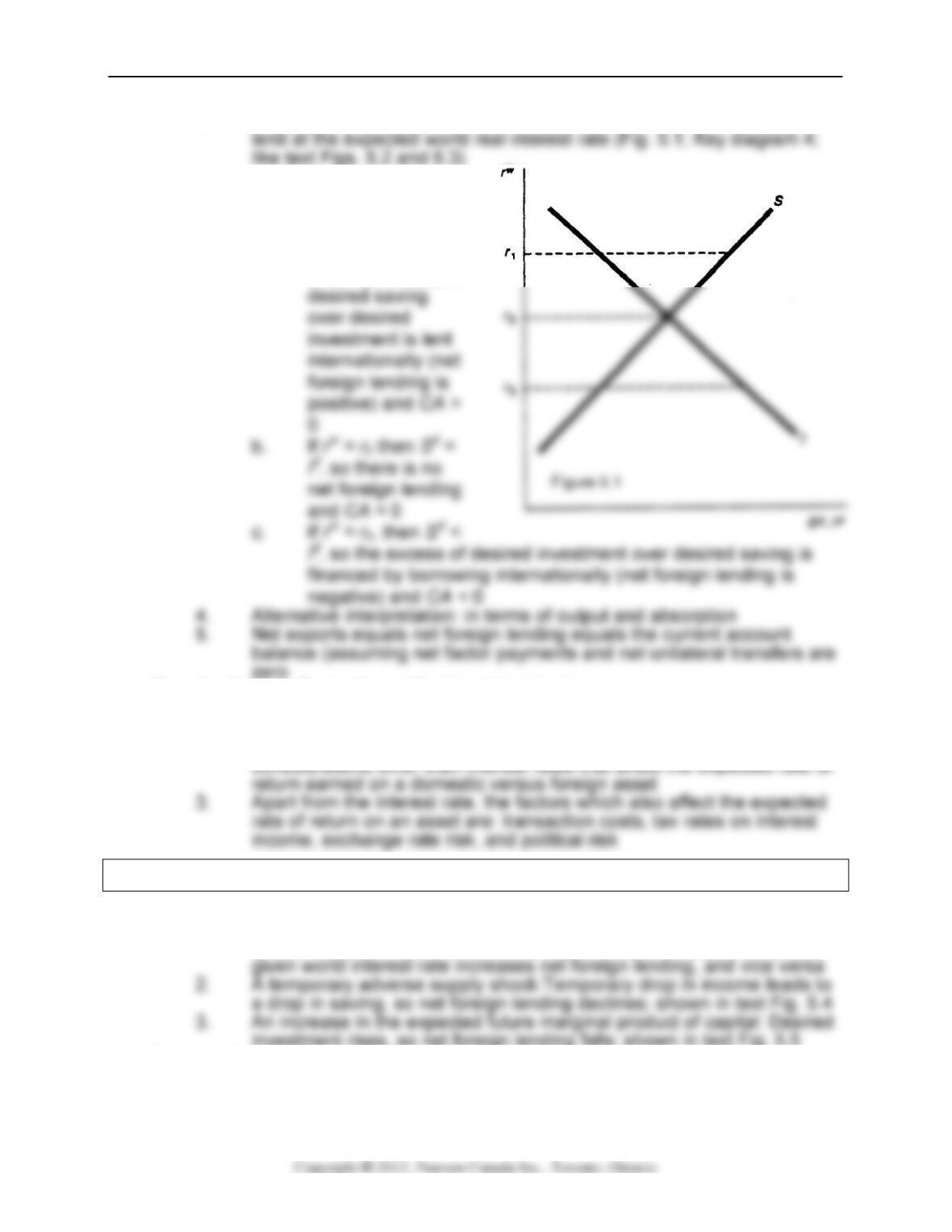
2. Key assumption: Residents of the small open economy can borrow or
3. Result: rw may be such
that Sd > Id, Sd = Id, or Sd
< Id
a. If rw = r1, then Sd >
Id, so the excess of
B. Application: Domestic and foreign interest rates
1. Text fig. 5.1 show that the interest rate paid on an asset in Canada
differs from the interest rate paid on a comparable asset in the US
2. Interest rates will tend to differ on comparable assets if there are
Numerical Problems 2 and 3 look at saving and investment in small open economies.
C. The effects of economic shocks in a small open economy
1. Anything that increases desired national saving (Y rises, future output
falls, or G falls) relative to desired investment (MPKf falls, t rises) at a
investment rises, so net foreign lending falls; shown in text Fig. 5.5
D. Application: The LDC debt crisis
1. Less developed countries wanted funds for investment in the 1970s
a. Saving was low because income was low
80 Chapter 5
E. Application: Globalization and the Canadian Economy
1. Globalization has increased quite significantly over the past 20 years
2. The rapid expansion of exports and imports since 1991 reflects the
impact of Canada signing free trade agreements.
3. The increase in FDI associated with the increased integration of world
Data Application
Why is the international capital market growing so rapidly? Maurice Obstfeld in his
article “The Global Capital Market: Benefactor or Menace?”, Journal of Economic
Perspectives, Fall 1998, pp. 9-30, outlines the historical development of the global
financial market. To help explain the rapid growth, he describes both the benefits (which
include stimulating economic growth by increasing the ability of poorer countries to
borrow capital and increasing the efficiency in investment allocation) and the costs
(including financial mismanagement and other distortions arising from imperfect
information). Do the benefits outweigh the costs?
IV. Saving and Investment in Large Open Economies (Sec. 5.4)
A. Large open economy: an economy large enough to affect the world real
interest rate
1. Suppose there are just two economies in the world
a. The home or domestic economy (saving S, investment /)
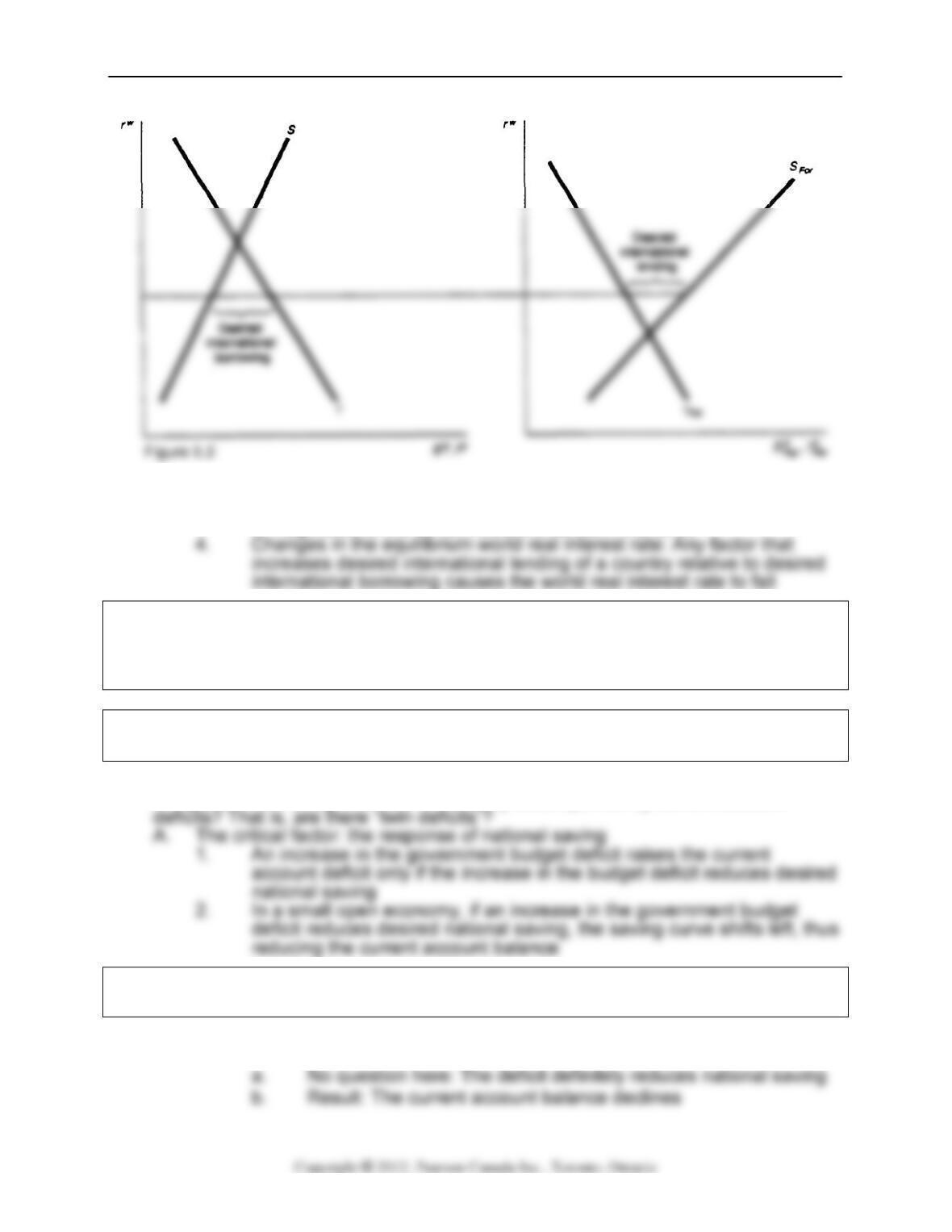
Saving and Investment in the Open Economy 81
3. Equivalent statement: The equilibrium world real interest rate is
determined such that a current account surplus in one country is equal
in magnitude to the current account deficit in the other
Note: A key assumption is that the international capital market is integrated, so that
there is a free flow of funds across countries. This is not always true; for example, for
many years Japan had backward and restrictive financial markets, though they have
developed more in recent years.
Numerical Problem 4 and Analytical Problems 3, and 5 are all exercises dealing with
large open economies.
V. Fiscal Policy and the Current Account (Sec. 5.5)
Are government budget deficits necessarily accompanied by current account
Analytical Problem 4 asks students to work out the case of a large open economy with
an increase in the government budget deficit.
B. The government budget deficit and national saving
1. A deficit causes by increased government purchases
82 Chapter 5
2. A deficit resulting from a tax cut
a. Sd falls only if Cd rises
C. Application: The twin deficits
1. Relationship between the Canadian government budget deficit and
Canadian current account deficit
2. Text Fig. 5.12 shows data from 1961 to 2009
Saving and Investment in the Open Economy 83
ADDITIONAL ISSUES FOR CLASSROOM DISCUSSION
1. The Importance of Trade for the Canadian Economy
As a small economy located beside the world’s largest economy, Canada is highly
dependent on international trade. Exports and imports are about 61% of GDP for
Canada (73% of our exports go to the United States). Moreover, with increased
communications, transportation, and the impact of ‘globalization’, trade is likely to play
International trade allows us to consume a much broader selection of goods and
services. In the winter, grapes from Chile and strawberries from Mexico enhance our
diets. Fresh flowers and pop-up books from Colombia add enjoyment to our lives. We
may drive Japanese or German cars and take our vacations in Australia or Kenya as
well as in Canada.
International trade can be a major cause of growth. In Europe the lowering of trade
barriers through what is now the European Union has led to rapid economic growth and
2. Should Nations Always Avoid Current Account Deficits?
There is a strong feeling that nations shouldn’t run deficits in their current accounts. Like
individuals, nations are expected to save and thus increase reserves to cope with future
difficulties. Is this generally a good idea? Can current account deficits benefit a nation?
84 Chapter 5
consumption. If such investment is productive, it will raise output by more than
necessary to provide a fair return to its owners and therefore all benefit. The country
receiving the investment increases its productive capacity, which will probably add to
employment, and those who invest gain a continuing stream of earnings over a long
period of time.
ANSWERS TO TEXTBOOK PROBLEMS
Review Questions
1. Credit items in the current account are exports of merchandise and services and
income receipts from abroad. Debit items in the current account are imports of
2. The current account includes only the trade of currently produced goods and
services. Trades of existing assets are counted in the capital account.
3. The sale of books from Canada to Brazil is a credit item in the Canadian current
account. Offsetting transactions include anything that is a debit item in either the
4. In any period the net amount of new foreign assets that a country acquires equals
its current account surplus, which in turn must equal its capital account deficit. A
5. In a small open economy, saving does not have to be equal to investment. Saving
can be used to finance domestic investment or it can be lent abroad. So saving
Saving and Investment in the Open Economy 85
6. A small open economy is likely to run a large current account deficit and to borrow
abroad for two main reasons. First, there may be an increase in the expected
future marginal product of capital. This shifts the investment curve, reducing the
7. In a world with two large open economies, the world real interest rate is determined
such that desired international lending by one country equals desired international
borrowing by the other country. When the world real interest rate is at its
equilibrium value, the current accounts of the two countries sum to zero.
8. An increase in desired national saving in a large open economy reduces the world
real interest rate. The shift to the right in the saving curve increases the country’s
account at the current world real interest rate, so the international asset market is
out of equilibrium. To restore equilibrium, the world real interest rate must fall.
9. An increase in the government budget deficit raises the current account deficit of a
small open economy if and only if the increase in the budget deficit reduces
10. The twin deficits are the government budget deficit and the current account deficit.
They are connected because if an increase in the government budget deficit
NUMERICAL PROBLEMS
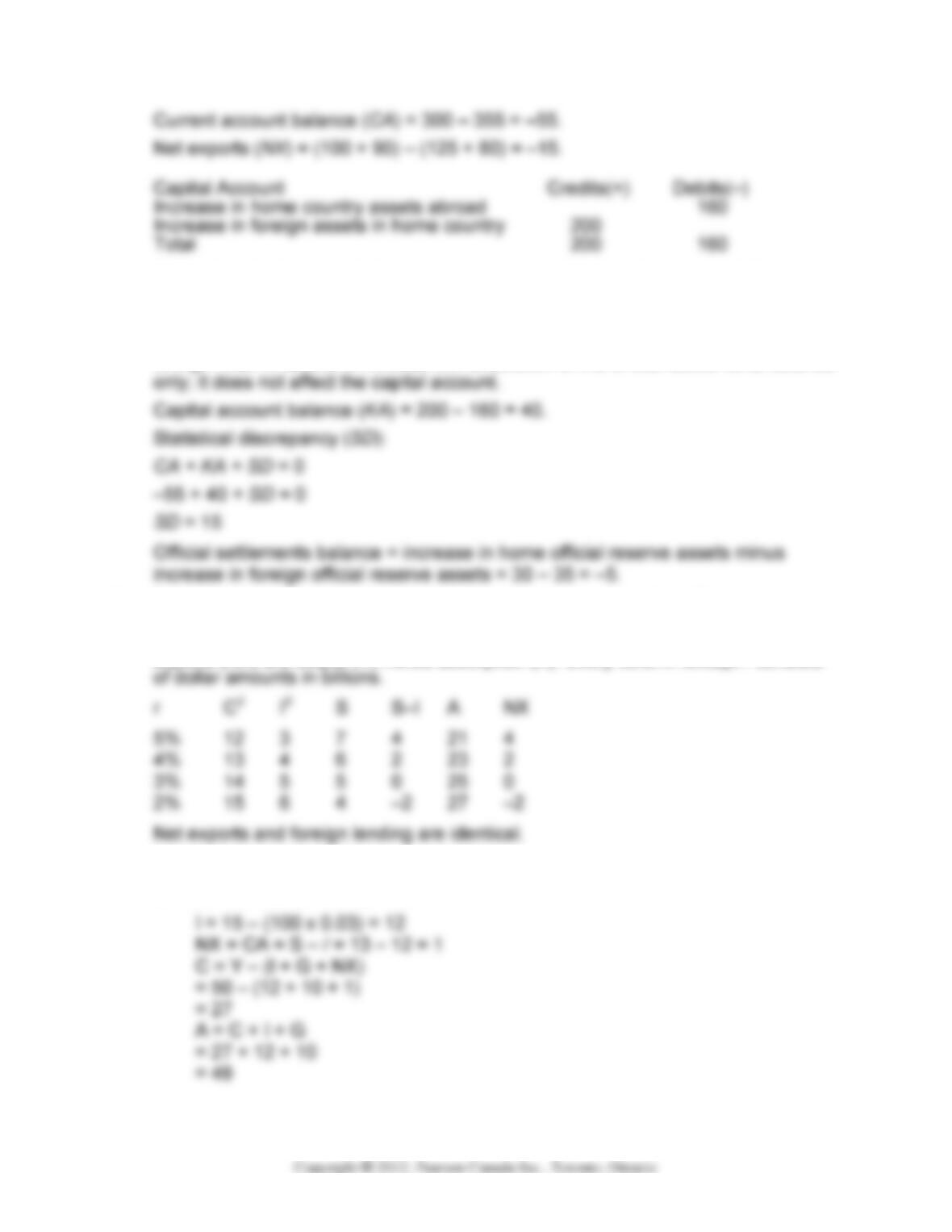
1. The merchandise trade balance equals merchandise exports minus merchandise
imports, which equals 100 – 125 = –25.
Current Account Credits(+) Debits (–)
Merchandise 100 125
86 Chapter 5
Notice that the increase in home reserve assets is just a subcategory of the
increase in home country assets, so it is not included separately. Similarly, the
increase in foreign reserve assets is just a subcategory of the increase in foreign
assets in the home country. The information about the changes in home and
foreign reserve assets is included Jot calculation of the official settlements balance
2. The following table calculates key variables for this question for different values of
the real interest rate. The column for S is calculated by the equation S = Y – (Cd +
G). The column headed S – / is foreign lending. Absorption (A) is Cd + ld + G. Net
exports (NX) are output (Y) minus absorption (A). Every column except r consists
3. All variables but interest rates are in billions of dollars.
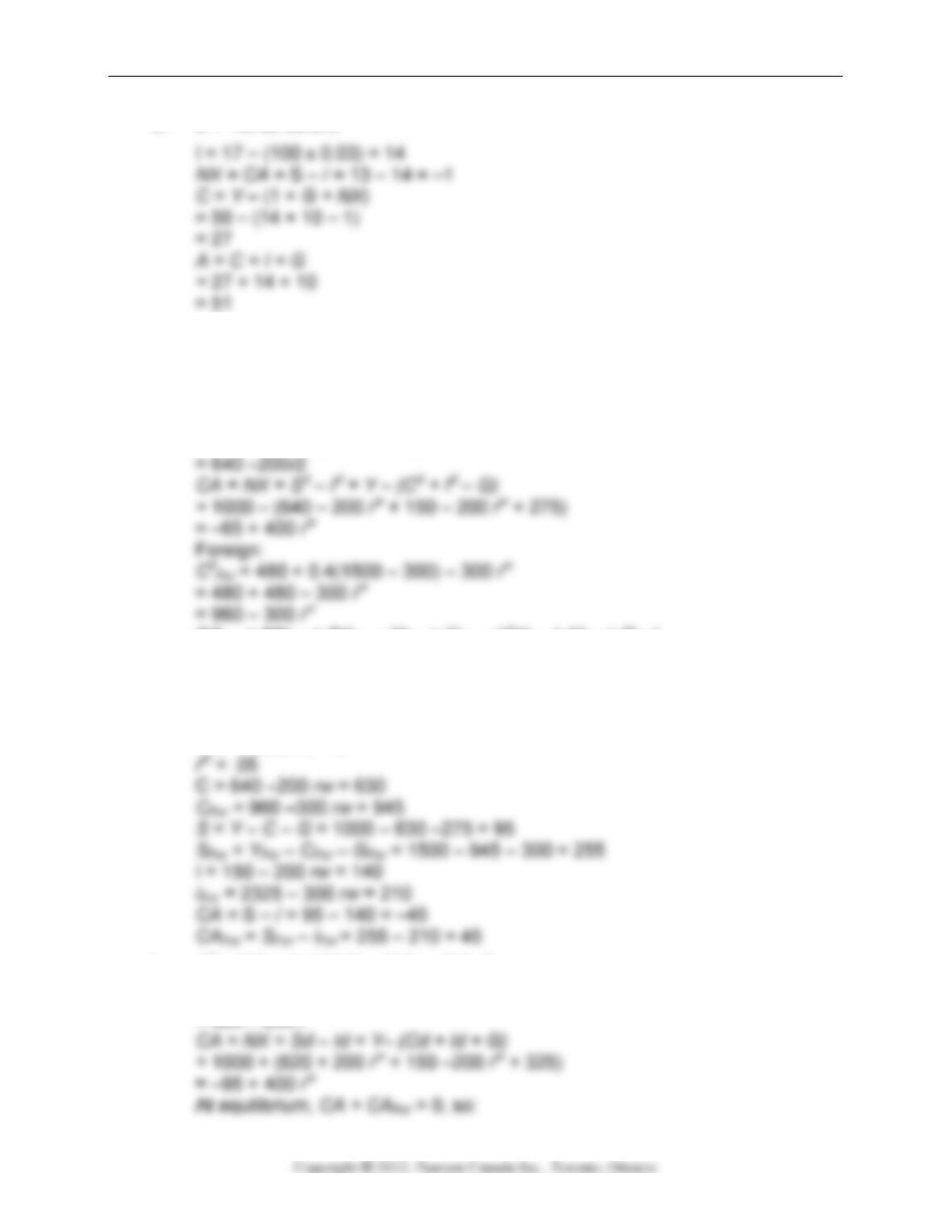
a. S = 10 + (100 × 0.03) = 13
Saving and Investment in the Open Economy 87
b. S = 13, as before.
4. a. To find the equilibrium interest rate (rw), we must first calculate the current
account for each country as a function of rw. Then we can find the value of rw
that clears the goods market, that is, where CA + CAFor = 0.
Home:
Cd = 320 + 0.4(1000 – 200) – 200 rw = 320 + 320 – 200 r2
CAFor = NXFor = SdFor – IdFor = YFor – (CdFor + IdFor + GFor)
= 1500 – (960 – 300 rw + 225 – 300 rw + 300)
= 15 + 600 rw
At equilibrium, CA + CAFor = 0, so:
–65 + 400 rw + 15 + 600 rw = 0
–50 + 1000 rw = 0
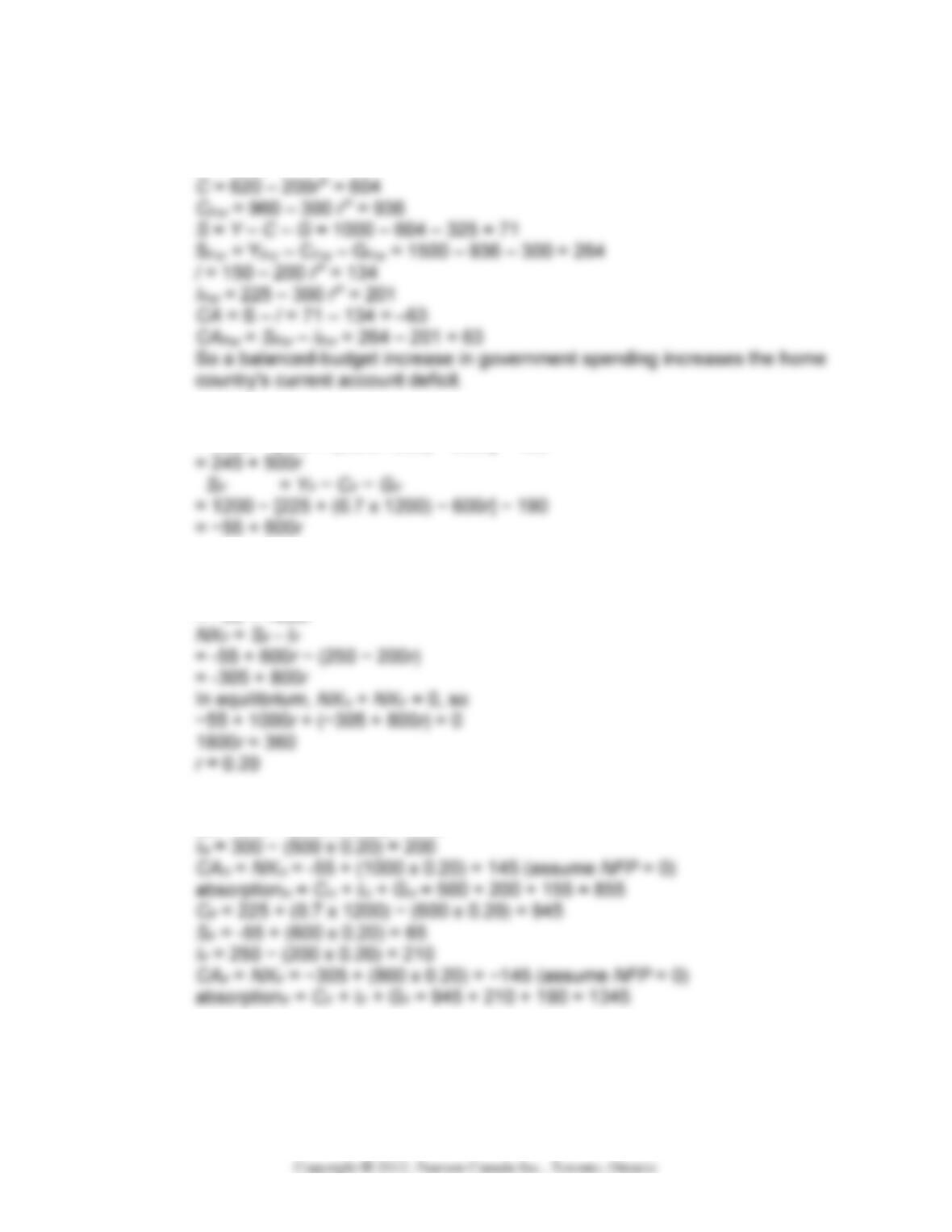
b. Cd = 320 + 0.4(1000 – 250) – 200 rw
= 320 + 300 – 200 rw
88 Chapter 5
–95 + 400¢ + 15 + 600 rw = 0
–80 + 1000 rw = 0
rw = 0.08
5. a. SH = YH – CH – GH
= 1000 − [100 + (0.5 x 1000) − 500r] − 155
b. NXH = SH – IH
= 245 + 500r − (300 − 500r)
= −55 + 1000r
c. CH = 100 + (0.5 x 1000) − (500 x 0.20) = 500
SH = 245 + (500 x 0.20) = 345
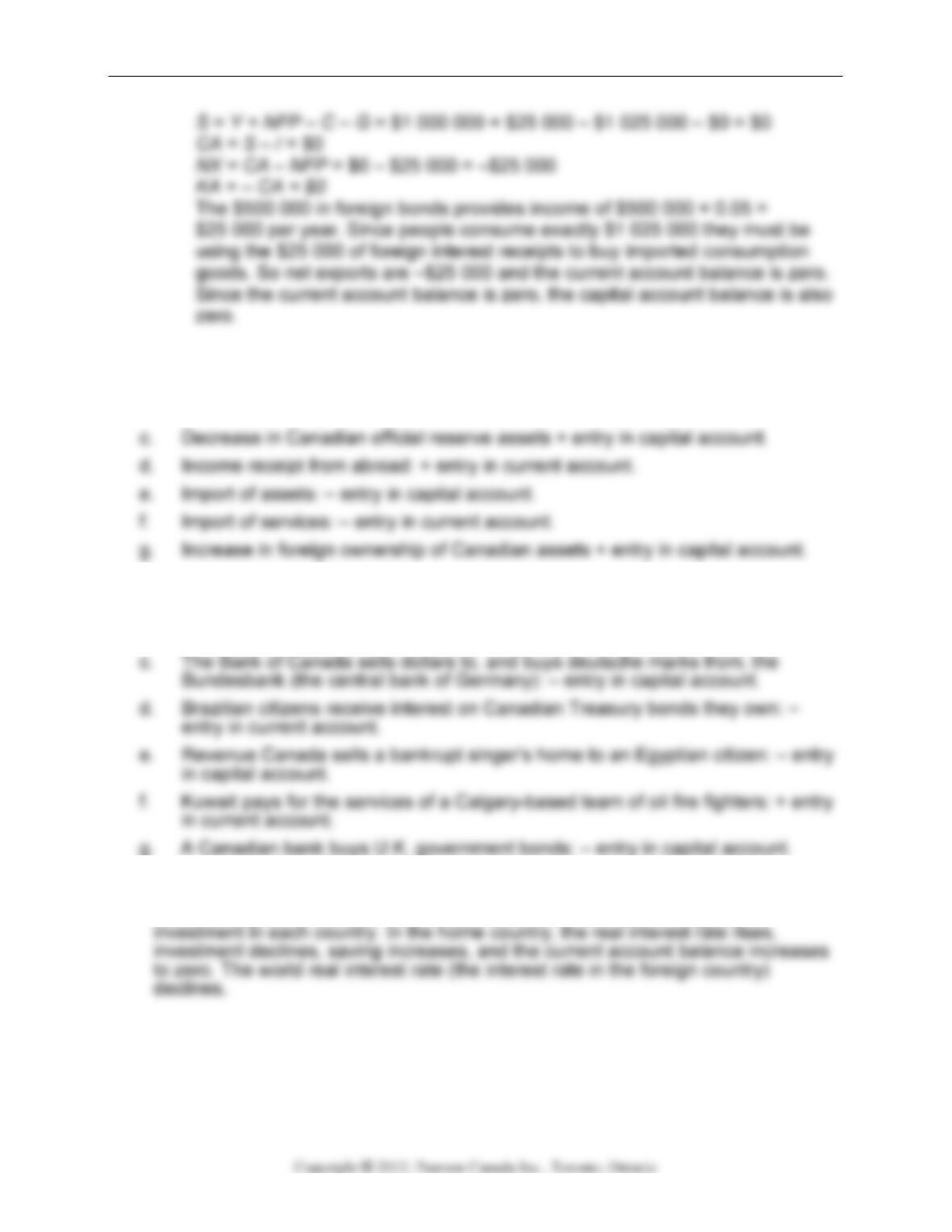
6. GDP = Y = $1 000 000 = total production of coconuts
GDP = $1 025 000 = production of coconuts + net factor income from abroad
NFP = $25 000
/ = $0
Saving and Investment in the Open Economy 89
Analytical Problems
1. a. Export of merchandise: + entry in current account.
b. No entry: just changes the type of foreigner holding Canadian assets.
2. There are many possible answers; an example for each is given here.
a. Canadian citizens buy cars from the foreign country: – entry in current account.
b. No transaction needed.
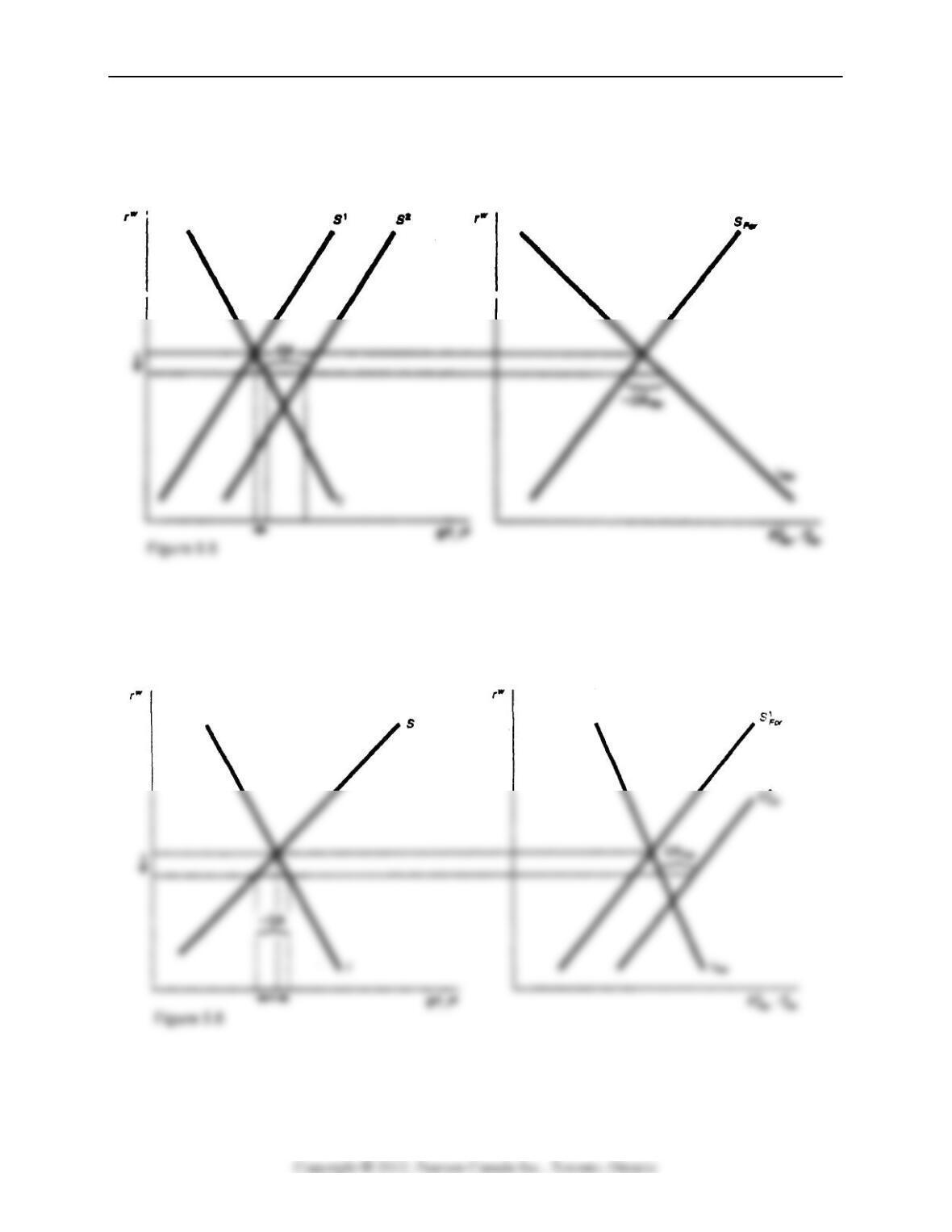
3. In Fig. 5.3 before the capital controls are imposed the home country has a current
account deficit of the amount CA, while the foreign country has a matching current
account surplus. The effect of the capital controls is to make saving equal
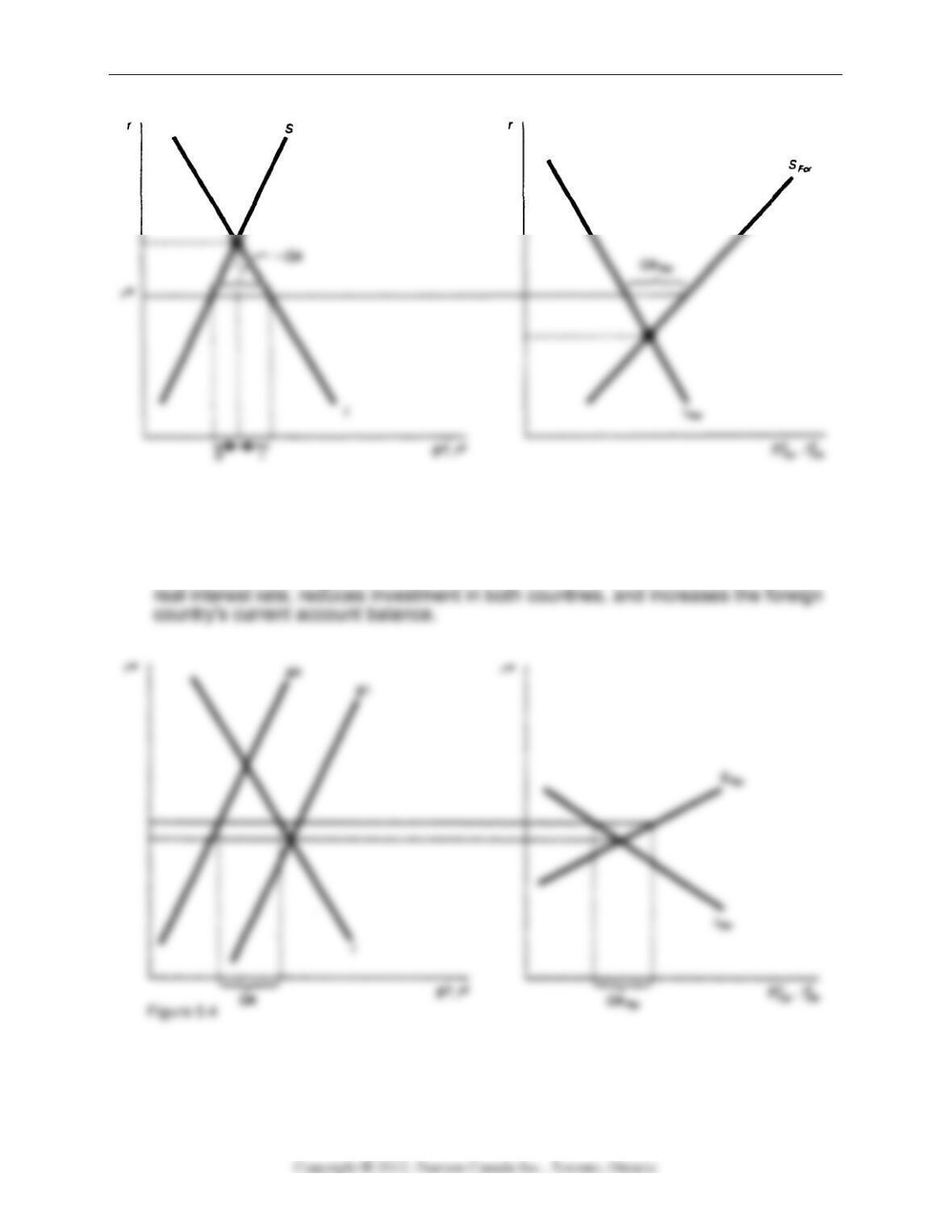
Figure 5.4
90 Chapter 5
4. In Fig. 5.4 suppose initially both countries have a zero current account. A rise in
the government budget deficit has no effect on desired investment, so it affects the
current account only if it affects desired national saving. If desired national saving
is affected, the saving curve shifts to the left from S1 to S2. This raises the world
Figure 5.3
Saving and Investment in the Open Economy 91
5. a. The home country’s saving curve shifts to the right, from S1 to S2 in Fig. 5.5 The
real world interest rate falls, so that the current account surplus in the home
country equals the current account deficit in the foreign country. From Fig. 5.5,
S rises, / rises, CA rises, rw falls.
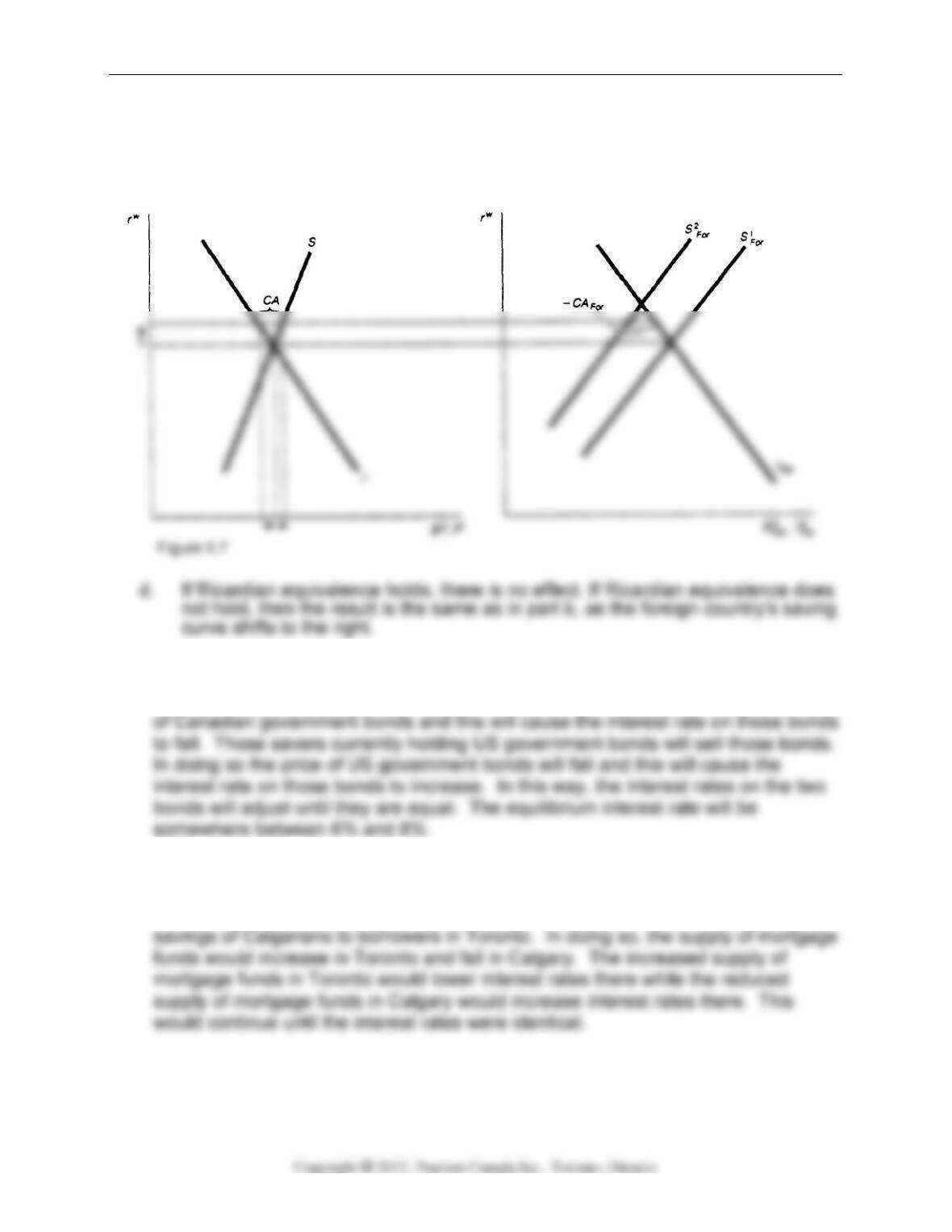
b. The foreign country’s saving curve shifts to the right, from S1For to S2For in Fig.
5.6. The real world interest rate must fall, so the current account surplus in the
foreign country equals the current account deficit in the home country. As
shown in the figure, S falls, / rises, CA falls, rw falls.
92 Chapter 5
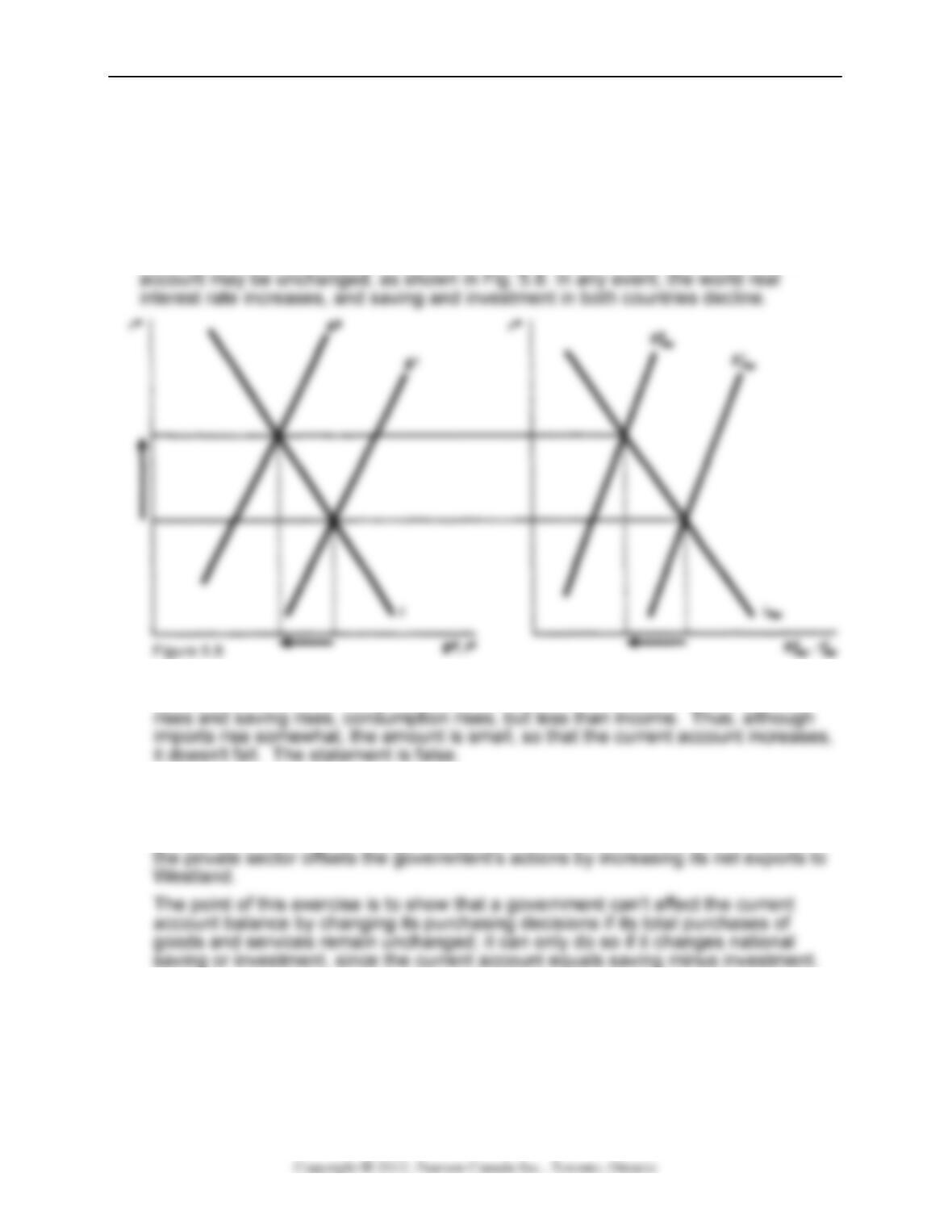
c. The foreign country’s saving curve shifts to the left, from S1For to S2For in Fig.
5.7. The real world interest rate must rise, so the current account deficit in the
foreign country equals the current account surplus in the home country. As
shown in the figure, S rises, / falls, CA rises, rw rises.
6. Since the bonds are identical, we would expect that the interest rates would adjust
until they were equal. Savers would choose to purchase the Canadian bonds
because they pay the higher rate of return. By doing so, they will bid up the price
7. To see that this must be the case, suppose for a moment that it were not true.
Suppose that the Royal Bank (for example) could lend mortgage money at 10% in
Toronto but only 6% in Calgary. In this case, the Royal Bank would lend the
Saving and Investment in the Open Economy 93
8. A temporary adverse supply shock hitting the foreign economy causes the foreign
saving curve to shift up, from S1For to S2For in Fig. 5.7. This raises the equilibrium
world real interest rate, increasing home country saving and decreasing home
country investment. Since saving rises and investment falls, the home country’s
current account balance increases.
If the shock is worldwide, then the effect on the current account depends on how big
the shift to saving is in the home country relative to the foreign country, as well as on
the slope of the investment curve. If the saving curves shift just right, the current
9. The shock shifts the saving curve to the right, with no change in the investment
curve, since the future marginal product of capital is unaffected. Since income
10. Note that when the government of Eastland makes this change, it isn’t changing
total government purchases, so there is no effect on national saving. Thus the
current account balance is unaffected. How can that be, given that Eastland’s
government is now purchasing more goods from Westland? The answer is that