CHAPTER 4: CONSUMPTION, SAVING, AND INVESTMENT
LEARNING OBJECTIVES
I. Goals of Chapter 4
A. Examine the factors that underlie economywide demand for goods and
services
B. Assumes closed economy (for now, dropped in Chapter 5)
C. Focuses on consumption and investment
TEACHING NOTES
I. Consumption and Saving (Sec. 4.1)
People think about the present vs. the future in choosing saving and consumption
1. Increase in current income: both consumption and saving increase
A. The consumption and saving decision of an individual.
1. The rate a person trades off current and future consumption depends
on the real interest rate prevailing in the economy.
Consumption, Saving, and Investment 53
Theoretical Application
The classic discussions of consumption are the permanent-income hypothesis of Milton
Friedman (A Theory of the Consumption Function, Princeton: Princeton University
3. Keynesian consumption function: Cd = c0 +cyY (4.2)
a. Desired consumption depends on current aggregate output
Data Application
Recall from Chapter 2 that measured consumption in the national income accounts
includes spending on durable consumption goods, like autos and major appliances. But
consumption theory, including the Keynesian consumption function, requires that
consumption be defined to include only the services from durable consumer goods. So
empirical researchers must adjust the national income data to arrive at a measure of
consumption that matches the theory. For example, they might assume that durable
goods provide services proportional to the stock of durables.
C. Effects of changes in expected future income.
1. Higher expected future income leads to more consumption today, so
after the recent recession of 2008-2009.
D. Effects of changes in wealth
1. Increase in wealth raises current consumption, so lowers current
saving
2. Application: The 1987 stock market crash and consumer spending.
When the stock market crashed in 1987, wealth declined by about
$100 billion. Consumption fell somewhat less than might be expected,
and it wasn’t enough to cause a recession. There was a temporary
54 Chapter 4
E. Effect of changes in the real interest rate
1. Increased expected real interest rate has two opposing effects
a. The income effect of the real interest rate reflects a positive
effect on saving, since rate of return is higher; greater reward for
2. Taxes and the real return to saving
a. Expected after-tax real interest rate: r!-t = (1- t)i –
π
e
Data Application
Eytan Sheshinski, in “Treatment of Capital income in Recent Tax Reforms and the Cost
of Capital in Industrialized Countries,” in Larry Summers, ed., Tax Policy and the
Economy 4, Cambridge, Mass.: MIT Press, 1990, pp. 25-42, finds that real after-tax
3. A Closer Look 4.1: interest rates
Discusses different interest rates, default risk, term structure, tax status
Numerical Problem 1 explores how changes in income, future income, wealth, and
interest rates affect consumption.
F. Fiscal policy
1. Affects desired consumption through changes in current and expected
future income
2. Directly affects desired national saving, Sd = Y – Cd – G
3. Government purchases (temporary increase)
a. Higher G financed by current taxes reduces after-tax income,
Consumption, Saving, and Investment 55
4. Taxes
a. Lump-sum tax cut today, financed by higher future taxes
Data Application
This theory is confirmed by empirical data. Shaghil Ahmed, in “Temporary and
Permanent Government Spending in an Open Economy: Some Evidence for the United
Kingdom,” Journal of Monetary Economics, March 1986, pp. 197-224, finds, using a
long time series of British data, that temporary government purchases indeed crowd out
consumption spending, even though the expenditures are useful in increasing the
marginal productivity of private capital and providing a substitute for consumption
goods.
(1) If future income loss exactly offset current income gain, no
change in consumption
Theoretical Application
There are a number of reasons why Ricardian equivalence may not hold. The text notes
that if people don’t see that future taxes are equal (in present value) to a current tax cut,
then Ricardian equivalence may not hold. An additional reason for the failure of
Ricardian equivalence, liquidity constraints, is covered in Chapter 8. It may also be
possible for people to avoid future taxes, even if they foresee them, by moving or dying;
II. Investment (Sec. 4.2)
A. Why is investment important?
1. Investment fluctuates sharply over the business cycle, so we need to
56 Chapter 4
1. Desired capital stock is the amount of capital that allows firms to earn
the largest expected profit
2. Desired capital stock
4. The user cost of capital
a. Example of Tony’s
Bakery: cost of
capital, depreciation
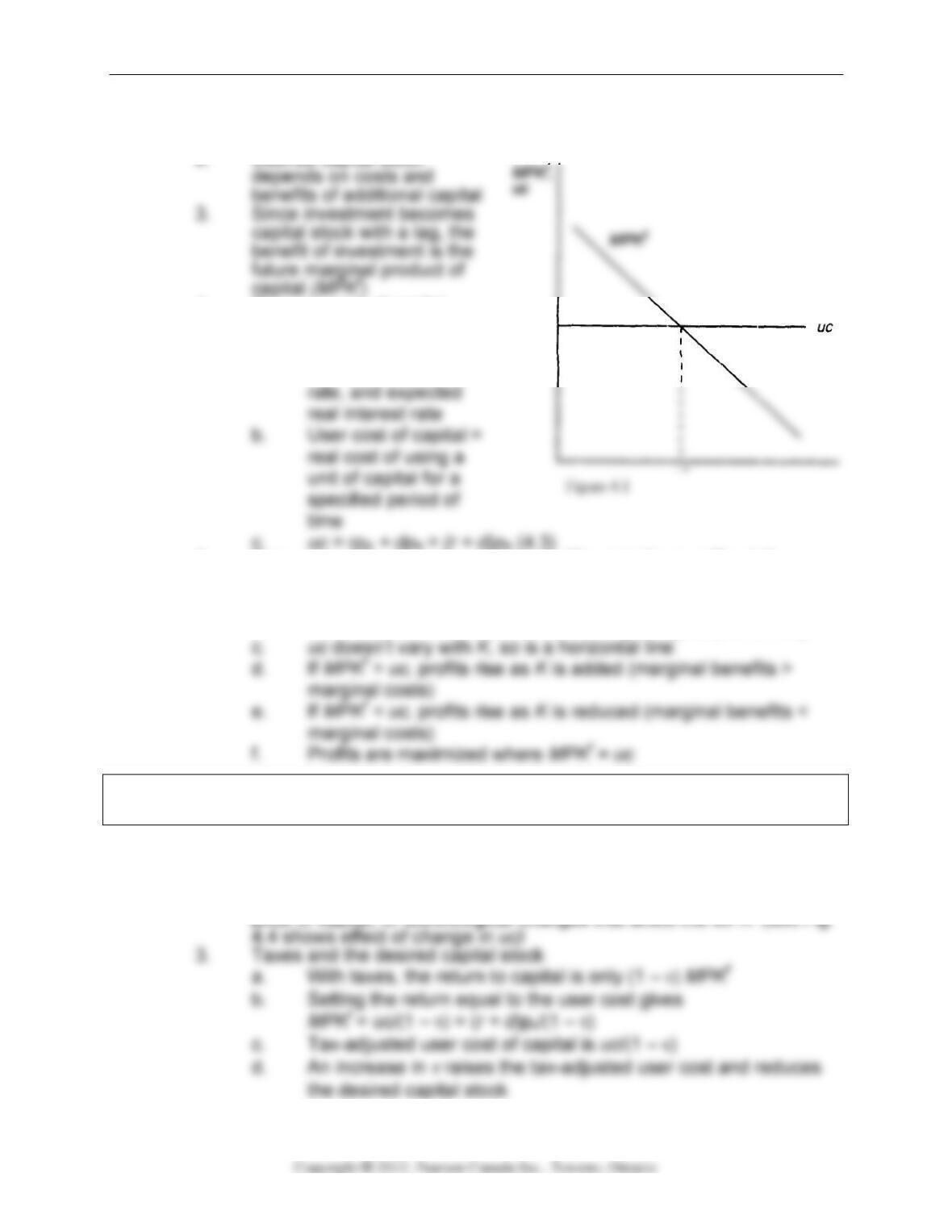
5. Determining the desired capital stock (Fig. 4.1; like text Fig. 4.3)
a. Desired capital stock is the level of capital stock at which MPKf
= uc
b. MPKf falls as K rises due to diminishing marginal productivity
See A Closer Look 4.2, “Investment and the Stock Market,” for an alternative method of
determining the desired stock of capital.
C. Changes in the desired capital stock
1. Factors that shift the MPKf curve or change the user cost of capital
cause the desired capital stock to change
2. These factors are changed in the real interest rate, depreciation rate,
Consumption, Saving, and Investment 57
Theoretical Application
The first general use of the user cost of capital concept was by Dale Jorgenson. “Capital
Theory and Investment Behavior,” American Economic Review Papers and
Proceedings, May 1963, pp. 247–259.
Numerical Problems 2 and 4 give students practice in working with the marginal product
of capital and the user cost of capital.
e. In reality, there are complications to the tax-adjusted user cost
(1) We assumed that firm revenues were taxed
(a) In reality, profits, not revenues, are taxed
Data Application
Another simplification that is used in this chapter is the assumption that taxes are based
on a firm’s real revenue. In reality, taxes on nominal revenue combine with inflation to
(5) Table 4.3 shows effective tax rates on capital across
sectors and over time in Canada,
D. Application: Measuring the effects of taxes on investment
1. Two problems in measuring tax effects: controlling for other influences
Theoretical Application
For a detailed discussion about the effects of tax policy on investment, see Chapter 24
in Rosen, Boothe, Dahlby, and Smith, Public Finance in Canada, Toronto: McGraw-Hill
Ryerson, 1999.
E. From the desired capital stock to investment
1. The capital stock changes from two opposing channels
a. New capital increases the capital stock; this is gross investment
58 Chapter 4
d. Text Fig. 4.6 shows gross and net investment for the Canada
from 1926–2009
2. Rewriting (4.5) gives It = Kt+1 – Kt + dKt
a. If firms can change their capital stocks in one period, then the
Theoretical Application
Acknowledging that it may take time to get capital in place may be crucial to modeling
the business cycle. See Finn E. Kydland and Edward C. Prescott, “Time to Build and
Numerical Problem 3 applies the user-cost concept to the purchase or rental of a home.
III. Goods Market Equilibrium (Sec. 4.3)
B. The saving-investment diagram
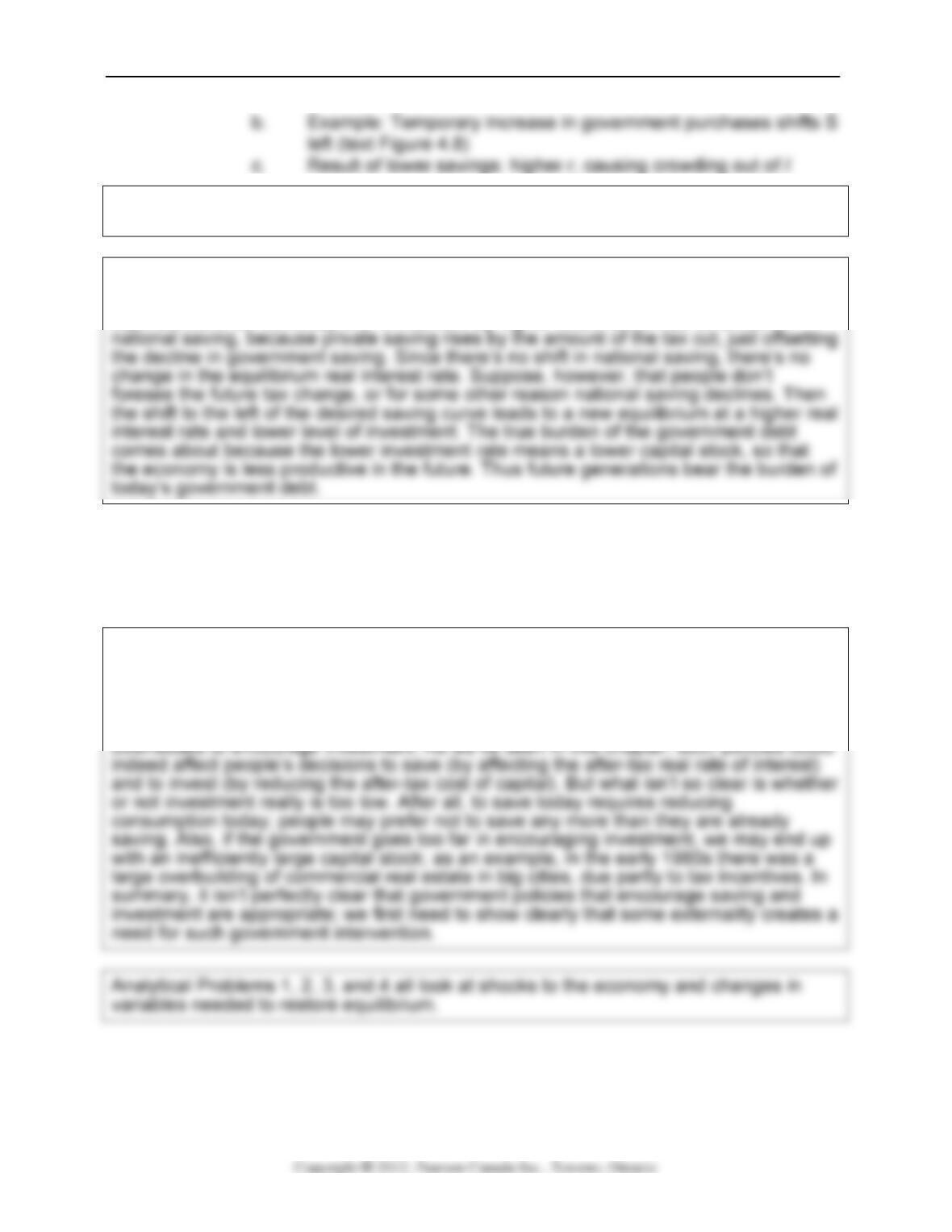
1. Plot Sd vs. Id (Fig. 4.2; Key
Diagram 3; like text Fig. 4.7
2. Equilibrium where Sd = /d
Consumption, Saving, and Investment 59
Numerical Problems 5 and 6 and Analytical Problem 5 examine what happens when
government spending changes.
Theoretical Application
What happens to the economy if government taxes change? Under Ricardian
equivalence a tax cut today that is financed by higher future taxes has no effect on
5. Shifts of the investment curve
a. Investment curve shifts right due to a fall in the effective tax rate
or a rise in expected future marginal productivity of capital (text
Figure 4.9)
b. Result of increased investment: higher r, higher S and /
Policy Application
Should tax policy be used to promote savings or investment? Many policymakers and
economists have argued that obtaining the correct amount of future economic growth
requires us to have a higher capital stock, so that we need more investment than we
have. They suggest tax policies like RRSPs to encourage saving and tax breaks for
60 Chapter 4
ADDITIONAL ISSUES FOR CLASSROOM DISCUSSIONS
1. Saving, Investment, and the Baby Boomers
Recently, saving has been relatively low in Canada compared to other countries and
other times. Is this because a large portion of the adult population was born in the late
1940s and the 1950s and these people are in the phase of life when they spend
heavily? Probably not.
Relatively few children were born during the Great Depression of the 1930s and World
War II in the first half of the 1940s. Shortly after the war ended, the birth rate rose and
stayed high for over 10 years. The children born during this period are called the “baby
boomers.”
2. Concern About the Level of Saving
While Canadian saving is not low by OECD standards, it is much lower than that of the
fast growing Asian economies. On average high savings countries tend to be high
growth countries.
Consumption, Saving, and Investment 61
3. What Should Be Included in Investment?
Investment is the sum of business fixed investment (structures and equipment),
residential investment, and the change in inventories. But if investment is the purchase
of goods and services that will increase productive capacity in the long run, then several
important categories, such as education, are left out.
Spending on education, infrastructure, and health and nutrition programs should be
included in investment. People are frequently the crucial factor in determining whether
an enterprise is successful or not. When businesses, individuals, and government
spend money on education, they are helping to increase human productivity and thus
4. Housing as an Investment Good
Residential construction, which is just investment in housing (including apartment
buildings) represents a large component of total fixed investment in Canada. For
instance, in Table 2.1 of the text, it is shown that for 2006 residential construction
62 Chapter 4
What particular aspects of the investment decision are specific to housing investment?
One is that housing investment is exceptionally sensitive to movements in interest rates.
One reason for this is that depreciation in housing in very low at annual rates. This
make the user-cost of capital very sensitive to the interest rate. Generally we see that
Consumption, Saving, and Investment 63
ANSWERS TO TEXTBOOK PROBLEMS
Review Questions
1. Saving is current income minus consumption. For given income, any increase in
2. When a consumer gets an increase in current income, both current consumption
and future consumption increase. Since current consumption rises, but by less
than the increase in current income, saving increases. When the consumer gets an
increase in expected future income, again both current and future consumption
3. The effect on desired saving of an increase in the expected real interest rate is
potentially ambiguous. An increase in the real interest rate has two effects on
desired saving: (1) the substitution effect increases saving, because the amount of
future consumption that can be obtained in exchange for giving up a unit of current
4. When government purchases increase temporarily, consumers see that higher
taxes will be required in the future to pay off the deficit. They reduce both current
consumption and future consumption, but current consumption declined by less