82 Abel/Bernanke/Croushore • Macroeconomics, Ninth Edition
◼ Additional Issues for Classroom Discussion
1. Do You Believe in Ricardian Equivalence?
Economists have debated the idea of Ricardian equivalence for some time now (Robert Barro’s classic
article, “Are Government Bonds Net Wealth?” appeared in 1974). An interesting debate for students is for
2. The Interaction of Taxation and Inflation
Macroeconomists like to debate whether the central bank should drive inflation down to zero or merely
maintain it at a fairly low level. But the evidence on the interaction of inflation with the tax system may
3. Should the Government Reduce Taxes on Capital?
Our analysis of investment and the desired capital stock shows that taxes are important. A policy issue
4. Is Saving Too Low in the United States?
The analytical framework that is developed in the textbook can be used to analyze the consequences of the

5. Should Social Security Funds Be Invested in the Stock Market?
The Social Security trust fund is projected to decline to zero around the year 2030, thanks to demographic
changes, especially the aging of the population and lower birth rates. A number of solutions are possible,
including reducing Social Security benefits or increasing taxes. Another possibility is to allow the trust
6. How Are You Trading Off the Present for the Future?
The material in the appendix may seem theoretical and abstract, but it’s easy to show students that they’re
7. What Borrowing Constraints Do You Face?
Some of your students may have already faced severe borrowing constraints in their lives. Some may note
84 Abel/Bernanke/Croushore • Macroeconomics, Ninth Edition
◼ Answers to Textbook Problems
Review Questions
1. Saving is current income minus consumption. For given income, any increase in consumption means
2. When a consumer gets an increase in current income, both current consumption and future
consumption increase. Since current consumption rises, but by less than the increase in current
3. The effect on desired saving of an increase in the expected real interest rate is potentially ambiguous.
An increase in the real interest rate has two effects on desired saving: (1) the substitution effect
increases saving, because the amount of future consumption that can be obtained in exchange for
4. The expected real after-tax interest rate is the nominal after-tax interest rate, (1 − t)i, minus the
5. When government purchases increase temporarily, consumers see that higher taxes will be required in
the future to pay off the deficit. They reduce both current consumption and future consumption, but
current consumption declines by less than the amount of the government purchases. Since national
saving is output minus desired consumption minus government purchases, and government purchases

Chapter 4 Consumption, Saving, and Investment 85
6. The two components of the user cost of capital are the interest cost and the depreciation cost.
7. The desired capital stock is the amount of capital that allows the firm to earn the largest possible
profit. The higher the expected future marginal product of capital, the higher the desired capital stock,
8. Gross investment represents the total purchase or construction of new capital goods that takes place
during a period. Net investment is gross investment minus the depreciation on existing capital. Thus
9. Equilibrium in the goods market occurs when the aggregate supply of goods (Y) equals the aggregate
10. The saving curve slopes upward because saving is assumed to increase with an increase in the
expected real interest rate. The investment curve slopes downward because investment is lower the
86 Abel/Bernanke/Croushore • Macroeconomics, Ninth Edition
Numerical Problems
1. First, a general formulation of the problem is useful. With income of Y1 in the first year and Y2 in the
second year, the consumer saves Y1 − C in the first year and Y2 − C in the second year, where C is the
consumption amount, which is the same in both years. Saving in the first year earns interest at rate r,
where r is the real interest rate. And the consumer needs to accumulate just enough after two years to
pay for college tuition, in the amount T. So the key equation is (Y1 − C)(1 + r) + (Y2 − C) = T.
2. (a) This chart shows the MPKf as the increase in output from adding another fabricator:
# Fabricators
Output
MPKf
0
0
—
1
100
100
2
150
50
3
180
30
4
195
15
5
205
10
Chapter 4 Consumption, Saving, and Investment 87
(b) uc = (r + d)pK = (0.12 + 0.20)$100 = $32. HHHHC should buy two fabricators, since at two
fabricators, MPKf = 50 32 = uc. But at three fabricators, MPKf = 30 32 = uc. You want to add
fabricators only if the future marginal product of capital exceeds the user cost of capital. The
MPKf of the third fabricator is less than its user cost, so it should not be added.
3. (a) The expected real after-tax interest rate is r = i(1 − t) −
e
= 0.10 (1 − 0.30) − 0.05
= 0.07 − 0.05 = 0.02.
4. Since the price of capital declines from 60 to 51, the depreciation rate is 9/60 = .15.
(a) uc = (r + d)pK = (.10 + .15)60 = 15 units of output per year.
(b) The desired capital stock is such that MPKf = uc, so 165 − 2K = 15, or 2K = 150, so K = 75.
5. (a) Desired consumption declines as the real interest rate rises because the higher return to saving
encourages higher saving; desired investment declines as the real interest rate rises because the
user cost of capital is higher, reducing the desired capital stock, and thus investment.
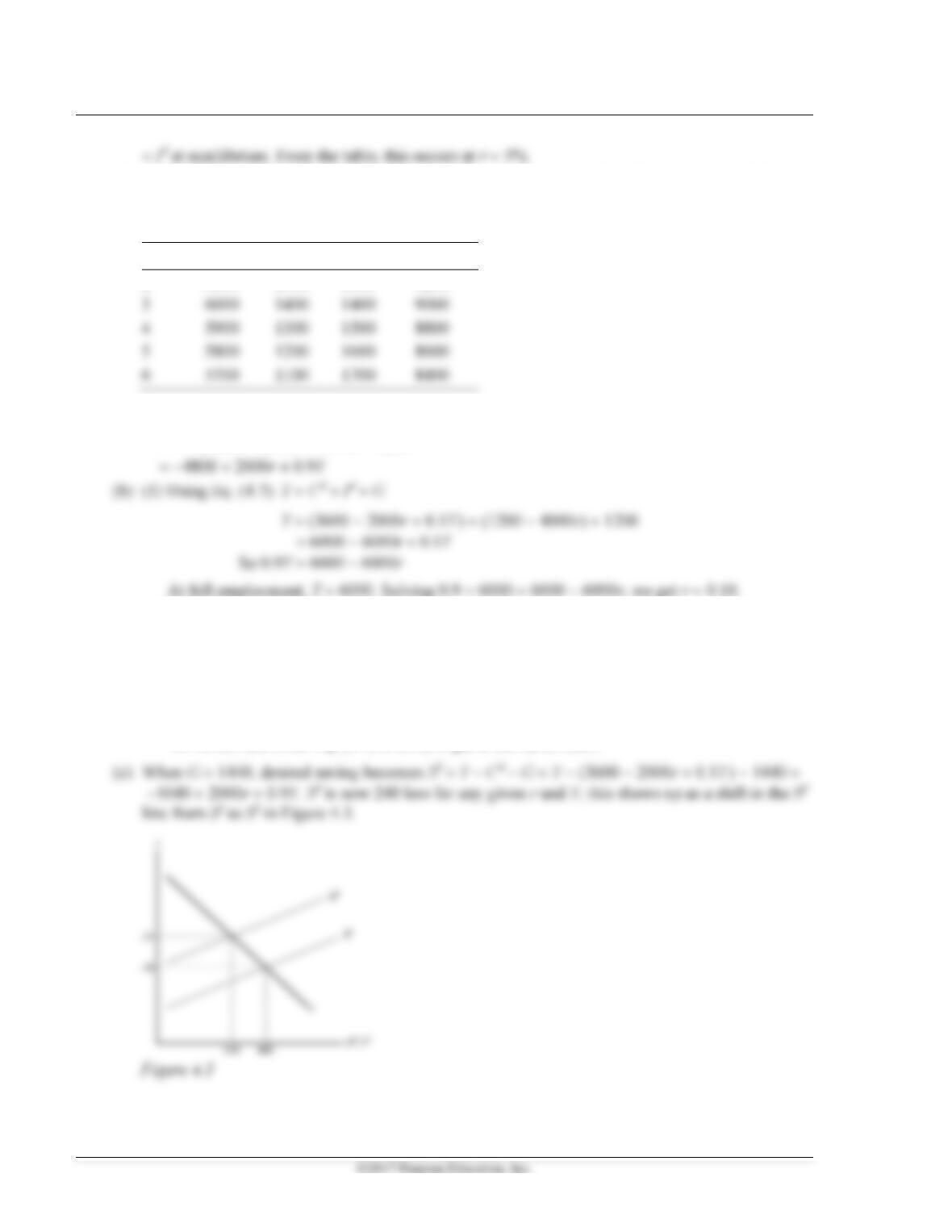
(b) Use the following table, where Sd = Y − Cd − G = 9000 − Cd − 2000 = 7000 − Cd.
r
Cd
Id
Sd
Cd +
Id +
G
88 Abel/Bernanke/Croushore • Macroeconomics, Ninth Edition
(d) When government purchases fall by 400 to 1600, each Sd entry in the table is higher by 400,
and each Cd + Id + G entry is lower by 400. Then Y = Cd + Id + G occurs at r = 3%, as does Sd =
Id = 1400.
r
Cd
Id
Sd
Cd +
Id +
G
2
6100
1500
1300
9200
3
6000
1400
1400
9000
4
5900
1300
1500
8800
5
5800
1200
1600
8600
6. (a) Sd = Y − Cd − G
= Y − (3600 − 2000r + 0.1Y) − 1200
(2) Using Eq. (4.8):
Sd = Id
−4800 + 2000r + 0.9Y = 1200 − 4000r
0.9Y = 6000 − 6000r
When Y = 6000, r = 0.10.
So we can use either Eq. (4.7) or (4.8) to get to the same result.

Chapter 4 Consumption, Saving, and Investment 89
7. (a) r = 0.10
uc/(1 − τ) = (r + d)pK/(1 −
) = [(.1 + 0.2) 1]/(1 − 0.15) = 0.35.
MPKf = uc/(1 −
), so 20 − 0.02K = 0.35; solving this gives K = 982.5.
Since K − K-1 = I − dK, I = K − K–1 + dK = 982.5 − 900 + (.2 900) = 262.5.
(b) i. Solving for this in general:
8. (a) PVLR = y + [yf/(1 + r)] + a
When cf = 0, c = 210; this is the horizontal intercept of the budget line.
90 Abel/Bernanke/Croushore • Macroeconomics, Ninth Edition
(c) c = cf: c + (c/1.10) = 210.
= −20.
(d) y increases by 11, so new PVLR = 221.
2.1c = 221 1.1 = 243.1.
c = 115.76.
s = y − c = 101 − 115.76 = − 14.76.
So part of the temporary increase in income is consumed and part is saved.
9. (a) PVLR = a + yl + yw + yr = 1500.
(1) No borrowing constraint: cl + cw + cr = 1500.
cl = cw = cr = c = 1500/3 = 500.
sl = 200 − 500 = −300; sw = 800 − 500 = 300; sr = 200 − 500 = −300.
(2) The borrowing constraint is now binding, since cl = 400 a + yl = 200. So cl is constrained to
be 200. That leaves PVLR of 1000 for cw + cr, so they both equal 500. cw = 500 800 = yw,
so the borrowing constraint is not binding in working age.

Chapter 4 Consumption, Saving, and Investment 91
Analytical Problems
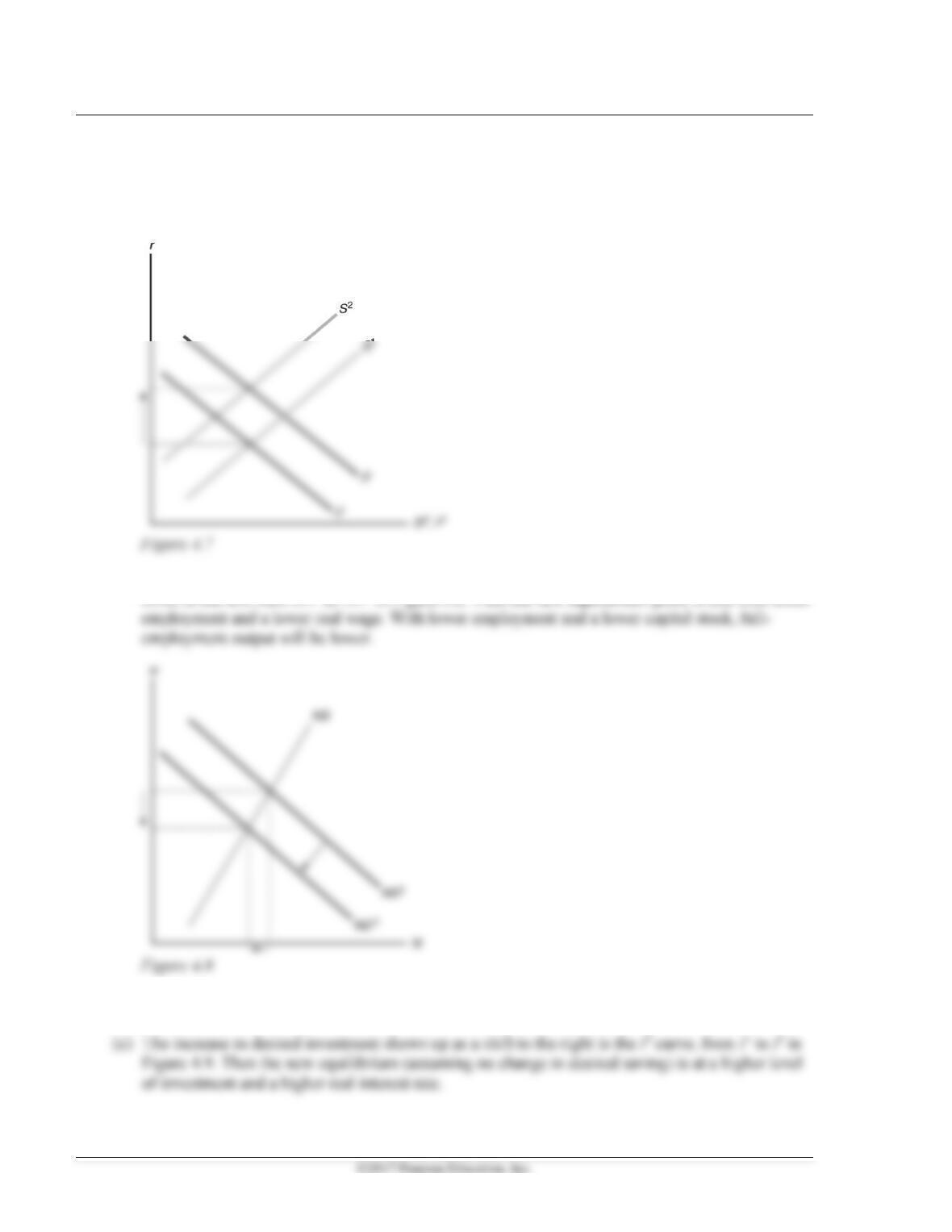
1. (a) As Figure 4.5 shows, the shift to the right in the saving curve from S1 to S2 causes saving and
investment to increase and the real interest rate to decrease.
(b) This is really just a transfer from the general population to veterans. The effect on saving
depends on whether the marginal propensity to consume (MPC) of veterans differs from that
(c) The investment tax credit encourages investment, shifting the investment curve from I1 to I2 in
Figure 4.6. Saving and investment increase, as does the real interest rate.
92 Abel/Bernanke/Croushore • Macroeconomics, Ninth Edition
(d) The increase in expected future income decreases current desired saving, as people increase
desired consumption immediately. The rise of the future marginal productivity of capital shifts
the investment curve to the right. The result, as shown in Figure 4.7, is that the real interest rate
rises, with ambiguous effects on saving and investment.
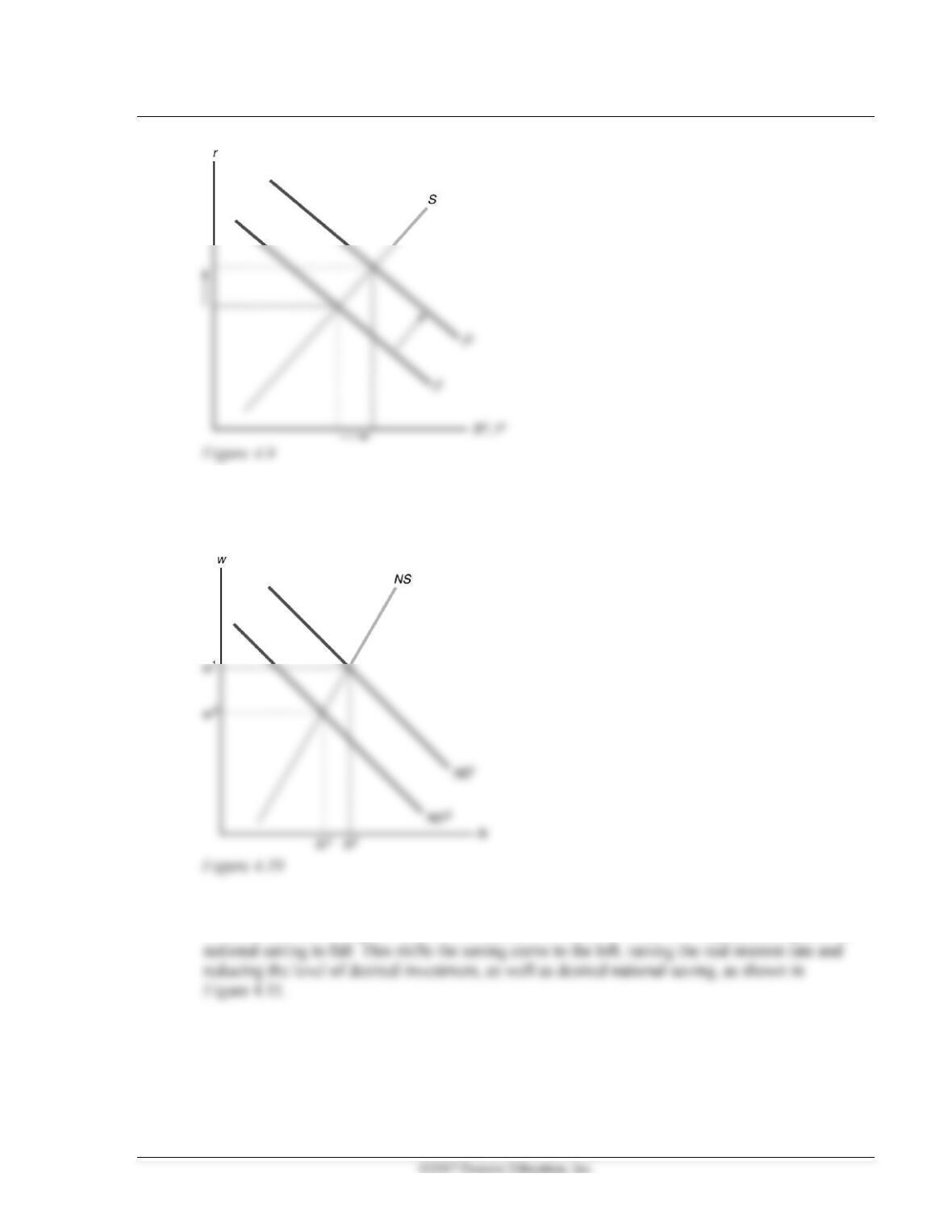
2. (a) With a lower capital stock, the marginal product of labor is reduced, so the labor demand curve
(b) Because the capital stock is lower, the marginal product of capital will be higher, so desired
investment will increase.
Chapter 4 Consumption, Saving, and Investment 93
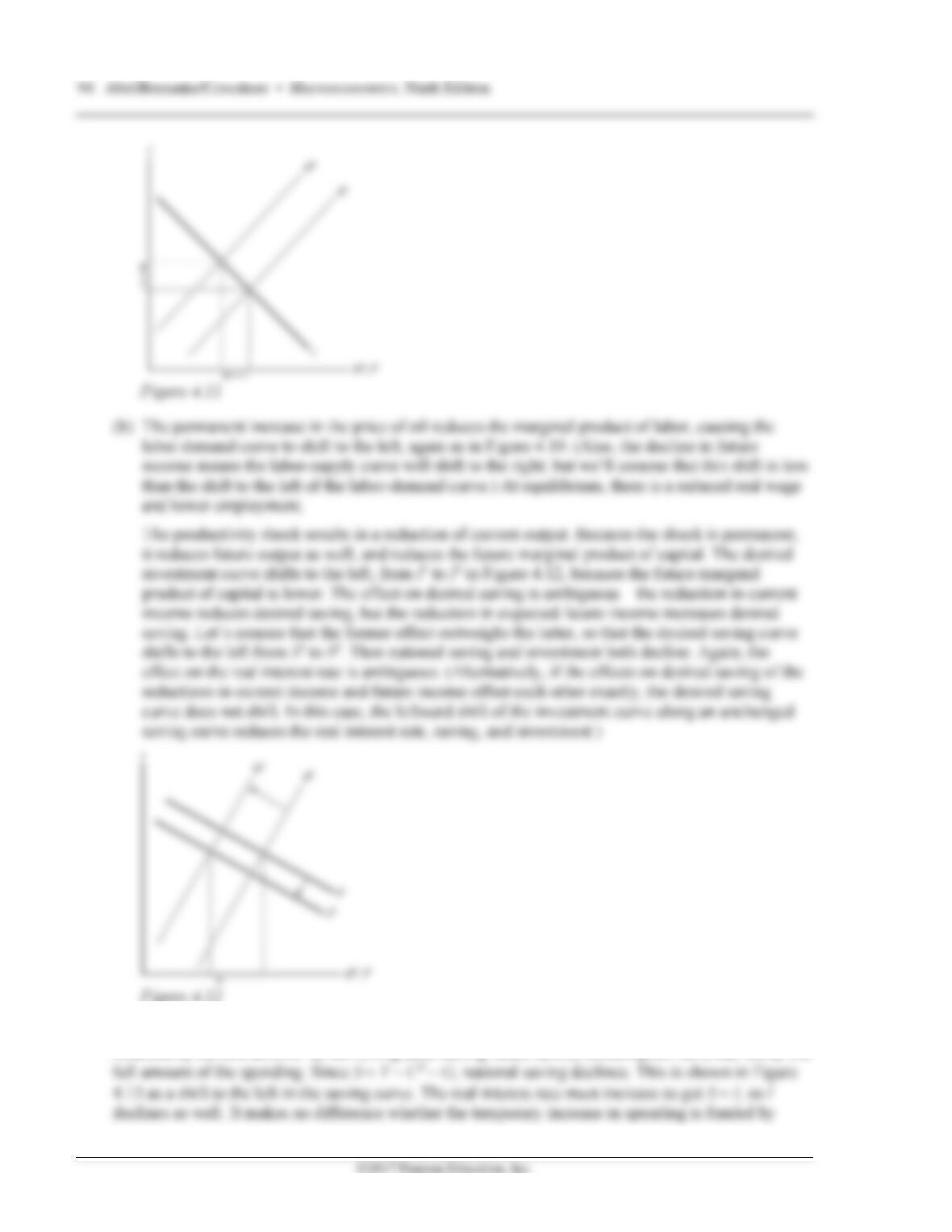
3. (a) The temporary increase in the price of oil reduces the marginal product of labor, causing the
labor demand curve to shift to the left from ND1 to ND2 in Figure 4.10. At equilibrium, there is a
reduced real wage and lower employment.
The productivity shock results in a reduction of output. Because the shock is temporary, the only
effect on desired saving or investment is due to the reduction in current output, causing desired
4. A temporary increase in government spending reduces national saving. Whether the spending is
financed by current taxes or by borrowing (and raising future taxes), consumption falls, but not by the
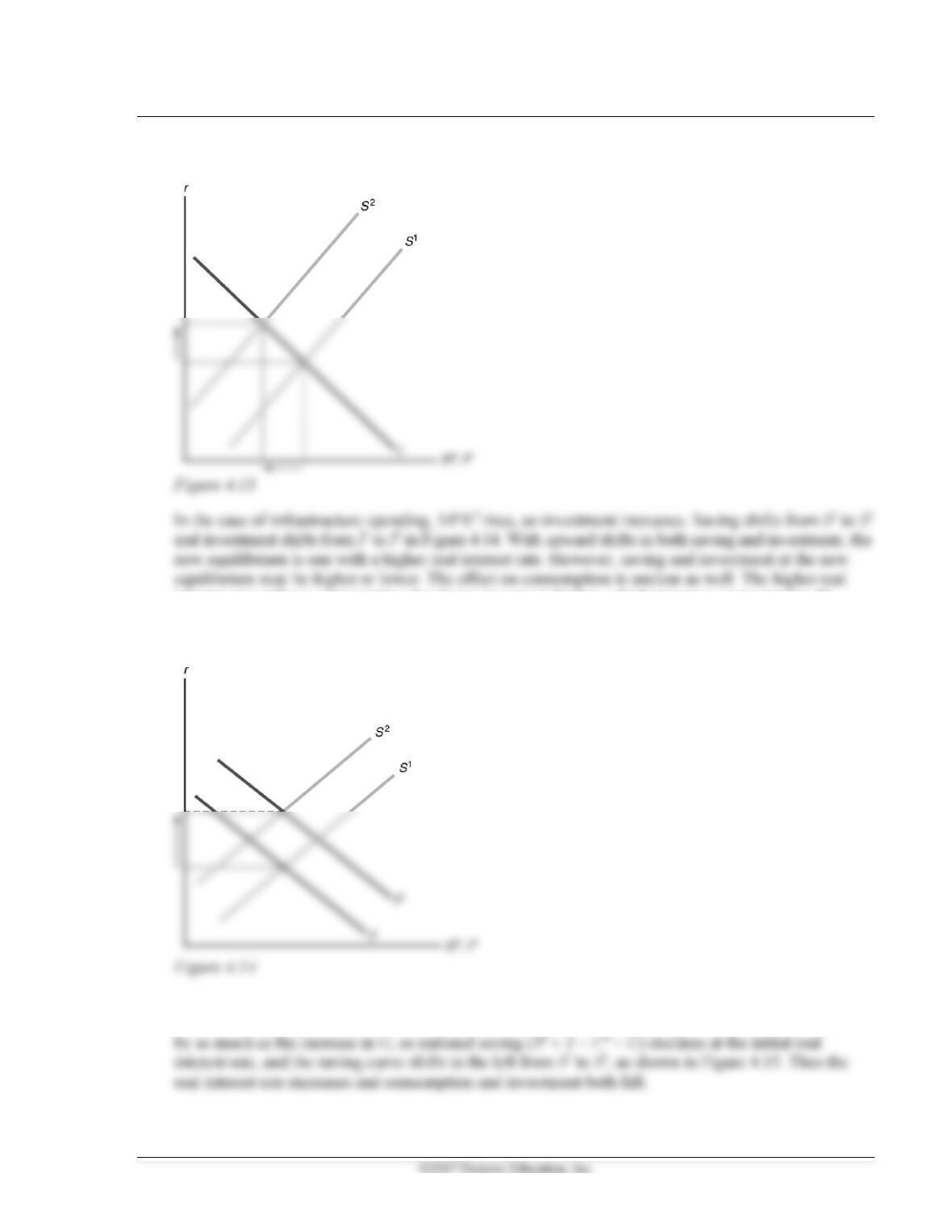
Chapter 4 Consumption, Saving, and Investment 95
taxes or by borrowing.
interest rate reduces consumption, but future income is higher, which increases consumption. If
investment actually rises, then the increase in government spending causes private investment to be
“crowded in” rather than “crowded out.” In this case consumption is crowded out.
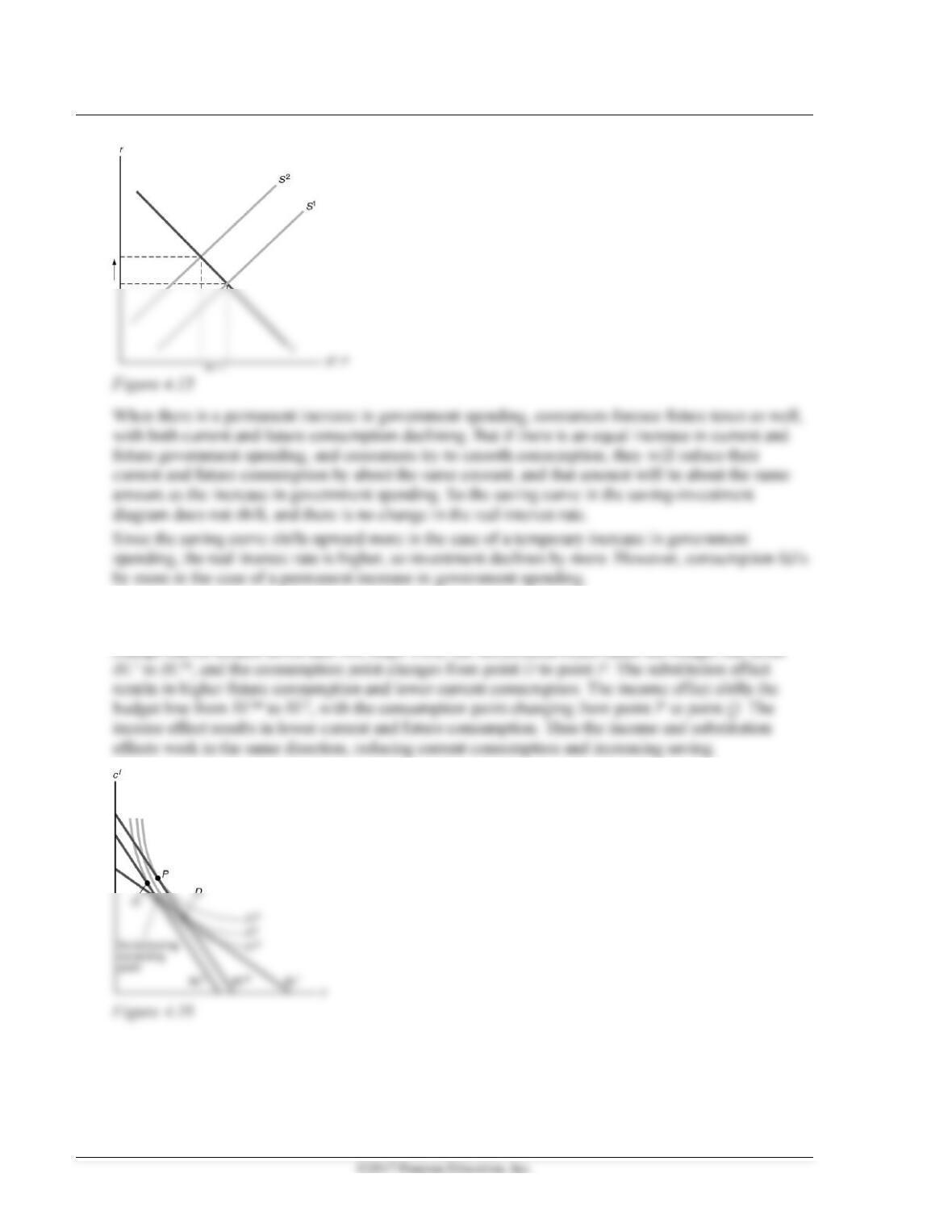
5. When there is a temporary increase in government spending, consumers foresee future taxes. As a
result, consumption declines, both currently and in the future. Thus current consumption does not fall
96 Abel/Bernanke/Croushore • Macroeconomics, Ninth Edition
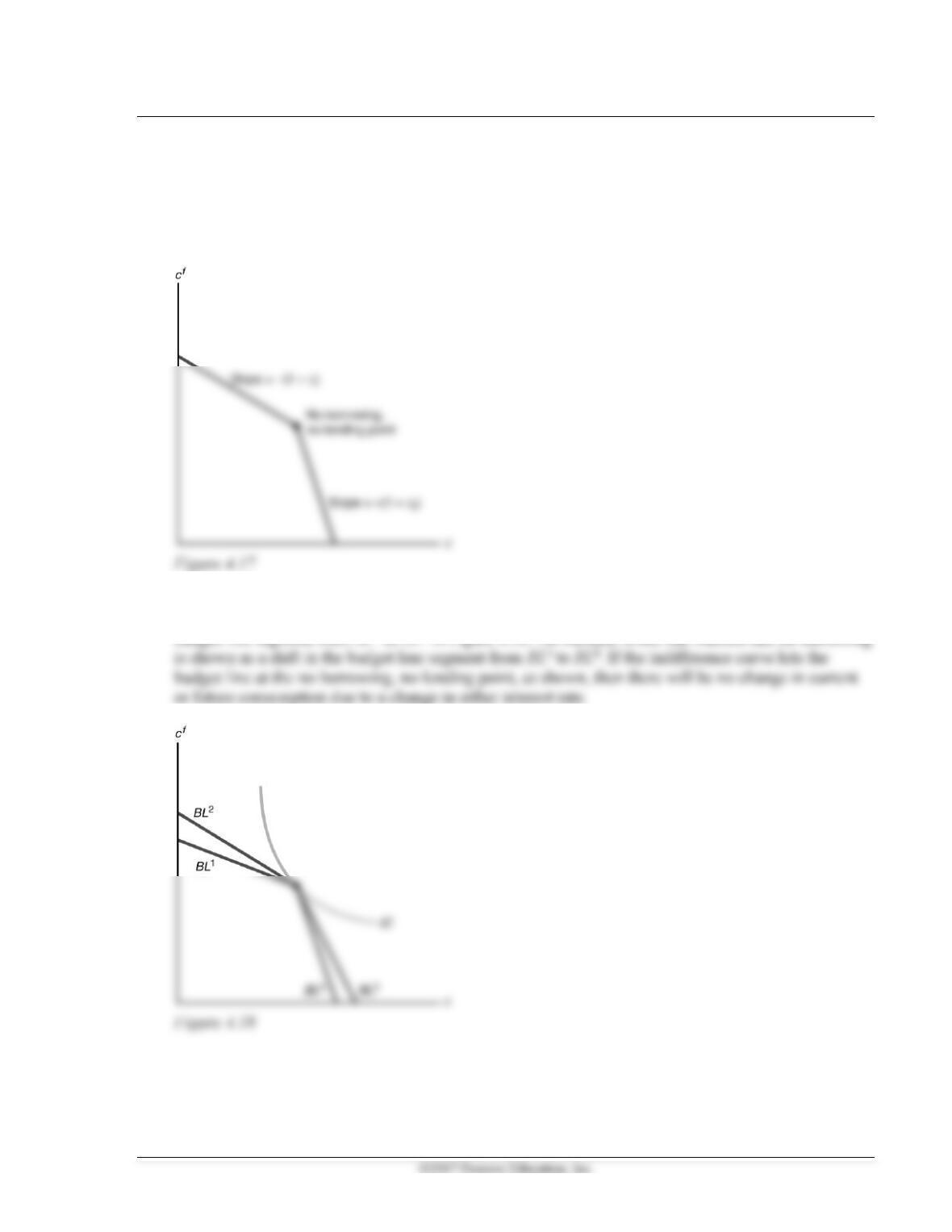
6. See Figure 4.16. The consumer is originally on budget line BL1, with consumption at point D. An
increase in the real interest rate shifts the budget line to BL2, with consumption at point Q. The
change can be broken down into two steps. First, the substitution effect shifts the budget line from
Chapter 4 Consumption, Saving, and Investment 97
7. The difference in interest rates between borrowing and lending means there is a kink in the budget
constraint at the no-lending, no-borrowing point, as shown in Figure 4.17. Borrowing is zero when
c = y + a. If current consumption is less than y + a, the person is a saver (lender), and the budget line
has slope − (1 + rl). If current consumption is greater than y + a, the person is a borrower, and faces
a steeper budget constraint with slope − (1 + rb), because the interest rate is higher.
An increase in either interest rate would steepen only the portion of the budget constraint for which
that interest rate is relevant. An increase in the real interest rate on lending is shown as a shift in the
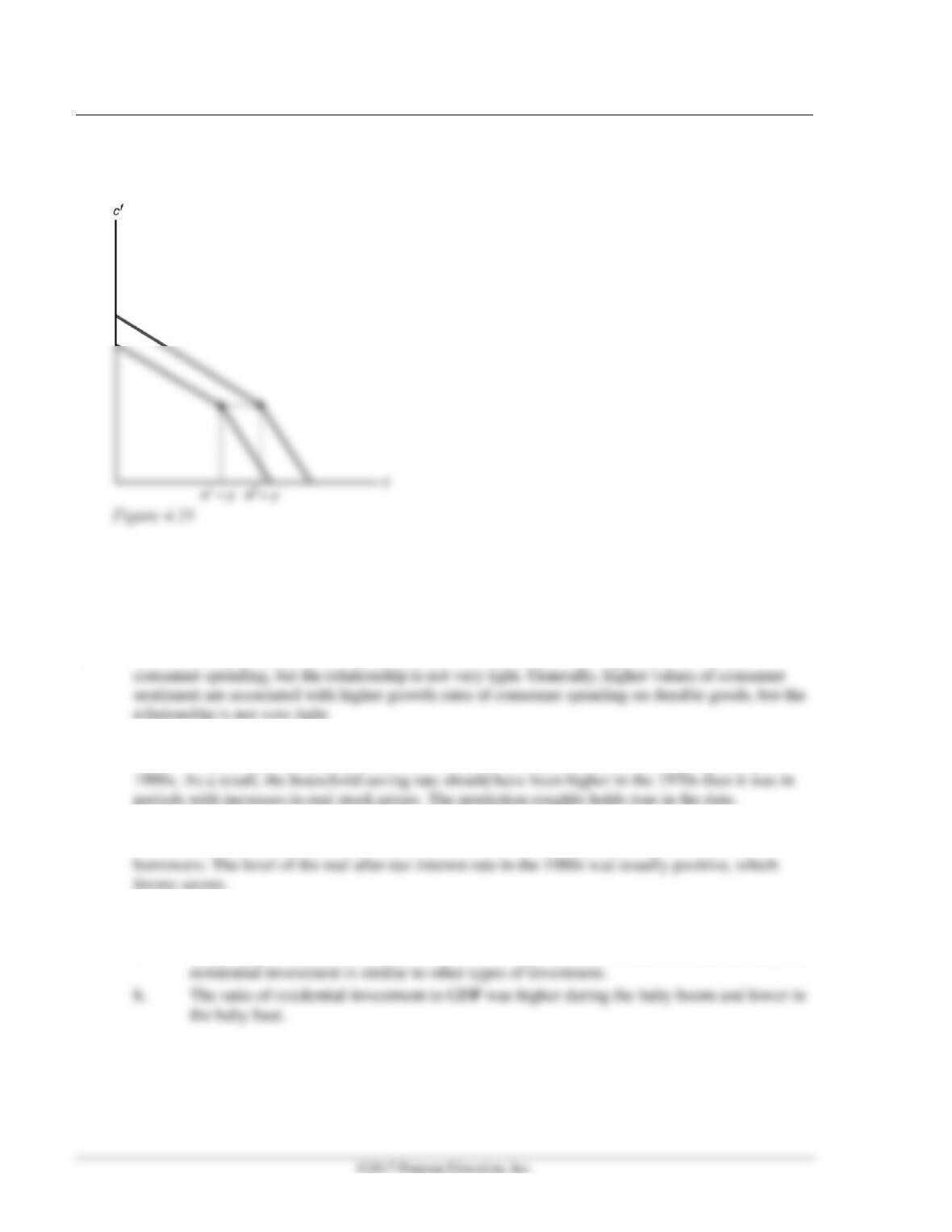
98 Abel/Bernanke/Croushore • Macroeconomics, Ninth Edition
An increase in the consumer’s initial wealth would lead to a parallel rightward shift of both segments
of the budget line, as shown in Figure 4.19.
Working with Macroeconomic Data Questions
1. Generally, higher values of consumer sentiment are associated with higher growth rates of
2. Real stock prices generally declined in the 1970s, but increased in other decades, especially in the
3. The level of the real after-tax interest rate in the 1970s was usually negative, which favors
4.
a. Residential investment as a percent of GDP usually declines in recessions. In that respect,

Chapter 4 Consumption, Saving, and Investment 99
5. The high-grade corporate bond rate (AAA) and the mortgage rate (MORTG) tend to be the
highest. They are long-term interest rates with some default risk. The ten-year T-bond rate (GS10)
6. Investment in equipment has an upward trend, investment in structures has a flat trend, and