
Chapter 4: Analysis of Financial Statements
Learning Objectives
49
Chapter 4
Analysis of Financial Statements
Learning Objectives
After reading this chapter, students should be able to do the following:
◆ Explain what ratio analysis is.
◆ List the five groups of ratios and identify, calculate, and interpret the key ratios in each group.
◆ Discuss each ratio’s relationship to the balance sheet and income statement.
◆ Discuss why return on equity (ROE) is the key ratio under management’s control and how the other
ratios impact ROE, and explain how to use the DuPont equation for improving ROE.
◆ Compare a firm’s ratios with those of other firms (benchmarking) and analyze a given firm’s ratios
over time (trend analysis).
◆ Discuss the tendency of ratios to fluctuate over time (which may or may not be problematic); explain
how they can be influenced by accounting practices as well as other factors; and explain why they
must be used with care.
50
Lecture Suggestions
Chapter 4: Analysis of Financial Statements
Lecture Suggestions
Chapter 4 shows how financial statements are analyzed to determine the firm’ strengths and weaknesses.
Based on this information, management can take actions to exploit the firm’s strengths and correct its
weaknesses.
At Florida, we find a significant difference in preparation between our accounting and non-
accounting students. The accountants are relatively familiar with financial statements, and they have
covered in depth in their financial accounting course many of the ratios discussed in Chapter 4. We pitch
our lectures to the non-accountants, which means concentrating on the use of statements and ratios, and
DAYS ON CHAPTER: 3 OF 56 DAYS (50–minute periods)
Chapter 4: Analysis of Financial Statements
Answers and Solutions
51
Answers to End-of–Chapter Questions
4-1 The emphasis of the various types of analysts is by no means uniform nor should it be.
Management is interested in all types of ratios for two reasons. First, the ratios point out
weaknesses that should be strengthened; second, management recognizes that the other parties
4-2 The inventory turnover ratio is important to a grocery store because of the much larger inventory
required and because some of that inventory is perishable. An insurance company would have
4-3 Given that sales have not changed, a decrease in the total assets turnover means that the
company’s assets have increased. Also, the fact that the fixed assets turnover ratio remained
4-4 Differences in the amounts of assets necessary to generate a dollar of sales cause asset turnover
ratios to vary among industries. For example, a steel company needs a greater number of
4-5 Inflation will cause earnings to increase, even if there is no increase in sales volume. Yet, the
book value of the assets that produced the sales and the annual depreciation expense remain at
historic values and do not reflect the actual cost of replacing those assets. Thus, ratios that
compare current flows with historic values become distorted over time. For example, ROA will
increase even though the same assets are generating the same sales volume.
When comparing different companies, the age of the assets will greatly affect the ratios.
4-6 ROE is calculated as the return on assets multiplied by the equity multiplier. The equity
4-7 a. Cash, receivables, and inventories, as well as current liabilities, vary over the year for firms
with seasonal sales patterns. Therefore, those ratios that examine balance sheet figures will
vary unless averages (monthly ones are best) are used.
4-8 Firms within the same industry may employ different accounting techniques that make it difficult
to compare financial ratios. More fundamentally, comparisons may be misleading if firms in the
4-9 The three components of the DuPont equation are profit margin, assets turnover, and the equity
multiplier. One would not expect the three components of the discount merchandiser and high-
4-10 A review of Yahoo! Finance on 04/07/18 showed that the trailing twelve-month P/E ratio for
Alphabet Inc. (Google’s parent company) was 55.96 compared to 26.43 for Walmart. The P/E
ratio indicates how much investors are willing to pay per dollar of reported profits. Alphabet’s
4-11 ROE measures the rate of return on common stockholders’ investment, while ROIC measures the
rate of return to investors—both debtholders and common stockholders. Since ROE measures
Chapter 4: Analysis of Financial Statements
Answers and Solutions
53
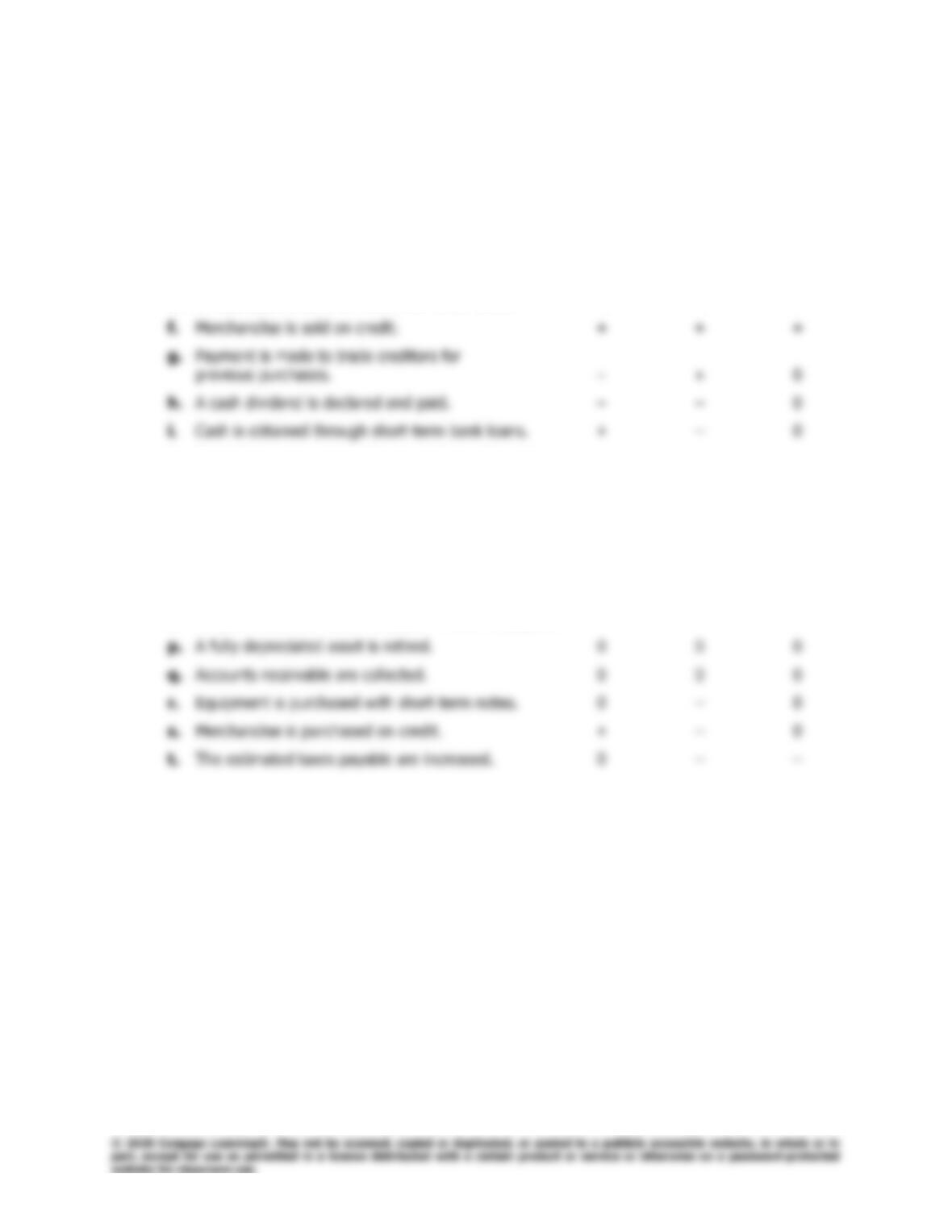
4-12 Total Current Effect on
Current Assets Ratio Net Income
a. Cash is acquired through issuance of additional
common stock. + + 0
b. Merchandise is sold for cash. + + +
c. Federal income tax due for the previous year is paid. – + 0
d. A fixed asset is sold for less than book value. + + –
e. A fixed asset is sold for more than book value. + + +
j. Short-term notes receivable are sold at a discount. – – –
k. Marketable securities are sold below cost. – – –
l. Advances are made to employees. 0 0 0
m. Current operating expenses are paid. – – –
n. Short-term promissory notes are issued to trade creditors
in exchange for past due accounts payable. 0 0 0
o. 10-year notes are issued to pay off accounts payable. 0 + 0
54
Answers and Solutions
Chapter 4: Analysis of Financial Statements
Solutions of End-of-Chapter Problems
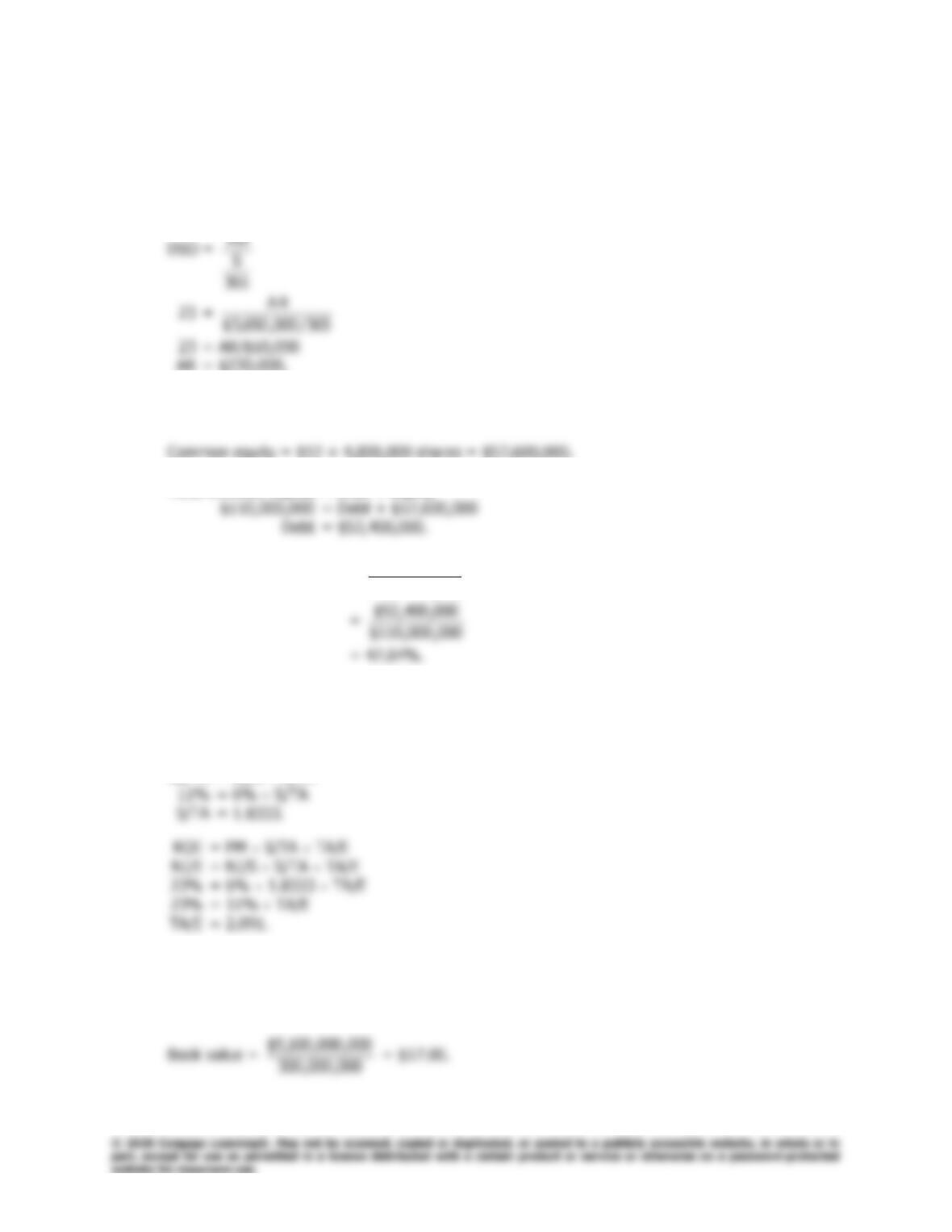
4-1 DSO = 23 days; S = $3,650,000; AR = ?
4-2 Since the firm’s M/B ratio = 1, then its total market value of equity is equal to its book value of equity.
Total invested capital = Debt + Equity
Total debt to total capital =
Equity Debt
Debt
+
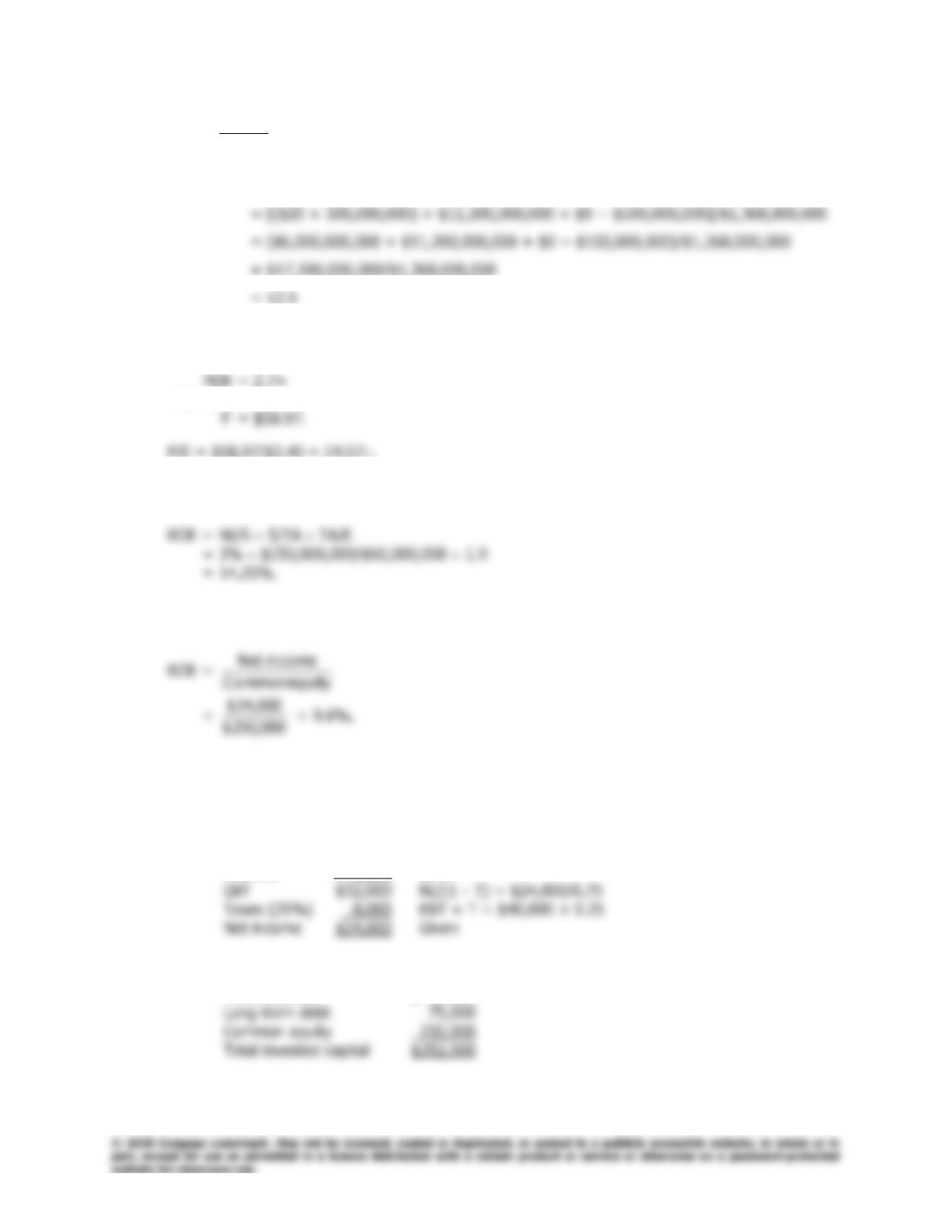
4-3 ROA = 11%; PM = 6%; ROE = 23%; S/TA = ?; TA/E = ?
ROA = NI/TA; PM = NI/S; ROE = NI/E.
ROA = PM S/TA
NI/TA = NI/S S/TA
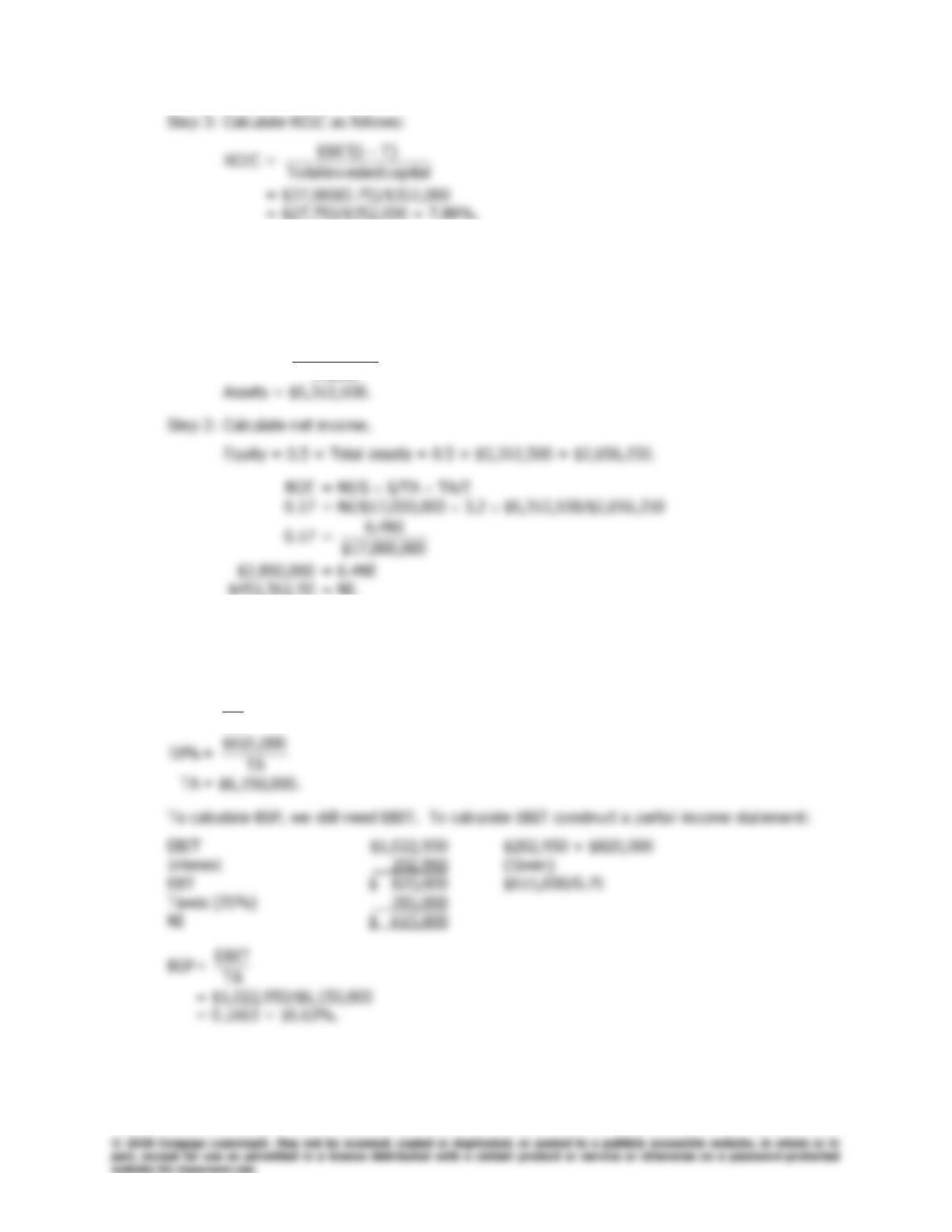
4-4 TA = $17,000,000,000; Cash and equivalents = $100,000,000; CL = $1,700,000,000; NP =
$1,000,000,000; LT debt = $10,200,000,000; CE = $5,100,000,000; Shares outstanding =
300,000,000; P0 = $20; EBITDA = $1,368,000,000; M/B = ?; EV/EBITDA = ?
Chapter 4: Analysis of Financial Statements
Answers and Solutions
55
M/B =
00.17$
00.20$
= 1.1765.
EV/EBITDA = (MVEquity + MVDebt + MVOther Claims – Cash and Equivalents)/EBITDA
4-5 EPS = $2.40; BVPS = $21.84; M/B = 2.7; P/E = ?
P/$21.84 = 2.7×
4-6 NI/S = 3%; TA/E = 1.9; Sales = $150,000,000; Assets = $60,000,000; ROE = ?
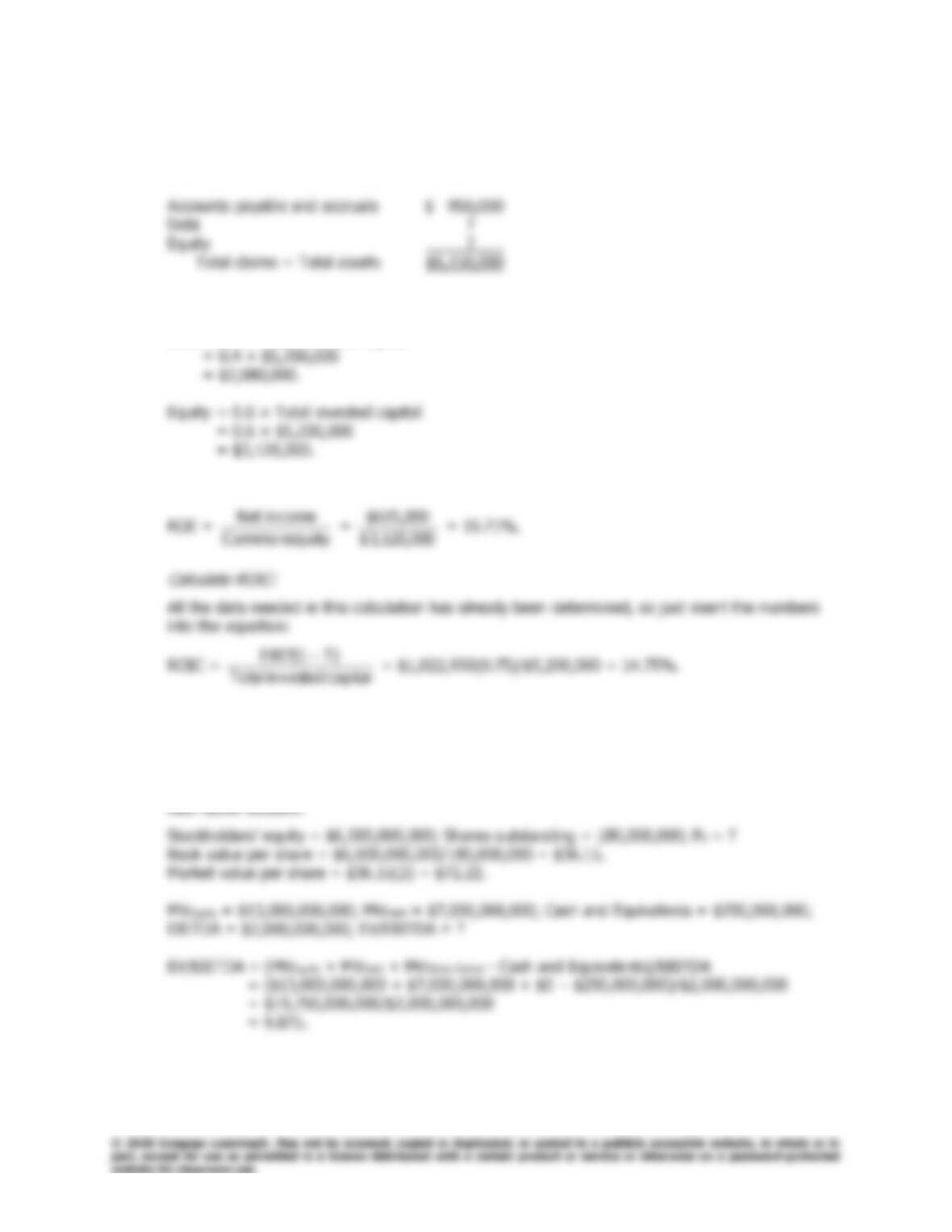
4-7 Given: Net income = $24,000; Common equity = $250,000
To calculate ROIC we need to find EBIT and total invested capital.
Step 1: To calculate EBIT, we use the income statement and calculate up the income statement
beginning with net income as follows:
EBIT $37,000 EBT + Int = $32,000 + $5,000
Interest 5,000 Given
Step 2: Calculate total invested capital as follows:
Notes payable $ 27,000
56
Answers and Solutions
Chapter 4: Analysis of Financial Statements
4-8 Step 1: Calculate total assets from information given.
Sales = $17 million.
3.2 = Sales/TA
3.2 =
Assets
000,000,17$
$451,562.50 = NI.
4-9
Calculate BEP:
ROA = 10%; Net income = $615,000; TA = ?
ROA =
TA
NI
Chapter 4: Analysis of Financial Statements
Answers and Solutions
57
Calculate ROE:
We need to determine common equity from total assets calculated above and the accounts
payable and accrual balance given in the problem.
Therefore, Debt + Equity = $5,200,000 = Total invested capital.
Debt = 0.4 × Total invested capital
Now, we can calculate ROE as follows:
4-10 Stockholders’ equity = $6,500,000,000; M/B = 2.0; P0 = ?
Total market value = $6,500,000,000 (2) = $13,000,000,000.
Market value per share = $13,000,000,000/180,000,000 = $72.22.
58
Answers and Solutions
Chapter 4: Analysis of Financial Statements
4-11 We are given ROA = 4% and Sales/Total assets = 1.3.
From the DuPont equation:
ROA = Profit margin Total assets turnover
4% = Profit margin(1.3)
4-12 TA = $12,000,000,000; T = 25%; EBIT/TA = 10%; ROA = 5.25%; TIE = ?
EBIT/$12,000,000,000 = 0.10
EBIT = $1,200,000,000.
NI/$12,000,000,000 = 0.0525
NI = $630,000,000.
4-13
Calculate TIE:
TIE = EBIT/INT, so find EBIT and INT.
Interest = $600,000 0.07 = $42,000.
Calculate ROIC:
4-14 ROE = Profit margin TA turnover Equity multiplier
= NI/Sales Sales/TA TA/Equity.
Now we need to determine the inputs for the DuPont equation from the data that were given.
On the left we set up an income statement, and we substitute values on the right:
Sales (given) $17,000,000
4-15 Currently, ROE is ROE1 = $15,000/$200,000 = 7.5%.
The current ratio will be set such that 2.5 = CA/CL. CL is $50,000, and it will not change, so
we can solve to find the new level of current assets: CA = 2.5(CL) = 2.5($50,000) = $125,000.
This is the level of current assets that will produce a current ratio of 2.5.
60
Answers and Solutions
Chapter 4: Analysis of Financial Statements
4-16 Known data:
TA = $3,000,000; Int. rate = 8%; T = 25%; BEP = 0.35 = EBIT/Total assets, so EBIT =
0.35($3,000,000) = $1,050,000; Equity = 0.7 × $3,000,000 = $2,100,000.
No Debt Debt = 30%
EBIT $1,050,000 $1,050,000
4-17 Statement a is correct. Refer to the solution setup for Problem 4-16 and think about it this way:
(1) Adding assets will not affect common equity if the assets are financed with debt. (2) Adding
assets will cause expected EBIT to increase by the amount EBIT = BEP(Added assets). (3)
Interest expense will increase by the amount Int. rate(Added assets). (4) Pre-tax income will rise
4-18 TA = $6,000,000,000; T = 25%; EBIT/TA = 11%; ROA = 6%; TIE ?
11.0
,000$6,000,000
EBIT
=
Chapter 4: Analysis of Financial Statements
Answers and Solutions
61
4-19 Present current ratio =
625,076,1$
2,5009,32$
= 2.22.
4-20 Step 1: Solve for current annual sales using the DSO equation:
71 = $205,000/(Sales/365)
71Sales = $74,825,000
4-21 The current EPS is $8,000,000/540,000 shares or $14.8148. The current P/E ratio is then
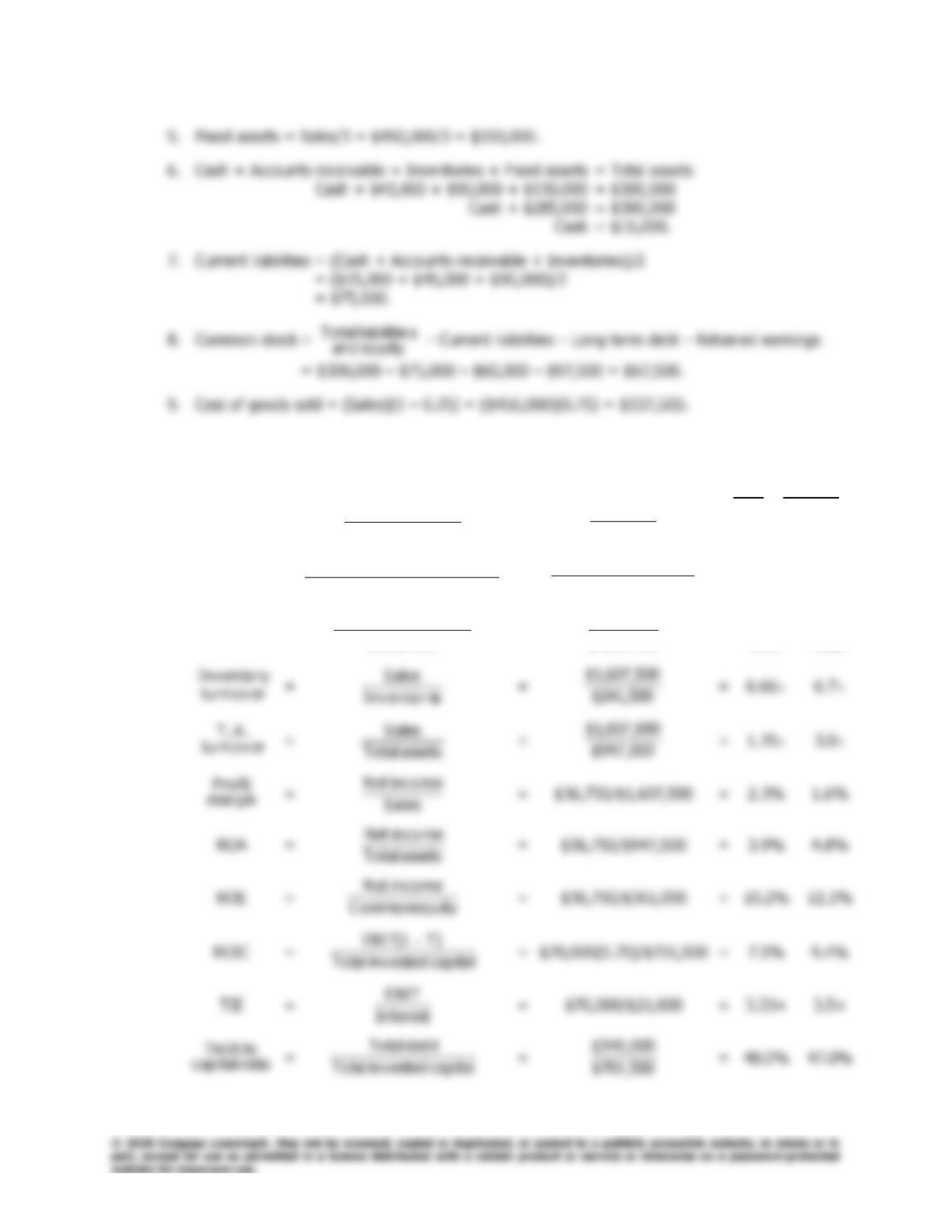
4-22 1. Total assets = Total liabilities and equity = $300,000.
62
Answers and Solutions
Chapter 4: Analysis of Financial Statements
4-23 a. (Dollar amounts in thousands.)
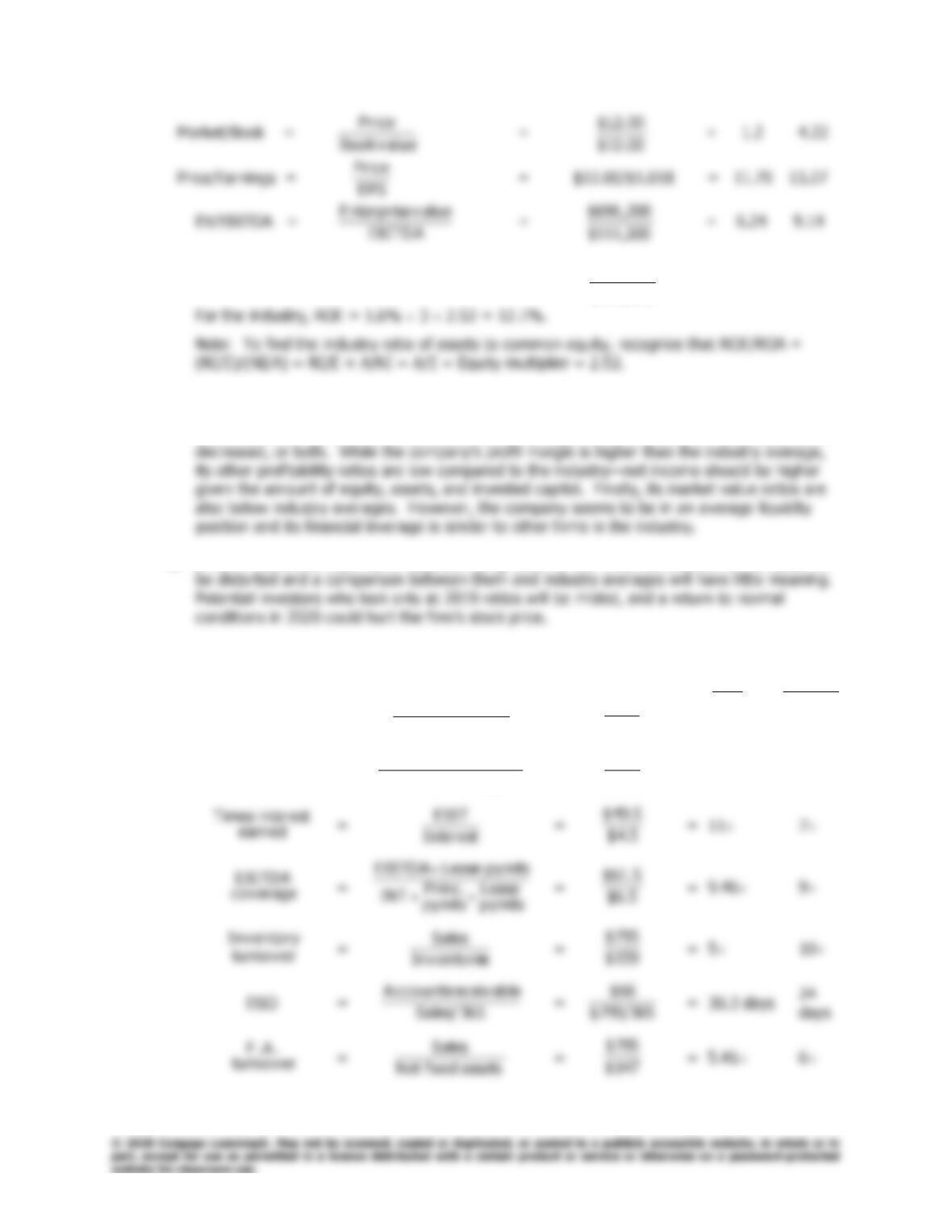
Industry
Firm Average
ratio
C urrent
=
sliabilitieCurrent
assetsCurrent
=
000,330$
000,655$
=
1.98
2.0
ratio
Quick
=
sliabilitieCurrent
sInventorie assetsCurrent −
=
000,330$
500,241$0005,65$−
=
1.25×
1.3×
DSO
=
536Sales/
receivable Accounts
=
=
=
6.66
6.7
=
=
=
=
=
=
=
11.404$4,
000,336$
=
76.3
days
35
days
Chapter 4: Analysis of Financial Statements
Answers and Solutions
63
b. For the firm, ROE = NI/S S/TA TA/E = 2.3% 1.7
$361,000
$947,500
= 10.2%.
c. The firm’s days sales outstanding ratio is more than twice the industry average, indicating
that the firm should tighten credit or enforce a more stringent collection policy. The total
assets turnover ratio is well below the industry average, so sales should be increased, assets
d. If 2019 represents a period of supernormal growth for the firm, ratios based on this year will
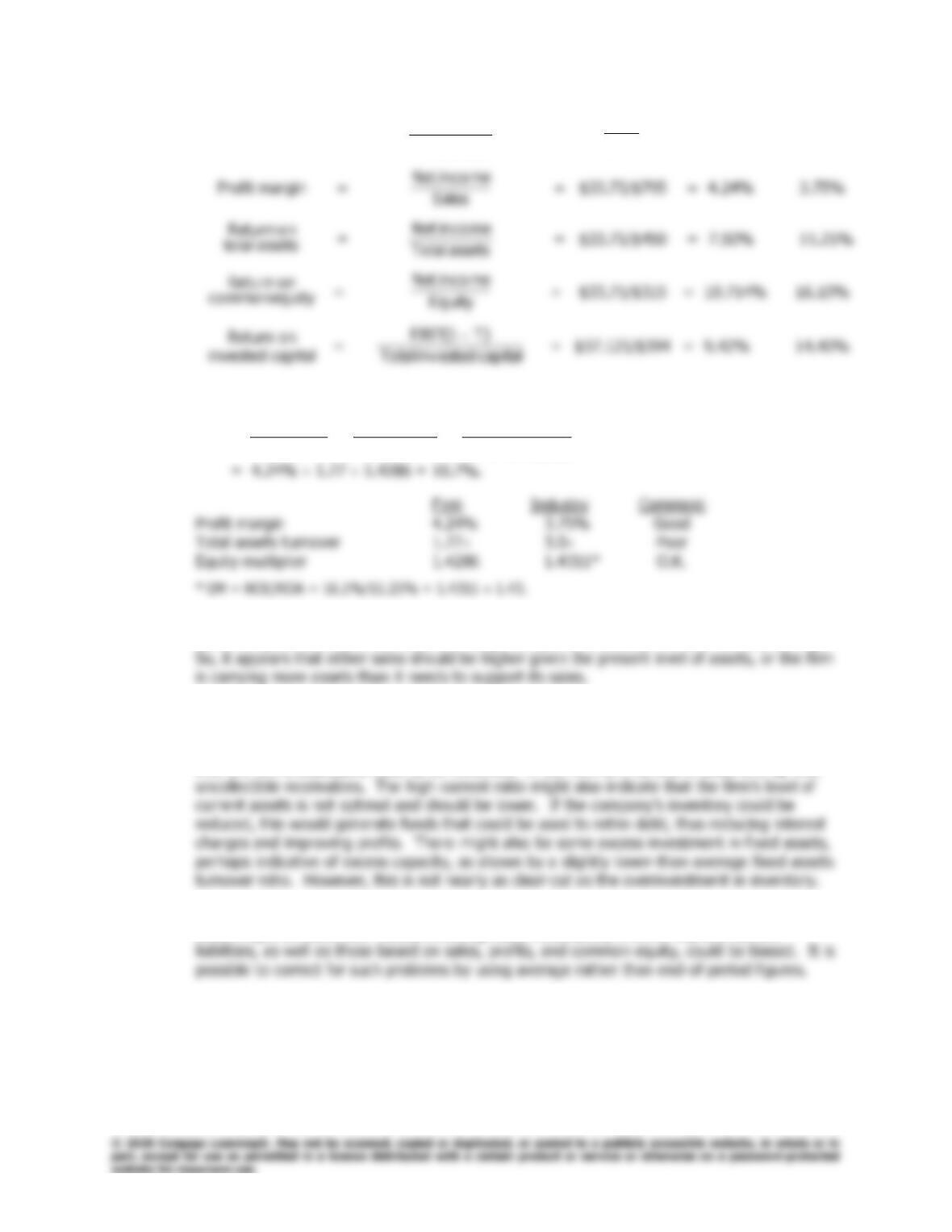
4-24 a. Industry
Firm Average
Current ratio
=
sliabilitieCurrent
assetsC urrent
=
85$
$303
=
3.56
3
capital total
toDebt
=
capital invested Total
debt Total
=
394$
79$
=
20.05%
20.00%
=
=
=
11
7
=
=
=
5
10
=
=
=
30.3 days
64
Answers and Solutions
Chapter 4: Analysis of Financial Statements
turnov er
A .T.
=
assets Total
Sales
=
$450
$795
=
1.77
3
assets Total
b. ROE = Profit margin Total assets turnover Equity multiplier
=
Sales
incomeNet
assets Total
Sales
equity Common
assets Total
c. Analysis of the DuPont equation and the set of ratios shows that the turnover ratio of sales to
assets is quite low; however, its profit margin compares favorably with the industry average.
d. The comparison of inventory turnover ratios shows that other firms in the industry seem to
be getting along with about half as much inventory per unit of sales as the firm. In addition,
the firm’s days’ sales outstanding is higher than the industry average, which could indicate
that the firm’s collections need to be reviewed. If the firm isn’t careful it could end up with
e. If the firm had a sharp seasonal sales pattern, or if it grew rapidly during the year, many
ratios might be distorted. Ratios involving cash, receivables, inventories, and current