Chapter 4
The Heckscher-Ohlin Model
The chapter lays out the basic structure of the simple (2 2 2) Heckscher-Ohlin (HO) model of trade
flows. First, the model is described intuitively. As with the models of earlier chapters, a more formal
presentation begins with a description of the assumptions, including a discussion of why certain
assumptions are made and the differences between the assumptions of this model and those in the classical
model. Students are then shown how the solution of the model and the resulting pattern of trade stem
directly from the assumptions. Once the model has been solved, the chapter compares and contrasts the
equilibrium of this model with that of the classical model. Following this discussion, the chapter moves to
consider some of the other theorems that make up the HO model. The chapter closes with an evaluation of
the model.
Despite its shortcomings, the HO model remains the primary tool of general equilibrium analysis of open
economies. As such, this chapter seeks to provide students with a clear but relatively analytical
introduction to the model. There is probably a bit more attention to theoretical detail than is found in
comparable textbooks at this level. We have successfully taught this material to students with limited
background in economics on a number of occasions. While we feel that it is important that students be
◼ Chapter Outline
Introduction
The HO Model: Basic Assumptions
Global Insights 4.1: Capital/Labor Ratios of Selected U.S. Industries
The HO Theorem
Equilibrium in the HO Model
16 Husted/Melvin • International Economics, Ninth Edition
Some New HO Theorems
Global Insights 4.2: Trade, Wages, and Jobs in the U.S. Economy
Some Final Observations
Summary
◼ Suggested Answers for the End-of–Chapter Exercises
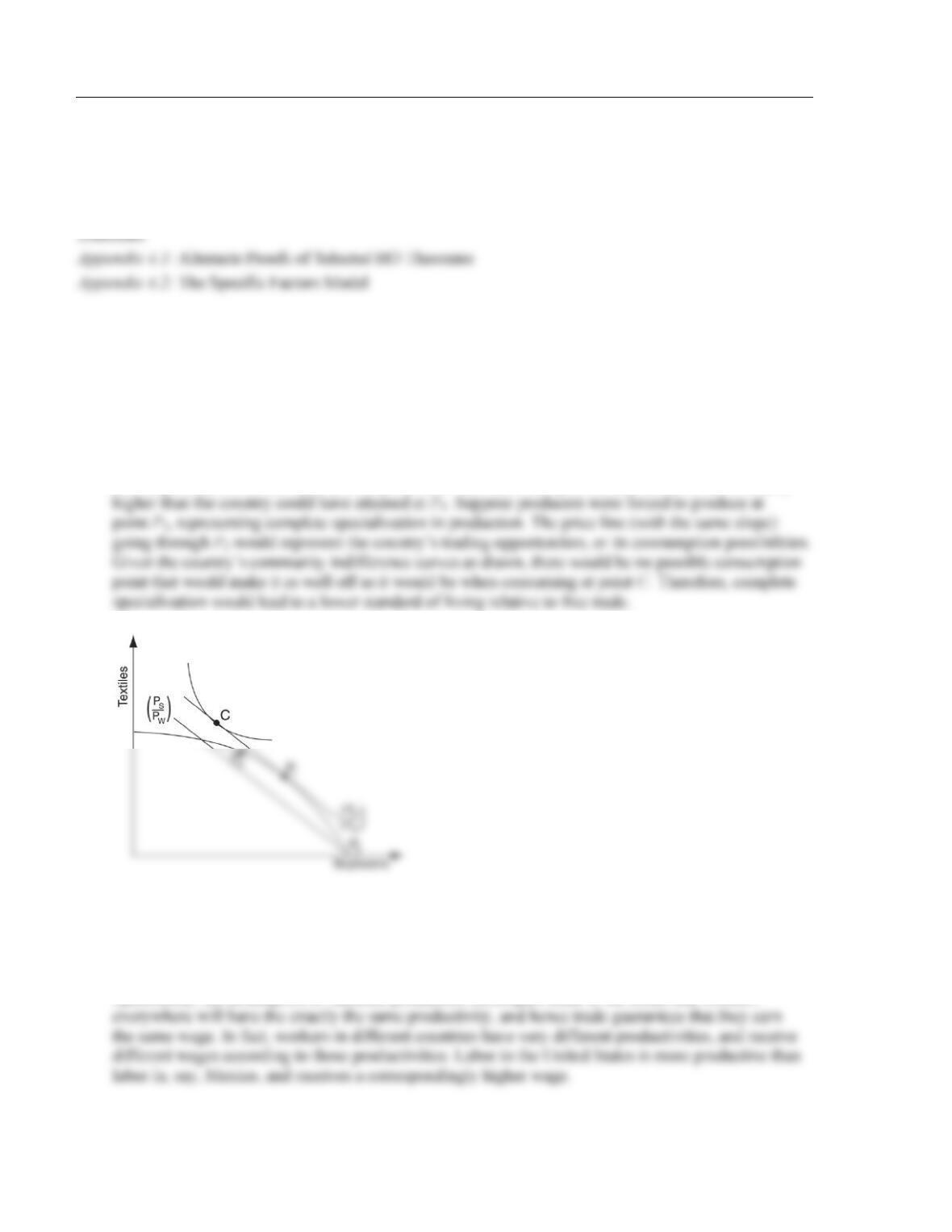
1. Use a general equilibrium depiction of trade equilibrium in the HO model to prove that complete
specialization in the production of exports will, in general, lower the standard of living of an
economy relative to that found in free trade.
The country depicted below is in trading equilibrium. Autarky production and consumption occurs at
point P0. Equilibrium production occurs at point P1, with increased soybean production and decreased
textile production. At the international price ratio PS /PT, consumption occurs at C, which is clearly
2. Some have argued that the factor price equalization theorem implies that American wages must fall
to the level of those found in the least developed countries of the world. Comment on the validity of
this statement.
The factor price equalization theorem holds in the HO model because of certain assumptions.
Specifically, the assumption of identical production techniques leads to the result that workers
3. Consider the following data on the factor endowments of two countries, A and B:
Countries
A
B
Labor Force
(millions of workers)
45
20
Capital Stock
(thousands of machines)
15
10
a. Which country is relatively capital abundant?
b. Which country is relatively labor abundant?
c. Suppose that good S is capital intensive relative to good T. Which country will have comparative
advantage in the production of S? Explain.
First, both countries have more labor than machines. But country A’s labor-capital ratio is three-to–
one, while B’s is only two–to-one. Thus country A is relatively labor abundant, and country B must
4. Compare and contrast the classical and HO theories of the commodity composition of trade. Discuss
differences in assumptions, post trade production points, and the effects of trade on the distribution of
income.
Assumptions: Classical theory assumes that labor is the only relevant factor, and that the production
of goods in each country requires different amounts of labor input (i.e., technology differs). Thus,
labor in the two countries has different productivities. The HO theory assumes there are two factors,
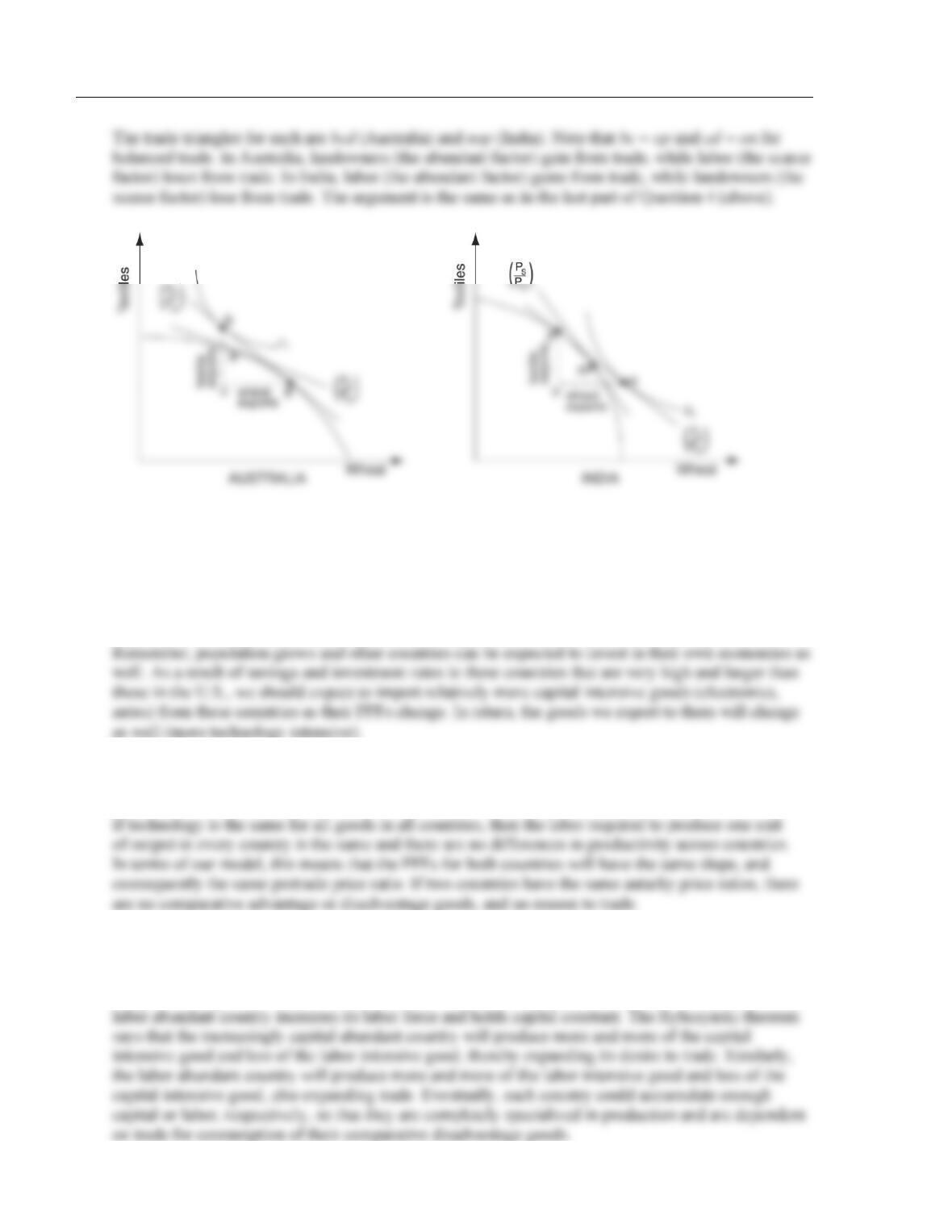
5. Australia is land abundant; India is labor abundant. Wheat is land intensive relative to textiles.
Graphically demonstrate the pre- and post-trade equilibria between these two countries. Find and
label the trade triangles for each. Which factors gain and which factors lose when trade arises
between these two countries? Explain carefully.
18 Husted/Melvin • International Economics, Ninth Edition
6. One of the important changes in the world economy over the past three decades has been the rapid
increase in capital investment in the countries of the Pacific Basin (notably Japan and Korea). What
are the implications of this investment for the commodity patterns of trade of these two countries say
with respect to the U.S.? Explain carefully. (Hint, think about the Rybczynski theorem.)
The Rybczynski theorem tells us that countries that save and invest relatively large amounts in new
capital will tend to produce more capital intensive goods over time. Why relatively large amounts?
7. Explain carefully why the assumption of identical technology worldwide eliminates the classical
basis for international trade.
8. Use the Rybczynski theorem to prove that the more dissimilar countries become in their factor
endowments, the more likely it is to obtain complete specialization once trade begins.
Suppose the capital abundant country increases its stock of capital and holds labor constant, while the
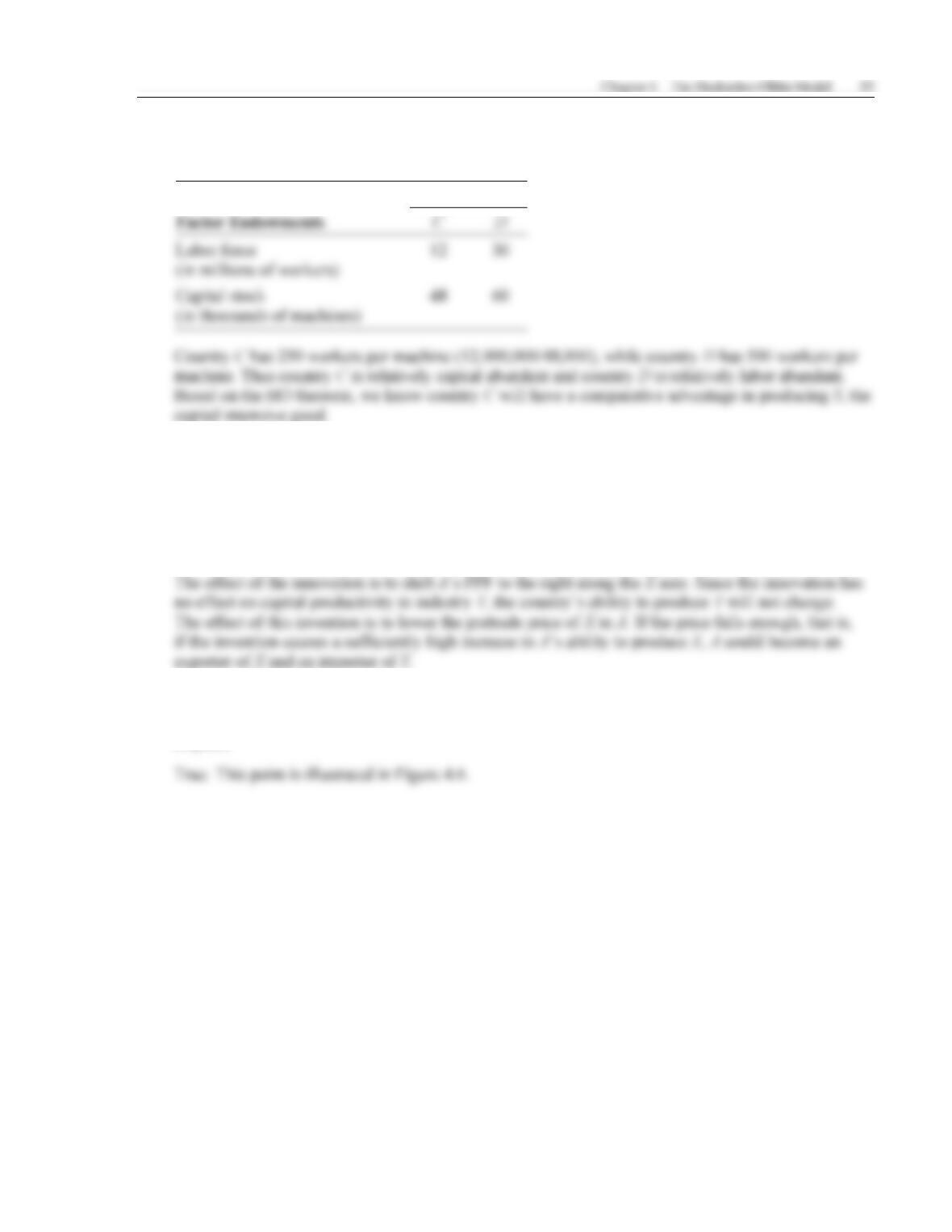
9. Answer the questions in Exercise 3 using the following data on factor endowments of countries C
and D:
Countries
(in millions of workers)
10. Suppose that country A is labor abundant. It can produce two goods, X and Y. Good X is capital
intensive relative to good Y. Derive A’s PPF and determine the pretrade relative price of X in terms
of Y. Now, suppose that there is technological innovation that makes capital more productive in the
X industry, but not in making Y. In a separate diagram, illustrate what would happen to A’s PPF and
explain your result. Show as well what would happen to the pretrade relative price of X in A. How
might this affect A’s trade patterns? Explain.
11. The assumption of identical tastes in the HO model increases the likelihood that comparative
advantage will be determined by international differences in factor endowments. True or false?
Explain.