is inelastic, the price elasticity of demand is
between 0 and –1.
Hints and Common Errors: It’s impor tant
to keep in mind that a number that is less than –1
is going to be larger than 1in absolute value and
vice versa. For example, -3 is less than –1, but –0.5
is greater than –1.
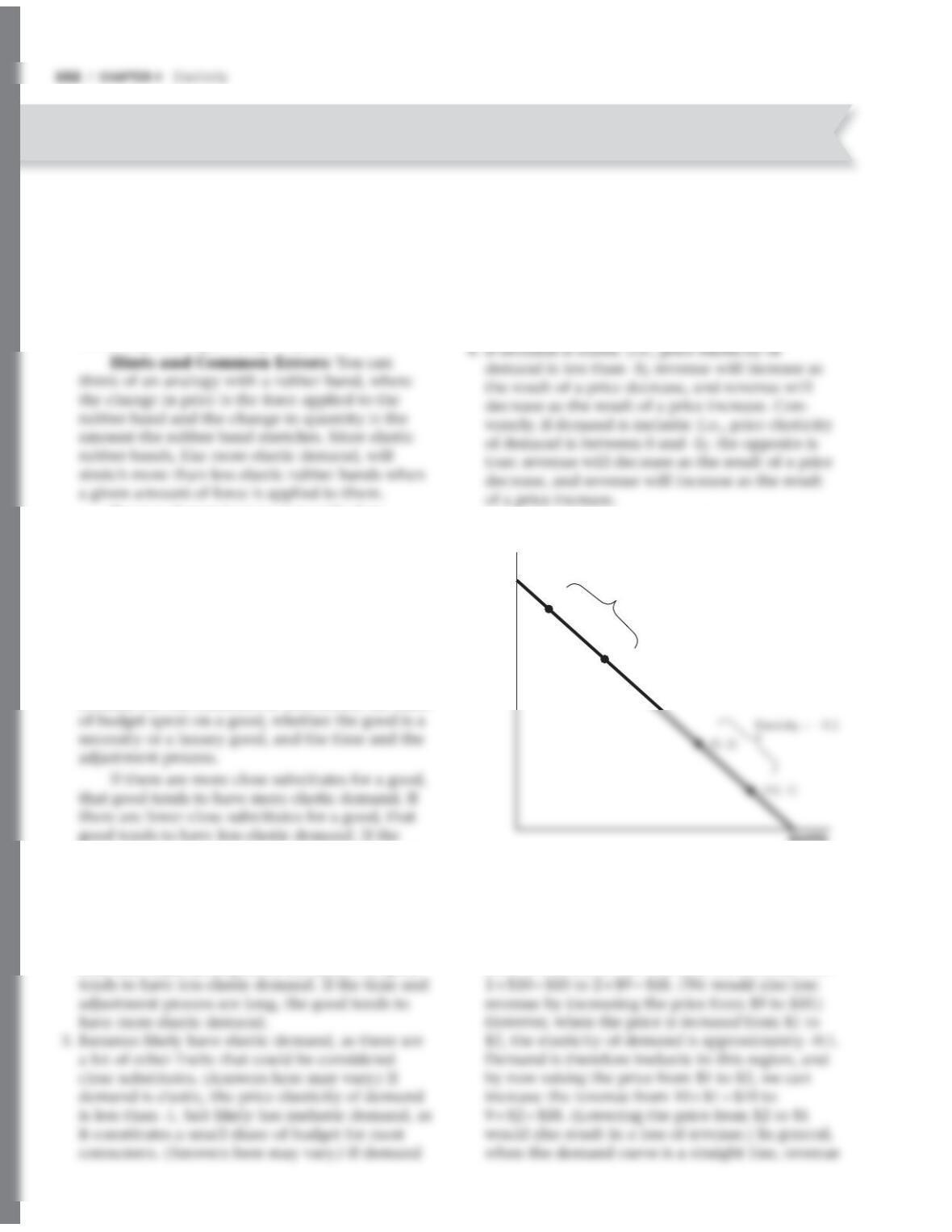
To see this, consider the following simple
demand curve.
Elasticity ⫽ ⫺10
Quantity
Price
(1, 10)
(2, 9)
When the price is lowered from $10 to $9, the
elasticity of demand is approximately –10. (The
calculation is approximate because it’s not done
with the midpoint method.) Demand is therefore
elastic in this region, and by lowering the price
from $10 to $9, we can increase the revenue from
Questions for Review
1. Price elasticity of demand, conceptually speaking,
mea sures the responsiveness of quantity demanded
to changes in price. Mathematically, price elasticity
of demand is equal to the relative (i.e., percentage)
change in quantity demanded divided by the rela-
tive (i.e., percentage) change in price.
Because demand curves generally slope
downward, it is typical for changes in quantity
demanded and changes in price to move in
opposite directions. This results in price elasticity
of demand that is usually negative. It’s fairly
common for economists just to look at price
elasticity of demand as an absolute value (in
other words, drop the negative sign), but we
aren’t going to do that here.
2. The four determinants of price elasticity of
share of bud get spent on a good is low, the good
tends to have less elastic demand. If the share of
bud get spent on a good is high, the good tends to
have more elastic demand. If a good is a necessity,
need trumps price, and demand is inelastic. If a
good is a luxury, demand is more elastic. If the
time and adjustment pro cess are short, the good
Solutions to Chapter4 Text Prob lems
8. Digital music likely has elastic supply, as produc–
ers have a lot of exibility over the quantity pro-
duced. (Answers here may vary.) If supply is
than 1.
Hints and Common Errors: Because the
law of supply suggests that price elasticity of
supply won’t be negative, one could say that a
good with inelastic supply has a price elasticity
of supply that is greater than or equal to 0 but
less than 1.
9. Taxi rides are likely a normal good. If a good is a
normal good, demand for the good increases
when income increases (and vice versa). Because
income and demand move in the same direction
Because income and demand move in opposite
directions for inferior goods, income elasticity of
demand for inferior goods is less than 0.
10. Cross- price elasticity of demand mea sures the
change in quantity demanded of one good in
response to a change in price of another good.
ative cross- price elasticity of demand are com-
plements, as when the price of one of the goods
goes up, the quantity demanded of the other
good decreases (and vice versa), so the numera-
tor and denominator of the elasticity number
5. A demand curve is drawn with price on the ver–
tical axis and quantity demanded on the hori-
zontal axis. Therefore, the slope of a demand
whereas the reverse is true with the slope of the
demand curve. Second, price elasticity of
demand is calculated using relative or percent–
age changes in price and quantity demanded,
whereas the slope of the demand curve is calcu-
lated using absolute changes.
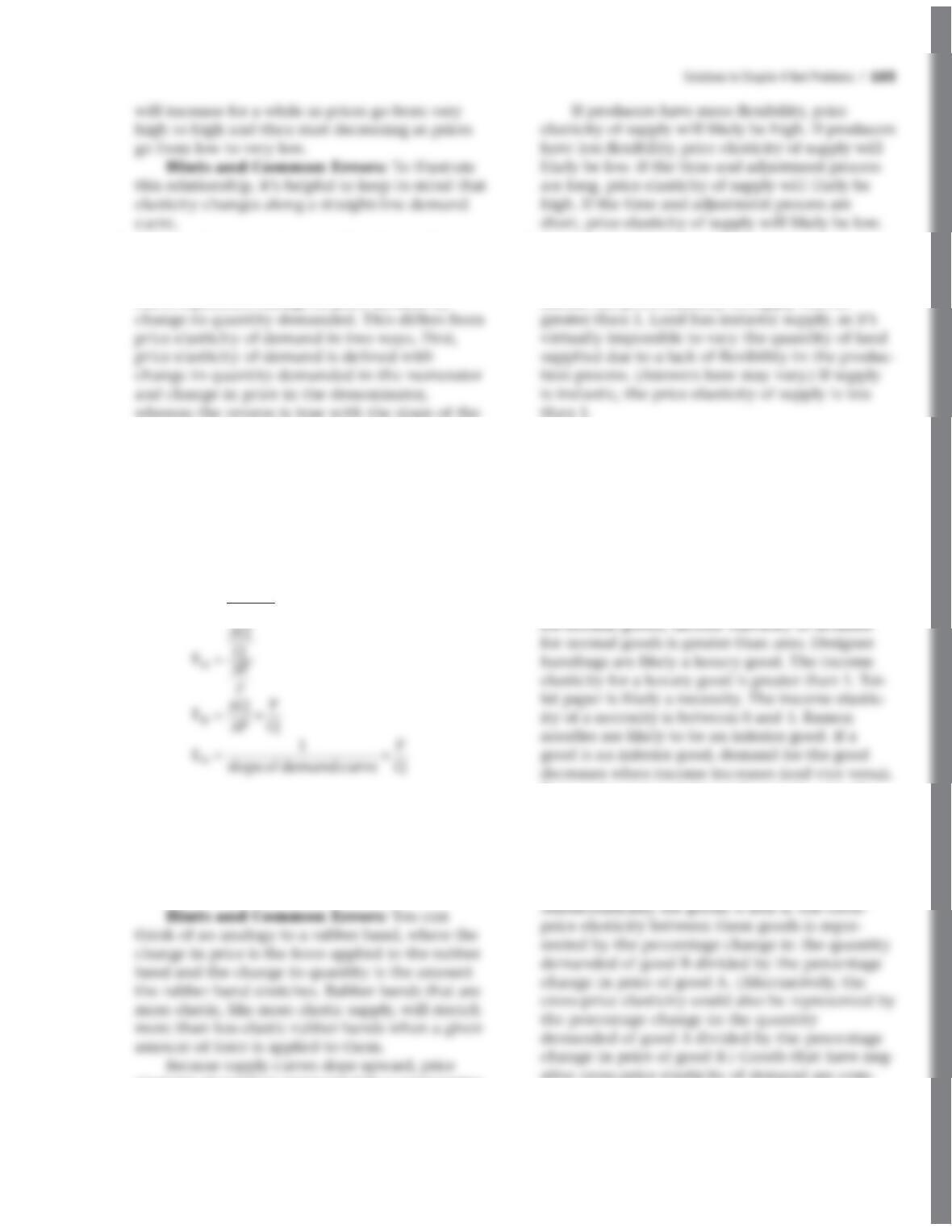
Hints and Common Errors: The
mathematical relationship between slope and
elasticity goes as follows:
ED=%QD
%P
6. Price elasticity of supply, conceptually speaking,
mea sures the responsiveness of quantity supplied
to changes in price. Mathematically, price elastic-
ity of supply is equal to relative (i.e., percentage)
change in quantity supplied divided by relative
(i.e., percentage) change in price.
elasticity of supply is represented by a nonnegative
number.
7. Two determinants of price elasticity of supply are
the exibility of producers and the time and
adjustment pro cess.
of demand of less than –1.
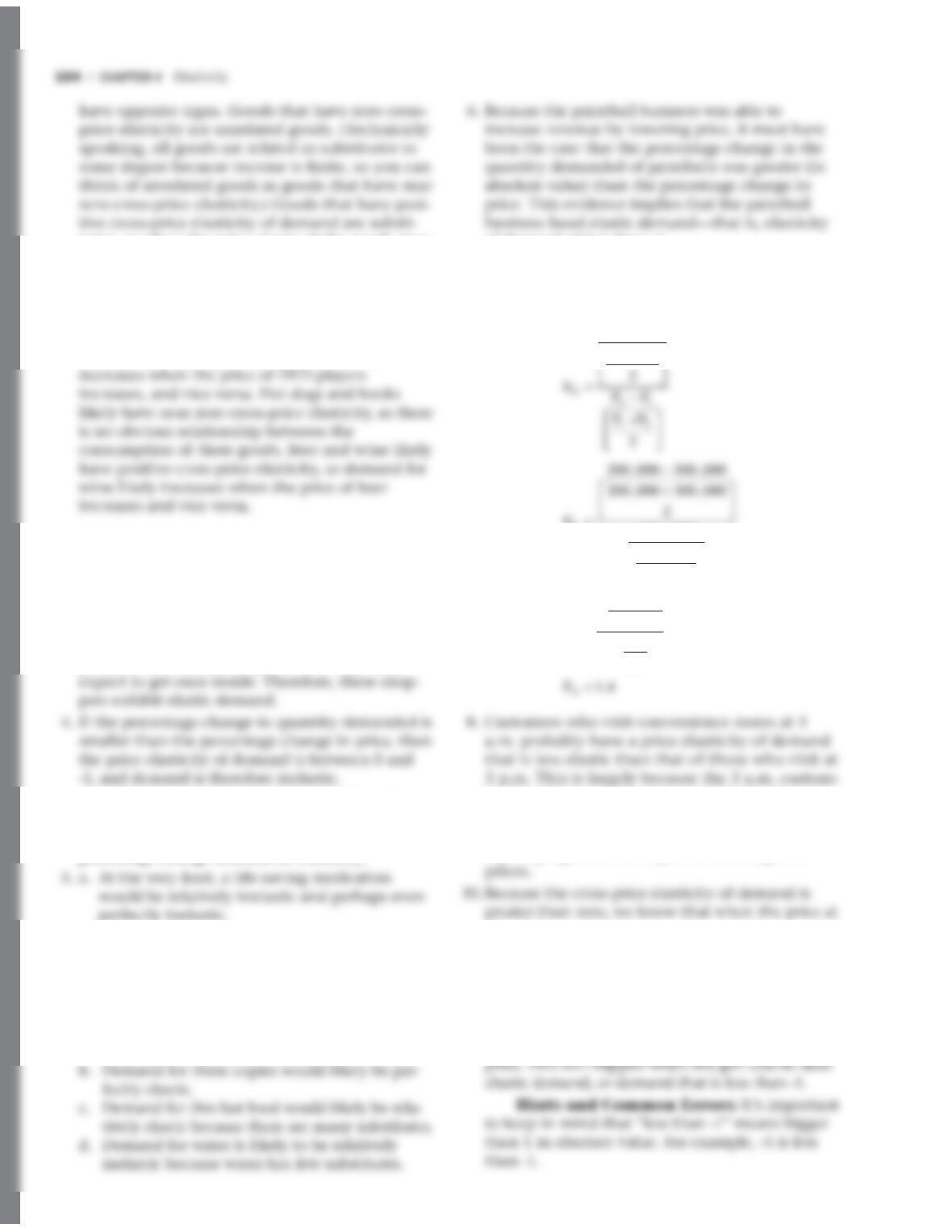
7. We use the midpoint method whenever pos si ble,
as it is the preferred method for solving elasticity
prob lems:
Q2Q1
Q1+Q2
ES=
150 200
150 +200
2
ES=
100 , 000
250 , 000
50
175
ers have fewer substitutes available for the con-
ve nience store, which means they cannot
change their quantity demanded as much as the
3 p.m. people can in response to changes in
one of the stores increases, the quantity
demanded of the other store’s merchandise
increases and vice versa. Therefore, we can con-
clude that the two stores are substitutes.
11. Lowering the fee will increase revenue when the
percentage increase in quantity demanded is more
than enough to offset the percentage reduction in
tutes, as when the price of one of the goods goes
up, the quantity demanded of the other good
increases (and vice versa), so the numerator and
denominator of the elasticity number have the
same sign.
DVDs and DVD players likely have negative
cross- price elasticity, as demand for DVDs
Study Prob lems
3. You often hear about very long lines of people
waiting to get into Best Buy or Walmart on Black
Friday, which suggests that the change in quan-
tity demanded by these shoppers is large com-
pared to the decrease in prices that they could
Hints and Common Errors: When there
isn’t enough information to use the midpoint
method, it is okay to revert to the regular
Hints and Common Errors:
Technically, no good can have perfectly
inelastic demand over all prices, but it can be
a reasonable approximation in some cases.
This is simply because people have nite
amounts of wealth and therefore can’t
demand an item at every pos si ble price.
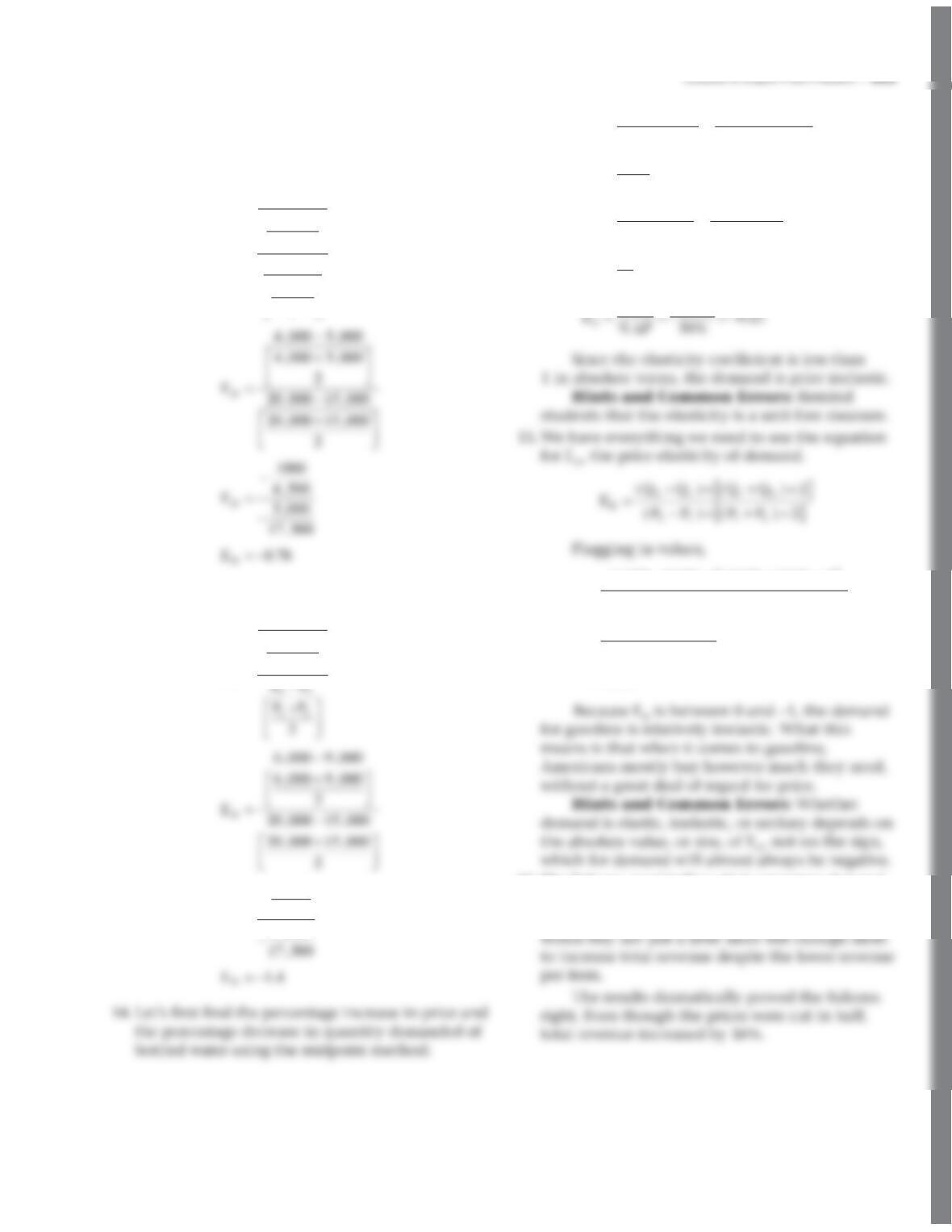
%
Q
=
Q
2
Q
1
(
Q
2+
Q
1)/2
=900 1000
( 900 +1000 ) / 2
•100
=100
950
•100 =10.5%
%
P
=
P
2
P
1
(
P
2+
P
1)/2
=$5 $3
($5 +$3 ) / 2
•100
=$2
$4
•100 =50%
Q
ED=(143 B 133B)÷(133 B +143B)÷2
[]
( $ 2.25 $ 3.64 ) ÷( $ 3.64 +$ 2.25 ) ÷2
[]
=10 B ÷138 B
($1.39 ) ÷$ 2.945
=0.15
16. The Falcons must believe that consumer demand
is elastic. The team lowered the prices on food and
drink sold at the stadium in hopes that fans
12. We use the midpoint method when pos si ble, as it
is the preferred method for solving elasticity
prob lems.
For in- state applicants:
ED=
Q2Q1
Q1+Q2
2
P2P
1
P
1+P2
2
For out– of- state applicants:
ED=
Q2Q1
Q1+Q2
2
ED=
3000
7 , 500