4 Trade and Resources: The Heckscher–Ohlin Model
Notes to Instructor
Chapter Summary
This chapter presents the Heckscher–Ohlin model with two factors (capital and labor),
two goods (computers and shoes), and two countries (Home and Foreign). A test of the
model is discussed with Leontief ’s paradox. Additionally this chapter, like the last,
discusses the affect of trade on factor prices. The “sign test” in the Heckscher-Ohlin
model is discussed in the Appendix.
Comments
Note that this chapter covers only two theorems of the Heckscher–Ohlin model—the
Heckscher–Ohlin theorem and the Stolper–Samuelson theorem. The other two
theorems—the Rybczynski theorem and Factor Price Insensitivity—are deferred to the
next chapter, in an effort to break the material into smaller pieces.
Unlike the previous chapters, a discussion of the theory is followed by an empirical
test. This concept is possibly new to students and could be highlighted to generate
interest in the topic. Moreover, although students are quite familiar with graphing supply
and demand from their principles course, place emphasis on teaching the export supply
and import demand curves, particularly because the derivation of these curves requires an
understanding of the relationship between the no-trade and free–trade relative prices.
Similarly, the topic of relative demand and supply may also benefit from additional
attention as the shift of the curves due to changes in the relative price may not be
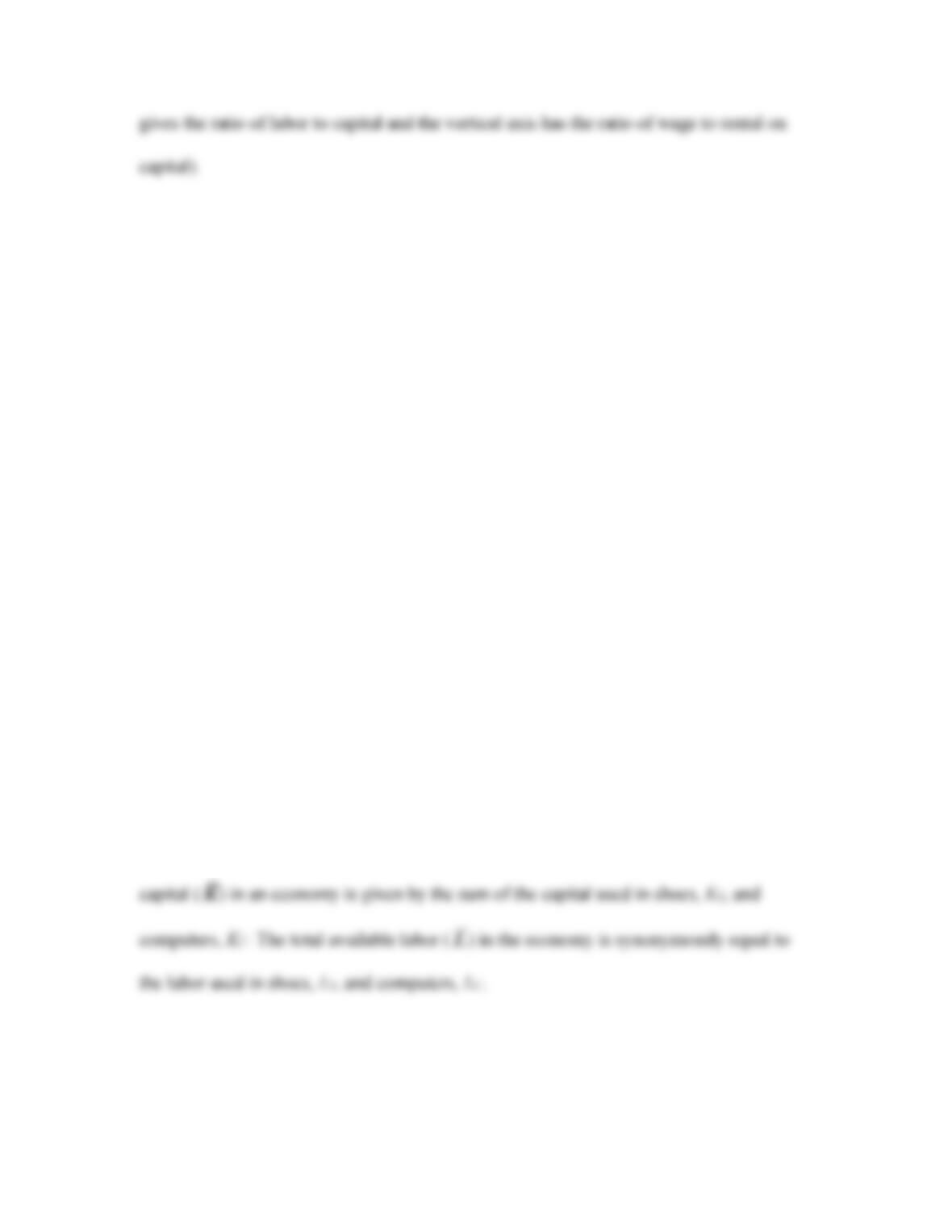
immediately obvious to the students because the curves are in ratios (i.e., horizontal axis
Lecture Notes
Introduction
We begin the chapter with a comparison between the Ricardian model, in which trade
occurs due to differences in technology between countries giving rise to their
comparative advantage, and the Heckscher–Ohlin model, in which uneven distribution
in resources leads countries to trade with one another. The Heckscher–Ohlin model also
differs from the specific-factors model in that factors of production can move between
industries because the model is set in the long run. The model was developed to explain
the “golden age” of international trade between 1890 and 1914, during which there was
an increase in the ratio of trade to gross domestic product (GDP) coinciding with
improvements in transportation.
1 Heckscher–Ohlin Model
The Heckscher-Ohlin model consists of two factors (capital and labor), two goods
(computers and shoes), and two countries (Home and Foreign). The total amount of
Assumptions of the Heckscher–Ohlin Model
The six assumptions of the Heckscher–Ohlin model are as follows:

Assumption 1: Both factors can move freely between the industries.
The implication of the first assumption is that the rental on capital, R, is identical
across the two industries. If one industry has a higher rental, it would attract capital from
Assumption 2: Shoe production is labor-intensive, that is, it requires more labor per unit
of capital to produce shoes than computers, so that LS/KS > LC/KC.
The second assumption states how intensive the factors are in the production of each
good. Namely, computer production is capital-intensive, requiring more capital per
worker than the production of shoes. Because shoe production is labor-intensive, the
relative demand curve in shoes, LS/KS, is to the right of the relative demand curve in
computers, LC/KC, in Figure 4-1, where the horizontal axis gives the ratio of labor to
capital used in production and the vertical axis denotes the ratio of the labor wage to the
capital rental.
[FIGURE 4–1 MISSING FROM PDF TEXT]
Assumption 3: Foreign is labor-abundant, by which we mean that the labor–capital ratio
in Foreign exceeds that in Home, . Equivalently, Home is capital
abundant, so that .
The third assumption distributes the resources unevenly across the two countries, with
Home being capital-abundant, whereas Foreign is labor-abundant. Remember, labor- and
capital-abundance are always in relative terms. The textbook provides an example
Assumption 4: The final outputs, shoes and computers, can be traded internationally, but
labor and capital do not move between countries.
Assumption 5: The technologies used to produce the two goods are identical across the
countries.
From the fifth assumption, we see that each good is produced using the same
Assumption 6: Consumer tastes are the same across countries, and preferences for
computers and shoes do not vary with a country’s level of income.
The sixth assumption implies that although the poorer country would consume less of

APPLICATION
Are Factor Intensities the Same Across Countries?
In the United States, footwear production is more capital-intensive than call centers
because of the expensive automated–manufacturing machines used by a New Balance
plant. However, there is a “reversal” of factor intensities in India, where call centers are
N E T W O R K
The New Balance website can be found through the following link:
No–Trade Equilibrium
Production Possibility Frontiers Figure 4-2 shows the production possibility frontiers
(PPFs) for Home in panel (a) and Foreign in panel (b). The bowed-out PPF is biased
Indifference Curves With the assumption of common consumer tastes across the
countries, we add an identical indifference curve to each country’s PPF. The tangency of
No–Trade Equilibrium Price The no–trade equilibrium for Home is at point A, with
production of computers and shoes given by QC1 and QS1. The no-trade equilibrium for
Free–Trade Equilibrium
Home Equilibrium with Free Trade With free trade, the equilibrium relative price of
computers is between the no-trade relative prices found at Home and Foreign. More
specifically, panel (a) of Figure 4-3 shows that the free–trade equilibrium price of
computers, (PC/PS)W, is steeper than the no-trade price at Home (see Figure 4–2) because
Foreign Equilibrium with Free Trade In panel (a) of Figure 4-4, the Foreign no-trade
equilibrium is at point A*. Because the Foreign no–trade relative price is higher than at
Home, the world equilibrium price of computers, (PC/PS)W, is cheaper than the no-trade
Foreign price, (P*/P*S)A*. Facing a lower relative price of computers under free trade,
Equilibrium Price with Free Trade Putting together Home’s export supply curve for
computers and Foreign’s import demand curve for computers gives the equilibrium
relative price of computers with free trade as shown in Figure 4-5. At the world relative
Pattern of Trade The pattern of trade can be determined from the free–trade equilibrium.
Namely, a country will export the good that uses intensively the factor of which it has an
Heckscher–Ohlin Theorem With two goods and two factors, each country will export
2 Testing the Heckscher–Ohlin Model
Testing the Heckscher–Ohlin Theorem: Leontief’s Paradox
Using 1947 data for the United States, Leontief measured the amount of capital and labor

required to produce $1 million worth of U. S. exports. The measurement indicated that
the capital–labor ratio used in export production was $14,000 per worker. Applying U. S.
technology to measure the labor and capital used in producing imports, Leontief found
Explanations Many explanations have been offered to explain Leontief ’s paradox,
including the following:
• Technologies in the United States and rest of the world may not have been the
same as the Heckscher–Ohlin theorem assumes.
Many of these explanations focus on the importance of more than two factors or the
ability of factors (such as skilled vs. unskilled labor). In the remainder of this section, we

Endowments in the New Millennium
The method for measuring factor abundance differs when we consider more than two
factors of production. The general definition of factor abundance is given by the
country’s share of that factor, as compared with its share of world GDP. A country is
Capital Abundance Using the general definition and data from Figure 4-6, we see that in
2013 the United States was physical–capital scarce because its share of the world’s capital
Labor and Land Abundance Using a similar comparison, Figure 4-6 shows that the
United States is abundant in research and development (R&D) scientists and skilled
Differing Productivities Across Countries
Although the extended Heckscher–Ohlin model is better at predicting the pattern of
international trade by allowing for many goods, factors, and countries, we can further
examine the accuracy of the model by dropping the assumption of identical technologies
Measuring Factor Abundance Once Again Measuring whether a country is abundant
in that effective factor or scarce in that effective factor is similar to the method we
Effective R&D Scientists To account for the differences in productivities across
countries due to the availability of laboratory equipment, we measure effective R&D
scientists by multiplying the actual number of R&D scientists by the amount of R&D
Effective Arable Land The effective amount of arable land is defined as the actual
arable land in a country times its productivity in agriculture. After accounting for the
differing productivities in arable land, we find that the U.S. was abundant in effective
arable land in 2013 because its share of effective arable land (20.7%) was greater than its
H E A D L I N E S
China Drawing High–Tech Research from the United States
Applied Materials, a U.S. firm that is currently the world’s largest supplier of equipment
Leontif’s Paradox Once Again
Going back to data from the time periods studied by Leontief, with our newly developed
concepts of effective abundance, we can redo Leontief ’s factor calculations, taking into
account the productivity of the U. S. workforce. To do this, we estimate productivity with
3 Effects of Trade on Factor Prices
In this section, we determine the impact of trade on the wage and rental earned by labor
Effect of Trade on the Wage and Rental of Home
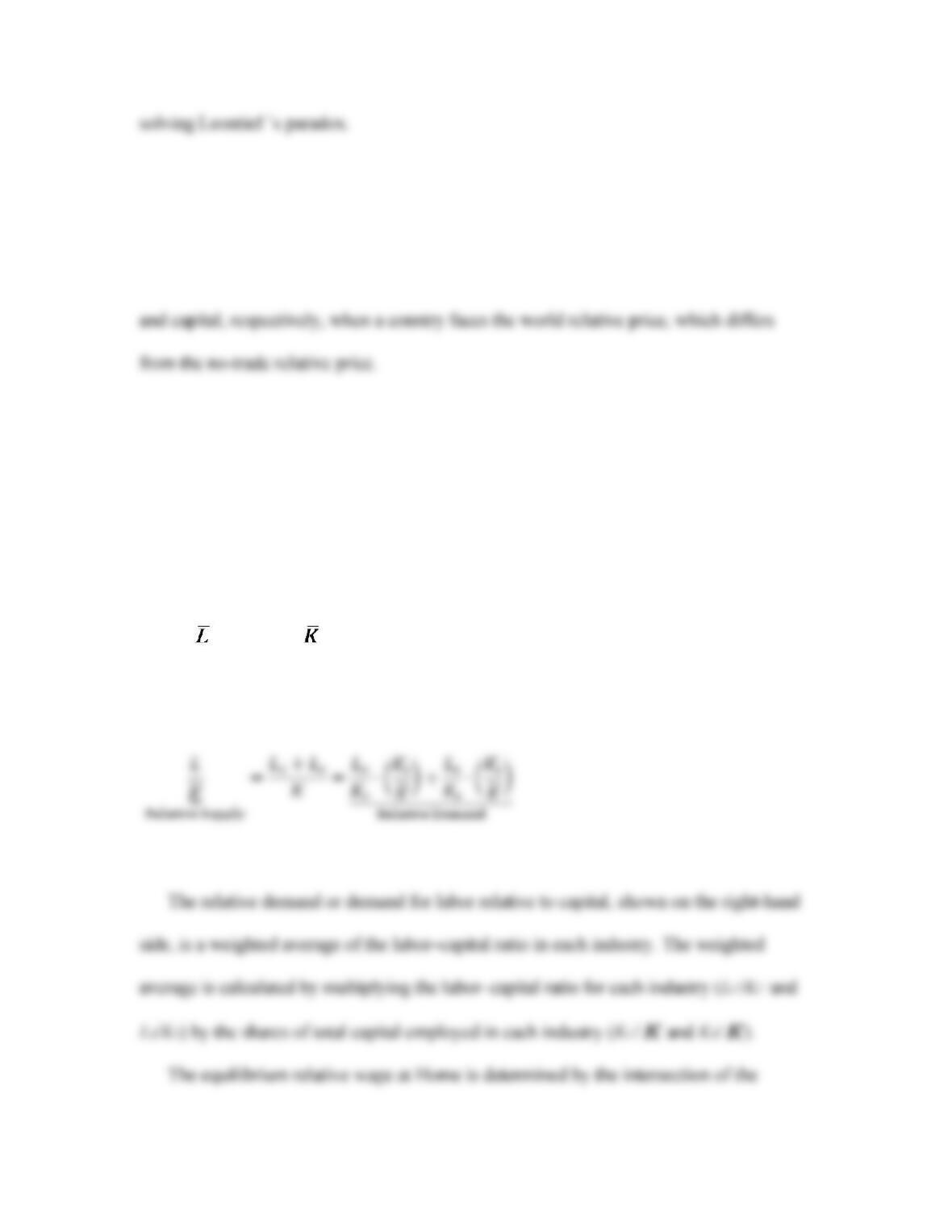
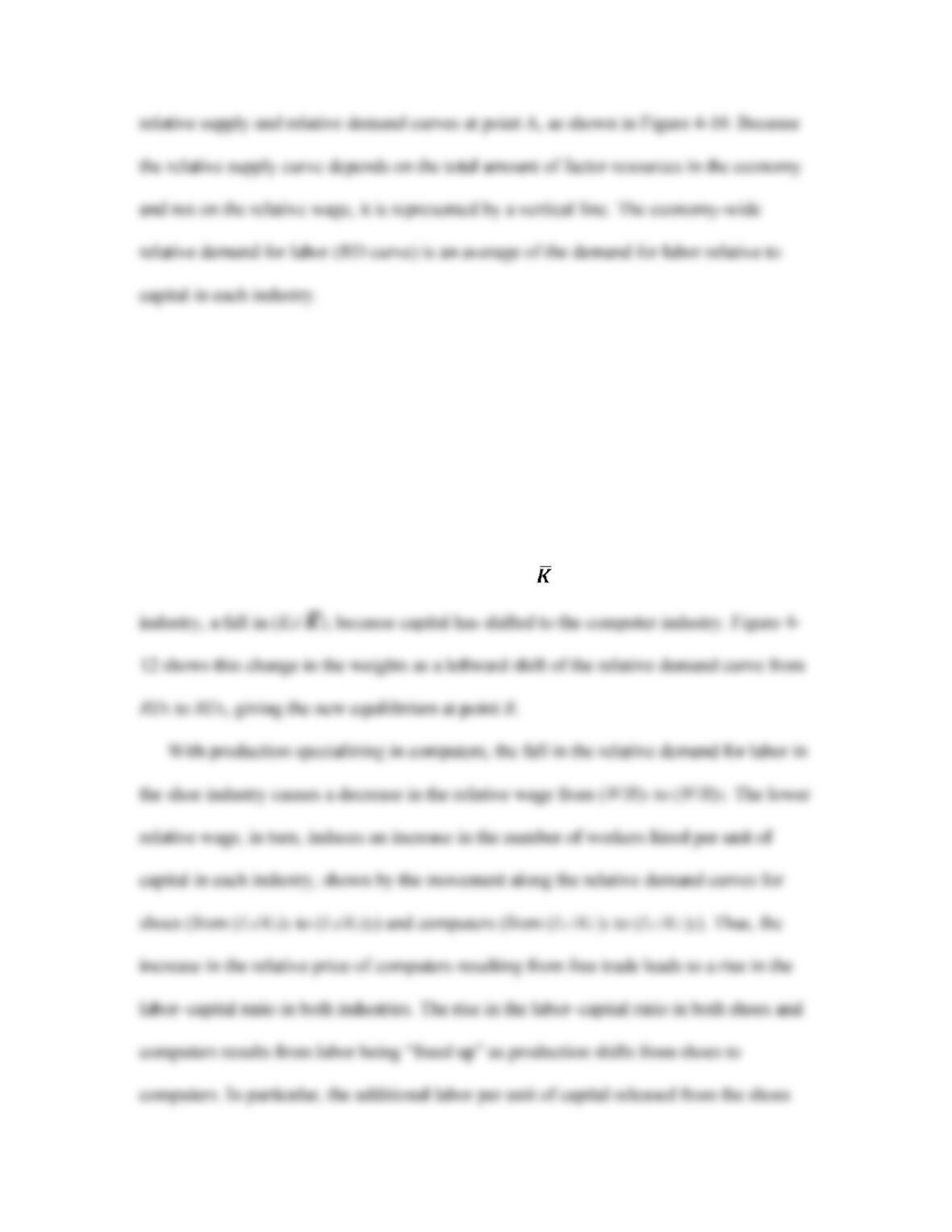
Economy-Wide Relative Demand for Labor Recall that the total amount of labor
(capital) in an economy is equal to the sum of the labor (capital) in each industry, i.e., LC
+ LS = (KC + KS + ). Dividing total labor by total capital, we get the supply of labor
relative to capital or relative supply:
Increase in the Relative Price of Computers Because of free trade, Home faces a
higher relative price of computers, which drives it to further specialize in the production
of computers, shifting away resources from the production of shoes. The increase in the
production of the capital-intensive good (computers) leads to a change in the relative
demand for labor. More specifically, for the relative demand for labor in the economy,
we put more weight toward computers, a rise in (KC/ ), and less weight toward the shoe
exceeds the requirement necessary to operate the capital in computers. The change in the
relative supply and relative demand due to an increase in the relative price of computers
can be summarized by the following:
Determination of the Real Wage and Real Rental
Change in the Real Rental The rental on capital in computers (shoes) is equal to its
marginal product multiplied by the price of computers (shoes):
R = PC • MPKC and R = PS • MPKS
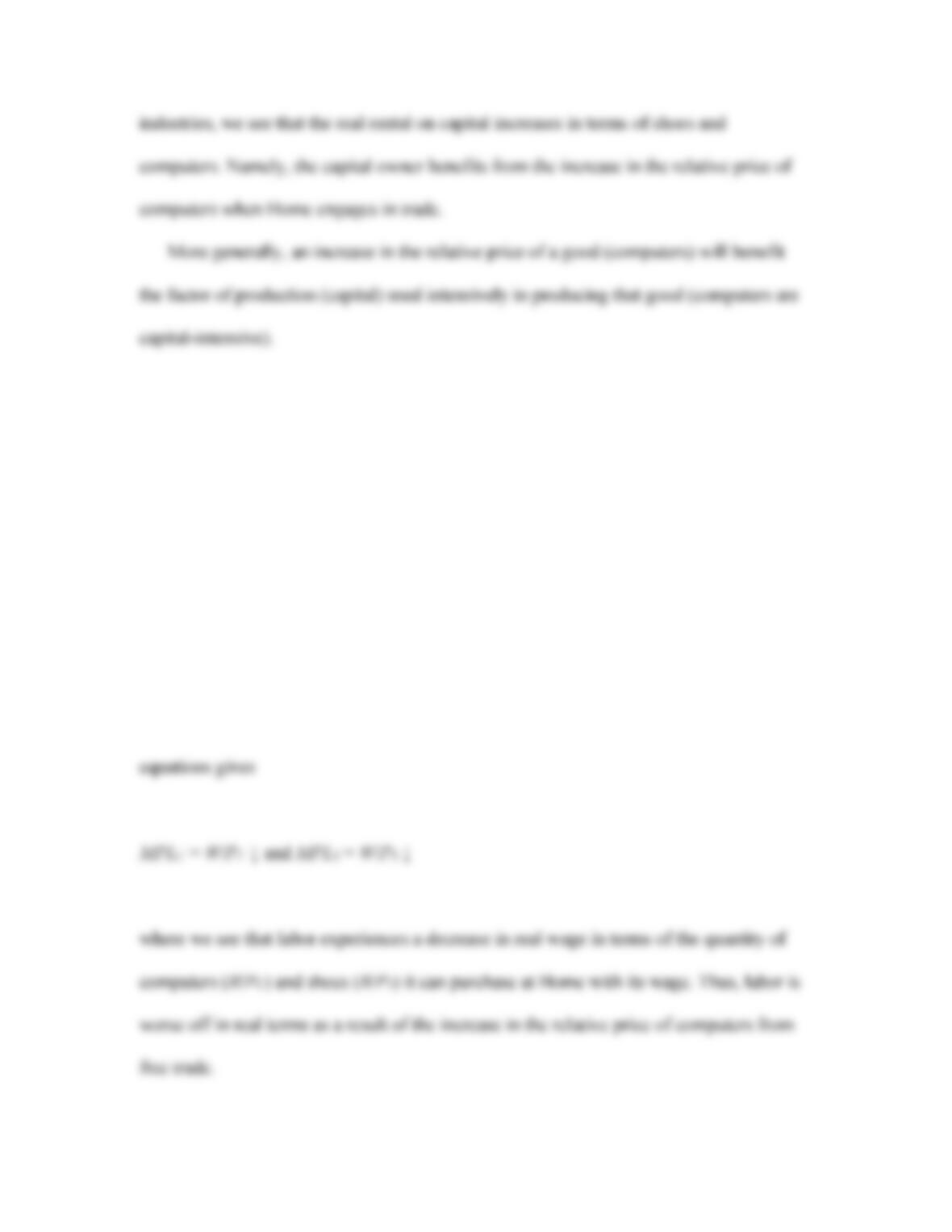
Because the labor–capital ratio increases in both industries due to the higher world
relative price of computers, the marginal product of capital also increases in both shoes
and computers. Rearranging the previous equations, we get
Change in the Real Wage Similarly, the wage in computers (shoes) is equal to its
marginal product multiplied by the price of computers (shoes):
W = PC • MPLC and W = PS • MPLS
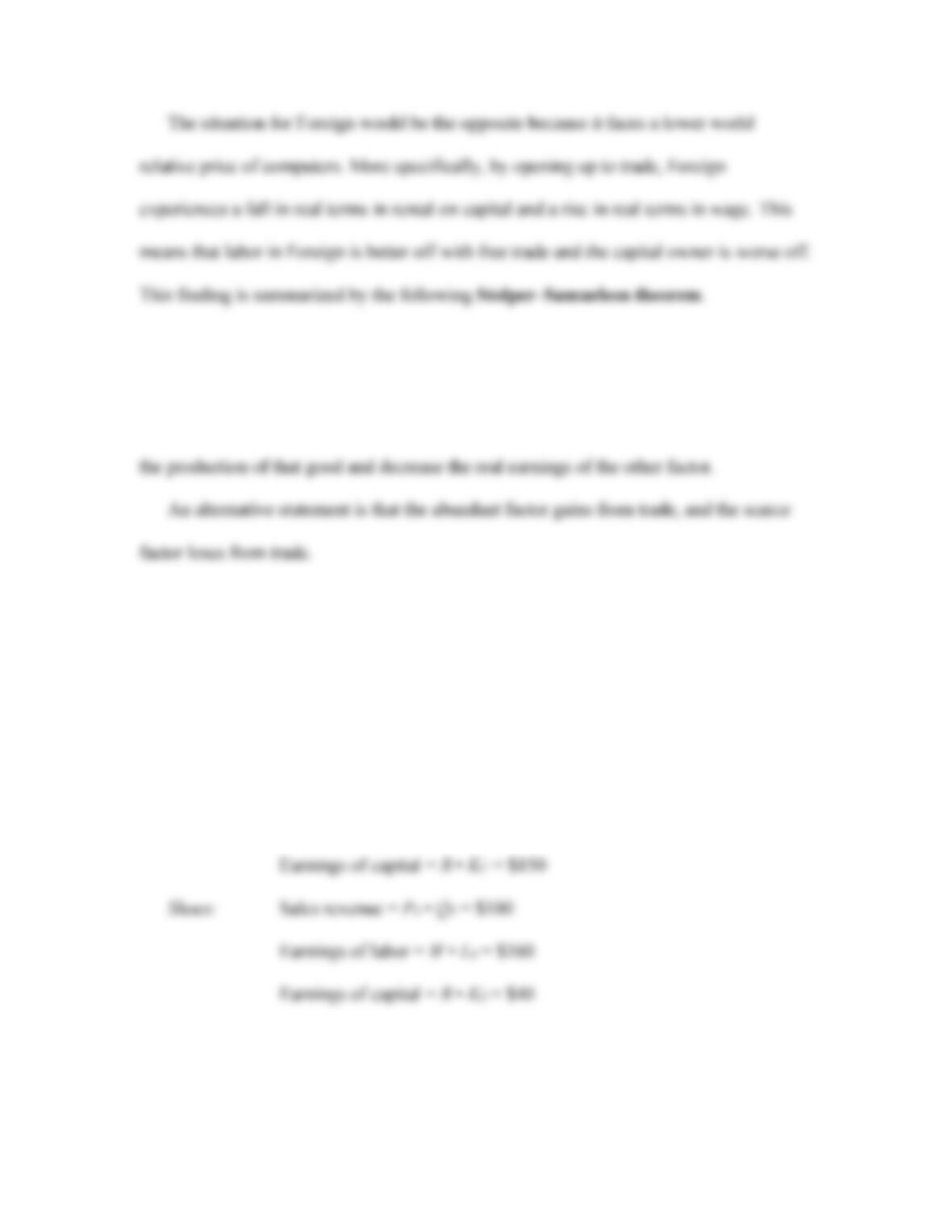
However, unlike the case for capital, the law of diminishing returns tells us that the
increase in the labor–capital ratio (i.e., more labor per unit of capital) will lead to a
decrease in marginal produce of labor in both industries. Re arranging the preceding
Stolpe–Samuelson Theorem In the long run, when all factors are mobile, an increase in
the relative price of a good will increase the real earnings of the factor used intensively in
Changes in the Real Wage and Rental: A Numerical Example
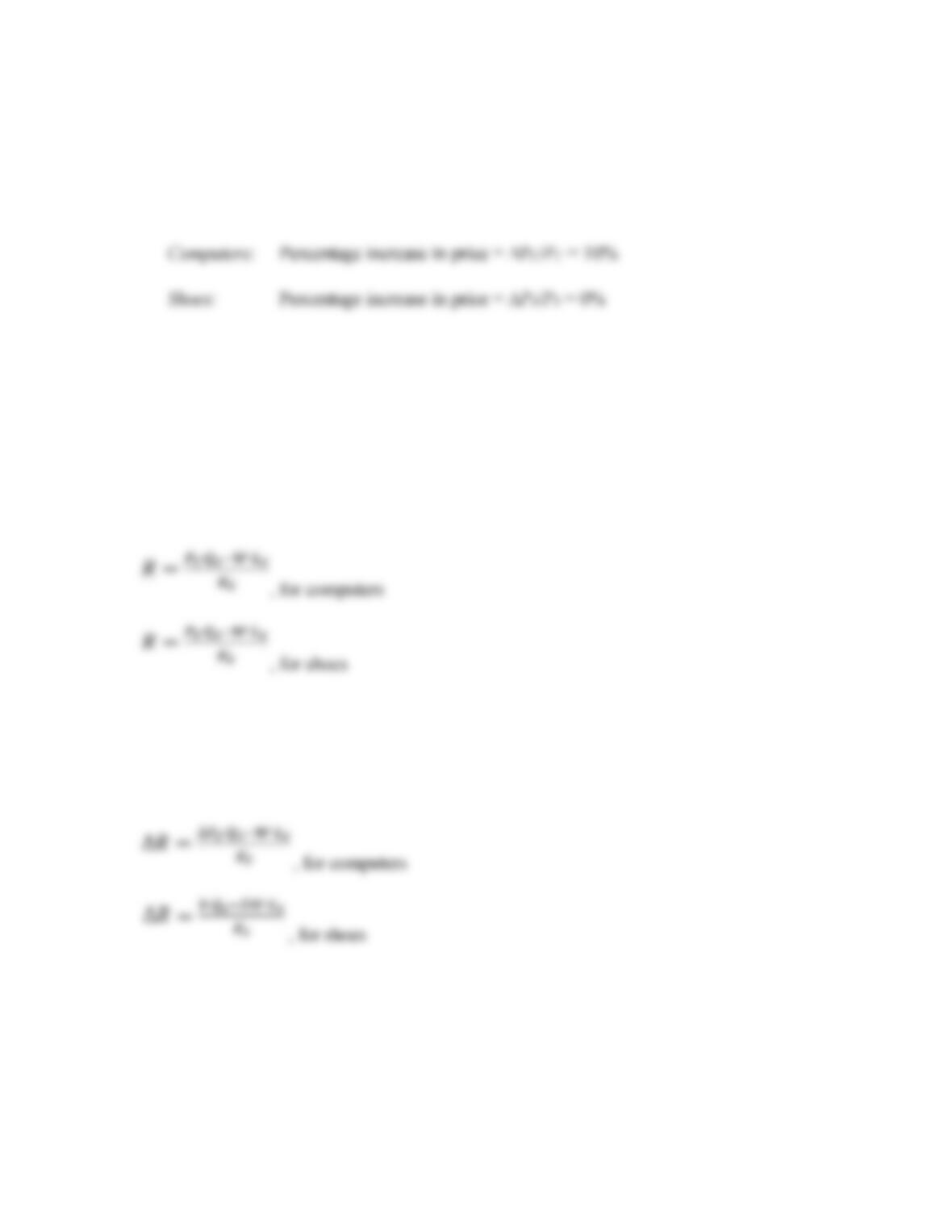
Suppose the following:
Computers: Sales revenue = PC • QC = $100
Earnings of labor = W • LC = $50
Note that shoes are more labor-intensive than computers because the share of total
revenue paid to labor in shoes (60/100 = 60%) is more than that share in computers
(40/100 = 40%). Under free trade, the relative price of computers rises as follows:
To determine the impact of the higher relative price of computers on the rental on
capital for each industry, we subtract the payments to labor from total sales revenue and
divide the difference by the amount of capital:
We now add in the information pertaining to the increase in the price of computers:
Rewriting the previous equations in terms of percentage changes, we have the
following:
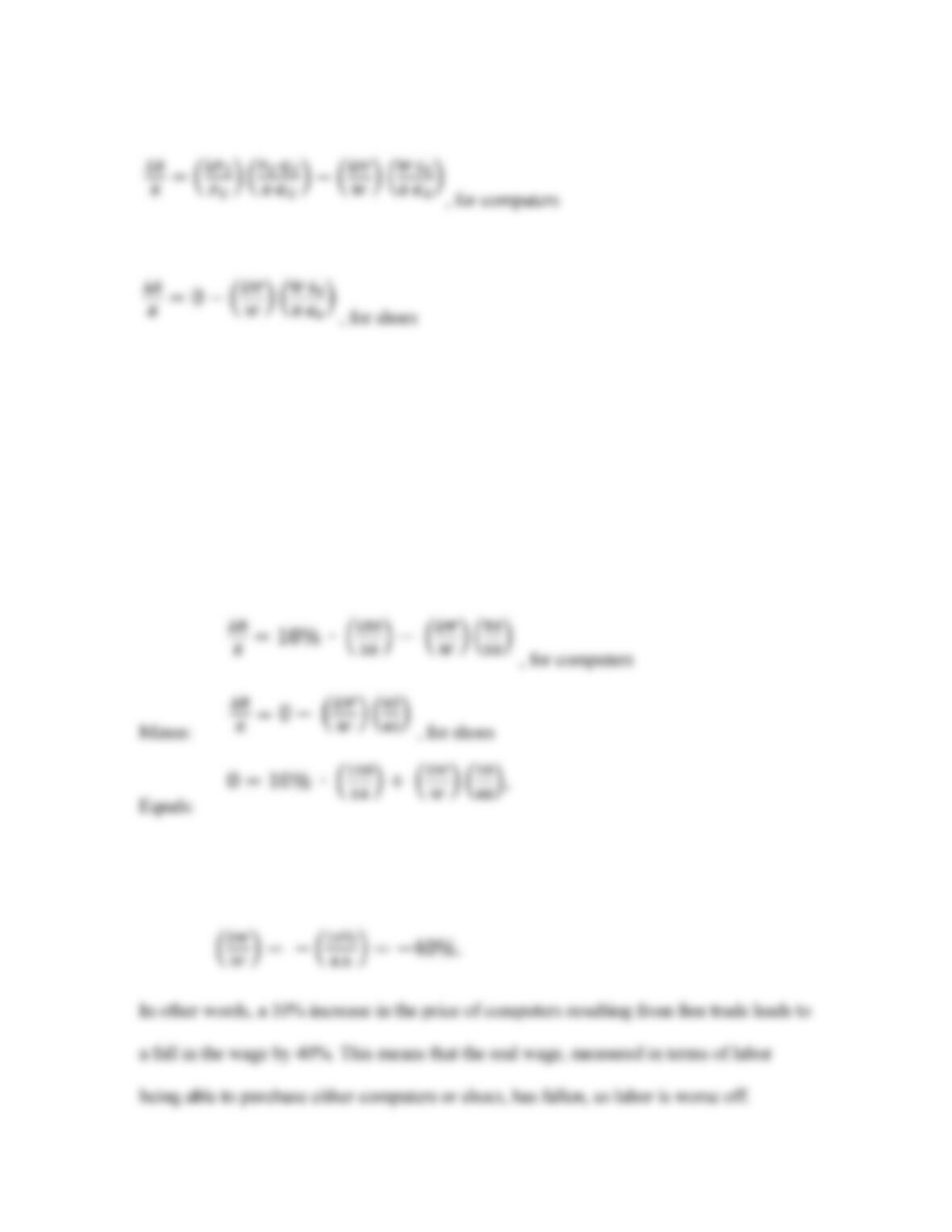
where ∆PC/PC is the percentage change in the price of computers, ∆W/W is the
percentage change in the wage, and ∆R/R is the percentage change in the rental on
capital.
Substituting the numbers given and subtracting one equation from the other, we get
which gives the change in wages as
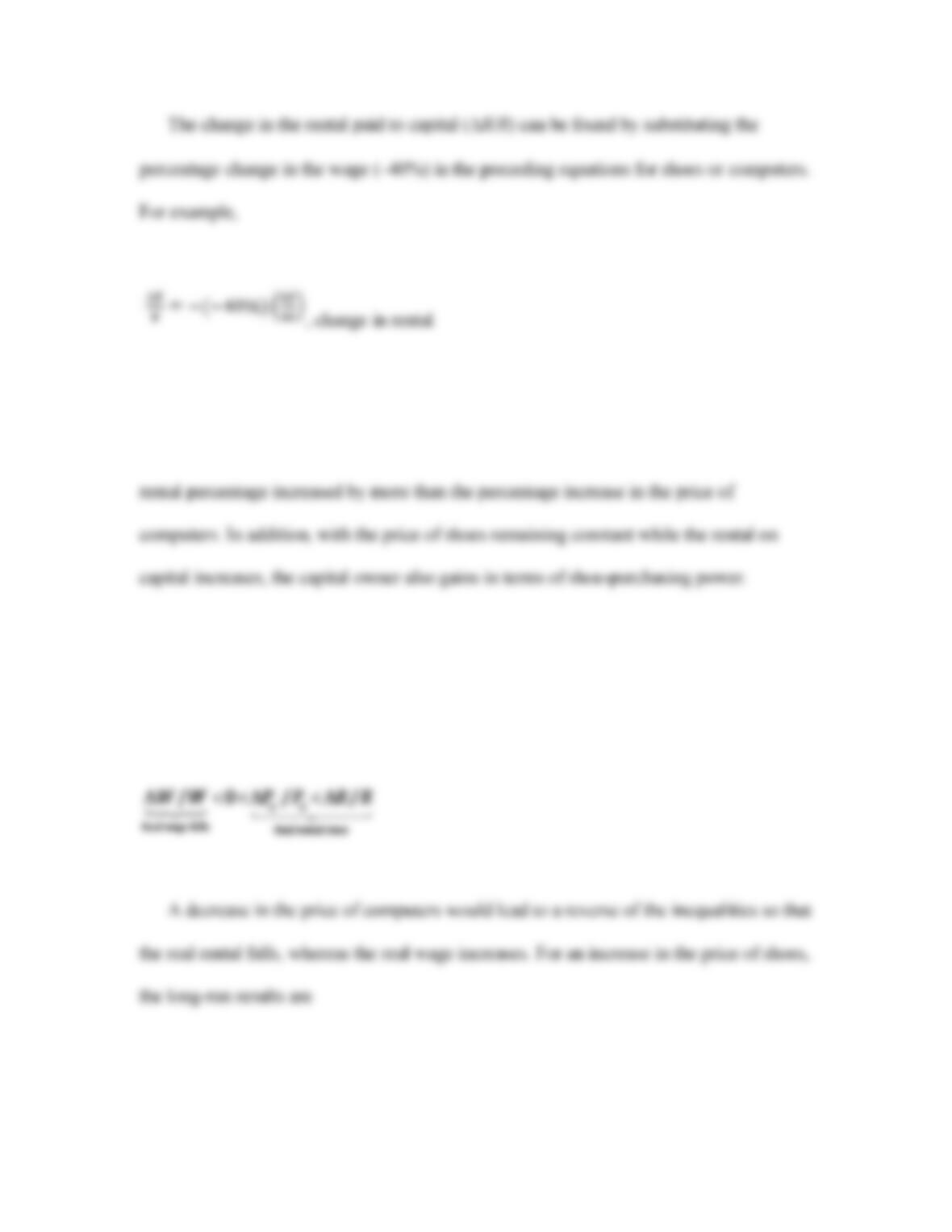
Solving the equation, we get that the rental on capital increases by 60% when the
price of computers rises by 10%. The capital owner is better off from trade because the
General Equation for the Long-Run Change in Factor Prices The long-run results due
to an increase in the price of computers are given by the following: