Chapter 4: Analysis of Financial Statements
Comprehensive/Spreadsheet Problem
65
Comprehensive/Spreadsheet Problem
Note to Instructors:
The solution to this problem is not provided to students at the back of their text. Instructors
can access the
Excel
file on the textbook’s website.
4-25
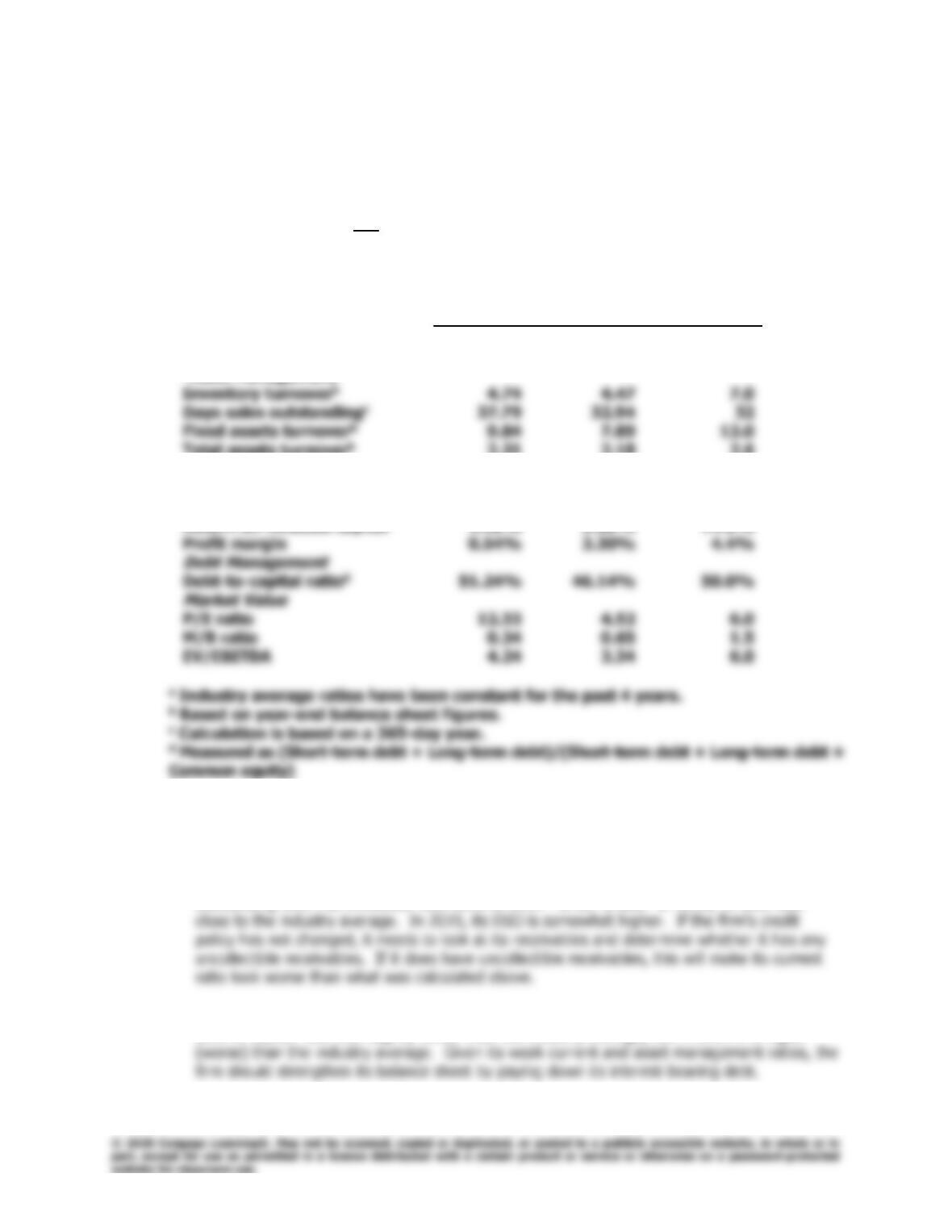
Ratio Analysis
2019
2018
Industry
Avga
Liquidity
Current ratio
2.33
2.11
2.7
Asset Management
Inventory turnoverb
4.74
4.47
7.0
Fixed assets turnoverb
9.84
7.89
Total assets turnoverb
2.31
2.18
2.6
Profitability
Return on assets
1.25%
7.20%
11.4%
Return on equity
2.76%
14.34%
18.2%
Return on invested capital
Profit margin
0.54%
3.30%
Debt Management
50.0%
P/E ratio
6.0
M/B ratio
0.34
EV/EBITDA
4.24
6.0
4.28%
9.80%
14.5%
a. Corrigan’s liquidity position has improved from 2018 to 2019; however, its current ratio is still
below the industry average of 2.7.
b. Corrigan’s inventory turnover, fixed assets turnover, and total assets turnover have improved
from 2018 to 2019; however, they are still below industry averages. The firm’s days sales
outstanding ratio has increased from 2018 to 2019—which is bad. In 2018, its DSO was
c. Corrigan’s debt-to-capital ratio has increased from 2018 to 2019, which is bad. In 2018, its
debt-to-capital ratio was slightly better than the industry average, but in 2019 it is higher
66
Comprehensive/Spreadsheet Problem
Chapter 4: Analysis of Financial Statements
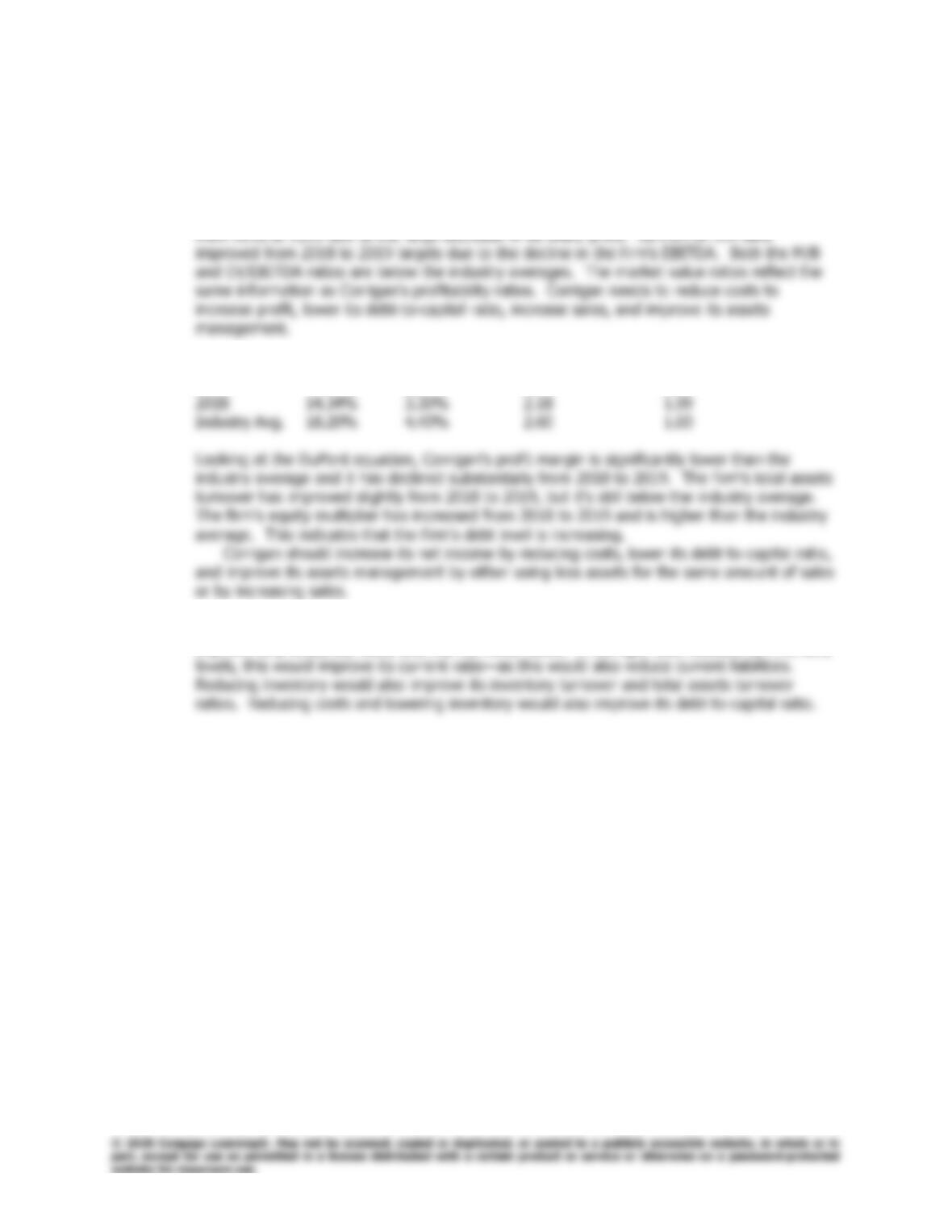
d. Corrigan’s profitability ratios have declined substantially from 2018 to 2019, and they are
substantially below the industry averages. Corrigan needs to reduce its costs, increase sales,
or both.
e. Corrigan’s P/E ratio has increased from 2018 to 2019, but only because its net income has
declined significantly from the prior year. Corrigan’s M/B ratio has declined substantially
f. ROE = PM × TA Turnover × Equity Multiplier
2019 2.76% 0.54% 2.31 2.20
g. If Corrigan initiated cost-cutting measures, this would increase its net income. This would
improve its profitability ratios and market value ratios. If Corrigan also reduced its inventory
Chapter 4: Analysis of Financial Statements
Integrated Case
67
Integrated Case
4-26
D’Leon Inc., Part II
Financial Statements and Taxes
Part I of this case, presented in Chapter 3, discussed the situation of D’Leon
Inc., a regional snack foods producer, after an expansion program. D’Leon
had increased plant capacity and undertaken a major marketing campaign in
an attempt to “go national.” Thus far, sales have not been up to the
forecasted level, costs have been higher than were projected, and a large
68
Integrated Case
Chapter 4: Analysis of Financial Statements
a small profit by December. Thus, the annual data look somewhat worse
than final monthly data. Also, it appears to be taking longer for the
advertising program to get the message out, for the new sales offices to
generate sales, and for the new manufacturing facilities to operate
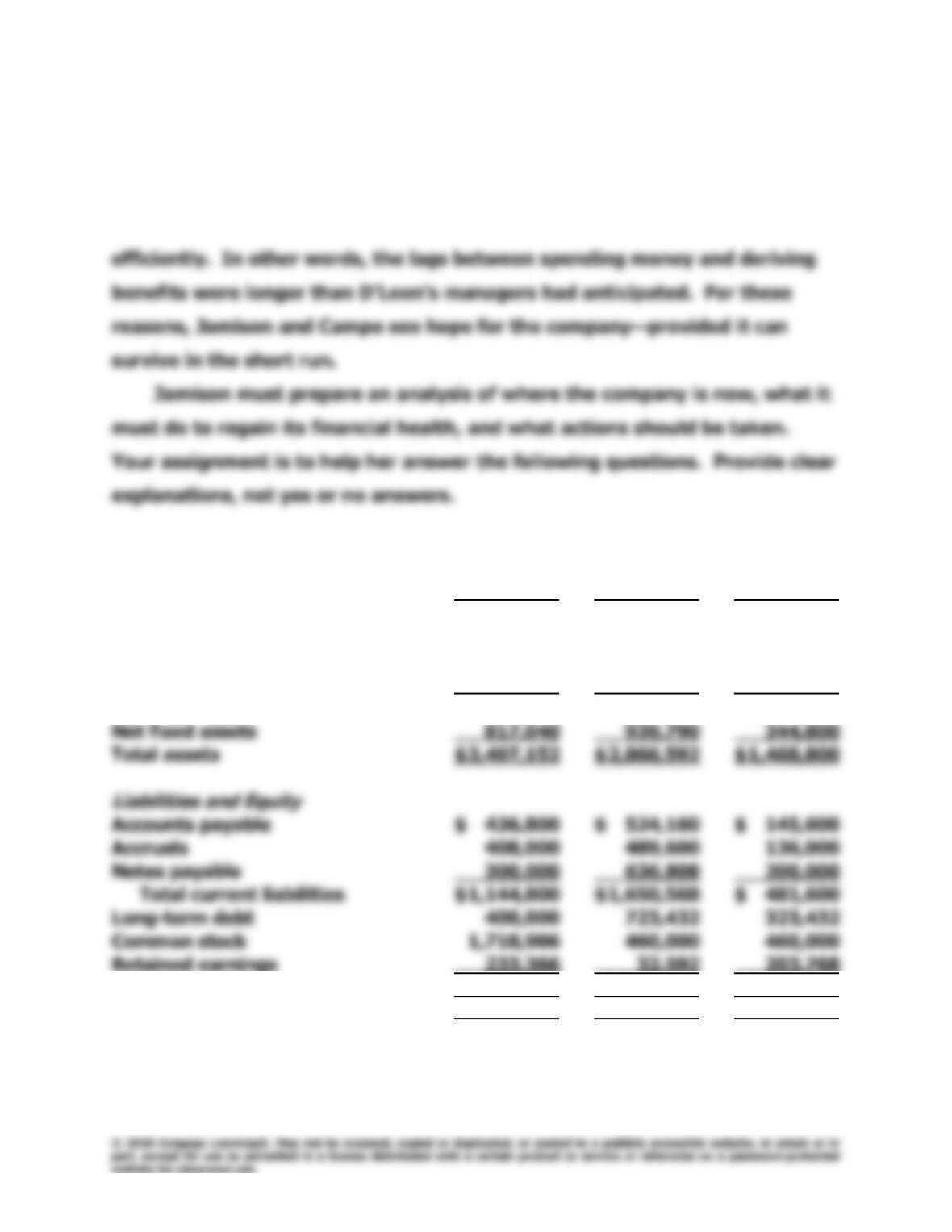
Table IC 4.1. Balance Sheets
2020E 2019 2018
Assets
Cash $ 85,632 $ 7,282 $ 57,600
Accounts receivable 878,000 632,160 351,200
Inventories 1,716,480 1,287,360 715,200
Total current assets $ 2,680,112 $ 1,926,802 $ 1,124,000
Total equity $ 1,952,352 $ 492,592 $ 663,768
Total liabilities and equity $ 3,497,152 $ 2,866,592 $ 1,468,800
Note: “E” indicates estimated. The 2019 data are forecasts.
Chapter 4: Analysis of Financial Statements
Integrated Case
69
Table IC 4.2. Income Statements
EBT $ 287,640 ($ 160,176) $ 146,600
Taxes (25%) 31,866a 0a 36,650
Net income $ 255,774 ($ 160,176) $ 109,950
EPS $ 1.023 ($ 1.602) $ 1.100
DPS $ 0.220 $ 0.110 $ 0.275
70
Integrated Case
Chapter 4: Analysis of Financial Statements
Table IC 4.3. Ratio Analysis
Industry
2020E 2019 2018 Average
Current 1.2 2.3 2.7
Quick 0.4 0.8 1.0
Inventory turnover 4.8 4.8 6.1
Debt-to-capital ratio 73.4% 44.1% 40.0%
TIE -0.3 4.3 6.2
Operating margin -0.6% 5.5% 7.3%
Profit margin -2.6% 3.2% 4.3%
a Calculation is based on a 365-day year.
A. Why are ratios useful? What are the five major categories of
ratios?
Answer: [S4-1 through S4-6 provide background information. Then, show
S4-7 and S4-8 here.] Ratios are used by managers to help
Chapter 4: Analysis of Financial Statements
Integrated Case
71
B. Calculate D’Leon’s 2020 current and quick ratios based on the
projected balance sheet and income statement data. What can
you say about the company’s liquidity positions in 2018, in 2019,
and as projected for 2020? We often think of ratios as being
useful (1) to managers to help run the business, (2) to bankers for
credit analysis, and (3) to stockholders for stock valuation. Would
these different types of analysts have an equal interest in these
liquidity ratios? Explain your answer.
Answer: [Show S4-9 and S4-10 here.]
Current ratio20 = Current assets/Current liabilities
= $2,680,112/$1,144,800 = 2.34.
C. Calculate the 2020 inventory turnover, days sales outstanding
(DSO), fixed assets turnover, and total assets turnover. How does
D’Leon’s utilization of assets stack up against other firms in the
industry?
Answer: [Show S4-11 through S4-16 here.]
Inventory turnover20 = Sales/Inventory
72
Integrated Case
Chapter 4: Analysis of Financial Statements
Fixed assets turnover20 = Sales/Net fixed assets
= $6,900,600/$817,040 = 8.45.
D. Calculate the 2020 debt-to-capital and times-interest-earned
ratios. How does D’Leon compare with the industry with respect
to financial leverage? What can you conclude from these ratios?
Answer: [Show S4-17 and S4-18 here.]
Debt-to-capital ratio20 = Total debt/Total invested capital
Chapter 4: Analysis of Financial Statements
Integrated Case
73
The firm’s debt–to-capital ratio is much improved from 2019
and 2018, and it is well below the industry average (which is
good). The firm’s TIE ratio is also greatly improved from its 2018
and 2019 levels but it is still below the industry average.
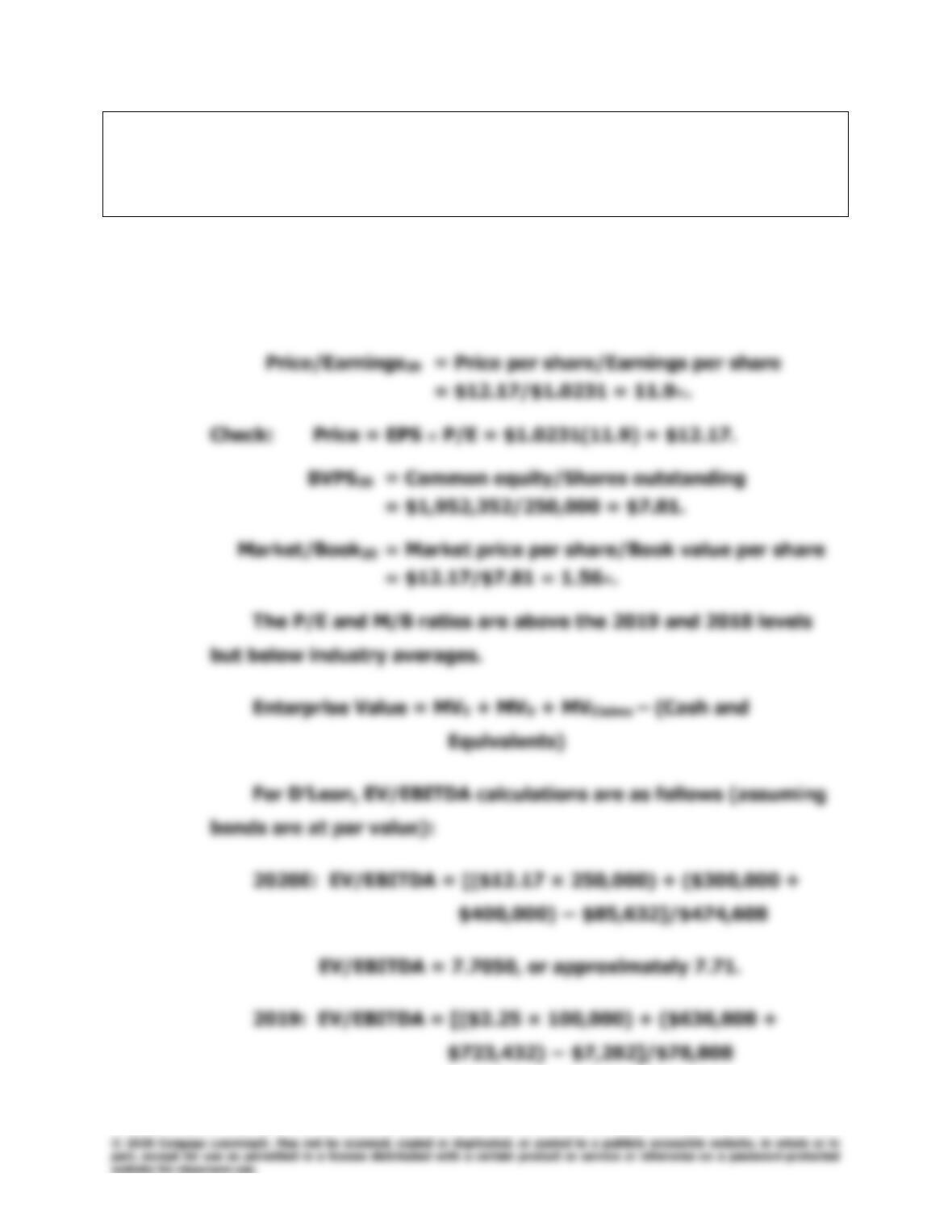
E. Calculate the 2020 operating margin, profit margin, basic earning
power (BEP), return on assets (ROA), return on equity (ROE), and
return on invested capital (ROIC). What can you say about these
ratios?
Answer: [Show S4-19 through S4-25 here.]
Operating margin20 = EBIT/Sales
= $357,648/$6,900,600 = 5.18%.
74
Integrated Case
Chapter 4: Analysis of Financial Statements
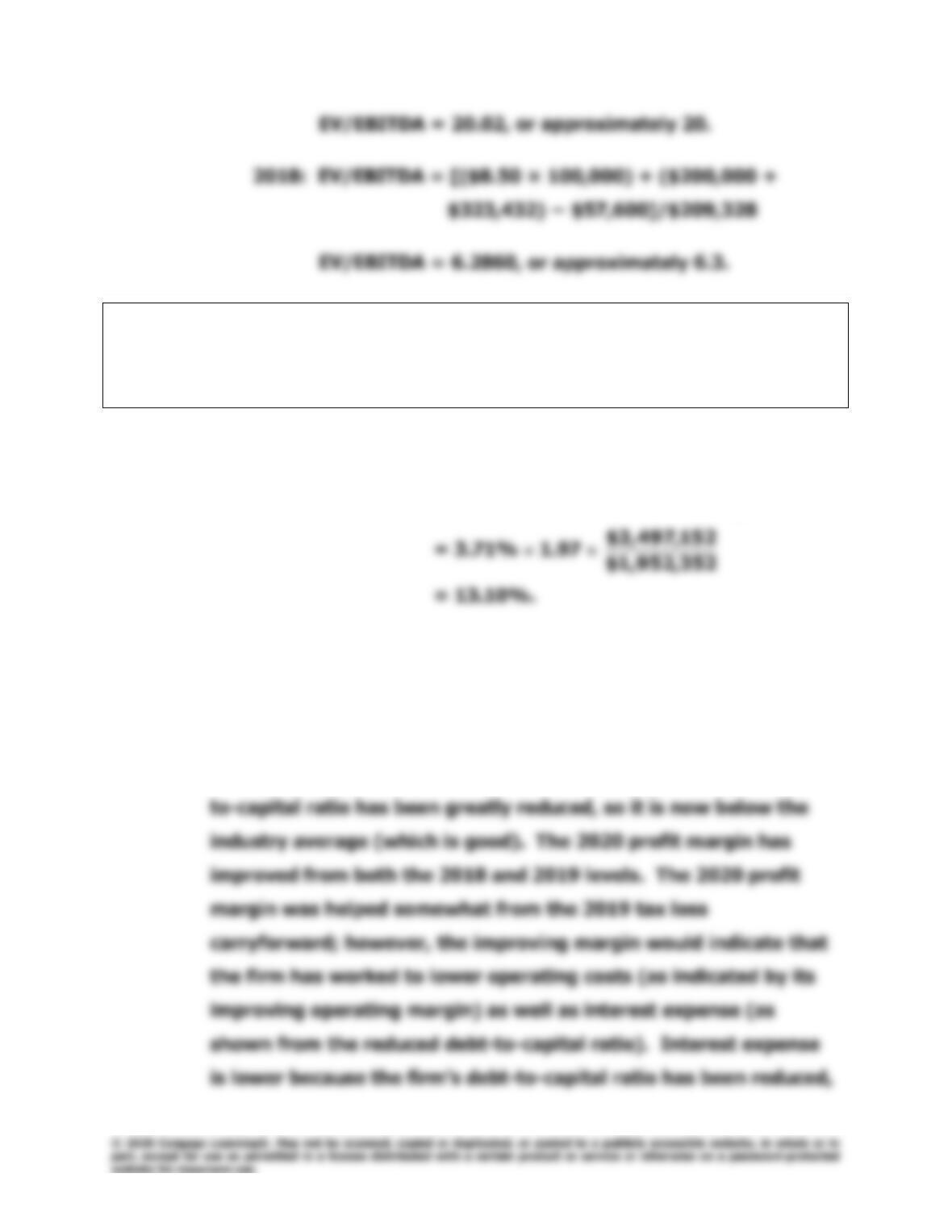
F. Calculate the 2020 price/earnings ratio and market/book ratio.
Do these ratios indicate that investors are expected to have a high
or low opinion of the company?
Answer: [Show S4-26 through S4-28 here.]
EPS20 = Net income/Shares outstanding
= $255,774/250,000 = $1.0231.
Chapter 4: Analysis of Financial Statements
Integrated Case
75
G. Use the DuPont equation to provide a summary and overview of
D’Leon’s financial condition as projected for 2020. What are the
firm’s major strengths and weaknesses?
Answer: [Show S4-29 and S4-30 here.]
DuPont equation =
margin
Profit
turnover
assets Total
multiplier
Equity
Strengths: The firm’s fixed assets turnover was above the industry
average. However, if the firm’s assets were older than other firms
in its industry this could possibly account for the higher ratio.
(D’Leon’s fixed assets would have a lower historical cost and
would have been depreciated for longer periods of time.) Its debt-
76
Integrated Case
Chapter 4: Analysis of Financial Statements
H. Use the following simplified 2020 balance sheet to show, in
general terms, how an improvement in the DSO would tend to
affect the stock price. For example, if the company could improve
its collection procedures and thereby lower its DSO from 46.4 days
to the 32-day industry average without affecting sales, how would
that change “ripple through” the financial statements (shown in
thousands in the following table) and influence the stock price?
Accounts receivable $ 878 Current liabilities $ 845
Other current assets 1,802 Debt 700
Net fixed assets 817 Equity 1,952
Total assets $3,497 Liabilities plus equity $3,497
Answer: [Show S4-31 through S4-34 here.]
Sales per day = $6,900,600/365 = $18,905.75.
Accounts receivable under new policy = $18,905.75 32 days
= $604,984.

Chapter 4: Analysis of Financial Statements
Integrated Case
77
I. Does it appear that inventories could be adjusted? If so, how
should that adjustment affect D’Leon’s profitability and stock
price?
Answer: The inventory turnover ratio is low. It appears that the firm either
has excessive inventory or some of the inventory is obsolete. If
J. In 2019 the company paid its suppliers much later than the due
dates; also, it was not maintaining financial ratios at levels called
for in its bank loan agreements. Therefore, suppliers could cut the
company off, and its bank could refuse to renew the loan when it
comes due in 90 days. On the basis of data provided, would you,
as a credit manager, continue to sell to D’Leon on credit? (You
could demand cash on delivery—that is, sell on terms of COD—but
that might cause D’Leon to stop buying from your company.)
Similarly, if you were the bank loan officer, would you recommend
renewing the loan or demanding its repayment? Would your
actions be influenced if, in early 2020, D’Leon showed you its 2020
projections along with proof that it was going to raise more than
$1.2 million of new equity?
Answer: While the firm’s ratios based on the projected data appear to be
improving, the firm’s current asset ratio is low. As a credit
K. In hindsight, what should D’Leon have done in 2018?
Answer: Before the company took on its expansion plans, it should have
done an extensive ratio analysis to determine the effects of its
L. What are some potential problems and limitations of financial ratio
analysis?
Answer: [Show S4-35 through S4-37 here.] Some potential problems are
listed below:
1. Comparison with industry averages is difficult if the firm
operates many different divisions.
3. Sometimes hard to tell if a ratio is “good” or “bad.”
5. “Average” performance is not necessarily good.
M. What are some qualitative factors analysts should consider when
evaluating a company’s likely future financial performance?
Answer: Top analysts recognize that certain qualitative factors must be
considered when evaluating a company. These factors, as
summarized by the American Association of Individual Investors
(AAII), are as follows:
1. Are the company’s revenues tied to one key customer?
2. To what extent are the company’s revenues tied to one key
product?