interactive activity
Chapter 4
Consumer and
Producer Surplus
1. Determine the amount of consumer surplus generated in each of the following
situations.
a. Leon goes to the clothing store to buy a new T-shirt, for which he is willing to
2. Determine the amount of producer surplus generated in each of the following
situations.
a. Gordon lists his old Lionel electric trains on eBay. He sets a minimum
3. There are six potential consumers of computer games, each willing to buy only
one game. Consumer 1 is willing to pay $40 for a computer game, consumer 2 is
willing to pay $35, consumer 3 is willing to pay $30, consumer 4 is willing to pay
$25, consumer 5 is willing to pay $20, and consumer 6 is willing to pay $15.
a. Suppose the market price is $29. What is the total consumer surplus?
b. The market price decreases to $19. What is the total consumer surplus now?
3. a. Consumer 1 buys a game since her willingness to pay is greater than the price.
b. Consumer 1 buys a game since her willingness to pay is greater than the price.
She gains $40 − $19 = $21.
c. Total consumer surplus increases by $55 − $18 = $37 as a result of the price
decrease. For consumers 1, 2, and 3 (the consumers who would also have
bought games at the higher price), individual consumer surplus increases
4. a. In an auction, potential buyers compete for a good by submitting bids. Adam
Galinsky, a social psychologist at Northwestern University, compared eBay
auctions in which the same good was sold. He found that, on average, the
higher the number of bidders, the higher the sales price. For example, in two
b. You are considering selling your first car. If the car is in good condition, it is
worth a lot; if it is in poor condition, it is useful only as scrap. Assume that
4. a. The higher the sales price, the greater the producer surplus received by a seller.
So Galinsky’s observation that a larger number of bidders results in a higher sales
price means that a seller will want to take actions that increase the number of
Solution
Solution
Chapter 4 Consumer and ProduCer surPlus S-59
b. If each potential buyer for your car has to pay $40 for the CARFAX report or
take the chance of paying for a car that is in poor condition, then very few
5. Assume that due to a decrease in demand, the average domestic airline fare
decreased from $371.72 in the third quarter of 2015 to $362.56 in the fourth
quarter of the same year, a decrease of $9.16. The number of passenger tick–
5. Without knowing the exact supply curve, you cannot be specific about the
6. The accompanying table shows the supply and demand schedules for used
copies of the fourth edition of this textbook. The supply schedule is derived
from offers at Amazon.com. The demand schedule is hypothetical.
Price of book
Quantity of books
demanded
Quantity of books
supplied
$55 50 0
60 35 1
65 25 3
70 17 3
a. Calculate consumer and producer surplus at the equilibrium in this market.
b. Now the fifth edition of this textbook becomes available. As a result, the will-
Solution
S-60 Chapter 4 Consumer and ProduCer surPlus
6. a. The equilibrium price is $85, and 10 copies are bought and sold. Starting with
the buyers with the highest willingness to pay, the first two buyers’ willingness to
pay is $105, and so they each receive consumer surplus of $105 − $85 = $20. The
next two buyers’ willingness to pay is $100, and so they each receive consumer
surplus of $100 − $85 = $15. The next two buyers’ willingness to pay is $95, and
so they each receive consumer surplus of $95 − $85 = $10. The next two buyers’
willingness to pay is $90, and so they each receive consumer surplus of
$90 − $85 = $5. The next two buyers’ willingness to pay is $85, and so they each
b. The new demand schedule is shown in the accompanying table.
Price of book
Quantity of books
demanded
Quantity of books
supplied
$55 14 0
60 12 1
65 10 3
70 8 3
75 6 6
80 4 9
85 210
The equilibrium price is $75, and 6 copies are bought and sold. Starting with
the buyers with the highest willingness to pay, the first two buyers’ willingness
to pay is $85, and so they each receive consumer surplus of $85 − $75 = $10. The
next two buyers’ willingness to pay is $80, and so they each receive consumer
surplus of $80 − $75 = $5. The next two buyers’ willingness to pay is $75, and
Solution
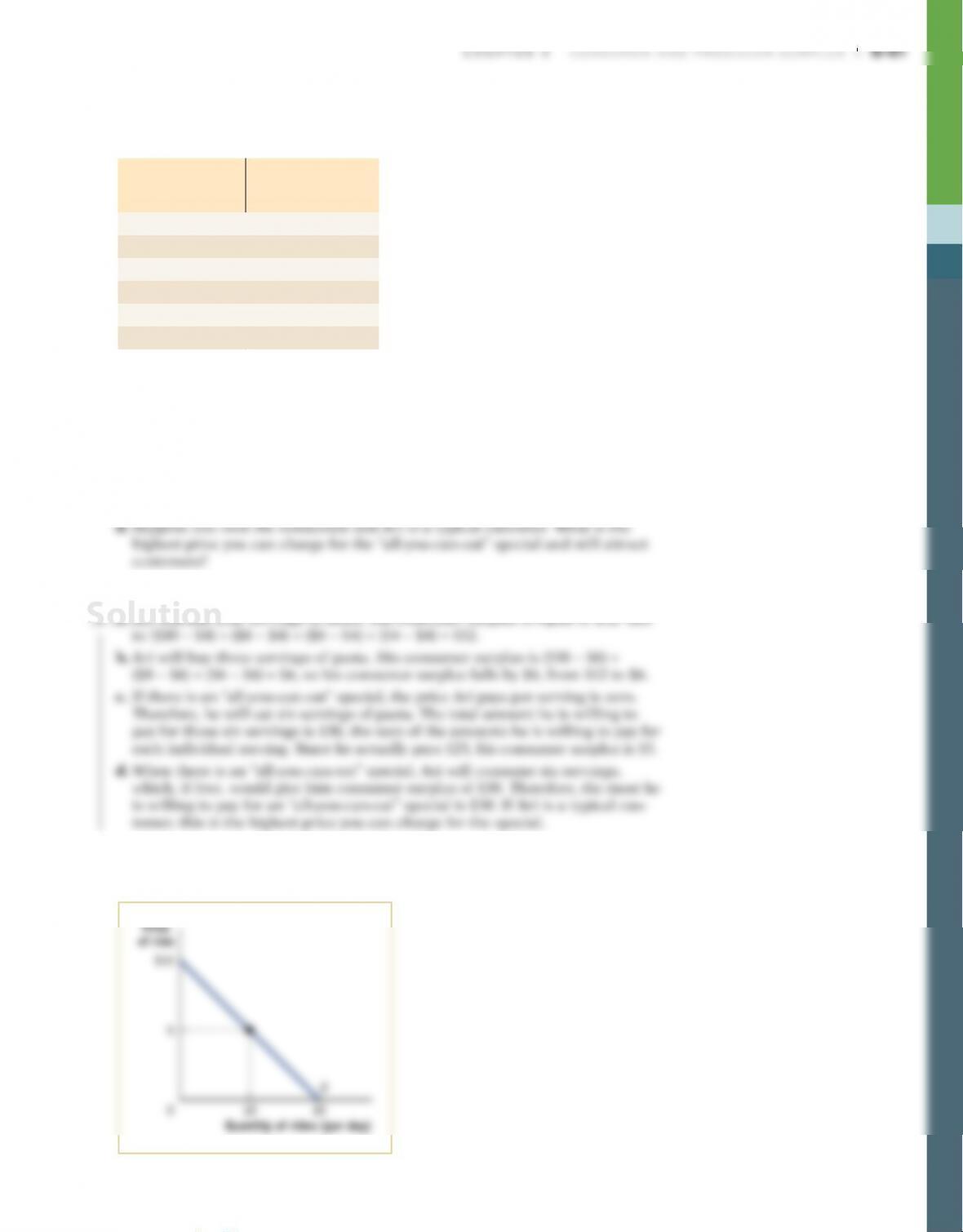
7. On Thursday nights, a local restaurant has a pasta special. Ari likes the
restaurant’s pasta, and his willingness to pay for each serving is shown
in the accompanying table.
Quantity of pasta
(servings)
Willingness to pay
for pasta
(per serving)
1$10
2 8
3 6
4 4
5 2
6 0
a. If the price of a serving of pasta is $4, how many servings will Ari buy? How
much consumer surplus does he receive?
b. The following week, Ari is back at the restaurant again, but now the price of
a serving of pasta is $6. By how much does his consumer surplus decrease
compared to the previous week?
c. One week later, he goes to the restaurant again. He discovers that the restau-
rant is offering an “all-you-can-eat” special for $25. How much pasta will Ari
eat, and how much consumer surplus does he receive now?
7. a. Ari will buy four servings of pasta. His consumer surplus is equal to $12, that
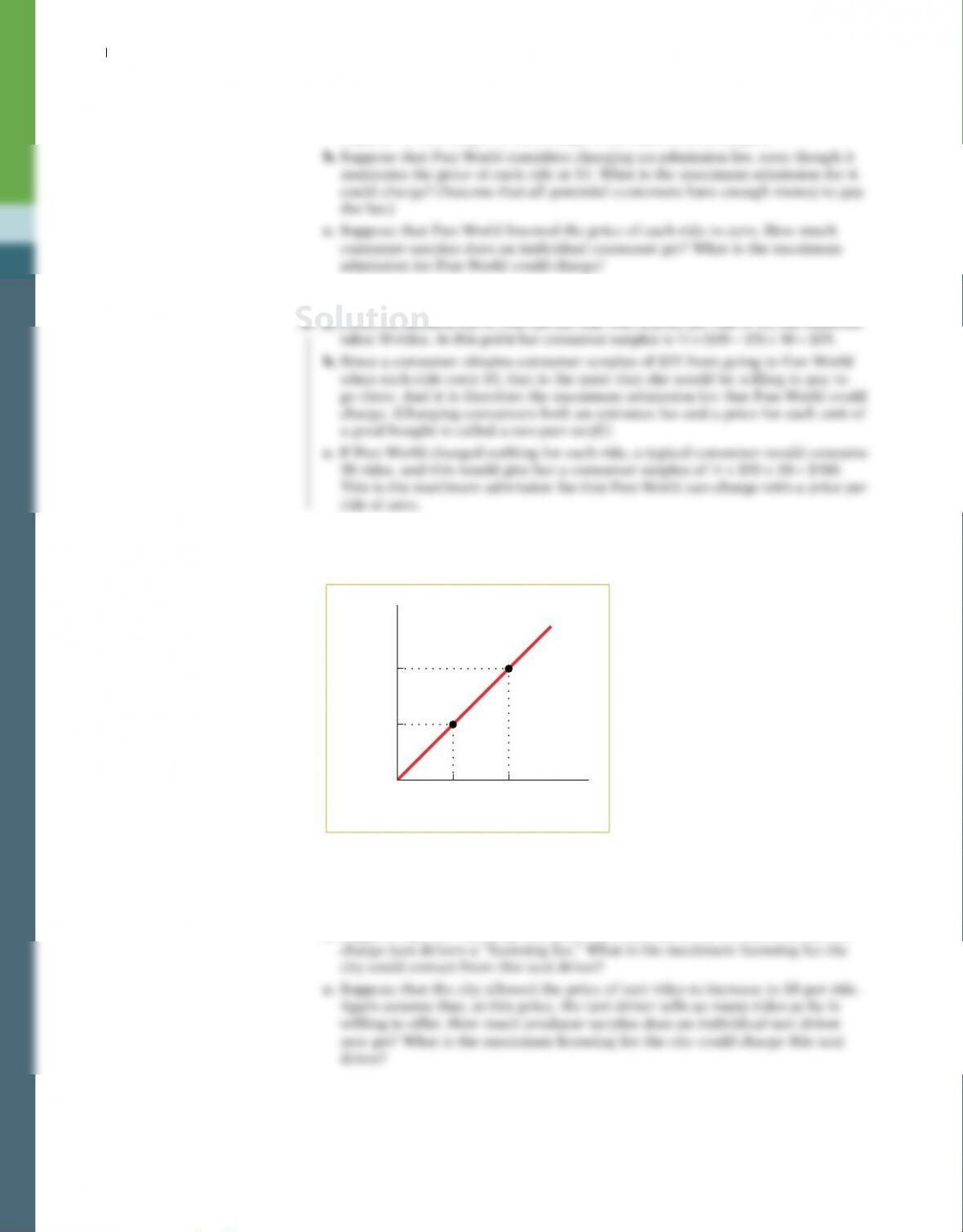
8. You are the manager of Fun World, a small amusement park. The accompanying
diagram shows the demand curve of a typical customer at Fun World.
Price
of ride
D
5
$10
Solution
S-62 Chapter 4 Consumer and ProduCer surPlus
a. Suppose that the price of each ride is $5. At that price, how much consumer
surplus does an individual consumer get? (Recall that the area of a right tri-
angle is ½ × the height of the triangle × the base of the triangle.)
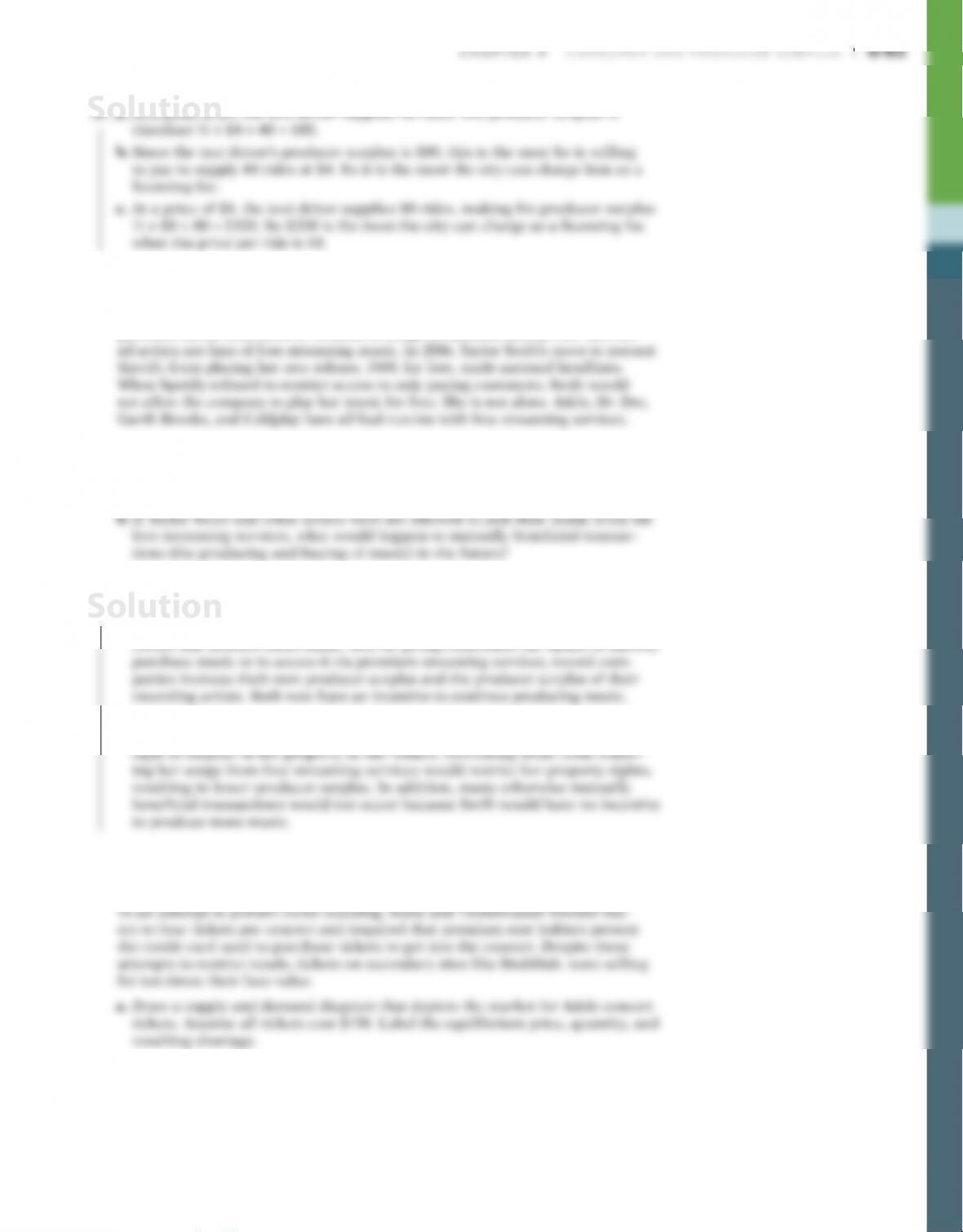
9. The accompanying diagram illustrates a taxi driver’s individual supply curve
(assume that each taxi ride is the same distance).
80
Price of
taxi ride
Quantity of taxi rides
40
S
0
$8
4
a. Suppose the city sets the price of taxi rides at $4 per ride, and at $4 the taxi
driver is able to sell as many taxi rides as he desires. What is this taxi driver’s
producer surplus? (Recall that the area of a right triangle is ½ × the height of
the triangle × the base of the triangle.)
b. Suppose that the city keeps the price of a taxi ride set at $4, but it decides to
10. Streaming music services have changed the way we listen to music. Spotify,
Pandora, Tidal, and Google Play are some of the more popular services. These
companies offer free access to music. For a small monthly fee users can purchase
premium access and listen to millions of songs on demand and ad free. But not
a. If music lovers obtain music and video content via free music streaming ser–
vices, instead of buying it directly or paying for premium access, what would the
record companies’ producer surplus be from music sales? What are the implica–
tions for record companies’ incentive to produce music content in the future?
10. a. If all music lovers obtain their music and video content for free, the producer
surplus for record companies would be zero. They would have no incentive to
record and produce more music. But, by giving consumers the option to directly
b. In the United States, artists like Swift have property rights: as an owner of
a valuable resource (Swift’s songs are worth millions of dollars), she has the
11. On December 17th, 2015, tickets for Adele’s highly anticipated U.S. concert tour
went on sale at Ticketmaster on a first come, first served basis. Throughout the
day, a record 10 million people tried to purchase the 750,000 tickets available.
Solution
S-64 Chapter 4 Consumer and ProduCer surPlus
b. In your diagram, highlight or label the areas that correspond to consumer
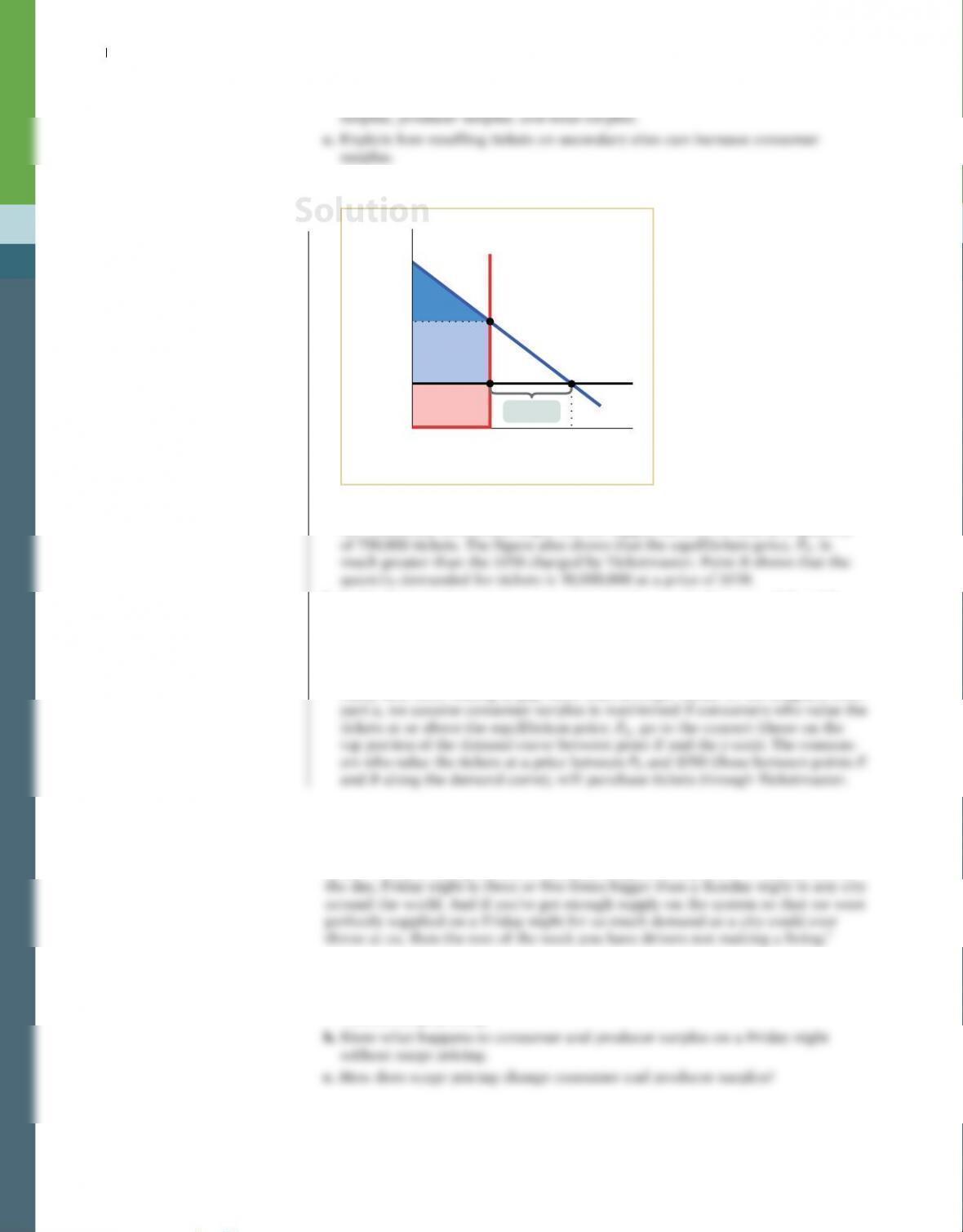
11. a.
Price of
tickets
Quantity of tickets
E
X
Y
ZD
S
BA
PE
$150
0750,000 10,000,000
Shortage
From the diagram, you can see that the demand curve for Adele tickets takes
the traditional downward slope, but the supply curve is vertical at a quantity
b. In the diagram from part a, consumer surplus equals the areas of X and Y,
producer surplus is area Z, and total surplus equals the areas X + Y + Z.
c. Tickets for the Adele concerts were distributed online on a first come, first
served basis. Most of her 10 million fans tried to buy tickets immediately.
Given that tickets were selling on secondary sites for ten times their face value,
many fans were willing to pay more than $150 per ticket. In the diagram from
12. Uber has long been criticized for its use of surge pricing, setting prices based
on current supply and demand factors, which, at times, results in a sudden and
drastic increase in prices. In a Wall Street Journal article, the CEO of Uber was
asked if we are seeing the end of surge pricing. His response: “. . . at the end of
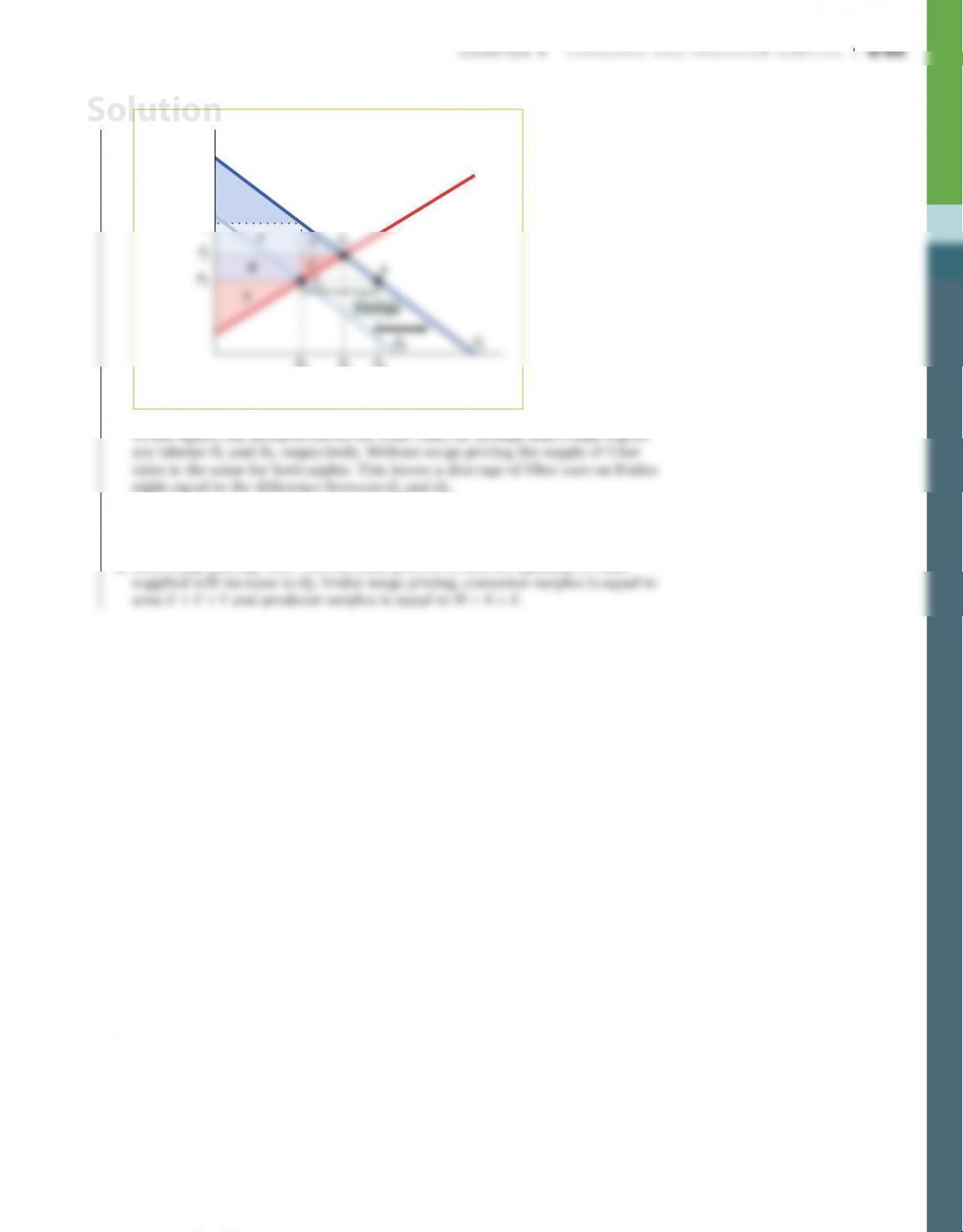
a. Draw a demand and supply graph for Uber rides in Miami on a Sunday night.
How does demand change on a Friday night? How does the supply of Uber
rides change? Label the shortage of Uber cars that results on a Friday night
without surge pricing.
Solution
12. a.
S
U
Ph
Price of
Uber rides
Shortage
b. As shown in the figure in part a, without surge pricing Uber will charge Ps.
Consumer surplus for Uber rides on Friday night is equal to area U + V + W.
Producer surplus is area X.
c. With surge pricing, Uber will increase price to Pf and the quantity of rides
13. Hollywood screenwriters negotiate a new agreement with movie producers stipu-
lating that they will receive 10% of the revenue from every rental of a movie they
wrote. They have no such agreement for movies shown on on-demand television.
a. When the new writers’ agreement comes into effect, what will happen in the
market for movie rentals—that is, will supply or demand shift, and how?
And, as a result, how will consumer surplus in the market for movie rentals
change? Illustrate with a diagram. Do you think the writers’ agreement will be
popular with consumers who rent movies?
b. Consumers consider movie rentals and on–demand movies substitutable to some
extent. When the new writers’ agreement comes into effect, what will happen in
the market for on-demand movies—that is, will supply or demand shift, and how?
And, as a result, how will producer surplus in the market for on-demand movies
change? Illustrate with a diagram. Do you think the writers’ agreement will be
popular with the cable television companies that show on-demand movies?
c. More consumers are shifting their movie-watching preferences from Red–
box rentals to streaming services like Netflix and Amazon Prime. What will
happen in the market for movie rentals after the shift in movie preferences?
How will producer surplus in the market for movie rentals change? Illustrate
with a diagram. How will the shift to streaming movies affect movie rental
companies and Hollywood screenwriters?
Solution
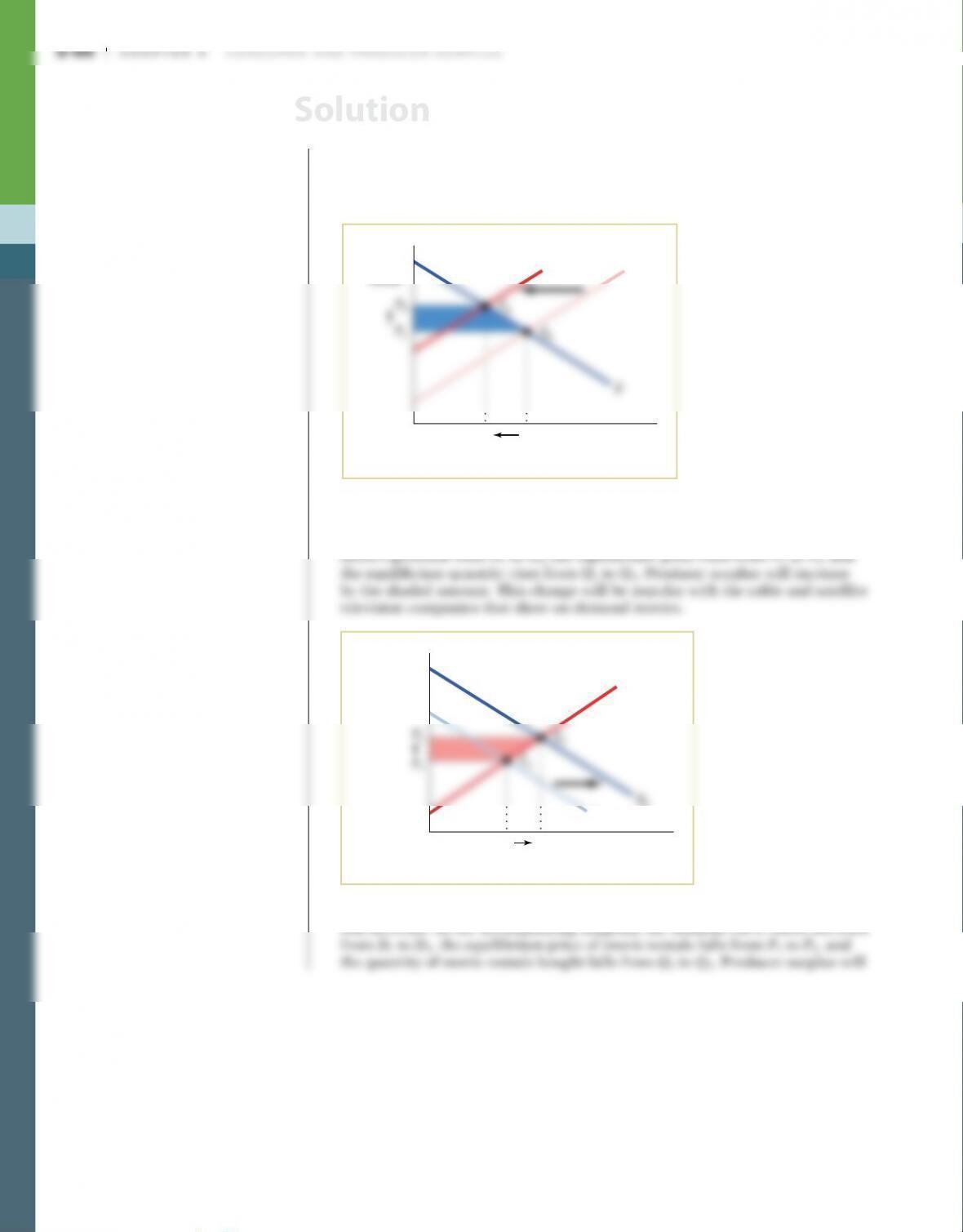
13. a. The payment to writers will increase the cost of providing movie rentals.
In the accompanying diagram, the supply curve shifts leftward from S1 to S2,
the equilibrium price of movie rentals rises from P1 to P2, and the quantity of
movie rentals bought and sold falls from Q1 to Q2. As a result, consumer sur-
plus will decrease by the shaded amount. The writers’ agreement will not be
popular with consumers.
Q2Q1
Quantity of movie rentals
Price
of
movie
rental
S1
S2
b. The higher price of movie rentals will make on-demand movies more popular.
They are substitute goods, and the demand for them will increase when the
price of movie rentals rises. In the accompanying diagram, the demand curve
Q2
Q1
Quantity of on-demand movies
D1
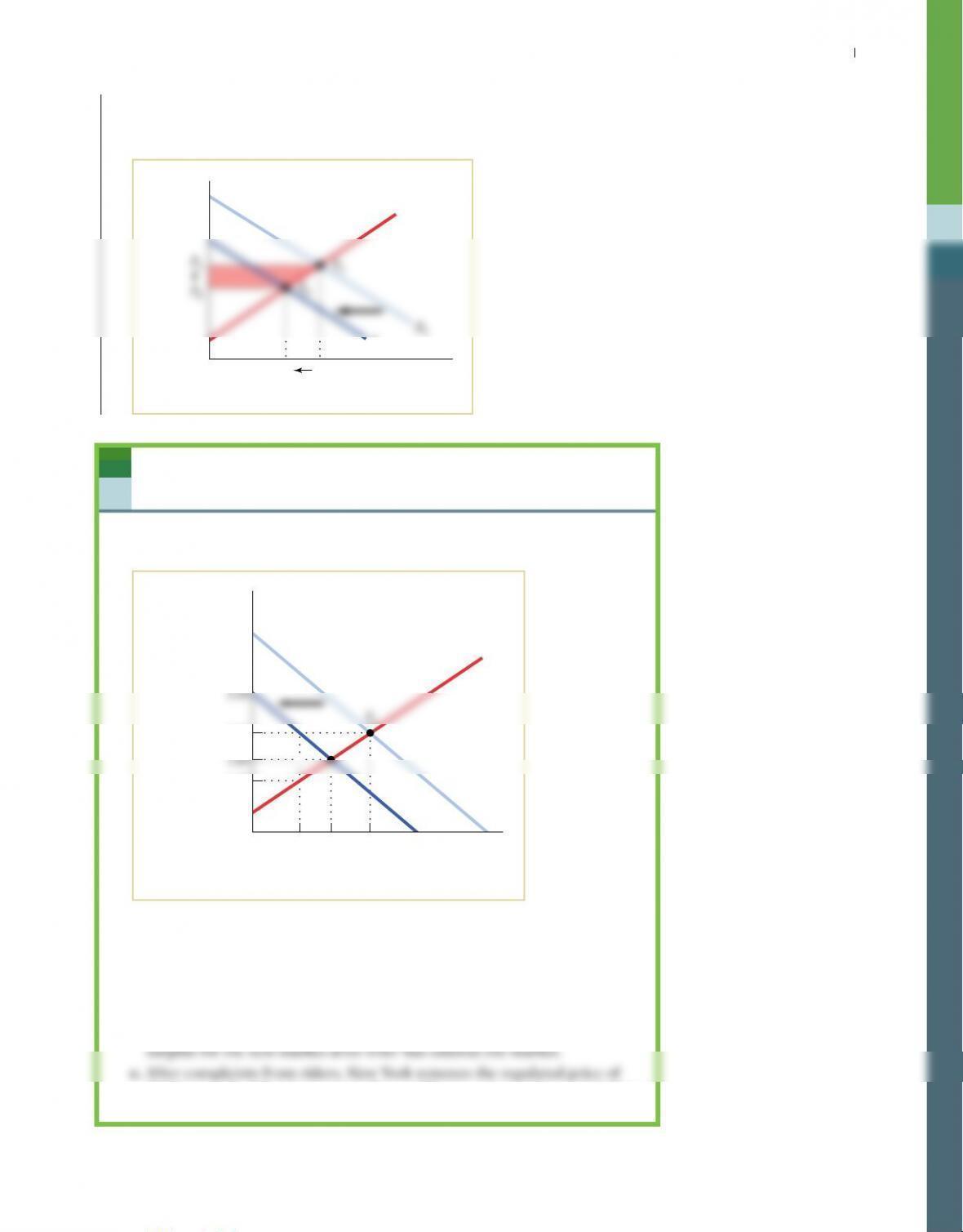
c. As consumers watch more streaming movies, the demand for movie rentals
will decrease. In the accompanying diagram, the demand curve shifts leftward
Solution
Chapter 4 Consumer and ProduCer surPlus S-67
decrease by the shaded amount. The decrease in producer surplus will lower
the revenue for movie rental companies, causing some to go out of business.
With fewer movie rentals, screenwriters will see a reduction in their incomes.
Q1
Q2
Quantity of movie rentals
Price of
movie
rentals S
D2
WORK IT OUT Interactive step-by-step help with solving this
problem can be found online.
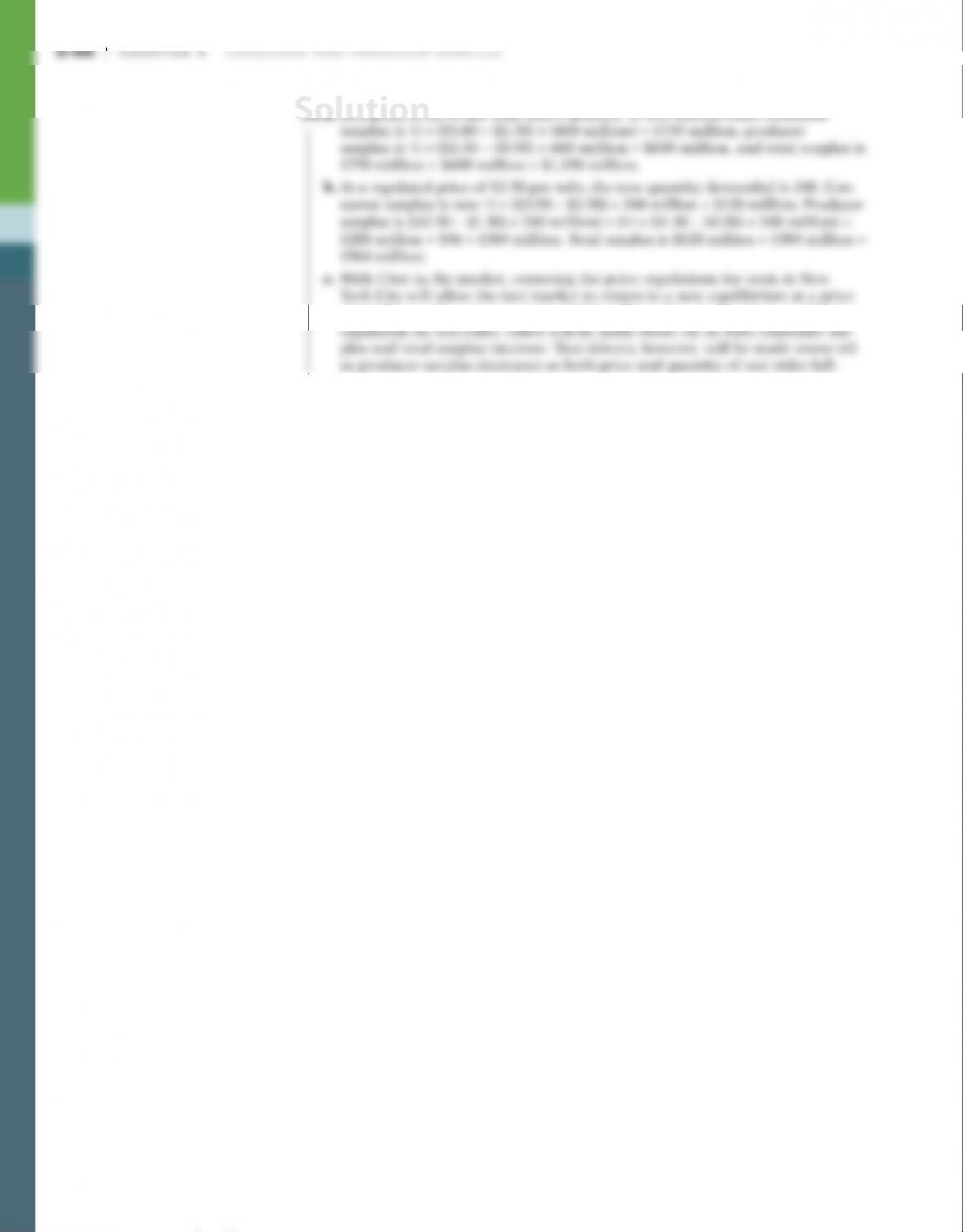
14. The accompanying diagram shows the demand and supply curves for taxi
rides in New York City.
Price
(dollar
s per mile)
S
Quantity of taxi rides
(millions of miles)
1,2006000 400240 840
$5.00
2.50
1.30
0.50
E2
D
D(after
Uber)
a. At E1 the market is at equilibrium with 600 million miles of rides
transacted at an equilibrium price of $2.50. Calculate consumer surplus,
producer surplus, and total surplus at E1.
b. Uber’s entry into the market reduces the quantity of rides demanded from
taxis by 30% at every price, shifting the demand curve leftward. Assume
that New York City politicians respond by imposing a regulated price of
$2.50 per mile. Calculate consumer surplus, producer surplus, and total
$2.50 per mile. What happens to the equilibrium price and quantity? How
will taxi drivers and riders be affected?
of $1.83 per mile and a quantity of 400 million rides. In the absence of price