Chapter 4
Saving and Investment in Closed and Open Economies
◼ Chapter Outline, Overview, and Teaching Tips
Chapter Outline
Relationship Between Savings and Wealth
Private Saving
Policy and Practice: Government Policies to Stimulate Saving
Uses of Saving
The Link Between Saving and Wealth
Macroeconomics in the News: Balance of Payments Accounts
Application: How the United States Became the Largest Net Debtor in the World
Saving, Investment, and Goods Market Equilibrium in a Closed Economy
Saving and Investment Equation
Response to Changes in Saving and Investment in a Closed Economy
Changes in Saving: Autonomous Consumption
Changes in Saving: Effects of Fiscal Policy
Policy and Practice: Crowding Out and the Debate Over the 2009 Fiscal Stimulus Package
Changes in Autonomous Investment
Saving, Investment, and Goods Market Equilibrium in an Open Economy
Perfect Capital Mobility and the Open Economy
Large Versus Small Open Economies
Chapter 4 Web Appendix: Saving and Investment in Large Open Economies
Chapter 4 Saving and Investment in Closed and Open Economies 33
Chapter Overview and Teaching Tips
This chapter discusses the relationship of saving and investment and its impact on the economy. A key point
to make to students is that the analysis here is a long-run context in which wages and prices are flexible
The chapter starts by clarifying the relationship of saving and wealth and what the concept of saving actually
means. Students need to understand that high saving is one way of accumulating wealth and is one of the
reasons there is so much focus on increasing saving. Also higher saving, holding everything else constant,
leads to lower current account deficits and less foreign borrowing. These concepts can be made more
concrete by discussing in class the Policy and Practice case on government policies to stimulate saving and
the application on how the United States has become the biggest net debtor in the world.
Armed with an understanding of the saving–investment diagram, the next step is to show what happens to
the equilibrium when the saving curve shifts, either because of changes in autonomous consumption or
government fiscal policy. This naturally leads to the policy discussion in the Policy and Practice case,
“Crowding Out and the Debate Over the 2009 Fiscal Stimulus Package.” Discussing this debate is an
excellent way of getting students to see the relevance of the saving–investment analysis. The instructor can
then take the students through the exercise of seeing what happens when the investment curve shifts
because autonomous investment changes, due, say, to a rise in business optimism.
phenomenon.
The body of the chapter conducts the open-economy framework only for a small open economy. This is
because the discussion of the large open economy is a lot more complicated and so is left to an online
appendix on the Companion Website, www.pearsonhighered.com/mishkin, which can be taught to students
34 Mishkin • Macroeconomics: Policy and Practice, Second Edition
◼ Answers to End of Chapter Review Questions and Problems
Answers to Review Questions
Relationship Between Saving and Wealth
1. The two components of national saving (S) are private saving (SP) and government saving (SG). Private
saving is disposable income (YD, which is GDP or national income Y minus taxes T) minus consumption
Saving, Investment, and Goods Market Equilibrium in a Closed Economy
2. Desired national saving is positively related to income, the real interest rate, and taxes and inversely
related to consumption and government purchases. Desired investment is positively related to the
additional profits the investment is expected to generate and inversely related to the real interest rate.
In a closed economy, goods market equilibrium requires the amounts of desired saving and
Response to Changes in Saving and Investment in a Closed Economy
3. Desired saving increases if autonomous consumption or government purchases decline or if taxes
4. Crowding out refers to the decrease in investment spending that results because government spending
increases. This occurs because an increase in government spending reduces desired saving and causes
Saving, Investment, and Goods Market Equilibrium in an Open Economy
5. A closed economy has no interactions with other economies. Therefore, its net exports and net capital
outflow both equal zero. An open economy does engage in international trade and is open to outflows
6. The world real interest rate is the rate that equates desired world saving and desired world investment
and thus achieves goods market equilibrium for the world as a whole. If an individual country’s
equilibrium real interest rate (r) is not the same as the world real interest rate (rw), perfect capital
Chapter 4 Saving and Investment in Closed and Open Economies 35
Saving, Investment, and the Trade Balance in a Small Open Economy
7. Both types of economies are open to trade and capital flows, but the “small” economy is so small
8. The small open economy will have a trade surplus if the world real interest rate is above rE, the real
interest rate at which the small open economy’s desired amounts of saving and investment would be
9. Unlike a closed economy where an increase in desired saving would lower the domestic real interest
rate and increase investment, an increase in domestic saving in a small open economy has no effect
Response to Changes in Saving and Investment in a Small Open Economy
10. An increase in domestic saving shifts the saving curve to the right; as a result, the trade balance and
Large Versus Small Open Economies
11. A large open economy has characteristics of both closed and small open economies. It responds like a
small open economy in the way that given changes in domestic saving and investment affect the trade
Answers to Problems
Relationship Between Saving and Wealth
1. a. Japan’s national saving rate is 25 percent. Therefore Japan’s national saving is 0.25 $5 trillion
Saving, Investment, and Goods Market Equilibrium in a Closed Economy
2. a. If you buy a newly built home, you will add to the economy’s residential investment, therefore
adding to the investment spending component of GDP. If you buy a U.S. savings bond, you will
be transferring funds to the U.S. government, but that action will not add to the economy’s capital
36 Mishkin • Macroeconomics: Policy and Practice, Second Edition
Response to Changes in Saving and Investment in a Closed Economy
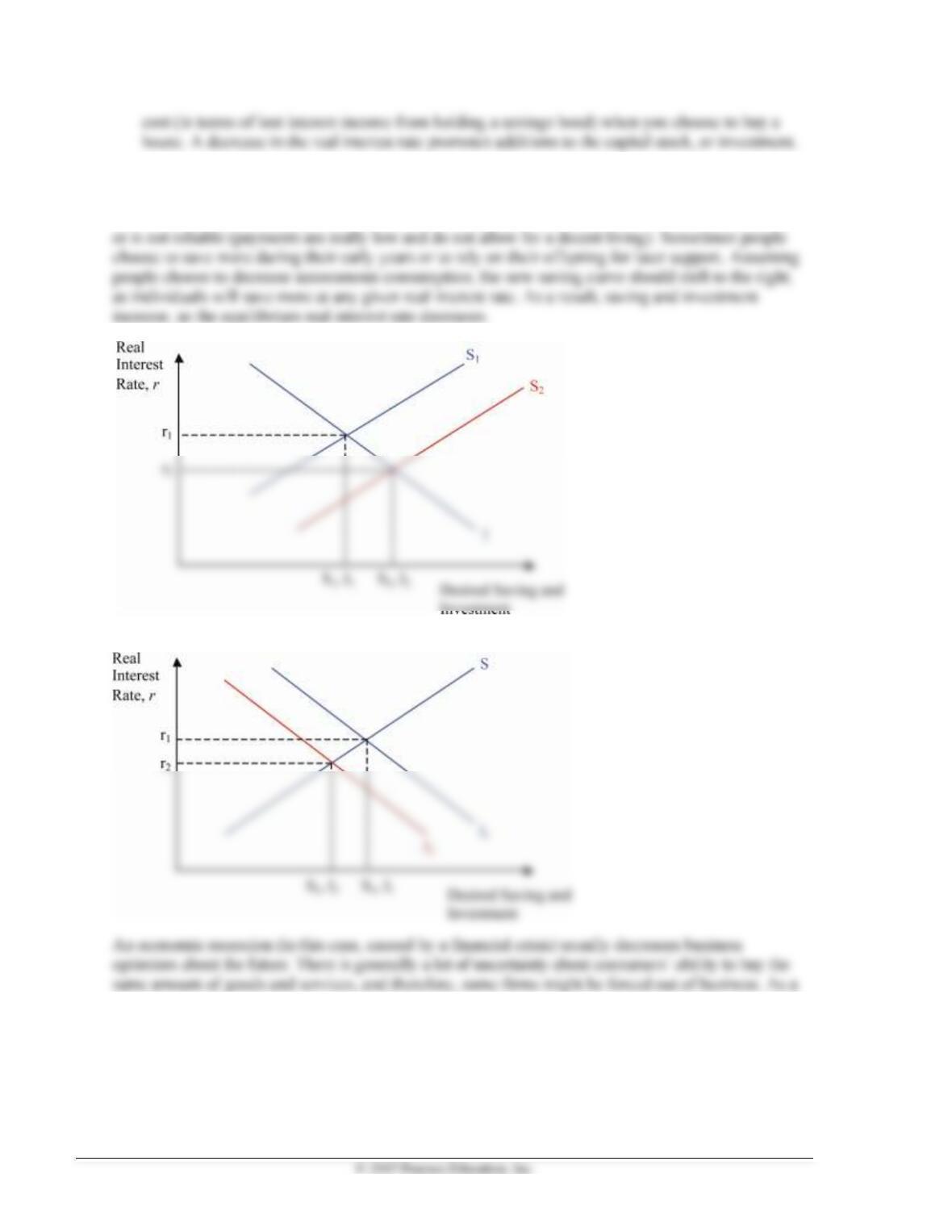
3. If workers realize that they will not have a safety net when they retire, they might start saving more
now. This is the case in many other countries in which a social security system either does not exist
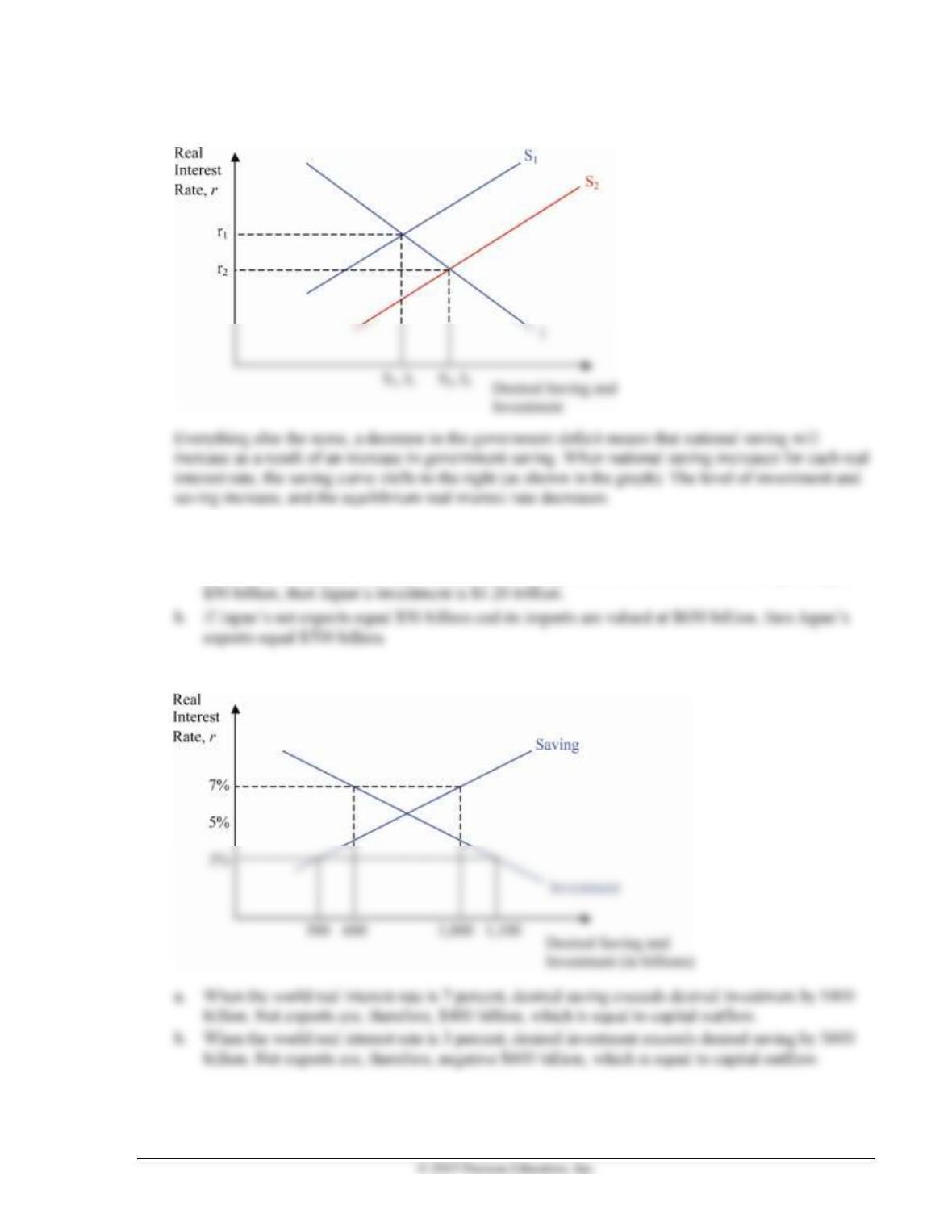
4.
consequence, firms hesitate to increase their capital stock in such an environment. Businesses decide
to decrease desired investment at every given real interest rate, as shown by the shift to the left on the
investment curve. Investment and saving decrease, as well as the equilibrium real interest rate.
Chapter 4 Saving and Investment in Closed and Open Economies 37
5.
Saving, Investment, and Goods Market Equilibrium in an Open Economy
6. a. Considering Japan an open economy means that Japan’s investment equals its national saving
minus its net exports. If saving is $1.25 trillion (25 percent of $5 trillion) and net exports equal
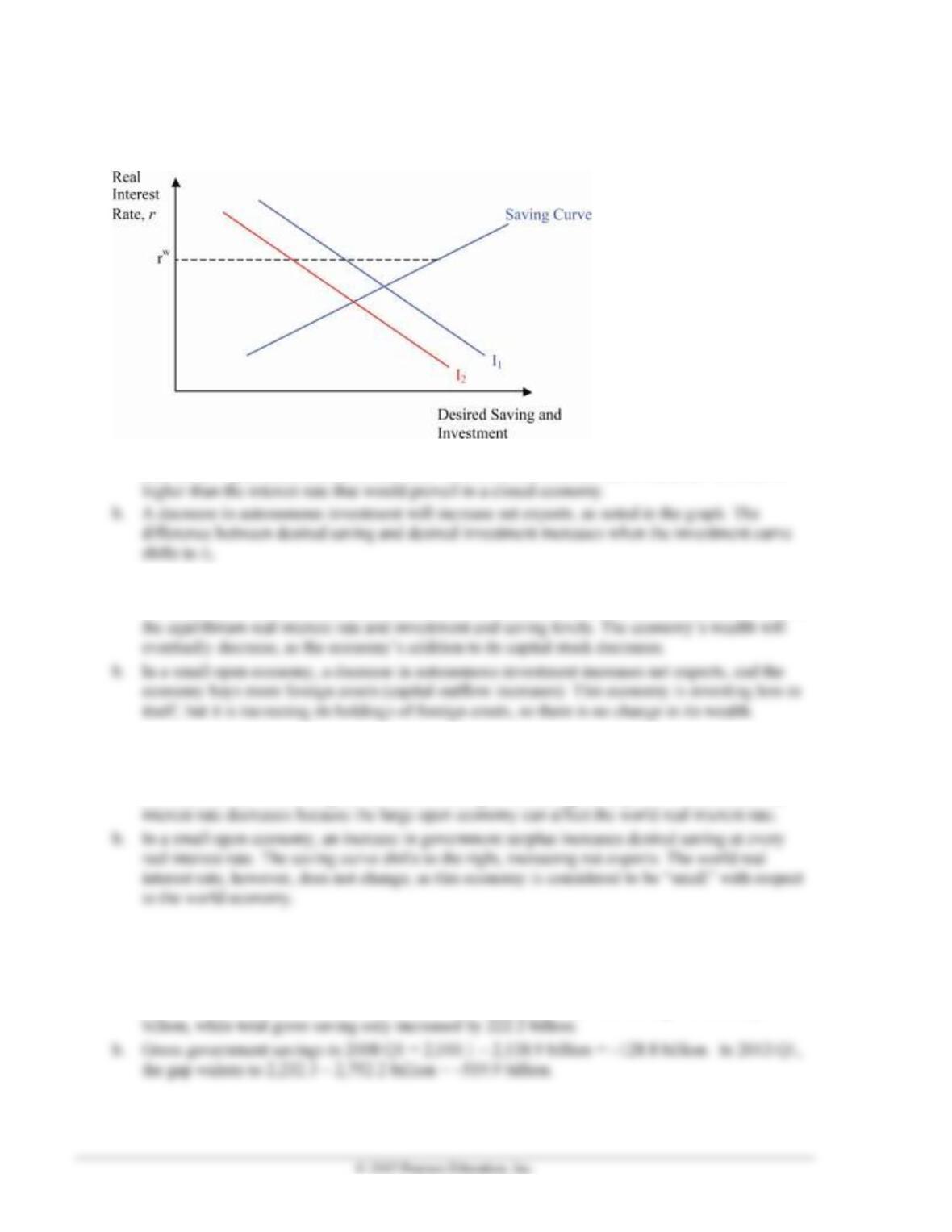
7.
38 Mishkin • Macroeconomics: Policy and Practice, Second Edition
Response to Changes in Saving and Investment in a Small Open Economy
8.
a. If this country is running a trade surplus, this means that the world real interest rate is such that
desired saving exceeds desired investment. The world real interest rate is noted as rw, which is
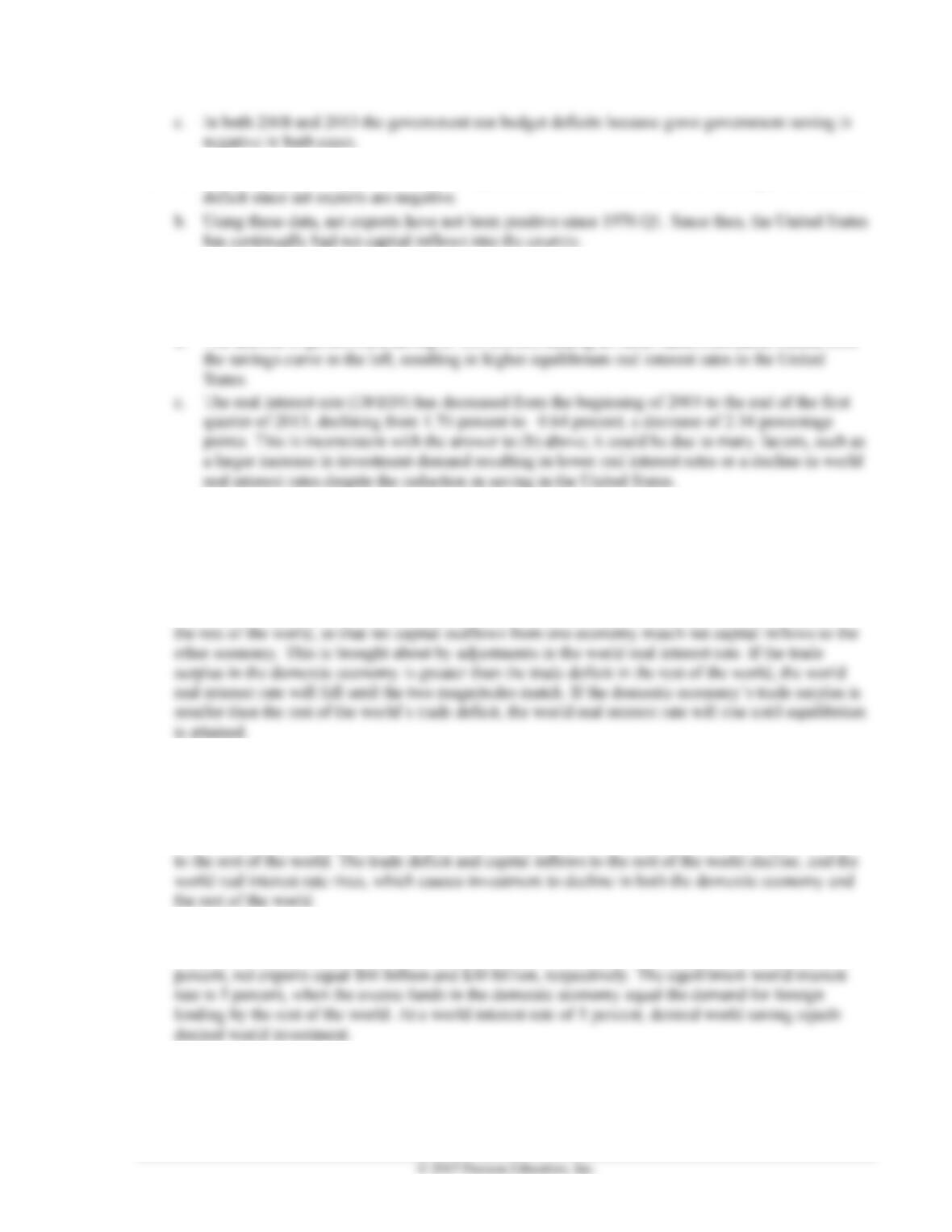
9. a. A decrease in autonomous investment decreases desired investment at each real interest rate and,
therefore, shifts the investment curve to the left. In a closed economy, this results in a decrease in
Large Versus Small Open Economies
10. a. For a large open economy, an increase in government surplus increases desired saving at every
real interest rate. The saving curve shifts to the right, increasing net exports. The domestic real
◼ Answers to Data Analysis Problems
1. a. GPSAVE was 2,138.9 billion in 2008:Q1, and 2,752.2 billion in 2013:Q1. GSAVE was 2,010.1
billion in 2008:Q1 and 2,232.3 billion in 2013:Q1. Thus, gross private saving increased by 613.3
Chapter 4 Saving and Investment in Closed and Open Economies 39
2. a. For 2013:Q1, net exports = 559.018 – 682.676 billion = –123.658 billion. This represents a trade
3. a. From 2005:Q1 to 2013:Q1 government saving decreased from –19.9 billion to –519.9 billion, a
decrease of 500 billion. This is due to persistently large budget deficits that grew rapidly during
and after the Great Recession of 2008–09 but have moderated in recent years.
b. The decline in government saving of 500 billion, holding all other factors constant, should shift
◼ Answers to Review Questions and Problems in Web Appendix,
“Saving and Investment in Large Open Economies”
1. Goods market equilibrium requires that world saving equal desired world investment, which means
that a trade surplus (or deficit) in the domestic economy must equal the trade deficit (or surplus) in
2. A decrease in domestic investment raises the domestic economy’s trade surplus and capital outflows
and raises the trade deficit and capital inflows in the rest of the world. The world real interest rate
decreases, and investment in the rest of the world rises.
3. A fall in domestic saving decreases the domestic economy’s trade surplus and its net capital outflow
4. When the interest rate is 7 percent, net exports are $90 billion, which equals the amount of funds that
domestic residents want to lend to the rest of the world. When the interest rate is 5 percent and 3
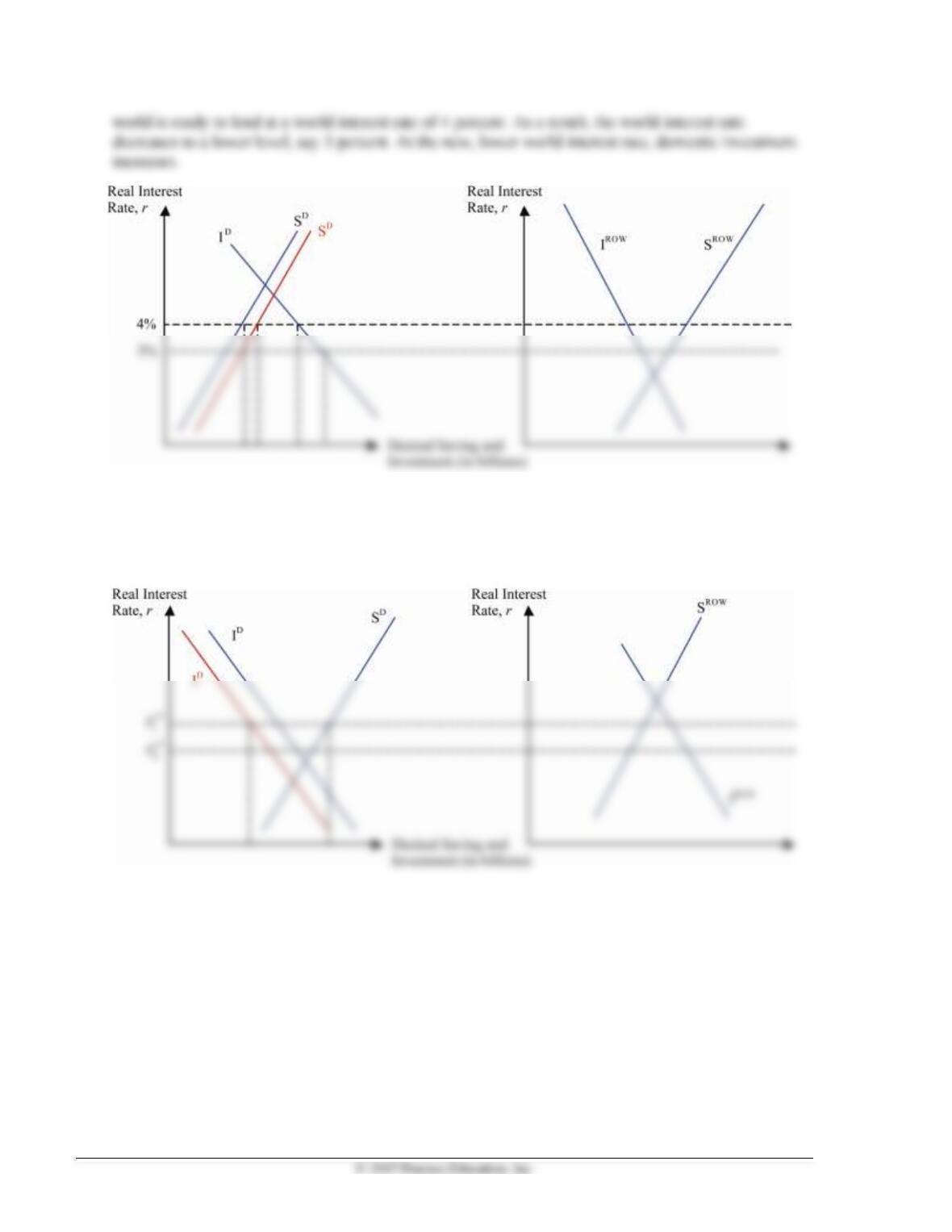
5. A decrease in government expenditures in the domestic economy results in an increase in domestic
saving, shifting the saving curve to the right. At a world interest rate of 4 percent, the trade deficit
shrinks (in absolute value). The domestic economy does not need the amount of funds that the rest of the
40 Mishkin • Macroeconomics: Policy and Practice, Second Edition
6. A decrease in autonomous domestic investment shifts the investment curve to the left and increases
the trade surplus at every given world interest rate. This will increase the amount of funds that U.S.
residents want to lend to the rest of the world. As a result, the world interest rate decreases from
1
w
r
to
2
w
r
.
◼ Data Sources, Related Articles, and Discussion Questions
A. For Information About Policy and Practice: Government Policies to
Stimulate Saving
Data Source
Federal Reserve Bank of St. Louis database: http://research.stlouisfed.org/fred2/categories/112. Here you
can find the latest data on saving and investment indicators in the United States (by clicking on a series
name, you can get a graphic representation immediately).
Chapter 4 Saving and Investment in Closed and Open Economies 41
Related Article
Ehrbar, Al, “Consumption Tax”: http://www.econlib.org/library/Enc/ConsumptionTax.html. This article
discusses the implications of capital income taxation. It refers to the 2003 tax bill that reduced the top tax
rate on dividends and capital gains.
Discussion Question
Suppose you are a policymaker and your goal is to increase national savings. Everything else the same, do
you think that a budget deficit reduction is the best way to achieve your goal? Explain.
Answer: Everything else the same, a decrease in the government budget deficit increases national saving.
B. For Information About Application: How the United States Became the
Largest Net Debtor in the World
Data Source
Bureau of Economic Analysis, “U.S. Net International Investment Position”:
Related Article
Caplan, Bryan, “Trade Deficit? What Trade Deficit?”:
Discussion Question
A negative trade balance indicates a net capital inflow (i.e., a negative net capital outflow), meaning that
foreigners are buying more U.S. assets than foreign assets bought by Americans. Describe the positive and
negative effects of such a situation.
Answer: Although usually considered a “bad” thing, a negative trade balance does not necessarily imply
C. For Information About Policy and Practice: Crowding Out and the Debate
Over the 2009 Fiscal Stimulus Package
Data Source
42 Mishkin • Macroeconomics: Policy and Practice, Second Edition
Related Articles:
Edwards, Chris, “10 Reasons to Oppose a Stimulus Package for the States”:
Discussion Question
How can one find evidence of crowding out due to an increase in the budget deficit (created by a stimulus
package)?
Answer: One way of finding evidence in favor of the crowding-out hypothesis is to find evidence of
D. For Information About Application: The Twin Deficits
Data Source
Bureau of Economic Analysis:
Related Article
Bartolini, Leonardo and Lahiri, Amartya, “Twin Deficits, Twenty Years Later”:
of a hypothesis that meant to explain the decline in the trade balance during the 1980s in the United States.
Discussion Question
What would be the effect on the trade balance of an autonomous increase in private saving?
Answer: An autonomous increase in private saving will improve the trade balance. If individuals (i.e., not
E. For Information About Application: The Global Saving Glut
Data Source
OECD Stats: http://stats.oecd.org/index.aspx. This link provides access to information about China from
Related Article
Bernanke, Ben, “The Global Saving Glut and the U.S. Current Account Deficit”:
Chapter 4 Saving and Investment in Closed and Open Economies 43
Discussion Question
One of the consequences of an abundance of savings in some regions of the world is that it might create
imbalances in other parts of the world. Do you think it is possible to solve these imbalances by restricting
the behavior of individuals or countries that save a lot or not enough?
Answer: Although such a measure might seem tempting (due to its apparent simplicity), it is actually quite