CHAPTER 35
(MACRO CHAPTER 20; MICRO CHAPTER 21)
International Trade Restrictions
FUNDAMENTAL QUESTIONS
1. Why do countries restrict international trade?
OVERVIEW AND OBJECTIVES
The primary purpose of this chapter is to describe the ways that countries protect their domestic
industries from foreign competition and the consequences of such protection.
The unique feature of this chapter is the use of the supply and demand model to show the consequences
of commercial policy for consumers and economic efficiency. The chapter also explores the ways in
which groups of countries organize themselves into trading blocks.
After reading and reviewing this chapter, the student should be able to:
1. Define commercial policy.
KEY TERM REVIEW
commercial policy
strategic trade policy
increasing-returns-to-scale industry
230 Chapter 35: International Trade Restrictions
.
LECTURE OUTLINE AND TEACHING STRATEGIES
I. Arguments for Protection
Teaching Strategy: You may find it interesting to divide your class into two sides and have each
side develop arguments either for or against protectionism.
A. Creation of domestic jobs: Many people argue that protectionism saves jobs. This may be
true in a protected industry, but the cost of protectionism exceeds the benefits for the
E. Infant industries: New and emerging industries are often protected until they are able to
compete with foreign counterparts that are more established.
F. Strategic trade policy: In industries with decreasing costs, it may be appropriate for
governments to use strategic trade policy.
II. Tools of Commercial Policy
Teaching Strategy: Ask your students to develop a commercial policy that minimizes the
economic costs of protectionism.
A. Tariffs: When a government imposes a tariff, the price paid by consumers and the quantity
3. Health and safety standards
III. Preferential Trade Agreements
A. Free trade areas and customs unions: In a free trade area, member countries trade freely
among themselves and establish tariff policies for nonmember countries. In customs unions,
member countries establish common tariff policies for nonmember countries. The most well
Chapter 35: International Trade Restrictions 231
OPPORTUNITIES FOR DISCUSSION
1. What are the costs and benefits of free trade? Use NAFTA as an example.
2. If countries can benefit by increasing their consumption possibilities through trade, why do so
many countries place restrictions on trade?
ANSWERS TO EXERCISES
1.
a. A commercial policy designed to protect jobs may do so in the industry itself. But the cost of
such protection is very high. Protection raises consumer prices and, because the higher
prices reduce the public’s real purchasing power, reduces the demand for other products in
the economy.
c. Tariffs have provided a substantial proportion of total government revenues for developing
countries. Because goods are easy to observe as they cross the border, a tariff is easy to levy.
But if a tariff is too high, the volume of trade may be reduced to such an extent that
government tariff revenues fall. The protection will also foster economic inefficiency.
f. In an increasing-returns-to-scale industry, protection can be beneficial if it allows the industry to
exploit economies of scale. One disadvantage of this approach is that it requires the government to
understand a broad range of technologies and the level of subsidy required to induce new products
from domestic producers. A second disadvantage is that other countries may retaliate with their
own tariffs and subsidies.2.
232 Chapter 35: International Trade Restrictions
.
a. To protect domestic jobs, quotas should be placed on foreign production because this would
minimize foreign competition.
f. Subsidies should be used to stimulate exports of an increasing-returns-to-scale industry.
3.
a. A tariff will raise revenues for the domestic government, but quotas will not.
4. Because the free trade area would eliminate tariffs and quotas, there would be no trade diversion
customs union impose common trade barriers against nonmember countries.
6.
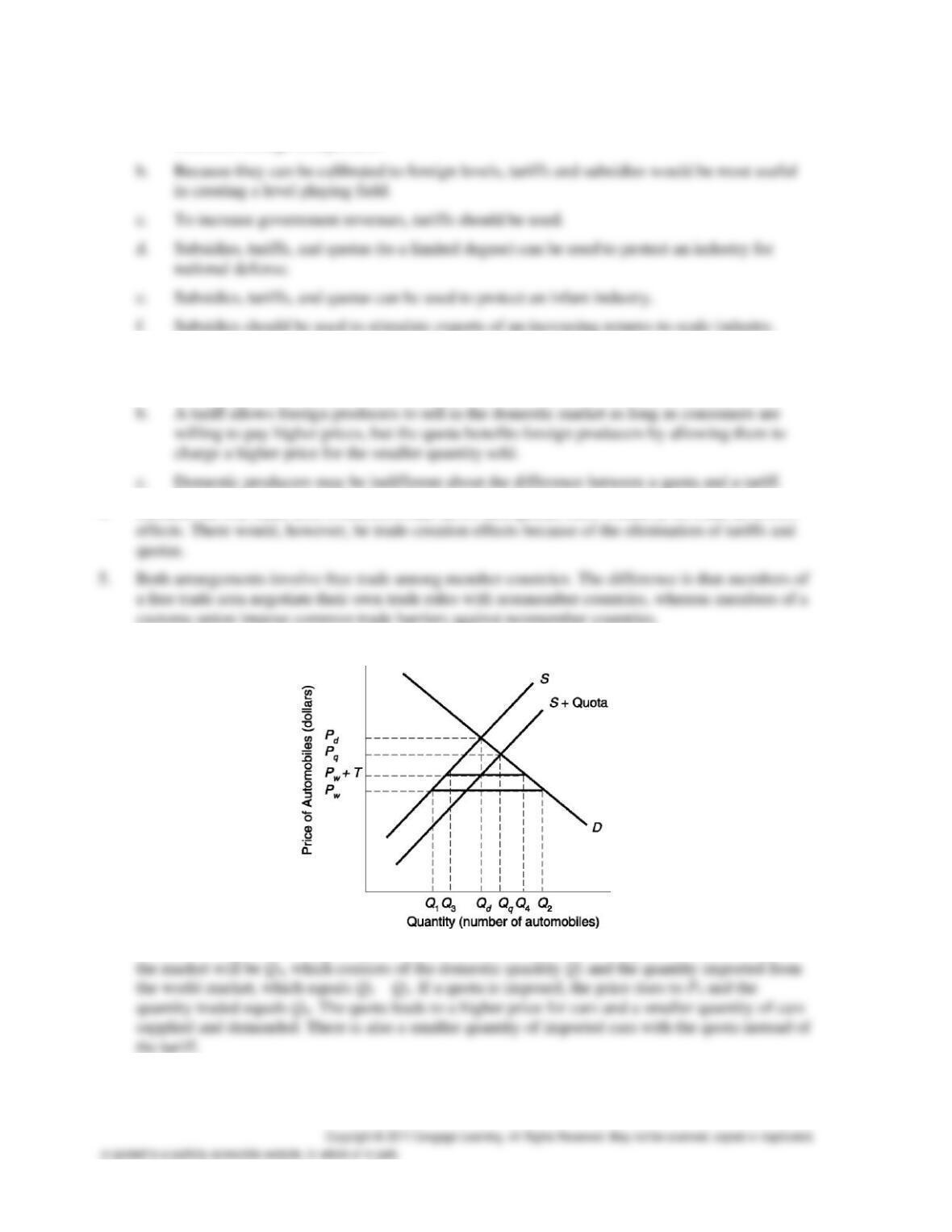
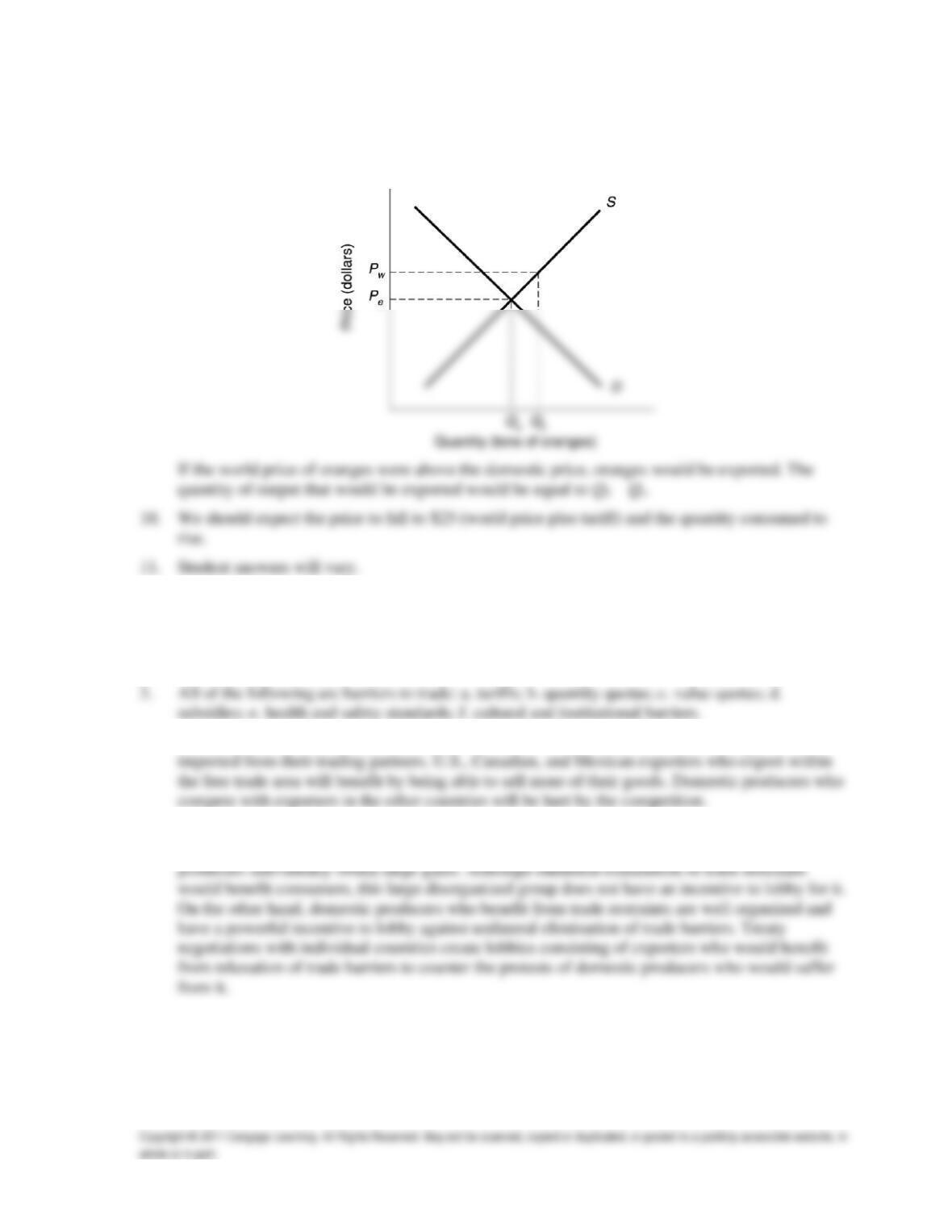
If a tariff is imposed, raising the price to Pw + T, the total quantity of output that will be traded in
7. U.S. residents would oppose commercial policy because tariffs and quotas raise consumer prices
of imports and reduce the quantities of imported goods that U.S. residents can enjoy.
Chapter 35: International Trade Restrictions 233
8. I would also need information about the cost of the misallocation of resources that occurs when
protections are imposed.
9.
ANSWERS TO STUDY GUIDE HOMEWORK
1. Commercial policy
2. Domestic producers; domestic consumers.
4. Consumers in the United States, Canada, and Mexico benefit from lower prices on goods
5. Trade restraints are an example of rent-seeking behavior. The political problem is that a large
number of consumers suffer relatively small individual losses, whereas a small number of
ACTIVE LEARNING EXERCISE
This exercise requires students to develop an understanding of the impact of a quantity quota on
automobiles by using simple demand and supply analysis. In addition to simply creating a graph, make
sure that students understand why a government would choose to impose a quantity quota on a good.
234 Chapter 35: International Trade Restrictions
.
Call on each pair to present its graph to the class. Student graphs should appear similar to Figure 2 in
the text chapter, with revised axes labels and quantities.