Chapter 33
Exchange Rates and the Balance of Payments
◼ Overview
In this chapter, the financial arrangements that accommodate international trade are discussed. Various
concepts of international payments balances and the difference between the balance of payments and
the balance of trade are analyzed. The freely floating exchange rate system of international monetary
arrangements is presented. In this presentation, the fact that the demand for foreign goods and services is
equivalent to the demand for foreign currency or a supply of domestic currency to the foreign exchange
markets is developed. Similarly, foreign demand for domestic goods and services is equivalent to the supply
of foreign currency, or demand for domestic currency, on foreign exchange markets. The international
◼ Learning Objectives
After studying this chapter, students should be able to:
• 33.1 Distinguish between the balance of trade and the balance of payments and identify the key
accounts within the balance of payments
• 33.2 Explain the demand and supply of foreign exchange
◼ Outline
I. The Balance of Payments and International Capital Movements
A. The Balance of Payments: A system of accounts that measures transactions of goods,
services, income, and financial assets between domestic households, businesses, and
Chapter 33 Exchange Rates and the Balance of Payments 497
B. Accounting Identities: Values that are equivalent by definition.
2. Equilibrium: Certain economic adjustment mechanisms have evolved to ensure equilibrium.
C. Current Account Transactions: All payments and gifts that are related to the purchase
or sale of both goods and services constitute the current account in international trade.
(See Table 33-2.)
1. Merchandise Trade Exports and Imports: The largest portion of any nation’s balance of
2. Service Exports and Imports: The services exports and imports have to do with invisible
3. Unilateral Transfers: Americans give gifts to relatives and others abroad. The federal
government grants gifts to foreign nations. Foreigners give gifts to Americans, and some
4. Balancing the Current Account: If the sum of net exports plus unilateral transfers plus
current account deficit.
D. Financial Account Transactions: Financial account transactions concern the buying and
selling of real and financial assets in international transactions.
1. Types of Financial Account Transactions: These transactions occur when foreigners
invest in the United States or Americans invest in other countries.
2. The U.S. Financial Account: In the absence of interventions by finance ministries or
E. What Affects the Distribution of Account Balances within Balance of Payments? The
II. Deriving the Demand for and Supply of Foreign Exchange: A foreign exchange market is a
market in which households, firms, and governments buy and sell national currencies. A foreign
498 Miller • Economics Today, Nineteenth Edition
A. Demand for and Supply of Foreign Currency: Flexible or floating exchange rates fluctuate
in the foreign exchange market in response to changes in supply and demand conditions. Every
B. Appreciation, Depreciation, and Demand for and Supply of Foreign Exchange: To
determine the equilibrium foreign exchange rate, the factors that determine the supply and
demand for foreign exchange must be determined.
1. Appreciation and Depreciation of Pounds: Appreciation means an increase in the value
2. An Example of Derived Demand: A downward-sloping demand curve for pounds is
derived from the U.S. demand for British pharmaceuticals. (See Figure 33-2.)
b. A Change in the Quantity of Foreign Exchange Demanded in Response to a
Change in the Exchange Rate: An increase in the price of pounds reduces the
3. Downward-Sloping Derived Demand: As the price of the British pound falls, the quantity
demanded will rise. (See Figure 33-2.)
4. Supply of Pounds: The supply of pounds is a derived supply in that it is derived from a
British resident’s demand for U.S. tablet devices. The British want dollars in order to
5. An Example (See Figure 33-3.)
III. Determining Foreign Exchange Rates: The values of exchange rates are determined by the
interacting forces of demand and supply in foreign exchange markets.
A. Total Demand for and Supply of Foreign Exchange: The intersection of the supply of
pounds and demand for pounds curves establishes the equilibrium exchange rate.
(See Figure 33-4.)
B. Changes in the Equilibrium Exchange Rate: Currency appreciations and depreciations result
from variations in exchange rates. Shifts in the demand for and supply of foreign currencies
1. A Shift in Demand: An increase in demand for British pharmaceuticals can be translated
2. A Shift in Supply: Assume that the supply curve of yen shifts outward to the right. There
Chapter 33 Exchange Rates and the Balance of Payments 499
C. Market Determinants of Exchange Rates: The foreign exchange market is affected by
relative price levels as well as many others, including the following:
1. Changes in Real Interest Rates: If the U.S. interest rate increases relative to the rest of
2. Changes in Consumer Preferences: If other countries change their preferences to U.S.
goods, this will increase the derived demand for U.S. dollars in foreign exchange markets.
3. Perceptions of Economic Stability: If the United States looks economically and
IV. Fixed versus Floating Exchange Rates
A. The Gold Standard: An international monetary system in which nations fix their exchange
rates in terms of gold. Thus, all currencies are fixed in terms of each other. Any balance of
B. Bretton Woods and the International Monetary Fund
1. The Purpose of the IMF in the Bretton Woods System: The Bretton Woods Agreement
2. The Dollar’s Role under Bretton Woods: Member governments were obligated to
maintain the values of their currencies in foreign exchange markets within 1 percent of
the declared par value (the legally established value of the monetary unit). The United
C. Fixing the Exchange Rate
1. Confronting Pressures for the Exchange Rate to Change: Other things being equal, an
2. Maintaining a Fixed Exchange Rate: Central banks can keep exchange rates fixed as
D. Pros and Cons of a Fixed Exchange Rate
1. Foreign Exchange Risk: Limiting foreign exchange risk is one major argument for fixed
2. The Exchange Rate as a Shock Absorber: If residents of a country are relatively immobile,
then exchange rate movements can reduce the shock of a decrease in demand for a
500 Miller • Economics Today, Nineteenth Edition
◼ Points to Emphasize
Trade Balances
The belief is widely shared by newspaper columnists, TV news commentators, politicians, and other people
that if the U.S. imports much more in money value terms of goods and services than it exports to a particular
country, a problem exists. Many are upset by the fact that the United States has such a large trade
imbalance with China. They think that an equivalent export–import value should exist for every two-country
Exchange Rate Systems
It is useful to make a distinction between flexible and fixed exchange rate systems. Under the fixed
exchange rate system (the IMF-modified gold exchange standard or the pure gold standard), international
equilibrium imbalances are restored by changing the price level except for one price, the exchange rate.
Under a fixed exchange rate system many, prices are forced to change in order to preserve the exchange
rate. Payments are brought into balance by having surplus nations inflate their price levels and having
deficit nations deflate their price levels. Nations are to change their price levels to accommodate agreed
upon exchange rates. Under a flexible exchange rate system, only one price changes, the exchange rate.
Nations need not induce recession or inflation in order to right payments disequilibrium. All that is
necessary is that exchange rates change, and income and price effects will eventually restore equilibrium.
Financial Account and the Current Account
A country that runs a current account deficit must also run a capital account surplus if central banks and
finance ministries do not intervene in the foreign exchange markets. The idea behind this is that when all
transactions are voluntary, the overall market value of what is gained is equal to the value of what is given
Chapter 33 Exchange Rates and the Balance of Payments 501
◼ For Those Who Wish to Stress Theory
Exchange Rate Determination Systems and International
Payments Equilibrium
Under the gold standard in a world consisting of the United States and Britain, if the United States has a
payments deficit, Britain must have a payments surplus. Both countries have tied their currencies to a
specific quantity of gold and thus each has set the value of its currency unit in terms of the others. The
gold standard is thus a fixed exchange rate system. If the United States is importing (in value) more in
goods and services than it is exporting, or if it is lending or giving away in transfers more than it is
receiving, then it will have a payments deficit, and Britain will have a payments surplus. Gold will flow
from the United States to Britain. The money supply in the United States falls, and Britain’s money
◼ Further Questions for Class Discussion
1. Why does no country today operate on a gold standard? To be on a gold standard is to allow a
2. How might different economic growth rates in different countries affect the exchange rate? The
3. In the financial crisis that began in September 2008, U.S. and foreign investors shifted large
amounts of funds used for investment into U.S. Treasury securities, driving the interest rates on
these securities to very low levels, in some cases to less than 1 percent. The Federal Reserve
4. Is a “strong” dollar necessarily a good thing? American politicians announced with regularity that a
strong dollar (i.e., one that is appreciating) is better for the economy than a “weak” dollar. The idea
seems to be that strong is good and weak is bad. Is this actually the case? Students will often be
5. In the past few years, the very large current account deficit of the United States has not led to a
significant depreciation of the dollar. This seems to be the case because other nations and foreign firms
and investors have been willing to hold U.S. dollars by purchasing U.S. financial assets denominated in
dollars. Recently, there has been concern that some of the major holders of U.S. financial assets may
◼ Answers to Questions for Critical Analysis
Harley-Davidson’s Sales of Motorcycles Are Reduced by the Strong Dollar
(p. 742)
Given that foreign prices of exports of firms such as 3M, General Motors, and Under Armor also
increased substantially, what do you think happened to amounts of foreign currencies supplied by
foreign residents?
Can Behavioral Economics Help Nations Achieve Balanced Trade (p. 746)
Why is it that if the sum of trade surpluses across all nations in the Eurozone were to shrink, the
sum of trade deficits experienced by the other nations in the Eurozone also would tend to diminish?
Chapter 33 Exchange Rates and the Balance of Payments 503
◼ You Are There
Nigeria’s Central Bank Forces a Reduction in the Demand for Foreign Exchange
(p. 749)
1. Why would a naira depreciation cause Nigerian exports top become less expensive to
residents of other nations?
2. Does Nigeria’s central bank appear to wish for the nation to operate with a trade deficit or
a trade surplus? Explain your reasoning?
◼ Issues and Applications
A Year of an appreciation, Lower Import Prices, and Higher Quantity of Foreign
Exchange Demanded (pp. 750–751)
1. Other things being equal, what do you think should have happened in 2015 to the prices of
goods and services exported by U.S. firms?
2. Why do you suppose that foreign expenditures on U.S. exports declined during 2015?
◼ Research Project
1. For a look at the latest percentage changes in U.S. import and export prices, see the Web Links in
◼ Answers to Problems
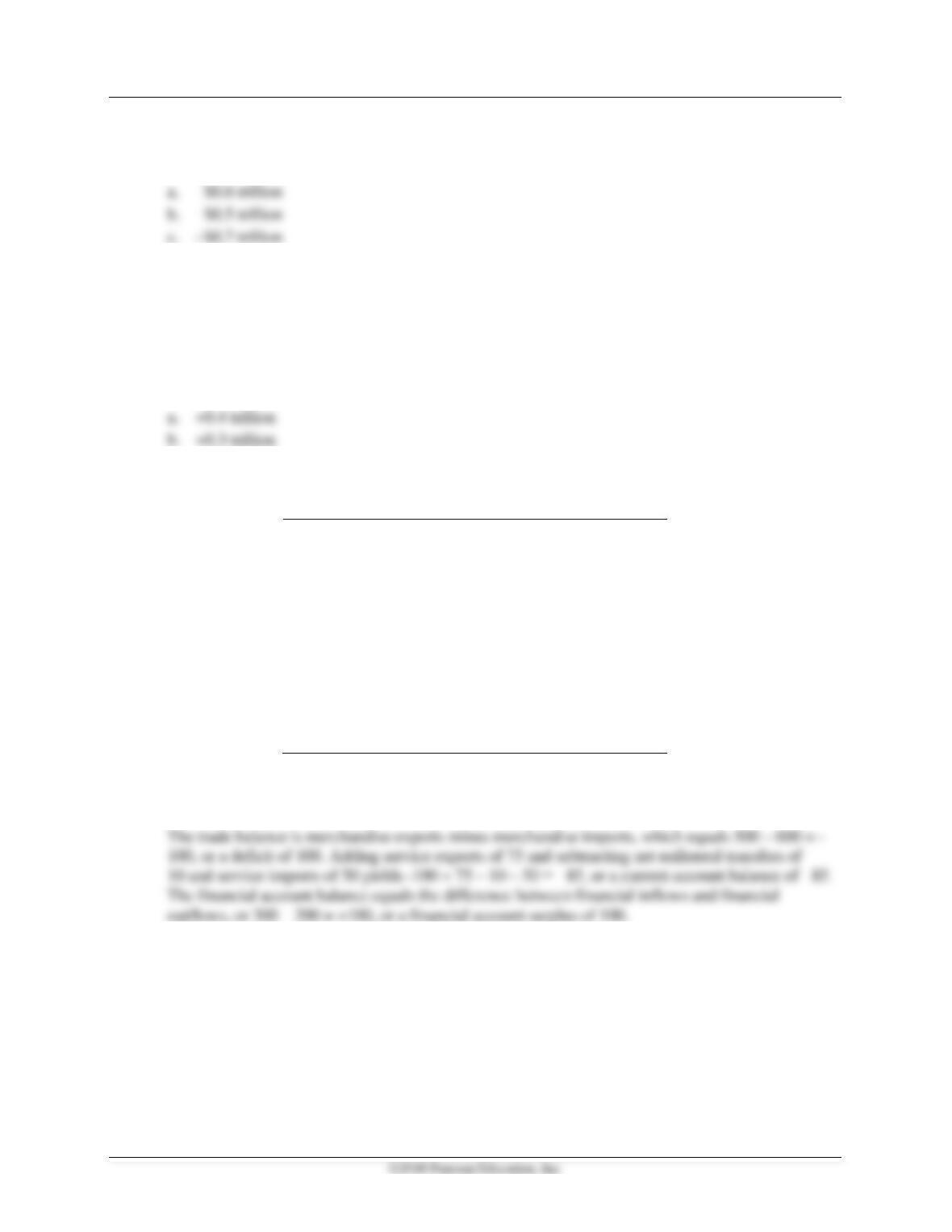
33-1. Suppose that during a recent year for the United States, merchandise imports were
$2 trillion, unilateral transfers were a net outflow of $0.2 trillion, service exports were
$0.2 trillion, service imports were $0.1 trillion, and merchandise exports were $1.4 trillion.
a. What was the merchandise trade deficit?
504 Miller • Economics Today, Nineteenth Edition
b. What was the balance on goods and services?
c. What was the current account balance?
33-2. Suppose that during a recent year for the United States, the current account balance was
–0.5 trillion, and the net acquisitions of financial assets by U.S. residents and government
entities was +$0.1 trillion.
a. What was the balance on the financial account during the year?
b. What was the net incurrence of financial liabilities by U.S. residents and government
entities during the year?
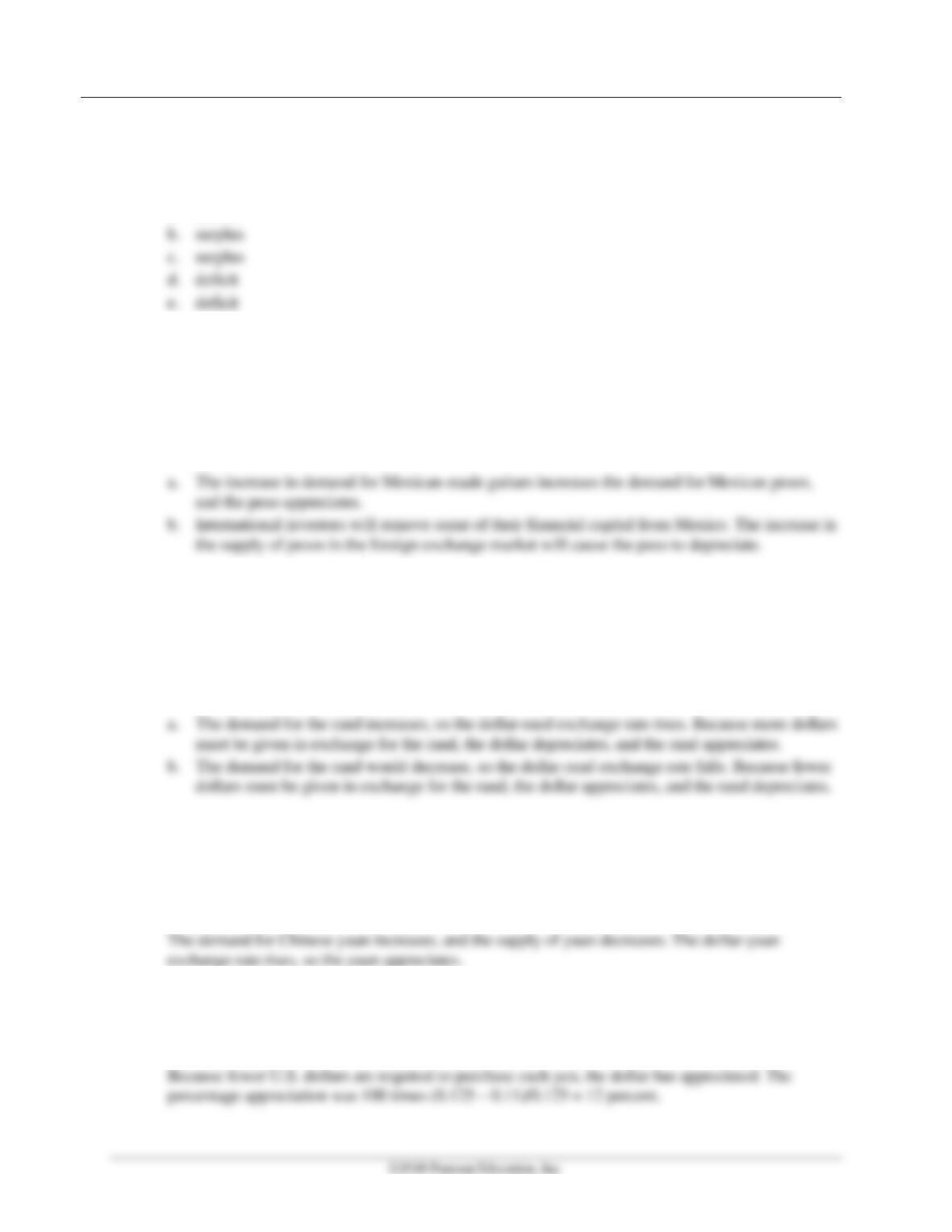
33-3. Over the course of a year, a nation tracked its foreign transactions and arrived at the
following amounts:
Merchandise exports
500
Service exports
75
Net unilateral transfers
10
Net change in domestic liabilities abroad
–235
(financial outflows)
Net change in foreign assets at home
300
(financial inflows)
Merchandise imports
600
Service imports
50
What are this nation’s balance of trade, current account balance, and financial account
balance?
33-4. Identify whether each of the following items creates a surplus item or a deficit item in the
current account of the U.S. balance of payments.
a. A Central European company sells products to a U.S. hobby-store chain.
b. Japanese residents pay a U.S. travel company to arrange hotel stays, ground
transportation, and tours of various U.S. cities, including New York, Chicago, and
Orlando.
c. A Mexican company pays a U.S. accounting firm to audit its income statements.
Chapter 33 Exchange Rates and the Balance of Payments 505
d. U.S. churches and mosques send relief aid to Pakistan following a major earthquake in
that nation.
e. A U.S. microprocessor manufacturer purchases raw materials from a Canadian firm.
a. deficit
33-5. Explain how the following events would affect the market for the Mexican peso, assuming a
floating exchange rate.
a. Improvements in Mexican production technology yield superior guitars, and many
musicians around the world buy these guitars.
b. Perceptions of political instability surrounding regular elections in Mexico make
international investors nervous about future business prospects in Mexico.
33-6. Explain how the following events would affect the market for South Africa’s currency, the
rand, assuming a floating exchange rate.
a. A rise in U.S. inflation causes many U.S. residents to seek to buy gold, which is a major
South African export good, as a hedge against inflation.
b. Major discoveries of the highest-quality diamonds ever found occur in Russia and
Central Asia, causing a significant decline in purchases of South African diamonds.
33-7. Suppose that the following two events take place in the market for China’s currency, the
yuan: U.S. parents are more willing than before to buy action figures and other Chinese toy
exports, and China’s government tightens restrictions on the amount of U.S. dollar–
denominated financial assets that Chinese residents may legally purchase. What happens to
the dollar price of the yuan? Does the yuan appreciate or depreciate relative to the dollar?
33-8. On Wednesday, the exchange rate between the Japanese yen and the U.S. dollar was $0,010
per yen. On Thursday, it was $0,009. Did the dollar appreciate or depreciate against the
yen? By how much, expressed as a percentage change?
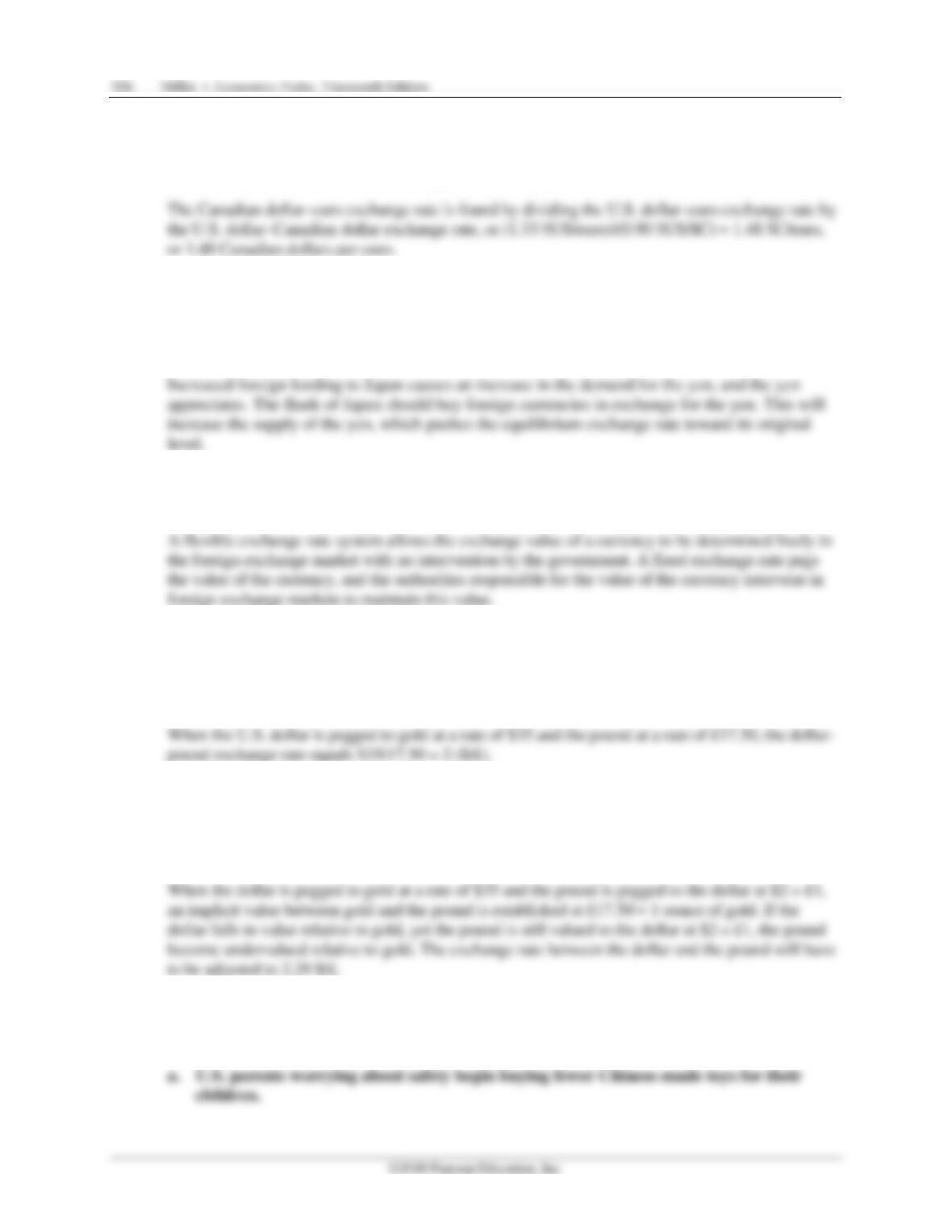
33-9. On Wednesday, the exchange rate between the euro and the U.S. dollar was $1.33 per euro,
and the exchange rate between the Canadian dollar and the U.S. dollar was U.S. $0.90 per
Canadian dollar. What is the exchange rate between the Canadian dollar and the euro?
33-10. Suppose that signs of an improvement in the Japanese economy lead international investors
to resume lending to the Japanese government and businesses. How would this event affect
the market for the yen? How should the central bank, the Bank of Japan, respond to this
event if it wants to keep the value of the yen unchanged?
33-11. Briefly explain the differences between a flexible exchange rate system and a fixed exchange
rate system.
33-12. Suppose that under a gold standard, the U.S. dollar is pegged to gold at a rate of $35 per
ounce and the pound sterling is pegged to gold at a rate of £17.50 per ounce. Explain how
the gold standard constitutes an exchange rate arrangement between the dollar and the
pound. What is the exchange rate between the U.S. dollar and the pound sterling?
33-13. Suppose that under the Bretton Woods system, the dollar is pegged to gold at a rate of $35
per ounce and the pound sterling is pegged to the dollar at a rate of $2 = £1. If the dollar is
devalued against gold and the pegged rate is changed to $40 per ounce, what does this imply
for the exchange value of the pound in terms of dollars?
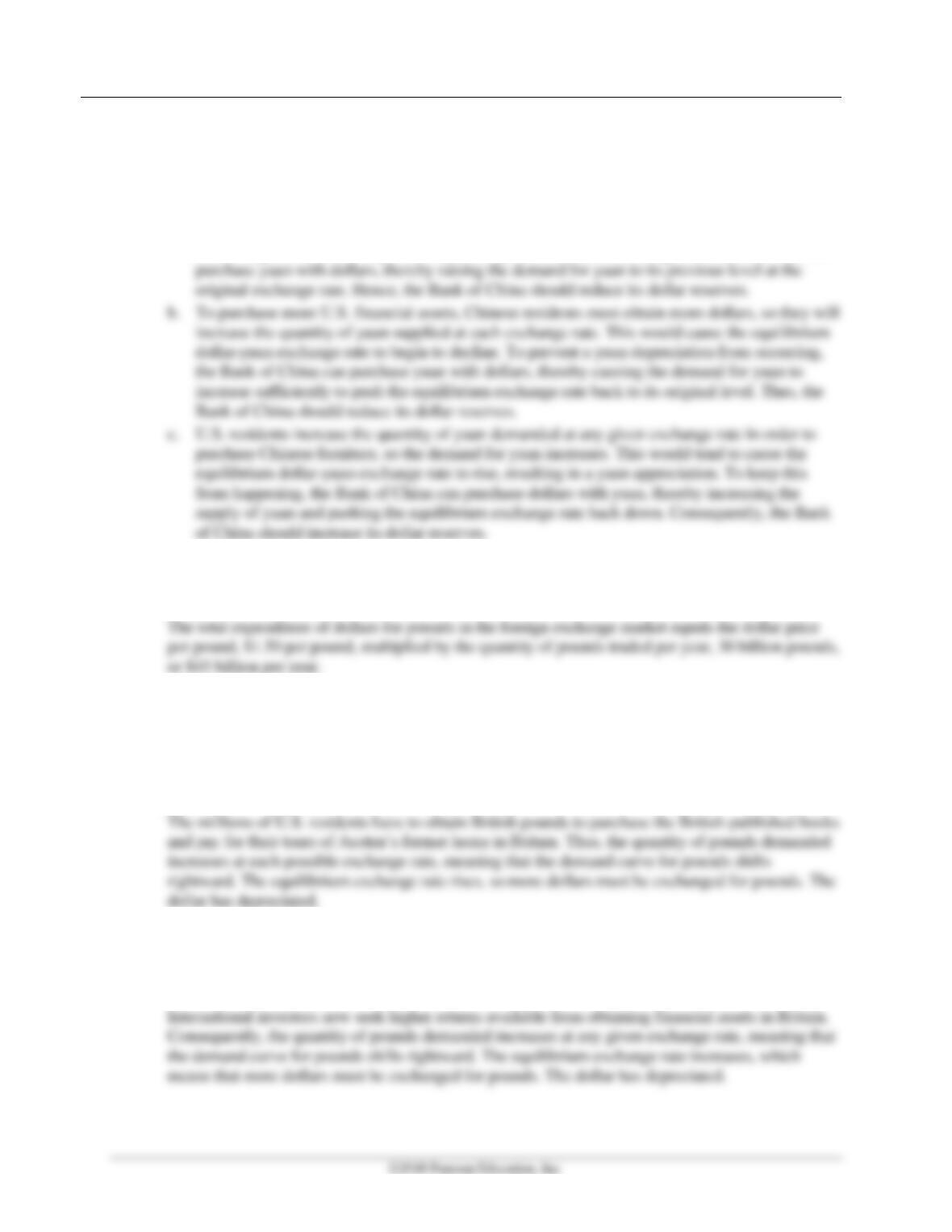
33-14. Suppose that the People’s Bank of China wishes to peg the rate of exchange of its currency,
the yuan, in terms of the U.S. dollar. In each of the following situations, should it add to or
subtract from its dollar foreign exchange reserves? Why?
Chapter 33 Exchange Rates and the Balance of Payments 507
b. U.S. interest rates rise relative to interest rates in China, so Chinese residents seek to
purchase additional U.S. financial assets.
c. Chinese furniture manufacturers produce high-quality early American furniture and
successfully export large quantities of the furniture to the United States.
a. The demand for yuan will decrease, which would cause the equilibrium dollar-yuan exchange
rate to begin to decline. To prevent a yuan depreciation from occurring, the Bank of China can
33-15. At the point E in Figure 33-4, how many dollars per year are traded for the equilibrium
quantity of pounds?
33-16. Take a look at Figure 33-5. Suppose that in response to a significant rise in interest in Jane
Austen’s works and life, millions of U.S. residents suddenly purchase British-published
books by and about the famous author and travel to Britain to visit Jane Austen’s former
home. What will happen to the equilibrium dollar price of the pound, and why? Does the
dollar appreciate or depreciate in relation to the pound?
33-17. Consider Figure 33-5. Suppose that the real interest rate in Britain increase relative to the
U.S. real interest rate. What will happen to the equilibrium dollar price of the pound, and
why? Does the dollar appreciate or depreciate in relation to the pound?
33-18. Take a look at Figure 33-6. Suppose that the preferences of most British residents alter
toward purchasing more downloaded online screaming videos of Hollywood movies
distributed by U.S. firms. What will happen to the equilibrium dollar price of the pound,
and why? Does the dollar appreciate or depreciate in relation to the pound?
33-19. Consider Figure 33-6. A sudden increase in economic and political instability throughout
Europe and Asia has caused the United States to appear to British residents to be relatively
more economically and politically more stable than was previously the case. What will
happen to the equilibrium dollar price of the pound, and why? Does the dollar appreciate
or depreciate in relation to the pound?
33-20. Suppose the initially in Figure 33-8, the market for Bahrain’s currency, the dinar, is in
equilibrium at point E1. Now, however, an increase in the U.S. real interest rate has
occurred even as real interest rates in Bahrain and elsewhere in the world either have
declined or have remained unchanged. What must Bahrain’s central bank do, and why, if it
wishes to maintain a fixed exchange rate?
Bahrain’s residents seek to earn higher returns on U.S. assets and thereby sell more dinars for
◼ Selected References
Aghevli, B. B., “The Balance of Payments and the Money Supply Under the Gold Standard Regime:
U.S. 1879–1914,” American Economic Review, March 1975.
Baillie, R. and P. MacMahon, The Foreign Exchange Market, Cambridge: Cambridge University Press,
1989.
Bordo, Michael D., “The Classical Gold Standard; Some Lessons for Today,” Review (Federal Reserve
Bank of St. Louis), May 1981, pp. 2–17.
Dreyer, Jacob S., Goffried Haberler, and Thomas D. Willett, Exchange Rate Flexibility, Washington,
Chapter 33 Exchange Rates and the Balance of Payments 509
Hamouda, Omar F., Robin Rowley, and Bernard M. Wolf, eds., The Future of the International Monetary
System, New York: M.E. Sharpe, 1989.