
CHAPTER 31
Work and Wages
Neoclassical View of Income Distribution
LEARNING OBJECTIVES
Discuss the determinants of the labor demand and labor supply curves.
Explain the relationship between factor prices and factor productivity.
Explain the criticisms of the marginal productivity theory.
OUTLINE OF CHAPTER
I. The Demand for Factors of Production
Marginal Revenue Product
The Labor Demand Curve
II. The Supply Curve for Labor
Shifting the Labor Supply Curve
III. Marginal Productivity and Wage Differentials
IV. Progressive Criticism of Neoclassical Distribution Theory
V. Summary
KEY TERMS
compensating differential
higher wages offered in jobs that involve danger, tedium, or significant physical labor

the education, training, and experience that increase worker productivity and therefore income
marginal physical product
a measure of the output of labor in terms of goods and services
marginal revenue product
the additional revenue earned from hiring one more worker
ANSWERS TO END OF CHAPTER REVIEW QUESTIONS
Discuss the determinants of the labor demand and labor supply curves.
1. Why is the demand for the factors of production called derived demand?
Derived demand means that the demand for the factors of production is derived or arises
2. Why is the MRP curve downward sloping? What factors cause it to shift? Answer with
respect to the MRP for each of the factors of production.
3. Under what conditions is the labor supply curve upward sloping? When is it backward
bending? What factors cause the labor supply curve to shift?
The supply curve of labor is upward sloping as long as individuals consume less leisure
Explain the relationship between factor prices and factor productivity.
4. How can marginal productivity theory be used to explain wage differentials? Give
specific examples.
Marginal productivity says that individuals earn wages based on their productivity. This
Use marginal productivity theory to explain what people earn in the labor market.
5. Using diagrams, illustrate
a. why offshore oil workers have higher wages than on-shore oil workers.
b.
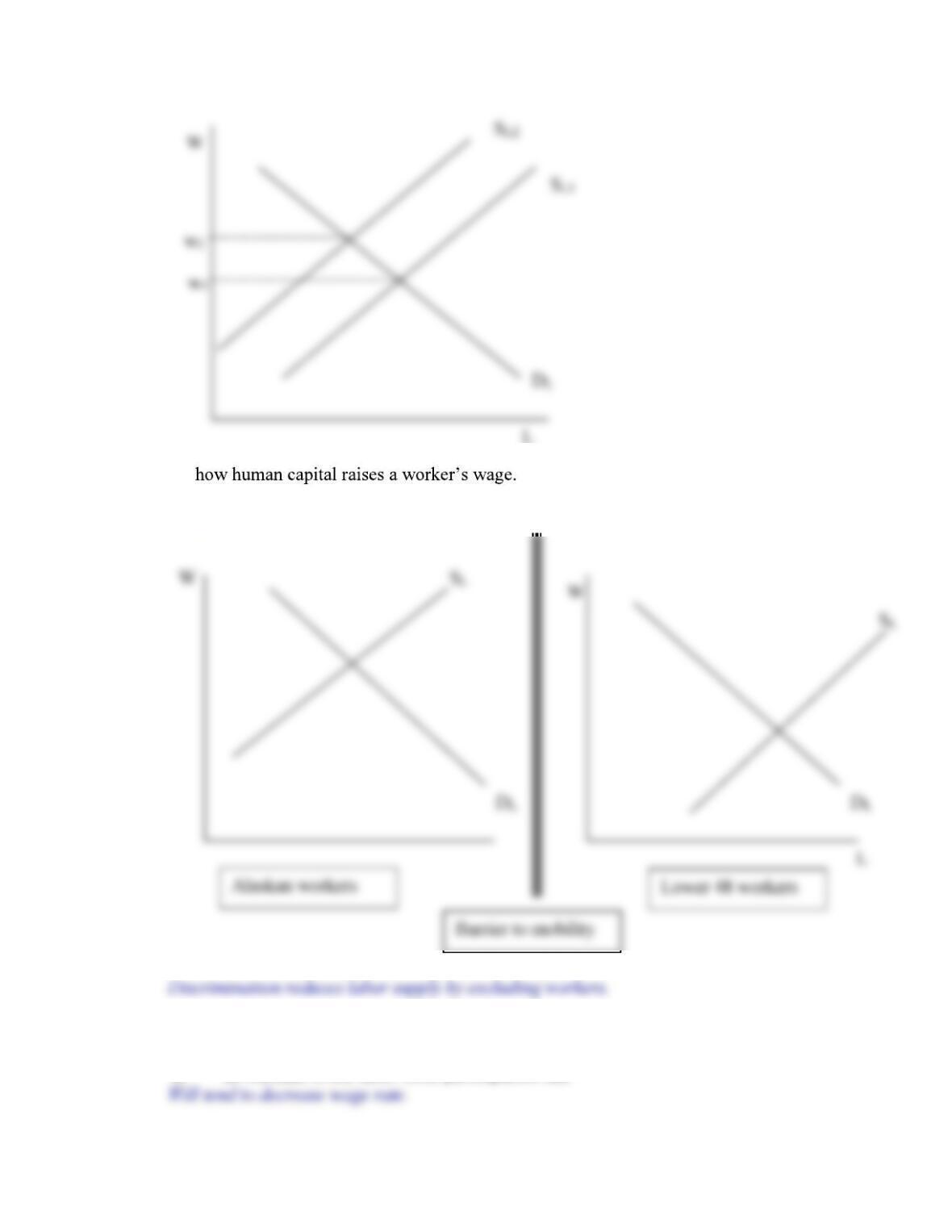
c. why Alaskan workers have higher wages than workers in the lower 48 states.
Wages are higher in Alaska due to barriers to mobility for workers.
d. why discrimination raises the wage rate for nondiscriminated workers.
6. Ceteris paribus, which of the following would tend to cause the wage rate to increase?
Draw diagrams to explain your answers.
a. an increase in the labor force participation rate

b. technological advance
May tend to decrease wage rate if labor demand is reduced. Will tend to increase wage
c. higher selling prices for output
d. additional education
Explain the criticisms of the marginal productivity theory.
7. Compare and contrast marginal productivity theory and progressive labor theory. What
are the key differences?
Marginal productivity theory depicts the production process as composed of two inputs
8. How do capitalists use marginal productivity to explain wages of workers and the large
profits for the owners?
APPENDIX 31.1
Profit Maximization and the Input Decision
LEARNING OBJECTIVES FOR APPENDIX 31.1
Use marginal productivity theory to explain the optimal, profit-maximizing level of
inputs.
OUTLINE OF APPENDIX
I. How Many Workers
II. The Markets for Capital and Land

1. Some Caveats
The Market for Land and Natural Resources
IV. Profits and the Adding Up Problem
V. Summary
KEY TERMS
accumulated net marginal revenue product
the area under the marginal revenue product curve above the wage line
economic rent
a factor payment over and above the payment necessary to bring that factor into production
ANSWERS TO APPENDIX 31.1 REVIEW QUESTIONS
Use marginal productivity theory to explain the optimal, profit-maximizing level of inputs.
1. Explain the rationale behind the optimal input rule that is, that firms should hire factors
until MRP=MFC. Draw a diagram to illustrate your answer.
Use marginal productivity theory to explain prices of capital and natural resources.
2. What conditions must hold for the capital market to be in equilibrium? What will happen
if the return on capital is less than the rate necessary to overcome risk and time
preference? Draw a diagram to illustrate your result.
Long run equilibrium occurs when the capital supply curve, the short run capital supply
3. Suppose that marginal revenue product of capital is greater than r*, the interest rate
necessary to induce saving. However, instead of buying more capital, the firm hires more
labor. Would this tend to increase or decrease profits? Why?
The effect on profit would depend on existing situation with labor. The firm could
Explain the concept of economic rent.
4. Carefully distinguish between marginal productivity rent and economic rent. When does
land command economic rent? marginal productivity rent? Draw a diagram to illustrate
your answer.
Economic rent is a factor payment greater than that necessary to bring that factor into
5.
productivity theory.
6. Economic rents can be earned on all factors of production, not just unimproved land.
Explain whether and why each of the following may command economic rent:
a. a Beatles reunion concert
b. Harvard University
c.
Unlikely that a burger flipper could claim any economic rent.
d. our college economics professor
7. Suppose you bought 100 acres of farmland, installed an irrigation system, and built a
farmhouse. You then rented the property for $5,000 per month. Five years later, you
have made no improvements on the land and you raise the rent to $7,000 per month.
Does the rent increase represent pure economic rent? Explain why or why not.
Not necessarily. It may reflect an increase in the demand for land.
APPENDIX 31.2
Labor Theory of Value versus Neoclassical Marginal Productivity

LEARNING OBJECTIVE FOR APPENDIX 31.2
List and explain the differences in the approaches of traditional and progressive
economists in explaining labor markets and labor market outcomes.
OUTLINE OF APPENDIX
I. The Battle of Wages and Profits
ANSWERS TO APPENDIX 31.2 REVIEW QUESTIONS
List and explain the differences in the approaches of traditional and progressive economists
in explaining labor markets and labor market outcomes.
1.
progressive analysis.
In neoclassical economic theory, production is viewed as a process in which three
separate and distinct factors of production make definite, measurable contributions. The
2. Describe how traditional and progressive analyses think about marginal productivity.
Neoclassical theory uses marginal productivity to provide a basis for reward to a