Chapter 31
Environmental Economics
◼ Overview
This chapter addresses the difference between private costs and social costs. The concept of a cost or
negative externality is introduced and developed. The problem of negative externalities and the theory of
optimal quantity of pollution are discussed. Pollution is a negative externality and results from poorly
◼ Learning Objectives
After studying this chapter, students should be able to:
• 31.1 Distinguish between private costs and social costs and understand market externalities and
possible ways to correct them
• 31.2 Explain how economists can conceptually determine the optimal quantity of pollution
• 31.3 Describe how many of the world’s governments are seeking to reduce pollution by capping and
controlling the use of pollution-generating resources
• 31.4 Contrast the roles of private and common property rights in alternative approaches to addressing
problems such as endangered species
◼ Outline
I. Private versus Social Costs
A. Private Costs: Also called internal costs, private costs are costs incurred by individuals when they
use scarce resources.
B. Social Costs: The full costs that society bears when a resource-using action occurs. For example,
C. The Costs of Polluted Air: The air in many cities is heavily polluted from automobile exhaust
468 Miller • Economics Today, Nineteenth Edition
D. Externalities: A situation in which a private cost or benefit diverges from a social cost or benefit,
that is, the cost or benefits of an action are not fully borne by the two parties engaged in
exchanges or by an individual engaging in a scarce resource-using activity. (See Figure 31-1.)
2. The Choices That Polluters Confront: Faced with a cost of polluting, polluters will be
3. Is a Uniform Tax Appropriate? It may not be appropriate to levy a uniform tax because
external costs are not necessarily the same everywhere for the same action.
a. Determining the Economic Damages from Pollution: The taxes imposed should
II. Pollution: The by-products of an economic activity. The optimal quantity of pollution is determined
when pollution is reduced up to the point where the marginal benefit from further reduction equals
the marginal cost of further reduction.
A. Assessing the Appropriate Amount of Pollution: There is no correct answer to how much
pollution should be in an economy because when the question of how much pollution there
should be is asked, a value judgment is being requested. There is no way to disprove a value
judgment scientifically. Measures to reduce pollution should be pursued up to the point at which
the marginal benefit from further reduction equals the marginal cost of further reduction.
1. The Marginal Benefit of a Less Polluted Environment: When, for example, the air is
2. The Marginal Cost of Pollution Abatement: When, for example, the air is very dirty, the
B. The Optimal Quantity of Pollution: The level of pollution at which the marginal benefit equals
the marginal cost of pollution abatement. (See Figure 31-2.)
III. Reducing Humanity’s Carbon Footprint: Restraining Pollution-Causing Activities: This
section examines how governments try to reduce pollution-causing activities.
A. Mixing Government Controls and Market Processes: Cap and Trade: In response to the
Chapter 31 Environmental Economics 469
1. Emissions Caps and Permits Trading: The EU countries established a set of rules called
the Emissions Trading Scheme. Each nation in the EU seeks to cap its total greenhouse gas
2. In Europe, Theory Confronts European Policy and Market Realities: The theory was
that as greenhouse gas emissions caps were reduced, the price of permits would rise,
providing firms with an incentive to reduce emissions rather than to buy permits.
a. The Theory of Capping Emissions Meets the Reality of Too Many Allowances: In
B. Are There Alternatives to Pollution-Causing Resource Use? Why don’t we simply stop
IV. Common Property and Wild Species: Common property is property that is owned by everyone
and, therefore, owned by no one. Air and water are common property resources.
A. Property Rights and Spillovers: Pollution occurs where there are no well-defined private
B. Voluntary Agreements and Transaction Costs
2. Transaction Costs: One major condition for successful voluntary contracting is that the
C. Changing Property Rights: Assume that many property rights and many resources are not
defined.
1. The Problem of a Zero Price: A problem develops only when and if a use is found for a
2. Aligning Private and Social Costs: There are three ways to fill the gap between private
D. Wild Species, Common Property, and Trade-Offs: Wild species of animals are common
property resources in that no one owns them, and thus no one has an economic interest in
protecting them. With the passage of the federal Endangered Species Act, protection of
470 Miller • Economics Today, Nineteenth Edition
◼ Points to Emphasize
Pollution as a General Problem
It is interesting to point out that pollution does not necessarily arise because of greedy capitalists. Non–
capitalist polluters include the following: (a) consumers who pollute directly; (b) producers in the
Externalities
If third parties are harmed (or incur costs) as a result of two-party transactions, then the marginal social cost
(MSC) is greater than marginal private cost (MPC). Much of economic analysis demonstrates that rational
people will tend to pursue an activity until the marginal private benefit (MPB) equals the MPC. If
negative externalities exist, then self-interest and perfect competition lead to an over-allocation of
resources to the production of the good in question, i.e., if MSC MPC and MSB = MPB = MPC MSC,
then MSB MSC.
For a negative externality to exist, people must, in principle, be willing to pay to avoid it. Willingness to
The Importance of Property Rights
The lack of property rights cannot be overstressed in the analysis of pollution problems. Property owners
will take care of their property and charge for the use of it. This will limit the use of the property to the point
at which marginal benefit in dollar terms from the use of the property is equal to the marginal cost of
Chapter 31 Environmental Economics 471
Property Rights and Transactions Costs
It is important to stress that defining property rights and then allowing private transactions to solve the
externality problem cannot always result in an optimal quantity of pollution. Suppose that there are a
◼ For Those Who Wish to Stress Theory
The Optimal Quantity of Anything
Before discussing externalities, it is helpful to spend some time discussing the optimal quantity of anything
The Optimal Level of Pollution
The ability of nature to self-cleanse is a resource and as such should be used wisely and can be analyzed
just like any other resource. When production levels are very low, relative to a bountiful atmosphere, ocean,
Businesses—The Cost of Pollution
It should be stressed that even a producer who is also a “nice guy environmentalist” may not voluntarily
treat his waste to reduce pollution problems (thereby internalizing social costs). To do so would place him
472 Miller • Economics Today, Nineteenth Edition
◼ Further Questions for Class Discussion
1. Some economists have argued that lands currently owned by the government and administered by
national and state park services might receive better long-term care if they were owned and
administered privately. They argue that the profit motive would be effective in preserving these
national parks and would encourage conservation efforts. How would the profit motive encourage
environmental conservation efforts at a private park? Private owners of a park have an incentive
2. Is environmental improvement a public good? Yes. Environmental improvement is a public good.
3. Would it be just as proper to label externalities as a government failure to provide private
property rights? Economists are nearly unanimous in regarding externalities as examples of
4. In Texas, the hunting of deer takes place primarily on fenced private ranches. Hunters are charged
a fee by landowners for hunting on their land, and in many parts of the state, these hunting fees
generate more revenue for the ranchers than does the raising of livestock. In addition, the state
requires hunters to buy hunting licenses. By contrast, the state and federal governments own most
5. China has no significant pollution-abatement standards for the mining industry. In recent years,
Chinese firms that mine rare earths (minerals such as scandium used in aluminum alloys, yttrium
used in high-temperature superconductors, and a wide variety of others used in magnets, lasers,
Chapter 31 Environmental Economics 473
6. Why would a cap-and-trade system for greenhouse gas emissions result in an efficient way to
reduce pollution to optimal levels determined by the authorities? The cap-and-trade system works
◼ Answers to Questions for Critical Analysis
How Behavioral Responses to Appeals to Conserve Energy Boost Carbon
Emissions (p. 694)
Why do you suppose that some observers have called for requiring installation of devices that
would enable governments to monitor households’ energy consumption?
The Environmental Protection Agency Creates a Negative Externality (p. 696)
Who ultimately pays to address costs of negative, externalities created by government agencies such
as the EPA when they accidentally release pollutants into the environment?
How Trophy Hunting Might Help to Protect Dwindling Big-Game Species (p. 702)
Why might allowing profit-maximizing firms to manage the hunting of particular endangered
animals potentially help to ensure the animals’ species would not disappear? (Hint: Would a
company continue to generate profits from selling hunting rights if it allowed hunters to kill all of
the animals that it manages?)
474 Miller • Economics Today, Nineteenth Edition
◼ You Are There
Companies in China Seek to Export Pollution Abroad (p. 703)
1. How would the relocation of pollution-generating Chinese plants to other nations affect the
optimal degree of air cleanliness in China? Explain briefly.
2. Why might a low-income nation with a currently very high degree of air cleanliness view a
higher pollution level created by newly relocated plants of Chinese firms as optimal?
◼ Issues and Applications
Assessing the Economics of Global Plastic-Waste Pollution (pp. 703−704)
1. What would be the appropriate change in the U.S. degree of plastic-waste cleanliness if the
marginal cost of pollution abatement is higher than the associated marginal benefit?
2. Should policymakers impose additional costly anti-plastics-pollution requirements if the
marginal benefit of pollution abatement currently equals the marginal cost? Explain.
◼ Research Project
◼ Answers to Problems
31-1. The market price of insecticide is initially $10 per unit. To address a negative externality in
this market, the government decides to charge producers of insecticide for the privilege of
polluting during the production process. A fee that fully takes into account the social costs
of pollution is determined, and once it is put into effect, the market supply curve for
insecticide shifts upward by $4 per unit. The market price of insecticide also increases, to
$12 per unit. What fee is the government charging insecticide manufacturers?
31-2. One possible method for reducing emissions of greenhouse gases such as carbon dioxide is
to inject the gases into deep saltwater-laden rock formations, where they would be trapped
for thousands of years. Suppose that the federal government provides a fixed per-unit
subsidy to firms that utilize this technology in West Virginia and other locales where such
rock formations are known to exist.
a. Use an appropriate diagram to examine the effects of the government subsidy on the
production and sale of equipment that injects greenhouse gases into underground rock
formations. What happens to the market clearing price of such pollution abatement
equipment?
b. Who pays to achieve the results discussed in part (a)?
31-3. Examine the following marginal costs and marginal benefits associated with water
cleanliness in a given locale:
Quantity of Clean Water (%)
Marginal Cost ($)
Marginal Benefit ($)
0
3,000
200,000
20
15,000
120,000
40
50,000
90,000
60
85,000
85,000
80
100,000
40,000
100
Infinite
0
a. What is the optimal degree of water cleanliness?
b. What is the optimal degree of water pollution?
c. Suppose that a company creates a food additive that offsets most of the harmful effects
of drinking polluted water. As a result, the marginal benefit of water cleanliness
declines by $40,000 at each degree of water cleanliness at or less than 80 percent. What
is the optimal degree of water cleanliness after this change?
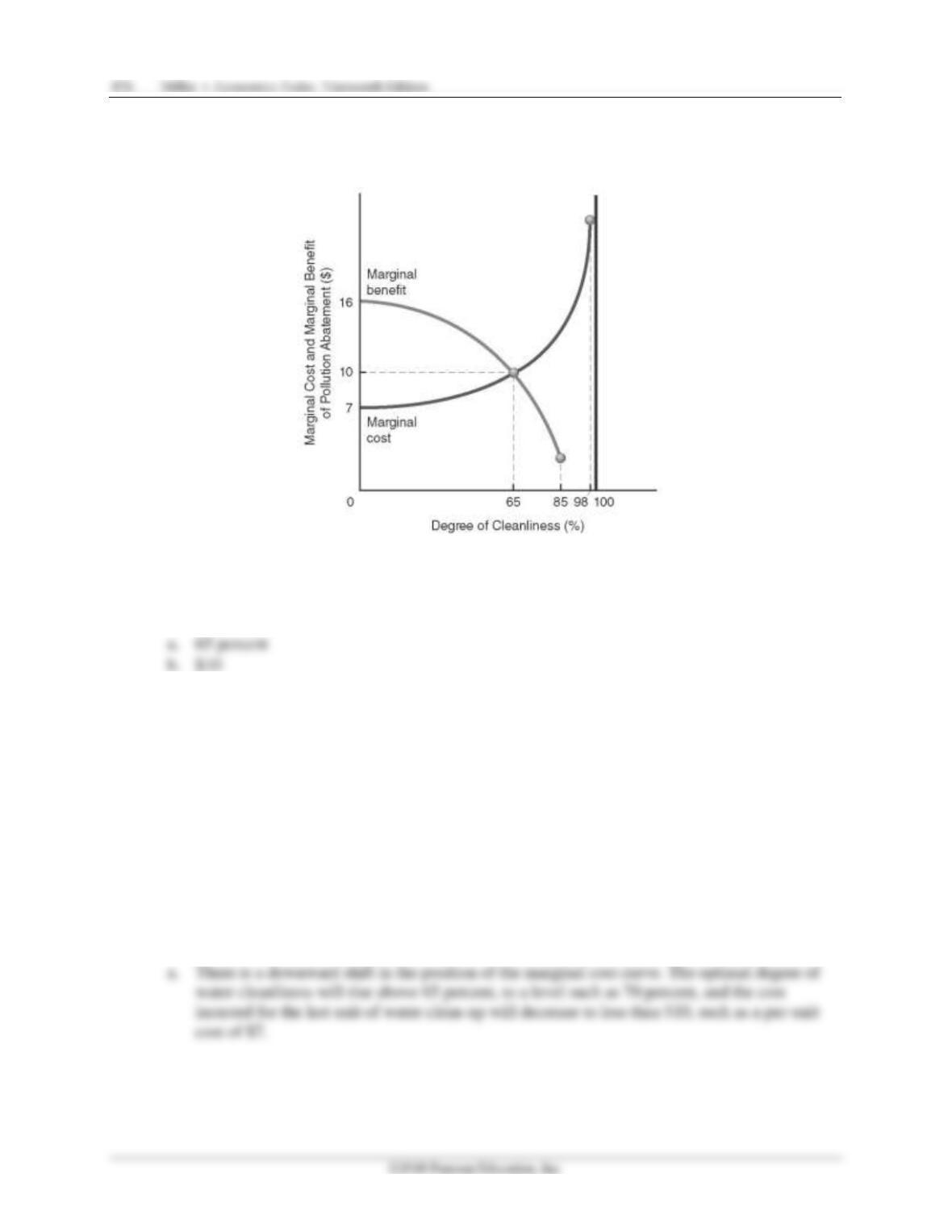
31-4. Consider the diagram below, which displays the marginal cost and marginal benefit of
water pollution abatement in a particular city, and answer the following questions.
a. What is the optimal percentage degree of water cleanliness?
b. When the optimal percentage degree of water cleanliness has been attained, what cost
will be incurred for the last unit of water cleanup?
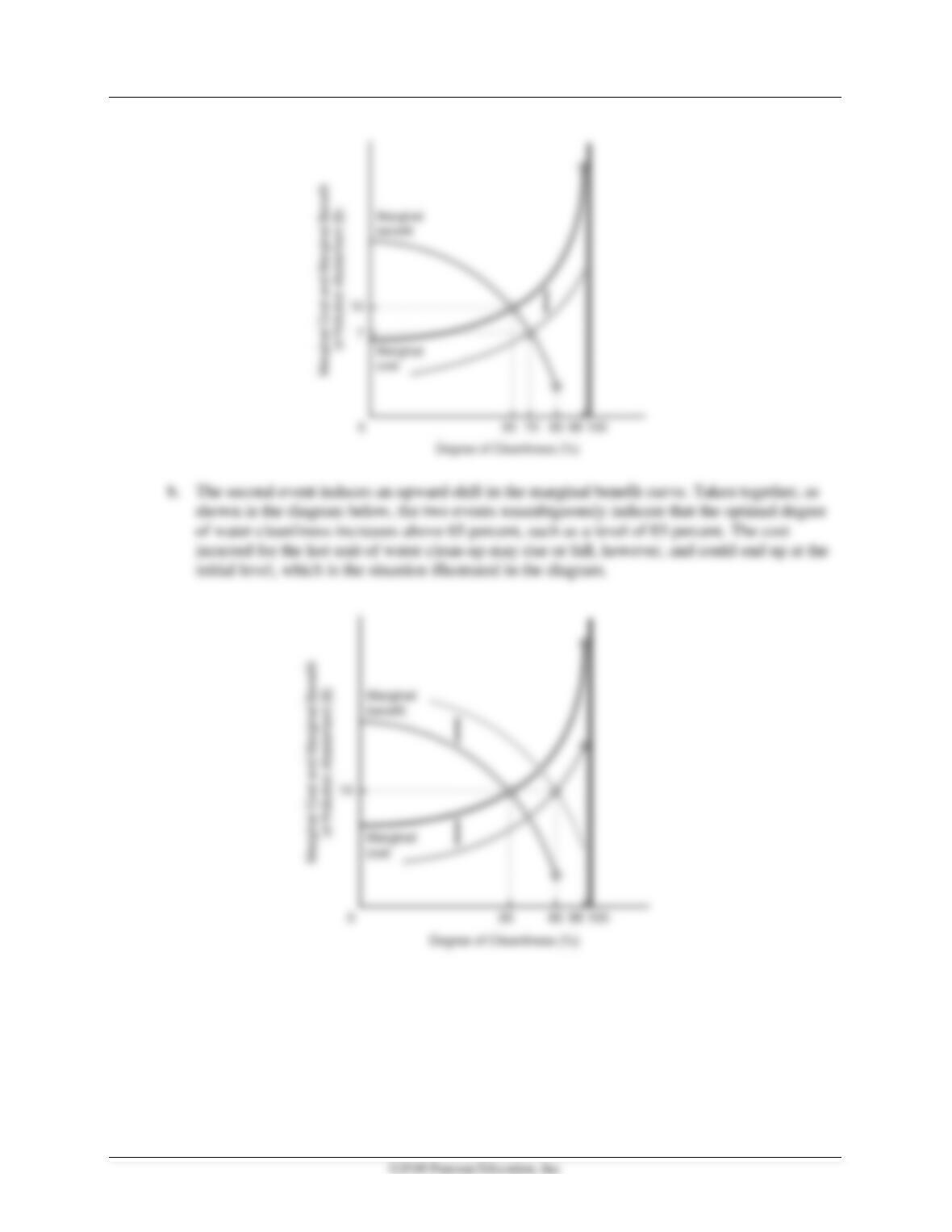
31-5. Consider the diagram in Problem 31-4, and answer the following questions.
a. Suppose that a new technology for reducing water pollution generates a reduction in the
marginal cost of pollution abatement at every degree of water cleanliness. After this
event occurs, will the optimal percentage degree of water cleanliness rise or fall? Will
the cost incurred for the last unit of water cleanup increase or decrease? Provide a
diagram to assist in your explanation.
b. Suppose that the event discussed in part (a) occurs and that, in addition, medical studies
determine that the marginal benefit from water pollution abatement is higher at every
degree of water cleanliness. Following both events, will the optimal percentage degree of
water cleanliness increase or decrease? In comparison with the initial optimum, can you
determine whether the cost incurred for the last unit of water cleanup will increase or
decrease? Use a new diagram to assist in explaining your answers.
Chapter 31 Environmental Economics 477
31-6. Under an agreement with U.S. regulators, American Electric Power Company of Columbus,
Ohio, has agreed to offset part of its 145 million metric tons of carbon dioxide emissions by
paying another company to lay plastic tarps. These tarps cover farm lagoons holding
rotting livestock wastes that emit methane gas 21 times more damaging to the atmosphere
than carbon dioxide. The annual methane produced by a typical 1,330-pound cow translates
into about 5 metric tons of carbon dioxide emissions per year.
478 Miller • Economics Today, Nineteenth Edition
a. How many cows’ worth of manure would have to be covered to offset the carbon dioxide
emissions of this single electric utility?
b. Given that there are about 9 million cows in the United States in a typical year, what
percentage of its carbon dioxide emissions could this firm offset if it paid for all cow
manure in the entire nation to be covered with tarps?
31-7. A government agency caps aggregate emissions of an air pollutant within its borders,
establishes initial pollution allowances across all firms, and grants the firms the right to
trade these allowances among themselves. The demand and supply curves for these
pollution allowances have normal shapes and intersect at a positive price. Explain in your
own words the government’s intent in establishing this private market for pollution
allowances.
31-8. Suppose that a new chief of the government agency discussed in Problem 31-7 decides to
restrict considerably the extent to which firms in this nation can legally utilize pollution
allowances. Evaluate the effects this policy change will have on the market price of pollution
allowances, and discuss whether the policy appears to be fully consistent with the original
intent of creating the market for these allowances.
31-9. The following table displays hypothetical annual total costs and total benefits of conserving
wild tigers at several possible worldwide tiger population levels.
Population of
Wild Tigers
Total Cost
($ millions)
Total Benefit ($
millions)
0
0
40
2,000
25
90
4,000
35
130
6,000
50
160
8,000
75
185
10,000
110
205
12,000
165
215
a. Calculate the marginal costs and benefits.
b. Given the data, what is the socially optimal world population of wild tigers?
c. Suppose that tiger farming is legalized and that this has the effect of reducing the
marginal cost of tiger conservation by $15 million for each 2,000-tiger population
increment in the table. What is the new socially optimal population of wild tigers?
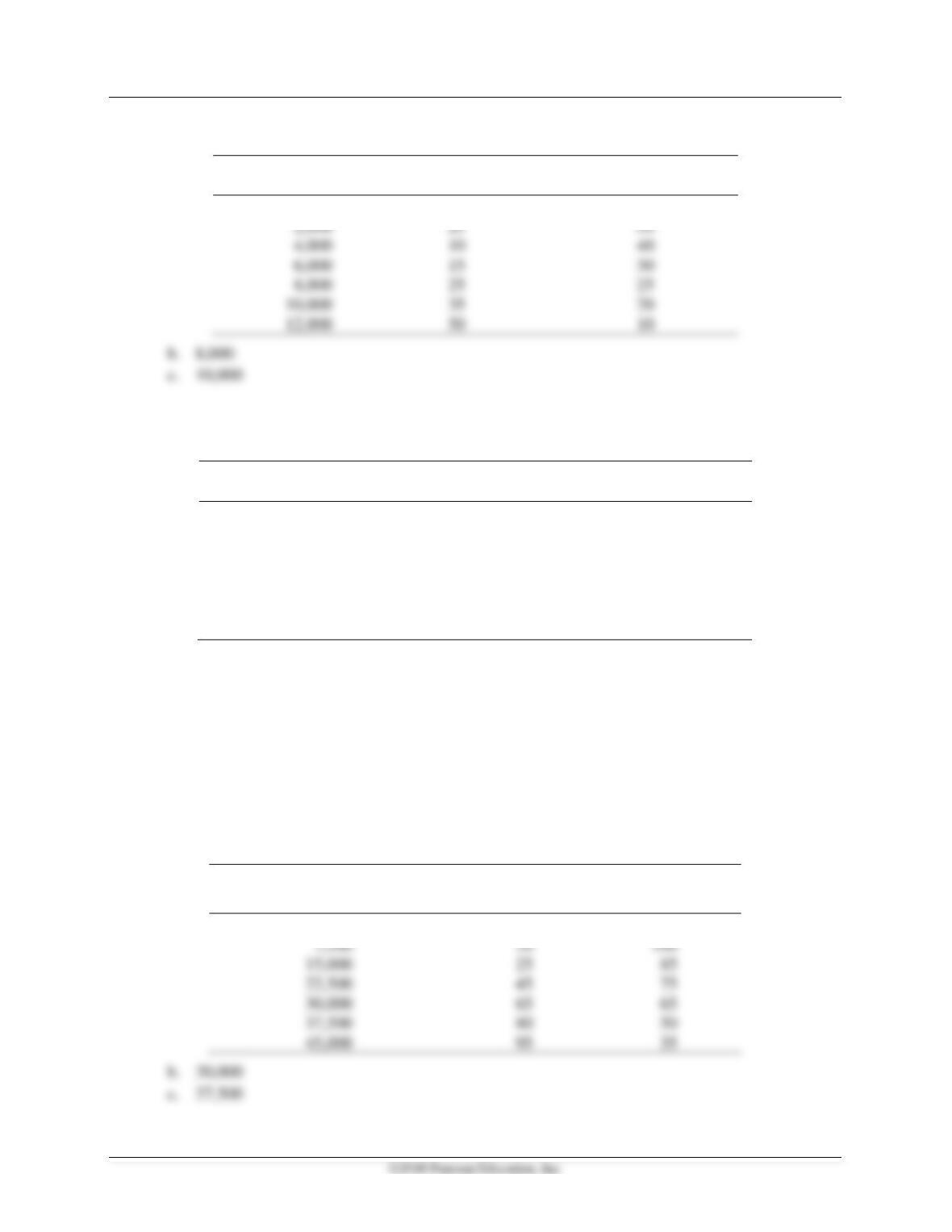
Chapter 31 Environmental Economics 479
a. The marginal costs and benefits are tabulated below:
Population of
Wild Tigers
Marginal
Cost ($)
Marginal
Benefit ($)
0
—
—
31-10. The following table gives hypothetical annual total costs and total benefits of maintaining
alternative populations of Asian elephants.
Population of Asian
Elephants
Total Cost
($ millions)
Total Benefit
($ millions)
0
0
0
7,500
20
100
15,000
45
185
22,500
90
260
30,000
155
325
37,500
235
375
45,000
330
410
a. Calculate the marginal costs and benefits, and draw marginal benefit and cost schedules.
b. Given the data, what is the socially optimal world population of Asian elephants?
c. Suppose that two events occur simultaneously. Technological development allows machines
to do more efficiently much of the work that elephants once did, which reduces by $10
million the marginal benefit of maintaining the elephant population for each 7,500
increment in the elephant population. In addition, new techniques for breeding, feeding,
and protecting elephants reduce the marginal cost by $40 million for each 7,500 increment
in the elephant population. What is the new socially optimal population of Asian elephants?
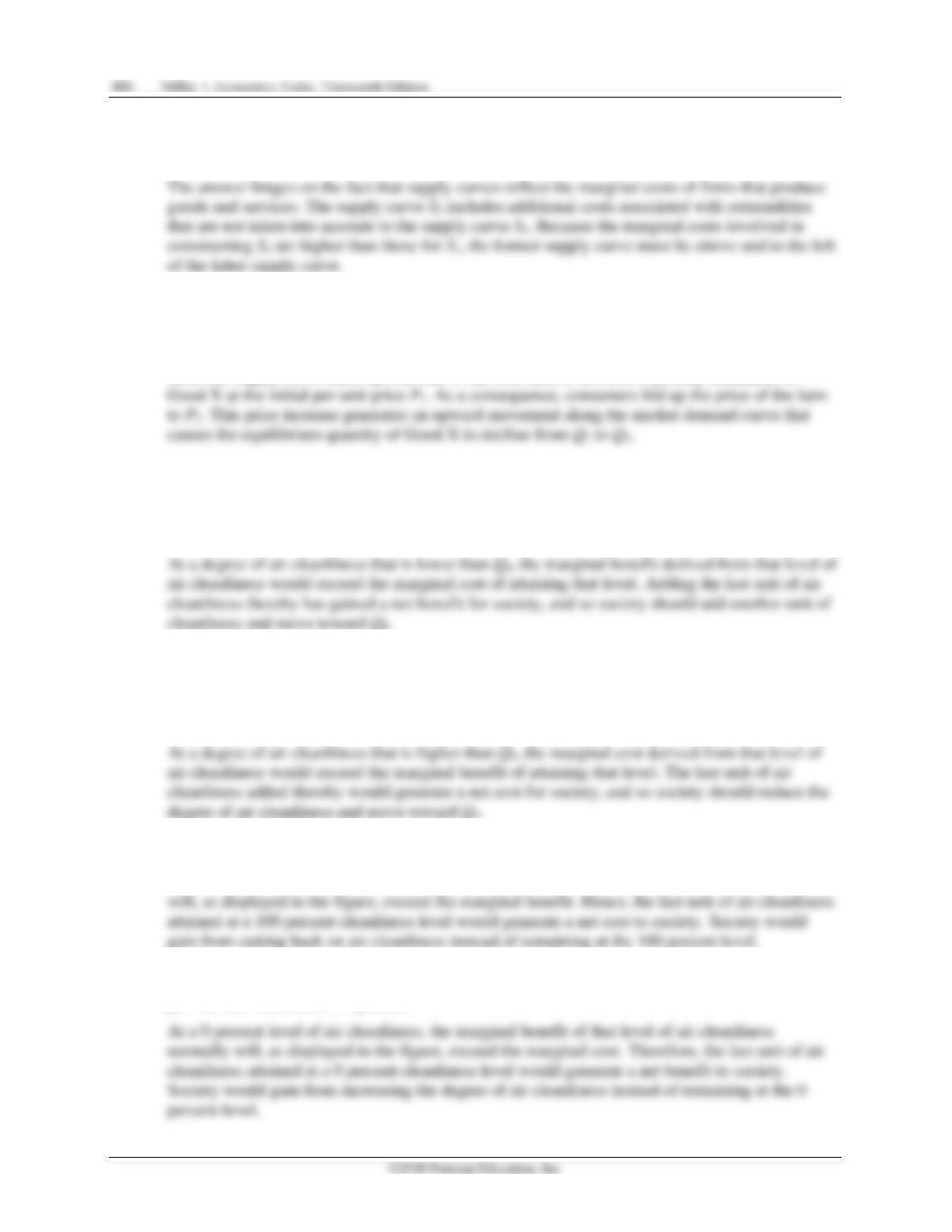
a. The marginal costs and benefits are tabulated below:
Population of
Asian Elephants
Marginal Cost
Marginal Benefit
0
—
—
15,000
30,000
45,000
31-11. Take a look at Figure 31-1. Why does “including externalities” cause the supply curve S2 to
lie above the supply curve S1 that has been drawn “excluding externalities”?
31-12. Consider Figure 31-1. What is the specific reason that accounting for externalities and
thereby shifting the market supply curve causes the equilibrium quantity of Good X to
decline from Q1 to Q2?
After the supply curve shifts upward and to the left, there is an excess quantity demanded of
31-13. Take a look at Figure 31-2. Suppose that initially society were to opt for a degree of air
cleanliness that is lower than Q0. What would be true of the marginal benefit in relation to
the marginal cost, and why would this fact induce society to increase the degree of air
cleanliness toward Q0?
31-14. Consider Figure 31-2. Suppose that initially society were to opt for a degree of air
cleanliness that is higher than Q0. What would be true of the marginal cost in relation to the
marginal benefit, and why would this fact induce society to reduce the degree of air
cleanliness toward Q0?
31-15. Take a look at Figure 31-2. Explain why 100 percent air cleanliness is not optimal.
At a 100 percent level of air cleanliness, the marginal cost of that level of air cleanliness normally
31-16. Consider Figure 31-2. Explain why a society usually would not determine that a degree of 0
percent air cleanliness is optimal.
Chapter 31 Environmental Economics 481
◼ Selected References
Barnett, H. and C. Morse, Scarcity and Growth, Baltimore, MD: Johns Hopkins Press, 1973.
Buchanan, J. M., “A Behavioral Theory of Pollution,” Western Economic Journal, Vol. 6, December
1968, pp. 347–358.