
Chapter 3
Aggregate Production and Productivity
◼ Chapter Outline, Overview, and Teaching Tips
Chapter Outline
Determinants of Aggregate Production
Factors of Production
Application: Why Are Some Countries Rich and Others Poor?
Cobb-Douglas Production Function Characteristics
Changes in the Production Function: Supply Shocks
Determination of Factor Prices
Demand for Capital and Labor
Distribution of National Income
Application: Explaining Real Wage Growth
Chapter Overview and Teaching Tips
This chapter develops one of the basic building blocks for all the macroeconomic analysis throughout this
book, the aggregate production function. Not only is the aggregate production function used in the study of
economic growth, where it plays a central role, it also is a key element of business cycle analysis because
it determines the level of potential output given the factor inputs.

24 Mishkin • Macroeconomics: Policy and Practice, Second Edition
This chapter has several applications to both stimulate students’ interest and to convince them that the
analysis helps explain the real world. The first application, “Why Are Some Countries Rich and Others
Poor?” shows how the aggregate production function can help us to understand the sources of huge
income differences between countries. Why some countries are so poor and some so rich is an inherently
◼ Answers to End of Chapter Review Questions and Problems
Answers to Review Questions
Determinants of Aggregate Production
1. The aggregate production function represents the relationship between the quantities of inputs that go
into the production process and the output that is produced with those inputs. In the production
2. Total factor productivity measures the productivity of all inputs. It is the average output produced by
one unit of capital together with one unit of labor. Labor productivity measures the average output
3. The Cobb-Douglas production function is Y = AK0.3L0.7, where Y = output, A = total factor productivity,
4. The Cobb-Douglas production function exhibits constant returns to scale and diminishing marginal
products for each input. Constant returns to scale means that if all inputs increase by an identical
proportion, output rises by that same proportion. For example, if the amounts of capital and labor
5. Supply shocks are events that either increase or decrease the amount of output that can be produced
with given amounts of capital and labor. In other words, they cause output to change even though

Chapter 3 Aggregate Production and Productivity 25
Determination of Factor Prices
6. Factor prices are the prices firms pay for each unit of labor and capital they hire. They pay the wage
rate for each unit of labor they hire and the rental price of capital for each unit of capital they hire.
7. The profit function is
= P F(K,L) − RK − WL.
denotes economic profits, which are revenues
earned from production minus the costs of production. Revenues are P F(K,L), where P is the
8. Firms will hire additional units of capital and labor inputs as long as the additional revenue they can
earn by doing so—the marginal product of capital or labor times the average price level—is greater
9. A factor demand curve for capital or labor shows how much of the factor firms will demand at various
real factor prices—the real rental price of capital or the real wage rate of labor—when all other variables
(including amounts of the other factor) are held constant. The negative slopes of the demand curves for
10. Equilibrium occurs in a factor market when the quantity of the factor demanded by firms equals the
quantity of the factor its owners offer for sale. The factor price at which this condition is met is the
equilibrium price of the factor. When there is an excess demand, firms want to hire more of the factor
26 Mishkin • Macroeconomics: Policy and Practice, Second Edition
Distribution of National Income
11. Based on the Cobb-Douglas production function and assuming that labor and capital inputs are hired
in perfectly competitive factor markets, national income is divided between labor and capital with the
Answers to Problems
Determinants of Aggregate Production
1. Replacing K and L by 2K and 2L respectively yields:
2. a.
0.4 1.0
0.4 (1.0 1.0) 0.4 .
dY dAK L
MPL AK L AK
dL dL
−
= = = =
b. According to the answer to part (a), this production function does not exhibit diminishing
3. a. Mexico total factor productivity:
0.3 0.7
1.0
0.065 .
0.18 105
=
45
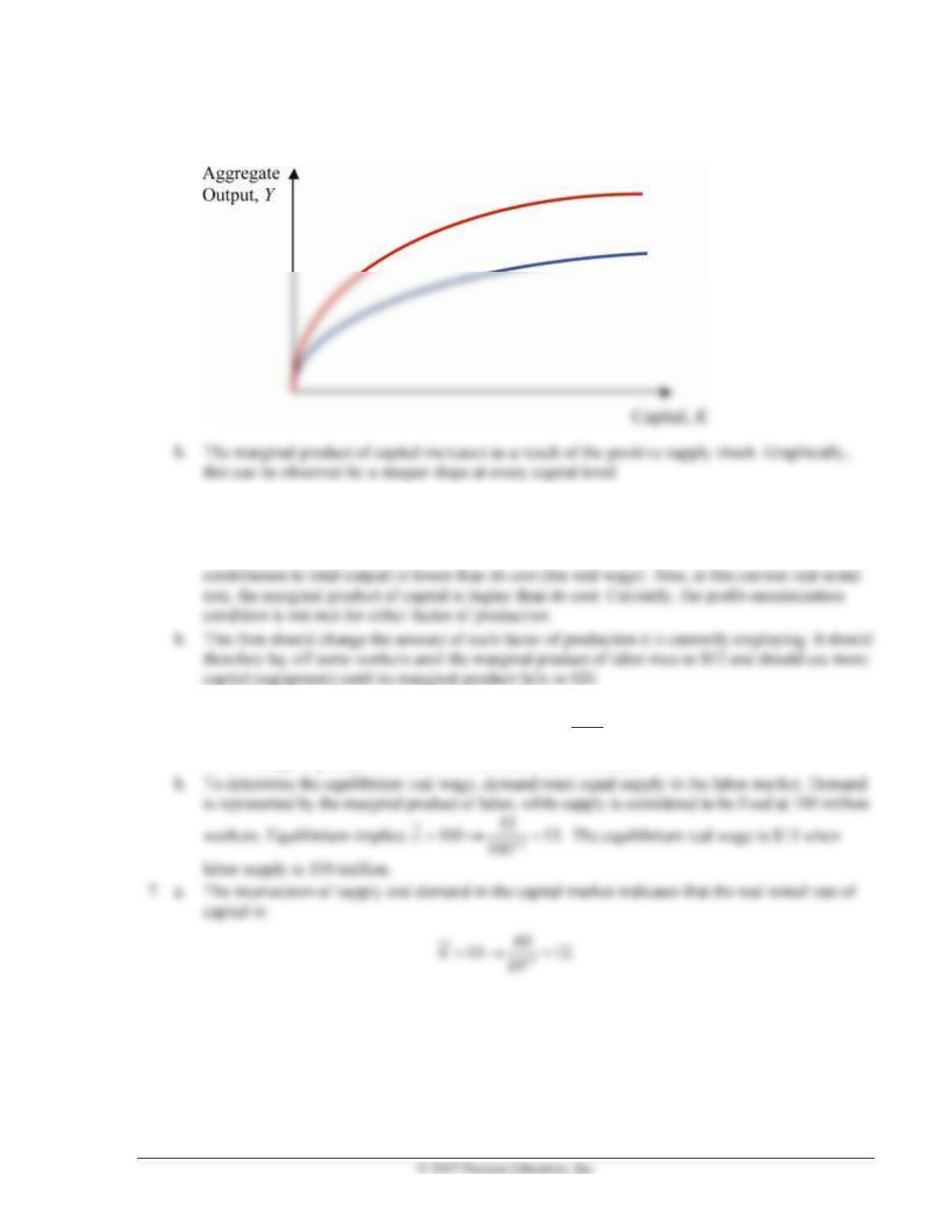
c. Spain’s per capita income is around four times Mexico’s per capita income. This difference is
explained by the fact that total factor productivity is higher in Spain than in Mexico (twice as
large). Spain has also a higher capital per worker ratio than Mexico:
Chapter 3 Aggregate Production and Productivity 27
4. a. The unusually high crop yield is interpreted as a positive supply shock. This increases output for
any given combination of capital and labor, shifting the production function upward.
Determination of Factor Prices
5. a. This firm is not maximizing its profit because it is hiring too many employees and using less
equipment (capital) than it should. At this current real wage, the marginal product of labor (worker’s
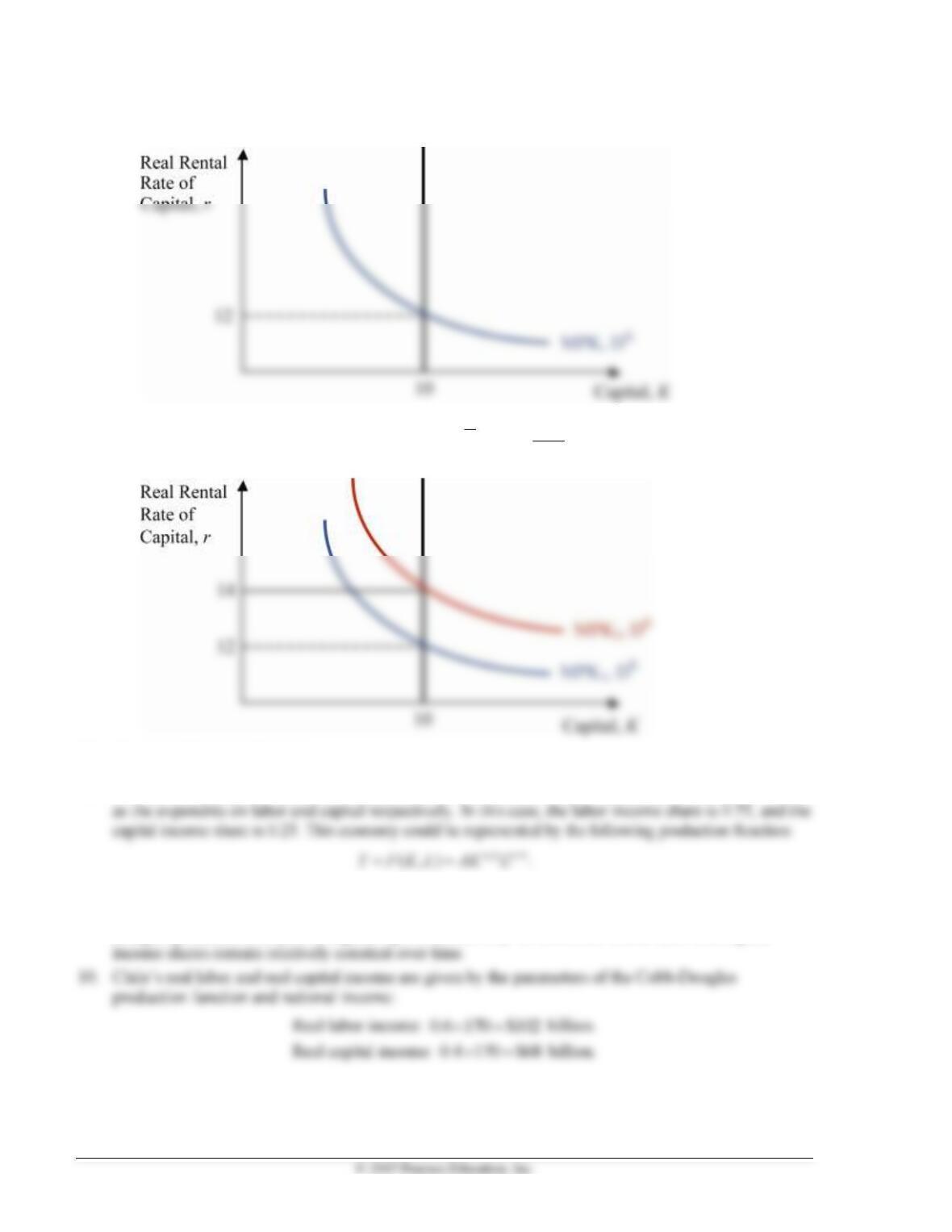
6. a. When L = 80 the marginal product of labor is
0.3
52 14.
80
MPL ==
As one can see from the formula
for the marginal product of labor, MPL decreases as L increases.
28 Mishkin • Macroeconomics: Policy and Practice, Second Edition
Graphically:
b. The new real rental rate of capital is given by:
= → =
0.7
70
10 14.
10
K
Distribution of National Income
8. A Cobb-Douglas production function uses the labor income and capital income shares of total income
9. Your boss is not correct because an important characteristic of a Cobb-Douglass production function
is that both the labor and capital income shares of total income are constant. Therefore, the Cobb-
Douglas production function is a good representation only for countries whose labor and capital
Chapter 3 Aggregate Production and Productivity 29
◼ Answers to Data Analysis Problems
1. a. From 1980 to 2012, nominal wage growth has averaged 4.3 percent, and CPI inflation has
averaged 3.6 percent per year. Thus, inflation has eroded away a substantial part of the
2. a. From 2000:Q1 through 2013:Q1, output per person has grown by 28.4 percent; from January
2000 to March 2013, the labor force participation rate fell from 67.3 percent to 63.3 percent, a
3. a. Generally, labor productivity rises during expansions and declines or does not grow much during
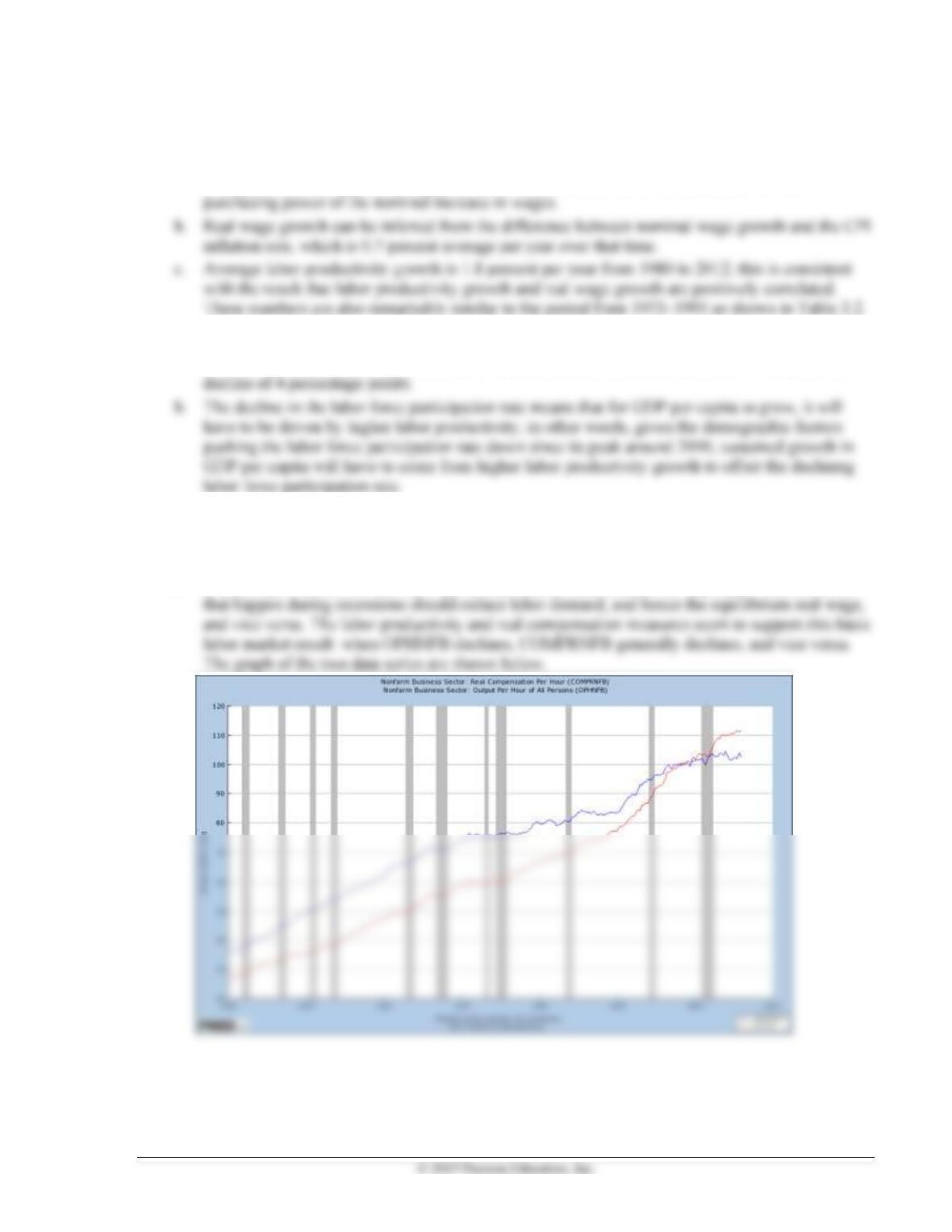
recessions, particularly near the beginning and middle of recessions. Generally, real
compensation per hour rises during expansions and declines or grows slowly during recessions.
b. If output per worker and the MPL are closely linked, then declines in output per worker (MPL)

30 Mishkin • Macroeconomics: Policy and Practice, Second Edition
◼ Data Sources, Related Articles, and Discussion Questions
A. For Information About Application: Why Are Some Countries Rich and
Others Poor?
Data Source
2. World Bank Classification (Atlas method):
http://data.worldbank.org/indicator/NY.GNP.PCAP.CD/countries/latest?display=default. This
Related Article
1. Lucas, Robert E. Jr., “On the Mechanics of Economic Development”:
Discussion Question
The “total factor productivity” term is usually conceived to be a “black box”: it could represent different
technologies, production processes, or even the efficiency of the financial system. Propose different ways
to fill that “black box”: factors that can increase a country’s income per worker (everything else given).
Answer: Even though there are no simple answers to this question, economists all over the world keep
B. For Information About Application: Explaining Real Wage Growth
Data Source
The Bureau of Labor Statistics: http://data.bls.gov/PDQ/outside.jsp?survey=pr. To reproduce (and expand)
Table 3.2: Select “nonfarm business” for sector, then “real hourly compensation” (real wages) and “Labor
productivity (output per hour)” for measures, and finally “percentage change from same quarter a year
ago” for duration. When done, click “get data.”
Related Article
Greenspan, Alan, “The Revolution in Information Technology”:

Chapter 3 Aggregate Production and Productivity 31
Answer: According to the previous “Application,” increases in total factor productivity will result in increases
in income per capita, thereby increasing the standards of living of the whole society. If real wage growth is
C. For Information About Application: Oil Shocks, Real Wages, and the Stock
Market
Data Sources
Federal Reserve Bank of Saint Louis database:
Related Article
Hamilton, James D., “Causes and Consequences of the Oil Shock of 2007–2008”:
Discussion Question
Fluctuations in the price of oil impact stock prices; real wages and can potentially create a recession. Can
you think of a way for countries to avoid such dependence on the price of oil?
Answer: There is no easy answer to this question. Many political leaders have pointed out the need for