
40 Chapter 3
ANSWERS TO TEXTBOOK PROBLEMS
Review Questions
1. A production function shows how much output can be produced with a given
amount of capital and labour. The production function can shift due to supply
2. The upward slope of the production function means that any additional inputs of
capital or labour produce more output. The fact that the slope declines as we move
3. The marginal product of capital (MPK) is the output produced per unit of additional
4. The marginal revenue product of labour represents the benefit to a firm of hiring an
additional worker, while the nominal wage is the cost. Comparing the benefit to the
cost, the firm will hire additional workers as long as the marginal revenue product
5. The MPN curve shows the marginal product of labour at each level of employment.
It is related to the production function because the marginal product of labour is
6. A temporary increase in the real wage increases the amount of labour supplied
because the substitution effect is larger than the income effect. The substitution
effect arises because a higher real wage raises the benefit of additional work for a

Productivity, Output, and Employment 41
7. The aggregate labour supply curve relates labour supply and the real wage. The
principal factors shifting the aggregate labour supply curve are wealth, the
8. Full-employment output is the level of output that firms supply when wages and
prices in the economy have fully adjusted; in the classical model of the labour
market, this occurs when the labour market is in equilibrium. When labour supply
9. The classical model of the labour market assumes that any worker who wants to
work at the equilibrium real wage can find a job, so it is not very useful for studying
unemployment.
10. The labour force consists of all employed and unemployed workers. The
11. An unemployment spell is a period of time that a person is continuously
unemployed. Duration is the length of time of an unemployment spell. Two
seemingly contradictory facts are that most unemployment spells have a short
duration and that most people who are unemployed at a particular time are
12. Frictional unemployment arises as workers and firms search to find matches. A
certain amount of frictional unemployment is necessary, because it is not always
possible to find the right match right away. For example, an unemployed banker
13. Structural unemployment occurs when people suffer long spells of unemployment
or are chronically unemployed (with many spells of unemployment). Structural
unemployment arises when the number of potential workers with low skill levels
42 Chapter 3
14. The natural rate of unemployment is the rate of unemployment that prevails when
output and employment are at their full-employment levels. The natural rate of
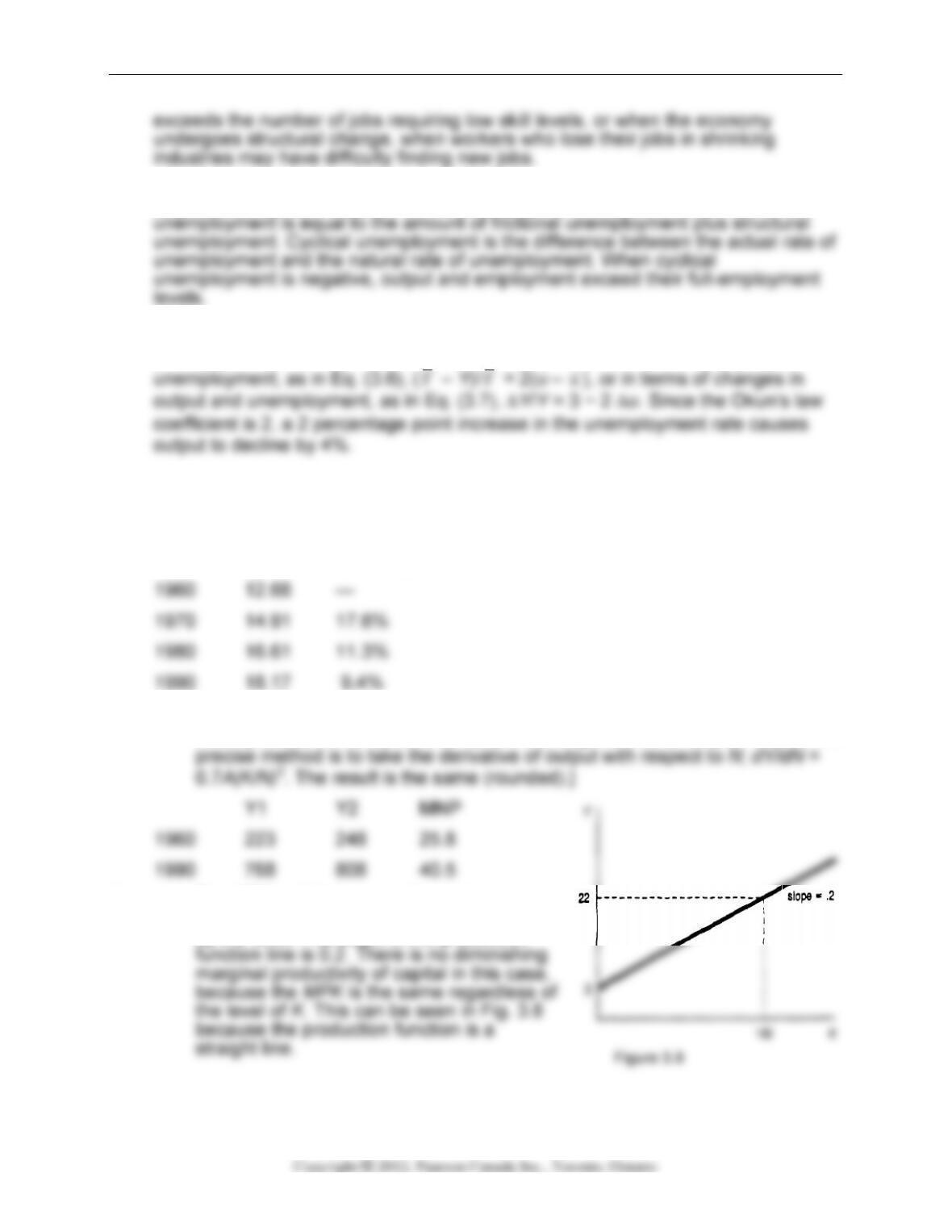
15. Okun’s Law is a rule of thumb that tells how much output falls when the
unemployment rate rises. It is written either in terms of the levels of output and
Numerical Problems
1. a. To find the growth of total productivity, you must first calculate the value of A
in the production function. This is given by A = Y/ (K.3N.7). The growth rate of
A can then be calculated as Ayear2/Ayear1 − 1. The result is:
A % increase in A
b. Calculate the marginal product of labour by seeing what happens to output
when you add 1.0 to N; call this Y2, and the original level of output Y1. [A more
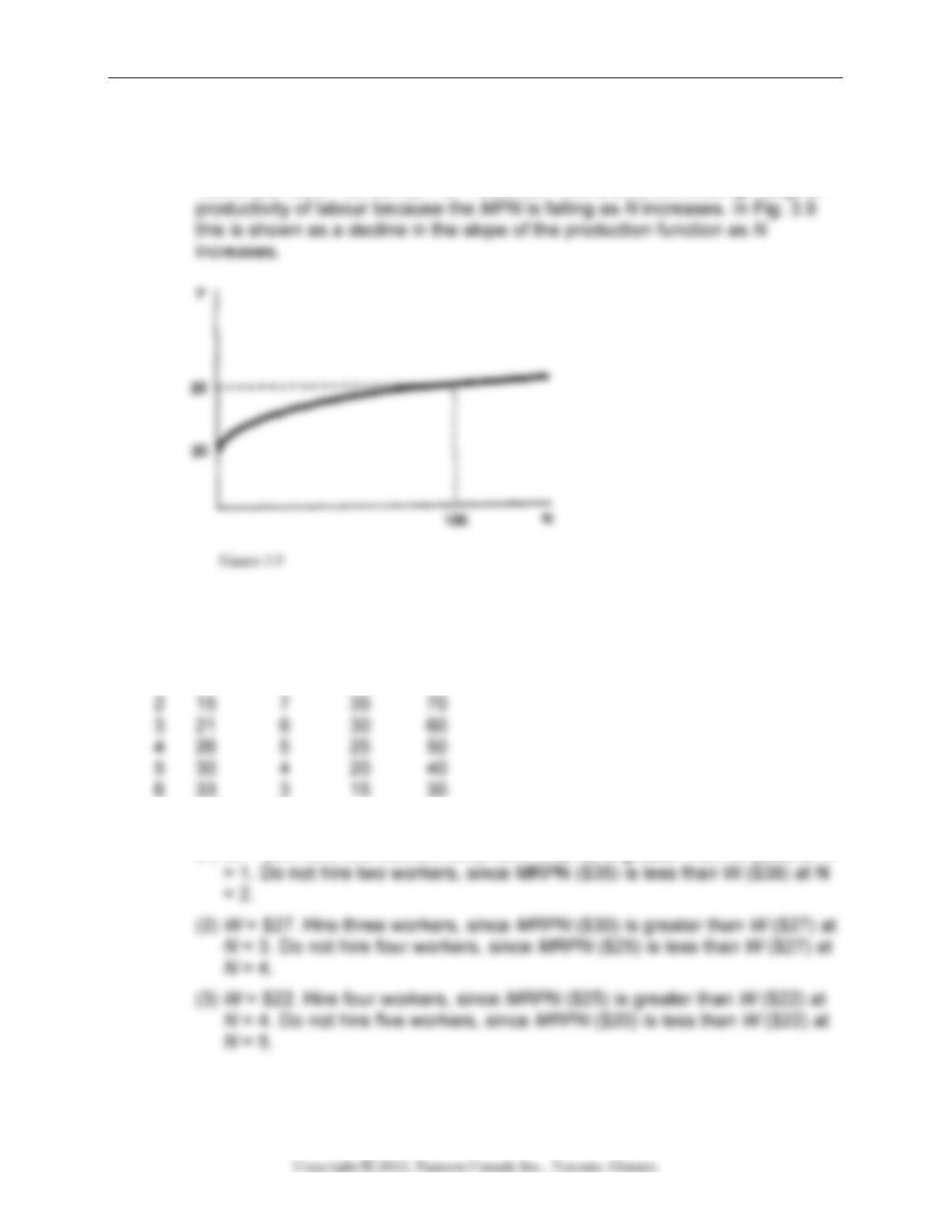
2. a. The MPK is 0.2, because for each
additional unit of capital, output increases
by 0.2 units. The slope of the production
Productivity, Output, and Employment 43
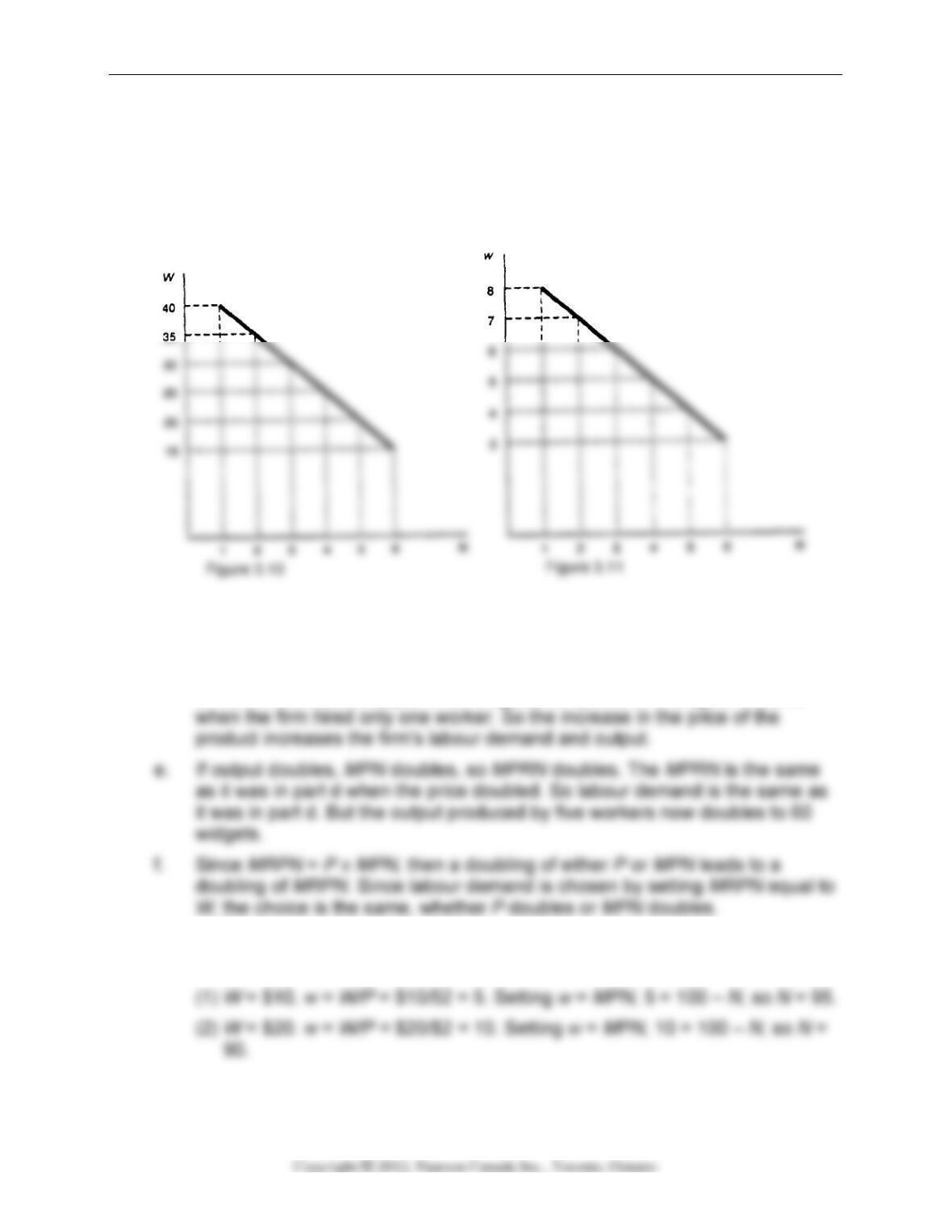
b. When N is 100, output is Y = 0.2(100 + 100.5) = 22. When N is 110, Y is
22.0976. So the MPN for raising N from 100 to 110 is (22.0976 − 22) / 10 =
0.00976. When N is 120, Y is 22.1909. So the MPN for raising N from 110 to
120 is (22.1909 − 22.0976) / 10 = 0.00933. This shows diminishing marginal
3. a.
N Y MPN MRPN MRPN
(P=5) (P=10)
1 8 8 40 80
b. P = $5.
(1) W = $38. Hire one worker, since MRPN ($40) is greater than W ($38) at N
44 Chapter 3
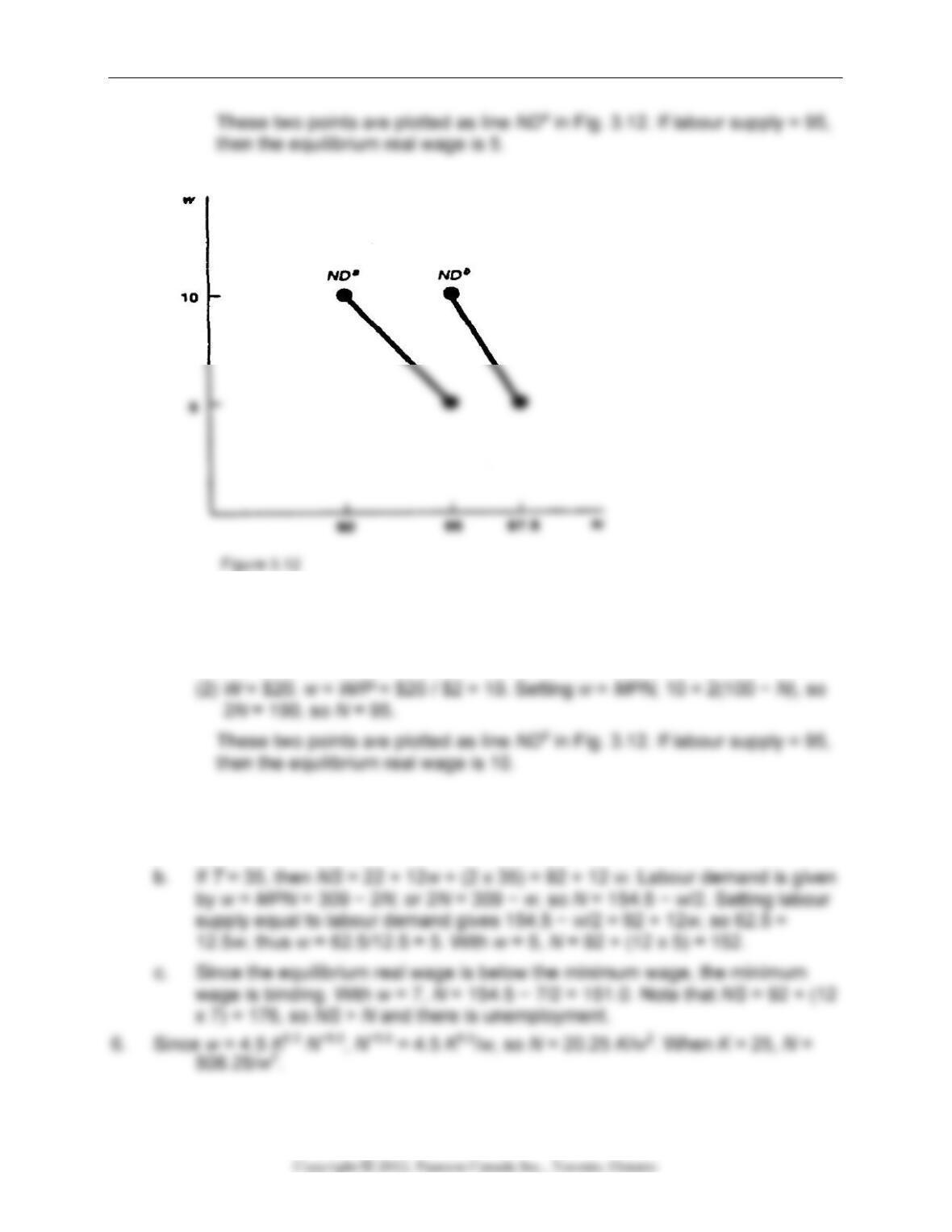
c. Figure 3.10 plots the relationship between labour demand and the nominal
wage. This graph is different from a labour demand curve because a labour
demand curve shows the relationship between labour demand and the real
wage. Figure 3.11 shows the labour demand curve.
d. P = $10. The table in part a shows the MRPN for each N. At W = $38, the firm
should hire five workers. MRPN ($40) is greater than W ($38) at N = 5. The
firm shouldn’t hire six workers, since MRPN ($30) is less than W($38) at N =
6. With five workers, output is 30 widgets, compared to 8 widgets in part a
4. MPN = A(100 – N)
a. A = 1. MPN = 100 – N.
Productivity, Output, and Employment 45
b. A = 2. MPN = 2(100 – N).
(1) W = $10. w = W/P = $10/$2 = 5. Setting w = MPN, 5 = 2(100 − N), so 2N
= 195, so N = 97.5.
5. a. If the lump-sum tax is increased, there is an income effect on labour supply,
not a substitution effect (since the real wage is not changed). An increase in
the lump sum tax reduces a worker’s wealth, so labour supply increases.

46 Chapter 3
a. If t = 0.0, then NS = 100w2. Setting labour demand equal to labour supply
gives 506.25/w2 = 100w2, so w4 = 5.0625, or w = 1.5. Then NS = 100 (1.5)2 =
225. [Check: N = 506.25/1.52 = 225] Y = 45N0.5 = 45(225)0.5 = 675. The total
after-tax wage income of workers is (1−t) w NS = 1.5 x 225 = 337.5.
7. a. At any date, 25 people are unemployed: 5 who have lost their jobs at the start
of the month and 20 who have lost their jobs either on January 1 or July 1.
The unemployment rate is 25 / 500 = 5%.
8. The unemployment rate has fallen by three percentage points over that period.
9. Since ( – Y) = 2(u – ), this can be rewritten as – Y = 2(u – ) or Y = [1 –
2(u – )] , or = Y/[1 – 2(u – )].
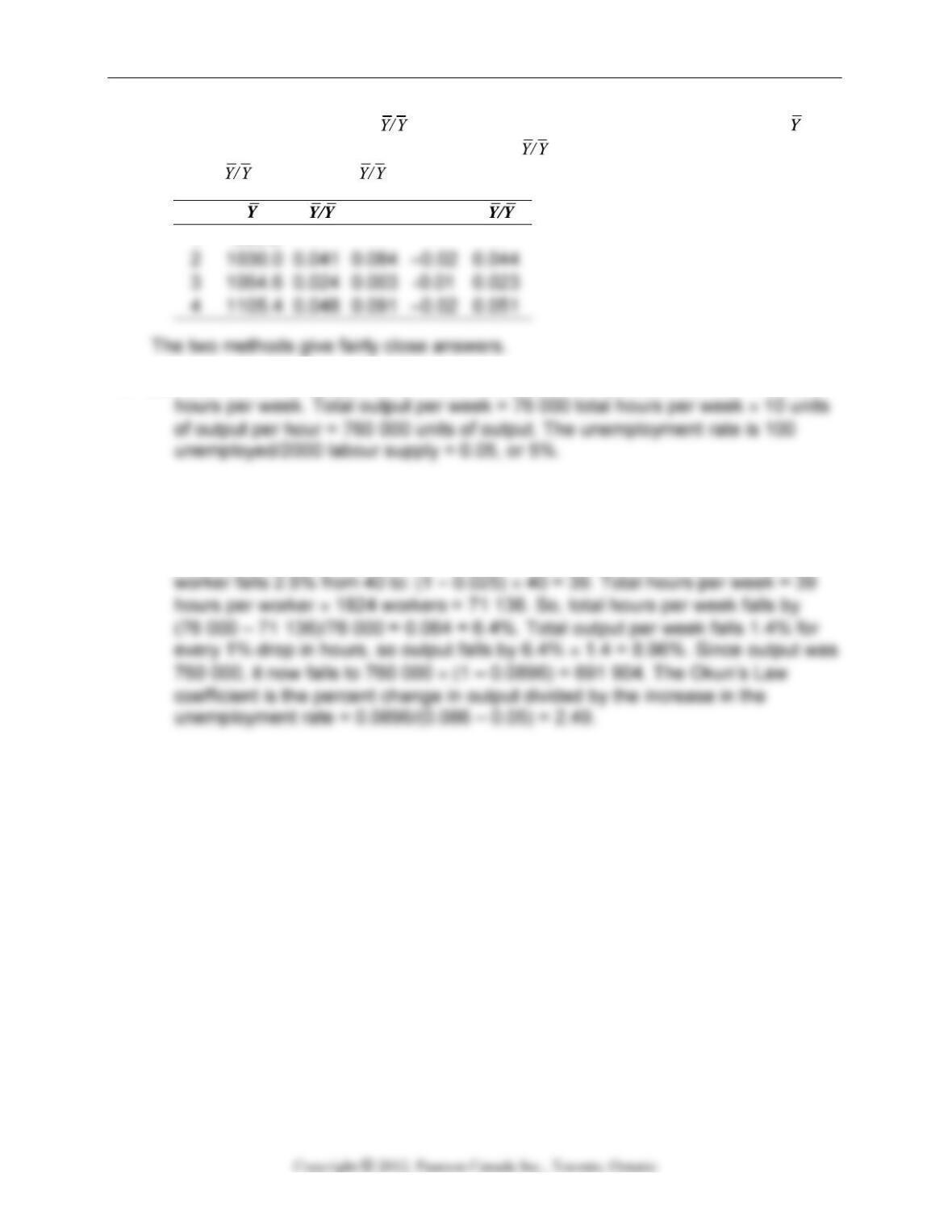
a. Using the formula above, this table shows the value of , given values for u
and Y.
Year
u
Y
1
0.08
950
989.6
Productivity, Output, and Employment 47
b. The first calculation of Δ comes from calculating the percent change in
from part a. The second calculation of Δ comes from using Eq. (3.7): ΔY/Y
= Δ – 2 Δu, so Δ = ΔY/Y + 2 Δu.
Year
Δ
ΔY/Y
Δu
Δ
1
989.6
—
—
—
—
10. (a) Total hours worked per week = 1900 workers × 40 hours per worker = 76 000
(b) Employment falls 4% from 1900 to: (1 – 0.04) × 1900 = 1824. The labour force
falls 0.2% from 2000 to: (1 – 0.002) × 2000 = 1996. With a labour force of 1996
and employment of 1824, unemployment is 1996 – 1824 = 172. The
unemployment rate is 172/1996 = 0.086, or 8.6%. Hours worked per employed
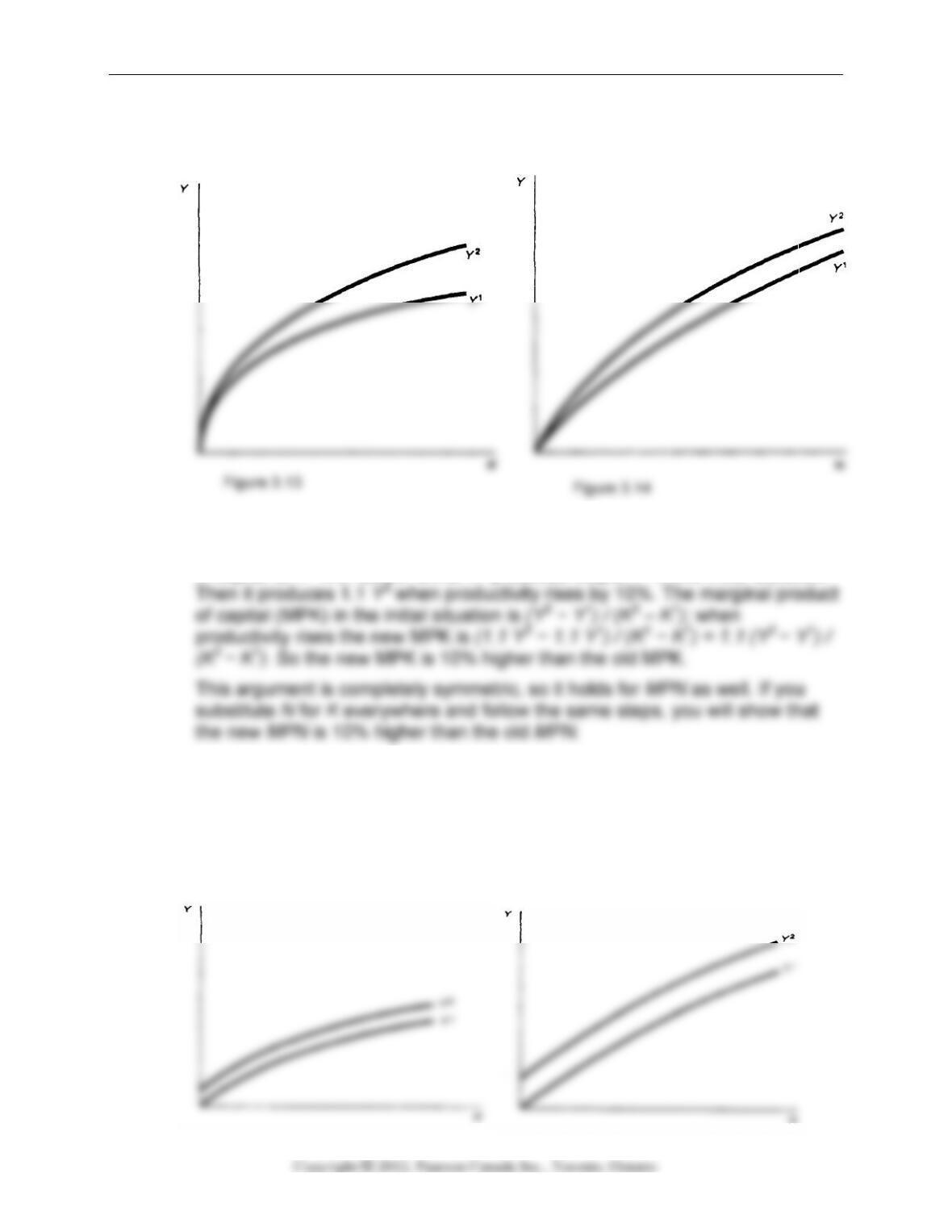
Figure 3.13
Figure 3.14
48 Chapter 3
Analytical Problems
1. a. See Figs. 3.13 and 3.14.
b. In the initial situation, capital K1 and labour N1 produce output Y1; when
productivity rises they produce output 1.1 Y1. Suppose that a small increase
in capital to K2 with labour left at N1 produces output Y2 in the initial situation.
c. Yes, it is possible for a beneficial productivity shock to leave the MPK and
MPN unchanged. This could happen only if the shock was additive that is, if it
shifted the whole production function upward, but did not affect its slope at
any point. In Figs. 3.15 and 3.16 this is shown as a shift up in the production
function, leaving the slope unchanged.
Figure 3.15
Figure 3.16

Productivity, Output, and Employment 49
2. a. An increase in the number of immigrants increases the labour force,
increasing employment and increasing full-employment output.
b. If energy supplies become depleted, this is likely to reduce productivity,
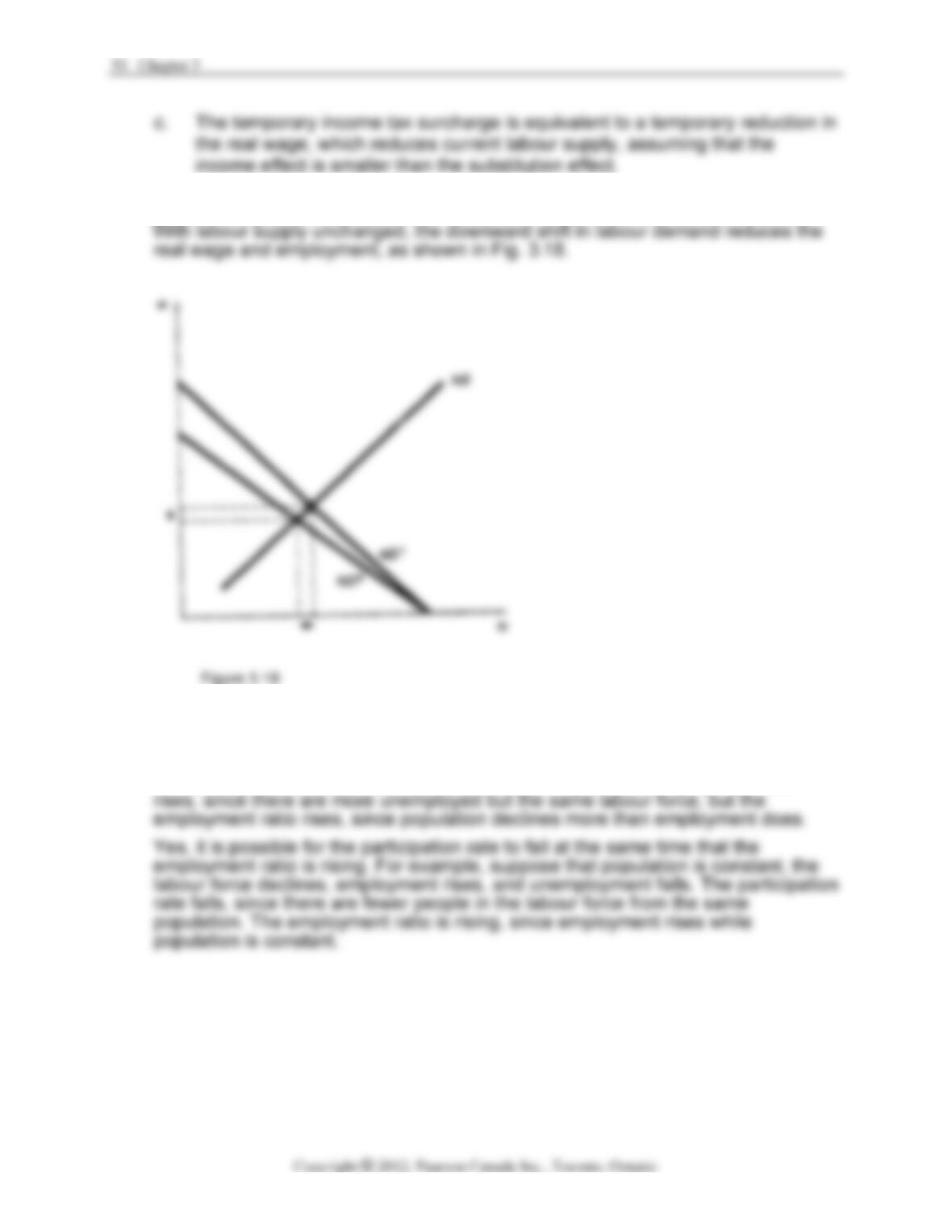
3. a. As shown in Fig. 3.17, when the real wage (w) is above its market-clearing
level, labour supply (NS) exceeds labour demand (ND). The difference is the
amount of unemployment (U).
4. a. The increased value of Helena’s home increases her wealth. The rise in
wealth leads to an income effect that leads Helena to reduce her labour
supply.
b. The permanent rise in Helena’s real wage gives rise to offsetting income and
5. The tax reduces the marginal product of labour by 6%, since that portion of output
goes to the government rather than to the firm. Thus labour demand is reduced.
6. Yes, it is possible for the unemployment rate and the employment ratio to rise
during the same month. For example, suppose the population falls, the labour
force is constant, the number of unemployed rises, and the number of employed
falls (but by less than the decline in population). Then the unemployment rate

Productivity, Output, and Employment 51
7. a. Relaxing these assumptions gives us the following equation of the growth
rate form of Okun’s Law:
b. Referring to the equation derived in part (a), if the economy has enjoyed
economic growth of 6% per year ( =6%) but there has been no change in