CHAPTER 3
ECONOMIC DECISION MAKERS
In this chapter, you will find:
Learning Outcomes
Chapter Outline with PowerPoint Script
Chapter Summary
Teaching Points (as on Prep Card)
Solutions to Problems Appendix
Experiential Assignments
INTRODUCTION
This chapter introduces the four economic decision makers and presents their roles in the economy.
LEARNING OUTCOMES
3-1 Describe the major sources of income and expenditures for households.
Households play the starring role in a market economy. Their demand for goods and services deter-
3-2 Outline the evolution of production over the centuries from the household
to the modern corporation. Household members once did everything for themselves. Over time, how-
3-3 Summarize the seven roles of government in the economy. Governments attempt to improve soci-
ety’s overall welfare by intervening in cases of market failure. Beneficial government interventions in
3-4 Explain why countries trade with each other and why they sometimes act to restrict that trade.
The rest of the world affects what U.S. households consume and what U.S. firms produce. U.S.
households and firms are consumers and suppliers of manufactured goods and raw materials from and
Chapter 3 Economic Decision Makers 36
CHAPTER OUTLINE WITH POWERPOINT SCRIPT
USE POWERPOINT SLIDES 2-3 FOR THE FOLLOWING SECTION
THE HOUSEHOLD: HOUSEHOLDS PLAY THE STARRING ROLE IN THE ECONOMY.
The Evolution of the Household
• In earlier times: Self-sufficient
USE POWERPOINT SLIDE 4 FOR THE FOLLOWING SECTION
Households Maximize Utility: the satisfaction derived from consumption
USE POWERPOINT SLIDES 5-7 FOR THE FOLLOWING SECTION
Households as Resource Suppliers
• Use limited resources: Labor, capital, natural resources, and entrepreneurial ability to satisfy unlimited
wants
Households as Demanders of Goods and Services
• Households spend over 80 percent of their income on consumption goods which include:
THE FIRM
USE POWERPOINT SLIDES 8-10 FOR THE FOLLOWING SECTION
Evolution of the Firm: Economic unit formed by a profit-seeking entrepreneur
• Cottage industry system: “Putting out” raw material to rural households that turned it into finished
goods
Types of Firms
USE POWERPOINT SLIDES 11-17 FOR THE FOLLOWING SECTIONS
Sole Proprietorships: Single-owner firms facing unlimited liability; most common form of U.S. business
organization in terms of total numbers: 72% of businesses, but only 4% of U.S. sales.
Partnerships: Multiple-owner firms with each owner bearing unlimited liability; continuity problems
exist with death or departure of one partner.
Chapter 3 Economic Decision Makers 37
Corporations:
• Legal entities established through articles of incorporation.
COOPERATIVES:
• A group of people who cooperate by pooling resources to buy and sell more efficiently
NOT-FOR-PROFIT ORGANIZATIONS:
• Engage in charitable, educational, humanitarian, cultural, professional, and other activities, often with
Why Does Household Production Still Exist? The opportunity cost of performing some tasks is below
the market price of those tasks.
• No Skills or Specialized Resources Are Required
THE GOVERNMENT
USE POWERPOINT SLIDES 18-24 FOR THE FOLLOWING SECTION
The Role of Government: Enters the market in cases of market failure
Establishing and Enforcing the Rules of the Game
Promoting Competition
Regulating Natural Monopolies
Providing Public Goods:
• Private goods are rival in consumption (the amount consumed by one person is unavailable for others)
Dealing With Externalities: Costs or benefits that fall on third parties
A More Equal Distribution of Income
Full Employment, Price Stability, and Economic Growth
Chapter 3 Economic Decision Makers 38
USE POWERPOINT SLIDES 25-27 FOR THE FOLLOWING SECTION
GOVERNMENT’S STRUCTURE AND OBJECTIVES: FEDERAL SYSTEM OF GOVERNMENT;
RESPONSIBILITIES ARE SHARED ACROSS LEVELS OF GOVERNMENT.
Difficulty in Defining Government Objectives
• What is government’s goal? It doesn’t act as a simple, consistent decision maker.
Voluntary Exchange Versus Coercion
USE POWERPOINT SLIDES 28-31 FOR THE FOLLOWING SECTION
SIZE AND GROWTH OF U.S. GOVERNMENT
IN 1929 ALL GOVERNMENT OUTLAYS TOTALED 10% OF GDP VERSUS 40% TODAY IN THE U.S.
USE POWERPOINT SLIDES 32-36 FOR THE FOLLOWING SECTION
TAX PRINCIPLES AND TAX INCIDENCE
• Tax incidence: Who actually bears the burden of the tax
USE POWERPOINT SLIDES 37-40 FOR THE FOLLOWING SECTION
THE REST OF THE WORLD
International Trade: Occurs because the opportunity cost of producing specific goods differs across
countries.
• Merchandise trade balance: The value of exported goods minus the value of imported goods
CHAPTER SUMMARY
Most household income arises from the sale of labor, and most household income is spent on personal
consumption, primarily services.
Chapter 3 Economic Decision Makers 39
Household members once built their own homes, made their own clothes and furniture, grew their own
food, and supplied their own entertainment. Over time, however, the efficiency arising from comparative
advantage resulted in a greater specialization among resource suppliers.
In the United States, the federal government has primary responsibility for providing national defense,
ensuring market competition, and promoting stability of the economy. State governments provide public
higher education, prisons, and—with aid from the federal government—highways and welfare. And local
governments provide police and fire protection, and, with help from the state, local schools.
TEACHING POINTS
1. This chapter discusses the principal players in the economy and also reviews the historical
2. Students should be familiar with the idea of household production. A common example would be
fixing the evening meal rather than dining out. Fixing the auto, painting the house, and cultivating
a garden are all examples of household production.
3. It might be instructive to point out how certain inventions, such as the vacuum cleaner, have
3. Many students will not know the basic structure of corporate finance. It is therefore advisable to
discuss the difference between corporate stocks and corporate bonds, one implying ownership and
Chapter 3 Economic Decision Makers 40
4. In discussing the section on the rationale for government, you may wish to emphasize the basic
ideas of public goods and externalities. It is interesting to note that while pollution abatement
5. It is important to stress externalities as examples of situations where the market outcome may not
be optimal. Externalities can be negative or positive. Cigarette smoking, for example, is an
6. Although students are probably aware of the recent large U.S. trade deficits, they probably do not
SOLUTIONS TO PROBLEMS APPENDIX
1. (Evolution of the Household) Determine whether each of the following would increase or decrease the
opportunity costs for mothers who choose not to work outside the home. Explain your answers.
a. Higher levels of education for women.
b. Higher unemployment rates for women.
c. Higher average pay levels for women.
d. Lower demand for labor in industries that traditionally employ large numbers of women.
a. Opportunity costs rise as higher levels of education increase the level of earnings available to
2. (Household Production) Many households supplement their food budget by cultivating small
vegetable gardens. Explain how each of the following might influence this kind of household
production:
Chapter 3 Economic Decision Makers 41
a. Both husband and wife are professionals who earn high salaries.
b. The household is located in a city rather than in a rural area.
c. The household is located in a region where there is a high sales tax on food.
d. The household is located in a region that has a high property tax rate.
a. This would reduce the amount of household production.
3. (Household Production) What factors does a householder consider when deciding whether to produce
a good or service at home or buy it in the marketplace?
The householder must consider factors such as (1) whether production requires specialized skills or
4. (Objectives of the Economic Decision Makers) In economic analysis, what are the assumed objectives
of households, firms, and the government?
Households are assumed to make decisions to maximize utility, or their overall level of satisfaction.
5. (Corporations) How did the institution of the firm get a boost from the advent of the Industrial
Revolution? What type of business organization existed before this?
With the Industrial Revolution it became more efficient to organize several stages of production under
6. (Sole Proprietorships) What are the disadvantages of the sole proprietorship form of business?
The owner of a sole proprietorship faces unlimited liability for the debts of the firm, meaning that the
7. (Cooperatives) How do cooperatives differ from typical businesses?
The goal of a typical business is profit maximization. Consumer cooperatives consist of many
Chapter 3 Economic Decision Makers 42
8. (Evolution of the Firm) Explain how production after the Industrial Revolution differed from
production under the cottage industry system.
In the cottage industry system, production was decentralized. Raw material was provided to rural
9. (Government) Complete each of the following sentences:
a. When the private operation of a market leads to overproduction or underproduction of some
good, this is known as a(n) _________________.
b. Goods that are nonrival and nonexcludable are known as __________________.
c. ________________ are cash or in-kind benefits given to individuals as outright grants from the
government.
d. A(n) ________________ confers an external benefit on third parties that are not directly
involved in a market transaction.
e. ________________ refers to the government’s pursuit of full employment and price stability
through variations in taxes and government spending.
a. Market failure
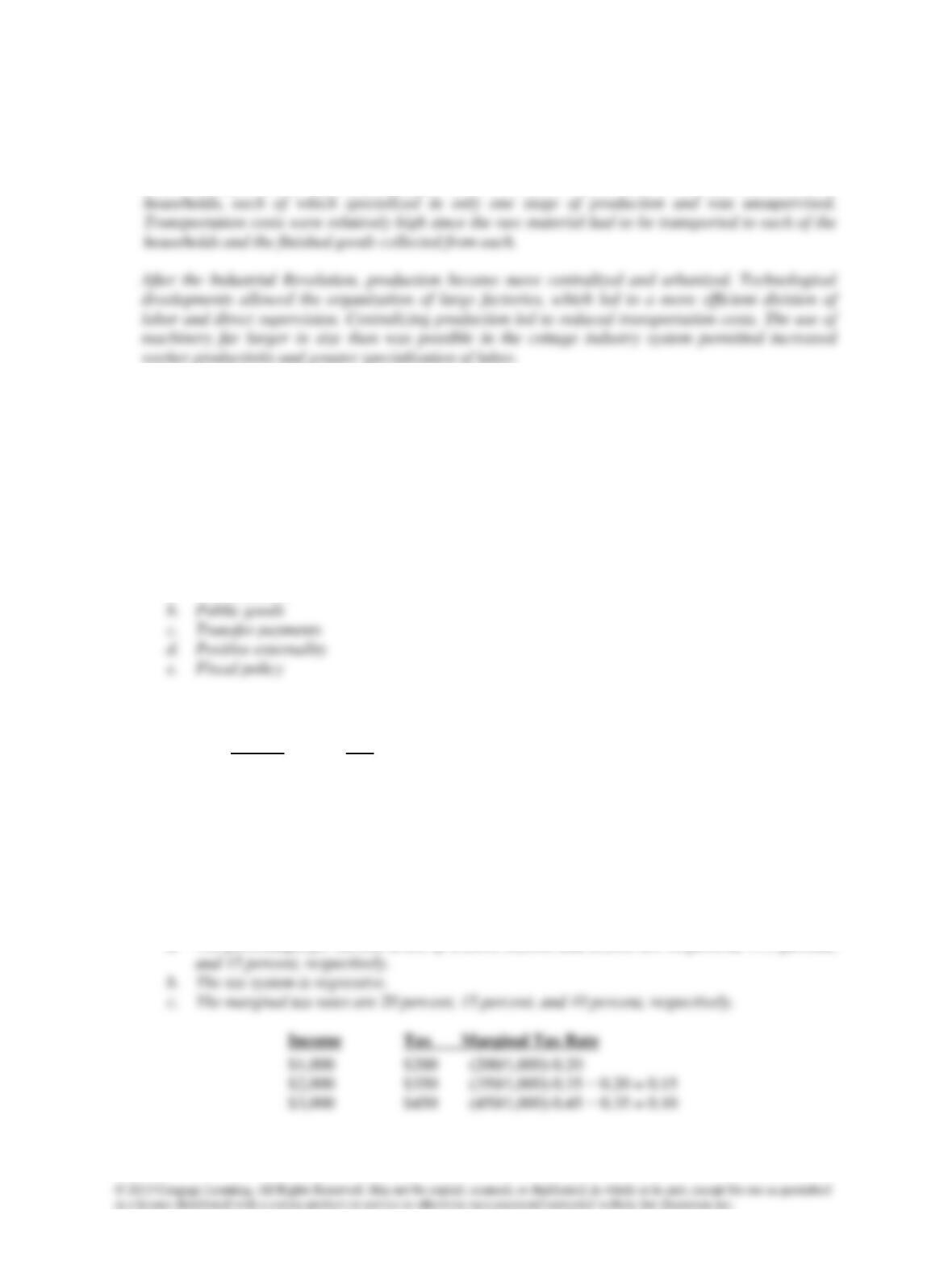
10. (Tax Rates) Suppose taxes are related to income level as follows:
Income Tax
$1,000 $200
$2,000 $350
$3,000 $450
a. What percentage of income is paid in taxes at each level?
b. Is the tax rate progressive, proportional, or regressive?
c. What is the marginal tax rate on the first $1,000 of income? The second $1,000? The third
$1,000?
a. The percentages for income levels of $1,000, $2,000, and $3,000 are 20 percent, 17.5 percent,
Chapter 3 Economic Decision Makers 43
11. (Government Revenue) What are the sources of government revenue in the United States? Which
types of taxes are most important at each level of government? Which two taxes provide the most
revenue to the federal government?
Federal, state, and local governments in the United States receive revenues from taxes (income, sales,
12. (Externalities) Suppose there is an external cost, or negative externality, associated with production
of a certain good. What’s wrong with letting the market determine how much of this good will be
produced?
An external cost is a cost not reflected in the price of the good and therefore is ignored by the buyers
13. (International Trade) Why does international trade occur? What does it mean to run a deficit in the
merchandise trade balance?
International trade occurs because of comparative advantage and specialization. Countries specialize
14. (International Trade) Distinguish between a tariff and a quota. Who benefits from and who is harmed
by such restrictions on imports?
Tariffs are trade restrictions in the form of taxes on imports. They affect sales by changing the price of
Experiential Assignments
1. Have students get a library copy of The Wealth and Poverty of Nations, by David Landes, and read
pages 207–210. Ask them how they would interpret Landes’s story about mechanization using the ideas
developed in this chapter.
2. The household is the most important decision-making unit in our economy. Have students look through