
Chapter 3
Comparative Advantage and
the Gains from Trade
◼ Outline
Introduction: The Gains from Trade
Adam Smith and the Attack on Economic Nationalism
A Simple Model of Production and Trade
Comparative Productivity Advantage and the Gains from Trade
The Production Possibilities Curve
Relative Prices
The Consumption Possibilities Curve
The Gains from Trade
Domestic Prices and the Trade Price
Absolute and Comparative Productivity Advantage Contrasted
Gains from Trade with No Absolute Advantage
Case Study: Changing Comparative Advantage in the Republic of Korea, 1960–2007
Comparative Advantage and “Competitiveness”
Economic Restructuring
Case Study: Losing Comparative Advantage
◼ A Thumbnail Sketch of the Material Covered in Chapter 3
The chapter begins with Adam Smith’s attack on economic nationalism. Mercantilists believed trade was a
zero sum activity; Smith said both sides must gain in order for trade to take place between willing partners.
Smith observed that specialization of labor not only improved well-being, but that specialization depends
on the size of the market. Smith disliked trade barriers because they decreased specialization, technological
progress, and wealth creation.
The first case study looks at oil producers and examines the important role—and limitations—of their
economies of oil production. The idea of the resource curse is introduced in an attempt to get students to
question the idea that resources are either essential to development or that they are completely beneficial.
16 Gerber • International Economics, Sixth Edition
The Ricardian trade model differentiates absolute productivity advantage, which is the basis of Smith’s
support for trade, from comparative advantage, which is based on opportunity cost. The simple model is
In order to clarify the idea of comparative advantage, an example is shown in which one country has no
absolute advantage yet both countries gain from trade. This is followed by a case study of Korea and its
successful attempt to develop its economy with no resources and, by implication, no absolute advantages.
The connection between comparative advantage and competitiveness is addressed. The interests of
business enterprises are contrasted with the interests of nations in terms of efficient resource allocation.
Government policies may lead to situations where a firm has a commercial or competitive advantage
◼ What Students Should Know after Reading Chapter 3
The primary goal for Chapter 3 is to convey the idea of comparative advantage and to distinguish it from
absolute advantage. Chapter 3 presents a standard Ricardian model with two countries, two outputs, and one
Chapter 3 Comparative Advantage and the Gains from Trade 17
◼ Assignment Ideas
1. The International Trade Administration in the Department of Commerce keeps an up-to-date
Web site with the easiest to access U.S. trade data. See http://tse.export.gov for their Trade Stats
Express site. Data are also provided for state exports. (Everything you might want to know about
these data series, and then some, is available on the Census Bureau’s Web site in their Foreign
Trade section. See http://www.census.gov/foreign-trade/guide/sec2.html for a complete description
of data, collection methods, measurement issues, and other background information.) Using the
Trade Stats Express page:
• What are the leading U.S. exports and imports in terms of value?
• Is there a pattern? That is, in what kinds of goods does it look like the United States might have a
comparative advantage?
• Which trading partners are most important to the United States? This can be measured in terms
2. A sample problem:
Foodland Production Possibilities
at Full Employment
Computerland Production Possibilities
at Full Employment
Food
(Billions of
Bushels)
Point
Computers
(Millions)
Point
Food
(Billions of
Bushels)
Computers
(Millions)
0
A
3
E
0
4.5
2
B
2
F
1
3
4
C
1
G
2
1.5
6
D
0
H
3
0
a. Draw the production possibility curve for each country using the data provided in the table.
b. Which country has an absolute advantage in what product? Which country has a comparative
advantage in what product? Show your work!
c. Without trade, what is the price of food in terms of computers for both countries? Show
your work!
18 Gerber • International Economics, Sixth Edition
d. What is the range of prices (i.e., the CPC) at which trade can occur? Also, show (a) the possible
CPC for each country and (b) the possible production and consumption possibility lines for both
countries after trade. Show your work!
e. What happened to employment?
Answers:
◼ Answers to End-of-Chapter Questions
1. Use the information in the table on labor productivities in France and Germany to answer questions a
through f.
Output per Hour Worked
France
Germany
Cheese
2 kilograms
1 kilogram
Cars
0.25
0.5
a. Which country has an absolute advantage in cheese? In cars?
b. What is the relative price of cheese in France if it does not trade? In Germany?
c. What is opportunity cost of cheese in France? In Germany?
d. Which country has a comparative advantage in cheese? In cars? Explain your answer.
e. What are the upper and lower bounds for the trade price of cheese?
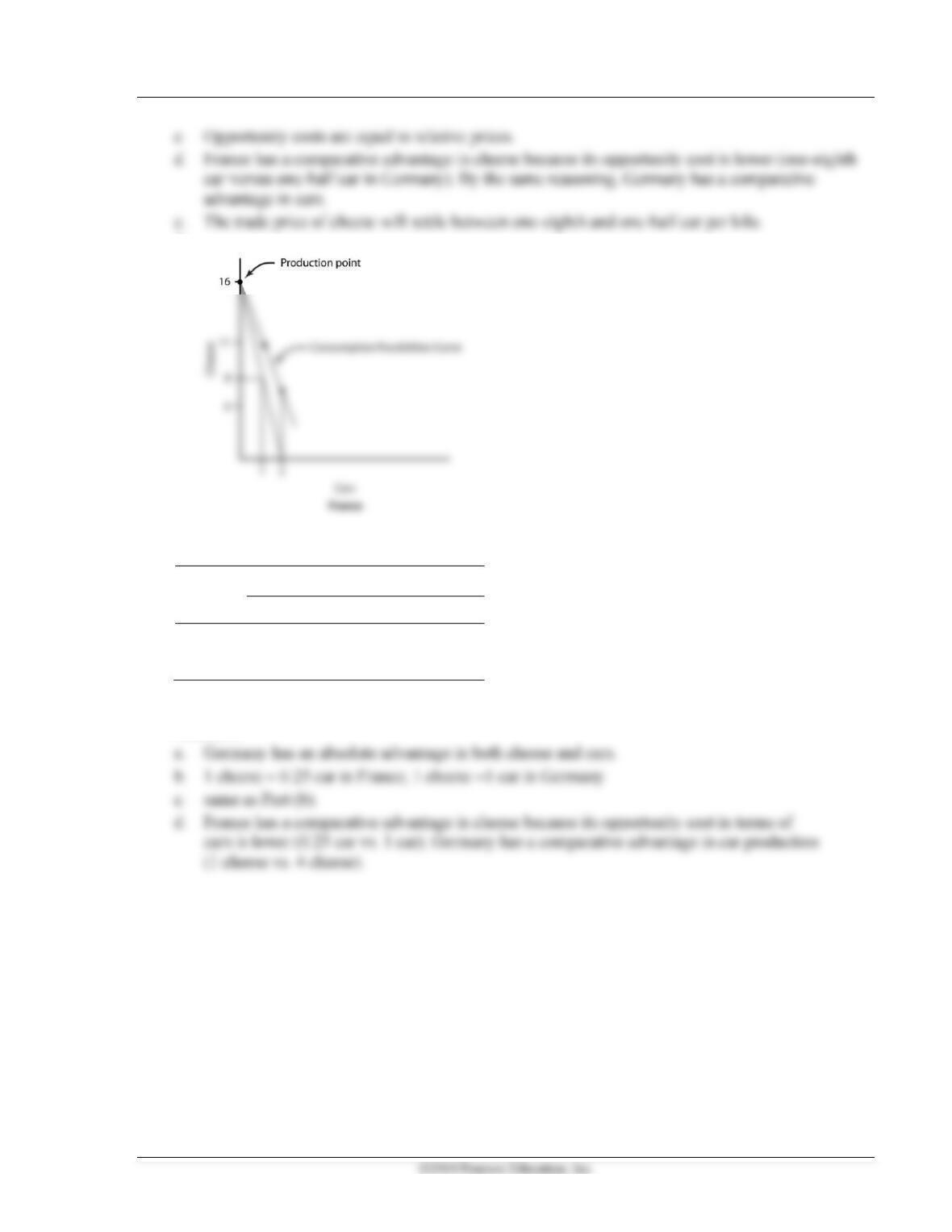
f. Draw a hypothetical PPC for France and label its slope. Suppose that France follows its
comparative advantage in deciding where to produce on its PPC. Label its production point.
If the trade price of cars is 5 kilograms of cheese per car, draw a trade line (CPC) showing how
France can gain from trade.
Answers:
Chapter 3 Comparative Advantage and the Gains from Trade 19
f.
2. Suppose the table in Problem 1 looks as follows. Use the information to answer questions a through f.
Output per Hour Worked
France
Germany
Cheese
1 kilogram
2 kilograms
Cars
0.25 car
2 cars
Answers:
20 Gerber • International Economics, Sixth Edition
f.
3. Explain how a nation can gain from trade even though not everyone is made better off. Is this a
contradiction?
Answer: This is not a contradiction. The gains from trade imply that the winners could compensate
4. Economic nationalists in developed countries worry that international trade is destroying the national
economy. A common complaint is that trade agreements open the economy to increased trade with
countries where workers are paid a fraction of what they earn at home. Explain the faulty logic of this
argument.
Answer: The error in logic is the failure to take into account the differences in productivity. The
5. Many people believe that the goal of international trade should be to create jobs. Consequently, when
they see workers laid off due to a firm’s inability to compete against cheaper and better imports, they
assume that trade must be bad for the economy. Is this assumption correct? Why, or why not?
Answer: The goal of trade is to improve a nation’s allocation of its resources so they are directed to
6. Suppose that Germany decides to become self-sufficient in bananas and even to export them. In
order to accomplish this, large tax incentives are granted to companies that will invest in banana
production. Soon, the German industry is competitive and able to sell bananas at the lowest price
anywhere. Does Germany have a comparative advantage? Why, or why not? What are the
consequences for the overall economy?
Answer: Government subsidies can lower the cost of production but they will not change the